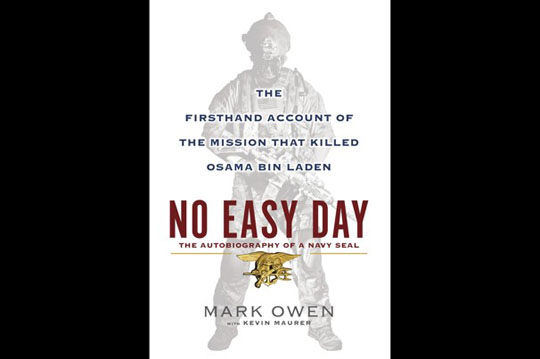
No Easy Day: The Firsthand Account … of a great book

Apparently, the Pentagon isn’t happy with the release of ‘No Easy Day’. Possible national security issues aside — readers will be.

What does a member of SEAL Team 6 do after he’s killed the most wanted terrorist alive — the mastermind behind the worst attack on American soil since Pearl Harbor? He does what anyone else would do: He goes to Taco Bell. By himself.

No Easy Day apparently has heads fuming at the Pentagon, and author Mark Owen might be persona non grata with his former teammates  (his real identity is known, but I’m still going to refrain from using it), but it’s a book that I’m glad he wrote. It’s a story that needed to be told, even if the timing of it could be called into question. And, while some of the information disclosed in the book is surprising, someone should remind the Navy SEALs that they were the ones who also worked with filmmakers on Act of Valor. Owen is most definitely one of the good guys.

There seems to be three factors that drove Owen to write the book. They are:

  1. To inspire other young men to become better than they knew they could ever be.
  2. To vent frustration over having to fight a war increasingly designed to protect the sensibilities of the politically correct civilian chattering class.
  3. To draw attention to politicians in Washington, D.C. who are much more of a threat to OPSEC than a retired SEAL.

As with other standout books by Navy SEALs, such as Marcus Luttrell’s Lone Survivor or Chris Kyle’s American Sniper, where the words make the book worth its hardcover price is in the personal story — not the details of any specific mission. You care about Owen not because he’s a Navy SEAL, but because he’s a good person. You want to keep reading his story — not because he’s a badass — but because he embodies the a kind of honor, commitment, selflessness and love of country that seems endangered in modern America.

The forward says it all:

‘No Easy Day’ is the story of “the guys,” the human toll we pay, and the sacrifices we make to do this dirty job. This book is about a brotherhood that existed long before I joined and will be around long after I am gone.

My hope is one day a young man in junior high school will read it and become a SEAL, or at least live a life bigger than him. If that happens, the book is a success.

It only takes Owen a quick 299 pages to complete his mission. It’s hard to believe that any young man could read No Easy Day without having his patriotic passions stirred.

Since Owen is a smart guy, he also provided plenty of lessons for public policy makers. Case in point:

It felt like we were fighting the war with one hand and filling out paperwork with the other. When we brought back detainees, there was an additional two or three hours of paperwork. The first question a detainee at the base was always, “Were you abused?” An affirmative answer meant an investigation and paperwork. And the enemy had figured out the rules. …

On more recent deployments, they started hiding their weapons, knowing we couldn’t shoot them if they weren’t armed. The fighters knew the rules of engagement and figured they’d just work their way through the system and be back to their village in a few days.

It was frustrating. We knew what we were sacrificing at home; we were willing to give that up to do the job on our terms. As more rules were applied, it became harder to justify taking the risks to our lives. The job was becoming more about an exit strategy than doing the right thing tactically.

The best trained, best equipped, most-disciplined fighting force in the world is asked to go to war — provided it’s a politically correct war. Al Qaeda members sleep soundly in their beds (or caves or on floorboards) because they know they can take advantage of the rules of engagement. “Shoot, move, and communicate” has become, “shoot, move, and do ‘sensitive site exploitation’.” SEALs need to spend endless amounts of time on each mission documenting everything for the kind of person who sees any U.S. military action as an Abu Ghraib waiting to happen. It’s sad and sick, it’s going to come back to haunt us,  and it gets soldiers killed.

Mark Owen’s personality reminds me of a lot of the guys I once served with. He’s an intelligent guy, but he’s humble. He strives for perfection. He never gives up because failure isn’t an option. He’s a professional, and he most-certainly goes about his job with the ‘failure to prepare is preparing for failure’ mentality. He loves his country and has done amazing things for freedom and liberty. He’s a real-life hero, but at the end of the day he’s perfectly content … with Taco Bell. In short, he’s everything I’d like my future son to be.

I highly suggest No Easy Day.

Remembering 9/11 and the ‘what if?’ that never ends

On September 11th, 2001 I was just over a year out of the military, taking college classes and preparing myself to transfer to the University of Southern California. My grandmother spoke to me from our living room and said a plane had hit the World Trade Center. I talked about it with her from the kitchen for a few moments, and just as I walked into the family room I saw United Flight 175 hit the South Tower. A chill ran down my spine. The phone rang seconds later. It was my sister: “A plane just flew by my window. What’s going on?” she asked. Sadly, I don’t even remember my response, and I’ve never thought to ask her. I know that she was evacuated from her building, and that a kind stranger offered her a tee shirt to breath into to avoid inhaling dust and debris. I also know that on a deeper, more philosophical level I’ve been trying to answer her question — as it pertains to Islamic terrorism — ever since.

We can count dead bodies. We can put a dollar amount on the damage to the city of New York and the country as a whole. We can calculate the economic impact al Qaeda had on the United States and the world, but what we can’t do is quantify the psychological toll the terrorist attacks of 9/11 wreaked on the nation. Regardless, I am more than happy to offer myself up for amateur and professional sociologists everywhere.

Prior to 9/11, I was not much of a crier. As a former infantryman, I prided myself on having a bit of a “tough” exterior. I was a master at hiding my emotions and keeping my “military manner” when necessary. On that day though, I remember driving to class with tears in my eyes. I had to compose myself in the parking lot before entering the building, and while my body was in a college classroom my mind was somewhere else. Psychological aftershocks were reverberating in my head, and it wouldn’t be until years later that I would be able to look back and identify many of the changes to the landscape.

For instance, post 9/11 I found myself tearing up just listening to Tony Blair defend Western Civilization. I’d see pictures of George W. Bush meeting with injured soldiers and I’d get a lump in my throat. Sometimes, random stories about 9/11 would come on television and I’d struggle to keep my composure. I tried to tell a friend about former Navy SEAL Marcus Luttrell and I couldn’t finish because my voice kept cracking. I’ll now see the random veteran in public, and I although I want so badly to thank them for their service I rarely can do so because the tears begin before I ever utter a word. I can’t control it and I understand how it comes across as inane. However, I tend to think of my physiological response to these situations as something born out of the realization that the freedoms we enjoy are much more fragile than most people realize. When I think about the idea of America I have reactions that late night comedians find humorous — and I don’t care.

A friend of mine recently asked what my life would have been like if I entered the military after attending USC. It’s a good question, and it’s a slightly different version of the same question I ask myself almost every day: “What if I stayed in?”

When I exited the service in August, 2000 I was generally of the mindset that I had fulfilled some sort of unspoken, patriotic duty. In my mind, war could have broken out at any time, but it didn’t during my enlistment. I was under the impression that any war that involved the United States would take place years after I was in any position to help out. After returning to civilian life, working so hard to get into a prestigious university, taking out college loans and charting out a new path for myself, 9/11 suddenly had me second guessing everything. My friends were being sent to Afghanistan, and then Iraq. While I was in Southern California reading and writing my friends were being shot at. In California I was dating the woman who would ultimately become my wife, and yet there was always a part of me that screamed “You should be over there!” And I wasn’t. How many of my tears are of guilt and remorse I guess I’ll never know.

As a religious man, I have tried my best to live up to God’s plan for my life. There are too many coincidences — sheer blessings — for me to to believe there isn’t someone upstairs looking out for me. And so, my mind and my spirit tell me that writing is what I was made for. My mind and my spirit tell me that I can do more for God and country through the written word than I could with an M16A2 or an M4 carbine — but my heart often tells me I failed to be there for my buddy Leija or any number of other guys I knew from Charlie 1/18.

Perhaps the better question is: What would I be like if September 11th never happened? In a sick and twisted way, I think I would have been worse off spiritually. Hopefully, I’ll have many more September 11ths to turn it over in my head, along with the the friends I’ve met through this blog.

Thanks for reading,

Doug

What if this kid had stayed in the military instead of getting out and going to USC? I ask myself that almost every day.

All balding men should pledge allegiance to Bruce Willis

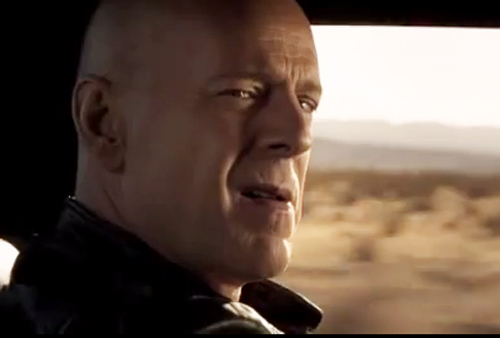
Bruce Willis is a man who knows how to own his hair loss. Be like Bruce Willis, my dihydrotestosterone producing friends.

All good things must come to an end … like my hair. And so, since I am a conservative blogger I have no choice but to accept personal responsibility for my male pattern baldness. As much as I would like to blame my father, my grandfather, “the rich,” and a cruel, uncaring capitalistic system that surreptitiously gives men like me androgenic alopecia, I will do no such thing.

I first noticed my hair thinning up front. Soon, it wasn’t long before my crown began to crack under the pressure that baldness, the bastard, applies. The question became: Do I fight a slow war of attrition with my hair loss (one I was destined to lose), or would I employ a scorched-scalp strategy, whereas I could guarantee victory by embracing the landscape of a shaved head?

This is Bruce Willis thinking, “I’m incredibly awesome, even though I’m incredibly bald.”

As a former soldier, the choice was simple: I would go back to the future, buy some shears, and see to it that my inner Bruce Willis was given his time to shine. The key to baldness is to revel in it and say to those stubborn genes, “You will not shake my confidence.” People can easily tell the difference between a man who sulks over finicky follicles that turned off too early, as if he was Samson done in by Delilah, and a man who likes what he sees and is empowered by it.

There are many men who pull off a shaved or bald head. Terry Crews, Dwayne “The Rock”Johnson, and Jason Statham are just a few. But to me, no one knows how to make it work better than Bruce Willis. The dude is the textbook case for cool. As so, as a newly-minted member of the Balding Men Club, I hereby announce my commitment to always strive for The Willis Ideal.

12 Monkeys is required viewing, Willis 101, for anyone who seeks to emulate Bruce’s mastery of baldness.

When we can see through walls, but not the debt in our face

New technology allows us to see light move at one trillion frames per second, but yet many citizens still can’t see the slow motion economic train wreck caused by out-of-control debt and a bloated federal bureaucracy.

How is it that it’s only a matter of time before Americans will be able to see through walls, but they can’t see the writing on the wall when it comes to debt and deficits? Professor Ramesh Raskar’s presentation on cameras that can film at one trillion frames per second is amazing, but it also demonstrates one of the problems conservatives have when it comes to talking about recessions, depressions and the economy in general.

Not too long ago I got to cover the Defending the American Dream Summit for work. While I was there, I got to talk to a number of older individuals who honestly believe that the standard of living their grandchildren will be lower because of the policies we are putting in place today. That’s true — in many respects — but it’s hard to get anyone to buy it when new technologies keep emerging that will change the course of human history.

How do you get people to understand the future that never was? While it’s a godsend that humans are constantly pushing the limits of what is possible, it also is maddening that so many are regularly susceptible to public policies that retard economic growth and the entrepreneurial spirit inside us. We adopt health care policies that hinder the innovation of lifesaving drugs while giving more people crappier coverage. We enact well-intentioned entitlement programs that turn able-bodied men and women into human gerbils waiting for the next government pellet — instead of encouraging them to break free of their mind-forged manacles. We use the tax code for social engineering instead of allowing the individual to keep more of his own money with which to build a brighter future.

The “poor” in the United States are not getting poorer. In fact, the “poor” (who are also not a static group) in the United States do quite well when compared with their counterparts around the world. Given that the standard of living generally goes up for all Americans each generation — even if the rates differ among social classes — conservatives need to find a way to talk about lost futures. It’s not enough to say that if we elect liberal politician “x” that life will be worse off, because benefits gained through technological advances mask all sorts of theft to our standard of living.

If conservatives are smart they will become tech-savvy nerds who not only care about cameras that can see around corners, but talented orators who can paint vivid pictures of the future by describing their vision for the world and the vision of their political opponents.

The Dark Knight Rises: A conservative review

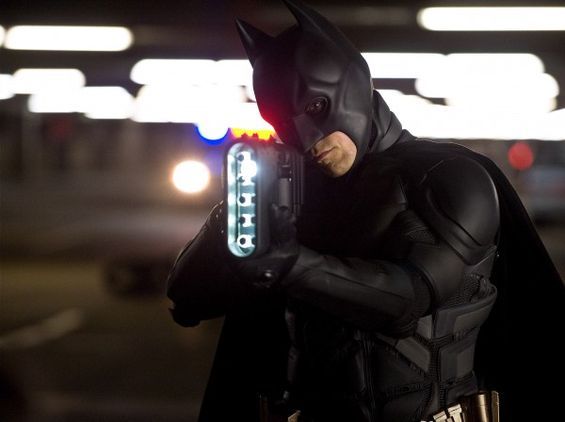
Christopher Nolan has set the bar mighty high for whomever follows him on the Batman franchise. The Dark Knight Rises might not be the perfect movie, but it’s a superhero film that transcends almost all other superhero films. It succeeds much more often than it fails, and for that Nolan should be proud of what he’s accomplished.

Where was Christopher Nolan supposed to go after the success of The Dark Knight? How could he have possibly topped the second installment of his Batman trilogy? There really weren’t many options, except to make a superhero movie that was more than a superhero movie — and for that Nolan apparently turned to Dickens’ A Tale of Two Cities. The director went for something truly epic — he shot for the moon — and while we can debate whether or not he actually hit his target, it seems pretty obvious that he made it to the stars.

After the second trailer for The Dark Knight Rises came out on May Day, I hoped that years from now political junkies would hear Bane say, “When Gotham burns, you have my permission to die,” and immediately associate him with Keynesian economics and the totalitarian tendencies that spring forth from it. The movie didn’t disappoint, as Bane displays classical training in the rhetoric of leftist dictator-goons throughout history. And if Bane comes across as a Marxist revolutionary, then Selena Kyle is the useless idiot who buys into his snake oil.

Take note of Catwoman, as she displays jealousy, greed, envy and a sense of entitlement all in one minute conversation with Bruce.

Selena Kyle: You don’t get to judge me just because you were born in the master bedroom of Wayne Manor. … I started out doing what I had to. When you’ve done what you’ve had to they’ll never let you do what you want to.

Bruce Wayne: Start fresh.

Selena Kyle: There is no fresh start in today’s world. Any 12 year old with a cell phone can find out what you did. … Everything sticks.

Bruce: Is that how you justify stealing?

Selena Kyle: I take what I need from those who have more than enough. I don’t stand on the shoulders of people with less. … I think I do more to help someone than most of the people in this room — than you.

Bruce Wayne: Do you think maybe you’re assuming a little too much? …

Selena Kyle: You think all of this can last? There’s a storm coming, Mr. Wayne. You and your friends better batten down the hatches, because when it does you and your friends are going to wonder how you ever thought you could live so large and leave so little for the rest of us.

Ms. Kyle wants to live in a world where she doesn’t have to suffer the consequences of her actions. She made mistakes, and instead of owning up to them she doubles down on a path of deceit. It is only when Ms. Kyle moves in the ideological direction of Mr. Wayne that her fortunes begin to change. Revolutionaries like Bane only bring misery and terror, while men like Wayne offer order, true hope, redemption and selflessness.

Perhaps no better part sums up the difference between Bruce Wayne and his leftist adversaries than the rising climax. The cynical, class-warfare spewing Catwoman intellectually aligned with Bane throughout most of the movie, a man who sought to destroy an entire city to realize his goals. Bruce, on the other hand, proves that he is willing to sacrifice himself for an entire city.

Selena Kyle: Sorry to keep letting you down. Come with me. Save yourself. You don’t owe these people any more. You’ve given them everything.

Bruce: Not everything. Not yet.

Within minutes, Kyle knows that Bruce is the better man, and she falls for him. By the end of The Dark Knight Rises, the man she accused of “living so large” and leaving “so little for the rest of us” has proven himself her superior mentally, physically and spiritually, and she shows her epiphany in dramatic fashion.

As I said before, The Dark Knight trilogy will be, on many levels, the Bane of liberal moviegoers’ existence. No matter what Christopher Nolan does—no matter what he says from this day forward—he can never take back these films (thank God). It’s a gold mine of conservative values waiting to be explored. And, while Nolan’s personal politics might not be conservative, he at least gave the worldview a fair shake. In Hollywood, that’s all conservatism needs to starts winning hearts and minds. Besides, when The Village Voice hates a movie, I know I have something to work with.

If you haven’t seen The Dark Knight Rises yet, check it out while it’s in theaters. Love it or hate it, it’s a movie that’s going to be talked about for a long time.

Schwarzenegger’s ‘Six Rules for Success’: Sage advice for all Americans

Schwarzenegger’s most important rule of all for attaining success: “Work your butt off.” Sage advice from the Austrian Oak.

Like all of us, Arnold Schwarzenegger has his moral failings. We know what they are since he’s a public figure, but if we’re honest with ourselves we know that we too are “warped timber.” Given that, the question becomes:  How did a scrawny kid grow up to become the Austrian Oak, and can the principles that helped bring him success be applied to the rest of us? There’s a video that’s been on YouTube for quite some time that highlights Schwarzenegger’s “Six Rules for Success.” I believe they can be inspiring to anyone, in any field.

As I’ve noted before, it’s been my experience that those who are serious about lifting weights tend to have a conservative streak in them — or at least seem to be more open to the worldview than my other friends and acquaintances. The weights are about tough love, and Arnold does a great job imparting their wisdom here:

Now of course, people ask me all the time, they say to me: “What is the secret to success?” The first rule is: Trust yourself. But what is most important is that you have to dig deep down — dig deep down — and ask yourself, “Who do you want to be?” Not what, but who? I’m talking about not what your parents and teachers want you to be, but you. I’m talking about figuring out for yourselves, what makes you happy no matter how crazy it may sound to the people.

Rule #1 is: Trust yourself, no matter what anyone else thinks.

Rule #2 is: Break the rules.

We have so many rules in life about everything. I say break the rules — not the law — but break the rules. It is impossible to be a maverick or a true original if you’re too well behaved and don’t want to break the rules. You have to think outside the box. That is what I believe. After all, what is the point of being on this earth if all you want to do is be liked by everyone and avoid trouble? The only way I ever got anyplace was by breaking some of the rules.

Which of course brings me to Rule Number 3: Don’t be afraid to fail.

Anything I’ve ever attempted, I was always willing to fail. You can’t always win, but don’t be afraid of making decisions. You can’t be paralyzed by fear of failure or you will never push yourself. You keep pushing because you believe in yourself and in your vision. And you know that it is the right thing to do and success will come. So don’t be afraid to fail, which brings me to Rule #4, which is: Don’t listen to the naysayers.

I mean, how many times have you heard that you can’t do this and you can’t do that and it has never been done before? I love it when someone says no one has ever done this before, because when I do it that means that I’m the first person who has done it! So pay no attention to the people who say it can’t be done.

I never listen to “you can’t.” I always listen to myself and say, “Yes, you can.” And that brings me to Rule #5, which is the most important rule of all: Work your butt off. Leave no stone unturned.

Mohammad Ali, one of my great heroes, had a great line in the 70’s when he was asked: “How many situps do you do?” He said, “I don’t count my situps; I only start counting when it starts hurting. When I feel pain, that’s when I start counting because that’s when it really counts. That’s what makes you a champion.” And that’s the way it is with everything: No pain, no gain.

While you’re out there partying, horsing around, someone out there at the same time is working hard. Someone is getting smarter and someone is winning. Just remember that. Now if you want to win, there is absolutely no way around hard, hard work. None of my rules for success will work unless you do. I’ve always figured that there were 24 hours in a day.  You sleep 6 hours. There are 18 hours left. Now, I know there are some of you out there now who say, “Well wait a minute. I sleep 8 hours or 9 hours.”  Well, just sleep faster, I would recommend.

That takes me to Rule #6, which is a very important rule. It’s about giving back. Whatever path that you take in your lives, you must always find time to give something back. Something back to your community. Give something back to your state or your country.

Let me tell you something: Reaching out and helping people will give you more satisfaction than anything you have ever done.

Remember these six rules:

1. Trust yourself
2. Break some rules
3. Don’t be afraid to fail
4. Ignore the naysayers
5. Work like hell
6. Give something back

Well said, Arnold. Well said, indeed.

Related: ‘Pumping Iron’ inspires, decades after its release

Missing Etta: Final thoughts from a thankful grandson

My grandmother, Etta Mae Deghetto, was born March 4, 1914. Woodrow Wilson was president. Last night, on the 4th of July, she passed away. She was 98 years old. I have always had a lot to be thankful for on Independence Day, but from now on the date will take on added significance.

My grandmother lived with me since I was born, her husband having passed away from cancer shortly before my birth. With my mom and dad both working full time jobs, our family was blessed to have someone waiting at home at the end of the school day to help look after the kids, raise us, shape us and give us all the tools we would need to be honest, productive citizens. She was a living history book, having experienced the Great Depression, World War II, the moon landing, Vietnam and a host of other seminal moments in American history.

Some of my fondest memories growing up involved lying on her bed while she sat in her favorite chair. I’d ask her to tell me stories about what it was like growing up. She was one of 13 children and her family grew up poor — very poor — in ways it’s hard for modern Americans to really grasp. She never went to college, but in many ways I learned more from her than any of my professors.

“What was it like to live through The Great Depression?” I’d ask. “What did you think when you saw Albert Einstein walking through the streets of Princeton barefooted? What did you think when FDR rolled down his car window to speak with you?” I asked these questions repeatedly over the years, and each time I learned something new.

I consider myself blessed to have had someone close to me who could share such experiences and impart the kind of knowledge the internet can never provide. Facebook status updates, Twitter feeds and even streaming video can never fully capture a one-on-one conversation with our elders.

Sometimes, I see a World War II veteran in a restaurant or in a store and I have to force myself not to tear up, knowing that before too long they’ll be gone, along with the opportunity to glean knowledge and wisdom from them. I won’t be able to shake their hand and say “thank you.” There’s a sadness in those moments that stems from knowing I haven’t done my due diligence to pay respect and learn from them. My tears are tears of regret.

With my grandmother, it will be different. Next year on Independence Day I’m sure I’ll well up, but my tears will be of joy and happiness and thanks because God gave me more time with my grandmother than I probably deserved before He called her home. In this world she had to battle breast cancer and kidney failure and blood clots and finally the ravages of old age. And while life is a special gift, it is also a joyous occasion when someone is reunited with their Creator.

Hopefully, in the time that I have left on this earth, I will love those closest to me in ways that would make her proud. Eventually we will meet again, at which point my first words will be: “I love you.”

Dan Slott’s Spider-Man: World’s Dumbest Super Hero

The ‘Ends of the Earth’ storyline in Marvel’s Amazing Spider-Man has severely damaged the character’s credibility, due almost entirely to writer Dan Slott. I took flak from fans for mentioning that Spider-Man’s dangerously naive “no one dies” mentality is a war zone liability, and that only a fool would jeopardize a time-sensitive mission by worrying about the well-being of North Korean soldiers — when over six billion lives were on the line. Only a few weeks ago I said: “A hero is still a hero, but some of them are meant for city streets, and some of them are meant to determine the fate of the world.” And now, Dan Slott’s Spider-Man proved it through his own dialogue and actions:

“I’m not used to ‘End of the World’ stuff. Gimme a bank robbery or one of my regular bad guys. Now that I can handle,” (Dan Slott’s Spider-Man, Amazing Spider-Man #687).

Sadly, truer words were never spoken. Only pages later, Spider-Man is put in a situation where he must choose between saving Silver Sable’s life as she is held beneath rising water by the immovable Rhino, or stopping a satellite launch that will doom billions. Our hero feebly pulls at his enemy’s forearm like a little boy who yearns for a toy until Sable uses one of her last breaths to berate his idiocy: “If you don’t go — EVERYONE DIES! GO!”

Look at Spider-Man with that blank stare on his face. You can almost see the wheels turning as he realizes what a fool his “no one dies” mantra is. Even in the face of death, Silver Sable has a clear enough head to know the correct course of action to take.

As I said before, Dan Slott’s Spider-Man is so myopic that he only sees the lives right there in front of him. He’s like a baby, tricked by peek-a-boo because his mind isn’t fully developed; if there are lives to be saved right in front of him, there’s a good chance he can be distracted.

With the climax of ‘Ends of the Earth’ at hand, Slott delivers — in the wrong way. The blinded fan will only remember Spider-Man finding an inner reserve of strength to break free from his bonds to save billions — again, thanks to the Silver Sable’s clear thinking at death’s door. What they won’t remember is that Doctor Octopus admitted he is pure evil right before Peter decided to save his life — instead of using the opportunity to return to Silver Sable. Doctor Octopus says: “I shall live on in infamy — a mass murderer worse than Pol Pot, Hitler, and Genghis Khan combined.

Only moments later, as Peter attempts to save the genocidal maniac from the crumbling fortress, he says: “I made a promise. As long as I’m around no one — … Come on. I’m getting you out of here.”

Note the pause. Peter obviously thinks of his teammate possibly drowning a few rooms over. I say ‘possibly’ because Spider-Man doesn’t know what happened after he left the room, and neither does the reader. Perhaps Silver Sable had one last trick up her sleeve. Perhaps another hero found a way to come to her aid. In that moment, wouldn’t the true hero have ditched the man who hoped to transcend Hitler, in an effort to check on his ally? In that situation, would it not have been better to at least recover her dead body over saving the man who was willing to subject billions to a burning death just seconds earlier? Let’s not even get into the many people who have been resuscitated after having been submerged in water for lengths of time conventional wisdom says is impossible…

It’s fitting that ‘Ends of the Earth’ would feature a character who (seemingly) died from drowning, because Dan Slott’s Spider-Man walks around like there isn’t enough oxygen going to his brain. Here’s to hoping that one day Spider-Man will come to his (spider) senses.

Spider-Man: War Zone liability thinks small in big situations

A week ago I covered Spider-Man, and how liberal writers have turned him into a walking war zone liability. In a situation where 6 billion lives hung in the balance, the friendly neighborhood Spider-Man did the “neighborly” thing and thought to use precious seconds wondering whether a bunch of North Korean soldiers (those same guys overseeing the world’s most notorious gulags) were ushered to safety before explosives took out the weapons … they were guarding. He then saw fit to warn his soldierly teammates “no one dies,” precisely the kind of all-or-nothing delusional thinking that sets the stage for death to occur.

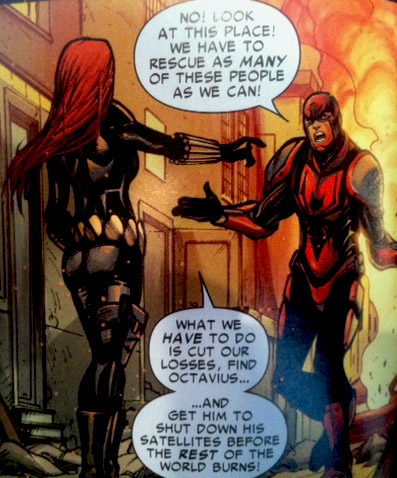
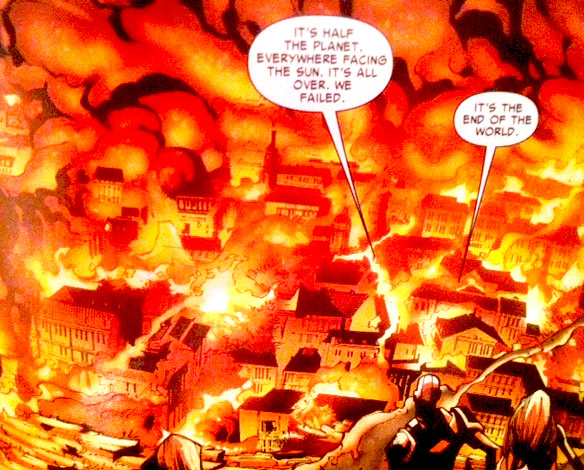
Issue #686 of Amazing Spider-Man takes place right after our heroes believe half the world has been destroyed. With carnage surrounding them, Black Widow tells Spider-Man they must leave immediately, as time is not on their side if they want to save the roughly 3 billion people remaining on earth. Spider-Man’s response? He’s not budging because he has people to save right there. Dan Slott’s Spider-Man is so myopic that he only sees the lives right there in front of him. He’s like a baby, tricked by peek-a-boo because his mind isn’t fully developed; if there are lives to be saved right in front of him, there’s a good chance he can be distracted. The Black Widow knows it and, sadly, his deadliest foes take advantage of it.

With 3 billion lives at stake and with every second counting, Dan Slott’s Spider-Man wanted to play search and rescue. It’s an honorable job, but the problem with that is this:  At that moment in time Spidey was the guy who was supposed to be saving the world — not Black Widow.
Even Spider-Man’s deadliest foes know that while his heart is pure, his mind is clouded with the quixotic belief that “no one dies” on his watch. Like a heroic Spider-Man-Pigeon, he’s easily distracted by lives in immediate danger, never acknowledging that by “saving” the few to his front, he may very well condemn 3 billion to his rear. A hero is still a hero, but some of them are meant for city streets, and some of them are meant to determine the fate of the world. Dan Slott’s Spider-Man may save the world, but an honest writer would have penned the more logical conclusion: utter defeat caused by unforced errors.

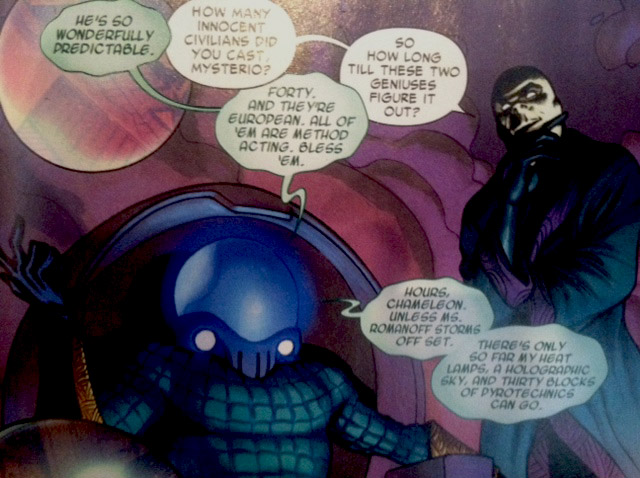
In the end, Dan Slott gives Spider-Man a reprieve, and the hero is given a chance to save the day by taking advantage of the vanity, greed and hubris of his enemies. The “end of the world” was an illusion meant to distract the heroes and buy time for the machinations of evil men to materialize. It would have worked, but the enemies who literally have the world in their hands want more, overreach and lose it all. Spider-Man takes advantage of his second chance, but it feels like a Deus ex Machina of sorts, freeing the character of the consequences of his short-sighted actions. In the real world we often don’t get second chances.

Even Black Widow can’t resist rubbing Peter Parker’s nose in the evidence of his ignorance — in his own book, no less:

Spider-Man’s complete lack of foresight nearly cost his team the chance to save the world. Black Widow makes sure to let him know it. Lectured by a supposedly-lesser hero in his own title. Sad.

At $4.00 a pop, The Amazing Spider-Man hurts the wallet over the course of a year. These days, it also hurts just to read the title, period. Here’s to hoping Peter learns something from the experience. If not, look for books featuring Black Widow. She deserves it.

Spider-Man won’t kill N. Korean soldiers or waterboard a man to save 6 billion

Marvel has officially killed Spider-Man. They did it before with his deal, for all intents and purposes, with the devil. And now they’ve done it again by turning him into such a pacifist clown that his lack of moral clarity actually makes him an accomplice to evil. Correction: Writer Dan Slott’s pacifist-clown take on Spider-Man has made him an accomplice to evil.

Case-in-point would be Marvel’s current storyline, ‘Ends of the Earth.” In it, Doctor Octopus has come up with a plan that could seal the ozone layer and save humanity, but the technology — that only he possesses — could also be used to bring about world-wide genocide. Isn’t the ozone layer so … 1989? Regardless, Spider-Man is convinced his enemy is going to trick the international community into agreeing with him and kill billions with the push of a button.

That is precisely what seems to happen, which makes the “amazing” Spider-Man’s actions leading up to the event so maddening (and that’s not even counting the “one man’s hero is another man’s terrorist” moral relativism that’s dished up by a supporting character).

It all starts with a race to stop a number of satellites from being made, some of which are being put together in North Korea — home of the world’s very notorious, very real gulags. A member of Spidey’s team sets explosives at the factory, taking out all the tech and presumably the North Korean soldiers guarding it. Peter Parker then channels Jimmy Carter, berating the hero: “No one dies! Understood?” Sadly, it turns out the North Koreans — those giving direct aid in an effort to cause a mass-extinction event — were led to safety!

The story then moves on to an interrogation scene, where Peter must extract information from Flint Marko (aka, Sandman) as to the location of another weapons factory.With Flint not wanting to talk, a team member begins the equivalent (arguably) of waterboarding to get the intelligence she needs. Spider-Man acknowledges that he would have caved in to appeals for the “pretty please” approach if the terrorist foot soldier had pleaded with him for just a bit longer. Once again, a braver hero must pick up the slack for Spider-Man’s ineptitude. There is never really any acknowledgement by the characters that Spider-Man is out of his league, or that his “peace at any cost” mentality will actually bring out his worst fears: word-wide death and destruction.

The new Spider-Man waffles on water boarding a guy who could help stop the death and destruction of billions of lives. Let’s just rename Peter Parker ‘Jimmy Carter’ and get it over with.

There is really no way to spin this (no pun intended) into the character’s favor. If good and evil exists — if it is real — then there should be no hesitation by the true hero to do what is right when the moment calls. Not using deadly force for a purse snatcher? Sure. I get it. Freaking out over the death of soldier-scum enablers of one of the most vile, despicable regimes in the world? No excuse. In this day and age, Spider-Man will make a deal with the devil but he won’t kill a few North Korean soldiers when the fate of the world hangs in the balance and the situation demanded it? Thanks a lot, Marvel: You’ve turned my childhood hero into a morally bankrupt loser, sailing through life without a rudder.

My spider-sense is tingling, and it’s telling me Marvel’s Dan Slott might want to talk to Shin in Geun, who escaped from North Korea’s infamous Camp 14, before he writes another issue.

Update: Looks like Dan Slott didn’t bone up on the North Korean regime. See how Spider-Man has become a war zone liability.

Editor’s Note: It’s always fun to see Dan Slott’s CBR drones read my stuff and then distort my words over in their little forums. I suspect the reason why you haven’t tried that in the comments section is because I’d call you out on it immediately.

Spider-Man’s moral compass broke and billions of people may have died. But hey, at least he can pat himself on the back because he saved the lives of the North Korean Communist goons who helped bring about hell on earth.
While I'm not into Spider-Man porn, I am the "NeoCon" who wrote about Spider-Man's absurd "no one dies" mentality proved what a naive loser he has become with Slott at the helm. Maybe Dan Slott never read up on North Korean gulags. It's a shame.
While I’m not into Spider-Man porn, I am the “NeoCon” who wrote about Spider-Man’s absurd “no one dies” mentality proved what a naive loser he has become with Slott at the helm. Maybe Dan Slott never read up on North Korean gulags. It’s a shame.
Once again Dan Slott addresses me in a way that I would never see unless I was stalking his Twitter feed or a kind reader brought it to my attention. I wonder why I wasn't tagged or why Mr. Slott didn't comment here? Perhaps because he wouldn't be able to make disingenuous claims without having them shot to pieces.
Another example of Dan Slott addressing me in a way that I would never see unless a kind reader brought it to my attention. I wonder why I wasn’t tagged or why Mr. Slott didn’t comment here… Perhaps because he wouldn’t be able to make disingenuous claims without having them shot to pieces.