Before the weekend was out on the Guardians of the Galaxy’s successful box office debut, Marvel Studios released some news the size of an oak tree. Or, perhaps a Groot. The reasoning is also likely to enrage DC fans. Marvel’s Phase 3 will include ‘I am Groot,’ to be released in the summer of 2017, which all but guarantees that the plant from Planet X gets his day in the sun before “Justice League.”
“We are Groot!” Marvel Studios President of Production Kevin Feige said at a press conference late Saturday. “It’s a go. It’s happening. I know a lot of people are wondering how we’re going to pull this off, but I assure you that ‘I am Groot’ has an amazing creative team behind it. The screenplay is great and we’re close to sealing the deal with a director who I’m sure will knock it out of the ballpark.”
The Hollywood Reporter reached out to ‘Man of Steel’ producer Wesley Coller for a response and was told that a reply would be forthcoming. Entertainment Weekly likewise said that calls to DC’s front office were not returned.
DC’s silence, in many ways, speaks louder than words. ‘Batman v Superman: Dawn of Justice’ is scheduled to be released May 6, 2016, which would put Marvel Studios in a position to have ‘I am Groot’ in theaters before fans ever get a chance to see an official Justice League movie. While all comic fans can rejoice at the sheer volume of superhero films being made, it’s sure to inflame the rivalry between the two industry giants.
In a recent article with the Belfast Telegraph, actor Vin Diesel said that playing Groot was a challenge for him as an actor, due to the character’s limited vocabulary. When asked about the ‘I am Groot’ movie by the Los Angeles Times, he said “I love the character. He’s challenging, but it’s worth every second. The world fell in love with Groot this weekend because he’s innocent and pure and good. I consider it an honor to be able to bring this character to life in his very own movie.”
Besides DC fans, diversity activists voiced “serious concern” with Marvel’s decision.
“I…I can not get behind this,” said Eileen Einhorn, a Gender Studies major at U.C. Berkeley. “It’s troublesome that although Vin Diesel is not white that his true nature must be hidden behind tree bark. I’m worried that Groot’s limited vocabulary sends a coded racial message about the mental acuity of minorities and, worst of all…Groot is a man. Until Black Widow gets her own movie I urge anyone who loves diversity to boycott ‘I am Groot.'”
When asked during his press conference if Rocket Raccoon would be getting his own movie, Feige just smiled and said, “Phase 4 may have some surprises to your liking. That’s all I’ll say right now. Sometimes I feel as if all of this isn’t real. Like it’s satire. The fans have been good to us. As long as they keep seeing Marvel movies, we’ll keep making them.”
Tom Cruise may be getting older, but that hasn’t stopped him from giving 110% in every role. With ‘Edge of Tomorrow,’ it’s paid off. Director Doug Liman (The Bourne Identity) makes use of a solid screenplay (based on “All You Need is Kill,” by Hiroshi Sikurazaka), in addition to Cruise’s and Emily Blunt’s acting chops to create a product worth checking out. It’s impossible to ignore the ‘Groundhog Day’ jokes, but ‘Edge of Tomorrow’ is no joke.

One element of ‘Edge of Tomorrow’ that makes it so good is Cruise’s ability to sell his transformation from self-absorbed public relations officer Major William Cage into a legitimate hero. Minutes into the movie Maj. Cage is informed that he’ll participating in a D-Day-type invasion that he helped sell to the world — and he isn’t happy. His response to the direct order given General Brigham (Brendan Gleeson) is to try his hand at blackmail:
“I appreciate the confidence, general. I do this to avoid doing that. I was in ROTC in college, the war broke out, I lost my advertising firm — here I am. I do what I do — you do what you do, but I’m not a soldier, really. … General, I just inspired millions of people to join your army, and when the body bags come home and they’re looking for someone to blame, how hard to you think it would be for me to convince people to blame you? I imagine the general would prefer to avoid that. … I would prefer not to be filming acts of heroism and valor on that beach tomorrow.”
The general responds by having Cage arrested. As Cruise’s character tries to flee he is knocked out, only to wake up at a staging area for the next day’s big battle. Each time Cruise’s character dies throughout the movie, he is jolted into consciousness at that location; there he meets Master Sergeant Farell (Bill Paxton). The no-nonsense NCO puts Cage in his place:
“You’re a coward and a liar putting your life above theirs. The good news is there’s hope for you, private. Hope in the form of glorious combat. Battle is the great redeemer.The fire and crucible in which the only true heroes are forged. The one place where all men truly share the same rank, regardless of what kind of parasitic scum their were going in. … I envy you, Cage. Tomorrow morning you will be baptized — born again.”
Farell’s words are prescient — Cage is born again many times, and the sergeant’s assertion “through readiness and discipline we are masters of our fate,” becomes one of the major themes running throughout the movie. “You might call that notion ironic, but trust me…you’ll come around,” he tells Cage. It takes countless “deaths” for him to realize the wisdom embedded within the quote, but eventually it takes hold.

Cage needs help if he’s going to save the world from invading aliens, and Rita Vrataski (Emily Blunt), also known as the “Angel of Verdun,” fills the role. At one point in time Rita shared Cage’s ability to “reset” with each death, but lost the power. Between the two of them, they slowly and methodically go about figuring out how to save humanity from the alien “Mimics.” Overall, Blunt delivers — she is believable as a woman who could slice and dice her way through deadly tentacled aliens.
What made her character even more interesting was that as Cage began to learn more about her (and become more attached) with each death, she still managed to keep her guard up. No matter how many intimate details Cage knew about Rita, he would never truly know her until she decided that she knew him enough to relax and present him with her “real” self — the one behind the tough-talk soldier exterior.
Like ‘X-Men: Days of Future Past,’ Cruise’s ‘Edge of Tomorrow’ wants us to know that people can change. It is possible to turn a cowardly liar into a courageous hero. It is possible to overcome seemingly impossible odds. “Through readiness and discipline we are masters of our fate.”
There is a treasure trove of positive messages in ‘Edge of Tomorrow’ that, coupled with Cruise’s ability to carry a film, make it worthy of your time. Movie money used on seeing ‘Edge of Tomorrow’ in theaters is money well spent. If you like science fiction movies, give it a chance. You’ll be glad you did.
‘X-Men: Days of Future Past’ may be the most important superhero movie of all time. I don’t say that lightly. Those whose blood pressure is starting to rise should take note: I didn’t say it was the “most fun” or “action packed” movie of all time — I said it may be the most important film ever.
Right out of the gates director Bryan Singer lets the audience know he’s created a movie about big ideas. When the first thing a director asks is “Does free will exist?” he’s given himself a tall order to fulfill:
Charles Xavier: The future…a dark desolate world. A world at war. Suffering and loss on both sides. Mutants and the humans who dared to help them fighting an enemy we can not defeat. Are we destined down this path, destined to destroy ourselves like so many species before us? Or can we evolve fast enough to change ourselves, change our fate? Is the future truly set?
Everything from the visuals and the narration to the music by John Ottman says: “This movie has gravity. Leave now if you just want a mindless popcorn flick.”
How many of us yearn to be able to go back in time and visit our younger selves — to talk some sense into them? What price would you pay for a single attempt to impart wisdom and knowledge on your reckless youthful counterpart — who wouldn’t listen to anyone — because maybe, just maybe, he’d listen to you? What if you could go back in time and convey something to your younger consciousness that would save all sorts of pain and suffering that you — although you wouldn’t ever admit it publicly — caused friends and loved ones? What if you’ve created a “dark desolate world” for yourself, but you knew there was a moment in time that could set things on a very different path? Would you risk ripping your consciousness into a million pieces for a chance to travel through space and time to set things right?
These are all very deep questions, and the actors tasked with making it all real to the audience do a magnificent job. James McAvoy, Hugh Jackman, Peter Dinklage, Michael Fassbender, Jennifer Lawrence, Patrick Stewart, Ian McKellen, Evan Peters and basically the entire cast all do a commendable job. Everyone who was required to provide emotional weight to movie comes through in the clutch, and the end result is a movie worth watching many times.
In addition to the covering free will, ‘X-Men: Days of Future Past’ covers redemption. The turning point in the film (major spoilers ahead — you have been warned) comes when young Charles finally comes face-to-face with his older self.
Young Charles: So this what becomes of us. Eric was right. Humanity does this to us.
Old Charles: Not if we show them a better past.
Young Charles: You still believe?
Old Charles:Just because someone stumbles and loses their way, it doesn’t mean they’re lost forever. Sometimes we need a little help.
Young Charles: I’m not the man I was. I open my mind and it almost overwhelms me.
Old Charles: You’re afraid, and Cerebro knows it.
Young Charles: In all those voices…so much pain.
Old Charles:It’s not their pain you’re afraid of — it’s yours. And frightening as it can be their pain will make you stronger if you allow yourself to feel it. Embrace it. It will make you more powerful than you ever imagined. It’s the greatest gift we have that can bear pain without breaking, and it’s born from the most human power: Hope. Please Charles, we need you to hope again.
Can you forgive yourself for all the mistakes you’ve made? Can you forgive your friends and loved ones for the pain they’ve inflicted upon you? Can you forgive humanity for all the injustices it’s inflicted upon itself? Can you find strength in pain and then use that strength to make the world a better place? These are all questions asked by Singer, and the end result is a movie that aims — and largely succeeds — at affecting those who are willing to let it do so on the deepest of philosophical levels.
In short, the evolution of Charles Xavier over the course of the film from a broken man and into the hero who would lead the X-Men to a better tomorrow is nearly flawless. Along the way you might even forget that you’re watching “just” a superhero movie and find yourself welling up inside. For much of the movie you don’t know how it’s going to turn out. Yes, fans “know” how it’s going to end (another movie is on the way, of course) but the writing, acting and directing are so good that it’s easy to get lost in it all and say, “Wow, they might not pull this out.”
Luckily, Professor Xavier regains his hope at a pivotal point in the film.
Hank McCoy:There’s a theory in quantum physics that time is immutable. It’s like a river — you can throw a pebble in and create a ripple, but the current always corrects itself. No matter what you do the river just keeps flowing in the same direction.
Wolverine: What are you trying to say?
Beast: What I’m saying is, what if the war is inevitable? What if she’s meant to kill Trask? What if this is simply who she is?
Charles Xavier:Just because someone stumbles and loses their way it doesn’t mean they’re lost forever. No, I don’t believe that theory Hank, and I can not believe that is who she is. Ready the plane. We’re going to Washington.
If you get a chance to see ‘X-Men: Days of Future Past’ in theaters, I would highly suggest making the trip. It’s rare for a movie to work on so many levels, and the fact that it’s an X-Men film makes this longtime Marvel fan very happy.
Editor’s Note for regular readers: I know I mentioned not being able to pay to see this movie, given the storm clouds hanging over the director’s head. I went to the movie theater with every intention of paying for Godzilla and then walking into X-Men: Days of Future Past, but the theater turned out to be about the size of my bedroom. There was no way I could pull it off without creating an awkward scene, so I allowed a friend to pay for me. I still don’t feel right about it, so if Mr. Singer’s legal issues do not turn out in his favor I will make a donation that would in all likelihood meet his accuser’s approval.
Continuing Marvel and Disney’s enviable winning streak, Captain America: The Winter Soldier is making history at the global box office, debuting to a record-breaking $96.2 million in North America for an early worldwide total of $303.3 million.
Reviewing ‘Captain America: The Winter Solider’ is tough to do without adding spoilers. How do you critique an espionage tale without giving away the best parts? I’ll give it a shot.
Long story short: Chris Evans (Captain America), Scarlett Johannson (Black Widow), Anthony Mackie (The Falcon) find themselves in a situation where it’s essentially them against the world as they try and unravel the mystery behind an attack on Samuel L. Jackson’s Nick Fury. They handle the situation with wit, intelligence, strength, speed, and agility. The chemistry between each of them was great, and Marvel would be wise to continue keeping the three of them together moving forward.
At one point in the film, Cap manages to find a way to directly address agents of S.H.I.E.L.D. He wants them to disobey a direct order — one that may end up costing them their lives — and in doing so he tells the audience what the film is essentially about.
Attention all S.H.I.E.L.D. agents, this is Steve Rogers. You’ve heard a lot about me over the last few days. Some of you were even ordered to hunt me down. But I think it’s time you know the truth. S.H.I.E.L.D is not what we thought it was. … They almost have what they want: absolute control. … I know I’m asking a lot. The price of freedom is high. It always has been. That’s a price I’m willing to pay. And if I’m the only one, then so be it — but I’m willing to bet I’m not.
What is the price of freedom? If you’re a wise guy who enjoyed ‘Team America: World Police,’ you might say “freedom costs a buck-o-five.” If you’re a serious person, you might say that it’s a tough call because those in positions of power have to find a way to maximize both individual liberty and security.
How do you protect a nation when there are individuals and organizations tirelessly plotting ways to take down free societies? When you’re facing down enemies who see no difference between civilian and military targets — when you’re up against an opponent who has erased any notion of the traditional battlefield and replaced it with one where everything is fair game, how much power are you willing to grant your protectors? As Captain America says to S.H.I.E.L.D.’s agents: our leaders want “absolute control.” But then the question becomes: Who watches the watchmen? What happens when the ones who protect us lose their way?
Director Joe Russo fills in the details during an interview with Mother Jones:
“[Marvel] said they wanted to make a political thriller. […] So we said if you want to make a political thriller, all the great political thrillers have very current issues in them that reflect the anxiety of the audience. … That gives it an immediacy, it makes it relevant. So [Anthony] and I just looked at the issues that were causing anxiety for us, because we read a lot and are politically inclined. And a lot of that stuff had to do with civil liberties issues, drone strikes, the president’s kill list, preemptive technology. [etc.]”
While I’m actually rather shocked that a Hollywood director had the guts to say that concerns over President Obama’s “Terror Tuesday Kill List” helped inspire a top-notch Marvel movie, on some level it’s no surprise given that the industry’s old-reliable when it comes to political thrillers is to blame America.
The trailer for Captain America: Winter Soldier is finally here. The good news is that it looks like it has all the makings of solid espionage fare: Robert Redford? Check. Russian spies? Check. Shady spy agencies? Check.
The bad news? It has all the makings of a blame-America espionage flick. …
Mullah nuts in the Middle East who deny the Holocaust and call for pushing the Jews “into the sea”? Eh. Chinese Communist intelligence agencies who have never met a U.S. business or defense contractor they wouldn’t hack? Eh. Nebulous terrorist organizations that don’t fly under a flag, even as they plot and plan to kill military and civilian targets on a massive scale? Eh. CIA attempts to “connect the dots” and “neutralize” threats before thousands of Americans die on their way to work on a Tuesday morning? Now there’s a movie!
Is it annoying that Marvel went for the easy layup by once again putting America in the cross hairs? Yes, slightly. Was the movie entertaining? Of course. In fact, I highly recommend it. It’s just odd that critics of ‘Captain America: The Winter Soldier’ would have a point if they said it would have been better off going with ‘Captain America: Disillusioned with America.’ The movie has an assassin with a big red Soviet star on his metallic arm but no one talks about Communism, except for a passing reference? If the next installment doesn’t get into KGB agents and the world-wide espionage perpetrated by the Evil Empire, then Marvel should just openly admit that its favorite movie bad guys are aliens and Americans.
At the end of the day, there isn’t much to really complain about regarding Cap’s second solo outing. If Marvel continues churning out quality products like this, then Phase II, III, IV and V should roll along quite nicely. If you get a chance to see ‘Winter Soldier’ in theaters, check it out. You’ll be glad you did.
Wes Anderson films are like little cinematic snow globes. They’re intricate. They’re meticulously put together by someone who loves his craft. They’re truly unique little worlds that I wish I could jump inside and wander around in for hours at a time. With The Grand Budapest Hotel, Mr. Anderson adds yet another “snow globe” to a body of work that fans will treasure for years to come.
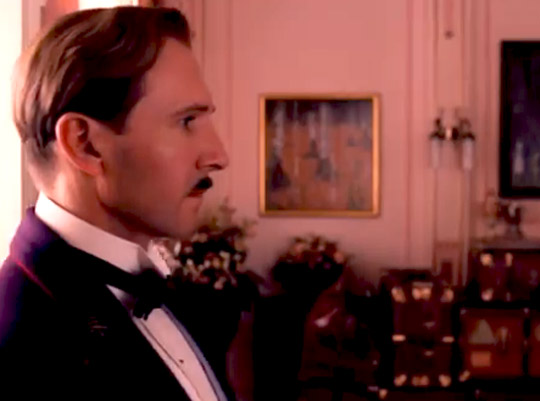
The story centers around Grand Budapest concierge Mr. Gustave (Ralph Fiennes), his friendship with lobby boy Zero (Tony Revolori), and the adventures that ensue when Gustave is framed for the murder of the incredibly wealthy Madame D. (Tilda Swinton). With a large inheritance at stake the “vipers” come out, as Gustave puts it, and it’s up to he and his friends (including Zero’s love interest Agatha, played by Saoirse Ronan) to set things right.
As with most Wes Anderson films, the thing I love about them is that so many of his characters are incredibly refined, yet they possess numerous idiosyncrasies that set them apart from one another. They’re all smart, but they don’t come across as clones because so much attention to detail has been paid to flesh out their histories, likes, dislikes and dispositions. If each character were compared to a color I would say that they are often similar shades, but that the pleasure comes from noting the subtle differences between them.
In between each shade of the same color are in fact infinite differences, and Wes Anderson’s appreciation for that is what resonates with this moviegoer.
Mr. Gustave is a man with whom, even if I were to disagree, I would not find him disagreeable. He harkens back to a day when strong differences in opinion were handled with class and dignity. It’s humorous for modern audiences — raised in the time and age in which the politics of personal destruction are the norm — to see on the big screen, but deep down we long for the world to breed more Gustaves:
M. Gustave: “Rudeness is merely the expression of fear. People fear they won’t get what they want. The most dreadful and unattractive person only needs to be loved, and they will open up like a flower. I’m reminded of a verse: ‘The painter’s brush touched the inchoate face with ends of nimble bristles.'”
Even when he’s vulgar, he has class:
Mr. Gustave: Oh, how the good die young. With any luck she’s left a few klubecks for your old friend, but one never knows until the ink is dry on the death certificate. She was fabulous in the sack, by the way.
Zero: She was 84, Mr. Gustave.
Mr. Gustave: I’ve had older. When you’re young it’s all fillet steak, but as the years go by you have to move on to the cheaper cuts, which is fine with me because I like those. More flavorful, or so they say.
He has standards. He lives by a set a principles and does his best to stick to them.
Mr. Gustave: “The beginning of the end of the end of the beginning has begun. The sad finale played off key on a broken down saloon piano in the outskirts of a forgotten ghost town. I’d rather not bear witness to such blasphemy. … The Grand Budapest has become a troops barracks. I shall never cross its threshold again in my lifetime.
And when facing Death’s door, he is stoic:
Mr. Gustave: If this to be the end, ‘Farewell!’ cried the wounded piper boy whist the muskets cracked and the yeoman cried “Hurrah!” and the ramparts fell. ‘Me thinks me breaths me last me fears,’ said he…”
We laugh at Gustave’s idealism, but we secretly wish we had 1/10 of his decency and decorum.
There are two scenes which, in my mind, best sum up Gustave’s friendship with Zero. Because I don’t want to include spoilers, I will only refer to the exchange where Gustave asks if he can officiate Zero’s future wedding with Agatha:
Mr. Gustave: May I officiate, by the way — the ceremony?
Zero: With pleasure.
Mr. Gustave: I must say, I find that girl utterly delightful. Flat as a board, enormous birthmark the shape of Mexico over half her face. Sweating for hours on end in that sweltering kitchen where Mendl — genius that he is — looms over her like a hulky guerrilla. Yet, without question, without fail, always and invariably she’s exceedingly lovely. Why? Because of her purity.
Zero: She admires you as well, Mr. Gustave.
Mr. Gustave: Does she?
Zero: Very much.
Mr. Gustave: That’s a good sign, you know. It means she gets it. That’s important.
Zero: Don’t flirt with her.
The audience knows that Gustave is at his core a good man, but like all of us he is deeply flawed. He wishes to officiate at his friend’s wedding, but both know that if given a chance he would sleep with Agatha. He admires her purity, but can not help himself for wanting to steal it. He strives to embody the best within him, yet regularly succumbs to his basest desires. He lives to serve others, yet often uses that service to fulfill his own selfish needs.
Like all of us, Mr. Gustave is a fusion of the decadent and the divine. With that said, he also aims to project that fusion in its most presentable package. Like the Mendl’s confectionery treats that play an important part of the film, The Grand Budapest Hotel shows us that beneath the pristine packaging and painstaking work we go to in order to appear a cut above the rest, our pomp and circumstance and cute little bow ties often belie our insides.
Some might say that such a message is a hopeless one — we’re all rotten inside. I disagree. Like I said: we are a fusion of the depraved and the sublime. That is the service rendered for human flesh. The Grand Budapest Hotel’s message, to me, is that while we may not be pure, by striving to become a better version of ourselves we can more often than not be “invariably and exceedingly” lovely.
Agatha says at one point in the movie: “Whence came these two radiant celestial brothers united for an instant as they crossed the stratosphere or our starry window — one from the East and one from the West?”
Answer:the mind of Wes Anderson. Hopefully, he’ll be turning out “radiant celestial brothers” on screen for years to come.
It’s hard to believe that Zack Snyder’s ‘300’ came out seven years ago. It was 2007 when King Leonidas and his Spartans met their “beautiful deaths” on the big screen, although for this moviegoer it felt like yesterday. Love or hate ‘300,’ it’s a movie that was unlike anything else around at the time, and it inspired a slew of imitators.
Due to the some of the lackluster derivatives of ‘300’ that have come out over the years, audiences could be forgiven for walking into ‘Rise of an Empire’ with a healthy dose of skepticism. Regardless, after having seen the film I must say that I was pleasantly surprised. A friend of mine put it nicely: bring on ‘300: End of an Empire’ with the Battle of Plataea.
Sullivan Stapleton plays Themistokles, the kind of politician-warrior the world has long forgotten. (Can you imagine Harry Reid at the Battle of Salamis? Western Civilization would be doomed!) Themistokles has seen battle — watched men die because of the decisions he has made — and so does not take the decision to go to war lightly. Like King Leonidas, however, he understands the danger of attempting to negotiate with the world’s “wolves.”
“Negotiate with tyranny? Give me one example of when that has ever profited a nation? My fellow countrymen, we can only judge the future from what we’ve suffered in the past. Now many of you here stood with me at Marathon. And for those of you who served with me and suffered the cut and thrust of battle, you know how true peace is forged. Xerxes, the son of Darius, is a wolf at our door. Right here, right now we must choose — do we stand and fight for Greece or not? … We must persevere as one nation or we will perish clinging on to our own self interests.” — Themistokles
Stapleton’s Themistokles could never live up to Leonidas, but director Noam Murro wisely doesn’t ask him to try. He’s very comfortable in his own skin. No one can match the awesomeness of the Spartans, but they could be the best Athenians they could be. It was actually satisfying to see men who weren’t born and bred to be soldiers charge into battle in defense of higher ideals.
The flip side of the coin is Eva Green’s Artemisia who, quite frankly, might be one of the best movie villains of all time. She’s got strength and intelligence mixed with pure evil and sexuality. Green delivered a hell of a performance; when she was on screen you couldn’t take your eyes off her — even when she was kissing a man she just decapitated.
To understand how evil Artemisia was the audience just needs to have a sense of history. During ‘Rise of an Empire’ she meets with Themistokles and tells him that if he does not join her, then he will die simply because she has the numbers to overwhelm him. As it is with all dictators and despots, people are merely their pawns; the person with enough pieces to send to the slaughter “wins.”
Remember Ho Chi Min’s warning to the French? I do: “You can kill ten of my men for every one I kill of yours, but even at those odds, you will lose and I will win.” Human life means little to Communists in real life, and it meant little to Ms. Green’s Artemisia.
During the same scene she also promises Themistokles freedom “without consequences or responsibilities.” The Spartans and the Athenians knew that it is the fusion of freedom and liberty that is worth dying for, and not some definition of freedom that would require no concern for the man next to you. Strangely enough, when people talk about “freedom” today in America they are most often (sadly) using the term as Artemisia defines it.
Those who think “freedom” from consequences and responsibilities are what our founding fathers envisioned for the country have been mislead by individuals who are just as manipulative as Artemisia.
Finally, it would be a case of gross negligence to discuss ‘Rise of an Empire’ without talking about the blood spilled and the battles fought. Long story short, if you enjoyed the original ‘300’ then you will enjoy ‘Rise of an Empire.’ The movie is beautiful to watch, and director Noam Murro did a worthy job of displaying Themistokles’ strategic and tactical prowess. The movie messes with historical accuracy a bit, but then again it’s not vying for a prime time slot on History.
Editor’s note for regular readers: The book I’m working on references the Battle of Salamis, which was depicted in ‘Rise of an Empire.’ My characters need to get out of some dicey situations, and one in particular uses the strategies and tactics employed during some of the world’s most famous battles to do so. I’ll continue to keep you posted regarding the book’s progress.
‘Son of God’ came out in theaters this past weekend, and you’ll be shocked (not really) to find out that critics hated it while most audiences walked away happy. The movie raked in well over $26 million dollars, coming in second to Liam Neeson’s ‘Non-stop,’ where the bad guy is a veteran who loves the Constitution. I saw ‘Son of God’ this weekend and am baffled (not really) how it could have possibly scored a “26% rotten” on Rotten Tomatoes. While it’s obvious that the movie was made by believers for believers (and those who may want to dip their toes into the pool of Christianity), it’s certainly not a “bad” film.
Perhaps critics were simply harsh because they feel it belongs on television instead of the big screen. That seems plausible. Given that, I decided to revisit another movie about Jesus, Mel Gibson’s ‘The Passion of the Christ.’ It turns out the critics didn’t like that one too much either.
Here is what I found: Rotten Tomatoes doled out a 49% “rotten” score for ‘The Passion of the Christ,’ while audiences overwhelmingly liked what they saw. Maybe if it made an extra $100 million over its already-impressive global haul it would have matched Rotten Tomatoes’ score for Neeson’s evil constitution-loving veterans flick…
‘The Passion of the Christ’ was a “film” by a “filmmaker.” Whether you like Mel Gibson as a person or not, the guy has talent. Audiences recognized it as well, and rewarded ‘The Passion of the Christ’ to the tune of $370 million at the box office in 2004. If I take my “Catholic hat” off and look at both movies from the point of view of someone who doesn’t particularly care for Christians, ‘Son of God’ would get the 49% “rotten” score and ‘Passion of the Christ’ would get a 65% “fresh” rating — but I’d shake my fist at Mel as I did it. There is really no way to read some of the critic’s reviews without coming to the conclusion that they simply don’t want Jesus on the big screen.
I was really skeptical about this movie. Going into it I was like: “All right, it’s part of a mini-series. It’s going to feel like it’s made for TV.” And it does for the most part, but there there were a couple of things about this movie that I did like what they did with it. Going into this movie first and foremost I was hoping they would touch on the fact as to why people felt this Jesus had to die. Seriously, a lot of these Jesus movies gloss over that. They’re like “Hey it was Jesus and he died because he had to, it’s salvation and stuff. It’s magic.”
But I’m always left with that feeling, “No, like politically speaking why did they feel they had to kill this guy and why was it just such a big deal and what went into it? And this movie — actually to my surprise — touched on that very thing. …
This movie is one of two things: it’s either a really impressive made-for-TV movie or it’s a not-as-impressive theatrically released movie. … ‘Son of God’ engaged me where I wanted to be engaged. And it played the angle I was actually hoping it would play that I didn’t think it would play. It still feels like a made-for-TV movie for sure, especially in some scenes. However, I’ll still say ‘Son of God’ is a good time…”
There’s more to it, but you get the point. It’s a fair review. Head on over to Rotten Tomatoes if you want to see a slew of people who seemed to be looking for things to criticize from the first moment Diogo Morgado — who did a commendable job as Jesus — appeared on screen.
The other thing that ‘Son of God’ did a good job with was showing the relationship Jesus had with his disciples. Think about it: Peter, the “rock” of the Church, denied Christ three times. Matthew was a tax collector. Judas betrayed him for 30 pieces of silver. Jesus called imperfect people to Him. He took in misfits. He loved the unloved and forgave those who society said were unforgivable. While ‘Son of God’ does skip a lot of important parts of the Bible, those it did show were handled with care. It’s a solid movie to watch if there is someone in your life who has ever essentially asked, “What’s the big deal with this guy? Tell me about Him.”
With that said, for those who already believe in Christ I’d have to go with Gibson’s ‘The Passion of the Christ’ as a must-see Jesus film. If you watched ten movies with Jesus in them and someone asked “Which one was directed by a Catholic?” there would be no question (which to this Irish-Catholic is a good thing).
While ‘Son of God’ says, “Hey, there’s this guy and his name was Jesus and you should look into him,” Gibson’s ‘The Passion of the Christ’ says: “Listen buddy, this guy went through some serious s**t — grueling gut-wrenching pain that you can not even fathom as you curl into bed at night with your XBox in 2014 — so check it out and appreciate what this man did for you.”
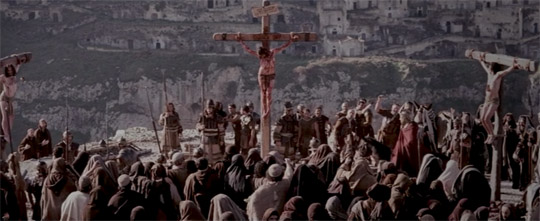
When I read reviews by critics who obviously have a thing against religious people I can’t help but think of the Romans laughing, kicking, spitting and punching Christ as he carried his own cross to the place of his execution. Whether one believes Jesus was the Son of God or not, no serious person argues that He wasn’t a real man who was put to a gruesome death for what He preached. That is why guys like Jeremy Jahns ask: “Why was it just such a big deal [to kill Him] and what went into it?” Most people do not know the story aside from the watered-down version they might get as a kid, or (sadly) the jokes that are told about Christ on television sitcoms.
In short, if you’re curious about Christianity, then check out ‘Son of God.’ If you want to get a taste of the very real pain Jesus went through before his death, check out Mel Gibson’s ‘Passion of the Christ.’ In both cases, if you go into each movie with an open mind, then you’ll walk away and realize that the critics at Rotten Tomatoes hold openly Christian films to an unfair standard.
Remember when Kevin Smith’s Westboro Baptist Church-inspired horror flick ‘Red State’ barely cracked $1 million dollars? Since portraying roughly half the nation as potential religious whack jobs worked out so well for him, he’s decided to up the ante by pitting humanity and Satan against a giant raging “Christzilla” figure. As usual, the “daring” filmmaker failed to disclose any plans to ridicule Islam.
Smith shared details about that project and updates on other movies in the works, and also revealed how he’s going to approach his film career going forward, in an extensive Facebook post on Monday.
The filmmaker wrote that he’ll soon start writing a movie about mankind teaming up with Hell to fight a rapturing giant Jesus.
“[R]ight now, the aim is to shoot CLERKS III this May — so this HELENA HANDBAG picture would still be a ways off anyway. But why sit around commenting on other people’s lives and art on the internet when I can try to make some NEW art instead? As for the title: If you heard the podcast, you know Scott suggested CHRISTZILLA in place of HOLY CHRIST! – the title of the fake movie in the original podcast. I asked the audience to offer up their suggestions at #BeatChristzilla and they were all really fun! But I’m going with the title HELENA HANDBAG – which comes directly from the plot of the flick (it’s kind of a nod to David Lynch’s unproduced ONE SALIVA BUBBLE screenplay, too — which was also about the end of the world and also carried a title that didn’t really prepare you for what the movie was about). So I’m off to write HELENA HANDBAG.
“Clerks III” followed by another attempt to get under the skin of religious folks? Perhaps in a few years “Clerks IV: Dante’s Inferno” can fuse Kevin Smith’s two primary go-to career options. Jay and Silent Bob can travel to the depths of Hell to save Brian O’Halloran.
For younger moviegoers, it is hard to explain how time has exposed Smith’s incredibly limited range as a writer and director. 1994’s “Clerks” was a truly inspired effort, and “Chasing Amy” solidified his reputation at the time as a witty guy with his finger firmly planted on the pulse of American pop-culture. People started copying his style, and instead of searching out new intellectual landscapes to explore he stayed in the same arena of thought with the usual creative teams. With each iteration, the “Kevin Smith” brand became more stale. Smith, however, doesn’t quite see it that way:
JERSEY GIRL, ZACK & MIRI, COP OUT – while I love them all, these are movies anybody could make. Like ’em or hate ’em, nobody else but me could’ve (or would’ve) ever made CLERKS. Or CHASING AMY. Or DOGMA. Or RED STATE. Or CLERKS II. Or MALLRATS. Or JAY & SILENT BOB STRIKE BACK.
Mall Rats — a funny movie about slackers. No one but Smith would have done that? The 90s would disagree.
Chasing Amy — a sharply written romantic comedy involving Lesbians? No one but Smith would make that? The growing Netflix section on gay and lesbian movies says otherwise.
Dogma — a critique on the Catholic Church. No one but Smith would make that? Okay.
Red State — a horror flick that blasts fundamentalist Christians. No one but Smith would make that? Gotcha.
Does Kevin Smith use the caps lock button to convince himself that his assertions are true, or does he think that talking loudly convinces the rest of us of the veracity of his claims? Will the sequel to “Helena Handbag” be called “Islamabad Burka”? Don’t count on it.
If Kevin Smith wants a movie that no one else would make, perhaps he could write a film that pits Giant Muhammed against Mothra. Giant Muhammed could also have a harem of topless women the size of The Sacred Mosque Al-Masjid Al-Haram. But Smith won’t go there because it’s easier to needle Christians with “Christzilla” than it is to make a film that lands on the radar of the world’s nuttiest Islamic clerics. Just ask Mark Basseley Youssef (formerly Nakoula Basseley Nakoula), the director of “Innocence of Muslims.” He’s the guy the Obama administration couldn’t act fast enough to pull out of his home for a perp walk. Crime? Daring to criticize Islam.
Kevin Smith is an intelligent guy with some good instincts. He was way ahead of the game when it came to podcasting and the format plays to his strengths. However, his role as screenwriter and filmmaker has suffered from years of staying inside his comfort zone. Worse, he still thinks that making jokes at the expense of devout followers of Jesus is edgy. It’s not. It’s just sad and, on some level, cowardly considering many of the real threats to the creative freedoms he enjoys as a citizen of the United States.
Kevin Smith doesn’t want to end up like Mark Basseley Youssef (Nakoula Basseley Nakoula), the director of “Innocence of Muslims,” so he sticks to mocking Christians.
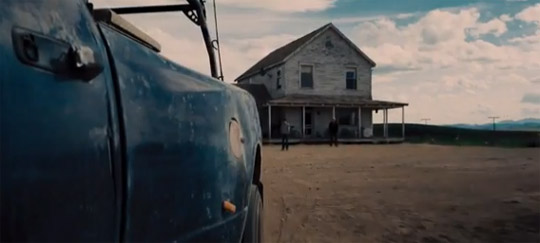
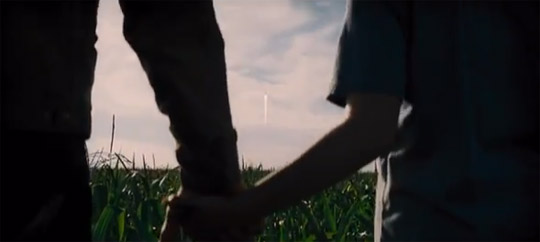
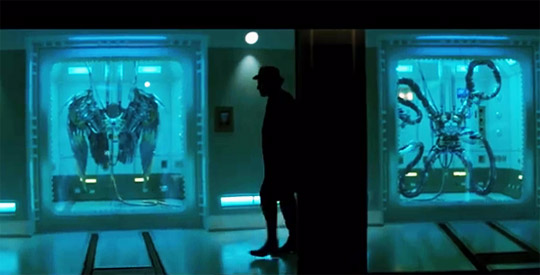
If there is such a thing as a flawless teaser trailer, the finished product for Christopher Nolan’s ‘Interstellar’ can count itself a member of the exclusive club. The narration, the gravel in Matthew McConaughey’s voice, the historical images that flash before the screen, and the score all combine to form what can only be described as something “stirring.” It says to the audience: “This is going to be a movie that seeks to tap into something deep inside you — if you’re willing to see just how much humanity is capable and just how often you sell yourself short.”
A group of explorers make use of a newly discovered wormhole to surpass the limitations on human space travel and conquer the vast distances involved in an interstellar voyage.
And here is Matthew McConaughey’s dialogue from the teaser:
“We’ve always defined ourselves by the ability to overcome the impossible. And we count these moments — these moments when we dare to aim hirer — to break barriers. To reach for the stars. To make the unknown, known. We count these moments as our proudest achievements, but we’ve lost all that. And perhaps we’ve just forgotten that we are still pioneers, that we’ve barely begun, and that our greatest accomplishments can not be behind us because our destiny lies above us.
Amazing stuff. I couldn’t agree more.
Anyone who has left loved ones behind in search of “bigger and better” things has a pioneer in them. Anyone who has walked away from a stable job for a chance to do what they really love has an explorer in them. Anyone who has taken great financial risk to back a cause they really believe in has an astronaut in them. These days, the pioneering spirit is squashed in its infancy. Public policy is often pushed on the population that locks people in place and prevents them from exercising their entrepreneurial spirit, and as a result it atrophies — we forget that we were meant to reach for the stars.
The teaser for ‘Interstellar’ first seeks to remind us what we’re capable of if we put our minds to it.
We can make the impossible possible because there are always men and women who swallow hard, leave loved ones behind, and find the grit in their spit needed to navigate uncharted waters.
The pioneers leave the comfort of family and friends behind, despite the pain and anguish it causes, because there is something deep within that compels them forward.
We shed tears in the pursuit of our dreams because a love of the safety and security of “home” pits us against our desire to explore new horizons, blaze our own path and create something unique and special that we can call our own. And when we succeed, we give thanks to the family and friends who encouraged us to take that leap of faith and who promised to catch us if we fell.
Predication: Christopher Nolan’s ‘Interstellar’ is going to be epic. The man makes smart movies that work on multiple levels. Those who just want to watch characters navigate worm holes for a few hours will be entertained, and those who like movies with more layers than an onion will go home happy. That is the nature of Christopher Nolan’s films, and for that I am thankful.
Christopher Nolan “gets it.” It’s a joy to watch his work and hopefully he’ll be at it for many years to come.
In August I said that the thing that would hurt Ben Affleck the most as he attempted to become Batman was his outspoken politics: “If I were a betting man, I’d say that Mr. Affleck will continue saying and doing things in public that will make it harder for roughly half the nation to lose themselves in his version of “Batman” on opening night.”
Affleck: People now know me as a Democrat, and that will always be the case to some extent.
Playboy: Does that polarize viewers?
Affleck: It does, and you can bifurcate your audience. When I watch a guy I know is a big Republican, part of me thinks, I probably wouldn’t like this person if I met him, or we would have different opinions. That shit fogs the mind when you should be paying attention and be swept into the illusion.
Playboy: Still, won’t that happen whether you take positions on candidates or causes?
Affleck: I have misgivings about it, counterbalanced with the larger things I care about. I don’t blindly do this stuff when it makes it harder to do my own job. And there’s an awful lot of gross money-raising going on that has made me want to pull back a bit from pure electoral politics. […]
Yes Ben, if the guy you’re watching on screen is a Republican and you’re a Democrat, it’s safe to say that you’ll have “different opinions.” Your powers of deduction are not quite at Bruce Wayne’s level at the moment, but you are correct.
Here’s the part that is somewhat bizarre for the future Batman to disclose: “I probably wouldn’t like this person…”
There are a lot of things I think about Matt Damon and Ben Affleck and most of Hollywood’s liberal activists, but I only tend to think “I wouldn’t like them” when they come across as elitist jerks. How someone comports themselves dictates how I feel about them as a person — a political party affiliation alone does not. Does Ben Affleck have zero Republican relatives? He must not, or he wouldn’t say such ridiculous things.
I love my fellow Americans. I want to like all of them and I want to give them the benefit of the doubt, but it’s hard when guys like Ben Affleck and President Obama keep dividing people.
“We’re gonna punish our enemies and we’re gonna reward our friends who stand with us on issues that are important to us.”
Here’s what Slate’s John Cook said in his maybe-sorta-kinda piece of satire (but not) titled ‘Thanksgiving Tips: How to pick a fight with your relatives this Thanksgiving.’ It was written just in time to coincide with the White House’s push to get family members to discuss Obamacare over the holidays:
First off, you should wait until everyone’s seated at the table before you try to get things started. That way you have a captive audience that has to watch the fireworks, and everyone is settled in for a nice long time. Getting the topic of conversation to politics shouldn’t be too hard. Stick to short, sarcastic, tendentious remarks to get things going. “I’m thankful for all that free stuff Obama gave me.” Once you’ve engaged the enemy, it won’t take much effort to pivot to whatever particular subject you feel most comfortable with.
Yes, according to the president and his most ardent disciples, your fellow Americans are “enemies.” Does anyone else find it weird that the president won’t call any number of thug-nations around the globe an enemy of America, but he will refer to his political opponents as such? But I digress…
Instead of just admitting that activist actors “fog the mind” of the audience with all sorts of extraneous junk, Ben Affleck lets us all know that an ‘R’ next to your name makes him immediately think that he “probably” doesn’t like you — even though he wants your money.
Why should I cough up my money for ‘Superman vs. Batman (vs. Wonder Woman?)’ when one of the lead actors openly conveys his disgust for me as a person? Because of my love of free markets, limited government, traditional American values and a strong national defense, Ben Affleck “probably” wouldn’t like me? It’s weird.
Yes Ben, it is possible to disagree with someone without being disagreeable. I know it’s hard for someone who lives in a Hollywood bubble, where everyone thinks along the same lines and tells each other how smart they are at cocktail parties (“Pass me the gruyère, will you?”) — but in the real world some of us get along with our politically-diverse family and friends just fine.
If Zack Snyder is smart, he’ll sit down privately with Ben and tell him to shut up with the political commentary until ‘Superman vs. Batman’ comes out. There are a lot of people who aren’t thrilled with the idea of Ben Affleck as the Dark Knight, and alienating roughly half the viewing audience out the gate is probably not a good PR move.
Hat tip to douglasernstblog.com reader PersonIsPerson for the story.