‘Act of Valor’ SEAL blasts Washington’s attempts to lower standards in ‘Damn Few’

Rorke Denver Damn-Few

Lieutenant Commander Rorke Denver was the former head of Basic and Advanced SEAL Training. He was one of the stars of a number one movie, “Act of Valor,” in which active-duty Navy SEALs gave Americans an inside look the world’s most elite fighting force. He is now the author of an illuminating book, “Damn Few,” which comes out February 19. And after its release, he’ll be known as the patriot who sounded the alarm on the Beltway political class’ efforts to lower the standards of arguably the greatest fighting force the world has ever known.

Since Secretary of Defense Leon Panetta announced that combat roles would now be open to female soldiers, Pentagon brass has assured Americans that the standards of excellence expected by infantrymen and special operations forces would not be compromised. Those promises ring hollow, given that the chairman of the Joint Chiefs of Staff, Patrick Dempsey, talked out both sides of his mouth in an effort to alleviate fears during a press conference last week: “[If we do decide that a particular standard is so high that a woman couldn’t make it, the burden is now on the service to come back and explain to the secretary, why is it that high? Does it really have to be that high?”

And that’s where the importance of Lt. Cmdr. Denver comes in. Speaking on the consequences of the success Navy SEALs had in Iraq and Afghanistan, the saving of Captain Richard Phillips of the MV Maersk Alabama when he was taken hostage by Somali pirates, and of course the capture and killing of Osama bin Laden, Lt. Commander Denver writes:

“The message as it was delivered from General Bryan “Doug” Brown, SOCOM’s commander, was simple: “You guys need to make ’em grow.”
Then an interesting thing happened.
The special-operations forces of the Army, Air Force, and Marines each produced projections of how their units could expand and how they would expand. Those units all expanded as promised. …
There was on notable exception: the SEAL teams. …
It didn’t take long, less than a year, for a fresh directive to find its way to the junior and senior SEAL leadership, this one considerably firmer in tone.
“That wasn’t a suggestion,” was the way it was heard on the ground. “We want more SEALs. You will get us more SEALs.” There was also an addendum to that, unstated by still perfectly clear: “And if you won’t, we will find new leaders who will.”

Lt. Cmdr. Denver’s first-hand experience should serve as a clarion call for anyone who cares about the safety of the American people. Pundits and politicians of all stripes — as well as Pentagon officials — claim that the integrity of our elite units will be maintained when it has already been attacked. “Damn Few” even details how at one point during Lt. Cmdr. Denver’s tenure on the SEAL’s Academic Review Board, candidates were getting “ten, eleven, and twelve opportunities to pass their tests.”

The mindset in Washington is that if teams of SEALs are so effective, the U.S. should simply double or triple or quadruple the numbers — but it doesn’t work that way. Why not just have all soldiers be SEALs while we’re at it? What Congress doesn’t get, and what “Damn Few” does an excellent job of demonstrating, is that it takes a very special, very rare kind of person to even want to try out for the challenge of becoming a SEAL. And then, only the best warriors have the mental and physical toughness to earn the coveted “SEAL Trident.”

Social engineers in Washington and the high-ranking Pentagon officials who want to curry favor with them are trying to turn the “damn few” into the “damn many.” Sadly, the concerns in Lt. Cmdr. Denver’s book may be a harbinger of things to come. At one point he writes of his time as an active-duty SEAL that “it was like being a member of an excellent fraternity, the greatest man club in the world. Maybe the last one.”

Inevitably, some women will have what it takes, physically and mentally, to become SEALs. But they shouldn’t earn that distinction with lower standards. It would be a shame if politicians who claim to act in the public’s interest decimated the one fighting force that consistently secures freedom and liberty around the world. “Damn Few” comes out February 19. For those who take national security seriously, it is a must-read.

Related: American Sniper Chris Kyle: Guardian Angel who doesn’t know it

Zero Dark Thirty is a first class movie

Zero Dark Thirty Maya
Jessica Chastain does a magnificent job as Maya in ‘Zero Dark Thirty’. She manages to embody the hopes, fears, determination and frustration of not just the CIA, but of the entire country. (Image: YouTube)

Not since Paul Greengrass’ United 93 has there been a movie related to 9/11 that has impressed me as much as Kathryn Bigelow’s Zero Dark Thirty. Fittingly, the film begins with 911 calls on September 11th from a helpless victim inside the World Trade Center. A woman says to the dispatcher: “I’m going to die, aren’t I? I’m going to die,” before the line cuts out. It was a wise move on Bigelow’s part. Sitting in the theater I was transported to that day and from there on out I was emotionally invested. By the final credits it was her directorial chops that kept me glued to my seat, despite the predictable ending.

The problem with reviewing a movie like Zero Dark Thirty is that everyone wants to talk about the torture scenes. And how could they not? Anyone who has seen Django Unchained will recall the “hot boxes” Broomhilda is thrown in when “the box” Zero’s recalcitrant detainees must face makes its debut, before thinking: “The more things change, the more they stay the same.” And the dog collar used in Zero alludes to Lynndie England’s Abu Ghraib leash photo, Bigelow’s way of saying the problem was much more systemic than previously thought. Perhaps in a parallel universe Quentin Tarintino will direct a jihad revenge fantasy titled Mohammed Unchained? Who knows.

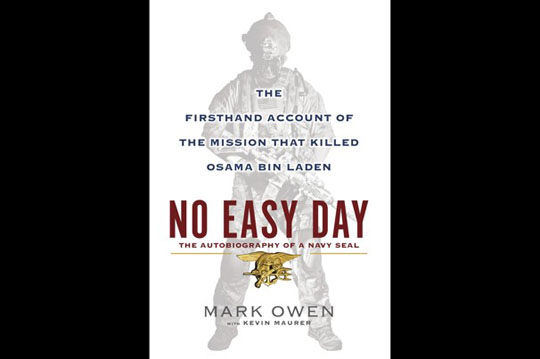
The point is, there is much more to this movie than water boarding and sleep deprivation. And that is: there are very smart, very evil people out there who are plotting and planning — every moment of every day — ways to attack Western Civilization and kill its people. They are hardened. They are crafty. They are true believers in their cause, and “solving” the problem is no easy task. Perhaps that’s one of the reasons why former Navy SEAL Mark Owen (his real name withheld here) titled his book on the capture and killing of Osama bin Laden No Easy Day.

During an explosive scene, one of the CIA big shots slams his hand on a desk in front of his team and says: “Do your fucking jobs! Bring me people to kill!” Well, that isn’t his job. His job is not to simply kill people — but when your own countrymen are dying, when your team members are dying (i.e., the Khost terror attack, in which a double-agent took out seven CIA members in a suicide bombing), and you can’t find the world’s most wanted terrorist after having spent billions of dollars and countless man hours — it becomes easy to unravel. The urge to substitute drone-bombing for a cohesive counter-terrorism strategy is tempting, but it only masks more difficult tasks; left unattended, they still fester and grow.

The star of Zero Dark Thirty is Maya, a CIA analyst played fabulously by Jessica Chastain. Maya is apparently a composite character, but she seems mostly based on an analyst mentioned in Owen’s No Easy Day. The trials and tribulations she displays during her quest to capture and kill Osama bin Laden are shared by the audience. Her frustrations are our frustrations. Her dilemmas are our dilemmas. And her triumph is the nation’s triumph.

I teared up during Zero Dark Thirty because this was the kind of movie the subject matter deserved years ago. I found myself thinking about my friends who were deployed overseas in a post 9/11 world, and one in particular who didn’t come back alive. I found myself thinking about my friends in the intelligence community or my sister, who lived in downtown Manhattan on 9/11 and watched the second plane fly by her window. It was gratifying to see onscreen just how messy and complex and difficult the subject of Islamic terrorism is. Knowing that millions of self-righteous know-it-alls will walk into the theater and leave enraged or confused means that Bigelow did the right thing.

Zero Dark Thirty ends with a pilot asking Maya where she wants to go. With Osama bin Laden dead, there is a cathartic release on her face — but she has no answer. I would argue that her expression is almost as classic as Dustin Hoffman’s and Katharine Ross’ in The Graduate. Regardless, the nation has its own soul-searching to do, and we should all thank Kathryn Bigelow for prompting an adult conversation on the subject when she could have created a polemic. Now somebody just needs to ask Hollywood: What took you so long?

Black Hawk Dumb: Terror haven Somalia likely to get U.S. taxpayer cash

It was only two years ago that then-CIA Director David Petraeus testified before Congress on the dangers posed by Somali terrorists, saying “extremist networks over the past two decades have made southern Somalia one of the world’s most significant havens for terrorists. Al Qaeda’s affiliate there — al Shabaab — is large and well-funded relative to most extremist groups, and it has attracted and trained hundreds of foreign fighters, including scores of Americans and dozens from other Western countries.”

Today the U.S. is preparing to formally recognize the Somali government, paving the way to send taxpayer dollars to the place that will forever be associated with “Black Hawk Down,” where a U.S. Army Ranger was dragged through the streets in 1993.

Bloomberg reports:

    The U.S. will formally recognize the government in Somalia tomorrow, a step that paves the way for the U.S. and international finance organizations to aid the war-torn African nation.

“It’s the start of a significant process that underscores the return to stability that has occurred in Somalia over the last four years,” U.S. Assistant Secretary of State for African Affairs Johnnie Carson said [told] reporters. …

Secretary of State Hillary Clinton plans to exchange diplomatic notes with Somali President Hassan Sheikh Mohamoud … in a meeting at the State Department.

Americans watched as the Obama administration gave weapons and aid to Libyan rebels. Our reward? U.S. Ambassador Christopher Stevens and former Navy SEALs were slain in the Benghazi terrorist attack on Sept. 11, 2012. Now the American people are supposed to believe that with a few U.S. dollars and some help from the CIA, Somali President Hassan Sheikh Mohamoud can transform Mogadishu into Club Med.

Most Americans don’t know about the importance of the clan in Islamic culture. They are unfamiliar with women like Ayaan Hirsi Ali, who grew up in Somalia and says she was beaten until she learned 800 years of her father’s ancestry, or that strangers in the country will often trace their lineages until they find a common ancestor. But the State Department does know this. Yet Secretary of State Hillary Clinton is planning to exchange “notes” with Somalia’s president, which will in all likelihood lead to dollars. And that cash will go to a clan culture riddled with African members of al-Shabaab, al Qaeda in the Islamic Maghreb, Boko Haram and other terrorist groups.

If the State Department thinks it can cozy up to Somalia and not get burned, maybe it should ask French intelligence agent Denis Allex for advice. Or maybe not, since the French government believes members of al Shabaab executed him on Jan. 11.

The question before Americans isn’t whether we should be engaged in Africa, because we should (to what extent can be debated). The question is, who are we going to hold accountable if this goes horribly wrong?

If Clinton’s aversion to answering questions about the Benghazi terrorist attacks and ensuing cover-up is the model for how this administration does business, conservatives should make oversight of any cash transfers to Somalia a priority. If something goes wrong in Mogadishu, the most likely scapegoat will be Republican members of the 113th Congress.

No Easy Day: The Firsthand Account … of a great book

Apparently, the Pentagon isn’t happy with the release of ‘No Easy Day’. Possible national security issues aside — readers will be.

What does a member of SEAL Team 6 do after he’s killed the most wanted terrorist alive — the mastermind behind the worst attack on American soil since Pearl Harbor? He does what anyone else would do: He goes to Taco Bell. By himself.

No Easy Day apparently has heads fuming at the Pentagon, and author Mark Owen might be persona non grata with his former teammates  (his real identity is known, but I’m still going to refrain from using it), but it’s a book that I’m glad he wrote. It’s a story that needed to be told, even if the timing of it could be called into question. And, while some of the information disclosed in the book is surprising, someone should remind the Navy SEALs that they were the ones who also worked with filmmakers on Act of Valor. Owen is most definitely one of the good guys.

There seems to be three factors that drove Owen to write the book. They are:

  1. To inspire other young men to become better than they knew they could ever be.
  2. To vent frustration over having to fight a war increasingly designed to protect the sensibilities of the politically correct civilian chattering class.
  3. To draw attention to politicians in Washington, D.C. who are much more of a threat to OPSEC than a retired SEAL.

As with other standout books by Navy SEALs, such as Marcus Luttrell’s Lone Survivor or Chris Kyle’s American Sniper, where the words make the book worth its hardcover price is in the personal story — not the details of any specific mission. You care about Owen not because he’s a Navy SEAL, but because he’s a good person. You want to keep reading his story — not because he’s a badass — but because he embodies the a kind of honor, commitment, selflessness and love of country that seems endangered in modern America.

The forward says it all:

‘No Easy Day’ is the story of “the guys,” the human toll we pay, and the sacrifices we make to do this dirty job. This book is about a brotherhood that existed long before I joined and will be around long after I am gone.

My hope is one day a young man in junior high school will read it and become a SEAL, or at least live a life bigger than him. If that happens, the book is a success.

It only takes Owen a quick 299 pages to complete his mission. It’s hard to believe that any young man could read No Easy Day without having his patriotic passions stirred.

Since Owen is a smart guy, he also provided plenty of lessons for public policy makers. Case in point:

It felt like we were fighting the war with one hand and filling out paperwork with the other. When we brought back detainees, there was an additional two or three hours of paperwork. The first question a detainee at the base was always, “Were you abused?” An affirmative answer meant an investigation and paperwork. And the enemy had figured out the rules. …

On more recent deployments, they started hiding their weapons, knowing we couldn’t shoot them if they weren’t armed. The fighters knew the rules of engagement and figured they’d just work their way through the system and be back to their village in a few days.

It was frustrating. We knew what we were sacrificing at home; we were willing to give that up to do the job on our terms. As more rules were applied, it became harder to justify taking the risks to our lives. The job was becoming more about an exit strategy than doing the right thing tactically.

The best trained, best equipped, most-disciplined fighting force in the world is asked to go to war — provided it’s a politically correct war. Al Qaeda members sleep soundly in their beds (or caves or on floorboards) because they know they can take advantage of the rules of engagement. “Shoot, move, and communicate” has become, “shoot, move, and do ‘sensitive site exploitation’.” SEALs need to spend endless amounts of time on each mission documenting everything for the kind of person who sees any U.S. military action as an Abu Ghraib waiting to happen. It’s sad and sick, it’s going to come back to haunt us,  and it gets soldiers killed.

Mark Owen’s personality reminds me of a lot of the guys I once served with. He’s an intelligent guy, but he’s humble. He strives for perfection. He never gives up because failure isn’t an option. He’s a professional, and he most-certainly goes about his job with the ‘failure to prepare is preparing for failure’ mentality. He loves his country and has done amazing things for freedom and liberty. He’s a real-life hero, but at the end of the day he’s perfectly content … with Taco Bell. In short, he’s everything I’d like my future son to be.

I highly suggest No Easy Day.

Remembering 9/11 and the ‘what if?’ that never ends

On September 11th, 2001 I was just over a year out of the military, taking college classes and preparing myself to transfer to the University of Southern California. My grandmother spoke to me from our living room and said a plane had hit the World Trade Center. I talked about it with her from the kitchen for a few moments, and just as I walked into the family room I saw United Flight 175 hit the South Tower. A chill ran down my spine. The phone rang seconds later. It was my sister: “A plane just flew by my window. What’s going on?” she asked. Sadly, I don’t even remember my response, and I’ve never thought to ask her. I know that she was evacuated from her building, and that a kind stranger offered her a tee shirt to breath into to avoid inhaling dust and debris. I also know that on a deeper, more philosophical level I’ve been trying to answer her question — as it pertains to Islamic terrorism — ever since.

We can count dead bodies. We can put a dollar amount on the damage to the city of New York and the country as a whole. We can calculate the economic impact al Qaeda had on the United States and the world, but what we can’t do is quantify the psychological toll the terrorist attacks of 9/11 wreaked on the nation. Regardless, I am more than happy to offer myself up for amateur and professional sociologists everywhere.

Prior to 9/11, I was not much of a crier. As a former infantryman, I prided myself on having a bit of a “tough” exterior. I was a master at hiding my emotions and keeping my “military manner” when necessary. On that day though, I remember driving to class with tears in my eyes. I had to compose myself in the parking lot before entering the building, and while my body was in a college classroom my mind was somewhere else. Psychological aftershocks were reverberating in my head, and it wouldn’t be until years later that I would be able to look back and identify many of the changes to the landscape.

For instance, post 9/11 I found myself tearing up just listening to Tony Blair defend Western Civilization. I’d see pictures of George W. Bush meeting with injured soldiers and I’d get a lump in my throat. Sometimes, random stories about 9/11 would come on television and I’d struggle to keep my composure. I tried to tell a friend about former Navy SEAL Marcus Luttrell and I couldn’t finish because my voice kept cracking. I’ll now see the random veteran in public, and I although I want so badly to thank them for their service I rarely can do so because the tears begin before I ever utter a word. I can’t control it and I understand how it comes across as inane. However, I tend to think of my physiological response to these situations as something born out of the realization that the freedoms we enjoy are much more fragile than most people realize. When I think about the idea of America I have reactions that late night comedians find humorous — and I don’t care.

A friend of mine recently asked what my life would have been like if I entered the military after attending USC. It’s a good question, and it’s a slightly different version of the same question I ask myself almost every day: “What if I stayed in?”

When I exited the service in August, 2000 I was generally of the mindset that I had fulfilled some sort of unspoken, patriotic duty. In my mind, war could have broken out at any time, but it didn’t during my enlistment. I was under the impression that any war that involved the United States would take place years after I was in any position to help out. After returning to civilian life, working so hard to get into a prestigious university, taking out college loans and charting out a new path for myself, 9/11 suddenly had me second guessing everything. My friends were being sent to Afghanistan, and then Iraq. While I was in Southern California reading and writing my friends were being shot at. In California I was dating the woman who would ultimately become my wife, and yet there was always a part of me that screamed “You should be over there!” And I wasn’t. How many of my tears are of guilt and remorse I guess I’ll never know.

As a religious man, I have tried my best to live up to God’s plan for my life. There are too many coincidences — sheer blessings — for me to to believe there isn’t someone upstairs looking out for me. And so, my mind and my spirit tell me that writing is what I was made for. My mind and my spirit tell me that I can do more for God and country through the written word than I could with an M16A2 or an M4 carbine — but my heart often tells me I failed to be there for my buddy Leija or any number of other guys I knew from Charlie 1/18.

Perhaps the better question is: What would I be like if September 11th never happened? In a sick and twisted way, I think I would have been worse off spiritually. Hopefully, I’ll have many more September 11ths to turn it over in my head, along with the the friends I’ve met through this blog.

Thanks for reading,

Doug

What if this kid had stayed in the military instead of getting out and going to USC? I ask myself that almost every day.

When we can see through walls, but not the debt in our face

New technology allows us to see light move at one trillion frames per second, but yet many citizens still can’t see the slow motion economic train wreck caused by out-of-control debt and a bloated federal bureaucracy.

How is it that it’s only a matter of time before Americans will be able to see through walls, but they can’t see the writing on the wall when it comes to debt and deficits? Professor Ramesh Raskar’s presentation on cameras that can film at one trillion frames per second is amazing, but it also demonstrates one of the problems conservatives have when it comes to talking about recessions, depressions and the economy in general.

Not too long ago I got to cover the Defending the American Dream Summit for work. While I was there, I got to talk to a number of older individuals who honestly believe that the standard of living their grandchildren will be lower because of the policies we are putting in place today. That’s true — in many respects — but it’s hard to get anyone to buy it when new technologies keep emerging that will change the course of human history.

How do you get people to understand the future that never was? While it’s a godsend that humans are constantly pushing the limits of what is possible, it also is maddening that so many are regularly susceptible to public policies that retard economic growth and the entrepreneurial spirit inside us. We adopt health care policies that hinder the innovation of lifesaving drugs while giving more people crappier coverage. We enact well-intentioned entitlement programs that turn able-bodied men and women into human gerbils waiting for the next government pellet — instead of encouraging them to break free of their mind-forged manacles. We use the tax code for social engineering instead of allowing the individual to keep more of his own money with which to build a brighter future.

The “poor” in the United States are not getting poorer. In fact, the “poor” (who are also not a static group) in the United States do quite well when compared with their counterparts around the world. Given that the standard of living generally goes up for all Americans each generation — even if the rates differ among social classes — conservatives need to find a way to talk about lost futures. It’s not enough to say that if we elect liberal politician “x” that life will be worse off, because benefits gained through technological advances mask all sorts of theft to our standard of living.

If conservatives are smart they will become tech-savvy nerds who not only care about cameras that can see around corners, but talented orators who can paint vivid pictures of the future by describing their vision for the world and the vision of their political opponents.

The Dark Knight Rises: A conservative review

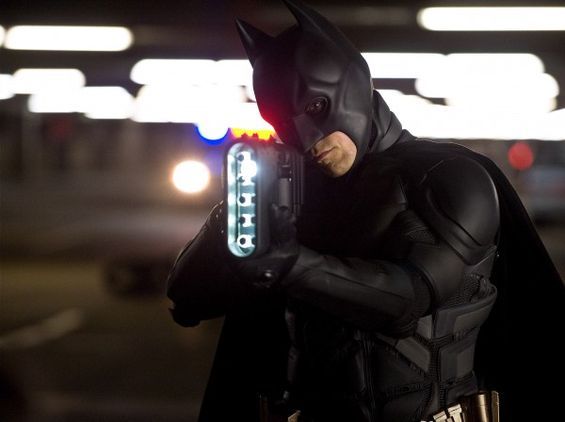
Christopher Nolan has set the bar mighty high for whomever follows him on the Batman franchise. The Dark Knight Rises might not be the perfect movie, but it’s a superhero film that transcends almost all other superhero films. It succeeds much more often than it fails, and for that Nolan should be proud of what he’s accomplished.

Where was Christopher Nolan supposed to go after the success of The Dark Knight? How could he have possibly topped the second installment of his Batman trilogy? There really weren’t many options, except to make a superhero movie that was more than a superhero movie — and for that Nolan apparently turned to Dickens’ A Tale of Two Cities. The director went for something truly epic — he shot for the moon — and while we can debate whether or not he actually hit his target, it seems pretty obvious that he made it to the stars.

After the second trailer for The Dark Knight Rises came out on May Day, I hoped that years from now political junkies would hear Bane say, “When Gotham burns, you have my permission to die,” and immediately associate him with Keynesian economics and the totalitarian tendencies that spring forth from it. The movie didn’t disappoint, as Bane displays classical training in the rhetoric of leftist dictator-goons throughout history. And if Bane comes across as a Marxist revolutionary, then Selena Kyle is the useless idiot who buys into his snake oil.

Take note of Catwoman, as she displays jealousy, greed, envy and a sense of entitlement all in one minute conversation with Bruce.

Selena Kyle: You don’t get to judge me just because you were born in the master bedroom of Wayne Manor. … I started out doing what I had to. When you’ve done what you’ve had to they’ll never let you do what you want to.

Bruce Wayne: Start fresh.

Selena Kyle: There is no fresh start in today’s world. Any 12 year old with a cell phone can find out what you did. … Everything sticks.

Bruce: Is that how you justify stealing?

Selena Kyle: I take what I need from those who have more than enough. I don’t stand on the shoulders of people with less. … I think I do more to help someone than most of the people in this room — than you.

Bruce Wayne: Do you think maybe you’re assuming a little too much? …

Selena Kyle: You think all of this can last? There’s a storm coming, Mr. Wayne. You and your friends better batten down the hatches, because when it does you and your friends are going to wonder how you ever thought you could live so large and leave so little for the rest of us.

Ms. Kyle wants to live in a world where she doesn’t have to suffer the consequences of her actions. She made mistakes, and instead of owning up to them she doubles down on a path of deceit. It is only when Ms. Kyle moves in the ideological direction of Mr. Wayne that her fortunes begin to change. Revolutionaries like Bane only bring misery and terror, while men like Wayne offer order, true hope, redemption and selflessness.

Perhaps no better part sums up the difference between Bruce Wayne and his leftist adversaries than the rising climax. The cynical, class-warfare spewing Catwoman intellectually aligned with Bane throughout most of the movie, a man who sought to destroy an entire city to realize his goals. Bruce, on the other hand, proves that he is willing to sacrifice himself for an entire city.

Selena Kyle: Sorry to keep letting you down. Come with me. Save yourself. You don’t owe these people any more. You’ve given them everything.

Bruce: Not everything. Not yet.

Within minutes, Kyle knows that Bruce is the better man, and she falls for him. By the end of The Dark Knight Rises, the man she accused of “living so large” and leaving “so little for the rest of us” has proven himself her superior mentally, physically and spiritually, and she shows her epiphany in dramatic fashion.

As I said before, The Dark Knight trilogy will be, on many levels, the Bane of liberal moviegoers’ existence. No matter what Christopher Nolan does—no matter what he says from this day forward—he can never take back these films (thank God). It’s a gold mine of conservative values waiting to be explored. And, while Nolan’s personal politics might not be conservative, he at least gave the worldview a fair shake. In Hollywood, that’s all conservatism needs to starts winning hearts and minds. Besides, when The Village Voice hates a movie, I know I have something to work with.

If you haven’t seen The Dark Knight Rises yet, check it out while it’s in theaters. Love it or hate it, it’s a movie that’s going to be talked about for a long time.

Spider-Man: War Zone liability thinks small in big situations

A week ago I covered Spider-Man, and how liberal writers have turned him into a walking war zone liability. In a situation where 6 billion lives hung in the balance, the friendly neighborhood Spider-Man did the “neighborly” thing and thought to use precious seconds wondering whether a bunch of North Korean soldiers (those same guys overseeing the world’s most notorious gulags) were ushered to safety before explosives took out the weapons … they were guarding. He then saw fit to warn his soldierly teammates “no one dies,” precisely the kind of all-or-nothing delusional thinking that sets the stage for death to occur.

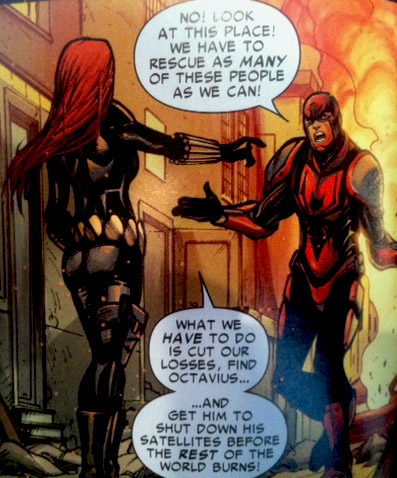
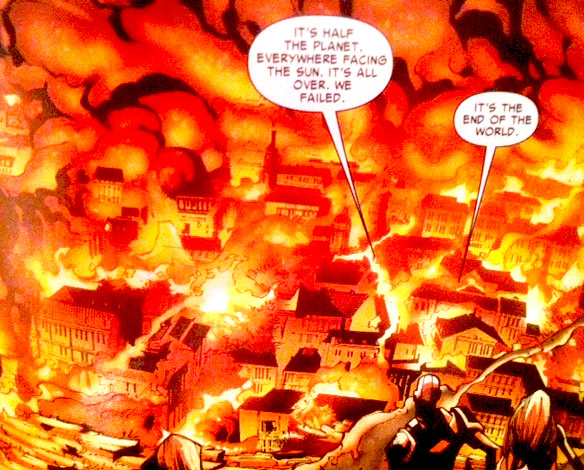
Issue #686 of Amazing Spider-Man takes place right after our heroes believe half the world has been destroyed. With carnage surrounding them, Black Widow tells Spider-Man they must leave immediately, as time is not on their side if they want to save the roughly 3 billion people remaining on earth. Spider-Man’s response? He’s not budging because he has people to save right there. Dan Slott’s Spider-Man is so myopic that he only sees the lives right there in front of him. He’s like a baby, tricked by peek-a-boo because his mind isn’t fully developed; if there are lives to be saved right in front of him, there’s a good chance he can be distracted. The Black Widow knows it and, sadly, his deadliest foes take advantage of it.

With 3 billion lives at stake and with every second counting, Dan Slott’s Spider-Man wanted to play search and rescue. It’s an honorable job, but the problem with that is this:  At that moment in time Spidey was the guy who was supposed to be saving the world — not Black Widow.
Even Spider-Man’s deadliest foes know that while his heart is pure, his mind is clouded with the quixotic belief that “no one dies” on his watch. Like a heroic Spider-Man-Pigeon, he’s easily distracted by lives in immediate danger, never acknowledging that by “saving” the few to his front, he may very well condemn 3 billion to his rear. A hero is still a hero, but some of them are meant for city streets, and some of them are meant to determine the fate of the world. Dan Slott’s Spider-Man may save the world, but an honest writer would have penned the more logical conclusion: utter defeat caused by unforced errors.

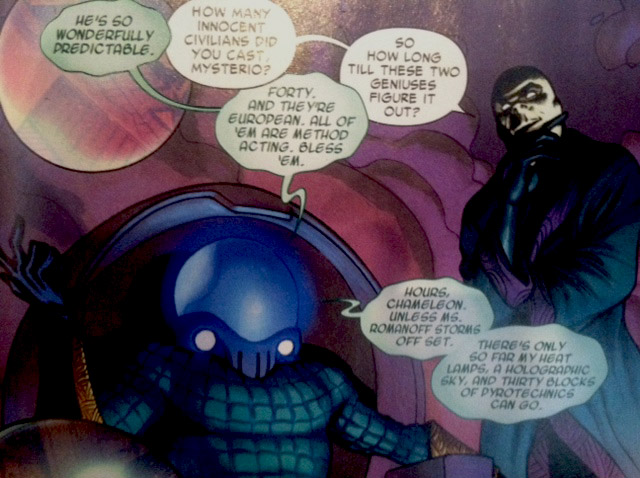
In the end, Dan Slott gives Spider-Man a reprieve, and the hero is given a chance to save the day by taking advantage of the vanity, greed and hubris of his enemies. The “end of the world” was an illusion meant to distract the heroes and buy time for the machinations of evil men to materialize. It would have worked, but the enemies who literally have the world in their hands want more, overreach and lose it all. Spider-Man takes advantage of his second chance, but it feels like a Deus ex Machina of sorts, freeing the character of the consequences of his short-sighted actions. In the real world we often don’t get second chances.

Even Black Widow can’t resist rubbing Peter Parker’s nose in the evidence of his ignorance — in his own book, no less:

Spider-Man’s complete lack of foresight nearly cost his team the chance to save the world. Black Widow makes sure to let him know it. Lectured by a supposedly-lesser hero in his own title. Sad.

At $4.00 a pop, The Amazing Spider-Man hurts the wallet over the course of a year. These days, it also hurts just to read the title, period. Here’s to hoping Peter learns something from the experience. If not, look for books featuring Black Widow. She deserves it.

Spider-Man won’t kill N. Korean soldiers or waterboard a man to save 6 billion

Marvel has officially killed Spider-Man. They did it before with his deal, for all intents and purposes, with the devil. And now they’ve done it again by turning him into such a pacifist clown that his lack of moral clarity actually makes him an accomplice to evil. Correction: Writer Dan Slott’s pacifist-clown take on Spider-Man has made him an accomplice to evil.

Case-in-point would be Marvel’s current storyline, ‘Ends of the Earth.” In it, Doctor Octopus has come up with a plan that could seal the ozone layer and save humanity, but the technology — that only he possesses — could also be used to bring about world-wide genocide. Isn’t the ozone layer so … 1989? Regardless, Spider-Man is convinced his enemy is going to trick the international community into agreeing with him and kill billions with the push of a button.

That is precisely what seems to happen, which makes the “amazing” Spider-Man’s actions leading up to the event so maddening (and that’s not even counting the “one man’s hero is another man’s terrorist” moral relativism that’s dished up by a supporting character).

It all starts with a race to stop a number of satellites from being made, some of which are being put together in North Korea — home of the world’s very notorious, very real gulags. A member of Spidey’s team sets explosives at the factory, taking out all the tech and presumably the North Korean soldiers guarding it. Peter Parker then channels Jimmy Carter, berating the hero: “No one dies! Understood?” Sadly, it turns out the North Koreans — those giving direct aid in an effort to cause a mass-extinction event — were led to safety!

The story then moves on to an interrogation scene, where Peter must extract information from Flint Marko (aka, Sandman) as to the location of another weapons factory.With Flint not wanting to talk, a team member begins the equivalent (arguably) of waterboarding to get the intelligence she needs. Spider-Man acknowledges that he would have caved in to appeals for the “pretty please” approach if the terrorist foot soldier had pleaded with him for just a bit longer. Once again, a braver hero must pick up the slack for Spider-Man’s ineptitude. There is never really any acknowledgement by the characters that Spider-Man is out of his league, or that his “peace at any cost” mentality will actually bring out his worst fears: word-wide death and destruction.

The new Spider-Man waffles on water boarding a guy who could help stop the death and destruction of billions of lives. Let’s just rename Peter Parker ‘Jimmy Carter’ and get it over with.

There is really no way to spin this (no pun intended) into the character’s favor. If good and evil exists — if it is real — then there should be no hesitation by the true hero to do what is right when the moment calls. Not using deadly force for a purse snatcher? Sure. I get it. Freaking out over the death of soldier-scum enablers of one of the most vile, despicable regimes in the world? No excuse. In this day and age, Spider-Man will make a deal with the devil but he won’t kill a few North Korean soldiers when the fate of the world hangs in the balance and the situation demanded it? Thanks a lot, Marvel: You’ve turned my childhood hero into a morally bankrupt loser, sailing through life without a rudder.

My spider-sense is tingling, and it’s telling me Marvel’s Dan Slott might want to talk to Shin in Geun, who escaped from North Korea’s infamous Camp 14, before he writes another issue.

Update: Looks like Dan Slott didn’t bone up on the North Korean regime. See how Spider-Man has become a war zone liability.

Editor’s Note: It’s always fun to see Dan Slott’s CBR drones read my stuff and then distort my words over in their little forums. I suspect the reason why you haven’t tried that in the comments section is because I’d call you out on it immediately.

Spider-Man’s moral compass broke and billions of people may have died. But hey, at least he can pat himself on the back because he saved the lives of the North Korean Communist goons who helped bring about hell on earth.
While I'm not into Spider-Man porn, I am the "NeoCon" who wrote about Spider-Man's absurd "no one dies" mentality proved what a naive loser he has become with Slott at the helm. Maybe Dan Slott never read up on North Korean gulags. It's a shame.
While I’m not into Spider-Man porn, I am the “NeoCon” who wrote about Spider-Man’s absurd “no one dies” mentality proved what a naive loser he has become with Slott at the helm. Maybe Dan Slott never read up on North Korean gulags. It’s a shame.
Once again Dan Slott addresses me in a way that I would never see unless I was stalking his Twitter feed or a kind reader brought it to my attention. I wonder why I wasn't tagged or why Mr. Slott didn't comment here? Perhaps because he wouldn't be able to make disingenuous claims without having them shot to pieces.
Another example of Dan Slott addressing me in a way that I would never see unless a kind reader brought it to my attention. I wonder why I wasn’t tagged or why Mr. Slott didn’t comment here… Perhaps because he wouldn’t be able to make disingenuous claims without having them shot to pieces.

Robert Downey Jr.’s politics: A lesson for liberal Hulks

Liberals are good at revising history, as they now attempt to do with news that Robert Downey Jr. attended a Barack Obama fundraiser. A trip down memory lane reveals they weren’t so warm and fuzzy about him when his politics were in question.

With the news that Robert Downey Jr. attended George Clooney’s $40,000 fundraiser earlier in the week, liberals incredulously asked how conservatives could have ever thought he was a Republican or perhaps even (gasp!) a conservative. As we all know, conservatives are racists, bigots and homophobes, right? Regardless, I will spell it out in ways even liberals with a mind like the Hulk can understand.

People put their children’s drawings on their refrigerator. They put cards from loved ones, their daily calendar and things they’re proud of on it. They put images on it that they don’t mind seeing every time they go to the get something to eat or drink. And so, when GQ Magazine, a piece of liberal propaganda disguised as a men’s magazine, is invited into Downey’s home and finds a picture of him with George and Laura Bush, it sends a message.

There are photos of Downey and Susan taped above the refrigerator: with President Bush and Mrs. Bush; with Tom Cruise, Mrs. Cruise, and Suri in a group hug on-set in Hawaii. The week’s schedule, in brightly colored fonts for easy reading, hangs from the bulletin board—yet another magazine interview tonight, rerecording dialogue tomorrow, a shooting day on Wednesday—along with Downey’s son’s soccer-playoff schedule.

In the liberal mind, such an act would already be considered heresy. But as with any case built on circumstantial evidence, there needed to be more. And so, we introduced the infamous New York Times interview, where Robert Downey Jr. told them that his time spent in prison had a profound impact on his politics; Downey’s liberal Hollywood critics responded by trying to convince people that he really just wanted to swim in Olympic-sized pools of gold like Scrooge McDuck.

“His values are pure Republican values … He’s a serious materialist. He loves the great clothes, the beautiful house, the cool cars. He’s a ‘protect the rich’ guy. Why should the rich have to pay for this or that? The people who have it should keep it, and the people who don’t have it shouldn’t complain.”

When Hollywood liberals start attacking the man, it sends up red flags to the world that they have him on notice: Shut up and keep quiet, “re-educate” yourself, or the character assassination will continue. Now that Downey has given up cold, hard cash to Obama, is he still a materialist? Probably not, since once liberals “evolve” their past is forgotten about the next day.

But let us dig even further back, to see what may have set off our liberal friends to begin with. Perhaps it had something to do with the launch of Andrew Breitbart’s websites, created precisely because Hollywood is the kind of place where in order to network with the elite it’s almost mandatory you attend functions like … a George Clooney, $40,000 a plate Democrat fundraiser. As rumors swelled that Downey was a Republican, the press sought answers. He refused to give them:

Breitbart simply refers to it as a continuous politics and culture posting board, and its underlying, unifying aim is just as simple: “Our goal is to create an atmosphere of tolerance, something that does not exist in this town,” he says. It’s kind of funny and ironic to read about how conservatives are being encouraged to come out of the closet.

Most amusing is the reaction from the agent for Robert Downey, Jr., who is believed to be a closet conservative … his publicist will neither confirm nor deny it, saying only, “We unfortunately have no comment, as RDJ does not comment on political matters.” (Opelika-Auburn News, Entering Stage Right, Jan. 6, 2009.)

There is no downside to announcing your political allegiance in Hollywood. None. Conservatives expect artists to be Democrats at this point. Generally, a politically mum A-list Hollywood star in the face of rumors they are conservative is another indicator that they might not fall into line with the “acceptable” positions of the industry’s power players. Refrain from comment, and liberal rags find it “most amusing.”

As I said before, can you blame Robert for not wanting to talk? The guy probably runs the gamut on any number of public policy issues, but was attacked by liberals for either a.) saying his time in prison taught him some lessons that were incompatible with liberalism, and b.) that he’d rather not talk politics and would not do so through his agent, at least as of 2009.

Now that Downey has attended a Barack Obama fundraiser, liberals would have us believe that delusional conservatives created the idea of a Hollywood star that was one of them out of pure desperation. Not true. As much as they want to deny it, liberal attacks on the man were often the catalyst for the conservatives who defended him.

Related: Robert Downey Jr. ambushed over politics: Reporters want Iron Man to be a liberal activist

Robert Downey Jr. was at the Republican National Convention in 2008, and yet liberal message boards wonder where anyone ever got the idea he was a Republican. Maybe he should just start the “Iron Man” Party and make everyone happy.

Related: Iron Man 3: Americans will love it, but so will moviegoers who hate America

Related: Samuel L. Jackson to Robert Downey Jr. circa 2008: I hope you die in a hurricane