Americans need to read more Saint Augustine and listen to less Mike Huckabee

Saint_Augustine Philippe de ChampaigneFormer Arkansas Gov. Mike Huckabee is once again threatening to leave the Republican Party if its leadership refuses to be outspoken critics of gay marriage. He made similar threats in March of 2013, which indicates he’s all bark and no bite. Regardless, every time I hear someone like Mr. Huckabee imply that the cultural decline of America begins and ends with a half-hearted rhetorical war with gay people, I cringe. Afterward, I think about how much better of a place America would be if those who believed in God spent less time listening to Mike Huckabee’s radio show and more time reading the works of Saint Augustine — “Confessions” in particular.

As hard is it might be for some Americans to believe, they could learn a lot from guys born over 1,600 years ago. Saint Augustine is one of them.

“Confessions” is a must-read for anyone who cares about preserving the intellectual brick and mortar of Western Civilization, but it’s also an amazing blueprint for Christians looking to share the faith. It may sound counter-intuitive, but in order to expand you must, on many levels, travel inward. Instead of pointing angry fingers at “You! And you! And you! And you! And you!” — we must take serious stock of our own spiritual shortcomings.

Take note of how Saint Augustine analyzes the time he sneaked into another man’s orchard to steal pears:

“Those pears were truly pleasant to the sight, but it was not for them that my miserable soul lusted, for I had an abundance of better pears. I stole those simply that I might steal, for having stolen them, I threw them away. My sole gratification in them was my own sin, which I was pleased to enjoy; for, if any one of these pears entered my mouth, the only good flavor it had was my sin in eating it. …

Covetousness desires to possess much; but you are already the possessor of all things. Envy contends that its aim is for excellence; but what is so excellent as you? Anger seeks revenge; but who avenges more justly than you?

Thus the soul commits fornication when she is turned from you, and seeks apart from you what she cannot find pure and untainted until she returns to you. All things imitate you — but pervertedly — when they separate themselves far from you and raise themselves up against you. …

What was it then, that I loved in that theft? And how was I imitating my lord, even in a corrupted and perverted way? Did I wish, if only by gesture, to rebel against your law, even though I had no power to do so actually — so that, even as a captive, I might produce a sort of counterfeit liberty, by doing with impunity deeds that were forbidden, in a deluded sense of omnipotence? …

See, my god, the lively review of my soul’s career is laid bare before you. I would not have committed that theft alone. My pleasure in it was not what I stole but, rather, the act of stealing. Nor would I have enjoyed doing it alone — indeed I would not have done it! What an unfriendly friendship this is, and strange seduction of the soul, eager to make mischief from games and jokes, craving another’s loss without any desire for profit or revenge of mine — only so that, when they say, “Let’s go, let’s do it,” we are ashamed not to be shameless. …

I fell away from you, my god, and in my youth I wandered too far from you, my true support. And I became a wasteland to myself.”

How many more people would Mike Huckabee draw to his message if he talked about all the times he became a wasteland unto himself instead of lashing out at gay people? Would the path to God be more easily found by non-believers if the radio host spent more time talking about his gluttonous past and youthful indiscretions, or if he continued to imply that those who believe in gay marriage are the dregs of society? Has Mike Huckabee ever viewed pornography? If so, what kind? How much? And if so, how did it spiritually damage him? It seems as though Saint Augustine’s decision to bare his soul before God is a much more productive strategy for growing the flock than throwing political temper tantrums at ideological allies while spitting invective at non-believers.

The Catholic Saints were not perfect when they walked the earth. They toiled with the same temptations as you and me. They anguished over the same kind of inner demons that plague man today. They understood, however, that “the commander triumphs in victory, yet he could not have conquered if he had not fought; and the greater the peril of battle, the more the joy of the triumph.”

Saint Augustine writes: “I was so fallen and blinded that I could not discern the light of virtue and of beauty which must be embraced for its own sake, which the eye of flesh cannot see, and only the inner vision can see.

If a man makes it his life’s mission to cast aspersions on those around him, then it is much less likely that he will see what “only the inner vision can see.” The cultural road ahead for America is dark and dangerous due to years of neglect, but the path will be lighted if we first look within.

Ben Affleck is Batman, but he can’t even confront Bill Maher on Islam without almost crying

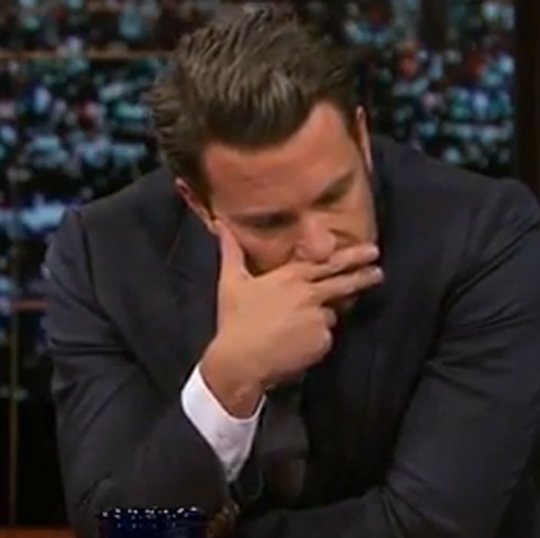
Ben Affleck angry nostril sniffWhen it was announced the Ben Affleck would be the Dark Knight in 2015’s ‘Superman vs. Batman: Dawn of Justice,’ I said that if director Zack Snyder were smart, then he would tell his new hire to stick to movie-talk. I said Mr. Affleck lives in a Hollywood bubble, where everyone thinks along the same lines and tells each other how smart they are at cocktail parties, and that he generally has a hard time discussing politics without alienating fans (e.g., When he sees a Republican actor on screen he thinks, “I probably wouldn’t like this person…”). His near-meltdown on Bill Maher’s Real Time on Oct. 3 proves nicely that Mr. Affleck doesn’t know how to deal with smart people who disagree with him.

Ben Affleck Bill MaherConsider this discussion between next summer’s Bruce Wayne, Bill Maher and author Sam Harris.

Sam Harris: Liberals have really failed on the topic of theocracy. They’ll criticize white theocracy. They’ll criticize Christians. They’ll still get agitated over the abortion clinic bombing that happened in 1984, but when you want to talk about the treatment of women and homosexuals and free thinkers and public intellectuals in the Muslim world, I would argue that liberals have failed us.

Ben Affleck: Thank God you’re here.

Sam Harris: The crucial point of confusion is that we have been sold this meme of Islamophobia, where every criticism of the doctrine of Islam gets conflated with bigotry towards Muslims as people, and that’s intellectually ridiculous.

Ben Affleck: Are you the person who understands the officially codified doctrine of Islam? You’re the interpreter of that?

Same Harris: I’m actually well-educated on this topic.

Ben Affleck: I’m asking you. So you’re saying that Islamophobia is not a real thing?

Sam Harris: I’m not denying that certain people are bigoted against Muslims as people.

Ben Affleck: “That’s big of you.”

Bill Maher: “Why are you so hostile about this concept?”

Ben Affleck: “Because it’s gross! It’s racist! It’s like saying ‘you shifty Jew.’”

Bill Maher: You’re not listening to what we are saying.”

For almost ten minutes, Ben Affleck responded to a serious discussion about Islam by giving angry little sniffs of his nostrils, fidgeting in his chair, making sarcastic little side-comments, interrupting, waving his hands around and slamming them down on the desk in front of him. He generally gave off body language that said, “I’m Batman! I should be beating these ‘racists’ up, but I can’t because I’m in my Bruce Wayne clothes on live television…”

In short, Ben Affleck was a petulant man-boy.

Ben Affleck finger face Bill MaherFaced with actual statistics about female genital mutilation in the Middle East and Africa, the percentages of Muslims who believe a man should be killed for leaving the religion, and troublesome data regarding opinions on free speech — in Western countries — Ben Affleck’s response was to call Bill Maher a “racist,” to say he “doesn’t understand idiots,” and that “we’ve killed more Muslims than they killed us by an awful lot,” (as if George H.W. Bush, Bill Clinton, George W. Bush and Barack Obama all just have a thing for militarily engaging Muslim countries for no other reason than to kill Muslims). Ben Affleck says that the Islamic State group couldn’t fill a “AA ballpark in West Virgina,” while ignoring the fact that it only took 19 al Qaeda terrorists to bring down the World Trade Center Towers on Sept. 11, 2011. Shall I go on?

In less than 10 minutes, the man who will play Batman next summer makes it close to impossible for millions of moviegoers to see Zack Snyder’s film with an open mind. The so-called defender of Gotham is, in real life, a man who can’t even defend his own political position without looking like he might cry on national television. He had no problem mocking Catholicism in Dogma, but yet he and his buddy Kevin Smith would probably consider it “racist” to appear in a similar film titled “Fatwa.” Telling.

Next summer I will see Superman vs. Batman, but I won’t be able to stop thinking, “Clark can end this right now. All he has to do is start talking about Islam.”

Related: Egyptian Muslims in Pew poll: We support religious freedom, but we also support killing you

Editor’s note: Hat tip KMT

Eastwood’s ‘American Sniper’ trailer is out, and it looks like a movie Chris Kyle fans will appreciate

Bradley Cooper American SniperWhen it was first announced that Navy SEAL Chris Kyle’s life would be made into a movie by Steven Spielberg, my first thought was, “Ummm, how is that going to work? Did Spielberg even read the book? Knowing his politics, I’m pretty sure that it’s going to be a horrible movie.”

Interestingly enough, Mr. Spielberg dropped the project and Clint Eastwood was there to pick it up. “That makes much more sense,” I thought. Now that the trailer is out, it appears as though the world will get the Chris Kyle story it deserves.

“They fry you if you’re wrong.”

How do you win a war when the men responsible for securing victory are paranoid that any mistake they make will land them in prison for the rest of their lives? The answer: You probably don’t win. You lose. Or you wind up pulling out of that country for political reasons and then having to go back in when things spiral out of control…

Chris Kyle wrote in American Sniper:

 “You cannot be afraid to take your shot. When you see someone with an IED or a rifle maneuvering toward your men, you have clear reason to fire. (The fact that an Iraqi had a gun would not necessarily mean he could be shot.) The ROEs were specific, and in most cases the danger was obvious.

But there were times when it wasn’t exactly clear, when a person almost surely was an insurgent, probably was doing evil, but there was still some doubt because of the circumstances or the surroundings —the way he moved, for example, wasn’t toward an area where troops were. A lot of times a guy seemed to be acting macho for friends, completely unaware that I was watching him, or that there were American troops nearby.

Those shots I didn’t take.

You couldn’t — you had to worry about your own ass. Make an unjustified shot and you could be charged with murder.

I often would sit there and think, “I know this motherfucker is bad; I saw him doing such and such down the street the other day, but here he’s not doing anything, and if I shoot him, I won’t be able to justify it for the lawyers. I’ll fry.” Like I said, there is paperwork for everything. Every confirmed kill had documentation, supporting evidence, and a witness.

So I wouldn’t shoot.” — Chris Kyle, American Sniper. (Harper Collins, 2012), 149-150.

If you’re not familiar with Chris Kyle’s life, then check out American Sniper — the book. And then make sure to see Clint Eastwood’s cinematic take on the Navy SEAL’s life. I’d recommend seeing Angelina Jolie’s take on ‘Unbroken,’ but she apparently gutted one of the most crucial aspect’s of World War II hero Louie Zamperini’s life — his conversion to Christianity that kept his world from falling to pieces and allowed him to personally forgive the men who tortured him in Japanese POW camps. If you’re wondering why I feared Spielberg’s take on Chris Kyle’s life, just think about Ms. Jolie’s “Unbroken” for a few moments, but I digress.

I’m looking forward to seeing “American Sniper” when it opens in theaters December 25. If you are as well, then stop by here shortly after its release, check out my review, and let me know what you thought.

Related: American Sniper: Chris Kyle, Guardian Angel who doesn’t know it

Related: American Sniper: More Dead Terrorists Than Sales By Occupiers?

Related: In remembrance: Navy SEAL Chris Kyle

Neil deGrasse Tyson gets caught lying by The Federalist; disciples at Wikipedia go full-Orwell

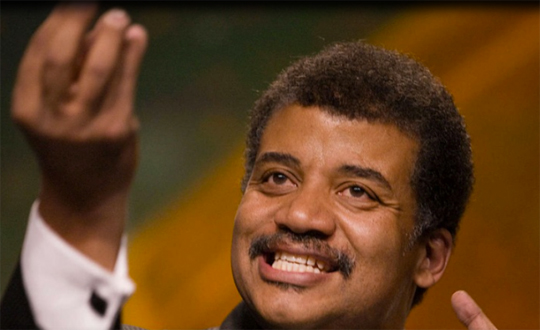
Neil Degrasse Tyson FederalistIf you have not checked out The Federalist, then you should do so. It produces some great content. In fact, a clear sign that The Federalist is a force to be reckoned with is the fact that Wikipedia has been throwing Orwellian temper tantrums over the website’s recent reporting. The reason: Congregants in the Church of Neil deGrasse Tyson are unhappy to find out that their god has a habit of pulling facts out of deGrassian black holes that no one else can verify.

Just one example (there are quite a few) includes the scientist’s repeated claim that George W. Bush said “Our God is the God who named the stars” after the September 11, 2001 terrorist attacks to find a way of intellectually divorcing Christianity from Islam.

Mr. Tyson has said the following in multiple speeches:

TYSON: Here’s what happens. George Bush, within a week of [the 9/11 terrorist attacks] gave us a speech attempting to distinguish we from they. And who are they? These were sort of the Muslim fundamentalists. And he wants to distinguish we from they. And how does he do it?

He says, “Our God” — of course it’s actually the same God, but that’s a detail, let’s hold that minor fact aside for the moment. Allah of the Muslims is the same God as the God of the Old Testament. So, but let’s hold that aside. He says, “Our God is the God” — he’s loosely quoting Genesis, biblical Genesis — “Our God is the God who named the stars.”

Unfortunately, that turns out not to be true. At all. The Federalist did some digging, and it did find that former President Bush said the following after the Columbia space shuttle disaster in 2003:

George W. Bush: In the skies today we saw destruction and tragedy. Yet farther than we can see, there is comfort and hope. In the words of the prophet Isaiah, “Lift your eyes and look to the heavens. Who created all these? He who brings out the starry hosts one by one and calls them each by name. Because of His great power, and mighty strength, not one of them is missing.”

The same Creator who names the stars also knows the names of the seven souls we mourn today. The crew of the shuttle Columbia did not return safely to Earth; yet we can pray that all are safely home.

One would think that if Mr. Tyson was going to charge people to see his presentations, then he would get his facts straight — or not, if the point was smear others while making himself look like a witty guy. The Federalist then smacks Tyson down for his blatant fabrication.

Tyson butchered the quote. He butchered the date. He butchered the context. He butchered the implication. And he butchered the biblical allusion, which was to the prophet Isaiah, not the book of Genesis (you can tell Bush was alluding to Isaiah because he explicitly said he was referencing Isaiah).

Bush’s statement about the Creator had nothing to do with making “us” look better than “them”: it was an attempt to comfort the families who lost loved ones in the crash. They weren’t nameless creatures who passed anonymously; their ultimate Creator, the one who knit them together in their mothers’ wombs, mourned them by name.

In response to Sean Davis’ reporting, Mr. Tyson’s Wikipedia page has repeatedly been scrubbed of his lies and outright distortions — again, there are enough to be rather troubling for a man whose profession relies on accuracy — and now there are even attempts to throw The Federalist’s Wikipedia page down the Memory Hole.

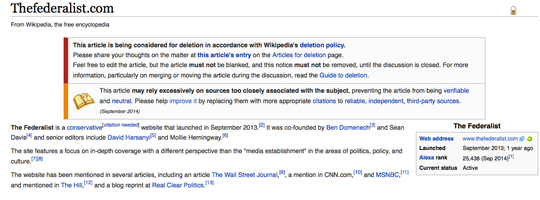
The Federalist Wiki OrwellThe Washington Examiner reported Sept. 26:

Three weeks after the oft-cited TheFederalist.com accused a popular scientist of making up quotes and numbers in a speech, Wikipedia has moved to eliminate the conservative news site.

In a surprise move, the hugely-trafficked Wikipedia posted a notice that the Federalist was “being considered for deletion” after an unknown critic said it “does not pass the threshold for notability.” Wikipedia asked users to comment on the decision, though it in the end it will not be made on a “majority vote.”

The claim shocked the new site’s staff, especially since the Federalist has been featured in mainstream media such as MSNBC and CNN.

As I have said before, when people deny God they always find a way to replace Him with someone or something else. That idol then must be protected at all costs, which is one of the reasons why Communism’s body count is roughly 100 million…but I digress.

The ease with which those who edit Wikipedia pages entertain their inner police state censorship czar is incredibly frightening, and should be exposed. However, it is also important to note that Mr. Tyson has gone out of his way to avoid telling the truth.

Here is what he said on Facebook regarding his imaginary Bush quote:

I have explicit memory of those words being spoken by the President. I reacted on the spot, making note for possible later reference in my public discourse. Odd that nobody seems to be able to find the quote anywhere — surely every word publicly uttered by a President gets logged. …

FYI: There are two kinds of failures of memory. One is remembering that which has never happened and the other is forgetting that which did. In my case, from life experience, I’m vastly more likely to forget an incident than to remember an incident that never happened. So I assure you, the quote is there somewhere. When you find it, tell me. Then I can offer it to others who have taken as much time as you to explore these things.

Translation: How dare you question the all-powerful Neil deGrasse Tyson! Be gone with you, mere mortal! Be gone!

How bizarre is it that a scientist would sneer at a reporter over the time he or she spends verifying…facts.

Mr. Tyson’s behavior is so weird that even Andrew Kaczynski at Buzzfeed was forced to call him out, saying “Just admit you either misremembered or made up a Bush quote @neiltyson. This denial [flies] in face of scientific method.”

Andrew Kaczynski DeGrasseThe next time you hear a Neil deGrasse Tyson tale that sounds too good to be true, just remember: it probably is. Why? Because it’s apparently okay to lie as long as more people subscribe to his worldview in the end. As the scientist said after getting caught red handed: “If this article contains the entire critique of my presentation to Tableau Software — the contents of 2 out of 60 slides — then I consider the talk to be a success, even to eavesdroppers.”

Why does it matter if a scientist makes up quotes about someone if the end result is more people who believe in Global Warming, right Mr. Tyson? Actually, it matters a lot. Intellectually honest people understand that. Most disciples in the Church of Neil DeGrasse Tyson apparently do not.

Bret Easton Ellis delivers near-flawless analysis of ‘Generation Wuss’ in Vanity Fair piece

A few years ago I helped oversee a rather large intern program for a think tank in Washington, D.C. In addition to the Millennials I was fortunate enough to meet, I also had the luxury of flying all over the country to talk to them on college campuses. Before that, I worked as a substitute teacher in a high school for two years while saving money for graduate school. While many of the kids I met were incredibly nice, it was obvious that the generation they belonged to was setting itself up for failure. Writer Bret Easton Ellis’ new piece for Vanity Fair, “Generation Wuss,” sums up Millenials perfectly.

The entire piece is worth reading, but here is an excerpt:

My huge generalities touch on their over-sensitivity, their insistence that they are right despite the overwhelming proof that suggests they are not, their lack of placing things within context, the overreacting, the passive-aggressive positivity, and, of course, all of this exacerbated by the meds they’ve been fed since childhood by over-protective “helicopter” parents mapping their every move. These are late-end Baby Boomers and Generation X parents who were now rebelling against their own rebelliousness because of the love they felt that they never got from their selfish narcissistic Boomer parents and who end up smothering their kids, inducing a kind of inadequate preparation in how to deal with the hardships of life and the real way the world works: people won’t like you, that person may not love you back, kids are really cruel, work sucks, it’s hard to be good at something, life is made up of failure and disappointment, you’re not talented, people suffer, people grow old, people die. …

When Millennials are criticized […] they seem to collapse into a shame spiral and the person criticizing them is automatically labeled a hater, a contrarian, a troll. And then you have to look at the generation that raised them, that coddled them in praise—gold medals for everyone, four stars for just showing up—and tried to shield them from the dark side of life, and in turn created a generation that appears to be super confident and positive about things but when the least bit of darkness enters into their realm they become paralyzed and unable to process it. …

I’m sympathetic to Generation Wuss and their neurosis, their narcissism and their foolishness—add the fact that they were raised in the aftermath of 9/11, two wars, a brutal recession and it’s not hard to be sympathetic. […] In-fact in order to be an artist, to raise yourself above the din in an over-reactionary fear-based culture that considers criticism elitist, you need to be [caustic and sympathetic]. But this is a hard thing to do because Millennials can’t deal with that kind of cold-eye reality. This is why Generation Wuss only asks right now : please, please, please, only give positive feedback please.

I often wondered if I was going too hard on the Millennials I dealt with while living in the nation’s capital. My military background caused me question whether or not I had unrealistic expectations of how they should react to criticism. Now, I realize that any occasional friction between us had more to do with their own cloistered upbringing than a lack of empathy on my part.

Given what we know about Generation Wuss, it isn’t a shocker that they flocked to the “we are the ones we’ve been waiting for” messaging of then-Senator Obama in 2008, and it is no surprise that they again returned to vote for him in droves in 2012 — despite “overwhelming proof” that they had made a grievous mistake.

What will be interesting to see is whether NSA spying scandals, the rise of Islamic State, the collapse of Libya into a terrorist jungle gym, the annexation of Crimea, and whatever other calamities that befall the U.S. over the next two years will change the collective Millennial mindset. Is facing reality an option, or will they fail realize that it is a bad idea to adopt public policy created by men who presume they are infallible geniuses? There is a good chance Millennials will retreat into Reddit and Buzzfeed and Facebook streams with friends who are always ready to spoon them fuel for the ego, but perhaps not.

If Millennials are half as smart as they seem to think they are, then they will listen to what Mr. Ellis is accurately saying about their shortcomings. If they do not heed his advice, then they can expect many painful years ahead.

When the NFL became a religion, America created sportscaster priests like Cris Carter, Bob Costas

Cris Carter cryingThe National Football league brings in roughly $10 billion in revenue per year. By 2027, it expects to up that to $25 billion. As USA today reported in February, that would put the NFL on track to haul in more money per year than the domestic gross product of “dozens of small countries.” At some point in time professional football became a weird religion for millions of Americans, and now the rest of us are forced to endure lectures by the High Priests of Sportscasting whenever the athlete-gods expose themselves as mere mortals.

If Americans didn’t idolize the men they watch each Sunday, then the world would not be forced to endure former Vikings receiver Cris Carter throwing his own mother under the bus on national television. In response to Adrian Peterson’s indictment on child abuse charges, Mr. Carter melted down on ESPN.

ABC News reported September 14 (while taking out the exclamation marks):

“My mom did the best job she could do raising seven kids by herself, but there are thousands of things that I have learned since then that my mom was wrong,” he said. “It’s the 21st century — my mom was wrong. She did the best she could but she was wrong about some of that stuff she taught me and I promised my kids I won’t teach that mess to them.”

A healthy culture enjoys the on-field exploits of their favorite player and gleans important lessons from what they bring to the game. A healthy culture admires the drive and dedication it takes to become one of only a handful of individuals in the world who can perform a particular sport at an elite level. An unhealthy culture creates shrines to its teams, hangs on star players’ every word via countless social media accounts, and dedicates more time to fantasy football each fall than actually playing catch with children.

Having to watch Cris Carter cry on national television while Mike Ditka uncomfortably fidgets in his chair is a sign that American culture has derailed. When Keyshawn Johnson looks like Mike Meyers after Kanye West said “George Bush doesn’t care about black people” during a live broadcast, then it is time for football fans to reevaluate the the importance leather balls and the men who carry them hold in their lives.

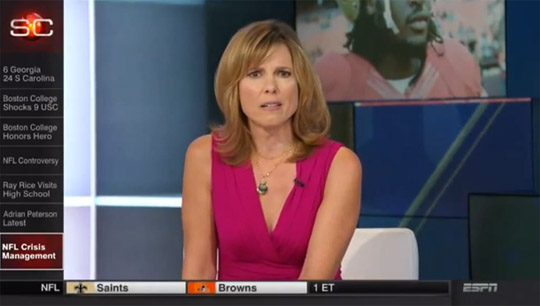
Hannah Storm emotionalESPN anchor Hannah Storm also gave a Cris Carter-esque sermon to viewers September 14, taking the NFL to task for the way it reacted to Ray Rice cold-cocking his wife in a hotel lobby. It was nice, and perhaps even appropriate, but a society with a working moral compass does not need to witness emotional testimonials from shaken sportscasters.

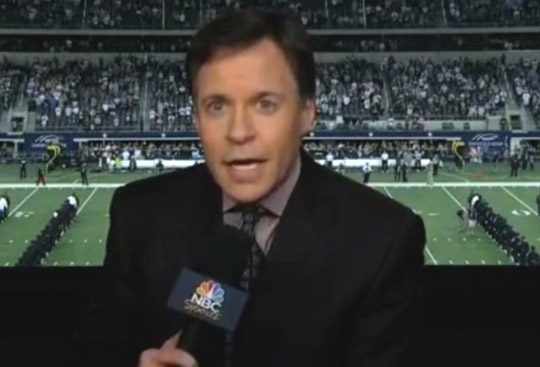
If things were as they should be, then individuals would realize that the NFL has a lower rate of domestic violence than the general population, silently reaffirm that they will always be their own harshest critic, and then vow not to put up with halftime lectures by guys like Bob Costas on the so-called need for strict gun-control legislation.

Bob Costas GunsWhen I tune in to watch sports, I do not want to hear wide receivers lump in people who occasionally spank their kids with those who leave children black and blue and bloody with a switch. When I want to see how my local team did over the weekend, I do not want to hear announcers go into extended diatribes — no matter how heartfelt they may be — about domestic violence. When I’m watching Monday Night Football, I do not want to listen to a sports pundit imply that millions of Americans are rotten people because they advocate on behalf of rights codified into law by the U.S. Constitution.

If the American people want to do the NFL a long-term favor, then they should turn off the television more often on a Sunday, buy less merchandise, and take their favorite players off the moral pedestals.

Dan Slott’s emasculated Spider-Man: Peter Parker is an embarrassment in his own book

Silk saves Spider ManMarvel Comics allowed writer Dan Slott to essentially kill off Peter Parker for over a year. While everyone’s favorite wall crawler was in limbo, a megalomaniac prone to “Nazi-like torture” experiments on his victims was in control of Peter’s body. Fans knew that one day the real hero would return, and some of them actually thought that his time away would give Dan Slott an opportunity to conceive of fresh new ideas for the title. They were wrong.

Six issues into The Amazing Spider-Man, it may as well be called The Emasculated Spider-Man or The Superficial Spider-Man. It is painful to see Spider-Man become a supporting  character in his own book, and that pain is exacerbated by Peter’s lack of character development.

Silk slaps Spider ManTake the new character Silk, for example. She shows up and it is immediately established that she is faster than Peter, she has webbing skills he doesn’t possess, her spider-sense is more acute and her command and control in the heat of battle matches or surpasses his — despite being locked up in a cell for 13 years. (Credibility points if you’re also annoyed at a character without a resume who lands an internship at a major cable news network.)

Is Silk a supporting character, or is Dan Slott using The Amazing Spider-Man as a vehicle to propel his creations onto bigger and better things? Why should fans who plunk down $4.00 to enjoy The Amazing Spider-Man be made to feel as if they’re reading The Sensational Silk? They shouldn’t.

Black Cat Spider ManPerhaps the most bizarre aspect of Dan Slott’s work is his penchant for making characters behave in incongruous ways with their established personality when the means serve his ends. While I am no Black Cat historian, I can’t help but think that her transformation into a bloodless killer has been handled with the finesse one would see if the Rhino waltzed down a supermodel runway. It’s jarring, it makes readers scratch their head when they’re supposed to be immersed in the book, and it reeks of a writer who is either a.) sloppy, b.) taking creative shortcuts because he thinks he can get away with it, c.) indifferent to what fans of that mistreated character think, or d.) all of the above.

Silk saves Spider Man ElectroReaders might be able to deal with Spider-Man repeatedly getting saved by a brand new hero in his own book if, as Peter Parker, there were sufficient character development. One would think that the six months after Peter Parker essentially returned from the dead would warrant considerable time for soul-searching introspection between action sequences. Instead, Peter Parker goes about his life as if nothing of much significance has happened; he has an “I sorta-kinda died — moving on,” mentality. Meanwhile, Silk comes to his aid, Black Cat embarrasses him, and Anna Maria Marconi runs his company. The Emasculated Spider-Man bumbles around on the battlefield and in his personal life, and at the end of the day fans are left hoping the upcoming Spider-Verse — where the original Spider-Man will likely take a bigger back seat in his own book — offers something more.

If you thought The Amazing Spider-Man would improve with its relaunch, then you were wrong. At this rate, the next time six months of strong Spider-Man stories take place will be when Dan Slott finally passes the torch to a new creative team.

Update: Alpha Game was kind enough to read and share my post. Head on over there if you get a chance and return the kindness.

"Goo-goo. Gaa-gaa. I'm Dan Slott's Peter Parker and I need the women in my life to save me and heal my wounds ... and run my company while I'm making a fool out of myself in battle."
“Goo-goo. Gaa-gaa. I’m Dan Slott’s Peter Parker and I need the women in my life to save me and heal my wounds after I make a fool of myself in battle. And then I need them to run my company because I’m an incompetent hero in my own book.”

Cenk Uygur names son ‘Prometheus’ in misbegotten attempt to smite God, fails miserably

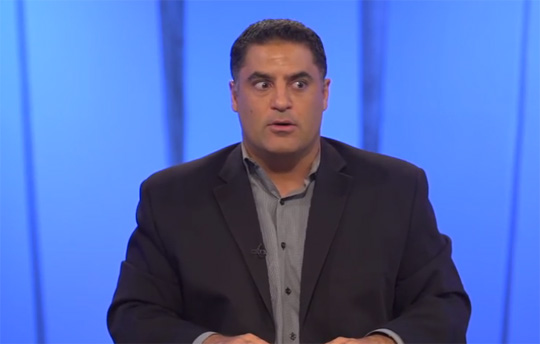
Cenk Uygur Young TurksUnder normal circumstances I would never write about Cenk Uygur of “The Young Turks.” However, it turns out that he named his son “Prometheus Maximus” as a metaphorical middle finger to the God he … doesn’t believe in. While years from now people will make the mistake of thinking his son was named after the Simpsons episode where Homer goes by Max Power, I still wanted to hear Mr. Uygur’s reasoning.

The Young Turks’ YouTube channel provides his answer:

Host: For the first question … How did you come up with the awesome name for your son? I wouldn’t have thought of that in a million years. Go!

Cenk Uygur: All right. My son’s name is Prometheus Maximus. Prometheus is my favorite mythical character of all time ’cause he had the nerve, the courage to challenge the gods to say ‘I’m going to help humanity.’ It’s the kind of thing the rest of mythology is set up to hate. … No, bow your head. Bow your head to God … In all religions, Christianity, it said bow your head to God, listen to whatever he says, do not challenge him, even if, for example, he slaughters everyone on earth as he did, you know, doing that that little fun thing called the flood with Noah’s Ark. Literally almost everyone but Noah’s family was killed. Support. Bow your head and support. No. Prometheus said I’m not going to bow my head. I’m going to take fire and give it to humans. Lovely.

Before we begin exposing Mr. Uygur’s confusion, we must first point out how sad it is that he has to crib Bill Maher’s old jokes, in which the Real Time host called the God … he doesn’t believe in … a “psychotic mass murderer” for bringing forth the flood. If this is some sort of new talking point among liberal atheist pundits, then we might as well address it now.

As Whittaker Chambers eloquently put it long ago, “Between man’s purposes in time and God’s purpose in eternity, there is an infinite qualitative difference.” That Mr. Uygur thinks his tiny insignificant mind could wrap itself around the purpose in eternity that God’s actions serve is quite hilarious. Consider this: A man who struggles to understand basic economics actually believes he could comprehend the actions of a being with the power to bring space and time into existence.

God’s role as the Creator also poses another conundrum: Whose life is it? Is it yours, or is it God’s? The Christian would say that his existence belongs to the one who breaths life into him every second of every day — God. Since life is only sustained by God, getting upset at Him for ending it makes no sense. Raising a fist in anger and shaking it at God for those who died in the flood assumes that the lives lost actually belonged to the departed. They did not. Mr. Uygur doesn’t understand that the body he has is essentially a rental home that houses his spirit for a short time before it returns to its Father.

And finally, while the young Turk may pride himself on his literary knowledge, it is quite apparent that he hasn’t read up on Dante.

In Canto XX of “The Inferno,” Dante weeps for those in hell and is instantly rebuked by his guide Virgil:

Truly I wept, leaning upon a peak
Of the hard crag, so that my Escort said
To me: “Art thou, too, of the other fools?
Here pity lives when it is wholly dead;
Who is a greater reprobate than he
Who feels compassion at the doom divine?”

God is certainly capable of separating the wheat from the chaff, and yet Mr. Uygur laments the “slaughter” of those in the flood. Those who wind up in hell do so because that is the choice they made with the free will they were given. Trying to elicit sympathy for those who made the conscious decision to reject God does not work with those who know Him.

Jesus says in John 10: 14-16:

I am the good shepherd; and I know My sheep, and am known by My own. As the Father knows Me, even so I know the Father; and I lay down My life for the sheep. And other sheep I have which are not of this fold; them also I must bring, and they will hear My voice; and there will be one flock and one shepherd.

He also says in John 13: 12-17 after washing Peter’s feet:

Do you know what I have done to you? You call Me Teacher and Lord, and you say well, for so I am. If I then, your Lord and Teacher, have washed your feet, you also ought to wash one another’s feet. For I have given you an example, that you should do as I have done to you. Most assuredly, I say to you, a servant is not greater than his master; nor is he who is sent greater than he who sent him. If you know these things, blessed are you if you do them.

That is a God who is worthy of endless bows. That is a God to listen to and obey. If the world wants to mock His followers as “sheep,” then it is a pejorative worth embracing because He truly is a “good shepherd.”

The funny thing is that despite Mr. Uygur’s efforts to deny his spirit, he can not rid himself of the tinctures of truth that flow through his mind:

Host: Do you believe in ghosts/paranormal activity?

Cenk Uygur: No, because I’m a rational human being. But not quite as rational as I make out. I will confess to two things: One is I know it’s not right, but from time to time I think I’ll look at signs or something and think, “Oh, is that a message?” And I’m like, ‘ Knuckle head, of course it’s not a message!’ … The second thing is one I’m perfectly proud of: I keep an open mind, meaning I haven’t foreclosed on the idea that there might be things that happen on this planet and in this universe that we haven’t yet figured out.

It is incredibly difficult to ignore the stinging slap of synchronicity, and yet the man deludes himself into thinking otherwise with each message that comes his way. He says he has an open mind while slamming it shut. He believes that with enough time humans can “figure out” the totality of the universe, when the person who truly possesses an open mind understands that perhaps reality exists in ways our five senses are incapable of detecting.

In a world of sentient AM radios, many of them would call frequency modulation a myth. Some of them would even name their AM radio kids “Prometheus.” Luckily, there is always hope that those who deny the truth today will accept it before it’s too late.

Here is what one looks like on the back end of WordPress. I erased part of his IP address because I’m a nice guy. I also erased part of the link he wanted to share. Sad. I was hoping Mr. Uygur’s Reddit fanboys would bring more to the table than “myballsinyourmouth.” I guess not.
Here is what a troll looks like on the back end of WordPress. I erased part of his IP address because I’m a nice guy. I also erased part of the link he wanted to share. Sad. I was hoping Mr. Uygur’s Reddit fanboys would bring more to the table than “myballsinyourmouth.” I guess not.

Dan Slott calls Spider-Woman #1 variant a ‘false’ controversy; feminists retreat from ‘mansplaining’ liberal

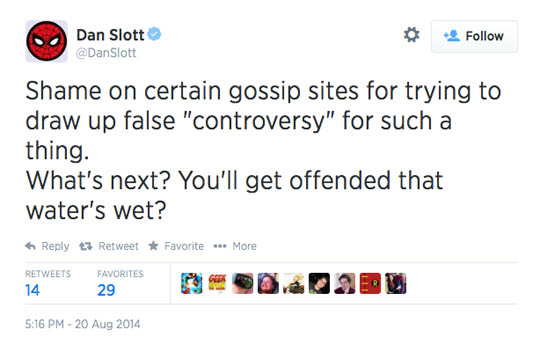
The Mary SueMarvel Comics is great at patting itself on the back for temporary stories that put women in the spotlight, but when it comes to variant covers that turn women into sex objects its male readers want to pat on the butt, then the company suddenly has no comment. Luckily, Dan “Go to Christ-land” Slott was willing to weigh in on The Mary Sue’s anger over the Spider-Woman #1 variant by Milo Manara. His verdict: it’s a “false ‘controversy'”.

Dan Slott shame

The Mary Sue disagreed. The self-proclaimed watchdog for female representation in “geek culture” reported:

I mean, there’s art you personally might consider too sexualized in general, but there’s that other level of comic book hell reserved for The Hawkeye Initiative-type stuff or otherwise absurd art.

Yesterday, Comic Book Resources posted exclusive November solicits from Marvel Comics, which included the anticipated Spider-Woman #1. The piece included this variant cover by Milo Manara.

I honestly don’t know what anyone involved was thinking. The series is being written by Dennis Hopeless with art by Greg Land, and although it appears Marvel is attempting to draw in women with a slew of new female-led titles, this does not instill confidence. Nor does it tell women this is a comic they should consider spending money on. In fact, what the variant cover actually says is “Run away. Run far, far away and don’t ever come back.”

That may sound like an exaggeration but it’s really not. This is what we talk about when we ask comic publishers not to actively offend their paying (or potentially paying) customers. …

Marvel has declined comment at this time.

As a conservative comic book fan, I know a thing or two about Marvel going out of its way to offend “paying (or potentially paying)” customers. Welcome to the club, Jill! But I digress. Ms. Pantozzi didn’t take too kindly to The Amazing Spider-Man writer’s assertion that her work was part of a  media-orchestrated “false” controversy:

Dan Slott variant debateDan Slott’s favorite go-to weapon, the red herring, was on full display when he tried to frame outrage at Marvel’s decision as some sort of misdirected beef with Mr. Manara’s artistic style. Luckily, Ms. Pantozzi was having none of it. It was never about Mr. Manara’s “style” — it was the fact that an artist who specializes in erotic (some might say “sleazy”) artwork was used for a book geared towards female readers.

Dan Slott v Jill PantozziBacked even deeper into a corner, Mr. Slott doubled down on the “fake” controversy line of defense. The move was reminiscent of the time he and Marvel used anger to sell the Superior Spider-Man #9, and then tried to pretend like they were doing no such thing.

Jill Pantozzi Dan Slott

But here is where it gets interesting, dear readers — the woman who works for a website that considers itself a watchdog for women’s representation then went soft on an ideological ally. Someone like me would be accused of “mansplaining” to Ms. Pantozzi if I delivered exactly the same message as Dan Slott, but she simply “walks away” from Slottian mansplaining. She respects Dan Slott (the guy whose great new female character burst onto the scene by getting super-sexy, super-fast with Peter Parker), too much to take the conversation to its logical conclusion: Dan Slott’s tolerance for other points of view only lasts until you put up a strenuous defense against his straw man arguments, red herrings and personal attacks.

Jill Pantozzi“Nothing is being gained.” That seems to be a pattern with the Marvel scribe. Conservative? Liberal? Apolitical? It doesn’t matter. If you disagree with Dan Slott, your point of view isn’t valid or it’s just a “false” controversy stirred up by the media.

As fate would have it, Twitter user Ryan D entered the fray and rightly called Ms. Pantozzi out just as she did the same to Marvel and Dan Slott earlier in the day.

Ryan D Dan SlottDan Slott would be “crucified” if he didn’t say the right thing in his Twitter feed, and he knows it. That’s why he decided to return to “less controversial stuff” (i.e., topics where he could easily put himself up on a moral pedestal and bask in the accolades).

Dan Slott FergusonI look forward to the moment that Dan Slott goes back to attacking those who disagree with him politically. When that happens, then all of his Twitter followers can forget about the time he “mansplained” to a feminist about her “false” controversy — and she let him get away with it.

Editor’s note: Hat tip to reader Truthwillwin1 for the story.

‘The Complete C.S. Lewis Signature Classics’: Pay a small price for the work of an intellectual giant

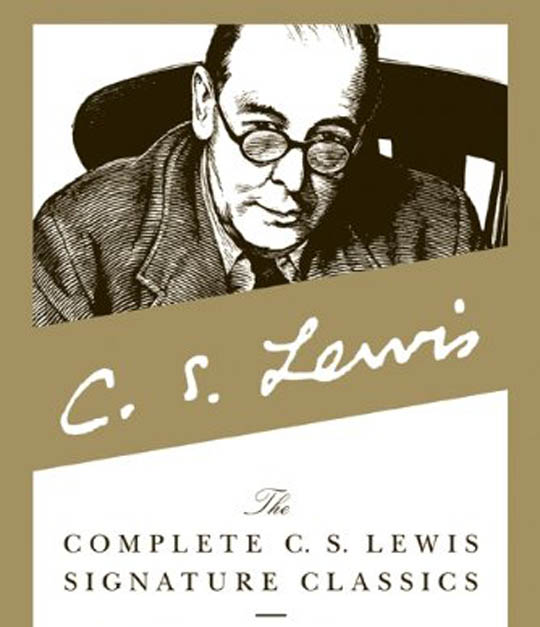
CS LewisFor years I only knew C.S. Lewis as the guy who was good for some really witty quotes and the author of “The Chronicles of Narnia.” I knew he was a Christian, and I knew he was friends with J.R.R. Tolkien. When I started writing a book roughly a year ago I told myself that I should really read his work to augment my knowledge of the Christian faith, yet I still procrastinated. Finally, after his name came up in the comments section of this blog, I vowed to get up to speed on C.S. Lewis — and I’m glad I did. “The Complete C.S. Lewis Signature Classics” may be $34.99, but it’s worth every penny.

Here is what readers get for their money: Mere Christianity, The Screwtape Letters, The Great Divorce, The Problem of Pain, Miracles, A Grief Observed and The Abolition of Man. Another way of putting it: 730 pages of philosophical and creative works written by an intellectual giant. Even those who disagree with the man, if they are honest, will concede that he was powerhouse.

C.S. Lewis writes in “Miracles”:

“Let us suppose a race of people whose peculiar mental limitation compels them to regard a painting as something made up of little colored dots which have been put together like a mosaic. Studying the brushwork of a great painting, through their magnifying glasses, they discover more and more complicated relations between the dots, and sort these relations out, with great toil, into certain regularities. Their labor will not be in vain. These regularities will in fact ‘work’; they will cover most of the facts.

But if they go on to conclude that any departure from them would be unworthy of the painter, and an arbitrary breaking of his own rules, they will be far astray. For the regularities they have observed never were the rule the painter was following. What they painfully reconstruct from a million dots, arranged in an agonizing complexity, he really produced with a single lightening-quick turn of the wrist, his eye meanwhile taking in the canvas as a whole and his mind obeying laws of composition which the observers, counting their dots, have not yet come within sight of, and perhaps never will,” (Miracles, 387).

The beauty of Lewis’ work is that it’s smart, but it’s personable. A man without a high school education and a Rhodes Scholar can both appreciate the product. Lewis’ insights are sharp, but he never talks down to his audience. Just as the U.S. Declaration of Independence artfully articulates the rights given to all men by their Creator — in ways anyone can understand — Lewis makes the case for God in ways that individuals of varying degrees of mental acuity can comprehend.

“What can you ever really know of other people’s souls — of their of their temptations, their opportunities, their struggles? One soul in the whole creation you do know: and it is the only one whose fate is placed in your hands. If there is a God, you are, in a sense, alone with Him. You can not put Him off with speculations about your next door neighbors or memories of what you have read in books. What will all the chatter and hearsay count (will you even be able to remember it?) when the anesthetic fog which we call ‘nature’ or ‘the real world’ fades away and the Presence in which you have always stood becomes palpable, immediate, unavoidable?” (Mere Christianity, 170).

One of the most interesting aspects of Lewis’ life is the fact that for many years he was an atheist. In many ways, his early atheism actually benefited Christianity because it is obvious that he thought long and hard about the existence of God. Those doubts are revisited in his journal entries pertaining to the death of his wife; the result is thought-provoking and hauntingly beautiful. Lewis says of dealing with his wife’s passing due to cancer: “You never know how much you really believe anything until its truth or falsehood becomes a matter of life and death to you.” He is correct. His faith comes out in tact, but the journal entries from “A Grief Observed” leaves readers shaken because the truth can be jarring.

I highly recommend “The Complete C.S. Lewis Signature Classics” for agnostics, atheists, Christians and non-Christians everywhere.