Bendis nicely sets up ‘Champions’ in Spider-Man #8, but classic heroes turned into giant goofs

miles-morales-spiderman-8

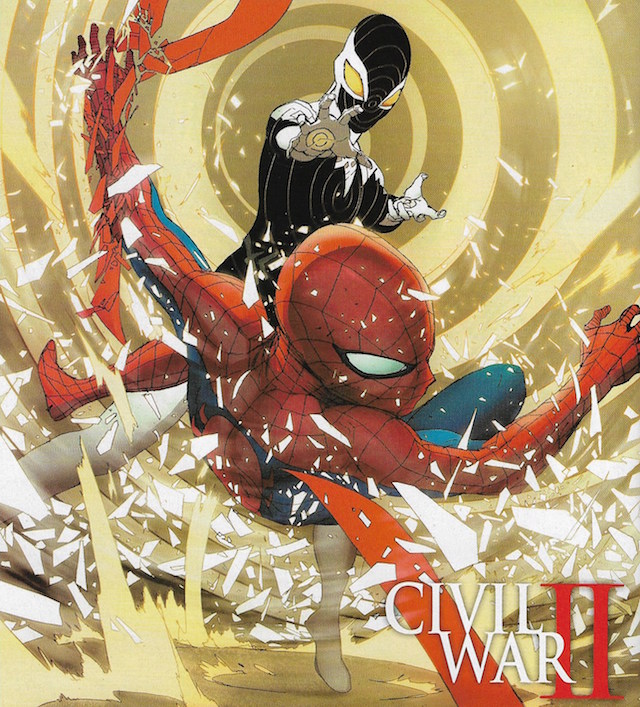
Brian Michael Bendis is one of Marvel’s key writers, but in a previous life he may have been a circus juggler. Spider-Man #8 somehow manages to move the title’s plot forward, set the stage for Champions, and seamlessly tie into Civil War II. Technically, Mr. Bendis hits all of his marks. Creatively, however, SM #8 once again shows why many older Marvel fans are fed up with the company.

Here is what you need to know for SM #8:

  • Jessica Jones and Luke Cage confront Miles Morales on a rooftop and say they know his secret identity.
  • Miles is upset to find out that his grandmother hired Jessica Jones to spy on him, but he is glad to hear that his mother tried to pay the investigator to cancel the contract. He agrees not to say anything to his family after the older heroes tell him to get his act together.
  • Miles is summoned to the Triskelion, S.H.I.E.L.D. headquarters, by Tony Stark. A large group of superheroes are informed by Stark and Captain Marvel that everyone will confront the Hulk about Ulysses’ vision of him killing everyone.
  • Bruce Banner is killed by Hawkeye, as previously shown in Civil War II #3.
  • Nova, Spider-Man, and Ms. Marvel are stunned by what happens and the two young men publicly state their allegiance to Tony Stark. Ms. Marvel breaks down into tears because her role model set the stage for Banners’s death.

This sounds like a great issue, right? Well, sort of. One’s enjoyment or hatred of SM #8 really hinges on his or her opinions on Civil War II. Bendis — and artist Nico Leon — do an admirable job showing young heroes who struggle to find their place in an “adult” world, but at the same time it all comes at the expense of classic characters.

nova-morales-spiderman-msmarvel

There is a scene after Banner’s death where the three kids come together to comfort one another that is incredibly poignant, but the feeling disappears the moment one realizes that Captain Marvel and every superhero who sides with her has taken on a goofy position to make Civil War II work.

sm-nova-msm-team

In short, Mr. Bendis has nicely set up an “us against the world” dynamic for the future “Champions” that will also serve Spider-Man well, but in many ways he is doing so at the expense of icons like the original Spider-Man, Peter Parker.

If you are an older reader, the best way to show your displeasure is to withhold your wallet for any title that engages in character assassination of the heroes that made Marvel what it is today.

spiderman-carol-danvers-cwii-asm4

‘Civil War II: Amazing Spider-Man #4’: Dan Slott’s ASM #17 haunts Christos Gage’s latest effort

cwii-asm4-spiderman-clash

It’s hard not to feel sorry for Christos Gage. The guy was asked to write a Spider-Man story that stood on its own while also supporting Brian Michael Bendis’ Civil War II and Dan Slott’s run on The Amazing Spider-Man.

Question: How does the hero who a.) asked The Prowler to resort to corporate espionage on behalf of Parker Industries, and b.) teams up with Carol “Minority Report” Danvers have the moral authority to lecture a confused man like Clayton Cole?

Answer: He doesn’t.

Civil War II: Amazing Spider-Man #4 is a book that actually reads better the less one knows about the current Marvel universe. For people who just want to roll around a few philosophical questions about redemption and free will like marbles, Mr. Gage’s work satisfies. For people who love the character Peter Parker, however, the issue is just one more reminder of just how intellectually discombobulated he has become thanks (in large part) to writer Dan Slott.
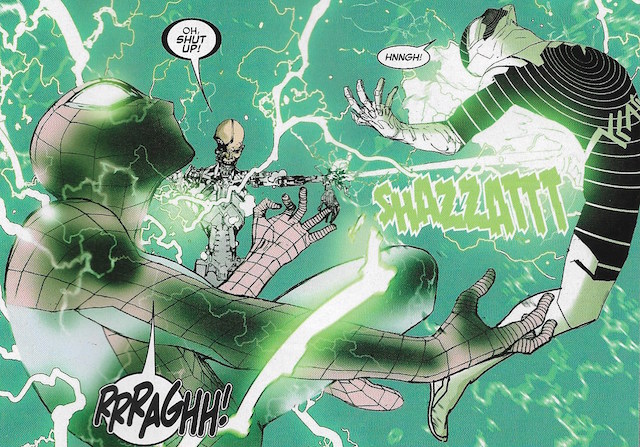
stromm

Here is what you need to know for CWII: ASM #4:

  • Spider-Man tries to talk Clayton Cole off a psychological ledge during the one-on-one battle predicted by Ulysses. Peter wants the scientist to give up his “Clash” technology and start a new life.
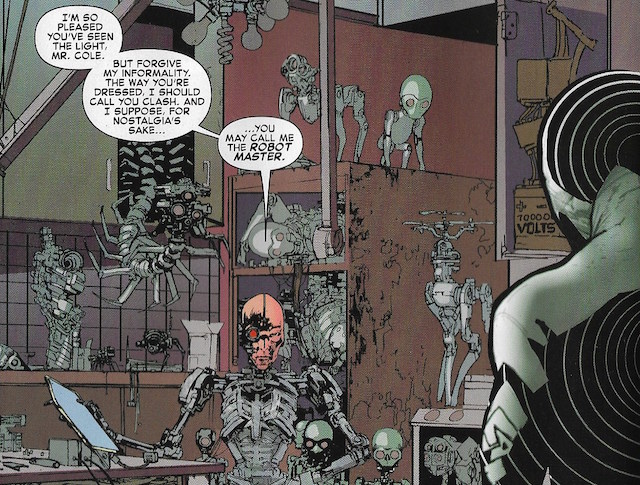
  • Robot Master reconstitutes himself and attacks the two men just as Peter seems as though he might have a breakthrough.
  • Clayton leaves Spider-Man to deal with the villain on his own, saying that he needs to go his own way.
  • Spider-Man defeats Robot Master, who vows to take Parker Industries to court for Cole’s attack.
  • Peter Parker and Ulysses discuss the Inhuman’s powers, whether they are appropriate to use, and how to channel them to save lives. Peter now says it would be wrong for Ulysses to work for Parker Industries because the company will be stronger by learning from its own from failures.
  • Spider-Man agrees to work with Carol Danvers to profile potential future criminals. He will fight for the cause if necessary, but says he will act like her personal Jiminy Cricket (It worked out so well with Doctor Octopus, right Pete?)
  • Clash steals a massive amount of off-the-books cash from Roxxon and announces that he will no longer work for other men. The villain begins to recruit for a criminal empire.

Fact: Clayton Cole wanted to “redefine” himself as a hero using Clash technology.

  • What then, we must ask, gave Spider-Man the moral authority to say that Clayton Cole should not do that, but Hobie Brown as the Prowler can?
  • Why is Dan Slott’s Peter Parker a stand-up guy for asking Mr. Brown to break into a business and steal technology for his own selfish reasons, but Mr. Cole is “ruining” his life for trying to turn over a new leaf as Clash — the superhero?
  • How can Peter Parker, a man who has been falsely convicted in the court of public opinion multiple times, endorse Captain “secret detention” Marvel?

In short, CWII: ASM #4 is filled with creative contradictions, which are not treated as such. As was stated in previous reviews, it is tough to discern how culpable Mr. Gage is for the story’s flaws when a strong argument can be made that he is doing the best he can with messes made by other men.

spiderman-carol-danvers-cwii-asm4

If you have read the previous three issues of Civil War II: The Amazing Spider-Man, then you may as well buy the conclusion. If you have held off this long, then skip it and take note: The modern Spider-Man is like a boat without an anchor in a storm that shows no sign of breaking.

Again, I feel bad for Mr. Gage — but even more so for the writer who eventually replaces Mr. Slott. Where does a man begin with so much rubble to clear? I guess we’ll find out.

clayton-cole-clash-cwii-asm4

Related:

‘Civil War II: Amazing Spider-Man #1’: Gage offers reprieve from Slott fare

‘Civil War II: Amazing Spider-Man #2’: Gage explores ‘self-fulfilling prophecy,’ recidivism, and redemption

‘Civil War II: Amazing Spider-Man #3’: Peter Parker turned into hypocritical jerk to keep story going


Bendis’ Tony Stark ‘loves’ woman he’s been on about 2 dates with; Invincible Iron Man #13 a giant boredom bubble

iim-tony-doom

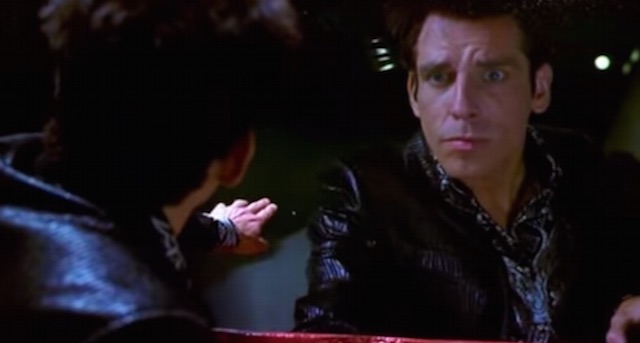
It was just under one year ago that Brian Michael Bendis’ Invincible Iron Man launched. Yours truly was excited at its potential, and even gave the first handful of issues rave reviews. Then, something weird happened. IIM became a plodding tale about Tony Stark’s search for an identity. He sat around his lab and, for all intents and purposes, did his own version of Derek Zoolander’s, “Who am I?” into a puddle of water.

IIM #13 is the culmination of a book that promised to take readers to great places when in reality it only gave them Victor Von Doom (looking quite a bit like Rand Paul) locked inside an energy bubble.

zoolander-who-am-i

Here is what you need to know about IIM #13:

  • Doom takes Tony to Cambridge, where biochemical engineer Amara Perera is illegally testing her experimental Alzheimer’s drugs.
  • Doom and Tony argue about whether or not they are friends or enemies.
  • Tony tries to explain why he didn’t tell his girlfriend that he was going undercover or get word to her that he didn’t die in Japan.
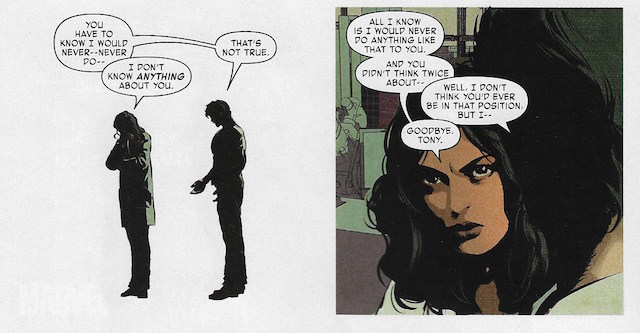
  • Amara Perera tells Tony “I don’t know anything about you,” and moments later he confesses his love.
  • Tony tells Amara about James Rhodes dying, leaves, and then spends time in his lab thinking about Rhodey. He does not attend the hero’s funeral.
  • Doom returns to torment Tony and is locked inside “a zero-point energy web net.” Tony says he wants answers. “You’re going to tell me why you’re all over me. Why? Why have you decided to be in my life all of a sudden? Why? Why me?” he asks.

Marvel fans already have a good idea how all of this will turn, given that IIM is going to be launched with RiRi Williams as Ironheart — and that Infamous Iron Man, “Iron Doom” will launch in October.

Before we move on, let us go over our Mighty Marvel Checklist:

  • Superior Spider-Man? Check.
  • Hydra-Cap? Check.
  • Infamous Iron Man? Check. 
  • Bruce Banner killed because he might go Infamous Hulk on everyone? Check.

Interesting pattern, Marvel. It seems like Tony isn’t the only one having an identity crisis…

iim-amara

What makes IIM #13 even worse is that Mr. Bendis is doing — on a much smaller level — what Dan Slott did with Peter Parker’s “close” girlfriend, Lian Tang (i.e., the one who tried to murder him).

It has been established that Amara Perera is a smart woman, but she and Tony’s “relationship” consists of a small bit of playful banter and cross-talk early on in the book. How does that translate into “love,” and why would Tony say that to a woman who a.) agreed to be “taken off the grid” by Doctor Doom, and b.) suddenly calls the villain “Victor”?

Answer: It would not translate into love.

Tony would not say that, and readers should be insulted that Bendis would make him go there with a woman who has always been skittish about his lifestyle, personality, and double-life as Iron Man.

iim-tony-stark-love

In short, if you have read IIM this long then you may as well buy the last issue before the relaunch. If you are considering Infamous Iron Man for you pull list, then just be aware that Iron Doom may essentially be the tale of Victor Von Zoolander.

Spider-Man #7: Bendis writes strong tie-in to Civil War II

Hulk kill

Brian Michael Bendis’ Civil War II has taken its lumps in terms of fan interest and sales, but the story is helping to define Miles Morales. Spider-Man #7 features the young man trying to determine whether he will stand and fight alongside Tony Stark in a war over the Inhuman named Ulysses, or if he will sit on the sidelines and let the veterans sort it out for themselves.

Here is what you need to know for Spider-Man #7:

  • Miles is having nightmares about the potential future he experienced, where the Hulk goes completely off the deep end (even by the Hulk’s standards), and kills everyone.
  • Miles’s parents cannot sleep. His mother knows that private investigator Jessica Jones is keeping information about Miles from her. Jones had to use her superhuman strength to carry Rio out of her office…and send a message to stay away.
  • Miles’s father wants the investigation (launched by his mother-in-law) called off, but the two parents seemingly don’t have the power to make it happen.
  • Miles web-slings around New York to clear his head and runs into Lana Baumgartner, aka Bombshell. After she stops a robbery by blowing up a van, Miles says her behavior is symbolic of a lot of other superheroes: “You stopped a robbery, but you started a fire.”
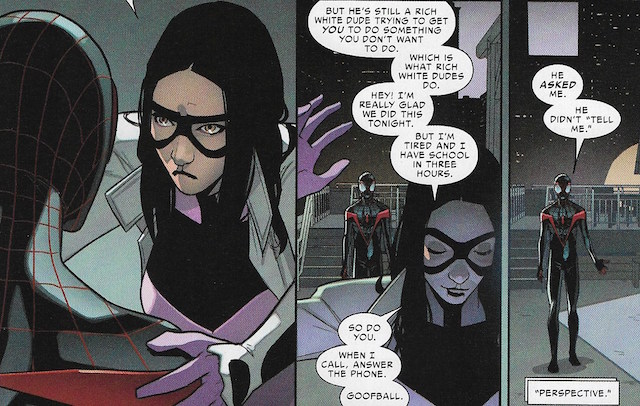
  • The two teenagers talk about the upcoming war between superheroes and Lana says that Miles is being manipulated by the “rich white dude” known as Tony Stark to do something against his will. Her reasoning — that’s what “rich white dudes do.” (Note: Don’t expect Bendis to ever have Miles Morales sarcastically reply: “You mean like Steve Jobs or Bill Gates or Elon Musk?”)
  • Miles has a nightmare during class and is forced to leave the room. He goes up onto a roof as Spider-Man and is confronted by Jessica Jones and Luke Cage.

All things considered, this was a pleasing issue for Bendis and it was made even better by strong work by artist Nico Leon. Whether one likes Civil War II or not, one of the long-term benefits of the tale is that it serves to define young characters like Miles.

SpiderMan Bombshell

The challenge for Bendis, however, will be to adequately show the “now what?” — the follow-through that often seems missing from his work. The writer has a habit of toying with big ideas and then placing them aside to focus on something else.

Whether Bendis is writing Tony Stark in Invincible Iron Man or Miles Morales in Spider-Man, in many ways he keeps them in a holding pattern. He occasionally dips and swerves the plane to the left or the right, but at some point in time his passengers realize that they have been deceived — they’ve just been flying in circles.

After seven issues of Spider-Man, readers want to know “Who is Miles Morales?” While it is true that he is a young character who is finding his voice — and part of the fun is going on that journey with him — it seems as though Bendis is being stingy with key aspects of the hero’s personality. Either the writer doesn’t yet know what the character really represents, or he is scared that readers will not like what they hear.

If you planned on checking on Spider-Man, then Bendis’ seventh issue is a good jumping-on point. Potential customers just need to know that  Miles Morales’s character development has been frustratingly slow since the series first launched. Perhaps the conclusion of Civil War II will change that.

Bombshell SpiderMan

Bendis botches Ironheart launch with Tony Stark fans

Iron Man fans know that the clock is ticking on Tony Stark. Brian Michael Bendis is relaunching Invincible Iron Man with a new character — Riri Williams — as the protagonist. This young woman, who Bendis said is “probably” smarter than Stark, will call herself Ironheart.

It is my belief that Marvel has once again botched an opportunity to diversity its stable of superheroes without annoying long-term readers. Check out my new YouTube video on the subject and let me know what you think in the comments section below.

Spider-Man movies called ‘white-boy fantasy’: The Root writer says Zendaya casting not ‘progress’

Jason Johnson

The Root bills itself as an “opinion and culture site for African-American influencers,” which works out nicely because I was recently looking to see what such self-proclaimed individuals were saying about Zendaya’s role as MJ in Spider-Man: Homecoming. It turns out that Spider-Man is a “white-boy fantasy” and nothing you ever do is good enough for “influencers” like Jason Johnson.

Mr. Johnson wrote on Aug. 23 for The Root’s “No, Zendaya in Spider-Man: Homecoming Is Not the Progress We’re Looking For”:

Consequently, the announcement that she’s been cast as Peter Parker/Spider-Man’s long-term love interest, Mary Jane, in Spider-Man: Homecoming next year has given many people all sorts of excitement and feels. I am not one of them. Casting Zendaya as Mary Jane is another example of Hollywood expecting black dollars at the box office, but disrespecting black consumers and fans on the big screen. …

Zendaya’s casting is yet another sign that makers of Hollywood sci-fi fantasy action films will “racebend” a character (change a character’s race from what it was in a book, film or cartoon), slap themselves on the back for being progressive and expect black fans to be satisfied, while pretty much maintaining the status quo. Racebending is fine so long as it’s for girlfriends and sidekicks, but the movies are still white-boy fantasy adventures in which the lead remains a straight white male no matter what. And that unfortunate fact can’t be separated from the choice to cast Zendaya as Mary Jane.

There was never a doubt or even a conversation about casting anyone other than a white man as Iron Man, Thor, Captain America or the Incredible Hulk. Even though Iron Man was black in the early 1980s, the first Captain America was a black man, and Thor as a Norse God could be anybody.

Are you a young comic book fan who is on the ideological fence? If so, then consider the psychology on display with Zendaya’s casting:

  • If you think movie producers should try to adhere as closely as possible to the source material, then liberal guys like Dan Slott will imply that you are a racist.
  • If you think movie producers should try to adhere as closely as possible to the source material, then liberal guys like director James Gunn will say that you have “too good of a life.”
  • If you think movie producers should try to adhere as closely as possible to the source material, then liberal guys like Devin Faraci of the website Birth. Movies. Death. will call you a “racist fanboy.”
  • Conservative guys like me will shrug their shoulders and say, “Yeah, but Zendaya may still be pretty good. As long as she tints her hair red then we should just give the girl a chance.”
  • Meanwhile, liberals like Jason Johnson will mock you for your “white-boy fantasy” even if you do give Zendaya’s casting three cheers for diversity. You are damned if you do and damned if you don’t. Welcome to a life of Kobayashi Maru-type scenarios if you board the USS Social Justice.

As your friendly neighborhood blogger has said on numerous occasions, social-justice obsessives are never satisfied. Any attempt to placate them will only result in additional admonitions that require an apology, new demands to meet without question, and more rules that undoubtedly conflict with a sub-group of professional victims someplace else.

Between now and the July release of Spider-Man: Homecoming, I implore anyone who is still trying to define their ideological identity to conduct a test: Come to this blog and disagree with me just to see how I react. Then, do the same with liberal writers like Dan Slott or Nick Spencer. By the time your favorite wall-crawler returns to theaters, I am confident that you will no longer be on the fence.

Dan Slott plays ‘Captain White Privilege’ after Zendaya-MJ casting reported

The announcement on Aug. 18 that Zendaya will play Mary Jane in next summer’s Spider-Man: Homecoming spread like wildfire across the internet. It wasn’t long before the usual suspects were attacking anyone who questioned the decision with charges of racism. Dan Slott, the man who once said that Peter Parker’s love for Mary Jane is “anti-Marvel,” joined in the fray to play “Captain White Privilege” (yes, he went there) in his twitter feed.

Since Marvel’s scribe for The Amazing Spider-Man has a habit of sliming long-time Marvel fans with attacks on their integrity, it seemed as if it were time to make a YouTube video on issue. Since Mr. Slott never is a magnet for controversy, I fully expect future installments to follow in the months and years ahead.

Check out the video and let me know what you think in the comments section below.

‘Civil War II: Amazing Spider-Man #3’: Peter Parker turned into hypocritical jerk to keep story going

Robot Master

Marvel “events” have a weird habit of warping a character’s personality in order to arrive at an author’s desired outcome — superhero integrity be damned. Civil War II: Amazing Spider-Man #3 officially falls victim to this recurring annoyance. Writer Christos Gage takes Peter Parker’s penchant for getting on his high horse and (in keeping with the theme of the story), jacks up the amplitude to a bizarre level. By turning the character into a hypocritical jerk, the prognostications of the Inhuman known as Ulysses once again come true.

Here is what you need to know about Civil War II: Amazing Spider-Man # 3:

  • Clayton Cole, aka Clash, meets with Robot Master. The villain, whose real name is Mendel Stromm, discusses his plans to steal money from Parker Industries but is ambushed by Clash.
  • Peter Parker laments having fired Clayton. He sulks at table as Harry Osborn Lyman condescendingly pats him on the back and says, “Clayton’s a grown man too. He made his own choices, and he’s responsible for them. Now it’s on him. (Note: How sad is it that a former Green Goblin now must lecture Peter on what it means to take responsibility for one’s actions?)
  • Robot Master, having anticipated a double-cross by Clash, notes that his mechanical minions have been upgraded and are ready for a fight. A battle ensues on the streets of New York City.
  • Spider-Man shows up to save the day. After Robot Master’s technology forms into a giant robot (and Spidey jokes, “Always giant robots…”), the two eventually agree to divvy up the tasks. Spider-Man agrees to “trust” Clash and leave him with the giant robot while he chases down Stromm.
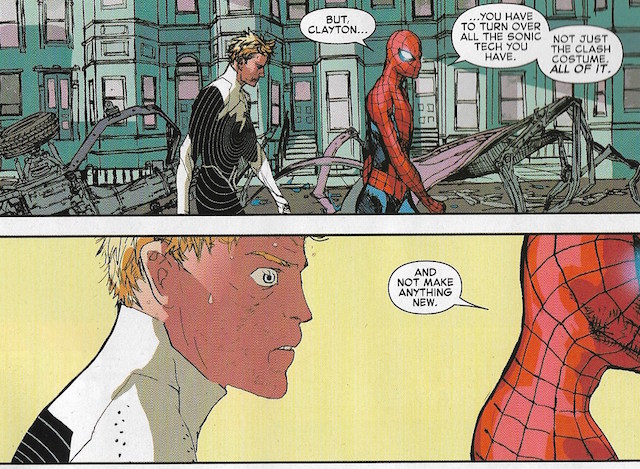
  • Both men defeat their respective opponents. Spider-Man then decides to lecture Clash on what a rotten person he is the moment the dust settles. The hero says that “Peter Parker” is going to let Clayton have his job back — provided he turn over all of his sonic technology.
  • Clayton gets an “angry Beavis” look in his eyes from the old Beavis and Butt-Head cartoons, and then attacks Spider-Man —just like Ulysses predicted.

This issue had so much potential. It is hard not to look at Robot Master’s lab, which appears to be something out of Tim Burton’s wildest dreams, and not anticipate a good read. Mr. Gage generally does an adequate job — and Spider-Man fans finally gets a decent fight scene — but it appears as though the constraints of Civil War constantly undermine the book.

ASM Civil War Clayton Cole

Consider this:

  • On one hand we have Peter Parker, a sulking mess who doesn’t understand basic responsibility. Harry recounts how Peter behaved like a stalking ex-boyfriend by sending Clayton “message after message” via “voice, text, email” to try and apologize … for firing a guy who probably deserved to be fired. At Parker Industries, it’s almost impossible to get terminated. (Does anyone know what happened to Lian Tang, the Parker Industries girlfriend who tried to kill him? I wouldn’t be surprised if she still has a job…)
  • On the other hand we have Clayton Cole, a guy who outwardly appears to be a nutcase (bulging eyes, screaming fits of rage, crying on the job, sweating, etc.), in addition to the issues raging beneath the surface. The audience is often encouraged by Mr. Cage to have sympathy for the man, but it is always negated by his actions.
  •  The question becomes: What the heck is the point of all of this?

As has been said before, Christos Gage handles issues of redemption and responsibility much better than the series’ regular writer, Dan Slott. The interactions between characters are more natural, which in turn give the action scenes added weight (i.e., Gage’s stories do not feel like a kid who mashes his action figures together and then expects you to care). It’s just a shame that Civil War makes it difficult to judge whether editorial mandates are the cause of The Amazing Über-Hypocrite, or if that is an mistake that rests solely on Gage’s shoulders.

Fact: Spider-Man is a vigilante. Vigilantes do not get to stand upon a giant moral pedestal and lecture other vigilantes about the collateral damage brought about by their actions.

Peter Parker of all people should know that Clayton Cole — a fellow man of science — sees his knack for sonic technology as his “great power,” which also comes with “great responsibility.”

Peter Parker of all people should also know that Clayton Cole would feel added pressure and guilt, given that he erred with his powers early on in life. Therefore, a well-written Spider-Man in this issue would not have behaved like a massive tool in the immediate aftermath of a street battle.

Clayton Cole ASM

Beavis and Butt-Head

In short, Civil War II:: Amazing Spider-Man #3 is worth checking out if you purchased the first two issues, but you can probably sit out the finale if you still haven’t coughed up any hard-earned cash.

Civil War II ASM4 preview

Editor’s Note: Just to keep the sound motif going, what is with the Amazing Spider-Man #15 “echo”? Clayton asks Peter Parker to trust him in battle, which is what Mary Jane did during her battle with Regent. Oddly enough, Peter had legitimate reasons to not trust either of them…

Related:

‘Civil War II: Amazing Spider-Man #1’: Gage offers reprieve from Slott fare
‘Civil War II: Amazing Spider-Man #2’: Gage explores ‘self-fulfilling prophecy,’ recidivism, and redemption

Amazing Spider-Man #15: Dan Slott’s Regent took down a god, then falls to … Mary Jane

Daredevil #10: ‘Dark Art’ starts strong, but Soule drops ball on basic Catholicism

Daredevil NYC

Charles Soule’s Daredevil #10 is out, which means that Matt Murdock fans once again get their fix of solid storytelling. “Dart Art: Part 1” is nearly pitch perfect except for the writer’s big whiff on basic Catholicism. It’s a minor complaint, but still very important considering the fact that Daredevil Season 2 on Netflix covered the same territory without any problems.

Before we address the religious issue, here is what you need to know for DD#2:

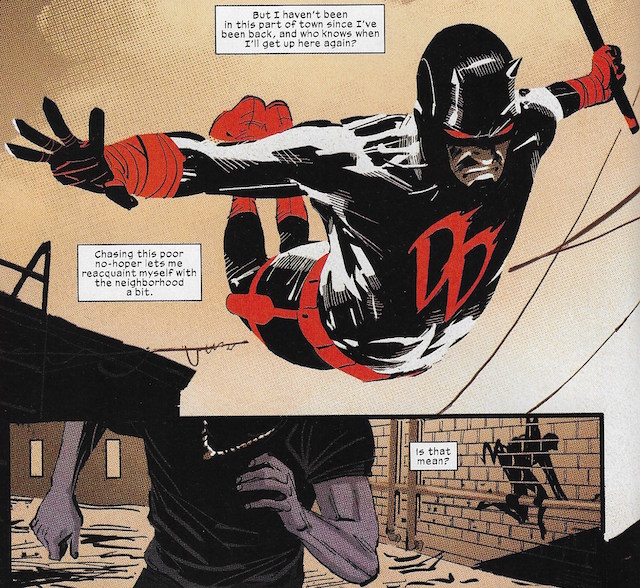
  • Daredevil tracks a common street thug across the NYC’s Upper East Side to familiarize himself with any changes in the terrain since his last visit.
  • Blindspot’s arm has healed after being broken by Elektra one month earlier. He’s ready to get back into the superhero game and continue his training.
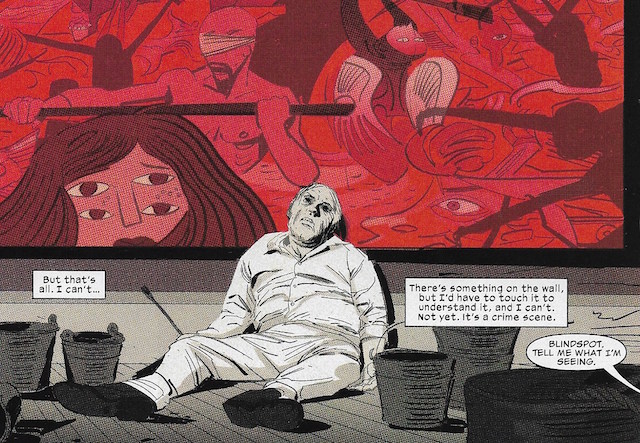
  • Blindspot receives an strange invitation that references a “battle,” but when he arrives at the location on the card he only finds a dead man —and a mural painted in blood.
  • Daredevil receives an emergency call to help out, which puts him in an awkward position. Matt Murdock, who know works as a prosecutor for the state, is swamped with cases and needs to call in favors he doesn’t really possess as the low man on the totem pole.
  • Blindspot worries that if he goes to the police about his invitation it will put him at risk for deportation since he is an illegal immigrant.
  • Daredevil takes the invite and says “if we ever need to surrender it, I’ll pass it along, say it was sent to me. Okay?” Blindspot agrees and thanks him.
  • Daredevil touches the painting and concludes that it was made with “at least one hundred and thirteen” different kinds of blood. When Blindspot says, “I thought you said I couldn’t touch anything” because they are at a crime scene, Daredevil replies, “It is. Mine.”

Again, as was said earlier, Charles Soule is on his game. Aside from a seemingly rushed issue with Daredevil #1 Annual, the man has been consistently good for months. Daredevil fans are experiencing an inspired run that, years from now, will be well-regarded by a new generation of readers.

Blindspot

DD Crime scene

This issue’s one problem, as Christian readers may have picked up on by the first panel, is Daredevil’s decision to refer to a common thug as a “no hoper.”

The one thing any Catholic man understands — as demonstrated in the Netflix series — is that no one is without hope. Everyone is capable of redemption. That theme was hammered home over and over and over again in scenes that pitted Daredevil against Frank Castle, aka The Punisher.

All Christians know that there is always hope for redemption through Jesus Christ.

Luke 23:39-43 says:

39 One of the criminals who were hanged there was hurling abuse at Him, saying, “Are You not the Christ? Save Yourself and us!” 40 But the other answered, and rebuking him said, “Do you not even fear God, since you are under the same sentence of condemnation? 41 And we indeed are suffering justly, for we are receiving what we deserve for our deeds; but this man has done nothing wrong.” 42 And he was saying, “Jesus, remember me when You come in Your kingdom!” 43 And He said to him, “Truly I say to you, today you shall be with Me in Paradise.”

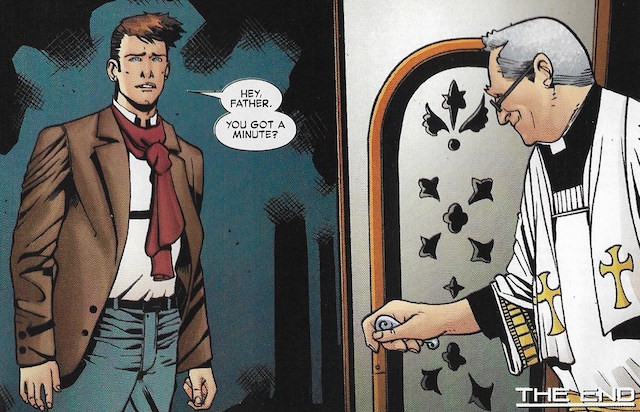
Charles Soule, a trained attorney, makes sure that Matt Murdock is never ignorant of something a first-year law student would know, but yet in this case a Catholic superhero says something that children making their First Communion would recognize as incorrect.

It isn’t a large gripe, but it is somewhat bothersome that Marvel cares enough about Kamala Khan to literally have it written by a practicing Muslim to make sure there are no hiccups, while Daredevil’s Catholicism is downplayed, ignored, and generally just treated (these days) with a “go ahead and fake it” mentality.

Marvel’s decision to give Mr. Murdock a generic Catholicism in 2016 is a shame because there are great tales to be told by any writer who is familiar with Hubert Van Zeller’s Suffering: The Cross of Christ and Its Meaning For You; G.K. Chesterton’s The Everlasting Man; Dom L. Scupoli Apulia’s The Spiritual Combat and a Treatise on Peace of Soul; and many, many others.

I will continue to read Daredevil, but I will also continue to be disappointed that there hasn’t been a writer in ages who is willing to mine the character’s faith to unearth amazing tales hidden just beneath the surface.

Suicide Squad reviews skewed by political correctness

Suicide Squad is out, and the reviews are not kind. It is fair to say that David Ayer’s script has problems, but the level of vitriol aimed at the movie is ridiculous. Just as political correctness inflated the positive reviews awarded to Ghostbusters, the same mentality allows critics to unjustly savage of movie like Suicide Squad.

Check out my latest YouTube video below for the full story and let me know what you think in the comments section below.