‘The White Donkey’: Iraq War veteran’s graphic novel a powerful read

White Donkey

For  years this blog has tried to make the case that a comic book can be much more than “just” a comic book. For years this blog has tried to make the case that the industry would benefit if it employed, say, men like Terminal Lance creator Maximilian Uriarte. His New York Times bestseller, “The White Donkey,” should officially put that debate to rest.

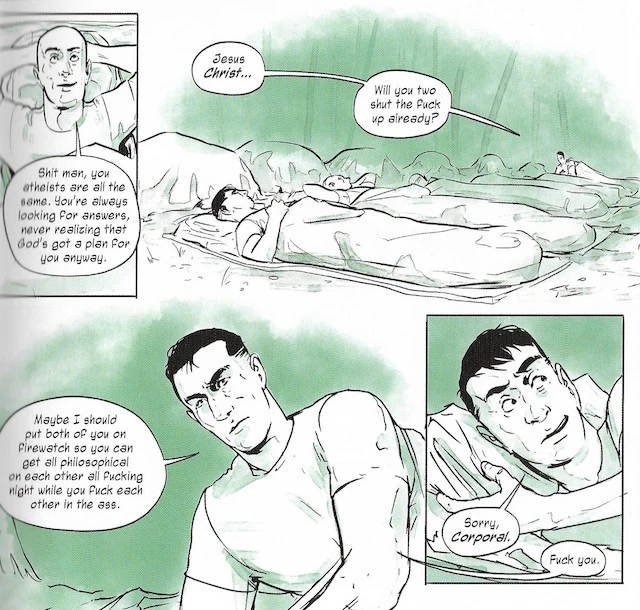
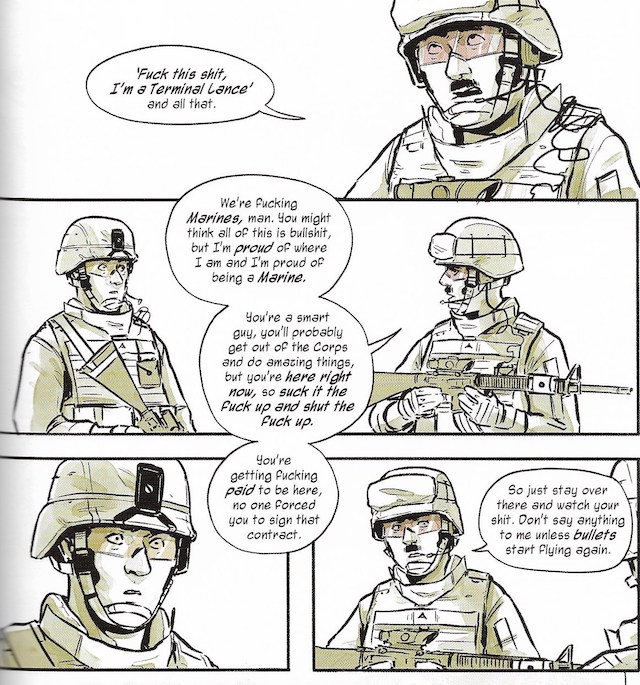
“The White Donkey” is the story about Abe, a young man who left his small Oregon town in search of … something. He wasn’t quiet sure what he was looking for, but he thought he might find it in the United States Marine Corps as an infantryman. Abe, his best buddy Jesus Garcia, and the rest of their battalion are eventually deployed to Iraq. There is not much more I can say without spoiling the book other than to note its honesty rivals National Book Award Winner Redeployment,” by Phil Klay.

White Donkey Garcia

Every so often a critic comes to this blog and says something along the lines of, “You write about popular culture because you wanted to make it in Hollywood and never did.”

Yes, I did go to USC upon exiting the Army as a mechanized infantryman, but nothing could be further from the truth regarding professional regrets. In fact, a better personal attack would be that I exited the military prior to 9/11, didn’t have the courage to re-enlist after the Twin Towers fell, and that it still haunts me to this day.

There actually is some truth to that — I carried a ton of guilt with me for years after 9/11, which was exacerbated after a friend of mine, Hector Leija, had his head blown off in Iraq by a sniper. I disclose these details because readers need to know that everything that happens to “Abe” prior to his deployment is eerily close to what I experienced as a peace time soldier (i.e., it’s authentic). The characters, situations, and confrontations Abe navigates in many ways mirror my own.

I see myself in Abe (except the atheist part), and cannot help but wonder what I would be like had I stayed in military.

White Donkey leave

If you’re looking for a book with intelligence and emotional weight, then check out “The White Donkey.” If you’re looking for a book that can help civilians better understand returning war veterans, PTSD, and the other burdens they might be carrying, then Uriarte’s work is a must-read. One can only hope that he continues telling tales for many years to come.

Daredevil, Elektra sizzle under Soule’s and Buffagni’s direction

DD Elektra

I never thought a modern Daredevil writer would make me bust into cheesy clichés, but here it is: It’s hot in Hell Kitchen under Charles Soules’ and Matteo Buffagni’s direction! Heck, kudos to color artist Matt Milla as well. Daredevil #6 kicks off “Elektric Connection” and the return of Elektra. The entire issue crackles with sexual tension, fisticuffs, and one very broken arm (sorry, Blindspot).

Here is what readers need to know: Soule keeps it simple and sweet:

  • Daredevil’s secret identity has been restored and no-one is the wiser — including Elektra.
  • The famous assassin shows up at a New York City bond hearing as Murdock is trying to work. She knows he has a connection to Daredevil and wants a meeting ASAP.
  • The “meeting” (or rather, beating) commences in short order.
  • Elektra wants to know what Daredevil has done with her daughter, and vows to “cut away every lie” in his body if he doesn’t give her answers.

Perhaps the best way to describe Soules’ writing is “efficient.” Words are not wasted. Each word means something. Each sentence is important. There is a plan. Both he and Buffagni know exactly what they need to do. They execute their respective jobs to the hilt. It is a welcome reprieve after digesting Marvel fare like The Amazing Spider-Man # 11.

Murdoch Elektra date

In one brief interaction between Matt Murdock and Elektra at a “lawyer bar,” one can see why Daredevil is one of the strongest titles on the market at the moment. In addition to Buffagni’s gorgeous art, it is obvious that Mr. Soule is a man who has had complex, mature relationships with the fairer sex.

Take, for instance, Murdock’s decision to meet with Elektra for a drink after she shows up at a bond hearing. His head is separated into an upper and lower half by Buffagni’s panels. Yes, he is “split” between being Daredevil and a New York City prosecutor, but he also spars between his logical  self and his bodily passions. Matt does not want to tell Elektra where Daredevil is, but he also would really like to sleep with her again.

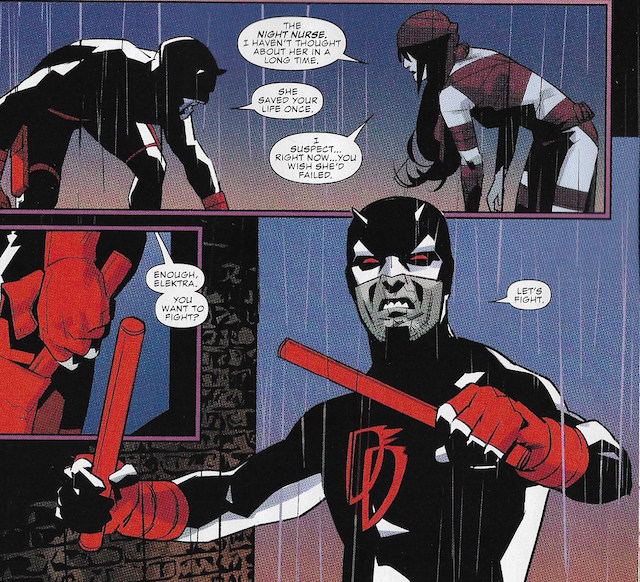
Needless to say, our Catholic superhero will have some explaining to do in the confession booth on Sunday. Murdock sets up a meeting between Daredevil and Elektra, and things get ugly fast. At one point Blindspot shows up and within seconds his arm is broken and he is off to see Night Nurse. Murdock finally has enough pussyfooting around and channels his inner Michael Keaton as Batman (i.e., “You wanna get nuts? Let’s get nuts!”).

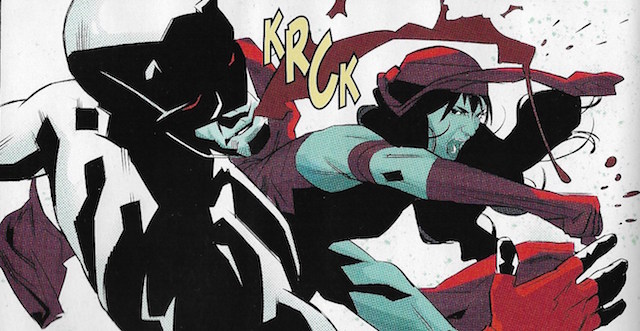
Daredevil Elektra fight

The issue ends, as mentioned earlier, with Elektra demanding to know the location of her daughter. Whatever Daredevil did to essentially mind-wipe the world of his secret identity has a great upside, but it also appears as though it will come with painful consequences.

If you’re looking for a top-notch Marvel book, then go with Daredevil. The protector of Hell’s Kitchen has not been this cool in a long time.

Bonus: Michael Keaton getting “nuts” as Bruce Wayne never gets old.

Amazing Spider-Man #11: Hero says ‘you didn’t see that coming’ after pushing villain into pure ‘power’

ASM11 SpiderMan

Imagine you are a superhero. You have tracked an international terrorist for months as he feverishly looked for an inter-dimensional field of pure “power” and “information.” In short, your suspect wanted to locate a “door into the future.” You catch up to him at the very moment he finds his target. Would you decide to push the terrorist into a quantum field of infinite possibility and lock the door, or would you try to pull him out?

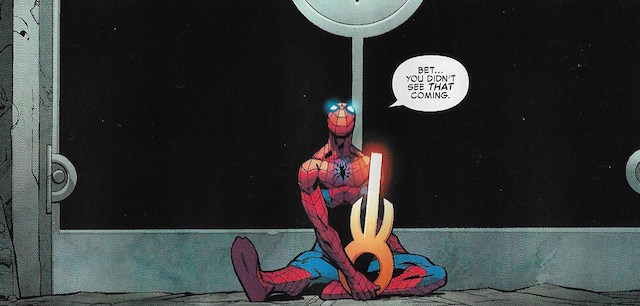
Dan Slott’s Spider-Man chooses the former and says, “I bet you didn’t see THAT coming.”

Fans of The Amazing Spider-Man do not typically expect their hero to aid villains in their evil machinations, so it is true that most of them probably would not have anticipated such a move. Touché, Dan Slott. Touché, indeed.

ASM11

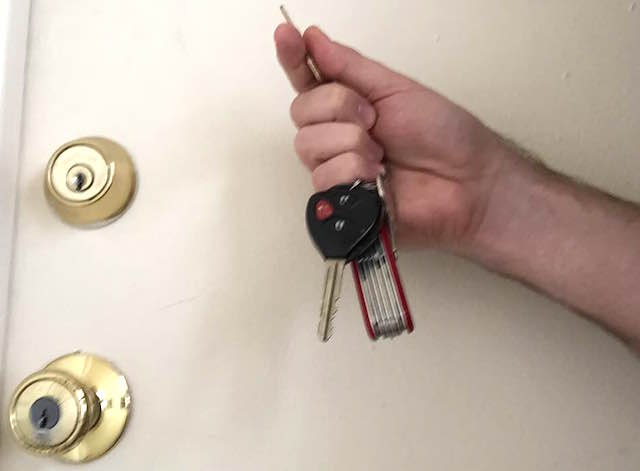
Here is an easy experiment: Glance at your front door. If you were standing under the threshold and a man pushed you inside, locked it from the outside and exclaimed, “Well, we don’t need to worry about that guy anymore,” then how would you react?

My guess is that you would laugh at the man’s stupidity before opening the door and demanding your key back. In a worst-case scenario you would go out your garage, a back door, or possibly one of many windows.

Key

The Amazing Spider-Man #11 is technically the culmination of many months of stories surrounding the Zodiac terrorist group, its mastermind Vernon Jacobs, and his plan to usher in the “age of Scorpio.” The issue was supposed to serve as this story’s climax, but in the end Peter Parker “saves” the world by kicking the can down the road — one year to be precise.

Note: Superheroes are not supposed to treat villains like the U.S. treats its $19 trillion debt and then declare victory. It doesn’t work that way. Regardless, here is the abridged version of how ASM #11 unfolds:

  • Nick Fury turns the International Space Station into a giant beacon for Morse code and sends Scorpio’s location to Spider-Man since most of earth’s satellites are inoperable.
  • Spider-Man, Anna Maria, and Living Brian (aka: Doctor Octopus), and Mockingbird  arrive at Greenwich, London, to stop Scorpio but are quickly dispatched by a giant energy pulse from the Zodiac Key.
  • A doorway to the future is opened and Jacobs reveals that he is the grandson of the original Scorpio, Jacob Fury.
  • Spider-Man decides the best way to defeat Scorpio — as the portal telepathically gives him immense power and precognition — is to push him through and shout, “Take a closer look!”
  • Peter Parker tells Mockingbird he “smacked [Scorpio] into next year,” and she jokes that he did it so they have an excuse to spend more time together.
  • Anna Maria tells Peter that Mockingbird likes him, and then tries to make her “jealous” by clinging to his arm.
  • Doctor Octopus witnesses the “intolerable” act and vows to make his “superior return!”

Regular readers who are disappointed with how the Zodiac tale wrapped up should look at the bullet points above and notice an ongoing trend: Dan Slott, fittingly, often expends more care setting up future events than he does with the task at hand (i.e., telling a tight and compelling story in the here and now).

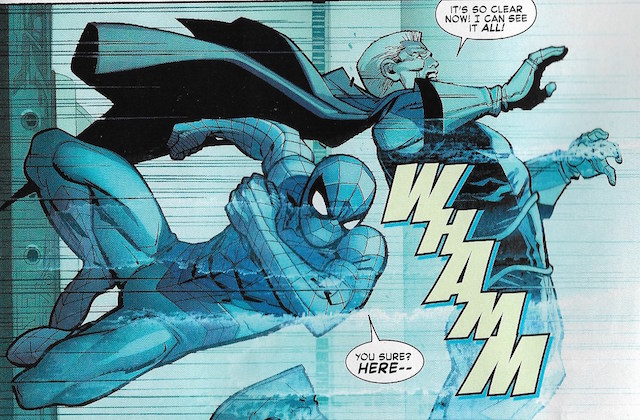
ASM11 Scorpio push
“It’s ‘so clear now’? You can ‘see it all’ with the power surging through your veins and the information flowing through your brain? Let me just push you closer into a field of infinite possibility…even though you’re evil.”

Just as Batman v Superman faltered because the writers spent too much time trying to set up a Justice League movie, Slott’s ASM regularly falls flat because he focuses too far into the future. No one except Mr. Slott and his good friends will care if 10,000 plot points over the course of ten years can be amusingly traced on a Saturday night if the stories connecting them are mediocre.

It is unfortunate, but once again ASM’s creative team over-promised and under-delivered. Giuseppe Camuncoli should take a bow for consistently stellar art, but he may want to ask to work on a title where his efforts are not a metaphorical life raft.

Exit Question:

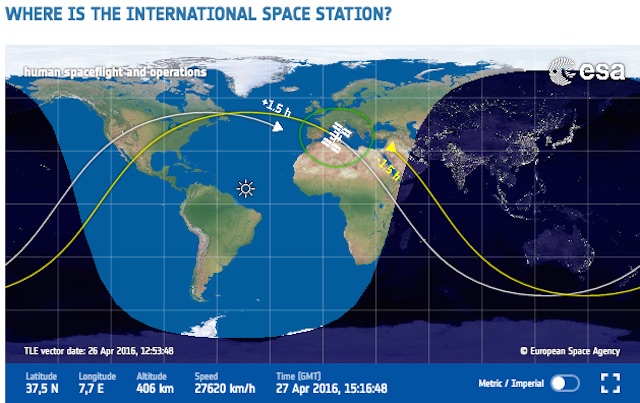
The International Space Station orbits the earth at over 17,000 miles per hour. Someone can correct me if I am wrong, but ASM appears to have been written like it is a fixed object in space. My guess is that Morse code would not have been a possibility for an object orbiting that fast at 155 miles above the earth.

ISS

Editor’s Note:

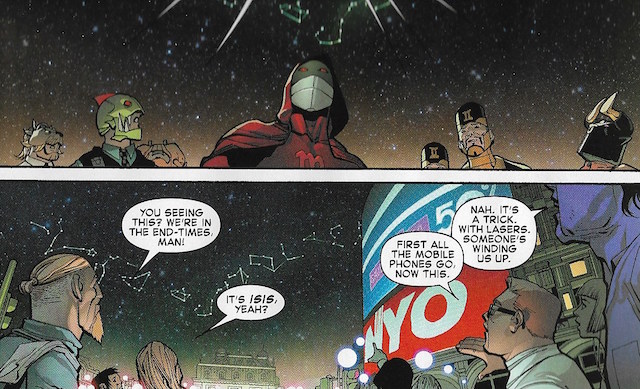
The Amazing Spider-Man may be the first Marvel comic to actually acknowledge the existence of the Islamic State group. The first person who can confirm this one way or the other will win a “Doug Prize.”

ASM11 Scorpio

Mark Waid says Captain America more ‘difficult’ to write now than WWII era … as ISIS takes sex slaves

Captain America Simon Kirby

Your friendly neighborhood blogger recently picked up Marvel’s “Captain America Anniversary Magazine” in his local comic book shop. The (free) special edition is indeed quite special. Unfortunately, one of the ways it is special is its ability to show how spotty the writing has been over the course of 75 years.

A kind of moral clarity existed at Marvel years ago that allowed for Steve Rogers to literally punch out Adolf Hilter on the cover whereas, these days, the Islamic terrorist groups are ignored in favor of attacks on the tea party.

ISIS terrorists
An ISIS terrorist executes an innocent man in Iraq. Meanwhile, over in America, Marvel editors wonder if it’s appropriate to do another story where Captain America takes on the tea party. Sad.

Writer Mark Waid inadvertently demonstrated why, 75 years from now, people will look back at this era and shake their heads in shame that Marvel was deathly silent on the issue of Islamic terrorism.

Marvel: A popular — and effective — approach writers take to the character is to look at what it means to be Captain America, the living symbol of a nation. You’ve certainly used this approach, and used it well. What makes him such a good character for that kind of examination?

Waid: First and foremost, it’s the thing that makes him unique among superheroes. You’re always going to be making a mistake if you just tell a generic superhero story with Cap because then it comes across as, “Well, this could have been a Spider-Man story or a Hulk story.” You look for the point of view that makes Cap unique and the reason for what he does. In his case, he’s out there being literally a symbol not only for a country, but also for an ideology. And what makes him a complex and interesting character for me is that it has become a much more difficult ideology to define than it would have have been when he first undertook his mission.

Wrong. The principles espoused in the Declaration of Independence are universal. Those principles are codified into law by the U.S. Constitution and transcend petty politics, which is why anyone who writes Captain America should not have a hard time doing so — unless said writer is a partisan guy who finds it “difficult” to rise above his personal biases.

ISIS

Question: Why on did Joe Simon and Jack Kirby have a moral compass that allowed them to call out the Nazi regime in print, but Mark Waid and modern Marvel writers cannot find it within themselves to do an issue on ISIS sex-slaves?

Answer:  Because they are so politically correct that they would rather attack opponents of illegal immigration than the Islamic terrorists who rape young women over and over and over.

ISIS sex slave survivor

The modern Marvel reader can find Captain America taking on tea party members, but they cannot find an issue where their hero stops Syrian members of ISIS from lighting caged innocents and Christians on fire.

Islamic State Jordanian pilot

The idea that it is harder to write Captain America as a symbol for the country in 2016 than it was in March 1941 is a myth. There are plenty of stories to tell that would capture the nation’s highest ideals as enshrined in the Declaration of Independence, the U.S. Constitution, and the Federalist Papers. If a writer is incapable of doing that then it isn’t because the world is more complex — it is because he willingly chooses not to expose pure, unadulterated evil.

Editor’s Note: For a glimpse into the mind of Mark Waid — and why he might have a difficult time writing Captain America — one needs to simply glance at his Twitter feed. 

Mark Waid

Mark Waid Twitter

Black Panther #1: Ta-Nehisi Coates debut a mixed bag for Marvel fans

Black Panther 1

Marvel Comics announced months ago that it would hand the reins of Black Panther to Ta-Nehisi Coates — a guy who believes the U.S. should consider paying reparations to modern black Americans for injustices inflicted upon their ancestors. At the time I said I doubted I would read the book, but ultimately I could not resist seeing how the activist would perform. Black Panther #1 is certainly a fascinating read, but not all of the reasons will make Marvel’s editors happy.

Comic book fans will soon get to see T’Challa, warrior king of Wakanda, on the big screen in Captain America: Civil War. That excitement has propelled Black Panther #1 to impressive sales (300K), but the question at hand is whether or not the book will have staying power. My prediction is that if Coates keeps T’Challa in Wakanda for an extended period of time — while boxing out other top-tier Marvel characters in the process — it will sink under its own weight.

Here is where things stand as of BP #1:

  • T’Challa has returned to reclaim his kingdom after an extended absence.
  • The king’s sister, Shuri, assumed the throne while he was gone but died during an invasion by Thanos.
  • Wakanda has an “elite female royal guard” called Dora Milaje that assists T’Challa in protecting the kingdom. One of them, Aneka, is sentenced to death for murdering a village chief known for abusing women.
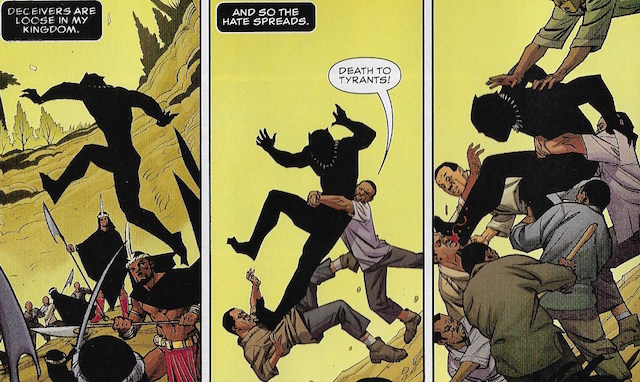
  • A mysterious adversary planted seeds of deception across the nation, which pits citizens against one another.
  • Ayo, one of the Dora Milaje, breaks Aneka — her lover — out of prison. The two don stolen “midnight angel” suits and vow some form of revenge because “no one man should have that much power.”
  • T’Challa tries, unsuccessfully, to resurrect his sister from the dead using Wakanda’s advanced technology.

Readers who say, “It seems like there is a lot going on here,” would be correct. Coates is asking his audience to stick with him as he maps out Wakanda’s history and a whole host of characters. The author’s intelligence and organizational skills are evident throughout the book, but it remains to be seen whether the journey will actually be fun. Black Panther has gravity, but too much gravity can be highly unpleasant.

Black Panther

T’Challa’s mother tells him at one point in the book, “It is not enough to be the sword, you must be the intelligence behind it.” That is a great message, but my fear at this point is that Coates’ desire to write a cerebral superhero may cause him to needlessly sacrifice the kind of action and adventure that translates into return customers.

Take, for example, Wakanda’s “midnight angel” lesbian lovers. There is no doubt that Coates will give them more respect than deceased dictator Moammar Gadhafi granted his “Amazon Guards,” but guys like me have no desire to drop $5.00 per issue reading about the heartache of Aneka and Ayo over T’Challa’s rule.

Likewise, liberation movements along “the Nigandan borer region” may work for an issue or two, but at some point in time Wakanda’s internal politics become just as boring as anything George Lucas dished out during Phantom Menace or Attack of the Clones.

Black Panther Aneka

Black Panther #1 is a worthy experiment on Marvel’s part to see if political commentators can make the transition from academia to the Marvel universe, but the jury is still out on whether it should be added to your pull-list at the local comic shop.

I suggest checking out this blog (shocker) over the next few months before making a financial investment in the book. If Coates produces a winner, then you will certainly read about it here.

Why does God seem absent at times? ‘Dark Night of the Soul’ explains

Dark Night of the Soul

The questions “Why does God allow bad things to happen to good people?” and “Why does God sometimes seem absent in my life?”  have repeatedly come up in conversations with my friends over the years. Many times people beat around the bush, but the underlying point is always transparent. A stellar resource on this subject — and quite honestly one of the toughest books I have ever read — is St. John of the Cross’ Dark Night of the Soul.

First, it should be noted that if anyone had a right to question why bad things happen to good people, then it was St. John of the Cross. The Spanish mystic and Catholic saint, born in 1542, was once kidnapped (by monks), thrown in a dark jail cell, and beaten for months until he managed to escape.

A man who could have looked at his circumstances and concluded that God does not exist instead found God within the darkness.

Key points to consider when contemplating the dark night of the soul include:

  • Man’s nature is both sensual and spiritual.
  • Man is inclined to judge God by Man’s standards instead of Man by God’s standards.
  • Just as looking into the sun forces a man to close his eyes because it is too bright, individuals often cannot grasp that what they perceive as darkness is actually a reaction to incomprehensible light.
  • Just as a small child becomes anxious when its mother seems to have disappeared, humans are confused when God creates the illusion of distance so that they might spiritually grow.
  • Souls cannot approach God without being purged of imperfections. Trials and tribulations serve a greater purpose.

Given all this, St. John says:

“It follows from this that the greater is the darkness wherein the soul journeys and the more completely is it voided of its natural operations, the greater is its security. […] Hence, at the time of this darkness, if the soul considers the matter, it will see very clearly how little its desire and its faculties are being diverted to things that are useless and harmful; and how secure it is from vainglory and pride and presumption, vain and false rejoicing and many other things. It follows clear, then, that by walking in darkness, not only is the soul not lost, but it has even greatly gained since it is here gaining the virtues.” — St. John of the Cross, Dark Night of the Soul.

Astute readers will note that St. John was talking about a spiritual darkness that envelops the soul as it continues on its path towards God, as opposed to physical ailments or obstacles that plague us all. That is true, but the physical and the spiritual overlap. It is often very difficult for an individual to discern which is which, and more so in an age where individuals are conditioned to believe they must be happy at all times or consider themselves broken.

It is incredibly difficult to see the blessings bestowed upon us through mental, physical and spiritual pain, but they are there.

Paradoxically, we must often embrace the darkness to see the light.

Good health, popularity, and financial success may be nice, but much is expected of the individual who has them all. Life’s difficulties are fertile ground for virtue, which is why we must not lament adversity.

If you have questions on the dark night of the soul, feel free to ask below. I’ll do my best to articulate St. John’s message for interested readers.

Happy Marriage 101: Don’t raise your voice, yell at your spouse

I was eating lunch with my wife a few days ago when she said that in hindsight she is thankful for a rule I established early on in our relationship. I told her many years ago that I would never raise my voice with her, but that I would expect the same treatment in return. I said I was willing to end the relationship if she could not abide by the rule.

This seems like a common sense condition, but it does not take long to realize that many people do not follow it — even in public. In fact, some people claim that yelling adds “passion” to a relationship. I would argue that screaming at a spouse and calling the ordeal an aphrodisiac is a form of denial; it is dysfunction masquerading as love.

When a person raises his or her voice in an argument, it is a sign of desperation. It indicates a loss of control. The couple immediately enters an emotional realm that is conducive to mental and physical violence, which is why it is exponentially embarrassing if the man is the one who raised his voice first.

Yelling at someone does not add legitimacy to an argument, but for some reason many individuals think increased decibel-levels magically perform such a function.

Raising your voice does denote anger, but a healthier way of conveying that feeling is to simply say, “I am angry.” If you say what you mean and mean what you say with your spouse on a regular basis, then that statement alone will be treated with the seriousness it deserves.

As was already mentioned, a man should never yell at his significant other. The vast majority of men are physically stronger than the women in their life, so ending a disagreement by introducing the specter of violence — even if the man has never physically harmed his wife — is  cowardly, wrong, and ipso facto detrimental to the long-term health of the relationship.

“Anybody can become angry,” Aristotle wrote. “That is easy. But to be angry with the right person and to the right degree and at the right time and for the the right purpose, and in the right way — that is not … easy.”

Anger is a natural feeling, and in general there is nothing wrong with feeling anger. The key is to channel that anger in healthy ways. If you struggle with this task, then I suggest checking out the book “Overcoming Sinful Anger,” by Rev. T.G. Morrow. It is a short book, but one filled with advice that will leave you happier and healthier if you take his words to heart.

RELATED: Ten tips for a stable relationship

Dan Slott’s Peter Parker: ‘I’m an idiot’ (Fans wonder when recurring theme will end)

ASM 10 Scorpio

Readers of The Amazing Spider-Man know that a recurring theme under writer Dan Slott’s watch has been Peter Parker’s Sudden Onset Idiocy (we’ll call it SOI), such as forgiving multiple women in his inner circle who allied with corporate saboteurs or terrorists groups to destroy his company. ASM #4 featured the time a child had to clue him in on how to stop a terrorist attack. Years from now, however, it appears at though ASM #10 will cited more often as the quintessential Slottian Spidey.

The latest issue of ASM takes place moments after the hero’s “nuke the fridge” moment — Spider-Man has fallen to earth like a meteor and survived. The terrorist leader Scorpio stands over Spider-Man ready to administer a death blow when his Gemini minions earn their deus ex machina badge. They tell Scorpio that he will miss “The Ascension” if he uses an extra second to blast through Frenchmen acting as a human shield for the hero.

Luckily for Peter, Anna Maria Marconi and Living Brain (i.e., Doctor Octopus) arrive in a flying car to help him locate the villain once he escapes. They eventually track him down to the Chunnel, where SOI rears its ugly head — Parker tries to spray his web-shooters forward on a train going 186 miles per hour and then somehow comes to the conclusion that Scorpio — who would be firing an energy weapon backwards — can’t get “a good shot either.”

Scorpio inexplicably decides to target Anna and Living Brain instead of Spider-Man, who can barely keep his footing on the fast-moving train and is rendered highly immobile. The terrorist escapes again.

With time running out before The Zodiac take control of the future, Peter needs to find clues as to where Scorpio might be. He’s stumped. SOI returns, but Doctor Octopus hidden within Living Brain jogs his memory regarding ways to track Scorpio’s movements.

“Brain. I’m an idiot. And YOU, are one smart robot!” Peter says for the intellectual assist.

ASM 10

The trio eventually wind up in the home of Vernon Jacobs, Parker Industries’ “biggest shareholder and investor.” After admitting that Jacobs (aka: terrorist Scorpio) was his “Secret Santa” for Christmas, Peter’s SOI kicks in and he asks Anna for help figuring out how Parker Industries’ technology was exploited.

Anna (who does not suffer from SOI) tells Peter to utilize his employees, calls them in for a hologram meeting, and harnesses their collective genius to quickly figure out what Scorpio has been up to for months.

ASM 10 Anna

The issue comes to a close with Scorpio appearing via a hologram and threatening to use his inside knowledge of Parker Industries to bring it all crashing down.

Spider-Man responds by saying Peter would still have “responsibility” if his company tanked, and that “losing it all” would be worth it if the end result were Scorpion’s defeat. Fans are asked to come back next month for a showdown that should have happened seven issues ago.

If readers are looking for a graphic analogy for ASM’s Zodiac story line, I will liken it to a bout of diarrhea I recently suffered while on vacation: It was funny at first for all the wrong reasons, annoying and embarrassing, repetitive, it went on for far too long, and in the end it was downright exhausting.

The stars are speaking, and this story needs to come to a close as soon as possible. Scorpio is a dud as a villain, which is always unfortunate, but he is now a failed foil who will have consumed at least eleven issues of ASM during its latest relaunch.

Do not buy this book unless you enjoy seeing Peter Parker repeatedly bailed out after outbreaks of Sudden Onset Idiocy.

Editor’s Note: Did anyone else find it odd that Peter Parker could run calculations in his head that would allow him to enter Earth’s atmosphere as a human meteor, but he doesn’t know how to convert kilometers to miles? There’s that SOI again…

Bendis gives Miles ‘toughest villain yet’: Christian grandmother

SP3 promo

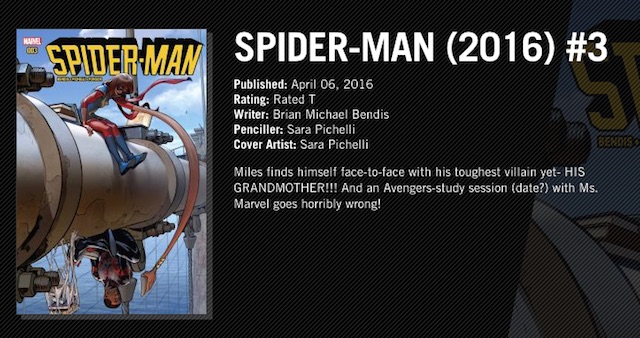
The promotional material for the third issue of Brian Michael Bendis’ Spider-Man promised Miles Morales would go up against “his toughest villain yet.” It did not disappoint, as the young hero and his family are subjected to an irascible jerk of a woman for most of the book. I found myself at times shocked that social-justice obsessed Marvel would allow a minority character to be written with so many flaws until Bendis disclosed the reason why: She’s a Christian hypocrite.

Miles Grandmother

Spider-Man #3 is a perfect example of how Marvel’s track record for inserting politics into comics alienates fans and mars an otherwise good title. It also shows how a good writer can subtly insert an agenda into his book so that many readers will be none the wiser.

Unlike other writers at Marvel, Bendis understands that most people will not care about the character under the mask if his personal life is not adequately developed. Readers will not be invested in supporting cast members if they randomly fly past the hero’s obit on occasion like a comet.

If Miles’ grandmother is going to play a huge part in his life moving forward, then it makes sense that an entire issue would be devoted to introducing her to the audience. If not, then the decision was a waste of time. I’m inclined to give Bendis the benefit of the doubt due to his track record.
Miles Dad

The problem, at least as far as this reader is concerned, is that once again a Marvel book shines an unfavorable light on Christianity.

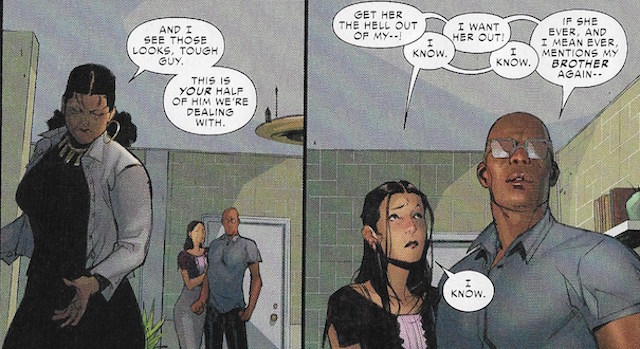
Miles grandmother generally acts like a buffoon. The way she treats his father is horrible. She shows zero respect for her own daughter. She barrels through the house and leaves anger and confusion in her wake, and then when she tries to show a softer side she tells Miles, “Let Jesus be your guide.”

Indeed, that is great advice. Unfortunately, it seems as though the only time Marvel talent puts a spotlight on Christianity it is in a negative light.

  • Dan Slott of The Amazing Spider-Man tells Christians who win legal cases before the U.S. Supreme Court to go to “Christ-Land.” (I’m still waiting for him to tell a bunch of Jews to go to Jew-topia over a similar disagreement, but I don’t think that will happen.)
  • Nick Lowe dresses up as the pope for Halloween for laughs because dressing up as Mohammed or an Orthodox Jew would require personal and professional courage.
  • Dan Slott used the San Bernardino, California, terror attack to mock Christians who prayed to God after the massacre.
  • Jose Molina’s “point” tales in ASM turned Peter Parker into The Amazing Spider-Atheist — so much so that he called God a “lie” after Uncle Ben’s death.

Under normal circumstances there would be no reason to care about having a Christian hypocrite appear in the Marvel universe because everyone is guilty of hypocrisy at some point. We are all fallible.

The reason why it is an issue with Marvel as a company is because there is a repeated pattern of anti-Christian sentiment disseminated by its staff.

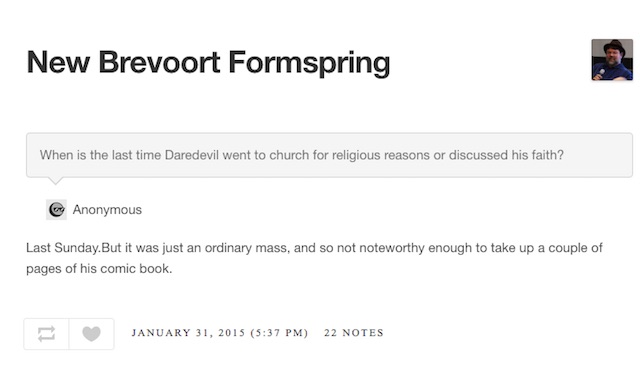
Jose Molina’s Peter Parker will call God “a lie,” but where is the Marvel character who openly calls God “the Truth” in print? Daredevil is a Catholic, but his faith is regularly ignored and Tom Brevoort makes jokes of that fact on Formspring

How sad is it that fans of the character have to watch the Netflix series to see him go to confession or make the sign of the cross?
Brevoort Formspring Daredevil

Brian Michael Bendis will introduce a Christian hypocrite who is incredibly grating to readers, but when will they get a Christian character who is the modern equivalent of Saint Francis, Dom L. Scupoli Apulia, G.K. Chesterton, St. John of the Cross, etc.?

Regular readers of this blog know that I have given Bendis’ work great word of mouth for months — for both Invincible Iron Man and Spider-Man.

I want to support Marvel, but there is almost no reason to do so when time after time its creators needlessly take sucker punches at my faith or political persuasion.

Miles Morales Grandma

With that said, the only other development in the issue involves Black Cat, who apparently wants to go after the “new” Spider-Man in town.

Marvel’s insistence on portraying Black Cat as a wannabe Mafia Queen is laughable. As is the case with every other editorial misstep, the guys in charge would rather dig their heels into a stupid-trench than admit they were wrong.
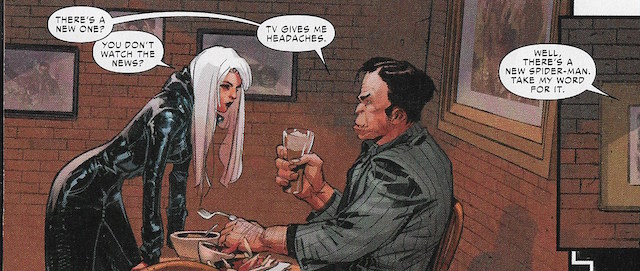
Black Cat Hammerhead

Spider-Man #3 is an important issue in terms of establishing family dynamics that will come into play in the months ahead, but it should also serve as a red flag for potential customers of faith.

When there is a chance to denigrate your worldview, Marvel will almost always jump at the opportunity. Its best writers insult you with kind of finesse that on some level is impressive, but they insult you nonetheless.

Do not buy this book if you are sick and tired veiled and unveiled political pot shots by Marvel’s writers and editors.

Exit question: Should I continue reviewing Bendis’ Spider-Man? On some level I feel as though it is important to shed light on what Marvel is doing. My thought process is that I may spend $50 a year reviewing a book, but exposing political or religious suck-punches will cost the company more in the long run. Let me know what you think in the comments section below.
Proactive healing: Recovery requires hard work and a humble mind

Sciatic nerves NIH

Regular readers of this blog know that while I am a writer, I also enjoy physical exercise. What they do not know is that for the past year I have dealt with chronic back pain, which left me inactive for the first time in my life. Now that I have almost completely alleviated the pain, I think sharing the lessons I learned from the experience may be applicable to anyone in need of healing — physical, mental, or spiritual.

Roughly one year ago my back seized up and I found myself on a hardwood floor after 10,000 volts of electricity seemingly ran through my body. It took about 45 minutes to crawl towards my bedroom about 15 feet away. I was covered with sweat after pulling myself into bed (where I spent the next four days). Afterward, the pain lingered throughout my lower back and butt, but I had no idea where it came from.

“Is my old back injury from the Army acting up? Did pushing my wife’s car out of the snow damage something? Did I somehow hurt my back dead-lifting with improper form?” I thought.

Then, I went to work trying to figure out the best way to heal.

  • I stopped lifting weights and opted to exclusively run and swim — no success.
  • I exercised muscles around the affected area, hoping they would compensate for the weak point and give it time to heal — no success.
  • I tried only doing upper-body work — no success.
  • I tried anti-inflammatory pills — no success (unless I wanted to live on anti-inflammatories for the rest of my life and destroy my kidneys).
  • I tried osteopathic manipulative treatment — no success (my hips and back were out of whack within 24 hours after each treatment).
  • I tried a complete secession of physical activity — no success.

For a man who has spent his entire life being physically active, this sort of repeated failure was, in many ways, demoralizing.

“What if I have been completely wrong about the underlying cause of my pain this entire time?” I thought.What if the problem is something I would have never expected? If so, what could that be?”

I finally concluded my pain could be caused by the hours upon hours I sit in a chair each day, even though I have always made time for exercise when I am not working.

The possible solution turned out to be something I have avoided for years: Yoga.

Sciatica yoga

I looked up many videos on yoga for sciatic nerve pain and began stretching religiously twice a day.

At first, no success. I had almost zero flexibility and the stretches were somewhat painful. I kept at it.

Then, pain that was once dispersed throughout my lower body localized around my sacrum.

Then, I could get out of bed in the morning without pain, even if my back “wasn’t quite right.” My flexibility had dramatically increased.

Then, one day, I felt good enough to do a little dance in front of my wife — and my back said, “Nope! Not ready for dancing.”

This week, for the first time in one year, I exercised every single day and managed to work in dead-lifts with no problem.

The moral of the story is this: Healing often requires hard work. It also may require you to admit that all of your preconceived ideas of where your pain is coming from are wrong. On top of everything else, the healing process itself may demand you willingly endure more pain.

Time does not heal all wounds. Pills do not always work, and smart people often cause themselves a lot of pain by refusing to admit that they do not have all the answers.

The last thing I wanted to do over the past month is to admit that regular yoga was what I needed to heal my back pain and counter the many hours I sit in a chair for work. Luckily, I put my ego aside and listened to yoga instructors like Jen Hilman.

I was wrong. If you are in some kind of pain, then I implore you to be open to the idea that you too may be wrong about a lot of things. The decision may put you on the road to recovery faster than you think.