Civil War II: The Accused #1: Guggenheim does Daredevil well despite flimsy ‘SRA II’ set-up

daredevil-accused-1

This blog asked the following question roughly four months ago: Did Marvel learn from the mistakes of Civil War I? The answer to that question is a resounding “no,” and Civil War II: The Accused #1 further highlights that unfortunate point. As was the case with Christos Gage’s work on The Amazing Spider-Man and even Brian Michael Bendis’ on Spider-Man, fairly impressive writing is undermined by the story’s weak foundation.

Marc Guggenheim does an admirable job showing Matt Murdock’s role in the project, but editorial mandates will give many readers heartburn. In short, Marvel has planted the seeds for Civil War III. Sigh.
dd-cwii-accused-1

Here is what you need to know for CWII: The Accused #1:

  • The Department of Justice has asked Matt Murdock to join its case against Hawkeye, aka Clint Barton, who killed Bruce Banner. The ace lawyer accepts the challenge.
  • Barton asserts that Bruce Banner gave him the means to the Hulk if he returned. He says he does not know if he did the right thing, but that he had “a reason and it was a good one.”
  • The trial starts and the judge seems to have her thumb (actually, her entire fist) on the scale in favor of Murdock and his team of federal prosecutors. Hawkeye’s legal team meets with Murdock and tells him there is a conspiracy to make sure the superhero winds up in prison. Matt is told that if he looks for the truth then he will find out that he is being manipulated like a puppet.
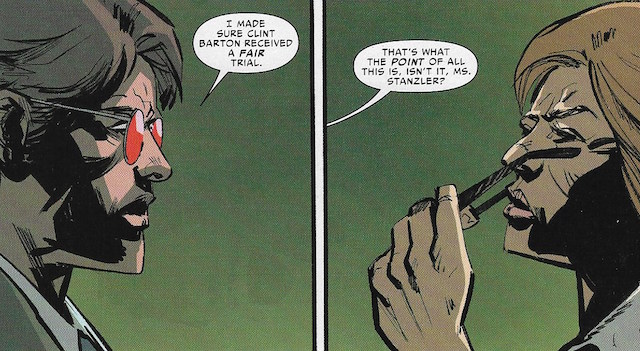
  • Daredevil breaks into the Department of Justice and comes across a meeting between a military general and federal prosecutor Evelyn Stanzler. The government wants Hawkeye in prison to give officials “political cover” to introduce Superhuman Registration Act II. A murder conviction will give them what they need.
  • Murdock shows up in court and withdraws the government’s motion to exclude Bruce Banner’s video diary from the case. He knows the move damages his case, but does so because he believes it will give Barton a fair trial.
  • Barton is ultimately acquitted. Most people believe Hawkeye did the world a favor.

The key bullet point here is the last one because people in the Marvel Universe would believe that a living and highly unpredictable nuclear weapon should be dead — especially after years of witnessing his destructive capabilities firsthand.

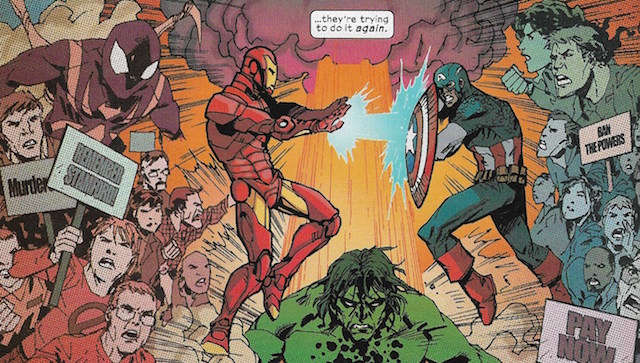
The government does not need to execute a successful conspiracy to launch Superhuman Registration Act II because the sound rationale for it never disappeared after it failed the first time.
matt-murdock-cwii-accused-1

CWII: The Accused #1 makes the case (no pun intended), that nefarious forces need a conviction to persuade the public that it is time for SRA II, which is laughable. The only reason why some readers do not get the absurdity is because Marvel turned Tony Stark into a psychotic warmonger in Civil War I.

If you want to see Mr. Guggenheim do the best he can with the shoddy hand he has been dealt, then check out CWII: The Accused. If you are tired of seeing heroes fighting heroes — and one side always being portrayed as cartoonish goons — then hold onto your cash. Amazing Spider-Man: Renew Your Vows is looking like a must-read.
Dan Slott, Mr. ‘politicize the f**k’ out of gun death ‘the second after news hits,’ bashes Trump for calling NYC bomb … a bomb

dan-slott-cbr

One of the most fascinating things about Marvel writer Dan Slott’s decision to turn his Twitter feed into a giant political soapbox is that readers get to see his never-ending stream of hypocrisy. When shootings or terror-related issues capture national headlines, he is always there to show fans of The Amazing Spider-Man that crafting strong stories comes secondary to political hackery.

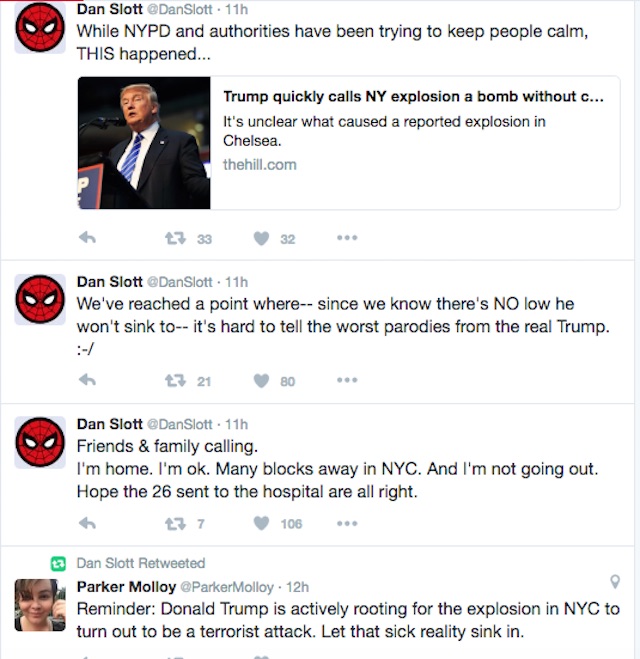
An improvised explosive device — a pressure cooker bomb — went off Thursday night in New York City and injured 29 people. A secondary device that failed to detonate was found blocks away. Republican presidential candidate Donald Trump told an audience of the explosion as news broke, and for that Mr. Slott called it a “new low.”

Anyone who is familiar with Mr. Slott’s online behavior over the years knows that the two men have more in common than he would like to admit. What makes this moment even richer is that his “new low” remark came moments after retweeting the following by another user: “Reminder: Donald Trump is actively rooting for the explosion in NYC to turn out to be a terrorist attack. Let that sick reality sink in.”

Dan Slott’s self awareness knows no bounds. It is indeed a “new low” to accuse a New Yorker of “actively rooting” for terrorism in New York.

Here is a”reminder” for everyone: Dan Slott is the same person who once said he wanted people to “politicize the f**k” out of his death if he were ever shot…“the second after news hits.”

dan-slott-nyc-explosion-tweets

Here is what Mr. Trump said:

“Just before I got off the plane, a bomb went off in New York and nobody knows exactly what’s going on, but, boy we are really in a time. We better get very tough, folks. It’s a terrible thing that’s going on in our world and in our country and we are going to get tough and smart and vigilant. We’ll see what it is.”

Question: Is it more deplorable for a presidential candidate to factually state that a bomb has gone off and that an investigation is underway, or for a writer to say that political opponents “actively root” for terrorism in their home town?

The answer is self-evident.

dan-slott-politicize-the-f

Even if Mr. Slott were correct and Mr. Trump was politicizing the bombing, what would give the writer the moral authority to lecture anyone on such behavior?

When a man tells tens-of-thousands of supporters to “please politicize” his own murder “the second after news hits,” he cannot harangue others for picking up the partisan baton and running with it.

Dan Slott’s Twitter feed is a free resource for anyone who ever wanted to learn about projection. His habitual need to blast “new lows” comes from the knowledge deep within his soul that it is he who engages in loathsome behavior.

Some of Mr. Slott’s many “new lows” have been chronicled here, since mainstream comic book websites fail to demand a modicum of professional behavior from the industry’s artists and writers:

The next time Mr. Slott starts bashing Donald Trump, I suggest reminding him that his online antics have mirrored the New York billionaire for many years. My guess is that the writer with impulse-control problems will block you, but that is to be expected as long as he continues to live in denial.

Update: 

Dan Slott, who blocked me on Twitter, once again shows the world that he still can’t help but read this blog. As usual, his tweets are filled with red herrings and utter falsities, which is why he won’t send people to check out with their own eyes what I have said.

dan-slott-stalking-douglasernstblog

I watched Trump’s speech as it was happening, and my Twitter feed had plenty of stories saying an explosion occurred inside a dumpster and that many people were hurt. I’m assuming that the New Yorker with Secret Service protection and national security briefings was also up-to-date well before the rest of us.

Readers who go to Dan Slott’s Twitter feed will note that he surreptitiously erased a re-tweet that said Donald Trump was “actively rooting for the explosion in NYC to turn out to be a terrorist attack.” Telling. Very telling.

Note to Dan Slott: I do not work for a “birther” conspiracy website. Nice try. That is your new go-to distraction because you don’t know how to respond to my blog posts and you are terrified to come here (there are no slavish moderators to shield you from intelligent scrutiny).

I have worked for years for the same newspaper, with only a brief leave of absence that I won’t get into for personal reasons. I wrote stories for another website for eight months, which has contracts with literally dozens of op-ed writers. Go online and try and find one birther story by me. You can’t find them because they do not exist.

In Dan Slott’s world, I am apparently responsible for what random op-ed writers say and do. Perhaps Dan should check with President Obama’s original literary agent, who boasted that he was “born in Kenya and raised in Indonesia and Hawaii.” Hmmm. Where would anyone get the idea that Obama was born in Kenya? Weird. I suppose the Daily Caller and every other media outlet that reported on this issue are also “birthers.”

Update II: You can’t make this up. Dan Slott deleted the tweets shown above. Classic! This is why he will not come to this blog and debate me. He knows that he cannot throw his stupid and impulsive comments down an Orwellian Memory Hole.

dan-slott-kobayashi-maru

What situation could possibly be Dan Slott’s “Kobayashi Maru”? Heh. Why don’t you join the comments section and tell us about it, Dan? Or not, because you can’t delete posts when you say foolish things.

Charles Soule’s ‘Dark Art’ continues slow burn in Daredevil #11

daredevil-11

New York City is home to the Museum of Modern Art and scores of creators who would do just about anything to get into its exhibits. Therefore, it makes sense that on a long enough timeline Marvel would have a Banksy-esque villain running around the city who would literally kill to get name recognition. The question on this blogger’s mind however, is this: Can a villain ever truly be cool if he wears suspenders?

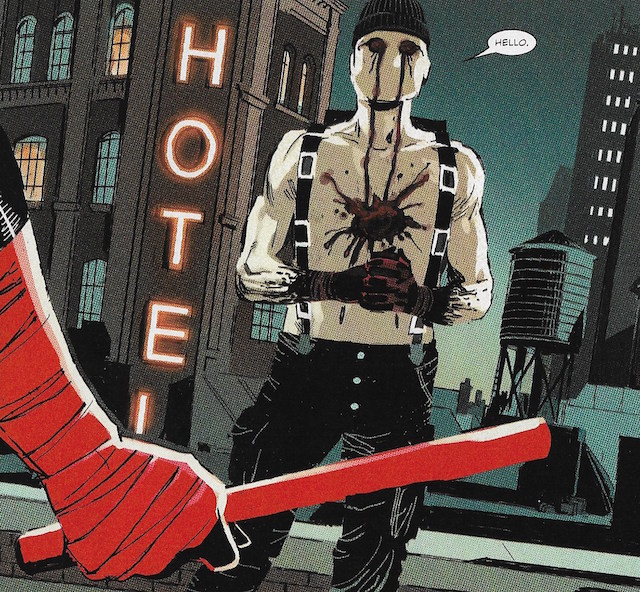
All joking aside, Charles Soule’s “Dark Art” continues its slow burn in Daredevil #11. When readers last left off, Blindspot had been lured to a Bronx building that contained a mural painted in blood. Daredevil concluded that over 100 people likely died during the project’s creation. DD #11 furthers the plot along and reveals the individual deemed “Vincent Van Gore” by the city’s tabloids.

Here is what you need to know about DD #11:

  • The owner of the building where the blood mural was found decides to charge people to see it. A powerful city councilwoman threatens to shut him down because her niece’s blood is on the evidence.
  • Owner Freedy Durnin tells the city official to take a hike because he knows his First Amendment rights and the painting is on private property. (Question: Wouldn’t the cops immediately take the mural as evidence for an ongoing missing persons case? It makes no sense that Mr. Durnin is allowed to keep it just because it was found inside his building.)
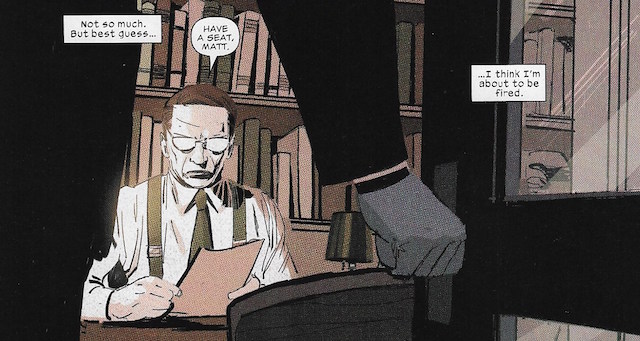
  • Matt Murdock’s boss calls him into his office and says the “wheels of justice have been greased” for him to shut down Mr. Durnin’s grotesque “exhibit.”
  • Matt meets with Foggy for coffee (the two have a chilled relationship), and they talk about what the D.A.’s office wants Matt to do. Matt says it isn’t right that government stooge’s are looking for ways to take a man down for political reasons instead focusing on their job — ensuring justice for all. Foggy says, “You wanted to be a D.A., Matt. All your wishes came true. So now…you do what they tell you to do.”
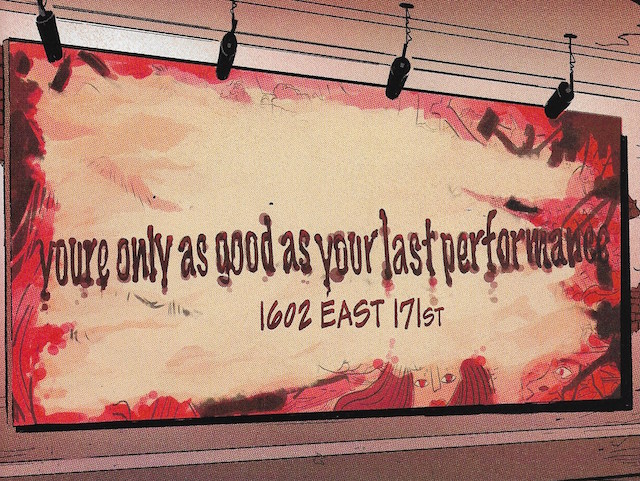
  • Opening night at Durnin’s exhibit is thrown into chaos when the mural is defaced with a new message: “You’re only as good as your last performance. 1602 East 171st.” Investigators find a murderous “tableau” with dead Inhumans inside an apartment. Matt Murdock interprets the “artist’s” work as, “Inhumans are humans, too.”
  • Matt picks up a racing heartbeat on a nearby roof. He finds and excuse to leave Samuel Cheung (aka, Blindspot), and their police escort, and soon confronts the individual as Daredevil.
  • “Did you like my work?” the killer asks.

Mr. Soule packs a lot of material into DD #11, but the slower pacing never hampers the book. If this were a story by Brian Michael Bendis, for example, it would be reasonable to believe that the payoff would come about 12 months from now — or never. But it’s Charles Soule, and up until this point his writing has been solid.

matt-dd11murdock

Perhaps one of the most impressive things about DD #11 isn’t the David Fincher-like murder mystery (think Se7en), but the fact that he is working a politically motivated D.A.’s office into the tale. The last thing I expected to see in a Marvel book in 2016 was an author who makes the case that city officials use a never-ending maze of laws and regulations to attack everyday citizens. In this instance the target of their rage happens to be a shameless jerk, but the underlying point is incredibly important. It is nice to see that Mr. Soule, unlike many of his peers, is capable of thinking outside petty partisan boxes.

dd-11-gallery

While it is a bit silly to think a man would not be forced to turn over a blood mural to the police, there really is not too much to complain about at this point. My wife says it sounds like Mr. Soule was inspired by an old episode of Criminal Minds, but until he reaches Slottian levels of “homage” (i.e., Dr. Who), I will forgive him.

Conclusion: Daredevil continues to roll as it nears one dozen issues. It’s just a huge shame that Mr. Soule continues to go with Bendis’ stupid decision to turn Matt Murdock into a “lapsed Catholic.”  That move fundamentally changes the character — in a negative way — for reasons I will cover in an upcoming blog post.

Editor’s note: A primer on my upcoming Daredevil post can be found here: ‘Daredevil Season 2 trailer: Good men grapple with rotten culture.’

inhumans-crime-scene-dd11

Related:

Daredevil #10: ‘Dark Art’ starts strong, but Soule drops ball on basic Catholicism

Bendis nicely sets up ‘Champions’ in Spider-Man #8, but classic heroes turned into giant goofs

miles-morales-spiderman-8

Brian Michael Bendis is one of Marvel’s key writers, but in a previous life he may have been a circus juggler. Spider-Man #8 somehow manages to move the title’s plot forward, set the stage for Champions, and seamlessly tie into Civil War II. Technically, Mr. Bendis hits all of his marks. Creatively, however, SM #8 once again shows why many older Marvel fans are fed up with the company.

Here is what you need to know for SM #8:

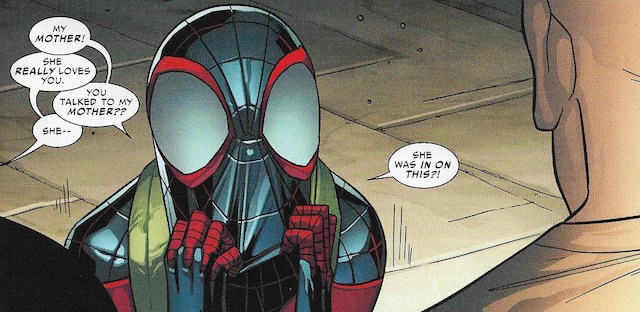
  • Jessica Jones and Luke Cage confront Miles Morales on a rooftop and say they know his secret identity.
  • Miles is upset to find out that his grandmother hired Jessica Jones to spy on him, but he is glad to hear that his mother tried to pay the investigator to cancel the contract. He agrees not to say anything to his family after the older heroes tell him to get his act together.
  • Miles is summoned to the Triskelion, S.H.I.E.L.D. headquarters, by Tony Stark. A large group of superheroes are informed by Stark and Captain Marvel that everyone will confront the Hulk about Ulysses’ vision of him killing everyone.
  • Bruce Banner is killed by Hawkeye, as previously shown in Civil War II #3.
  • Nova, Spider-Man, and Ms. Marvel are stunned by what happens and the two young men publicly state their allegiance to Tony Stark. Ms. Marvel breaks down into tears because her role model set the stage for Banners’s death.

This sounds like a great issue, right? Well, sort of. One’s enjoyment or hatred of SM #8 really hinges on his or her opinions on Civil War II. Bendis — and artist Nico Leon — do an admirable job showing young heroes who struggle to find their place in an “adult” world, but at the same time it all comes at the expense of classic characters.

nova-morales-spiderman-msmarvel

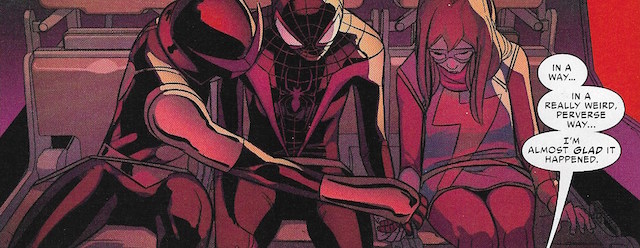
There is a scene after Banner’s death where the three kids come together to comfort one another that is incredibly poignant, but the feeling disappears the moment one realizes that Captain Marvel and every superhero who sides with her has taken on a goofy position to make Civil War II work.

sm-nova-msm-team

In short, Mr. Bendis has nicely set up an “us against the world” dynamic for the future “Champions” that will also serve Spider-Man well, but in many ways he is doing so at the expense of icons like the original Spider-Man, Peter Parker.

If you are an older reader, the best way to show your displeasure is to withhold your wallet for any title that engages in character assassination of the heroes that made Marvel what it is today.

spiderman-carol-danvers-cwii-asm4

‘Civil War II: Amazing Spider-Man #4’: Dan Slott’s ASM #17 haunts Christos Gage’s latest effort

cwii-asm4-spiderman-clash

It’s hard not to feel sorry for Christos Gage. The guy was asked to write a Spider-Man story that stood on its own while also supporting Brian Michael Bendis’ Civil War II and Dan Slott’s run on The Amazing Spider-Man.

Question: How does the hero who a.) asked The Prowler to resort to corporate espionage on behalf of Parker Industries, and b.) teams up with Carol “Minority Report” Danvers have the moral authority to lecture a confused man like Clayton Cole?

Answer: He doesn’t.

Civil War II: Amazing Spider-Man #4 is a book that actually reads better the less one knows about the current Marvel universe. For people who just want to roll around a few philosophical questions about redemption and free will like marbles, Mr. Gage’s work satisfies. For people who love the character Peter Parker, however, the issue is just one more reminder of just how intellectually discombobulated he has become thanks (in large part) to writer Dan Slott.

stromm

Here is what you need to know for CWII: ASM #4:

  • Spider-Man tries to talk Clayton Cole off a psychological ledge during the one-on-one battle predicted by Ulysses. Peter wants the scientist to give up his “Clash” technology and start a new life.
  • Robot Master reconstitutes himself and attacks the two men just as Peter seems as though he might have a breakthrough.
  • Clayton leaves Spider-Man to deal with the villain on his own, saying that he needs to go his own way.
  • Spider-Man defeats Robot Master, who vows to take Parker Industries to court for Cole’s attack.
  • Peter Parker and Ulysses discuss the Inhuman’s powers, whether they are appropriate to use, and how to channel them to save lives. Peter now says it would be wrong for Ulysses to work for Parker Industries because the company will be stronger by learning from its own from failures.
  • Spider-Man agrees to work with Carol Danvers to profile potential future criminals. He will fight for the cause if necessary, but says he will act like her personal Jiminy Cricket (It worked out so well with Doctor Octopus, right Pete?)
  • Clash steals a massive amount of off-the-books cash from Roxxon and announces that he will no longer work for other men. The villain begins to recruit for a criminal empire.

Fact: Clayton Cole wanted to “redefine” himself as a hero using Clash technology.

  • What then, we must ask, gave Spider-Man the moral authority to say that Clayton Cole should not do that, but Hobie Brown as the Prowler can?
  • Why is Dan Slott’s Peter Parker a stand-up guy for asking Mr. Brown to break into a business and steal technology for his own selfish reasons, but Mr. Cole is “ruining” his life for trying to turn over a new leaf as Clash — the superhero?
  • How can Peter Parker, a man who has been falsely convicted in the court of public opinion multiple times, endorse Captain “secret detention” Marvel?

In short, CWII: ASM #4 is filled with creative contradictions, which are not treated as such. As was stated in previous reviews, it is tough to discern how culpable Mr. Gage is for the story’s flaws when a strong argument can be made that he is doing the best he can with messes made by other men.

spiderman-carol-danvers-cwii-asm4

If you have read the previous three issues of Civil War II: The Amazing Spider-Man, then you may as well buy the conclusion. If you have held off this long, then skip it and take note: The modern Spider-Man is like a boat without an anchor in a storm that shows no sign of breaking.

Again, I feel bad for Mr. Gage — but even more so for the writer who eventually replaces Mr. Slott. Where does a man begin with so much rubble to clear? I guess we’ll find out.

clayton-cole-clash-cwii-asm4

Related:

‘Civil War II: Amazing Spider-Man #1’: Gage offers reprieve from Slott fare

‘Civil War II: Amazing Spider-Man #2’: Gage explores ‘self-fulfilling prophecy,’ recidivism, and redemption

‘Civil War II: Amazing Spider-Man #3’: Peter Parker turned into hypocritical jerk to keep story going


Bendis’ Tony Stark ‘loves’ woman he’s been on about 2 dates with; Invincible Iron Man #13 a giant boredom bubble

iim-tony-doom

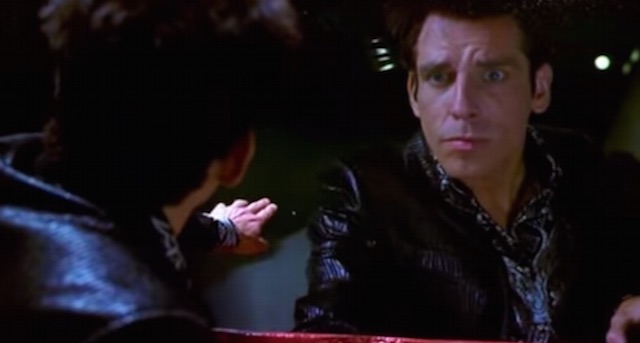
It was just under one year ago that Brian Michael Bendis’ Invincible Iron Man launched. Yours truly was excited at its potential, and even gave the first handful of issues rave reviews. Then, something weird happened. IIM became a plodding tale about Tony Stark’s search for an identity. He sat around his lab and, for all intents and purposes, did his own version of Derek Zoolander’s, “Who am I?” into a puddle of water.

IIM #13 is the culmination of a book that promised to take readers to great places when in reality it only gave them Victor Von Doom (looking quite a bit like Rand Paul) locked inside an energy bubble.

zoolander-who-am-i

Here is what you need to know about IIM #13:

  • Doom takes Tony to Cambridge, where biochemical engineer Amara Perera is illegally testing her experimental Alzheimer’s drugs.
  • Doom and Tony argue about whether or not they are friends or enemies.
  • Tony tries to explain why he didn’t tell his girlfriend that he was going undercover or get word to her that he didn’t die in Japan.
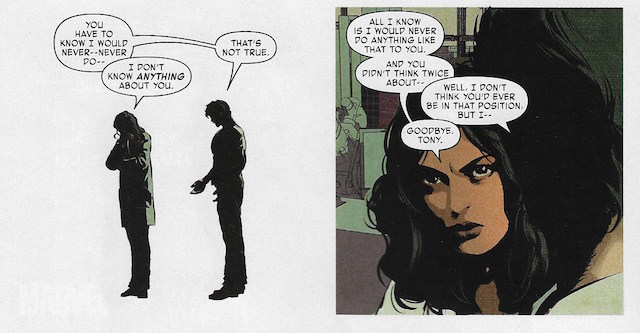
  • Amara Perera tells Tony “I don’t know anything about you,” and moments later he confesses his love.
  • Tony tells Amara about James Rhodes dying, leaves, and then spends time in his lab thinking about Rhodey. He does not attend the hero’s funeral.
  • Doom returns to torment Tony and is locked inside “a zero-point energy web net.” Tony says he wants answers. “You’re going to tell me why you’re all over me. Why? Why have you decided to be in my life all of a sudden? Why? Why me?” he asks.

Marvel fans already have a good idea how all of this will turn, given that IIM is going to be launched with RiRi Williams as Ironheart — and that Infamous Iron Man, “Iron Doom” will launch in October.

Before we move on, let us go over our Mighty Marvel Checklist:

  • Superior Spider-Man? Check.
  • Hydra-Cap? Check.
  • Infamous Iron Man? Check. 
  • Bruce Banner killed because he might go Infamous Hulk on everyone? Check.

Interesting pattern, Marvel. It seems like Tony isn’t the only one having an identity crisis…

iim-amara

What makes IIM #13 even worse is that Mr. Bendis is doing — on a much smaller level — what Dan Slott did with Peter Parker’s “close” girlfriend, Lian Tang (i.e., the one who tried to murder him).

It has been established that Amara Perera is a smart woman, but she and Tony’s “relationship” consists of a small bit of playful banter and cross-talk early on in the book. How does that translate into “love,” and why would Tony say that to a woman who a.) agreed to be “taken off the grid” by Doctor Doom, and b.) suddenly calls the villain “Victor”?

Answer: It would not translate into love.

Tony would not say that, and readers should be insulted that Bendis would make him go there with a woman who has always been skittish about his lifestyle, personality, and double-life as Iron Man.

iim-tony-stark-love

In short, if you have read IIM this long then you may as well buy the last issue before the relaunch. If you are considering Infamous Iron Man for you pull list, then just be aware that Iron Doom may essentially be the tale of Victor Von Zoolander.

Spider-Man #7: Bendis writes strong tie-in to Civil War II

Hulk kill

Brian Michael Bendis’ Civil War II has taken its lumps in terms of fan interest and sales, but the story is helping to define Miles Morales. Spider-Man #7 features the young man trying to determine whether he will stand and fight alongside Tony Stark in a war over the Inhuman named Ulysses, or if he will sit on the sidelines and let the veterans sort it out for themselves.

Here is what you need to know for Spider-Man #7:

  • Miles is having nightmares about the potential future he experienced, where the Hulk goes completely off the deep end (even by the Hulk’s standards), and kills everyone.
  • Miles’s parents cannot sleep. His mother knows that private investigator Jessica Jones is keeping information about Miles from her. Jones had to use her superhuman strength to carry Rio out of her office…and send a message to stay away.
  • Miles’s father wants the investigation (launched by his mother-in-law) called off, but the two parents seemingly don’t have the power to make it happen.
  • Miles web-slings around New York to clear his head and runs into Lana Baumgartner, aka Bombshell. After she stops a robbery by blowing up a van, Miles says her behavior is symbolic of a lot of other superheroes: “You stopped a robbery, but you started a fire.”
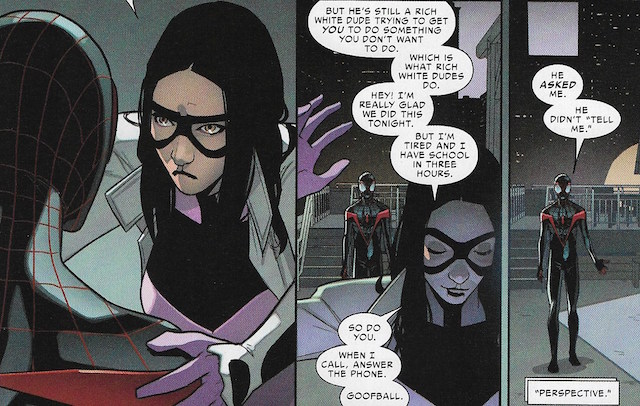
  • The two teenagers talk about the upcoming war between superheroes and Lana says that Miles is being manipulated by the “rich white dude” known as Tony Stark to do something against his will. Her reasoning — that’s what “rich white dudes do.” (Note: Don’t expect Bendis to ever have Miles Morales sarcastically reply: “You mean like Steve Jobs or Bill Gates or Elon Musk?”)
  • Miles has a nightmare during class and is forced to leave the room. He goes up onto a roof as Spider-Man and is confronted by Jessica Jones and Luke Cage.

All things considered, this was a pleasing issue for Bendis and it was made even better by strong work by artist Nico Leon. Whether one likes Civil War II or not, one of the long-term benefits of the tale is that it serves to define young characters like Miles.

SpiderMan Bombshell

The challenge for Bendis, however, will be to adequately show the “now what?” — the follow-through that often seems missing from his work. The writer has a habit of toying with big ideas and then placing them aside to focus on something else.

Whether Bendis is writing Tony Stark in Invincible Iron Man or Miles Morales in Spider-Man, in many ways he keeps them in a holding pattern. He occasionally dips and swerves the plane to the left or the right, but at some point in time his passengers realize that they have been deceived — they’ve just been flying in circles.

After seven issues of Spider-Man, readers want to know “Who is Miles Morales?” While it is true that he is a young character who is finding his voice — and part of the fun is going on that journey with him — it seems as though Bendis is being stingy with key aspects of the hero’s personality. Either the writer doesn’t yet know what the character really represents, or he is scared that readers will not like what they hear.

If you planned on checking on Spider-Man, then Bendis’ seventh issue is a good jumping-on point. Potential customers just need to know that  Miles Morales’s character development has been frustratingly slow since the series first launched. Perhaps the conclusion of Civil War II will change that.

Bombshell SpiderMan

Dan Slott’s Spider-Man: ‘White Privilege’ is having Peter Parker resort to corporate espionage, getting Hobie Brown to die for his sins

Hobie Brown death

Your friendly neighborhood blogger said less than one month ago that Marvel writer Dan Slott’s setup for “Dead No More” was worth buying, but that all the warning signs were there “for another round of character assassination.” In lightening-fast speed that would make Olympic sprinter Usain Bolt blush, Mr. Slott managed to stab Peter Parker in the back and twist the knife in 21 days.

Years from now, The Amazing Spider-Man #17 will hopefully be used in a documentary titled The People vs. Dan Slott. The issue includes the moment in time when Peter Parker — the guy who took on corporate saboteur Ghost on multiple occasions — became the very same kind of criminal. Worse, he guilted a good friend with a criminal past into doing the dirty work for him — and the result was deadly. 

For all those social-justice activists out there, let me put it to you in a way that you can understand: “White Privilege” is having Peter Parker resort to corporate espionage and convincing a black friend to die for his sins. Thanks, Dan Slott!

Here is what you need to know about ASM #17:

  • Peter Parker tells Hobie Brown that he needs him to break into New U and steal their intellectual property. He wants to use the company’s nascent technology on Jay Jameson, but requires access to its private data. (Yes Dan Slott, “taking pictures” of a company’s private research after breaking and entering is stealing.)
  • Hobie Brown tells Peter he can’t do that because “industrial espionage” is out of bounds. “I don’t do that anymore,” he says, which is met with a guilt trip about “FAMILY.”
  • Hobie reluctantly agrees and puts on his Prowler uniform. The once-reformed criminal, thanks to Dan Slott’s Peter Parker, becomes a recidivist offender. (The whole scene is more disgusting, given Spider-Man’s lecture to Clayton Cash in Civil War II: Amazing Spider-Man #3.)
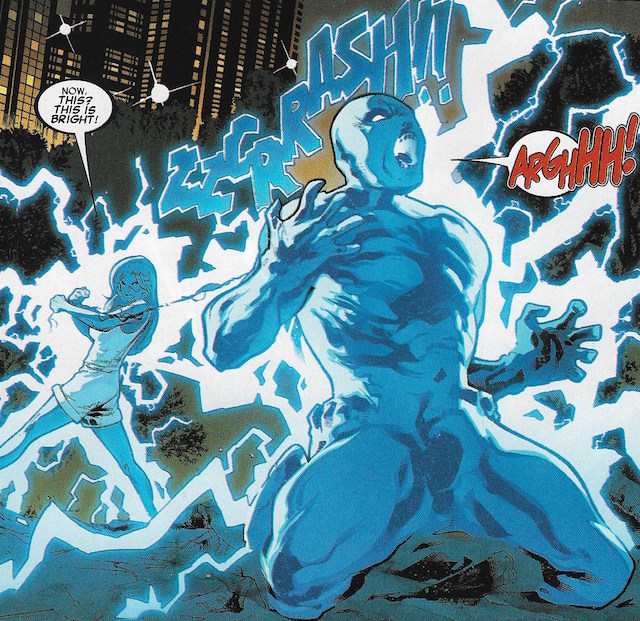
  • Miles Warren, aka The Jackal, tries to give Electro his powers back but the process does not work. Francine (the woman he killed with a kiss before she was resurrected) is nearby, which causes her “genetic mix” to attract Max Dillion’s latent powers. She kisses him to absorb his energy and ironically kills him.
  • Hobie gives up his position to stop Francine. He tries to flee after it is obvious that Dillion is dead, but the new Electro tracks him down and chars him to a crisp. “Told Parker I wasn’t cut out for this. I work best in the shadows…and I stay out…of the light,” he thinks before death overcomes him.
  • The Jackal revives Hobie and shows him secrets that prove his team consists of the real “good guys.” Hobie agrees. When Peter calls from Oklahoma to say New U scientists are going to perform a procedure on Jerry Salteres, he gives no indication that anything is wrong.
  • Miles Warren shows Hobie a pill and says he needs to take it on a daily basis.

Yes, you read that right, Peter Parker asked Hobie Brown to break the law, and then before his partner in crime got back to him with a full report he admits that he was going to approve New U’s procedure anyway (i.e., Thank for dying for nothing, sucker. Mr. Salteres is the perfect guinea pig to see if the surgery would be right for Jay Jameson).

Prowler

If you’re wondering how on earth Spider-Man fans got to the point where their hero is no better than the goons who tried to steal Tony Stark’s technology over the years, then look no further than the flashback scene Dan Slott writes on the first page of the issue.

Bad guys are just like the good guys…except they don’t hold back. They don’t follow any rules,” Francine says before kissing Electro.

This is the kind of moral relativism that has been on display since The Superior Spider-Man. Doctor Octopus is a megalomanic who nearly succeeded in exterminating 6 billion people, but to Dan Slott the two men are not all that different. (Heck, the writer even said that Doc Ock was better than Peter at appreciating those who are “truly beautiful”…)

Mr. Slott told Newsarama on April 5, 2013:

Slott: [Otto is] trying his best to be a hero, but he’s doing it in a very Doc Ock way. And Doc Ock’s an egotistical, annoying sh*t. It makes him an interesting character. At his core, he’s someone we don’t really think of heroic. But is he any more annoying than [former villain] Hawkeye used to be? …

Also, when you look at Doc Ock, he was so much like Peter Parker. Peter Parker, if he didn’t know the lessons of power and responsibility, that teenage nerd would have grown up to be an Otto Octavius nerd, with the same kind of, “I’m going to make them pay.” This is the flip of that. …

Do you see Punisher as a hero? Do you see Wolverine as a hero? If these guys can be heroes, why can’t Doc Ock?

Dan Slott admits that he thinks Peter Parker is, for all intents and purposes, one step away from becoming Doctor Octopus.

That is why his Peter is so obsessed with death.

That is why his Peter is willing to exploit the trust of a reformed criminal for his own selfish purposes.

That is why his Peter’s moral compass aimlessly spins in circles — and that is why readers can expect more embarrassing behavior from their “hero” in the months to come.

Hobie Electro

ASM #17 is officially the issue where Hobie Brown died, but many Spider-Man fans should consider it the issue where Dan Slott assassinated Peter Parker.

Prowler Hobie Brown death

Related:

Amazing Spider-Man #16: Dan Slott sets the stage for ‘Dead No More’

Amazing Spider-Man #15: Dan Slott’s Regent took down a god, then falls to … Mary Jane

Bendis botches Ironheart launch with Tony Stark fans

Iron Man fans know that the clock is ticking on Tony Stark. Brian Michael Bendis is relaunching Invincible Iron Man with a new character — Riri Williams — as the protagonist. This young woman, who Bendis said is “probably” smarter than Stark, will call herself Ironheart.

It is my belief that Marvel has once again botched an opportunity to diversity its stable of superheroes without annoying long-term readers. Check out my new YouTube video on the subject and let me know what you think in the comments section below.

Spider-Man movies called ‘white-boy fantasy’: The Root writer says Zendaya casting not ‘progress’

Jason Johnson

The Root bills itself as an “opinion and culture site for African-American influencers,” which works out nicely because I was recently looking to see what such self-proclaimed individuals were saying about Zendaya’s role as MJ in Spider-Man: Homecoming. It turns out that Spider-Man is a “white-boy fantasy” and nothing you ever do is good enough for “influencers” like Jason Johnson.

Mr. Johnson wrote on Aug. 23 for The Root’s “No, Zendaya in Spider-Man: Homecoming Is Not the Progress We’re Looking For”:

Consequently, the announcement that she’s been cast as Peter Parker/Spider-Man’s long-term love interest, Mary Jane, in Spider-Man: Homecoming next year has given many people all sorts of excitement and feels. I am not one of them. Casting Zendaya as Mary Jane is another example of Hollywood expecting black dollars at the box office, but disrespecting black consumers and fans on the big screen. …

Zendaya’s casting is yet another sign that makers of Hollywood sci-fi fantasy action films will “racebend” a character (change a character’s race from what it was in a book, film or cartoon), slap themselves on the back for being progressive and expect black fans to be satisfied, while pretty much maintaining the status quo. Racebending is fine so long as it’s for girlfriends and sidekicks, but the movies are still white-boy fantasy adventures in which the lead remains a straight white male no matter what. And that unfortunate fact can’t be separated from the choice to cast Zendaya as Mary Jane.

There was never a doubt or even a conversation about casting anyone other than a white man as Iron Man, Thor, Captain America or the Incredible Hulk. Even though Iron Man was black in the early 1980s, the first Captain America was a black man, and Thor as a Norse God could be anybody.

Are you a young comic book fan who is on the ideological fence? If so, then consider the psychology on display with Zendaya’s casting:

  • If you think movie producers should try to adhere as closely as possible to the source material, then liberal guys like Dan Slott will imply that you are a racist.
  • If you think movie producers should try to adhere as closely as possible to the source material, then liberal guys like director James Gunn will say that you have “too good of a life.”
  • If you think movie producers should try to adhere as closely as possible to the source material, then liberal guys like Devin Faraci of the website Birth. Movies. Death. will call you a “racist fanboy.”
  • Conservative guys like me will shrug their shoulders and say, “Yeah, but Zendaya may still be pretty good. As long as she tints her hair red then we should just give the girl a chance.”
  • Meanwhile, liberals like Jason Johnson will mock you for your “white-boy fantasy” even if you do give Zendaya’s casting three cheers for diversity. You are damned if you do and damned if you don’t. Welcome to a life of Kobayashi Maru-type scenarios if you board the USS Social Justice.

As your friendly neighborhood blogger has said on numerous occasions, social-justice obsessives are never satisfied. Any attempt to placate them will only result in additional admonitions that require an apology, new demands to meet without question, and more rules that undoubtedly conflict with a sub-group of professional victims someplace else.

Between now and the July release of Spider-Man: Homecoming, I implore anyone who is still trying to define their ideological identity to conduct a test: Come to this blog and disagree with me just to see how I react. Then, do the same with liberal writers like Dan Slott or Nick Spencer. By the time your favorite wall-crawler returns to theaters, I am confident that you will no longer be on the fence.