Spider-Man #4: Bendis reveals Morales’ secret identity — to ‘Goldballs’

Miles Ganke

Superheroes tend to place a high value on their secret identities, and Miles Morales is no exception to the rule. Unfortunately, the fourth issue of Brian Michael Bendis’ Spider-Man shows the hero losing it due to a decision by his best friend Ganke. He spills the beans to ex-X-Man “Goldballs” of all people. (Yes, Goldballs.)

Like the surface-to-air missiles that target Miles after Ganke’s betrayal, this issues misses the mark.

Before we move on, here is what you need to know:

  • Miles and Ganke argue in the school lunch room whether it’s harder to be a black teen in America or an overweight asian (groan).
  • Ganke wants Miles to talk to the new kid, Fabio Medina (aka: Goldballs), because they both have superpowers.
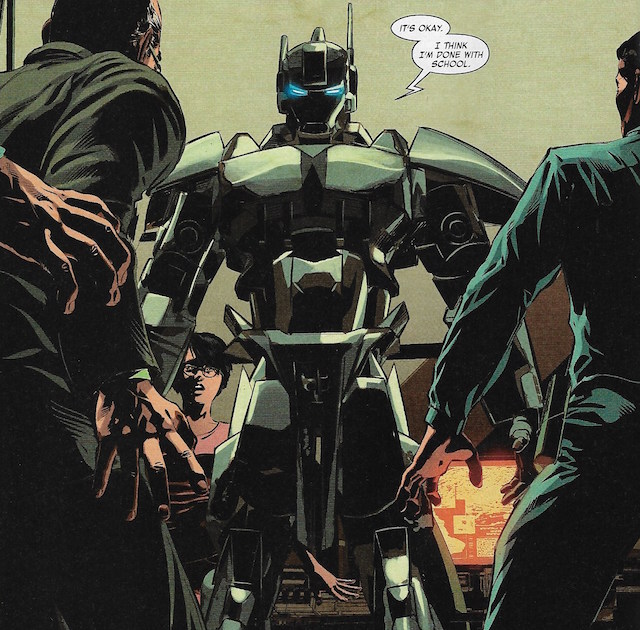
  • When Fabio accidentally launches one of his “goldballs” into Ganke’s food, the three young men start talking and Ganke inexplicably reveals his friend’s secret identity.
  • Miles storms off and while web-slinging through the city he is targeted by four heat-seeking missiles.
  • Spider-Man is knocked to the ground due to the concussive blast of one of the missiles. Hammerhead steps out of a vehicle and says it’s time to call Black Cat and collect his bounty.

Miles Morales 3

The decision to explore a best friend’s betrayal in a book involving high-school kids is appropriate, but it seems quite a stretch for someone like Ganke to suddenly reveal Miles’ secret identity. A writer should spend a lot of time setting the stage for game-changers, but readers sadly did not get it this time. As a result, half the issue didn’t ring true.

Making matters worse is the fact that Miles says, “I have actually never been this mad at anyone about anything,” but we never see his anger. He web-slings around the city for a few moments and then his spider-sense alerts him to incoming missiles.

Try this out: Think of the angriest you’ve ever been in your life. What did you do? How did you react? Did you just say, “I’ve never been this mad” and then walk around, or did you punch, kick, yell or scream?

A few years ago an old Army buddy of mine said, “Do you remember that time that you got so mad at [insert name of horrible squad leader here] that you burst into our room, slammed the door, screamed, flipped your entire bed, and then took off for the motor pool?” 

I do remember that — and that isn’t the most angry I have ever been.

People do not think clearly when they are livid. Given that, it seems like a no-brainer for Miles’ to have been so upset that he didn’t notice his own spider-sense going off until it was nearly too late. Maybe he could have even kicked a garbage can as he exited the school and sent it flying 100 yards down the road. Something — anything — would be better than just telling readers that Miles is angry.

After the heat-seeking missiles magically miss Miles while in “cammo mode,” he decides to lure them to parts of the city where detonations will pose the least amount of risk to the civilian population.

Miles Parker Industries

Miles chooses to destroy a Parker Industries sign, which is funny given that Arachno-Rockets” (See ASM #9) filled with liquid hydrogen are stored inside the building.

We’ll just say that it was by the grace of God that Miles didn’t kill scores of people…

Spider Rocket

Our hero’s luck runs out and he is seemingly incapacitated at Hammerhead’s feet. Besides wondering how a has-been underworld thug like Hammerhead got his hands on some SAMs and then deployed them in the middle of New York City, readers must now ask the following question: Is Spider-Man worth it? The jury is still out for this blogger.

  • If you like Marvel’s new take on Black Cat (I don’t), then Spider-Man #4 is for you.
  • If you like Hammerhead (I don’t), then Spider-Man #4 is for you.
  • If you like Goldballs (Huh?  Why, Marvel?), then I guess Spider-Man #4 is for you.
  • If you like best friends who act irrationally, then Spider-Man #4 is for you.

Spider-Man certainly has potential, but as of right now it still feels as though Bendis’ search for Miles identity within the 616 Universe is coming through in the title.

How big is his stable of characters to pick from? If Bendis is forced to use Goldballs and Hammerhead this early in his run, then it doesn’t bode well for the future. Perhaps he is limited one what villains he can use because Dan Slott needs them for The Amazing Spider-Man. Whatever the case, Bendis needs to settle into a groove soon our readers will move on.

Black Panther #2: Perhaps Ta-Nehisi Coates should have written a T’Challa novel instead

Black Panther 2

Black Panther #2 was released in comic shops across the nation on Wednesday, but it is beginning to feel as though Ta-Nehisi Coates would have been better off writing a novel called T’Challa instead. Marvel’s decision to experiment with a political commentator may be a noble one, but the company will need more than three variant covers to inflate sales in the future if Coates doesn’t make some editorial adjustments.

Black Panther 2 preview
Marvel is going to need more than three variant covers in the next year to sell copies of Black Panther if Mr. Coates doesn’t pick up the pace.

My review of BP #1 noted that there was a lot — perhaps too much — going on with “A Nation Under Our Feet.”  T’Challa returned to Wakanda to reclaim his kingdom; Shuri, his sister, died (or, rather, is trapped in a place “between” life and death); two members of an “elite female royal guard” stole “midnight angel” suits and vowed revenge against men who abuse their power; and T’Challa tried to revive his sister.

BP#2 is just as dense:

  • Readers learn more about the Nigandan plot to overthrow Wakanda.
  • The Midnight Angels save captured women in the Bandit Compound in Northern Wakanda.
  • Aneka and Ayo cuddle again and further plot their revenge.
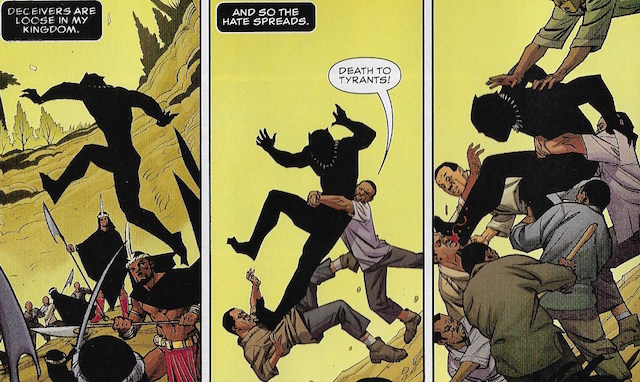
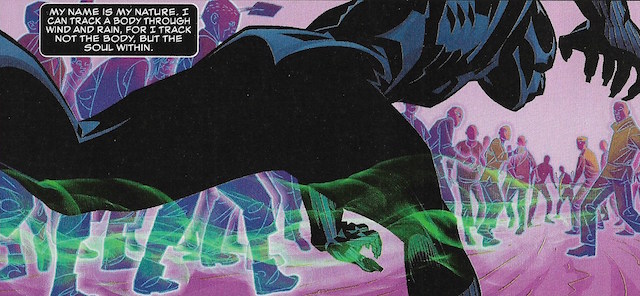
  • Black Panther confronts the “witch” who has been poisoning the minds of Wakandans, but learns that she is really a “revealer” who forces repressed feelings to the surface.
  • A shaman and an academic, old friends (soon to be rivals?) discuss how “the weak” should “marshal justice against the powerful.”
  • Shuri finds herself conscious on the “plane of Wakandan memory.”

In many ways, BP is set up to be a book that is almost totally devoid of fun:  T’Challa — a man who must bear the weight of family history, his nation’s history, and the needs of those currently alive — even says, “heavy is the head… [that wears the crown].” Given that, it would be strange to criticize the author for being too mired in politics and philosophy when the book dictates a mastery of both fields of study. The problem, therefore, is likely something else.

The reason why BP continues to be an awkward title is not because readers are introduced to John Locke or allegories to real-world crises (e.g., Boko Haram kidnapping and raping women). The problem with BP is that Coates is juggling too many balls at one time.

Instead of spending time on Aneka and Ayo, perhaps Coates should have solely focused on the “mysterious woman.” That is six pages in BP #2 that could have been devoted to T’Challa, his new enemy (who does have a cool power), or his sister.

Instead of spending time in Hekima Shule (a school), why not plant the seeds for introducing a major Marvel villain? I want to see Black Panther face off against Sabertooth. I want to see Black Panther in hand-to-hand combat with Crossbones. I want to see Black Panther battle Blackheart.

What I do not want to do is read a BP comic book that focuses for 12 months on how much Aneka and Ayo love each other — even if the writing is technically sound.

Mr. Coates is an intelligent man, but at some point in time it will be a stupid decision not to use the rich Marvel rogues gallery at his disposal. If there is not a major Marvel villain in the book — or even the hint of one — by the sixth issue, then this reader will move on to another title.

‘Captain America: Civil War’: Russo brothers deliver mic-drop worthy Marvel movie

Captain America Civil War

Captain America: Civil War is downright amazing. It’s scary-good. It’s so good that it makes one wonder if Joe and Anthony Russo cut some sort of weird deal with Mephisto to make it happen. The script is so tight and the direction is so proficient that employers should ask questions about it during job interviews — any candidate who says Civil War is a rotten film should be told to have a nice day and shown the door due to their unfortunate lack of good judgment (I’m kidding … sort of).

For those who have been living in an underground bunker for the last year, Civil War involves the disintegration of the Avengers when the international community demands regulations governing the actions of super-humans. The United Nations has had enough with civilian casualties and diplomatic headaches linked to free-wheeling superheroes, and Tony Stark agrees. Steve Rogers decides the world is safest if he and his allies are only beholden to their own consciouses, and the disagreement puts everyone on a collision course.

Since this is a spoiler-free review, I will concentrate on what the Russo brothers professionally accomplished and only talk in broad brushstrokes about the of the film.

Imagine you’re the Russo brothers.

Now imagine Kevin Feige gives you $250 million and tells you to find a way to utilize Captain America, Iron Man, Winter Soldier, Black Widow, Falcon, War Machine, Hawkeye, Black Panther, Vision, Scarlet Witch, Ant Man, Spider-Man, Crossbones, and Zemo. You need to make sure the script is tight, juggle all the weirdness that actors bring with them to the set, navigate countless professional mine fields, and then somehow deliver a product that can impress a fanbase that has been spoiled with excellence since 2008’s Iron Man.

The verdict is in: Captain America: Winter Soldier was not a fluke. These guys not only met expectations given an almost impossible task — they exceeded expectations. Civil War is a modern superhero classic and should be used as the gold standard by which future installments are judged. One almost feels bad for the pressure their own greatness has created as production on Avengers: Infinity War – Parts I and II begins.

Regular readers of this blog know I am a stickler for superhero stories that work on multiple levels. If some child (or an adult) just wants to see Spider-Man swing across the screen and come to blows with other superheroes, then he or she will exit the theater with a smile. If intellectually curious individuals want their superhero flicks to be much more than “popcorn fare,” they too will be happy after the end credits roll.

Civil War has gravity, but it also has lighthearted humor. There is plenty of action, but the blows actually mean something because the script took the time to adequately address every character’s motivations. As an added bonus, the world will now get to see cinematic killjoys attempt to nitpick the film into oblivion (e.g., Well, the score wasn’t all that great and it was a bit too long.)

“Compromise where you can, but where you can’t — don’t. Even if everyone is telling you that something wrong is something right. Even if the whole world is telling you to move, it is your duty to plant yourself like a tree, look them in the eye, and say, ‘No. You move,'” S.H.I.E.L.D. agent Sharon Carton (Emily VanCamp) says at one point of advice her aunt once gave her.

After watching Civil War, it is obvious that the Russo brothers had a vision and refused to compromise on all the issues that mattered.

If you are a fan of superhero movies, then you owe it to the creative team that put Civil War together to see it before it leaves theaters.  When you are old and grey you will watch it again and say, “Those were the good old days.”

Bendis hopes Tony Stark fans take to Iron Riri … because Riri

RiRi Man

When Invincible Iron Man fans last left off, writer Brian Michael Bendis led them to believe Tony Stark, James Rhodes, and Spider-Man died in an explosion perpetrated by a mysterious enemy. IIM #9 picks up four weeks later and Tony Stark is still missing.

Investors want answers because a dead man cannot run a company. James Rhodes wants answers because he and Spider-Man apparently survived. MIT student RiRi, a teenage genius, is also looking for the billionaire in a suit she made from stolen parts because … why, exactly? The reasoning Bendis gives her is pretty flakey: Fate.

RiRi

Before returning to RiRi, here is what you need to know about IIM #9:

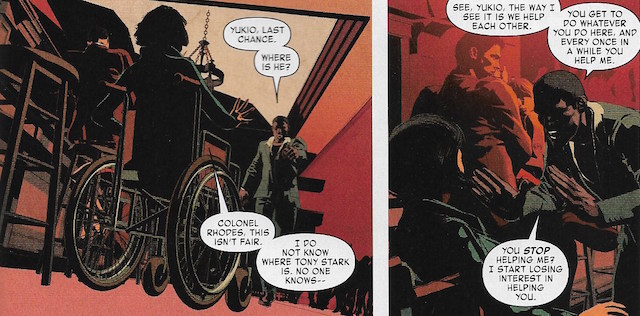
  • Rhodey returns to Osaka, Japan, to press Yukio for answers on Tony’s disappearance. He threatens to shut down her illegal gambling operation if she doesn’t talk.
  • S.W.A.T.-type agents raid Yukio’s establishment when she refuses to help. An anonymous man beats up Rhodey and takes her to safety during the chaos.
  • Doctor Doom convinces Stark’s girlfriend, biochemical engineer Amara Perera, to illegally test her experimental Alzheimer’s drugs on humans.
  • The man who helped Yukio escape, “Mr. Franco,” turns out to be Tony Stark in disguise. He somehow faked his own death to get closer to the organization that tried to kill him.

James Rhodes

IIM is now nine issues into its run and, quite honestly, not a whole lot has happened. While Bendis does a good job laying out breadcrumbs for readers to follow, there is only so long one can walk before fatigue sets in.

At this point it seems like a legitimate question for fans to ask, “When will we get the payoff?”

True, IIM has had moments of action, but they still have not really brought readers any closer to knowing what is going on with Madam Masque, Doctor Doom, or bio-hacking ninjas. The slog may be worth it, but at this point Bendis is testing readers’ patience. Spending time on a character who appears to be just the latest effort by Marvel to fill out a diversity checklist (i.e., We’ve got a new Iron Man — but’s it’s an Iron Woman and she’s a minority. How do you like us now?) exacerbates the problem.

Tony disguise

Will RiRi be a cool character? Perhaps. It just seems as though Marvel is on a weird quest to make female and minority versions of countless established characters.

Peter Parker, meet Miles Morales. Thor, meet She-Thor. Steve Rogers, go be an old man and make way for Sam Wilson. Logan, meet X-23. Bruce Banner, step aside for Amadeus Cho. Tony Stark, meet Iron Riri.

Sometimes it works, as with Sam Wilson and Amadeus Cho, but at the end of the day Marvel would be much better served by creating diverse heroes who are not derivatives of the classics.

If you have been reading IIM, then you should give Bendis a few more issues to deliver a decent payday before possibly jumping ship. If you have not been reading IIM, then you should probably wait until “The War Machines” wraps up before investing in the title.

Amazing Spider-Man #12: Slott’s Peter Parker impotent, Alpha Stark cradles MJ

SpiderMan IronMan

The introduction to the 12th issue of The Amazing Spider-Man informs readers that Peter Parker has returned to New York City to “breathe a sigh of relief” after his recent showdown with the Zodiac terrorist organization. Indeed, writer Dan Slott then goes on to provide a palate-cleanser in the form of an old-school team-up between Spider-Man and Iron Man. It’s generally a fun tale that includes the return of Mary Jane, plenty of action and humor, and set-ups for Marvel’s Civil War II and the return of Regent. Mr. Slott’s fundamental misunderstanding of who Peter Parker is, however, needlessly produces a character who is socially impotent and politically aligned with his adversary.

The story goes as follows:

  • Parker Industries is hosting a black tie event to raise money for the Uncle Ben Foundation.
  • Tony Stark and his personal assistant, Mary Jane, are in attendance.
  • Augustus Roman (aka, Regent) of Empire Unlimited shows up.
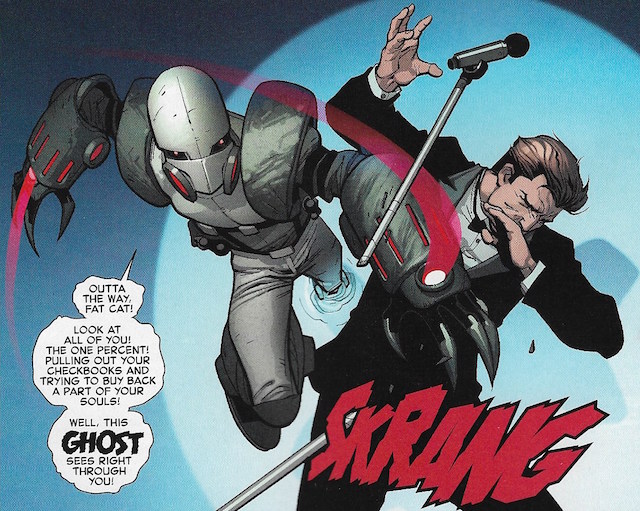
  • Corporate saboteur “Ghost” crashes the party.
  • Spider-Man and Iron Man team up to save the day.
  • Roman’s facility for super-powered criminals, The Cellar, is introduced.

If you are the type of reader who mindlessly consumes comic books like I devour chocolate-covered raisins before a big-budget movie, then stop reading now and buy ASM #12.

If you are the type of reader who wonders why Peter Parker so often does not seem right under Mr. Slott’s direction, then read on. You may want to save that $4.00 for another book — perhaps the next issue of Charles Soule’s Daredevil.

ASM #12 demonstrates from the very first panel that Dan Slott does not know how to strip his own politics from the book to provide a superior (no pun intended) product.

If you, dear reader, were to become the CEO of a major company, then you would have no problem buying a nice tuxedo for black tie events. If attending charity fundraisers was a recurring obligation you had as CEO of “Successful Business Dude Inc.,” then taking time out of your schedule to rent and return cheap suits would be bizarre.

Dan Slott’s Peter Parker, however, embraces the bizarre and as a result becomes, for all intents and purposes, politically aligned with corporate saboteur Ghost.

ASM12 Parker Harry

Only moments before Ghost attacks his fundraiser, Parker equates buying cheap suits with doing business “right.” Instead of being a CEO who finds a proper balance between thriving in a cutthroat industry and giving back to local communities, he possesses a mentality that is one step removed from the villain calling him a “fat cat” member of “the one percent.”

In short, Peter Parker can be a CEO without becoming self-loathing about it. I suggest Dan Slott read up on Tony Robbins if he wants a good blueprint for how to write about business and finance.

ASM12 Ghost

Finally, one cannot talk about ASM #12 without covering the return of MJ.

ASM12 Stark MJ

“I can face Doctor Doom or the Juggernaut. Easy,” says Peter Parker. “But knowing you’re right there, MJ … and with Tony Stark? Everything’s wrong. It shouldn’t be like this,” (emphasis added).

Indeed, long-time fans of ASM would concur that MJ locking arms with Tony Stark at a party is wrong. Likewise, seeing Stark cradle her head while asking if she is okay during an attack feels gross. Dan’s Slott’s decision is to have Peter react to the meeting by a.) first freezing up at the podium, and then b.) calling Pepper Potts and offering her a job at Parker Industries. She rejects the offer without hesitation.

Question: Is that really how Peter would react?

Answer: He would obviously be upset at seeing MJ with another man, but it seems sad and unacceptable to have him respond with a kind of impotence and immaturity that would signal she is better off with Stark.

One shudders to think of the indignities to come as Marvel writers explore the professional (as of now) relationship between MJ and Tony.

‘The White Donkey’: Iraq War veteran’s graphic novel a powerful read

White Donkey

For  years this blog has tried to make the case that a comic book can be much more than “just” a comic book. For years this blog has tried to make the case that the industry would benefit if it employed, say, men like Terminal Lance creator Maximilian Uriarte. His New York Times bestseller, “The White Donkey,” should officially put that debate to rest.

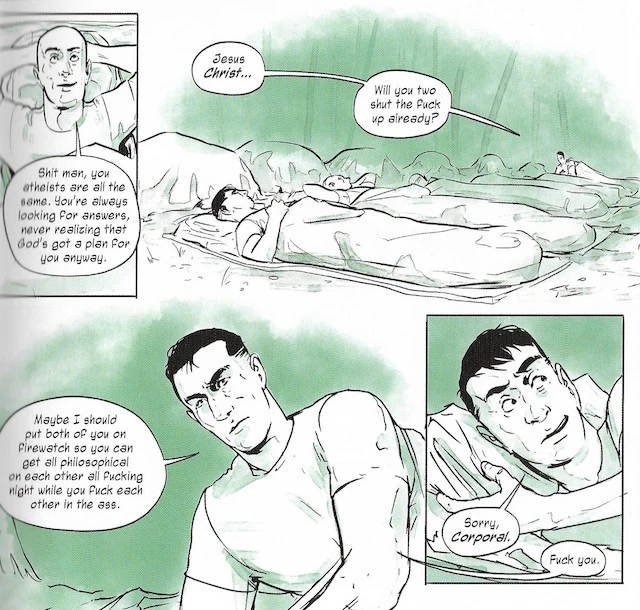
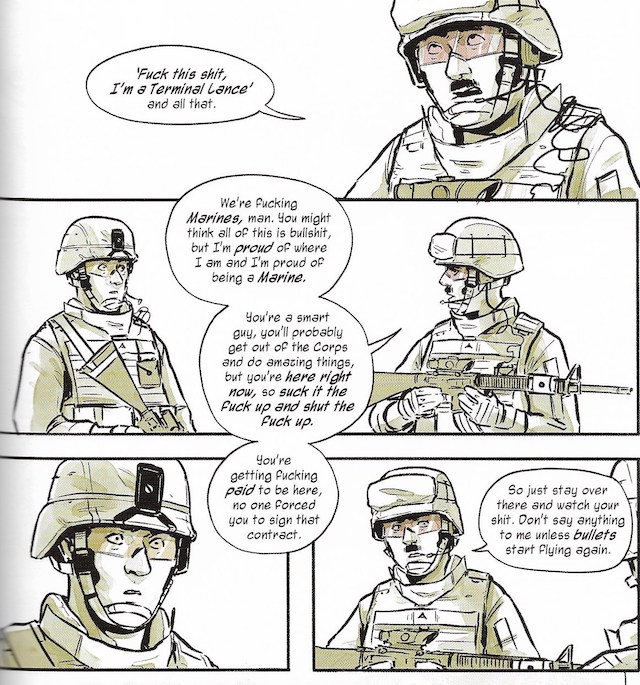
“The White Donkey” is the story about Abe, a young man who left his small Oregon town in search of … something. He wasn’t quiet sure what he was looking for, but he thought he might find it in the United States Marine Corps as an infantryman. Abe, his best buddy Jesus Garcia, and the rest of their battalion are eventually deployed to Iraq. There is not much more I can say without spoiling the book other than to note its honesty rivals National Book Award Winner Redeployment,” by Phil Klay.

White Donkey Garcia

Every so often a critic comes to this blog and says something along the lines of, “You write about popular culture because you wanted to make it in Hollywood and never did.”

Yes, I did go to USC upon exiting the Army as a mechanized infantryman, but nothing could be further from the truth regarding professional regrets. In fact, a better personal attack would be that I exited the military prior to 9/11, didn’t have the courage to re-enlist after the Twin Towers fell, and that it still haunts me to this day.

There actually is some truth to that — I carried a ton of guilt with me for years after 9/11, which was exacerbated after a friend of mine, Hector Leija, had his head blown off in Iraq by a sniper. I disclose these details because readers need to know that everything that happens to “Abe” prior to his deployment is eerily close to what I experienced as a peace time soldier (i.e., it’s authentic). The characters, situations, and confrontations Abe navigates in many ways mirror my own.

I see myself in Abe (except the atheist part), and cannot help but wonder what I would be like had I stayed in military.

White Donkey leave

If you’re looking for a book with intelligence and emotional weight, then check out “The White Donkey.” If you’re looking for a book that can help civilians better understand returning war veterans, PTSD, and the other burdens they might be carrying, then Uriarte’s work is a must-read. One can only hope that he continues telling tales for many years to come.

Daredevil, Elektra sizzle under Soule’s and Buffagni’s direction

DD Elektra

I never thought a modern Daredevil writer would make me bust into cheesy clichés, but here it is: It’s hot in Hell Kitchen under Charles Soules’ and Matteo Buffagni’s direction! Heck, kudos to color artist Matt Milla as well. Daredevil #6 kicks off “Elektric Connection” and the return of Elektra. The entire issue crackles with sexual tension, fisticuffs, and one very broken arm (sorry, Blindspot).

Here is what readers need to know: Soule keeps it simple and sweet:

  • Daredevil’s secret identity has been restored and no-one is the wiser — including Elektra.
  • The famous assassin shows up at a New York City bond hearing as Murdock is trying to work. She knows he has a connection to Daredevil and wants a meeting ASAP.
  • The “meeting” (or rather, beating) commences in short order.
  • Elektra wants to know what Daredevil has done with her daughter, and vows to “cut away every lie” in his body if he doesn’t give her answers.

Perhaps the best way to describe Soules’ writing is “efficient.” Words are not wasted. Each word means something. Each sentence is important. There is a plan. Both he and Buffagni know exactly what they need to do. They execute their respective jobs to the hilt. It is a welcome reprieve after digesting Marvel fare like The Amazing Spider-Man # 11.

Murdoch Elektra date

In one brief interaction between Matt Murdock and Elektra at a “lawyer bar,” one can see why Daredevil is one of the strongest titles on the market at the moment. In addition to Buffagni’s gorgeous art, it is obvious that Mr. Soule is a man who has had complex, mature relationships with the fairer sex.

Take, for instance, Murdock’s decision to meet with Elektra for a drink after she shows up at a bond hearing. His head is separated into an upper and lower half by Buffagni’s panels. Yes, he is “split” between being Daredevil and a New York City prosecutor, but he also spars between his logical  self and his bodily passions. Matt does not want to tell Elektra where Daredevil is, but he also would really like to sleep with her again.

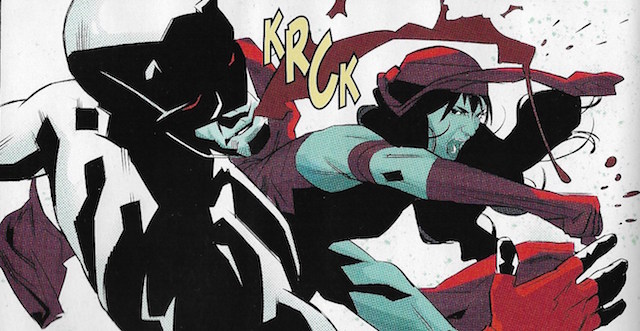
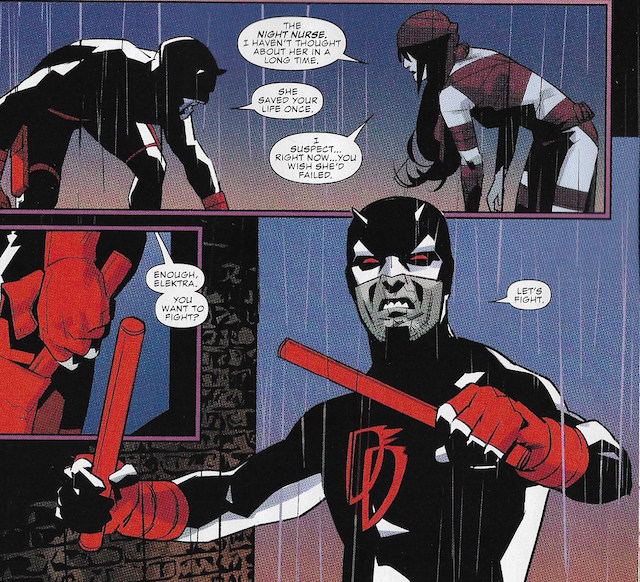
Needless to say, our Catholic superhero will have some explaining to do in the confession booth on Sunday. Murdock sets up a meeting between Daredevil and Elektra, and things get ugly fast. At one point Blindspot shows up and within seconds his arm is broken and he is off to see Night Nurse. Murdock finally has enough pussyfooting around and channels his inner Michael Keaton as Batman (i.e., “You wanna get nuts? Let’s get nuts!”).

Daredevil Elektra fight

The issue ends, as mentioned earlier, with Elektra demanding to know the location of her daughter. Whatever Daredevil did to essentially mind-wipe the world of his secret identity has a great upside, but it also appears as though it will come with painful consequences.

If you’re looking for a top-notch Marvel book, then go with Daredevil. The protector of Hell’s Kitchen has not been this cool in a long time.

Bonus: Michael Keaton getting “nuts” as Bruce Wayne never gets old.

Amazing Spider-Man #11: Hero says ‘you didn’t see that coming’ after pushing villain into pure ‘power’

ASM11 SpiderMan

Imagine you are a superhero. You have tracked an international terrorist for months as he feverishly looked for an inter-dimensional field of pure “power” and “information.” In short, your suspect wanted to locate a “door into the future.” You catch up to him at the very moment he finds his target. Would you decide to push the terrorist into a quantum field of infinite possibility and lock the door, or would you try to pull him out?

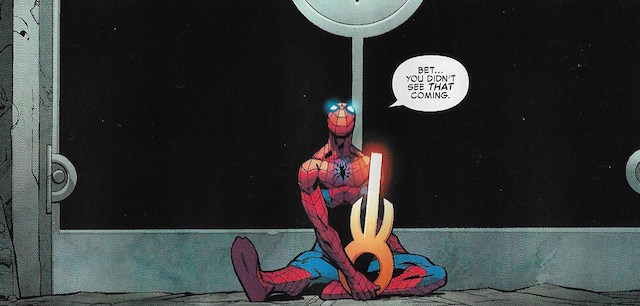
Dan Slott’s Spider-Man chooses the former and says, “I bet you didn’t see THAT coming.”

Fans of The Amazing Spider-Man do not typically expect their hero to aid villains in their evil machinations, so it is true that most of them probably would not have anticipated such a move. Touché, Dan Slott. Touché, indeed.

ASM11

Here is an easy experiment: Glance at your front door. If you were standing under the threshold and a man pushed you inside, locked it from the outside and exclaimed, “Well, we don’t need to worry about that guy anymore,” then how would you react?

My guess is that you would laugh at the man’s stupidity before opening the door and demanding your key back. In a worst-case scenario you would go out your garage, a back door, or possibly one of many windows.

Key

The Amazing Spider-Man #11 is technically the culmination of many months of stories surrounding the Zodiac terrorist group, its mastermind Vernon Jacobs, and his plan to usher in the “age of Scorpio.” The issue was supposed to serve as this story’s climax, but in the end Peter Parker “saves” the world by kicking the can down the road — one year to be precise.

Note: Superheroes are not supposed to treat villains like the U.S. treats its $19 trillion debt and then declare victory. It doesn’t work that way. Regardless, here is the abridged version of how ASM #11 unfolds:

  • Nick Fury turns the International Space Station into a giant beacon for Morse code and sends Scorpio’s location to Spider-Man since most of earth’s satellites are inoperable.
  • Spider-Man, Anna Maria, and Living Brian (aka: Doctor Octopus), and Mockingbird  arrive at Greenwich, London, to stop Scorpio but are quickly dispatched by a giant energy pulse from the Zodiac Key.
  • A doorway to the future is opened and Jacobs reveals that he is the grandson of the original Scorpio, Jacob Fury.
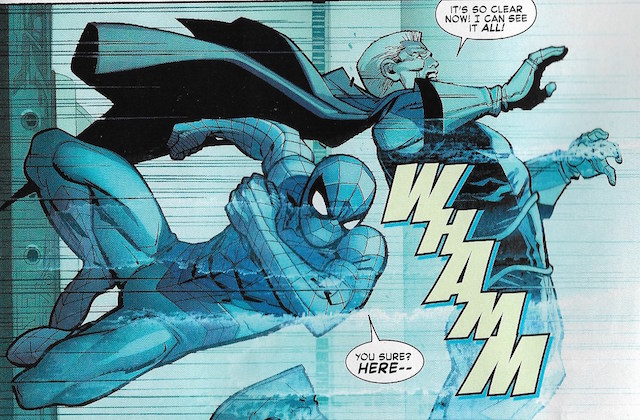
  • Spider-Man decides the best way to defeat Scorpio — as the portal telepathically gives him immense power and precognition — is to push him through and shout, “Take a closer look!”
  • Peter Parker tells Mockingbird he “smacked [Scorpio] into next year,” and she jokes that he did it so they have an excuse to spend more time together.
  • Anna Maria tells Peter that Mockingbird likes him, and then tries to make her “jealous” by clinging to his arm.
  • Doctor Octopus witnesses the “intolerable” act and vows to make his “superior return!”

Regular readers who are disappointed with how the Zodiac tale wrapped up should look at the bullet points above and notice an ongoing trend: Dan Slott, fittingly, often expends more care setting up future events than he does with the task at hand (i.e., telling a tight and compelling story in the here and now).

ASM11 Scorpio push
“It’s ‘so clear now’? You can ‘see it all’ with the power surging through your veins and the information flowing through your brain? Let me just push you closer into a field of infinite possibility…even though you’re evil.”

Just as Batman v Superman faltered because the writers spent too much time trying to set up a Justice League movie, Slott’s ASM regularly falls flat because he focuses too far into the future. No one except Mr. Slott and his good friends will care if 10,000 plot points over the course of ten years can be amusingly traced on a Saturday night if the stories connecting them are mediocre.

It is unfortunate, but once again ASM’s creative team over-promised and under-delivered. Giuseppe Camuncoli should take a bow for consistently stellar art, but he may want to ask to work on a title where his efforts are not a metaphorical life raft.

Exit Question:

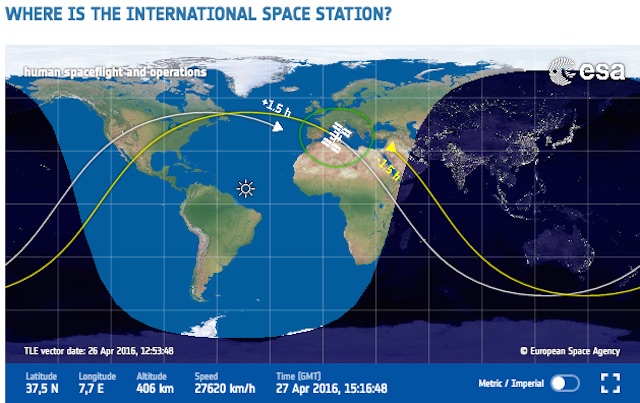
The International Space Station orbits the earth at over 17,000 miles per hour. Someone can correct me if I am wrong, but ASM appears to have been written like it is a fixed object in space. My guess is that Morse code would not have been a possibility for an object orbiting that fast at 155 miles above the earth.

ISS

Editor’s Note:

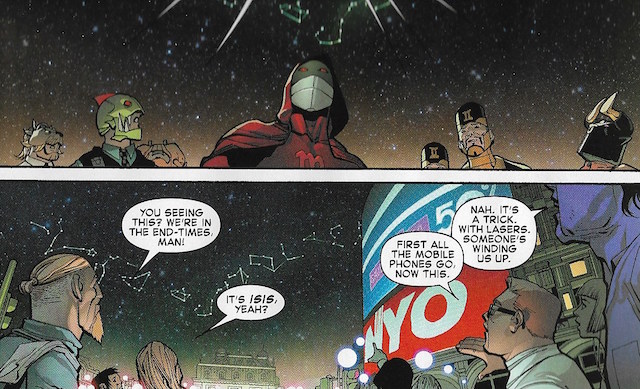
The Amazing Spider-Man may be the first Marvel comic to actually acknowledge the existence of the Islamic State group. The first person who can confirm this one way or the other will win a “Doug Prize.”

ASM11 Scorpio

Mark Waid says Captain America more ‘difficult’ to write now than WWII era … as ISIS takes sex slaves

Captain America Simon Kirby

Your friendly neighborhood blogger recently picked up Marvel’s “Captain America Anniversary Magazine” in his local comic book shop. The (free) special edition is indeed quite special. Unfortunately, one of the ways it is special is its ability to show how spotty the writing has been over the course of 75 years.

A kind of moral clarity existed at Marvel years ago that allowed for Steve Rogers to literally punch out Adolf Hilter on the cover whereas, these days, the Islamic terrorist groups are ignored in favor of attacks on the tea party.

ISIS terrorists
An ISIS terrorist executes an innocent man in Iraq. Meanwhile, over in America, Marvel editors wonder if it’s appropriate to do another story where Captain America takes on the tea party. Sad.

Writer Mark Waid inadvertently demonstrated why, 75 years from now, people will look back at this era and shake their heads in shame that Marvel was deathly silent on the issue of Islamic terrorism.

Marvel: A popular — and effective — approach writers take to the character is to look at what it means to be Captain America, the living symbol of a nation. You’ve certainly used this approach, and used it well. What makes him such a good character for that kind of examination?

Waid: First and foremost, it’s the thing that makes him unique among superheroes. You’re always going to be making a mistake if you just tell a generic superhero story with Cap because then it comes across as, “Well, this could have been a Spider-Man story or a Hulk story.” You look for the point of view that makes Cap unique and the reason for what he does. In his case, he’s out there being literally a symbol not only for a country, but also for an ideology. And what makes him a complex and interesting character for me is that it has become a much more difficult ideology to define than it would have have been when he first undertook his mission.

Wrong. The principles espoused in the Declaration of Independence are universal. Those principles are codified into law by the U.S. Constitution and transcend petty politics, which is why anyone who writes Captain America should not have a hard time doing so — unless said writer is a partisan guy who finds it “difficult” to rise above his personal biases.

ISIS

Question: Why on did Joe Simon and Jack Kirby have a moral compass that allowed them to call out the Nazi regime in print, but Mark Waid and modern Marvel writers cannot find it within themselves to do an issue on ISIS sex-slaves?

Answer:  Because they are so politically correct that they would rather attack opponents of illegal immigration than the Islamic terrorists who rape young women over and over and over.

ISIS sex slave survivor

The modern Marvel reader can find Captain America taking on tea party members, but they cannot find an issue where their hero stops Syrian members of ISIS from lighting caged innocents and Christians on fire.

Islamic State Jordanian pilot

The idea that it is harder to write Captain America as a symbol for the country in 2016 than it was in March 1941 is a myth. There are plenty of stories to tell that would capture the nation’s highest ideals as enshrined in the Declaration of Independence, the U.S. Constitution, and the Federalist Papers. If a writer is incapable of doing that then it isn’t because the world is more complex — it is because he willingly chooses not to expose pure, unadulterated evil.

Editor’s Note: For a glimpse into the mind of Mark Waid — and why he might have a difficult time writing Captain America — one needs to simply glance at his Twitter feed. 

Mark Waid

Mark Waid Twitter

Black Panther #1: Ta-Nehisi Coates debut a mixed bag for Marvel fans

Black Panther 1

Marvel Comics announced months ago that it would hand the reins of Black Panther to Ta-Nehisi Coates — a guy who believes the U.S. should consider paying reparations to modern black Americans for injustices inflicted upon their ancestors. At the time I said I doubted I would read the book, but ultimately I could not resist seeing how the activist would perform. Black Panther #1 is certainly a fascinating read, but not all of the reasons will make Marvel’s editors happy.

Comic book fans will soon get to see T’Challa, warrior king of Wakanda, on the big screen in Captain America: Civil War. That excitement has propelled Black Panther #1 to impressive sales (300K), but the question at hand is whether or not the book will have staying power. My prediction is that if Coates keeps T’Challa in Wakanda for an extended period of time — while boxing out other top-tier Marvel characters in the process — it will sink under its own weight.

Here is where things stand as of BP #1:

  • T’Challa has returned to reclaim his kingdom after an extended absence.
  • The king’s sister, Shuri, assumed the throne while he was gone but died during an invasion by Thanos.
  • Wakanda has an “elite female royal guard” called Dora Milaje that assists T’Challa in protecting the kingdom. One of them, Aneka, is sentenced to death for murdering a village chief known for abusing women.
  • A mysterious adversary planted seeds of deception across the nation, which pits citizens against one another.
  • Ayo, one of the Dora Milaje, breaks Aneka — her lover — out of prison. The two don stolen “midnight angel” suits and vow some form of revenge because “no one man should have that much power.”
  • T’Challa tries, unsuccessfully, to resurrect his sister from the dead using Wakanda’s advanced technology.

Readers who say, “It seems like there is a lot going on here,” would be correct. Coates is asking his audience to stick with him as he maps out Wakanda’s history and a whole host of characters. The author’s intelligence and organizational skills are evident throughout the book, but it remains to be seen whether the journey will actually be fun. Black Panther has gravity, but too much gravity can be highly unpleasant.

Black Panther

T’Challa’s mother tells him at one point in the book, “It is not enough to be the sword, you must be the intelligence behind it.” That is a great message, but my fear at this point is that Coates’ desire to write a cerebral superhero may cause him to needlessly sacrifice the kind of action and adventure that translates into return customers.

Take, for example, Wakanda’s “midnight angel” lesbian lovers. There is no doubt that Coates will give them more respect than deceased dictator Moammar Gadhafi granted his “Amazon Guards,” but guys like me have no desire to drop $5.00 per issue reading about the heartache of Aneka and Ayo over T’Challa’s rule.

Likewise, liberation movements along “the Nigandan borer region” may work for an issue or two, but at some point in time Wakanda’s internal politics become just as boring as anything George Lucas dished out during Phantom Menace or Attack of the Clones.

Black Panther Aneka

Black Panther #1 is a worthy experiment on Marvel’s part to see if political commentators can make the transition from academia to the Marvel universe, but the jury is still out on whether it should be added to your pull-list at the local comic shop.

I suggest checking out this blog (shocker) over the next few months before making a financial investment in the book. If Coates produces a winner, then you will certainly read about it here.