I'm a former Army guy who believes success comes through hard work, honesty, optimism, and perseverance.
I believe seeing yourself as a victim creates a self-fulfilling prophecy. I believe in God. I'm a USC Trojan with an MA in Political Science from American University.
In May, I broke down for readers what, exactly, it would mean to have a megalomaniac body-snatching Spider-Man running around in Peter Parker’s body. Dan Slott’s creation, on the cusp of enacting a world-wide Holocaust, in which 6 billion lives were meant to perish, proclaimed he would be a “mass murderer worse than Pol Pot, Hitler, and Genghis Khan combined!” What followed was months of Dan Slott following me around the internet, haranguing me for using that line as a springboard for discussion, as well as using an actual image of the Holocaust in the process.
I asked: What is more offensive: Dan Slott’s indiscriminate use of incendiary names, or my reminder of the implications of his indiscriminate use of incendiary names? I never really received an answer. Is it too early to say “vindicated”?
Because we have seen in the regular title, Spider-Man, now possessed fully by Doc Ock, trying to be a better man. He’s not trying to take over the world, he’s not trying to steal, he is trying to be a superhero. He is vicious, he makes different decisions, he has killed, but he saves people – both those close to him, and large numbers of strangers. His motives are positive, if warped by his previous nature.
In today’s Superior Spider-Man, the character goes a little further. Into full blown Nazi-like torture/experimentation on his victims. By ripping out teeth and fingernails…
How will Dan Slott react?
This is the “Spider-Man” Marvel gives readers in 2013.
This is Dan Slott’s creation. We reap what we sow.
There are moment’s in a man’s life where he says something that gives us a glimpse into his soul. Dan Slott’s Doctor Octopus — moments from wiping out humanity — did such a thing. Dan Slott put the words into his mouth. Now, even Bleeding Cool is acknowledging that a character who tortures his victims by pulling out their fingernails and teeth does, indeed, have quite a bit in common with the Nazis. Superior Spider-Man? More like Dan Slott’s Frankenstein. And no amount of feigned outrage by Dan Slott regarding the memories of his ancestors can change that.
Given one of the most iconic characters of all time, Dan Slott honors his ancestors by creating a “Spider-Man” who tortures his victims in the name of “science.” Telling.
As a kid there were two things that I would watch endlessly if my parents plopped me down in front of the television: Julia Child and football. While I still don’t quite understand my fascination with the famous French cook, my love of football can in many ways be traced to Marcus Allen — including his Super Bowl XVIII touchdown run for 74 yards. I was only two when the run actually happened, but as I aged it seemed that every year the Super Bowl came around that clip would find its way into the network’s promotional footage. To this day I shake my head in awe when I see it. In many respects it was the “perfect” run and a metaphor for life.
Marcus Allen was given the ball on the biggest stage and told to run with it to the end zone. He met a wall, so he reversed course. As he did so, he found himself in the middle of a mess of moving obstacles all honed in on stopping him from achieving his goal. Instead of falling down he accelerated forward, gracefully weaving through his adversaries into the open. As daylight approached, he knew he that he still had far to go and that his pursuers would be hot on his heels. It was off to the races, and with steely determination he sprinted to his final destination without anyone else laying a finger on him.
Perhaps Allen says it best:
“That was a beautiful run and it turned out to be a beautiful career. And yes, I did reverse field sometimes. […] but in the end I ended up where I wanted to end up.” —Marcus Allen
As a kid, every time I touched the football I believed I could score, and on some level that confidence was cultivated by watching men like Marcus Allen exhibit greatness on the most elite level. When sports stars try and say they’re not role models, they’re lying to themselves. Whether they like it or not — they are. Kids will mimic the adults in their life; I just happened to have a lot of good ones around, whether it was my own parents or Hall of Fame running backs on television like Marcus Allen. Oddly enough, I even ended up going to his alma mater, USC, as an adult…
If you’re a football fan, look into Marcus Allen. His career is fascinating, especially when one considers that Al Davis did everything within his power to sabotage it while Marcus was in his prime. That, too Mr. Allen handled with grace.
I missed Marcus Allen’s induction into the Hall of Fame, but one day I’ll get to Canton, Ohio. When I do, Marcus’ section will be the first I visit.
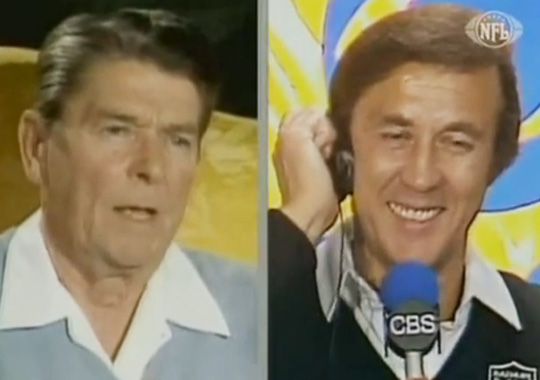
“Coach Tom Flores, I have already had a call from Moscow. They think that Marcus Allen is a new secret weapon and they insist we dismantle it.” — President Ronald Reagan
What would the world look like if more people realized that they were spiritual beings temporarily housed in human form — and then acted accordingly? To give you a clue, I present you with the story of “Thomas Coats,” as chronicled by Steve Hartman for CBS. Every year Mr. Hartman goes out with a businessman who poses as as “Secret Santa.” The anonymous good Samaritan gives out roughly $100,000 during the holiday season to people in bus stations and thrift stores. The effects are amazing.
Steve Hartman: You don’t really know what people are really going to do with this money. Do you care?
Secret Santa Businessman: No, because one of the things that I do is I do not judge.
It’s easy to look at a man and make all sorts of judgments about who he is and what he represents, but that is a dangerous game to play if those judgments fill us with pride while sapping our ability to empathize with those less fortunate. The Secret Santa Businessman does not fall victim to pride, and that is why the story gets better:
Thomas Coats: “I didn’t earn that.”
Secret Santa: “You did earn it, because I can tell you’re a good man.”
The Secret Santa Businessman says that Mr. Coats is a good man because he is. We all are. We all have the capacity for great good or great evil. Yin and Yang. The little devil on your shoulder vs. the little angel. However you describe it, that is the blessing and the curse of free will. We can be angels … or fallen angels, and those of us who realize that have an obligation to reach out a helping hand to those who have stumbled. It is our moral duty to remind others of the greatness inside them.
“When was the last time you heard that?” asks Steve Hartman to Thomas Coats. “Maybe … my mom?” he replies.
Steve Hartman: 30-year-old Thomas Coasts is a total deadbeat — at least by most accounts, including his own. Addicted to heroin, he recently hawked his own son’s toys for drug money. That’s how bad it is.
Thomas Coats: I haven’t worked in over a year. I’ve spent so much time in and out of treatment facilities.
Steve Hartman: Why his girlfriend hasn’t left him and taken their son is a mystery. Even to her. But she is now running out of patience, which is why the night before we met him, during another one of their many money fights, she suggested he try something radical.
Thomas Coats: “She said maybe you could shoot a prayer up to God real quick, you know? I know that you don’t really believe in Him, but maybe you could start.”
Steve Hartman: And so, he did pray — for the first time since childhood. Then, out of the blue this saint shows up, slipping hundreds into his hand. You could almost see the wheels turning. That kind of kindness from a total stranger the day after he prayed … it was too much of a coincidence for this atheist to bear.
Thomas Coats: It’s amazing. That to me was a miracle. That was God saying: “Have you had enough, now? I’m going to show you something.” So from here on out, it’s up to me.
Steve Hartman goes on to say that Thomas checked himself in to a treatment facility, although this time “he says this will be the first time with a higher power at the helm.”
The point of this story is not to say that this is definitive proof God exists. I’m not making that claim. What I am saying is that those of us who do believe in God have to think long and hard about how we go about reaching out to atheists, the poor and those who are just generally different than us.
This is why I support the Pope. By not being judgmental, “Secret Santa” found this guy. Maybe Thomas kicks addiction, maybe he doesn’t — but for the first time in years he has hope. Pope Francis has drawn criticism for not being “conservative.” That’s dumb. The guy is super conservative, but he’s not judgmental. He actually extends a “hand” to those different from him. Atheists, gays, juvenile delinquents … it’s amazing what a non judgmental hand can do. Catholic church attendance is even up around the globe.
We are told faith the size of a mustard seed can move mountains. In the story, it was the guy’s girlfriend that 1.) hasn’t left him, and 2.) told him to pray. That is faith. Kudos to her. I hope it works out for them.
This is why I think it is wrong to tell strangers they are going to hell. We (humans) don’t know that. It’s not our place to judge. I referenced St. Paul with that before. Second to Jesus, a huge chunk of the new testament is about/written by him. Before his conversion he made a living hunting down and killing Jews that converted to Christianity. He worked for the ruling priest class of Israel and possibly the Romans. Now, he’s a saint. He wrote of the tears when he felt Gods presence at his conversion, probably just like the “deadbeat” in the news story.
While I do not quite understand how individuals can walk through life and not realize that there are things at play beyond human comprehension, the fact remains: they’re here. As you move forward, try and figure out ways to reach out to those who are different from you politically, spiritually, and socially. Perhaps they’re just like Thomas, who went through his entire life with only his mother having told him he was a good man. Through your temperance, empathy, humility and random acts of kindness you too might become someone’s guardian angel — or the one who makes an atheist believe in God.
Any young boy who grew up in the late 80’s and early 90’s remembers how awesome Jean-Claude Van Damme was in his prime. The guy was absolutely amazing to watch, and perhaps no film better encapsulates what made him a star than 1988’s ‘Bloodsport.’ Along the way, JCVD got involved in all sorts of activities known for killing a career, and that’s exactly what happened. However, after an impressive stint in ‘JCVD’ and ‘The Expendables 2,’ the old man has shown his fans that he still has it. His new Volvo ad is icing on the cake.
It must be fun working in the marketing department of Volvo Trucks these days. It seems any crazy thought conjured around a conference room table can be turned into a stunt using tightrope walkers, bull runners or hamsters. Risking the life of their own president is even within the bounds of reason. And it’s working: the videos for these stunts have made Volvo Trucks a channel worth subscribing to on YouTube, with millions of people having clicked on them so far.
Their latest stunt, previewed earlier this week, involves actor and martial arts experts Jean-Claude Van Damme, well known for the butt-kicking he did on the big screen during the ’80s and ’90s. His signature move was the splits, which Volvo Trucks tapped into for this demonstration of how directionally stable its Volvo Dynamic Steering is.
Dynamic Steering is nice, and the Enya soundtrack is hilarious, but at the end of the day fans just want to feel nostalgic for all those roundhouse kicks, splits and epic baddie beatdowns JCVD was known for back in the day. If a grown man doesn’t like ‘Bloodsport’ there may in fact be something wrong with him. Low testosterone levels? Erectile dysfunction? Not enjoying Frank Dux’s tale as portrayed by Jean-Claude is a sign of a serious underlying medical condition.
Think about Dux’s story. He honors his sensei (i.e., for all intents and purposes his adopted father). He’s a member of the Armed Forces. He undergoes rigorous training and suffers countless setbacks in his youth, yet bears down and fights through it to accomplish things an earlier version of himself would have never thought possible. He travels great distances to take part in a contest where failure might mean death—for something larger than himself. He plays by the rules even when his opponent cheats, and ultimately he comes out on top.
The only time Frank missteps is when he decides to sleep with the sexy, blond and liberal reporter who looks down on the men involved with the tournament, but is willing to crawl into bed with them if they’ll talk. The error is so costly it almost disqualifies him, as the reporter outs Frank’s presence to the authorities and tries to have the tournament brought down. Note to self: Resist sexy blondes at all costs.
Another interesting aspect of Bloodsport is the dichotomy between Ray Jackson and Frank Dux. Ray Jackson represents the stereotypical American: loud, brash, in your face, and uncultured. He’s rude, but he’s also loyal…and kicks ass. And finally, he’s cocky, which actually ends up being his downfall. Those who are familiar with the movie know that there probably wasn’t any limit to what Ray could have done if he would have reigned in his attitude, had a bit more humility, and listened to his good friend’s advice.
Frank Dux is the American ideal. He’s soft spoken, but confident and strong. He’s distinctly American, but he’s honed his skills by drawing from the best of multiple cultures. He’s honorable and loyal, but he’s very much an individual. He doesn’t go out of his way to pick a fight, but he recognizes evil when he sees it and he’s not afraid to step in to right wrongs from time to time (e.g., the fighter who was forcing himself on the reporter in the lobby). Frank makes no apologies for who he is or where he came from, and his goal is to be the world’s best. Period.
What kind of red-blooded American man doesn’t go for that?
As a kid I subconsciously learned lessons from both of these characters, even if I wasn’t able to articulate them. Did Frank Dux’s story inspire me to enlist in the military when I was exited high school? Not directly, but in the mosaic that was my life it certainly left a mark. The power of popular culture to shape young minds is severely underrated, which is why I’ve always said that some of my social conservative friends are missing the boat by walking away from the entertainment field all together.
Anyway, God bless ya, JCVD. I hope you still have a couple more movies left in the tank.
Editor’s note: When I lived in Germany, I ran around the country in the 90s trying to find the ‘Bloodsport’ soundtrack. I finally succeed after months of searching. I played the entire thing and then threw my hands up in frustration when it turned out that the incredibly cheesy ‘Steal the Night,’ by Paul Hertzog was not included. What kind of sick bastard does such a thing? At least they had ‘Fight to Survive’…
Venezuela has number of problems on its hands lately, one of which had been toilet paper shortages predictably caused by its awesomely awesome socialist revolution. This is fitting, because its economy has been spinning down the drain. Now, Venezuelan president Nicolas Maduro has a bright idea for preventing the flush from completing — spin faster!
“I want a Sony plasma television for the house,” said Amanda Lisboa, 34, who waited seven hours outside a Caracas Daka store, USA Today reported. “It’s going to be so cheap!”
“This is for the good of the nation,” Mr. Maduro said in the report. “Leave nothing on the shelves, nothing in the warehouses. … Let nothing remain in stock!”
“This is more like government-sanctioned looting,” said Caracas-based engineer Carlos Rivero, 42, USA Today reported. “What stops them going into pharmacies, supermarkets and shopping malls?”
Looting, indeed. When you go after private property owners — at gunpoint — call them “bourgeois parasites,” and tell the people it’s all being done in the name of “fairness,” lawlessness ultimately will rule the day.
Think this can’t happen in the United States? Think again:
While the country is immersed in Obamacare headlines and a congressional tussle over delays and mandates, the Obama administration is stealthily moving toward unprecedented control over private property under a massive expansion of the Environmental Protection Agency’s Clean Water Act authority.
The proposed rule, obtained by the House Science, Space, and Technology Committee in advance of EPA Administrator Gina McCarthy’s testimony at a Thursday oversight hearing, widely broadens the definition of waterways over which the federal government has jurisdiction to as little as a water ditch in a backyard.
The Clean Water Act redefinition of “waters of the United States” would include all ponds, lakes, wetlands and natural or manmade streams that have any effect on downstream navigable waters — whether on public lands or private property.
The U.S. is going down the same drain, but the difference is that we have people who are trying to slow the process down. It’s just sad that advocates of administrative state are trying to create a bureaucratic vortex of centrifugal force to keep us in the toilet. “Got a ditch in your back yard, kid? Yeah, well, that means it’s the federal government’s yard, now. We’ve been spying on you for quite some time and, quite frankly, we don’t like what you’re up to. So now, you’re up to nothing.”
We know how statists feel about the Founding Fathers—and it’s not warm and fuzzy. In order to hide their animosity towards the Founding Fathers and the magnificent document they produced, they refer to the Constitution as “a living document” (i.e., it means whatever it is they want it to mean.) Only by viewing the Constitution in that light can the statists work around what has been an impediment—and a source of frustration—to their central planning for ages. In order for them to succeed, they need power. In a country of 400 million people—each with their own thoughts and dreams and desires—it requires incredible power to get everyone “in line.” The Constitution stops them in their tracks, which is why its defenders must be labeled “unhinged.”
To see how this works, one needs to look no further than the early roll out of Obamacare. Already, politicians are blaming the insurance industry for the economic fallout of their own policies. Individuals who understand basic economics predicted millions of people would lose their plans, that prices would go up, and that the Affordable Care Act would in fact not lower the underlying costs of the health care industry. Now that the writing is on the wall, even Diane “I think you might be a terrorist some day” Feinstein is trying to find a way to avoid the political fallout.
The world was always complex, but as technology advances the world’s perpetual busybodies will become increasingly frustrated. There are too many moving parts. Billions upon billions of voluntary transactions take place ever day between complex spiritual beings with free will. One camp seeks to control the uncontrollable — which has a historical track record of ending in tyranny — and the other believes that the free market (another imperfect system in an imperfect world) is still the best system ever devised for allowing man to obtain his full potential while pulling countless others out of poverty.
Americans should watch what is happening in Venezuela, because in many ways it is giving us a glimpse into the future if we refuse to change course.
Dark Elves, monsters and Tom Hiddleston as Loki in ‘Thor: The Dark World’ — what can go wrong? Not much, really. Audiences seem to agree:
Marvel Studios and Disney’s Thor: The Dark World thundered its way to a $86.1 million domestic launch as it continued its global assault, finishing the weekend with a sizeable $327 million in worldwide ticket sales.
That’s an impressive start considering the first Thor, which debuted to $65.7 million domestically in May 2011, grossed $449.3 million globally in all. The sequel nabbed one of the top November openings of all time in North America, although it couldn’t quite match the $88.4 million earned by Skyfall on the same weekend a year ago.
Marvel Studios is making it look easy at this point, which is rather impressive given the number of moving parts each of these films have. Kevin Feige, President of Production at Marvel Studios, must be eating his Cheerios or Wheaties over the last couple of years, because his job performance has been strong.
Anyone who goes to ‘Thor: The Dark World’ looking for a complex plot will be disappointed: Creatures of darkness want to fill all of existence filled with darkness. Thor must stop them. He does. The end.
Those who are looking for a little action, a little adventure, a helping of humor and a good dose of Tom Hiddleston’s Loki making everything he touches awesome will be pleased. Adopted kid who has all sorts of issues with mother, father and brother constantly plots and plans ways to show that he loves them — and hates them — to death. The end.
Chris Hemsworth does a fine job as Thor — he looks the part, is believably noble and worthy of Mjolnir — but it’s the nature of his relationship with his adopted brother Loki that makes the trek to the movie theater worth it. Hiddleston, in many ways, is the glue that holds the whole thing together. Without him, ‘The Dark World’ becomes an exponentially duller film. It may seem sad that, in his own movie, Thor needs Loki in order to achieve his full box-office potential, but is it really? You can’t have Yin without Yang, and you can’t fully appreciate Thor’s honor without holding him up to the actions of his mischievous brother.
At one point in ‘The Dark World’ Thor says, “Mother wouldn’t want us to fight.” Loki’s response: ” But she wouldn’t be that surprised.” Note to Thor: moviegoers want you to fight. We like when the anger and the jealously and the sibling rivalry plays out on screen because in our own mini-Asgards we deal with it every day. Do we overcome the pettiness and achieve great things, or do we give into our darker half and do as Loki would? If we see ourselves as manipulators, do we manipulate to serve our own selfish ends, or do we manipulate others so that they might soar? Seeing that struggle as depicted by Hiddleston is what elevates Marvel’s second Thor movie from “I’ll wait until it’s on Netflix” to “I’ll be there opening weekend sitting one row behind the girl with the Thor outfit on.”
If you’re looking for a fun “popcorn” movie to see this November, make a trip to see Thor’s second solo movie. If you want to see something that is critically acclaimed that doesn’t lend itself to carelessly flicking popcorn into your mouth, see “12 years a slave.”
Note: To the person who sees Marvel movies and then continues to leave as soon as the end credits begin to roll, I have a question for you: Why? You know you’re not supposed to, but you do it anyway. I say this out of love: Get with the program, already.
Marvel comics has some interesting priorities. It allowed Dan Slott to kill one of the most popular characters of all time — Peter Parker — and has been dragging its feet on bringing him back ever since. It recently announced an embarrassing new origin for Tony Stark. Tens-of-thousands of long time readers might be livid, but Marvel wants you to know that it’s all going to be okay because this February they’ll be introducing … a Muslim superhero who has the ability to look a lot like “Cock Knocker” from Kevin Smith’s ‘Jay and Silent Bob Strike Back’? Weird.
Marvel announced to the New York Times that G Willow Wilson (writer of the short-lived revival of the Crossgen series Mystic) will be writing a new Ms. Marvel series starring Kamala Khan, a Muslim American teenage girl with the ability to shapeshift. According to the Times, Khan idolizes Carol Danvers and takes up her original codename after discovering her powers.
Okay. Fair enough. Marvel gets to put out a press release and pat itself on the back for being “diverse.” Sure. But questions remain: Is this going to be a book on how all Americans are apparently fearful of Muslims, or will the superhero use her powers to save Muslims like Malala Yousafzai before they’re shot in the face and left for dead by Pakistani Taliban psychopaths? Or, will the book primarily just be about the struggles of a teenage girl?
Kamala will face struggles outside her own head, including conflicts close to home. “Her brother is extremely conservative,” [Marvel editor] Ms. Amanat said. “Her mom is paranoid that she’s going to touch a boy and get pregnant. Her father wants her to concentrate on her studies and become a doctor.” Next to those challenges, fighting supervillains may be a respite.
The creative team is braced for all possible reactions. “I do expect some negativity,” Ms. Amanat said, “not only from people who are anti-Muslim, but people who are Muslim and might want the character portrayed in a particular light.”
But “this is not evangelism,” Ms. Wilson said. “It was really important for me to portray Kamala as someone who is struggling with her faith.” The series, Ms. Wilson said, would deal with how familial and religious edicts mesh with super-heroics, which can require rules to be broken.
It’s really hard to comment on the book before it’s come out. I want to give Marvel the benefit of the doubt, but how can I? History indicates that they’ll go the politically correct route. Remember when Marvel wanted Spider-Man readers to know that Muslims are safer in Iran than New York? I do.
Let me set the stage. Something is very wrong in New York City. Citizens have been taken with fear, and they’re acting out in irrational ways. Spider-Man is working overtime (what else is new?) to keep the city from tearing itself apart. Cue Naveed Moshtaghi, a taxi driver and Iranian immigrant. Naveed’s vehicle is hit by an angry white guy, who then blames the accident on Naveed: ”He’s one of the terrorists. He wants to kill us all!”, says the aggressor. A mob is swarms around Naveed, swallowing him whole until Spider-Man saves the day.
At this point I’m willing to give writer Chris Yost a break. Maybe the “God of Fear” is really behind it all. I’m even willing to shrug off a narrator who begins, “Naveed Moshtaghi is afraid of the same thing he’s been afraid of for ten years,” (i.e., Americans are just itching for an excuse to bum rush Muslims post-9/11 to infinity and beyond), right before the story unfolds that way.
But then something interesting happens. All alone on a rooftop, Spider-Man tells the man he’s dealing with the crisis very well. Naveed responds: “I’m a second generation Iranian in New York City. Living in fear, that’s what I’m used to. What is happening down there, sometimes I think it was only a matter of time.”
Regardless, the point is, Marvel wonders why fans roll their eyes every time there is a new character seemingly invented for the sole purpose of throwing a diversity parade. Usually, those creations have less to do with adding an interesting new personality to the universe and more to do with beating readers over the head with a particular worldview. Don’t believe me? See DC’s Muslim Green Lantern.
Will I check out Ms. Marvel when it hits shelves? Perhaps. Although, quite honestly, it seems as though Marvel should get right with Spider-Man and Iron Man fans before it starts asking readers to fork over cash for teenage shapeshifters.
Fans of Orson Scott Card’s “Ender’s Game” have been waiting for decades to see Ender Wiggin on the big screen. The wait is over, and it’s safe to say that director Gavin Hood, actor Asa Butterfield, the support casting and the special effects team all churned out a product that Master Sun Tzu would be proud of.
‘The Art of War’ states:
“So it is said that if you know others and know yourself, you will not be imperiled in a hundred battles; if you do not know others but know yourself, you will win one and lose one; if you do not know others and do know know yourself, you will be imperiled in every single battle.” — Master Sun, ‘The Art of War’
Ender Wiggin states:
“In the moment when I truly understand my enemy, understand him well enough to defeat him, then in that very moment I also love him. I think it’s impossible to really understand somebody, what they want, what they believe, and not love them the way they love themselves. And then, in that very moment when I love them — I destroy them. I make it impossible for them to ever hurt me again.”
The idea that you should try and fully understand — and even love — your enemy is incredibly profound. The vast majority of people go through life spewing anger and vitriol at their political foes and battlefield opponents without considering the strategic implications that being a slave to hate entails. Instead of understanding enemies as complex spiritual beings worthy of the time and attention it takes to form an empathic connection, most people mentally coat them in a caricature, which makes attacking with blind rage easier. Ender Wiggin, however, is a complex young character who is tasked with saving the human race from an alien species of bug-like creatures — and thankfully (whether intentionally or not), Orson Scott Card imbued him with the characteristics of a master strategist, as spelled out in ‘The Art of War.’
Besides Ender’s desire to know his enemy, he is also a true leader:
“Leadership is a matter of intelligence, trustworthiness, humaneness, courage and sternness.” — Master Sun, ‘The Art of War’
What makes ‘Ender’s Game’ such a fun movie to watch is Asa Butterfield’s performance. Audiences must buy that this kid is a brilliant tactician, who is both compassionate and ruthless when necessary. He had to be vulnerable, but in charge. He had to show weakness that belied his inner strength. In short, he had to give an incredibly nuanced performance — and he pulled it off.
The problem with reviewing ‘Ender’s Game’ is that it’s so rich and layered with social commentary that one doesn’t know where to begin. The use of drones? Preemptive war? Military recruitment of children? Genocide? It’s all there. In some ways, ‘Ender’s Game’ might be too smart for its own good; people who flock to the theater just expecting to see lots of things explode in space will be disappointed. The movie brought in $27 million its opening weekend domestically, but it’s going to have a hard time making up its $110 million budget. Hopefully, word of mouth will give it enough legs to accomplish that goal.
If you’re looking for an intelligent science-fiction movie that was spawned from source material decades ahead of its time, see ‘Ender’s Game.’ If you’re looking for so-stupid-it’s-funny, then find some of the negative reviews of the movie. Some critics are so enraged over Mr. Card’s politics — that have nothing to do with ‘Ender’s Game — that they’re incapable of giving it a fair shake. I guess the whole part about loving your enemies went over their head…
If you go to the movies next weekend and Thor 2 is sold out, don’t head home. Check out ‘Ender’s Game,’ because it’s a fun and thought-provoking movie that is worth the price of admission. You might come for Harrison Ford, but you’ll stay for Asa Butterfield. Kudos to the young guy for a job well done.
As regular readers know, I occasionally have lucid dreams. Sometimes I share the memory of those dreams so that others can discuss their own experiences — or perhaps just see the weirdness floating around in my subconscious. For all those political posts that have made you ask: “What the heck is going on inside that man’s head?” you now have an answer:
Oct. 23, 2013: 5:00 a.m.
I’m in an office building. I’m following a young girl who is guiding me on a tour that involves a high-ranking military official. As I follow her I think: “I am lucid dreaming right … now.”
I break off from the girl, put my fist in the air, look up, and fly right through the ceiling and up, up, up. I don’t seem to be leaving the dream behind so I think: “Clarity now. Clarity now. Clarity now.” The dream dissipates around me and I find myself in a black void.
I feel as though wherever I am it’s at an incredible height. There’s a part of me that can’t believe I haven’t woken up. I think: “What is the meaning in life?” and I start falling.
During my decent I pass through all sorts of rainbows, fireworks, glittering ice particles (that don’t sting when you fly through them) … and then what I can only describe as childhood cereal boxes with cartoonish characters on the covers. There are words on the boxes, but everything is going so fast that it is hard to read them. Perhaps I pick up the word ‘linked.’
The entire time it sounds like I am in a casino and people are talking all around me. The voices are slightly high pitched in tone. I think: “Interesting. I must be doing something right. There is nothing negative here. Then I get slightly nervous, wondering if the act of pondering the existence of negativity would manifest something negative. That doesn’t happen, but I stop falling and realize that I’m still high above earth.
Still surprised that I’m conscious within my dream I think: “I want to see Yizhou,” [followed by my wife’s maiden name]. I am propelled through space, too fast to really even see what’s going on around me. I’m being hurled to some location. I look behind me and see an infinite blue cord stretching out and realize that it’s attached to me. I’m kind of taken aback by how long it is.
Finally I land, but I’m on some sort of puzzle board of the United States, and I’m in California. I’m on a map and it says my wife’s name. Underneath is a little red dot that is glowing and it says: “disconnected.” I get scared that something has happened to my wife and then realize that I said her maiden name. I shake my head and say: “No, I want to see Yizhou — my wife — in Arlington, Virginia.”
Immediately I am flying through space again like a ballistic missile. As I’m traveling I again think of the blue cord and can’t get over how long it is. When I land I’m on another map, this time with little cardboard houses. I get frustrated and start trying to read the lettering on the ground. I’m floating and can’t just walk like I normally do. When I try and stay still I levitate and sort of wobble around. All I can make out is “Lane.”
I start to float upward, but this time it’s out of my control. I grab a tiny cardboard house that was on the map and pick it up. I try to read lettering on the house and it says, “flick the white tab.” There is, indeed, a white tab on the piece of cardboard. I flick it, and then I wake up.
After waking I realize a.) I should not have said my wife’s maiden name because I ended up where we used to live in college, and b.) in my confusion I screwed up my wife’s location — again — because we used to live in Arlington, but she is now bouncing around due to medical school.
On some level I’m annoyed that I would screw up such a direct request, but on another I’m actually impressed that I was able to keep it as mentally together as I did, given how surreal the experience was. It would have been interesting to see what would have happened if I had I kept enough composure to get my wife’s actual address right.
Any armchair psychologists out there? If so, have at it.
Eric Hoffer’s ‘True Believer: Thoughts on the Nature of Mass Movements’ was published in 1951, but its wisdom is more relevant now than ever. Hoffer, the “longshoreman philosopher,” was an intellectual giant; his observations on human nature are essential reading for all Americans. In recent years, the split between the defenders of individual liberty and those who yearn to be lost in the collective has widened. The United States of America is united in name only, and the seeds of sinister things to come have shifted the cultural dirt with germination.
While I will always be grateful for the education I received at the University of Southern California, the bulk of my intellectual growth during my early twenties occurred because I was willing to seek out books my college professors never included on their recommended reading’ lists. I learned a lot by listening to my professors, but I knew that my greatest expansion would happen when I figured out what they didn’t want me to hear.
Eric Hoffer was kept from me by the “intellectuals” who were paid (handsomely) to introduce me to the best and brightest minds of human history. Don’t let his work be kept from you:
People whose lives are barren and insecure seem to show a greater willingness to obey than people who are self sufficient and self-confident. To the frustrated, freedom from responsibility is more attractive than freedom from restraint. They are eager to barter their independence for relief from the burdens of willing, deciding and being responsible for inevitable failure. They willingly abdicate the directing of their lives to those who want to plan, command and shoulder all responsibility. Moreover, submission by all to a supreme leader is an approach to their ideal of equality. …
The frustrated are also likely to be the most steadfast followers. It is remarkable, that, in a co-operative effort, the least self-reliant are the least likely to be discouraged by defeat. For they join others in a common undertaking not so much to ensure the success of a cherished project as to avoid an individual shouldering of blame in case of failure. When the common undertaking fails, they are still spared the one thing they fear most, namely, the showing up of their individual shortcomings. Their faith remains unimpaired and they are eager to follow in a new attempt.
The frustrated follow a leader less because of their faith that he is leading them to a promised land than because of their immediate feeling that he is leading them away from their unwanted selves. Surrender to a leader is not a means to an end but a fulfillment. Whither they are led is of secondary importance. (Eric Hoffer, The True Believer: Thoughts on the Nature of Mass Movements. 118-119.)
Sounds familiar? If not, you haven’t been paying attention to the American political landscape since 2008. The election (and re-election) of the Marshall Applewhite of modern American politics — and the blithe acceptance of policies anathema to the long-term health of a free nation — have been harbingers of things to come.
Don’t believe me? Ask yourself how it’s possible for a modern Paul Revere like Mark Dice was able to get Californians to willingly sign a petition to support an “Orwellian police state” with “Nazi Germany” as its model. Any way you slice it, the “Orwellian Police State” video is a sad commentary on the state of union. A certain percentage of the population will always be clueless, but there are some encounters that should receive near-universal revulsion. A request to sign up for a “police state” is one of them.
The stage is set for America to change drastically overnight. The room is filled with the fumes of tyranny, and all that is required for destruction and pain on an unprecedented scale is a spark. Perhaps an economic crash somewhere around the $25 trillion debt mark? Iran officially going nuclear? A large-scale terror attack on American soil? Take your pick.
Perhaps the final piece of the puzzle will fall into place when Americans, now content to bludgeon each other with violent rhetoric, tire of blaming political rivals and turn their attention to external boogeymen.
The Americans are poor haters in international affairs because of their innate feeling of superiority over all foreigners. An American’s hatred for a fellow American … is far more virulent than any antipathy he can work up against foreigners. … Should Americans begin to hate foreigners whole-heartedly, it will be an indication that they have lost confidence in their own way of life.” (Eric Hoffer, The True Believer: Thoughts on the Nature of Mass Movements. 96)
If you are concerned about the nation, I suggest reading ‘True Believer: Thoughts on the Nature of Mass Movements.’ While most institutions of higher learning these days are not interested in introducing you to men like Eric Hoffer, plenty of bloggers are happy to do so. Search them out, read their work, and together we might be able to pass on a freer society to future generations of Americans.
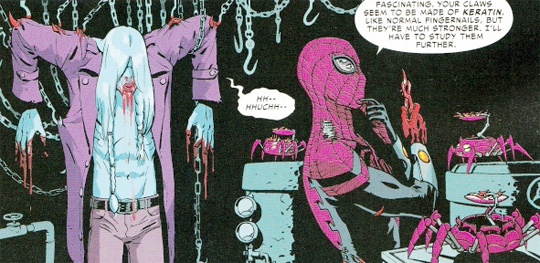 This is the “Spider-Man” Marvel gives readers in 2013.
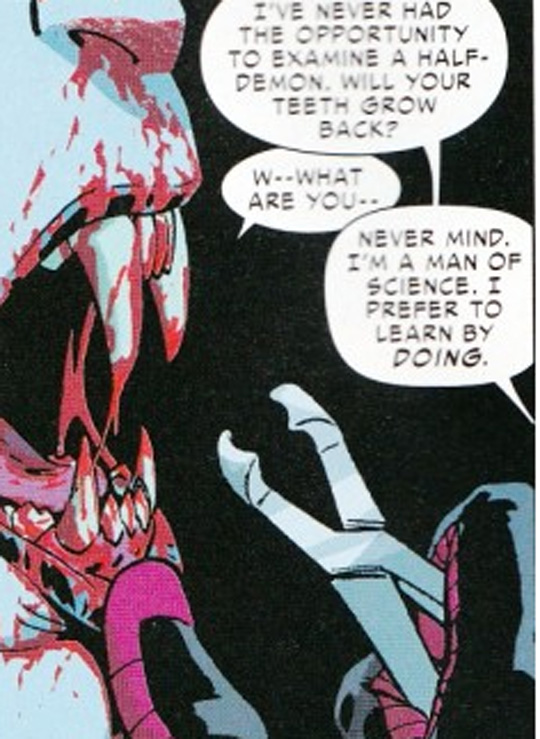 This is Dan Slott’s creation. We reap what we sow.
 There are moment’s in a man’s life where he says something that gives us a glimpse into his soul. Dan Slott’s Doctor Octopus — moments from wiping out humanity — did such a thing. Dan Slott put the words into his mouth. Now, even Bleeding Cool is acknowledging that a character who tortures his victims by pulling out their fingernails and teeth does, indeed, have quite a bit in common with the Nazis. Superior Spider-Man? More like Dan Slott’s Frankenstein. And no amount of feigned outrage by Dan Slott regarding the memories of his ancestors can change that.







 Douglas Ernst Blog