I'm a former Army guy who believes success comes through hard work, honesty, optimism, and perseverance.
I believe seeing yourself as a victim creates a self-fulfilling prophecy. I believe in God. I'm a USC Trojan with an MA in Political Science from American University.
Ghostbusters as a film is mostly forgettable, but the politics that have surrounded Sony’s project for months are something that should stay at the forefront of fans’ minds for a long time. Paul Feig and those connected with the project determined that a “Slime the Critics” strategy would pay off when it was clear that a $150 million investment was in big trouble — and it paid off. Reviewers were clearly afraid of being labeled sexists, and evidence of that is available on Rotten Tomatoes, YouTube, and across the internet.
Although I reviewed the movie opening weekend, my newest YouTube video discusses Sony’s small victory in terms of securing good reviews from political allies and moving the need in its direction with nice guys who have no desire to wade into gender politics.
Charles Soule’s Daredevil #9 should be assigned in every “Superhero Team-up 101” class for the next century. “Blind Man’s Bluff: Part II” brings the Man Without Fear and Spider-Man together in a pitch-perfect issue. It is flawless, and therefore should be mandatory reading for all Marvel employees.
Here is what you need to know for Daredevil #9:
Spider-Man meets Daredevil in Macau for a casino heist. Although DD offers scant details, the web-slinger agrees to help him snag a briefcase from heavily armed guards.
The heroes’ ambush does not go as planned and a man carrying the suitcase escapes onto a helicopter headed for Hong Kong.
Daredevil and Spider-Man hitch a hydrofoil ride to the city after Spider-Man reveals that he tagged the suitcase with a spider-tracer.
The two track down the suitcase to an apartment building, a massive fight ensues, and Spider-Man makes off with the prize. He agrees to meet up with DD later.
The two men convene at the top of a building looking over the entire city. Spider-Man refuses to give up the suitcase until DD explains why he needs it — in addition to why the memories of their friendship is hazy.
Matt Murdock debates lying to his friend, but then comes clean: He did something to wipe everyone’s memory of his secret identity. He also needs the suitcase because it has Black Cat’s files on the entire NYC criminal underworld. He wants to take down all the major players in one fell swoop.
Spider-Man hands over the suitcase and warns, “Watch out for those black-costume phases. They can really do a number on you.”
Mystery. Action. Humor. Intelligence. Wit. This issue had it all. There is hope for Marvel, and Daredevil #9 proves it.
How is this for a novel idea: Two characters with a rich history actually act in character while using the superpowers that helped make them famous to keep the other guy safe.
There were no “arachno-rockets” needed, and the moment of truth — when Matt takes a leap of faith on a good man and then his decision is reciprocated — was incredibly poignant. In short, Mr. Soule demonstrated that there is still a place in the world for good storytelling.
Perhaps the best way to describe Blind Man’s Bluff: Part II is “timeless.” The story feels like something I could have read in the 1980s as a kid, but at the same time it feels relevant now. It is a tale that I might reopen ten or twenty years from now and still enjoy. That is the sign of a good writer. That is why I continue to buy comic books, and that is why I pray to God that Mr. Soule does not get weirdly political in the future like so many of his industry peers.
Buy this book. Reward good writing. This is a comic book gem and everything about it is even sweeter because it comes from a writer who does not tell people to “eat a bag of d***s” over partisan politics.
Thank you, Mr. Soule. It has been a long, long time since a book has made me this happy, and for that I am deeply grateful.
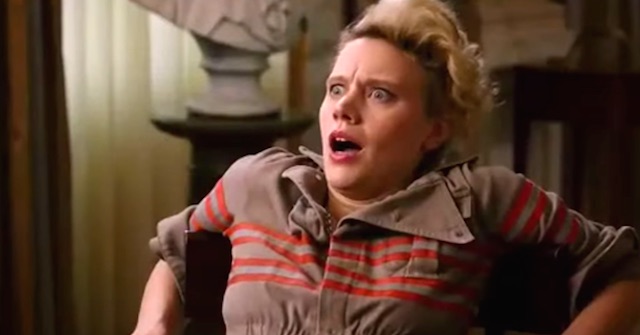
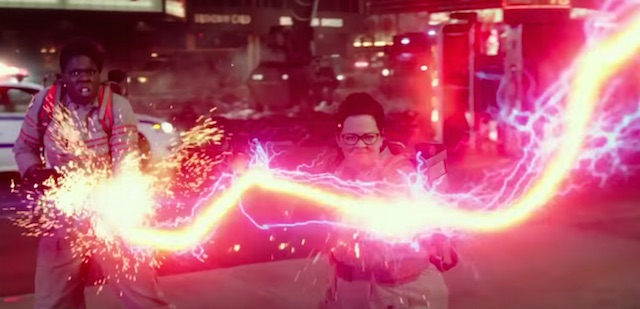
The new Ghostbusters is finally in theaters, and the good news is that its first trailer (the most hated YouTube video of all time) was not an accurate predictor of the movie’s overall quality. The bad news is that Ghostbusters, like Batman v Superman, is a film that is done in by a shoddy screenplay. The cast does the best it can with writer-director Paul Fieg’s story (co-written by Katie Dippold), but no amount of improvisation can lift the product above “mildly amusing” status.
First off, anyone who has seen the original Ghostbusters will know how the story goes:
Female versions of Dr. Peter Venkman, Dr. Raymond Stantz,
Dr. Egon Spengler, Winston Zeddmore form a band of misfit do-gooders who believe the city faces a spiritual threat of gargantuan proportions.
City officials treat them like second-class citizens.
The Ghostbusters piece together a mystery and stop a paranormal apocalypse by closing a portal to the netherworld.
With that being said, I think it is important to review Mr. Fieg’s movie by pretending the original film never existed. If the world were never introduced to Bill Murray’s Dr. Peter Venkman, then how would critics rate this movie?
They would say the following:
Kate McKinnon is a firecracker. Whether one likes or dislikes her weird tics throughout the movie, there is an energy and “it” factor to “Holtzmann” that a franchise can be built on.
The villain, Rowan (played by Neil Casey), is hardly defined — and that is putting it nicely. His motivations are not shown — viewers are told he was “bullied” when he was younger — and his actions during the movie’s climax make no sense. He literally controls a sea of cops and military personnel, but then chooses not to do the same to the four people who clearly pose a threat to his plans.
Chris Hemsworth’s character, Kevin, is so stupid that he is borderline retarded. Even if he is a parody of the “bimbo secretary,” I cannot remember a single female in similar roles who came across as Dumb and Dumber-stupid. Even desperate employers would not hire the man, no matter how handsome he may be.
There was obviously a Michael Jackson-inspired “Thriller” scene planned for the film that was cut from the finished product and wedged into the end credits. The problem is that aspects of the scene do show up in the film, which makes the audience go, “Huh? Why are the cops and the soldiers frozen in ‘Thriller’ poses? What the heck?”
Tension does not exist in this film because at no point does anyone feel as though the Ghostbusters might be in real danger. They become masters of new and experimental technology fairly quickly, and the one time they appear to be in trouble the camera angle shows them with the kind of smashed faces one might see in a Ghostbusters cartoon.
Ghostbusters is a movie that is worth checking out on Netflix if there is nothing else to do on a Friday night, but it is not worth full price at the movie theater. It is a movie that fails not because its cast is filled with women, but because its screenplay is sloppy.
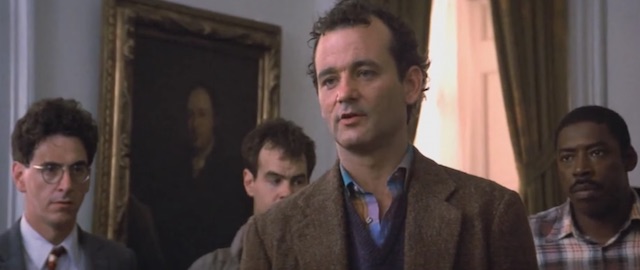
Finally, it must be mentioned that Bill Murray’s cameo will be painful to watch for anyone who enjoyed the original films. It is hard to believe the man agreed to the part unless he has serious issues with Ivan Reitman. If Mr. Fieg or anyone else associated with this re-imagining thinks they were giving the 1984 Ghostbusters a respectful tip of the hat with Mr. Murray’s cameo, then the property is in worse hands than previously thought.
If you have a little kid who really wants to see ghosts busted, then you probably should buy a cheap ticket on an early Sunday. If you don’t have kids, then my suggestion is to wait until you can check it out for little to no cost. That isn’t an “I have a thing against women” thing, it’s an “I have a thing against paying full price for muddled writing” thing.
Did you see Ghostbusters this weekend? Did you refuse to see it? Either way, let me know what you think of Sony’s tentpole film in the comments section below.
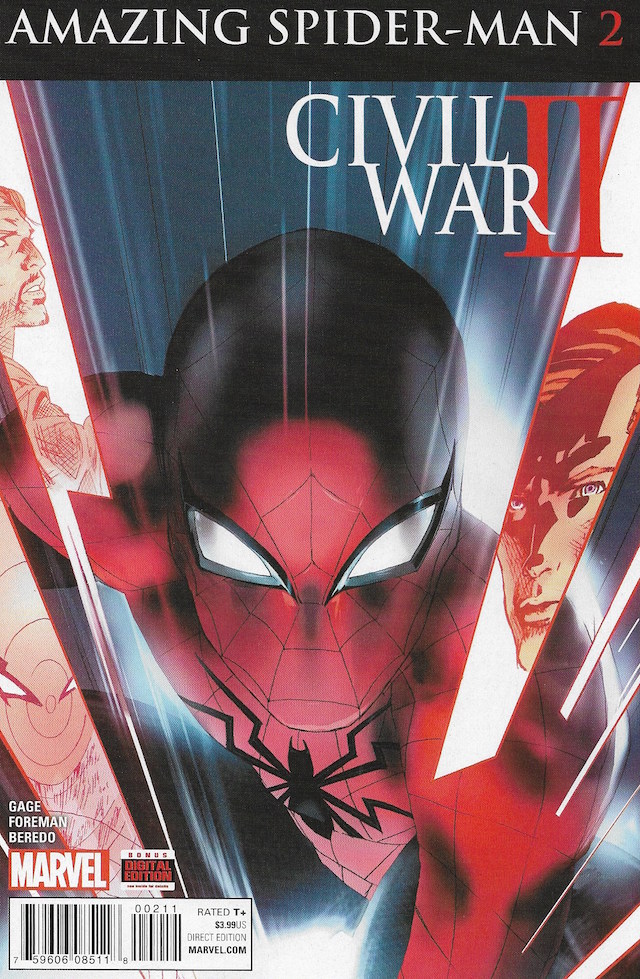
Marvel’s Civil War II has been a mixed bag of good ideas and poor execution, but writer Christos Gage’s work on the project has generally been a notch above his peers. Civil War II: Amazing Spider-Man #2, like the issue before it, highlights just how much potential he has as a writer, even if some elements of the book are rough around the edges.
Here is what you need to know for CWII: ASM 2:
Spider-Man, tipped off by Ulysses, defeats a “quintronic man.” (The aftermath features a nice nod to Amazing Fantasy #15.)
Clayton Cole (aka, Clash) runs into an old henchman he knows, but rebuffs an offer to talk about working with the Owl.
Clayton eats a meal with his parents, who are seemingly rotten people. They tell their son Peter Parker is exploiting his genius, liken Clayton’s beard to a something a homeless man would sport, and say his girlfriend Donna (a single mother who works at Parker Industries as an administrative assistant), is only interested in him for his future earnings.
Donna breaks up with Clayton just before he asks her to marry him. She is worried about what will happen when her son learns about his criminal past.
Clayton explodes on a coworker and later becomes paranoid (with good reason) when Ulysses and Spider-Man act like gossipy high-school kids around him.
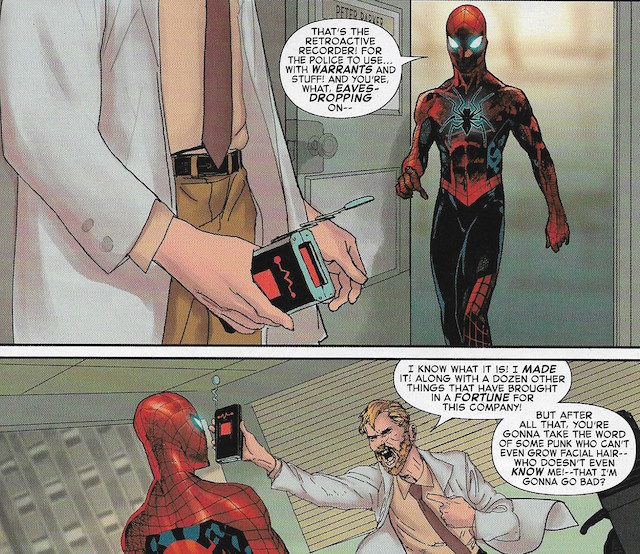
Spider-Man catches Clayton using an experimental device that can retroactively track and record sound waves. The two have an argument and Clayton storms off.
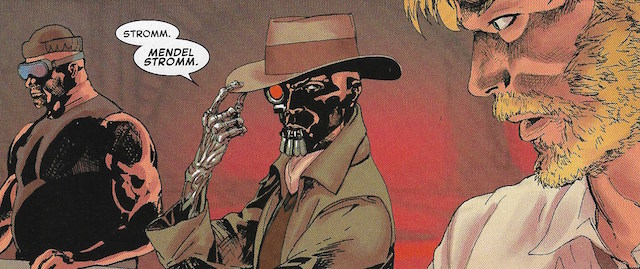
Mendel Stromm (aka, Robot Master), pitches a heist of Parker Industries to Clayton in a bar for henchmen. The plan is to frame Harry Osborn Lyman.
Peter tells Harry in a private meeting that he wants to make amends with Clayton, never realizing that the Tinkerer has been given a request to upgrade Mr. Cole’s “Clash” costume.
I mentioned in my first review that Mr. Gage added more intrigue to ASM in one issue than Dan Slott has in months. The good news is that Mr. Gage continues to creatively cross his ‘t’s’ and dot his ‘i’s’ in ways the head ASM scribe shows no interest in duplicating. The bad news is that as a reader it’s hard to witness Clayton’s behavior and not think, “Is Peter Parker the worst judge of character of all time?”
Consider this: Peter Parker’s ‘very close’ girlfriend tried to kill him, his inner circle lies to him and tries to work with corporate saboteurs, and his biggest investor (and secret santa) was the head of an international terrorist organization. He might want to have Doctor Strange check out that spider-sense one of these days, because it certainly doesn’t work during job interviews…
Overall, CWII: ASM #2 does a good job of getting readers to think about how hard it must be for an ex-convict to escape the long shadow of sins past. There is a nuance to Mr. Gage’s message about second chances and redemption that has always been absent from Mr. Slott’s work, and for that he should be commended.
At the end of the day, however, Mr. Cole largely comes across as an unsympathetic character due to his actions and the way artist Travel Foreman depicts his hair-trigger rage (an apology by the character afterwards does little to endear him to readers.)
The best-case scenario for Mr. Cole is that he is using inside knowledge of Mendel Stromm’s attack to his advantage — as a hero. Perhaps he will set-up the villain to prove beyond a shadow of a doubt to Spider-Man and Ulysses that he is a good man. There will likely be confusion along the way — a brief fight with Spider-Man, which technically will prove Ulysses was correct — but in the end Spider-Man and “Clash” will work together to take down Robot Master.
What did you think of CWII: ASM #2? Do you think “Clash” will be back to his villainous ways, or will he redeem himself by double-crossing Robot Master? Let me know in the comments section below.
Editor’s Note: Check out the YouTube page and subscribe if you’re into video reviews and podcasts. I plan on doing a lot more of that in the years ahead.
Marvel’s Civil War II #3 was released today, which means Bruce Banner is officially dead (until he’s alive again). Your friendly neighborhood blogger might do up a write-up in the future, but I figured the occasion offered a good excuse to experiment with uploading my first real YouTube review.
Imagine you are a writer on a Marvel comic book that can’t even sell 17,000 copies in its second month of release. Now imagine what would happen if you logged onto your social media account and mocked “liberal black people” while flippantly telling them to “eat a bag of d***s” if they were offended by your work.
Question: How long do you think you would last before Human Resources said you were fired?
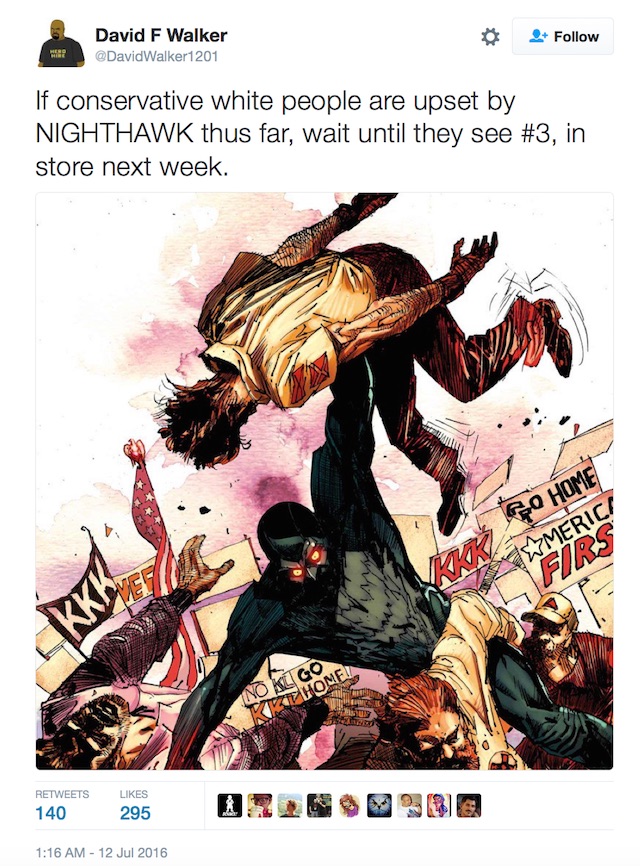
Answer: It’s a trick question — Marvel does not hire openly conservative writers. If you are David F. Walker of the basement-dwelling Nighthawk (16,522 copies sold in June), however, you can insult “conservative white people,” instruct them to “eat a bag of d***s,” and then get rewarded with an Avengers title: Occupy Avengers.
Occupy Avengers, a new Marvel Avengers comic from David Walker and Gabriel Walta, is hoping to be rather political. And certainly seems to be spinning out of events in Civil War II. Rather visibly.
Because someone who some people thought wouldn’t be there, is there. Up front and central.
Here is an uncomfortable truth: Marvel’s editors think so little of black people that they refuse to let go of an author whose atrocious online behavior and anemic sales would get anyone else terminated in a heartbeat. Emasculated white men within the former “House of Ideas” look the other way when a black writer embarrassingly manages to comport himself like Hooper X from Kevin Smith’s Chasing Amy.
I seldom make predictions, but it seems safe to say that any buzz Occupy Avengers will last about as long as Occupy Wall Street. It’s hard to sell comic books to white people when you spend obscene amounts of creative energy trying to portray them as “the white devil.”
Where do you think Occupy Avengers will bottom out? Let me know in the comments section below.
If you have never seen “Hooper X” in action, then make sure to check him out in the embedded YouTube video. It still holds up after almost 20 years.
Exit Question: How come liberal black guys can make homophobic cracks like “eat a bag of d***s” with impunity? Someone needs to ask activist-writers Dan Slott and Nick Spencer, or Editor Tom Brevoort, why Mr. Walker is exempt from the few rules governing the rest of Marvel’s staff.
Something rather amazing happened last week that mainstream comic book websites ignored: Marvel Editor Tom Brevoort likened Cyclops to Adolf Hilter — the infamous man responsible for killing six million Jews.
For some inexplicable reason, Mr. Brevoort thought it was a good idea to sell the upcoming “Champions” book on more political activism and “Kid Hitler.” Seriously.
BREVOORT: This is the young Scott Summers pulled from the past. In my head, he’s kind of the first challenge the group faces. Which is to say that when they get together and start to do this, what they’re doing is not just putting together a superhero team, they’re more like activists. They’re making an inclusive statement that they mean to be for all members of their generation: it’s time to get together and stand up and fix the world. This is a message that goes out and people come in response to it. Cyclops shows up and goes, “Boy I love what you’re putting down, I’d like to be a part of it.” It’s kind of like Kid Hitler showing up at the door. The older Cyclops has done some stuff. He’s a hugely divisive figure in the Marvel universe, so the first question these kids have to answer for themselves is, should we let him be a part of this? Is his very presence going to taint what we’re doing? His older self became a radical and a revolutionary and did awful things, but is it the same guy? And that’s kind of why he’s there I think. He wants to go down a different road than his older self did.
A comic book fan does not even know what has happened in the X-Men books for the past few years to understand how pathetic it is that Scott Summers is “Kid Hitler.”
At what point in time did the Holocaust essentially become an Entertainment Weekly punchline for Mr. Brevoort? Oh that ‘Kid Hitler.’ Tune into to see if the other super-kiddies welcome him into the club after what he’s done!
At what point did Marvel decide that it was “fun” to read heroes who earn Hitler analogies?
Marvel is in such sad shape these days that heroes seem to fight heroes more than villains, Hydra-Cap gimmicks are required for quick sales, Doctor Octopus spent over a year in Peter Parker’s body, and now Cyclops is “Kid Hitler.”
If you get a chance, ask Marvel’s writers and editors how much money they estimate Mr. Brevoort’s Holocaust analogy in Entertainment Weekly will net the company. My guess is that they will somehow try and portray you as the bad guy, but if they do then just keep in mind who you’re dealing with — men who turned Cyclops into “Kid Hitler.”
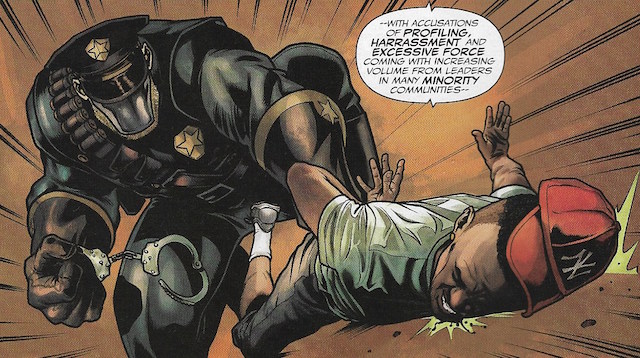
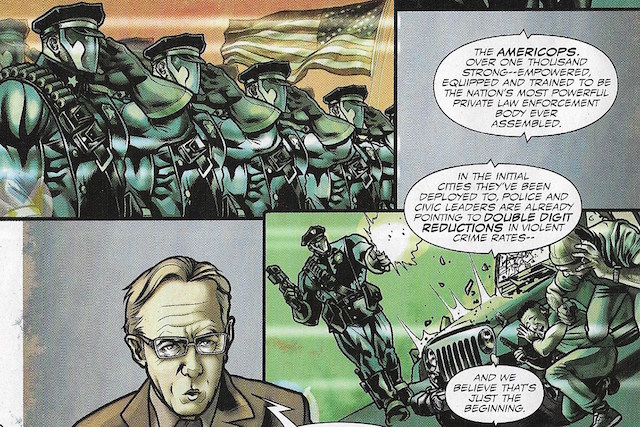
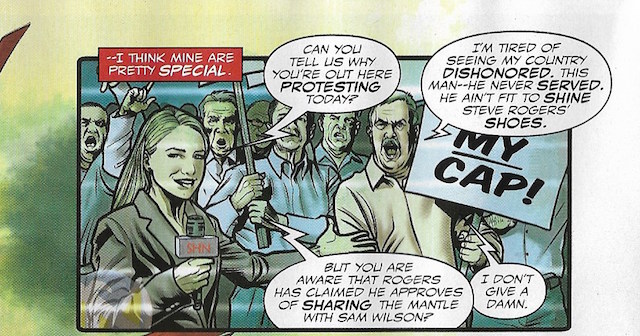
Marvel writer Nick Spencer, the guy who uses his Twitter feed to say all Republicans are “evil,” recently made national headlines with the company’s “let’s turn Steve Rogers into a Hydra agent” gimmick. He somehow managed escape the media radar with his tenth issue of ‘Captain America: Sam Wilson,’ which creates a nameless, faceless group of racist cops — ‘Americops’ — for hunting down minorities.
The end of the issue even features “Rage,” who tells a group of black kids that it’s “time we start hitting back” against the racist, left-hand saluting police patrolling their streets.
Ask yourself this question about Marvel Editor Tom “capture the zeitgeist” Brevoort as the nation comes to grips with the Dallas shooting of 12 police officers by Micah Xavier Johnson, which killed five: Why is it off limits to “capture the zeitgeist” of Islamic terrorist groups — real evil — in Marvel comics due to fears about how it will reflect on all Muslims, but yet it is fair game to create “Americops”?
The vast majority of cops are good men and women, and yet every single time someone like Alton Sterling is killed in Baton Rouge or Philando Castile is killed in Minneapolis, the Nick Spencers of the world use the moment to rhetorically slime over 12,000 local police departments across the country.
Here is another question for you: Have you ever seen an issue where Nick Spencer’s Sam Wilson must combat super-powered gangs of black kids in Chicago or Detroit who deal drugs, murder innocents, and make life a living hell for the majority of good citizens (and cops) in the city?
Answer: Of course not.
The lesson at Marvel under Tom Brevoort is clear:
If a writer wants to pen cartoonish versions of irrational and angry white men, then he or she can do that.
If a writer wants to take the actions of a few to incite anger against the whole, then doing so against cops and law-abiding gun owners is permissible.
Capturing the “zeitgeist” at Marvel is defined as, “Write or draw whatever inflammatory idea you have towards white people, but don’t you dare cover inner city violence or Islamic terrorism — even if you planned on handling the latter issues in a measured manner.
If you are sick and tired of Marvel hyper-politicizing its books while engaging in obscene double-standards, then stop buying any title that fills its pages with partisan bile. Sound off on social media and let everyone know exactly why you are walking away from the title.
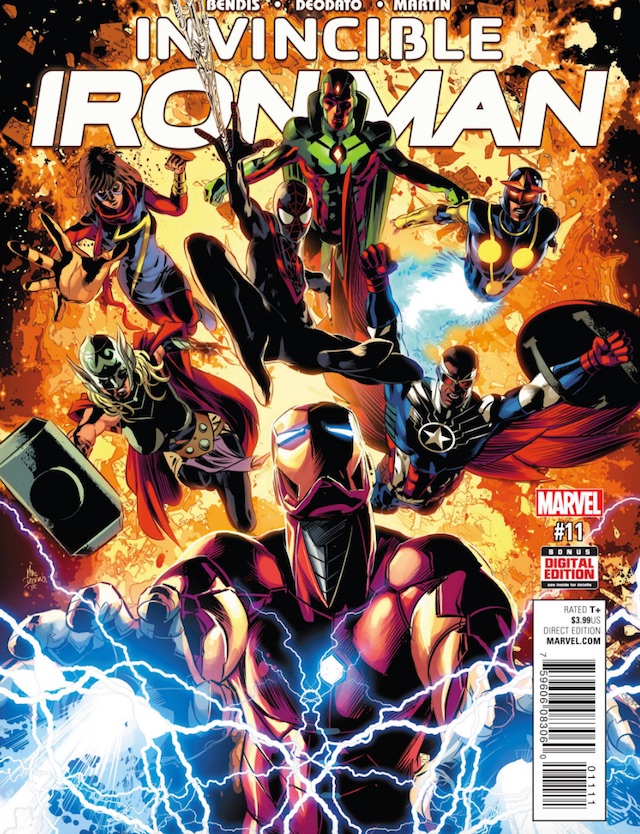
Invincible Iron Man #11 should have been an action-packed extravaganza with War Machine, Captain America, Nova, Ms. Marvel, She-Thor, Vision and War Machine all joining forces with Tony Stark to destroy “Techno Golem” and her network of terror. Writer Brian Michael Bendis had other things in mind — action for Riri Williams, and a tepid climax for Tony. Long-time readers should be chafing.
Here is what you need to know for IMM #11:
Stark’s board of directors hire corporate saboteur Ghost to break into Tony’s lab and override his servers.
Mary Jane informs the board that she is Tony’s new Executive Administrator. She wards off the hostile takeover by telling everyone that Stark is secretly working on new products.
Riri Williams tests her new suit during a prison break outside New Mexico State Penitentiary.
Tony meets “Rhodey” at a secret meeting place to ask why the Avengers are flying around Osaka, Japan. He soon realizes that he is speaking to Ms. Marvel in shape-shifted form. She informs him that a rescue operation is taking place.
The Avengers, War Machine, and S.H.I.E.L.D. launch an assault on the bio-hack ninjas that nets Zhang but misses the big fish “Techno Golem.” The action (that is being generous with the term) is a single shot that takes up two pages.
Tony poses as “Franco” in a prison cell with Zhang and asks where “Techno Golem” went. Zhang says she feels betrayed, but that the woman could be “anywhere” and will ultimately destroy S.H.I.E.L.D.
The best way to describe Invincible Iron Man at this point is disappointing. It had so much potential, but Mr. Bendis essentially over-promised and under-delivered. There needed to be serious action in IIM #11, and instead it was just talking…and more talking…and Tony scratching the back of his neck while in deep thought.
It’s nice to have witty and intelligent banter, but at some point it seems like endlessly watching two cats pat around a ball of string.
Perhaps the worst aspect of the issue is that it takes place before James Rhodes dies in Civil War II (i.e., the timing called for something special that never transpired).
This was a “rescue” operation to bring Tony out of hiding and wipe out a deadly foe, but readers are not given a memorable battle for a man who has meant so much to Mr. Stark. Instead, the book features Riri Williams punching the engine of a getaway vehicle in the desert, and a snapshot of the Avengers in action.
“That was my first superhero thing. I’ll do better next time,” Ms. Williams says after sending two convicted felons through a windshield. Meanwhile, Rhodey must embarrassingly hem and haw when he is informed that he captured the wrong High Value Target.
It is a good bet that when Marvel writer Dan Slott was a kid that he was the one who always changed the rules of whatever game he was playing with friends. The Amazing Spider-Man #15 is a perfect example of a story crumbling into a schizophrenic mess because the writer altered established realities to get to a desired end.
Readers last left their beloved web-slinger knowing that he and Iron Man were defeated at the hands of Regent. The same villain who defeated a god — She-Thor — Vision, Wolverine, Captain America, Daredevil, Deadpool, Human Torch and countless other superheroes (and villains), also took down Peter Parker and Tony Stark.
Regent has been established as a force to be reckoned with, right? Keep that in mind as we move forward with this review.
Here is what you need to know for ASM #15:
The Avengers are defeated. Heroes everywhere are missing. Regent is on the brink of victory.
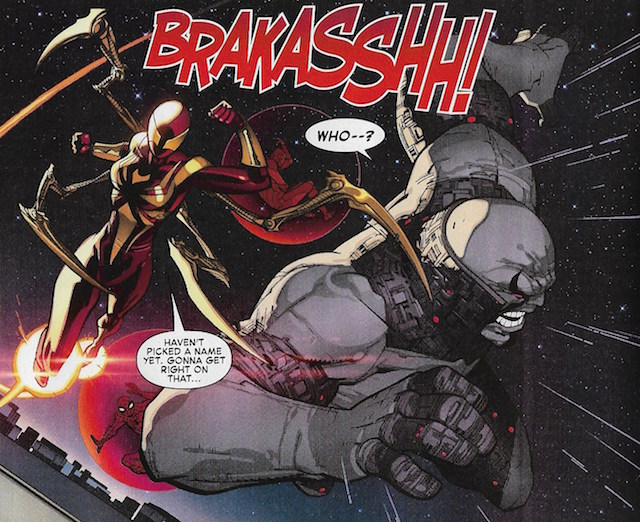
Mary Jane decides to suit up in Peter’s old “Iron Spider” costume because … she once wore an old Iron Man suit and temporarily had spider-powers. Her plan is to take on Regent by herself.
Harry Osborn Lyman, captured and contained in one of Regent’s holding tanks, uses new Webware technology that he “just had Clayton [install]” (how convenient) to escape. Sound waves from Harry’s glorified iWatch shatter glass that can hold She-Thor.
Peter, encased in a bubble, distracts Regent so Iron Spider-MJ can sucker punch him. The distraction bursts his psychic bubbles and the previously defeated and fatigued Spider-Man springs into action. The three have a déjà vu moment.
Spider-Man leaves to save Harry while M.J. and Iron Man continue to fight.
Miles Morales is freed and his instant-win venom blast takes out Dr. Stillwell.
An army of superheroes are released and Regent acknowledges defeat. He is then confined within his own prison.
MJ, Tony, and Jarvis have a private party with champagne (Tony, understandably, does not drink).
Peter, the billionaire CEO of Parker Industries, throws a party for his friends … at a coffee shop. Bobbi Morse is introduced to Aunt May and Jay Jameson collapses after coughing up blood.
ASM #15 fails because Dan Slott sets precedents and then disregards them when it suits his needs. He pens stories for an older-skewing audience, but then expects the average reader to accept deviations from established rules like a child.
To add insult to injury, fans of the marriage between Peter and Mary Jane are punched in the gut at least twice.
Spider-Man tells Tony: “[Peter] only realized he’d lost MJ after she moved on. You better not make the same mistake.”
If you want to see some stunning cover art by Alex Ross, then make sure to buy ASM #15.
If you don’t require a writer to stick to his own set of rules as long as characters are punching each other and “zany” hijinks ensue, then buy ASM #15.













 Douglas Ernst Blog