Amazing Spider-Man #16: Dan Slott sets the stage for ‘Dead No More’

ASM 16 SpiderMan lift

Marvel has big plans for The Amazing Spider-Man in the months ahead, and it appears as though the executive decision was made to make its 16th issue — Before Dead No More — a must-read. Writer Dan Slott packs the issue with important plot points and, in general, does a decent job organizing it all on the page.

As has been established many times before, Mr. Slott is a good stage-setter. Whether he can follow it through over the course of “Dead No More,” the obligatory After Dead No More, and Dead No More — No More remains to be seen.

Here is what you need to know for ASM #16:

  • Jay Jameson is surrounded in the hospital by friends and family with a mysterious illness when Dr. Clarkson from New U Technologies offers him a chance to take part in a “cutting edge” procedure. Peter Parker asks the doctor for details after Jonah flies of the handle.
  • An explosion takes place in Edmond, Oklahoma, at a Parker Industries chemical plant. Peter diverts his private jet, which was heading to San Francisco, back to Oklahoma.
  • Spider-Man (now with thermal imaging in his eye pieces) arrives on a spider-cycle and saves five of six people trapped inside in one fell swoop. He then rescues the sixth, Jerry Salteres, but the man is hospitalized after breathing in toxic fumes.
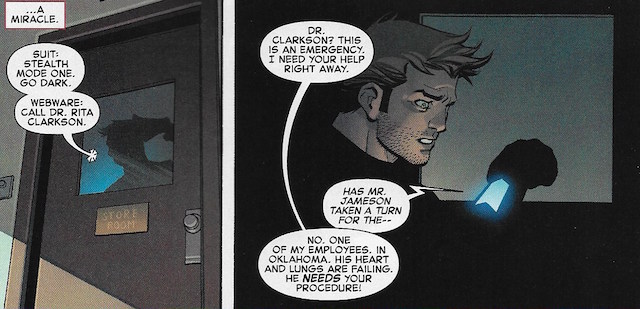
  • Peter Parker tells his suit to go into “Stealth Mode One” (Any guesses on how many stealth modes it’s capable of entering?), and contacts Dr. Clarkson. He requests New U come to Oklahoma and perform a life-saving procedure on Mr. Salteres.
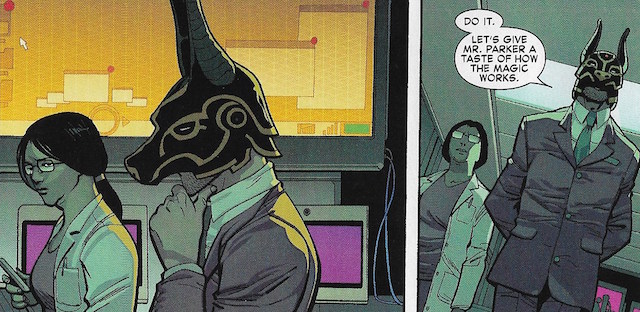
  •  Miles Warren, aka The Jackal, privately says the explosion at Parker Industries wasn’t part of his plans but tells the doctor to give Peter “a taste of how the magic works.”
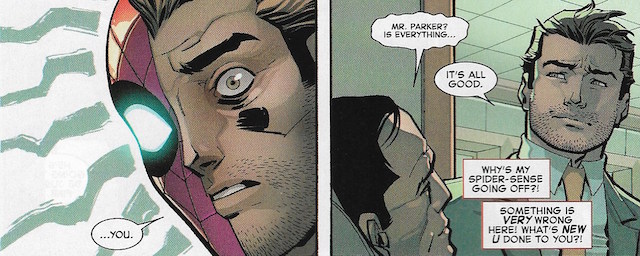
  • Peter’s spider-sense goes off after Mr. Salteres’ life is saved the New U operation.
  • Living Brain, aka Doctor Octopus, catches wind of how New U’s ability to grow healthy organs from a patient’s DNA and calls the technology “very promising.”
  • Electro agrees to Warren’s procedure after “Francine” is brought back from the dead.
  • Jonah secretly meets with New U and asks about its technology. His deceased wife Marla then walks through a doorway.

In short, ASM #16 is stuffed like a Thanksgiving turkey, which is not necessarily a bad thing.
ASM16 stealth

Before Dead No More is probably the best issue of ASM in many months because its function only requires Dan Slott to whet the reader’s appetite. Any one of the plot threads are likely to intrigue potential customers, which is great for Marvel, but Mr. Slott’s track record in terms of delivering a fully fleshed-out story is much more problematic.
Miles Warren

Take, for instance, the way Mr. Slott portrays Peter Parker. Years ago the hero was weirdly obsessed with the idea that “no one dies.” That mantra led him to behave in strange and irrational ways when he had to balance immediate threats to his front with global crises.

In this issue, Peter again seems monomaniacally focused on death — so much so that he embraces an experimental procedure that he knows will come with a heavy “price.” Dr. Clarkson even told him “some find the cost can be…too high.”

Does Peter Parker even ask Dr. Clarkson what that non-monetary “price” is before approving the operation on his employee? Answer: No. He just screams, “We have to move NOW!”
ASM16 Spider Sense

Long-time readers can debate whether or not Peter would dive right in to a dangerous and nascent technology over an accident at one of his power plants, but this blogger thinks his behavior is unstable and rash — the kind of thing Doctor Octopus would do as the Superior Spider-Man.

The good news is that ASM#16 is worth its $3.99 cover price. The bad news is that there are warning signs that Dan Slott is already setting up Peter Parker for another round of character assassination.

Agree? Disagree? Let me know what you think in the comments section below. I’d love to hear what you have to say.

Editor’s Note: Anime Hunter mentioned to me earlier today that editor Nick Lowe took part in a “secret meeting” on Spider-Man, as referenced in the Letters to the Editor section of the book. That might be another tidbit worth discussing. 

Amazing Spider-Man 1.6: Molina’s story mercifully ends — like Julio’s life

AG Julio

It’s a tough time to be a fan of The Amazing Spider-Man. Readers regularly must to deal with things like Dan Slott turing the wall-crawler into a living spider-meteor, or telling audiences that Peter Parker’s love for Mary Jane is “anti-Marvel.”  There seems to be no end in sight. The past year has added insult to injury with the addition of Jose Molina’s “Amazing Grace” storyline, which has finally ended with “Part Six: Lead Me Home.”

For those who have not paid attention since the beginning, here is a quick recap:

  • Peter Parker, The Amazing Atheist (on Molina’s watch) becomes obsessed with Julio Manuel Rodriguez. The mystery man died of cancer, returned from the dead, and seemingly performs miracles with his new lease on life.
  • Spider-Man and the Santerians (Julio’s friends) plan to track him down and reveal the truth.
  • Iron Man tells the group that Rodriguez is drawing power from a portal to the spirit world that is located in Harlem.
  • A “showdown” in the city is announced.

ASM 1.6 concludes with the group realizing that a demon has taken up shop in Julio’s body and will draw power from  it until the two are separated. Iron Man informs the group that a gate to the spirit world is opening that must be closed before all hell literally breaks loose.

Uncle Ben’s spirit returns once more to give his atheist nephew some advice about life, death and the nature of God — but the hero wants none of it.

“Unsubscribe,” Peter says before swinging into the fight.

Amazing Grace SpiderMan

AG1.6


One of the Santerians eventually break’s Julio’s neck, which causes the portal to close and the demons to disappear. Spider-Man is livid and scolds the team after Julio’s (second) funeral: “Julio was not to be harmed! There’s always another way!”

The fact of the matter is that there is not always another way. As the kids point out to the veteran superhero, “We had 30 seconds before that monster got loose in our world.”

Would it have been nice to have a priest on hand to perform an exorcist? Sure. Would it have been a good idea to call Dr. Strange for some help along the way? Of course. But that didn’t happen, and the Santerians did the best they could in a bad situation.

Peter mocks the group for believing Julio is in a better place, and they shoot back: “After everything you’ve seen…why can’t you?

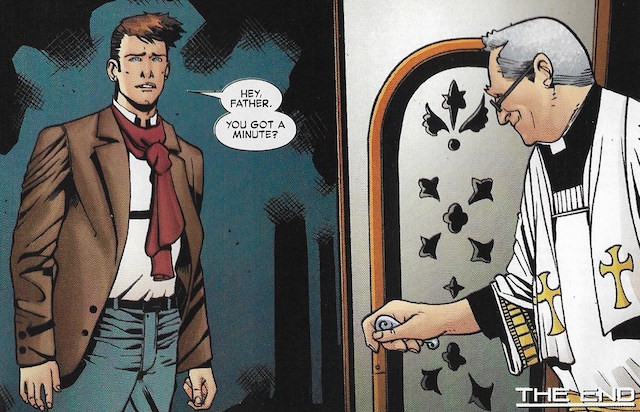
The story ends with Peter walking into a church and asking a priest to talk.

PeterParker Priest

The most disappointing thing about “Amazing Grace” is that it had a lot of potential and guys like me should have loved it.

  • Jose Molina is the first writer to seriously address spiritual issues in ASM in years.
  • “Spirit Uncle Ben,” or whatever you want to call him, actually makes some interesting points.
  • Peter Parker goes to a priest — for advice. (Marvel won’t even allow Matt Murdock into a church these days unless its on Netflix.)
  • The Santerians understand a grim reality that law enforcement personnel and soldiers all over the world are all too familiar with: Sometimes a life needs to be taken to save life.

The problem for Mr. Molina, however, is that Peter Parker should have never been portrayed as a militant atheist to begin with. He would have never blamed God for Uncle Ben’s death because he blames himself. Spider-Man was born out of the guilt that Peter felt over Ben’s murder.

I cannot cheer this particular scene, which respectfully broaches issues of faith, because the writer needed to warp Peter Parker’s origin to make it happen.

I hope Mr. Molina learns from this experience and goes on to write some solid comic books down the line, but someone needs a verbal beatdown for putting him on ASM before he was ready. The book was a disaster from start to finish.

Related:

Molina’s Amazing Spider-Man 1.5: Car crash scene a perfect metaphor for story

Molina’s Spider-Atheist: God ‘a lie’ because Uncle Ben died

Molina’s Amazing Spider-Atheist makes mockery of Peter Parker’s history

Molina’s Spider-Man: ‘Amazing Grace’ a sloppy mess

Daredevil #9: Charles Soule writes modern classic with Spidey-DD team-up

DD SpiderMan

Charles Soule’s Daredevil #9 should be assigned in every “Superhero Team-up 101” class for the next century. “Blind Man’s Bluff: Part II” brings the Man Without Fear and Spider-Man together in a pitch-perfect issue. It is flawless, and therefore should be mandatory reading for all Marvel employees.

Here is what you need to know for Daredevil #9:

  • Spider-Man meets Daredevil in Macau for a casino heist. Although DD offers scant details, the web-slinger agrees to help him snag a briefcase from heavily armed guards.
  • The heroes’ ambush does not go as planned and a man carrying the suitcase escapes onto a helicopter headed for Hong Kong.
  • Daredevil and Spider-Man hitch a hydrofoil ride to the city after Spider-Man reveals that he tagged the suitcase with a spider-tracer.
  • The two track down the suitcase to an apartment building, a massive fight ensues, and Spider-Man makes off with the prize. He agrees to meet up with DD later.
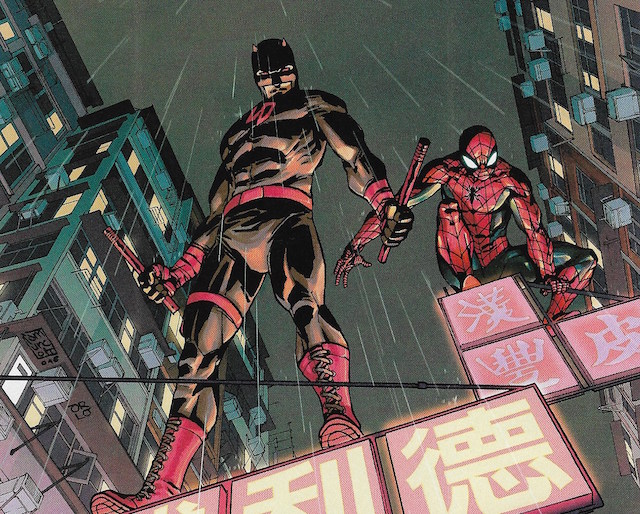
  • The two men convene at the top of a building looking over the entire city. Spider-Man refuses to give up the suitcase until DD explains why he needs it — in addition to why the memories of their friendship is hazy.
  • Matt Murdock debates lying to his friend, but then comes clean: He did something to wipe everyone’s memory of his secret identity. He also needs the suitcase because it has Black Cat’s files on the entire NYC criminal underworld. He wants to take down all the major players in one fell swoop.
  • Spider-Man hands over the suitcase and warns, “Watch out for those black-costume phases. They can really do a number on you.”

Mystery. Action. Humor. Intelligence. Wit. This issue had it all. There is hope for Marvel, and Daredevil #9 proves it.

How is this for a novel idea: Two characters with a rich history actually act in character while using the superpowers that helped make them famous to keep the other guy safe.

There were no “arachno-rockets” needed, and the moment of truth — when Matt takes a leap of faith on a good man and then his decision is reciprocated — was incredibly poignant. In short, Mr. Soule demonstrated that there is still a place in the world for good storytelling.

DD9 Spidey

Perhaps the best way to describe Blind Man’s Bluff: Part II is “timeless.” The story feels like something I could have read in the 1980s as a kid, but at the same time it feels relevant now. It is a tale that I might reopen ten or twenty years from now and still enjoy. That is the sign of a good writer. That is why I continue to buy comic books, and that is why I pray to God that Mr. Soule does not get weirdly political in the future like so many of his industry peers.

Buy this book. Reward good writing. This is a comic book gem and everything about it is even sweeter because it comes from a writer who does not tell people to “eat a bag of d***s” over partisan politics.

Thank you, Mr. Soule. It has been a long, long time since a book has made me this happy, and for that I am deeply grateful.

DD SpiderMan sunrise

‘Civil War II: Amazing Spider-Man #2’: Gage explores ‘self-fulfilling prophecy,’ recidivism, and redemption

CWII ASMII cover

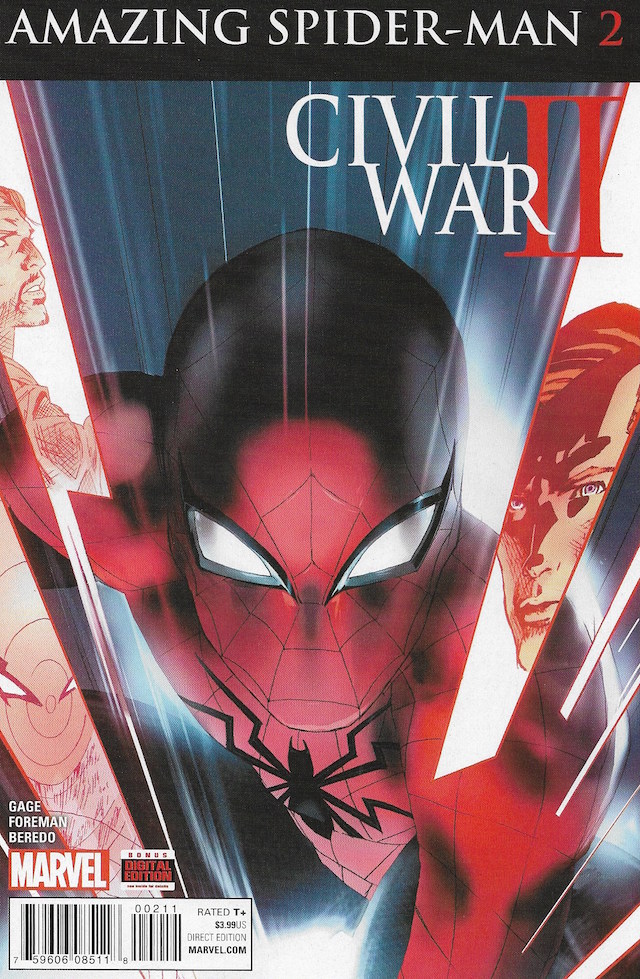
Marvel’s Civil War II has been a mixed bag of good ideas and poor execution, but writer Christos Gage’s work on the project has generally been a notch above his peers. Civil War II: Amazing Spider-Man #2, like the issue before it, highlights just how much potential he has as a writer, even if some elements of the book are rough around the edges.

Here is what you need to know for CWII: ASM 2:

  • Spider-Man, tipped off by Ulysses, defeats a “quintronic man.” (The aftermath features a nice nod to Amazing Fantasy #15.)
  • Clayton Cole (aka, Clash) runs into an old henchman he knows, but rebuffs an offer to talk about working with the Owl.
  • Clayton eats a meal with his parents, who are seemingly rotten people. They tell their son Peter Parker is exploiting his genius, liken Clayton’s beard to a something a homeless man would sport, and say his girlfriend Donna (a single mother who works at Parker Industries as an administrative assistant), is only interested in him for his future earnings.
  • Donna breaks up with Clayton just before he asks her to marry him. She is worried about what will happen when her son learns about his criminal past.
  • Clayton explodes on a coworker and later becomes paranoid (with good reason) when Ulysses and Spider-Man act like gossipy high-school kids around him.
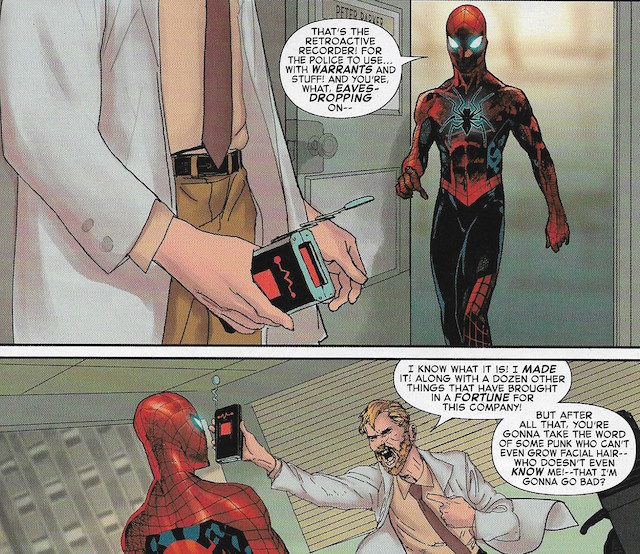
  • Spider-Man catches Clayton using an experimental device that can retroactively track and record sound waves. The two have an argument and Clayton storms off.
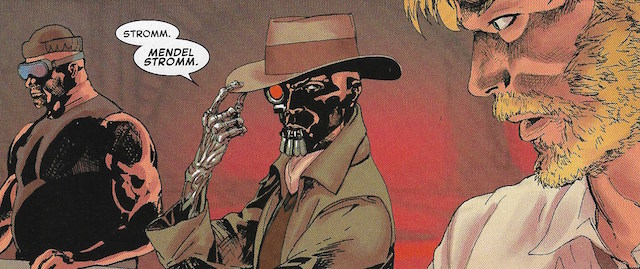
  • Mendel Stromm (aka, Robot Master), pitches a heist of Parker Industries to Clayton in a bar for henchmen. The plan is to frame Harry Osborn Lyman.
  • Peter tells Harry in a private meeting that he wants to make amends with Clayton, never realizing that the Tinkerer has been given a request to upgrade Mr. Cole’s “Clash” costume.

I mentioned in my first review that Mr. Gage added more intrigue to ASM in one issue than Dan Slott has in months. The good news is that Mr. Gage continues to creatively cross his ‘t’s’ and dot his ‘i’s’ in ways the head ASM scribe shows no interest in duplicating. The bad news is that as a reader it’s hard to witness Clayton’s behavior and not think, “Is Peter Parker the worst judge of character of all time?”

Consider this: Peter Parker’s ‘very close’ girlfriend tried to kill him, his inner circle lies to him and tries to work with corporate saboteurs, and his biggest investor (and secret santa) was the head of an international terrorist organization. He might want to have Doctor Strange check out that spider-sense one of these days, because it certainly doesn’t work during job interviews…

CWII ASMII

Overall, CWII: ASM #2 does a good job of getting readers to think about how hard it must be for an ex-convict to escape the long shadow of sins past. There is a nuance to Mr. Gage’s message about second chances and redemption that has always been absent from Mr. Slott’s work, and for that he should be commended.

At the end of the day, however, Mr. Cole largely comes across as an unsympathetic character due to his actions and the way artist Travel Foreman depicts his hair-trigger rage (an apology by the character afterwards does little to endear him to readers.)

Mendel Stromm

The best-case scenario for Mr. Cole is that he is using inside knowledge of Mendel Stromm’s attack to his advantage — as a hero. Perhaps he will set-up the villain to prove beyond a shadow of a doubt to Spider-Man and Ulysses that he is a good man. There will likely be confusion along the way  — a brief fight with Spider-Man, which technically will prove Ulysses was correct — but in the end Spider-Man and “Clash” will work together to take down Robot Master.

CWII ASMII SpiderMan

What did you think of CWII: ASM #2? Do you think “Clash” will be back to his villainous ways, or will he redeem himself by double-crossing Robot Master? Let me know in the comments section below.

Editor’s Note: Check out the YouTube page and subscribe if you’re into video reviews and podcasts. I plan on doing a lot more of that in the years ahead.

Amazing Spider-Man #15: Dan Slott’s Regent took down a god, then falls to … Mary Jane

Mary Jane Iron Spider

It is a good bet that when Marvel writer Dan Slott was a kid that he was the one who always changed the rules of whatever game he was playing with friends. The Amazing Spider-Man #15 is a perfect example of a story crumbling into a schizophrenic mess because the writer altered established realities to get to a desired end.

Readers last left their beloved web-slinger knowing that he and Iron Man were defeated at the hands of Regent. The same villain who defeated a god — She-Thor — Vision, Wolverine, Captain America, Daredevil, Deadpool, Human Torch and countless other superheroes (and villains), also took down Peter Parker and Tony Stark.

Regent has been established as a force to be reckoned with, right? Keep that in mind as we move forward with this review.

Here is what you need to know for ASM #15:

  • The Avengers are defeated. Heroes everywhere are missing. Regent is on the brink of victory.
  • Mary Jane decides to suit up in Peter’s old “Iron Spider” costume because … she once wore an old Iron Man suit and temporarily had spider-powers. Her plan is to take on Regent by herself.
  • Harry Osborn Lyman, captured and contained in one of Regent’s holding tanks, uses new Webware technology that he “just had Clayton [install]” (how convenient) to escape. Sound waves from Harry’s glorified iWatch shatter glass that can hold She-Thor.
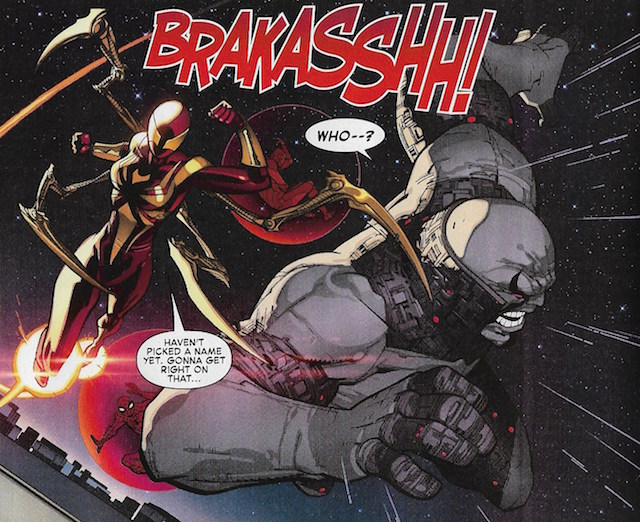
  • Peter, encased in a bubble, distracts Regent so Iron Spider-MJ can sucker punch him. The distraction bursts his psychic bubbles and the previously defeated and fatigued Spider-Man springs into action. The three have a déjà vu moment.
  • Spider-Man leaves to save Harry while M.J. and Iron Man continue to fight.
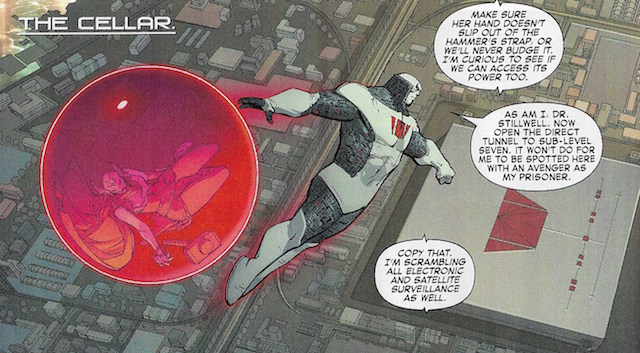
  • Miles Morales is freed and his instant-win venom blast takes out Dr. Stillwell.

Miles Morales ASM 15

  • An army of superheroes are released and Regent acknowledges defeat. He is then confined within his own prison.
  • MJ, Tony, and Jarvis have a private party with champagne (Tony, understandably, does not drink).
  • Peter, the billionaire CEO of Parker Industries, throws a party for his friends … at a coffee shop. Bobbi Morse is introduced to Aunt May and Jay Jameson collapses after coughing up blood.

ASM #15 fails because Dan Slott sets precedents and then disregards them when it suits his needs. He pens stories for an older-skewing audience, but then expects the average reader to accept deviations from established rules like a child.

Regent SheThor

To add insult to injury, fans of the marriage between Peter and Mary Jane are punched in the gut at least twice.

  1. Spider-Man tells Tony: “[Peter] only realized he’d lost MJ after she moved on. You better not make the same mistake.”
  2. Peter essentially introduces Mockingbird to Aunt May as his new girlfriend (Whatever happened to the girlfriend who tried to murder him?)

The fact of the matter is not that Mary Jane “moved on” — it’s that Marvel’s editors and Dan Slott are telling readers to move on.

The message is clear: “Stop spitting up Tom Brevoort’s medicine. Take it. The beatings will continue until morale improves!”

If you want to see some stunning cover art by Alex Ross, then make sure to buy ASM #15.

If you don’t require a writer to stick to his own set of rules as long as characters are punching each other and “zany” hijinks ensue, then buy ASM #15.

If, however, you expect writers to offer creative cohesion and linear logic, which can easily be traced to acceptable premises, then you might want to read Charles Soule’s Daredevil instead.

Amazing Spider-Man #14: Dan Slott puts ‘lipstick on a Regent-pig’

Regent SheThor

Marvel scribe Dan Slott hit a home run with 2015’s Renew Your Vows, but the feat happened despite the creation of a lame villain — Regent. ASM #14 attempts to once again elevate the character into upper echelons of evil, but one cannot help but think of the old line about putting “lipstick on a pig” while reading. Giuseppe Camuncoli puts forth a worthy effort to make the character look cool in costume (don’t ask about supporting cast), but readers care more about the side-stories than the main event.

Here is what you need to know about ASM #14.

  • Ms. Marvel, Nova, Captain America, Vision, and She-Thor are all captured by Regent.
  • Peter Parker, Tony Stark, and MJ tell Miles Morales’ parents that their son (also taken hostage) won a science contest, but is safe … somewhere … with no internet access … on purpose. (Note: This kind of idea only worked in Captain America: Civil War because Peter Parker wasn’t missing.)
  •  MJ tells Peter, “You have no idea how glad I am to have all of this ‘secret identity’ nonsense out of my life. Tony’s not perfect, but with him everything is out in the open.” (Don’t tell Dan Slott, but that is 180 degrees from the truth — Bendis’ Tony Stark disappears for weeks at a time for undercover missions, and no-one knows if he’s dead or alive.)
  • Aunt May coughs up blood and keeps it from her husband.
  • Harry Osborn Lyman calls for a meeting with Augustus Roman and reveals that he knows the businessman is Regent. Harry says he knows Betty Brant was kidnapped, and then uses webware to warn Spider-Man that he is in danger.
  • Spider-Man and Iron Man are crushed by Regent, whose suit was pushed to its limit.

Even if one were to take the position that Regent is an exciting new character, it doesn’t change the fact that readers are getting a rehashed version of Renew Your Vows less than one year after its publication. At least when Marvel does something as tired and worn out as Aunt May dying…the company waits a few years before hitting the “recycle” button. This is like a rerun of your favorite television show after the first three episodes of its new season.

Aunt May

As is often the case with Mr. Slott’s work, there are a lot of pieces shuffled around the chessboard while ultimately not a whole lot goes on. The story bounces from setup to setup (You’re going to love how this comes together in Dead No More, kids!) while ignoring the attention to detail that makes single issues soar.

For instance, Regent dispatches with heavy-hitting heroes like Vision and Captain America in a single panel. He battles She-Thor in what is teased as an epic clash, only to show her captured in an energy bubble two pages later. It’s jarring. It’s strange, and it just isn’t enough for a relatively new character who is met with indifference by most fans.

Regent

If you are the kind of Marvel fan who has collected ASM since 1975 and don’t want to break up your complete set, then make sure to head on out to your local comic book shop this week. For everyone else, I suggest waiting until the reviews for Dead No More are published before you consider opening up your wallets.

Daredevil #8: ‘Blind Man’s Bluff’ starts strong, teases Spider-Man team-up

Matt Murdock

It is fitting that Daredevil #8 takes place inside a Macau casino because readers must be wondering how long Charles Soule’s creative hot streak is going to last. “Blind Man’s Bluff” kicks off a new tale for Matt Murdock, and as far as stage-setters go the writer churns out another solid performance.

Is Mr. Soule just a lucky guy, or is his good fortune on the book positively correlated with his preparation and work ethic? This reviewer is inclined to go with the latter option.

Here is what you need to know about Daredevil #8 before we move on:

  • Matt Murdock has traveled to Macau for a winner-take-all poker tournament. He plays Texas Hold ‘Em because its rules are best suited for … a blind man with enhanced senses.
  • Daredevil is looking for an item that Black Cat sent to China.
  • A mysterious woman named Adhira latches onto Matt after he dominates his competitors.
  • The final round of the tournament features a telepath named Apex who is employed by the casino to make sure it never loses money. Matt’s telepathic defenses are pushed to the limits, but he ultimately holds out and wins a check for $10 million — made out to the alias Laurent Levasseur. (Note: He can’t cash the check.)
  • The casino gives Matt a complimentary stay in its best suite to keep him in town. Adhira also appears and asks to talk about his poker skills. He reminds her that he has a “friend” to meet, and the last page ends with Spider-Man telling Daredevil, “Took you long enough.”

One of the best things about Mr. Soule’s work on The Man Without Fear is that everything he does feels natural. Whether Matt Murdock is in a courtroom, battling ninjas, on a date with a beautiful woman, or in a high-stakes gambling tournament … everything feels right.

Ask yourself the following questions:

The answer (for many readers) is “No.”

With Daredevil, however, fans get stories that respect the character’s past while clearly charting a path forward. It says something about the quality of the title that Daredevil #8’s worst element is Goran Sudžuka’s artwork, which even isn’t bad; he just didn’t perform at Matteo Buffagni’s level with this particular issue.

“Why do I do this? Why do I always have to roll the dice?” Matt Murdock says at one point. “I’m always chasing. Trying to make up my losses. Betting everything I have to get back in the game. My identity, Kirsten, Foggy, my happiness…my life. On some level, I now it’s foolish. A compulsion. But if I don’t play…”

Readers take note: Charles Soule put more introspection into a single page of Daredevil than The Amazing Spider-Man writer Dan Slott has done in years with Peter Parker — a hero who was resurrected from the dead after a megalomaniac took over his body.

The point is this: If you have been unhappy with ASM for years but are still buying it out of sheer love for the character, then you owe it to yourself to purchase a book that consistently performs. There is no reason to give Marvel Comics money for dreck like Hydra-Cap (and an author who says all Republicans are “evil”), when someone like Mr. Soule is firing on all cylinders with Daredevil.

With that said, I will end this review with two points:

  1. I am not in Mr. Soule’s payroll, even if it seems like it at the moment.
  2. I look forward to seeing what the writer does with Spider-Man. That will be a true test of his creative prowess. If he hits a home run with the wall crawler, then I may have to announce a Charles Soule prize for one of the many Douglas Ernst C.R.O.N.I.E.S. (Comics Reconnaissance Operator, Negotiator, Intelligence Expert, and Soldier) around the globe.

Daredevil Spider-Man

Dan Slott’s Amazingly Immature Spider-Man makes protégé Miles Morales ‘ashamed’ of the costume

ASM13 SpiderMan IronMan fight

It would be incredibly hard for any comic book to steal headlines from Marvel’s Hydra-loving Captain America these days, but the latest issue of The Amazing Spider-Man gives it the old college try in terms of defiling a great character. It’s true that Marvel’s editors have not made Peter Parker admit to killing Uncle Ben — yet — but Dan Slott does turn a grown man into an immature loser who puts civilians’ lives at risk. Worse, Peter’s own protégé looks at his behavior and can barely keep his lunch down.

Before we continue on, here is what you need to know for ASM #13:

  • Harry Osborn and Betty Brant get ready to go to lunch with “the old gang.” Harry weirdly tells Peter that he isn’t invited because he’s “the big boss man” and Peter sheepishly replies, “Um…okay.”
  • Harry tells Betty he didn’t want to “risk” an awkward encounter with Mary Jane attending the lunch.
  • The three of them look at one of Betty’s Daily Bugle articles and realize that Augustus Roman is Regent.
  • Peter takes off as Spider-Man for a “Big Brother batting cage playdate” with Miles Morales, aka young Spider-Man.
  • Tony Stark arrived before Peter and soon ribs him about the quality of Parker Industries’ technology. Iron Man has also provided Miles with new web-shooters.
  • Spider-Man goes nuts and begins a street fight with Iron Man in front of parents and their children.
  • Miles Morales throws his hands in the air and says he’s “ashamed to be wearing this costume right now.” He leaves unnoticed and is immediately captured by Regent.
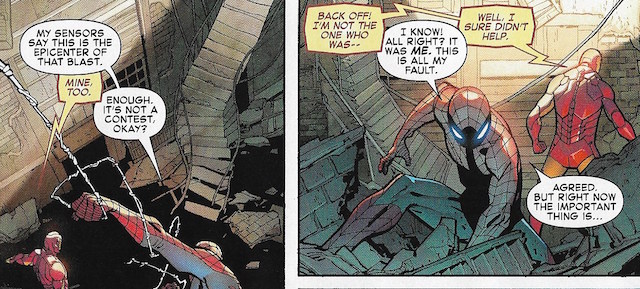
  • The giant explosion that takes down Miles stuns Spider-Man and Iron Man. The charge towards the blast area.

Ask yourself this question: If a writer claims to love Peter Parker, then why would he have the character behave in a way that causes a derivative version of himself to be “ashamed”?

The job of a writer is to make the protagonist shine in his own unique way as much as possible, yet Dan Slott’s Spider-Man has New Yorkers running for the hills as he acts like a clown.

“With great power comes great responsibility” — unless Tony Stark acts like Tony Stark, in which case it’s time to destroy public property and scare everyone within a half-mile radius. Perhaps J. Jonah Jameson was right all along…

ASM 13 SpiderMan IronMan

Regular readers will note that Peter Parker had a bizarre fight with Human Torch in ASM #3 and with Iron Man in ASM #12. He is actually regressing in terms of tact, professionalism, and maturity as the series goes on, so much so that his teenage protégé storms off in disgust. 

ASM 13 Miles explosion

“It was me. This is my fault,” Spider-Man says as he searches through wreckage for Miles. That may be true within the context of the story, but fans are left thinking, “No, this was Dan Slott. This is his fault.”

Long-time Spider-Man fans need to be told the following since they will never get it from websites like Newsarama: Dan Slott uses ASM #13 to elevate Miles Morales by making a mockery out of Peter Parker.

Writer Brian Michael Bendis did the very same thing in SM #2, which is why readers must pay close attention. There is a concerted effort to chip away at Peter Parker’s credibility until Miles usurps him in popularity, and it will certainly happen unless readers push back — hard.

If you want to see the slow-motion destruction of Peter Parker, then run out and buy ASM today.

If you want to see writers knee-cap the original Spider-Man so that Miles Morales wins the long-distance sales race, then check out ASM.

If you want to show Marvel your displeasure at what it’s doing to both Captain America and Spider-Man, then keep your hard-earned cash for better products. Charles Soule, for instance, is running creative laps around his peers as the moment. I highly suggest checking out his version of Daredevil.

ASM 13 IM SM

Spider-Man #4: Bendis reveals Morales’ secret identity — to ‘Goldballs’

Miles Ganke

Superheroes tend to place a high value on their secret identities, and Miles Morales is no exception to the rule. Unfortunately, the fourth issue of Brian Michael Bendis’ Spider-Man shows the hero losing it due to a decision by his best friend Ganke. He spills the beans to ex-X-Man “Goldballs” of all people. (Yes, Goldballs.)

Like the surface-to-air missiles that target Miles after Ganke’s betrayal, this issues misses the mark.

Before we move on, here is what you need to know:

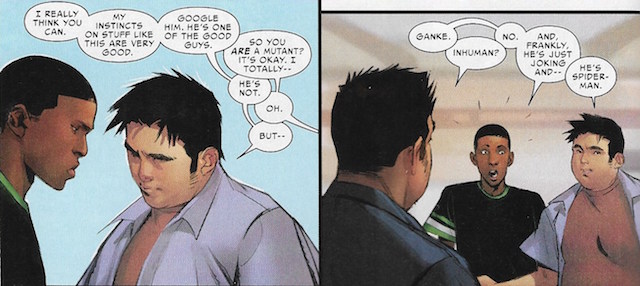
  • Miles and Ganke argue in the school lunch room whether it’s harder to be a black teen in America or an overweight asian (groan).
  • Ganke wants Miles to talk to the new kid, Fabio Medina (aka: Goldballs), because they both have superpowers.
  • When Fabio accidentally launches one of his “goldballs” into Ganke’s food, the three young men start talking and Ganke inexplicably reveals his friend’s secret identity.
  • Miles storms off and while web-slinging through the city he is targeted by four heat-seeking missiles.
  • Spider-Man is knocked to the ground due to the concussive blast of one of the missiles. Hammerhead steps out of a vehicle and says it’s time to call Black Cat and collect his bounty.

Miles Morales 3

The decision to explore a best friend’s betrayal in a book involving high-school kids is appropriate, but it seems quite a stretch for someone like Ganke to suddenly reveal Miles’ secret identity. A writer should spend a lot of time setting the stage for game-changers, but readers sadly did not get it this time. As a result, half the issue didn’t ring true.

Making matters worse is the fact that Miles says, “I have actually never been this mad at anyone about anything,” but we never see his anger. He web-slings around the city for a few moments and then his spider-sense alerts him to incoming missiles.

Try this out: Think of the angriest you’ve ever been in your life. What did you do? How did you react? Did you just say, “I’ve never been this mad” and then walk around, or did you punch, kick, yell or scream?

A few years ago an old Army buddy of mine said, “Do you remember that time that you got so mad at [insert name of horrible squad leader here] that you burst into our room, slammed the door, screamed, flipped your entire bed, and then took off for the motor pool?” 

I do remember that — and that isn’t the most angry I have ever been.

People do not think clearly when they are livid. Given that, it seems like a no-brainer for Miles’ to have been so upset that he didn’t notice his own spider-sense going off until it was nearly too late. Maybe he could have even kicked a garbage can as he exited the school and sent it flying 100 yards down the road. Something — anything — would be better than just telling readers that Miles is angry.

After the heat-seeking missiles magically miss Miles while in “cammo mode,” he decides to lure them to parts of the city where detonations will pose the least amount of risk to the civilian population.

Miles Parker Industries

Miles chooses to destroy a Parker Industries sign, which is funny given that Arachno-Rockets” (See ASM #9) filled with liquid hydrogen are stored inside the building.

We’ll just say that it was by the grace of God that Miles didn’t kill scores of people…

Spider Rocket

Our hero’s luck runs out and he is seemingly incapacitated at Hammerhead’s feet. Besides wondering how a has-been underworld thug like Hammerhead got his hands on some SAMs and then deployed them in the middle of New York City, readers must now ask the following question: Is Spider-Man worth it? The jury is still out for this blogger.

  • If you like Marvel’s new take on Black Cat (I don’t), then Spider-Man #4 is for you.
  • If you like Hammerhead (I don’t), then Spider-Man #4 is for you.
  • If you like Goldballs (Huh?  Why, Marvel?), then I guess Spider-Man #4 is for you.
  • If you like best friends who act irrationally, then Spider-Man #4 is for you.

Spider-Man certainly has potential, but as of right now it still feels as though Bendis’ search for Miles identity within the 616 Universe is coming through in the title.

How big is his stable of characters to pick from? If Bendis is forced to use Goldballs and Hammerhead this early in his run, then it doesn’t bode well for the future. Perhaps he is limited one what villains he can use because Dan Slott needs them for The Amazing Spider-Man. Whatever the case, Bendis needs to settle into a groove soon our readers will move on.

‘Captain America: Civil War’: Russo brothers deliver mic-drop worthy Marvel movie

Captain America Civil War

Captain America: Civil War is downright amazing. It’s scary-good. It’s so good that it makes one wonder if Joe and Anthony Russo cut some sort of weird deal with Mephisto to make it happen. The script is so tight and the direction is so proficient that employers should ask questions about it during job interviews — any candidate who says Civil War is a rotten film should be told to have a nice day and shown the door due to their unfortunate lack of good judgment (I’m kidding … sort of).

For those who have been living in an underground bunker for the last year, Civil War involves the disintegration of the Avengers when the international community demands regulations governing the actions of super-humans. The United Nations has had enough with civilian casualties and diplomatic headaches linked to free-wheeling superheroes, and Tony Stark agrees. Steve Rogers decides the world is safest if he and his allies are only beholden to their own consciouses, and the disagreement puts everyone on a collision course.

Since this is a spoiler-free review, I will concentrate on what the Russo brothers professionally accomplished and only talk in broad brushstrokes about the of the film.

Imagine you’re the Russo brothers.

Now imagine Kevin Feige gives you $250 million and tells you to find a way to utilize Captain America, Iron Man, Winter Soldier, Black Widow, Falcon, War Machine, Hawkeye, Black Panther, Vision, Scarlet Witch, Ant Man, Spider-Man, Crossbones, and Zemo. You need to make sure the script is tight, juggle all the weirdness that actors bring with them to the set, navigate countless professional mine fields, and then somehow deliver a product that can impress a fanbase that has been spoiled with excellence since 2008’s Iron Man.

The verdict is in: Captain America: Winter Soldier was not a fluke. These guys not only met expectations given an almost impossible task — they exceeded expectations. Civil War is a modern superhero classic and should be used as the gold standard by which future installments are judged. One almost feels bad for the pressure their own greatness has created as production on Avengers: Infinity War – Parts I and II begins.

Regular readers of this blog know I am a stickler for superhero stories that work on multiple levels. If some child (or an adult) just wants to see Spider-Man swing across the screen and come to blows with other superheroes, then he or she will exit the theater with a smile. If intellectually curious individuals want their superhero flicks to be much more than “popcorn fare,” they too will be happy after the end credits roll.

Civil War has gravity, but it also has lighthearted humor. There is plenty of action, but the blows actually mean something because the script took the time to adequately address every character’s motivations. As an added bonus, the world will now get to see cinematic killjoys attempt to nitpick the film into oblivion (e.g., Well, the score wasn’t all that great and it was a bit too long.)

“Compromise where you can, but where you can’t — don’t. Even if everyone is telling you that something wrong is something right. Even if the whole world is telling you to move, it is your duty to plant yourself like a tree, look them in the eye, and say, ‘No. You move,'” S.H.I.E.L.D. agent Sharon Carton (Emily VanCamp) says at one point of advice her aunt once gave her.

After watching Civil War, it is obvious that the Russo brothers had a vision and refused to compromise on all the issues that mattered.

If you are a fan of superhero movies, then you owe it to the creative team that put Civil War together to see it before it leaves theaters.  When you are old and grey you will watch it again and say, “Those were the good old days.”