‘Civil War II: Amazing Spider-Man #4’: Dan Slott’s ASM #17 haunts Christos Gage’s latest effort

cwii-asm4-spiderman-clash

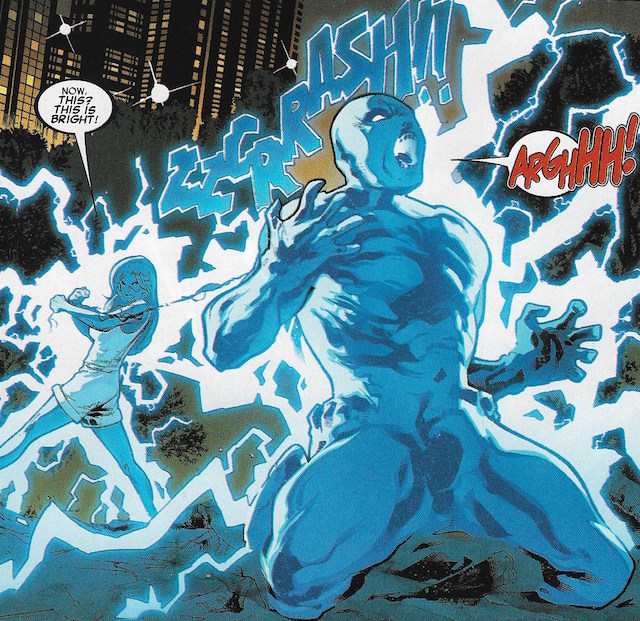
It’s hard not to feel sorry for Christos Gage. The guy was asked to write a Spider-Man story that stood on its own while also supporting Brian Michael Bendis’ Civil War II and Dan Slott’s run on The Amazing Spider-Man.

Question: How does the hero who a.) asked The Prowler to resort to corporate espionage on behalf of Parker Industries, and b.) teams up with Carol “Minority Report” Danvers have the moral authority to lecture a confused man like Clayton Cole?

Answer: He doesn’t.

Civil War II: Amazing Spider-Man #4 is a book that actually reads better the less one knows about the current Marvel universe. For people who just want to roll around a few philosophical questions about redemption and free will like marbles, Mr. Gage’s work satisfies. For people who love the character Peter Parker, however, the issue is just one more reminder of just how intellectually discombobulated he has become thanks (in large part) to writer Dan Slott.
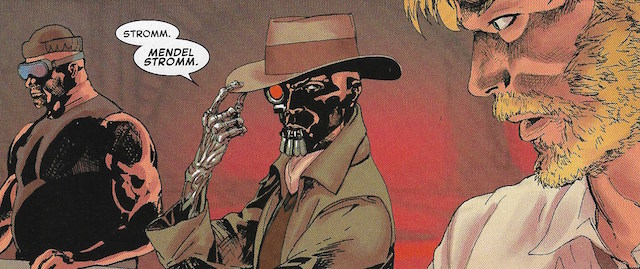
stromm

Here is what you need to know for CWII: ASM #4:

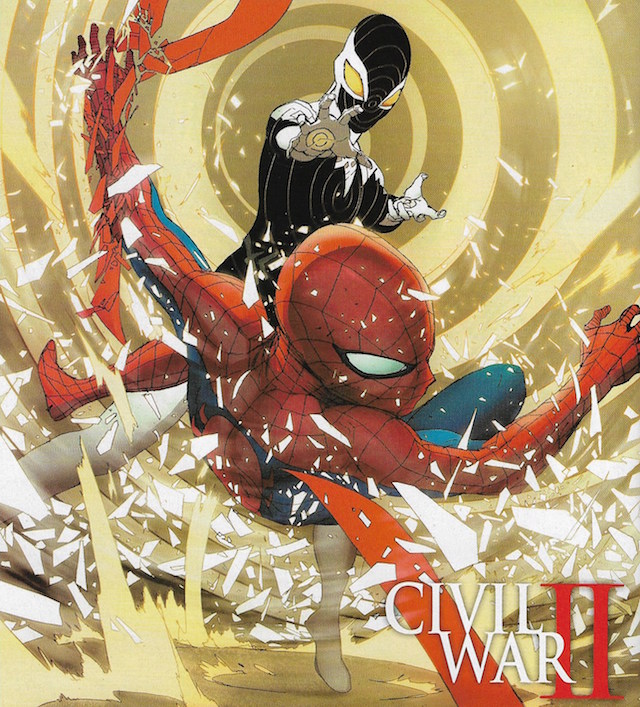
  • Spider-Man tries to talk Clayton Cole off a psychological ledge during the one-on-one battle predicted by Ulysses. Peter wants the scientist to give up his “Clash” technology and start a new life.
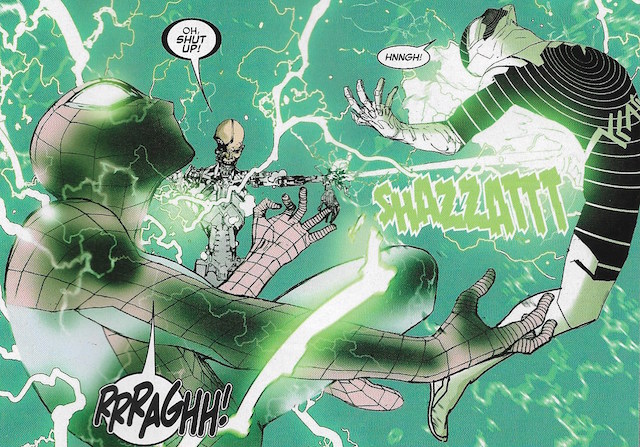
  • Robot Master reconstitutes himself and attacks the two men just as Peter seems as though he might have a breakthrough.
  • Clayton leaves Spider-Man to deal with the villain on his own, saying that he needs to go his own way.
  • Spider-Man defeats Robot Master, who vows to take Parker Industries to court for Cole’s attack.
  • Peter Parker and Ulysses discuss the Inhuman’s powers, whether they are appropriate to use, and how to channel them to save lives. Peter now says it would be wrong for Ulysses to work for Parker Industries because the company will be stronger by learning from its own from failures.
  • Spider-Man agrees to work with Carol Danvers to profile potential future criminals. He will fight for the cause if necessary, but says he will act like her personal Jiminy Cricket (It worked out so well with Doctor Octopus, right Pete?)
  • Clash steals a massive amount of off-the-books cash from Roxxon and announces that he will no longer work for other men. The villain begins to recruit for a criminal empire.

Fact: Clayton Cole wanted to “redefine” himself as a hero using Clash technology.

  • What then, we must ask, gave Spider-Man the moral authority to say that Clayton Cole should not do that, but Hobie Brown as the Prowler can?
  • Why is Dan Slott’s Peter Parker a stand-up guy for asking Mr. Brown to break into a business and steal technology for his own selfish reasons, but Mr. Cole is “ruining” his life for trying to turn over a new leaf as Clash — the superhero?
  • How can Peter Parker, a man who has been falsely convicted in the court of public opinion multiple times, endorse Captain “secret detention” Marvel?

In short, CWII: ASM #4 is filled with creative contradictions, which are not treated as such. As was stated in previous reviews, it is tough to discern how culpable Mr. Gage is for the story’s flaws when a strong argument can be made that he is doing the best he can with messes made by other men.

spiderman-carol-danvers-cwii-asm4

If you have read the previous three issues of Civil War II: The Amazing Spider-Man, then you may as well buy the conclusion. If you have held off this long, then skip it and take note: The modern Spider-Man is like a boat without an anchor in a storm that shows no sign of breaking.

Again, I feel bad for Mr. Gage — but even more so for the writer who eventually replaces Mr. Slott. Where does a man begin with so much rubble to clear? I guess we’ll find out.

clayton-cole-clash-cwii-asm4

Related:

‘Civil War II: Amazing Spider-Man #1’: Gage offers reprieve from Slott fare

‘Civil War II: Amazing Spider-Man #2’: Gage explores ‘self-fulfilling prophecy,’ recidivism, and redemption

‘Civil War II: Amazing Spider-Man #3’: Peter Parker turned into hypocritical jerk to keep story going


Dan Slott’s Spider-Man: ‘White Privilege’ is having Peter Parker resort to corporate espionage, getting Hobie Brown to die for his sins

Hobie Brown death

Your friendly neighborhood blogger said less than one month ago that Marvel writer Dan Slott’s setup for “Dead No More” was worth buying, but that all the warning signs were there “for another round of character assassination.” In lightening-fast speed that would make Olympic sprinter Usain Bolt blush, Mr. Slott managed to stab Peter Parker in the back and twist the knife in 21 days.

Years from now, The Amazing Spider-Man #17 will hopefully be used in a documentary titled The People vs. Dan Slott. The issue includes the moment in time when Peter Parker — the guy who took on corporate saboteur Ghost on multiple occasions — became the very same kind of criminal. Worse, he guilted a good friend with a criminal past into doing the dirty work for him — and the result was deadly. 

For all those social-justice activists out there, let me put it to you in a way that you can understand: “White Privilege” is having Peter Parker resort to corporate espionage and convincing a black friend to die for his sins. Thanks, Dan Slott!

Here is what you need to know about ASM #17:

  • Peter Parker tells Hobie Brown that he needs him to break into New U and steal their intellectual property. He wants to use the company’s nascent technology on Jay Jameson, but requires access to its private data. (Yes Dan Slott, “taking pictures” of a company’s private research after breaking and entering is stealing.)
  • Hobie Brown tells Peter he can’t do that because “industrial espionage” is out of bounds. “I don’t do that anymore,” he says, which is met with a guilt trip about “FAMILY.”
  • Hobie reluctantly agrees and puts on his Prowler uniform. The once-reformed criminal, thanks to Dan Slott’s Peter Parker, becomes a recidivist offender. (The whole scene is more disgusting, given Spider-Man’s lecture to Clayton Cash in Civil War II: Amazing Spider-Man #3.)
  • Miles Warren, aka The Jackal, tries to give Electro his powers back but the process does not work. Francine (the woman he killed with a kiss before she was resurrected) is nearby, which causes her “genetic mix” to attract Max Dillion’s latent powers. She kisses him to absorb his energy and ironically kills him.
  • Hobie gives up his position to stop Francine. He tries to flee after it is obvious that Dillion is dead, but the new Electro tracks him down and chars him to a crisp. “Told Parker I wasn’t cut out for this. I work best in the shadows…and I stay out…of the light,” he thinks before death overcomes him.
  • The Jackal revives Hobie and shows him secrets that prove his team consists of the real “good guys.” Hobie agrees. When Peter calls from Oklahoma to say New U scientists are going to perform a procedure on Jerry Salteres, he gives no indication that anything is wrong.
  • Miles Warren shows Hobie a pill and says he needs to take it on a daily basis.

Yes, you read that right, Peter Parker asked Hobie Brown to break the law, and then before his partner in crime got back to him with a full report he admits that he was going to approve New U’s procedure anyway (i.e., Thank for dying for nothing, sucker. Mr. Salteres is the perfect guinea pig to see if the surgery would be right for Jay Jameson).

Prowler

If you’re wondering how on earth Spider-Man fans got to the point where their hero is no better than the goons who tried to steal Tony Stark’s technology over the years, then look no further than the flashback scene Dan Slott writes on the first page of the issue.

Bad guys are just like the good guys…except they don’t hold back. They don’t follow any rules,” Francine says before kissing Electro.

This is the kind of moral relativism that has been on display since The Superior Spider-Man. Doctor Octopus is a megalomanic who nearly succeeded in exterminating 6 billion people, but to Dan Slott the two men are not all that different. (Heck, the writer even said that Doc Ock was better than Peter at appreciating those who are “truly beautiful”…)

Mr. Slott told Newsarama on April 5, 2013:

Slott: [Otto is] trying his best to be a hero, but he’s doing it in a very Doc Ock way. And Doc Ock’s an egotistical, annoying sh*t. It makes him an interesting character. At his core, he’s someone we don’t really think of heroic. But is he any more annoying than [former villain] Hawkeye used to be? …

Also, when you look at Doc Ock, he was so much like Peter Parker. Peter Parker, if he didn’t know the lessons of power and responsibility, that teenage nerd would have grown up to be an Otto Octavius nerd, with the same kind of, “I’m going to make them pay.” This is the flip of that. …

Do you see Punisher as a hero? Do you see Wolverine as a hero? If these guys can be heroes, why can’t Doc Ock?

Dan Slott admits that he thinks Peter Parker is, for all intents and purposes, one step away from becoming Doctor Octopus.

That is why his Peter is so obsessed with death.

That is why his Peter is willing to exploit the trust of a reformed criminal for his own selfish purposes.

That is why his Peter’s moral compass aimlessly spins in circles — and that is why readers can expect more embarrassing behavior from their “hero” in the months to come.

Hobie Electro

ASM #17 is officially the issue where Hobie Brown died, but many Spider-Man fans should consider it the issue where Dan Slott assassinated Peter Parker.

Prowler Hobie Brown death

Related:

Amazing Spider-Man #16: Dan Slott sets the stage for ‘Dead No More’

Amazing Spider-Man #15: Dan Slott’s Regent took down a god, then falls to … Mary Jane

Spider-Man movies called ‘white-boy fantasy’: The Root writer says Zendaya casting not ‘progress’

Jason Johnson

The Root bills itself as an “opinion and culture site for African-American influencers,” which works out nicely because I was recently looking to see what such self-proclaimed individuals were saying about Zendaya’s role as MJ in Spider-Man: Homecoming. It turns out that Spider-Man is a “white-boy fantasy” and nothing you ever do is good enough for “influencers” like Jason Johnson.

Mr. Johnson wrote on Aug. 23 for The Root’s “No, Zendaya in Spider-Man: Homecoming Is Not the Progress We’re Looking For”:

Consequently, the announcement that she’s been cast as Peter Parker/Spider-Man’s long-term love interest, Mary Jane, in Spider-Man: Homecoming next year has given many people all sorts of excitement and feels. I am not one of them. Casting Zendaya as Mary Jane is another example of Hollywood expecting black dollars at the box office, but disrespecting black consumers and fans on the big screen. …

Zendaya’s casting is yet another sign that makers of Hollywood sci-fi fantasy action films will “racebend” a character (change a character’s race from what it was in a book, film or cartoon), slap themselves on the back for being progressive and expect black fans to be satisfied, while pretty much maintaining the status quo. Racebending is fine so long as it’s for girlfriends and sidekicks, but the movies are still white-boy fantasy adventures in which the lead remains a straight white male no matter what. And that unfortunate fact can’t be separated from the choice to cast Zendaya as Mary Jane.

There was never a doubt or even a conversation about casting anyone other than a white man as Iron Man, Thor, Captain America or the Incredible Hulk. Even though Iron Man was black in the early 1980s, the first Captain America was a black man, and Thor as a Norse God could be anybody.

Are you a young comic book fan who is on the ideological fence? If so, then consider the psychology on display with Zendaya’s casting:

  • If you think movie producers should try to adhere as closely as possible to the source material, then liberal guys like Dan Slott will imply that you are a racist.
  • If you think movie producers should try to adhere as closely as possible to the source material, then liberal guys like director James Gunn will say that you have “too good of a life.”
  • If you think movie producers should try to adhere as closely as possible to the source material, then liberal guys like Devin Faraci of the website Birth. Movies. Death. will call you a “racist fanboy.”
  • Conservative guys like me will shrug their shoulders and say, “Yeah, but Zendaya may still be pretty good. As long as she tints her hair red then we should just give the girl a chance.”
  • Meanwhile, liberals like Jason Johnson will mock you for your “white-boy fantasy” even if you do give Zendaya’s casting three cheers for diversity. You are damned if you do and damned if you don’t. Welcome to a life of Kobayashi Maru-type scenarios if you board the USS Social Justice.

As your friendly neighborhood blogger has said on numerous occasions, social-justice obsessives are never satisfied. Any attempt to placate them will only result in additional admonitions that require an apology, new demands to meet without question, and more rules that undoubtedly conflict with a sub-group of professional victims someplace else.

Between now and the July release of Spider-Man: Homecoming, I implore anyone who is still trying to define their ideological identity to conduct a test: Come to this blog and disagree with me just to see how I react. Then, do the same with liberal writers like Dan Slott or Nick Spencer. By the time your favorite wall-crawler returns to theaters, I am confident that you will no longer be on the fence.

‘Civil War II: Amazing Spider-Man #3’: Peter Parker turned into hypocritical jerk to keep story going

Robot Master

Marvel “events” have a weird habit of warping a character’s personality in order to arrive at an author’s desired outcome — superhero integrity be damned. Civil War II: Amazing Spider-Man #3 officially falls victim to this recurring annoyance. Writer Christos Gage takes Peter Parker’s penchant for getting on his high horse and (in keeping with the theme of the story), jacks up the amplitude to a bizarre level. By turning the character into a hypocritical jerk, the prognostications of the Inhuman known as Ulysses once again come true.

Here is what you need to know about Civil War II: Amazing Spider-Man # 3:

  • Clayton Cole, aka Clash, meets with Robot Master. The villain, whose real name is Mendel Stromm, discusses his plans to steal money from Parker Industries but is ambushed by Clash.
  • Peter Parker laments having fired Clayton. He sulks at table as Harry Osborn Lyman condescendingly pats him on the back and says, “Clayton’s a grown man too. He made his own choices, and he’s responsible for them. Now it’s on him. (Note: How sad is it that a former Green Goblin now must lecture Peter on what it means to take responsibility for one’s actions?)
  • Robot Master, having anticipated a double-cross by Clash, notes that his mechanical minions have been upgraded and are ready for a fight. A battle ensues on the streets of New York City.
  • Spider-Man shows up to save the day. After Robot Master’s technology forms into a giant robot (and Spidey jokes, “Always giant robots…”), the two eventually agree to divvy up the tasks. Spider-Man agrees to “trust” Clash and leave him with the giant robot while he chases down Stromm.
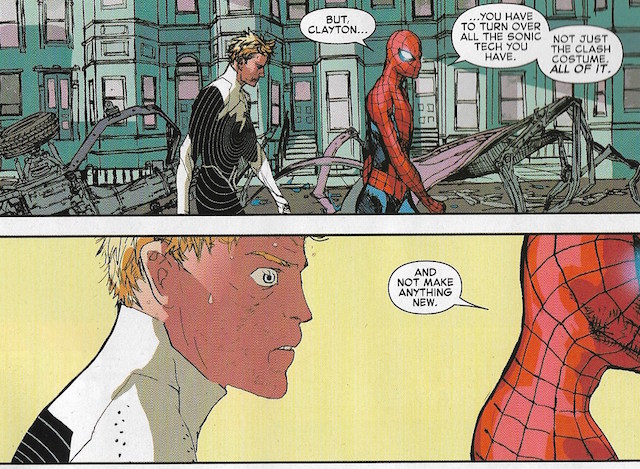
  • Both men defeat their respective opponents. Spider-Man then decides to lecture Clash on what a rotten person he is the moment the dust settles. The hero says that “Peter Parker” is going to let Clayton have his job back — provided he turn over all of his sonic technology.
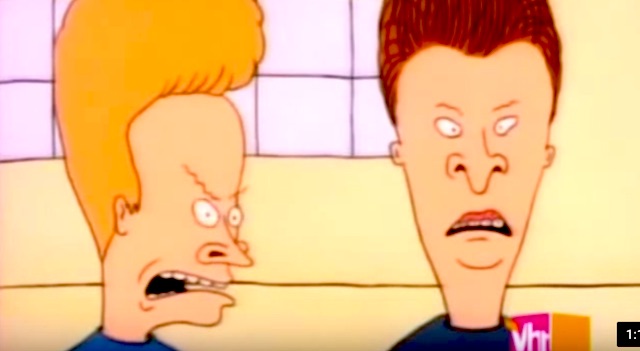
  • Clayton gets an “angry Beavis” look in his eyes from the old Beavis and Butt-Head cartoons, and then attacks Spider-Man —just like Ulysses predicted.

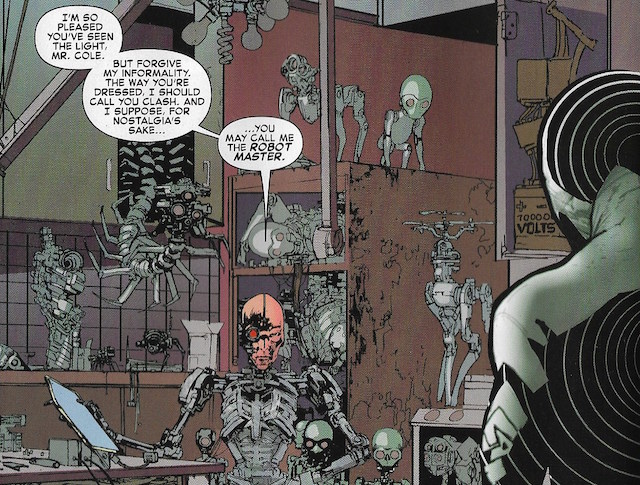
This issue had so much potential. It is hard not to look at Robot Master’s lab, which appears to be something out of Tim Burton’s wildest dreams, and not anticipate a good read. Mr. Gage generally does an adequate job — and Spider-Man fans finally gets a decent fight scene — but it appears as though the constraints of Civil War constantly undermine the book.

ASM Civil War Clayton Cole

Consider this:

  • On one hand we have Peter Parker, a sulking mess who doesn’t understand basic responsibility. Harry recounts how Peter behaved like a stalking ex-boyfriend by sending Clayton “message after message” via “voice, text, email” to try and apologize … for firing a guy who probably deserved to be fired. At Parker Industries, it’s almost impossible to get terminated. (Does anyone know what happened to Lian Tang, the Parker Industries girlfriend who tried to kill him? I wouldn’t be surprised if she still has a job…)
  • On the other hand we have Clayton Cole, a guy who outwardly appears to be a nutcase (bulging eyes, screaming fits of rage, crying on the job, sweating, etc.), in addition to the issues raging beneath the surface. The audience is often encouraged by Mr. Cage to have sympathy for the man, but it is always negated by his actions.
  •  The question becomes: What the heck is the point of all of this?

As has been said before, Christos Gage handles issues of redemption and responsibility much better than the series’ regular writer, Dan Slott. The interactions between characters are more natural, which in turn give the action scenes added weight (i.e., Gage’s stories do not feel like a kid who mashes his action figures together and then expects you to care). It’s just a shame that Civil War makes it difficult to judge whether editorial mandates are the cause of The Amazing Über-Hypocrite, or if that is an mistake that rests solely on Gage’s shoulders.

Fact: Spider-Man is a vigilante. Vigilantes do not get to stand upon a giant moral pedestal and lecture other vigilantes about the collateral damage brought about by their actions.

Peter Parker of all people should know that Clayton Cole — a fellow man of science — sees his knack for sonic technology as his “great power,” which also comes with “great responsibility.”

Peter Parker of all people should also know that Clayton Cole would feel added pressure and guilt, given that he erred with his powers early on in life. Therefore, a well-written Spider-Man in this issue would not have behaved like a massive tool in the immediate aftermath of a street battle.

Clayton Cole ASM

Beavis and Butt-Head

In short, Civil War II:: Amazing Spider-Man #3 is worth checking out if you purchased the first two issues, but you can probably sit out the finale if you still haven’t coughed up any hard-earned cash.

Civil War II ASM4 preview

Editor’s Note: Just to keep the sound motif going, what is with the Amazing Spider-Man #15 “echo”? Clayton asks Peter Parker to trust him in battle, which is what Mary Jane did during her battle with Regent. Oddly enough, Peter had legitimate reasons to not trust either of them…

Related:

‘Civil War II: Amazing Spider-Man #1’: Gage offers reprieve from Slott fare

‘Civil War II: Amazing Spider-Man #2’: Gage explores ‘self-fulfilling prophecy,’ recidivism, and redemption

Amazing Spider-Man #15: Dan Slott’s Regent took down a god, then falls to … Mary Jane

Amazing Spider-Man #16: Dan Slott sets the stage for ‘Dead No More’

ASM 16 SpiderMan lift

Marvel has big plans for The Amazing Spider-Man in the months ahead, and it appears as though the executive decision was made to make its 16th issue — Before Dead No More — a must-read. Writer Dan Slott packs the issue with important plot points and, in general, does a decent job organizing it all on the page.

As has been established many times before, Mr. Slott is a good stage-setter. Whether he can follow it through over the course of “Dead No More,” the obligatory After Dead No More, and Dead No More — No More remains to be seen.

Here is what you need to know for ASM #16:

  • Jay Jameson is surrounded in the hospital by friends and family with a mysterious illness when Dr. Clarkson from New U Technologies offers him a chance to take part in a “cutting edge” procedure. Peter Parker asks the doctor for details after Jonah flies of the handle.
  • An explosion takes place in Edmond, Oklahoma, at a Parker Industries chemical plant. Peter diverts his private jet, which was heading to San Francisco, back to Oklahoma.
  • Spider-Man (now with thermal imaging in his eye pieces) arrives on a spider-cycle and saves five of six people trapped inside in one fell swoop. He then rescues the sixth, Jerry Salteres, but the man is hospitalized after breathing in toxic fumes.
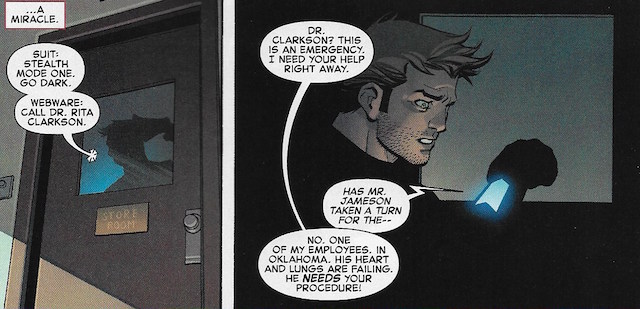
  • Peter Parker tells his suit to go into “Stealth Mode One” (Any guesses on how many stealth modes it’s capable of entering?), and contacts Dr. Clarkson. He requests New U come to Oklahoma and perform a life-saving procedure on Mr. Salteres.
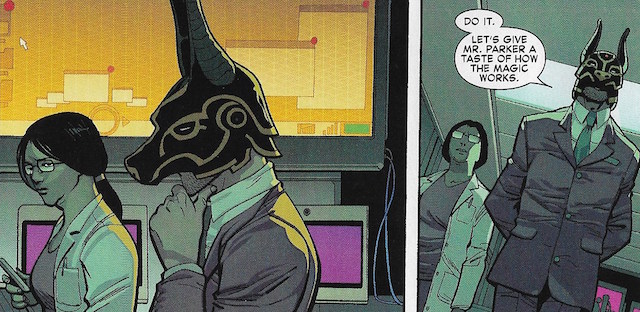
  •  Miles Warren, aka The Jackal, privately says the explosion at Parker Industries wasn’t part of his plans but tells the doctor to give Peter “a taste of how the magic works.”
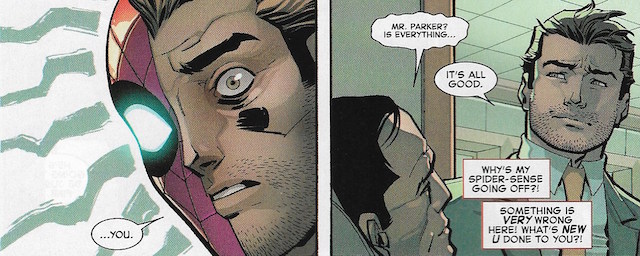
  • Peter’s spider-sense goes off after Mr. Salteres’ life is saved the New U operation.
  • Living Brain, aka Doctor Octopus, catches wind of how New U’s ability to grow healthy organs from a patient’s DNA and calls the technology “very promising.”
  • Electro agrees to Warren’s procedure after “Francine” is brought back from the dead.
  • Jonah secretly meets with New U and asks about its technology. His deceased wife Marla then walks through a doorway.

In short, ASM #16 is stuffed like a Thanksgiving turkey, which is not necessarily a bad thing.

ASM16 stealth

Before Dead No More is probably the best issue of ASM in many months because its function only requires Dan Slott to whet the reader’s appetite. Any one of the plot threads are likely to intrigue potential customers, which is great for Marvel, but Mr. Slott’s track record in terms of delivering a fully fleshed-out story is much more problematic.

Miles Warren

Take, for instance, the way Mr. Slott portrays Peter Parker. Years ago the hero was weirdly obsessed with the idea that “no one dies.” That mantra led him to behave in strange and irrational ways when he had to balance immediate threats to his front with global crises.

In this issue, Peter again seems monomaniacally focused on death — so much so that he embraces an experimental procedure that he knows will come with a heavy “price.” Dr. Clarkson even told him “some find the cost can be…too high.”

Does Peter Parker even ask Dr. Clarkson what that non-monetary “price” is before approving the operation on his employee? Answer: No. He just screams, “We have to move NOW!”

ASM16 Spider Sense

Long-time readers can debate whether or not Peter would dive right in to a dangerous and nascent technology over an accident at one of his power plants, but this blogger thinks his behavior is unstable and rash — the kind of thing Doctor Octopus would do as the Superior Spider-Man.

The good news is that ASM#16 is worth its $3.99 cover price. The bad news is that there are warning signs that Dan Slott is already setting up Peter Parker for another round of character assassination.

Agree? Disagree? Let me know what you think in the comments section below. I’d love to hear what you have to say.

Editor’s Note: Anime Hunter mentioned to me earlier today that editor Nick Lowe took part in a “secret meeting” on Spider-Man, as referenced in the Letters to the Editor section of the book. That might be another tidbit worth discussing. 

Amazing Spider-Man 1.6: Molina’s story mercifully ends — like Julio’s life

AG Julio

It’s a tough time to be a fan of The Amazing Spider-Man. Readers regularly must to deal with things like Dan Slott turing the wall-crawler into a living spider-meteor, or telling audiences that Peter Parker’s love for Mary Jane is “anti-Marvel.”  There seems to be no end in sight. The past year has added insult to injury with the addition of Jose Molina’s “Amazing Grace” storyline, which has finally ended with “Part Six: Lead Me Home.”

For those who have not paid attention since the beginning, here is a quick recap:

  • Peter Parker, The Amazing Atheist (on Molina’s watch) becomes obsessed with Julio Manuel Rodriguez. The mystery man died of cancer, returned from the dead, and seemingly performs miracles with his new lease on life.
  • Spider-Man and the Santerians (Julio’s friends) plan to track him down and reveal the truth.
  • Iron Man tells the group that Rodriguez is drawing power from a portal to the spirit world that is located in Harlem.
  • A “showdown” in the city is announced.

ASM 1.6 concludes with the group realizing that a demon has taken up shop in Julio’s body and will draw power from  it until the two are separated. Iron Man informs the group that a gate to the spirit world is opening that must be closed before all hell literally breaks loose.

Uncle Ben’s spirit returns once more to give his atheist nephew some advice about life, death and the nature of God — but the hero wants none of it.

“Unsubscribe,” Peter says before swinging into the fight.

Amazing Grace SpiderMan

AG1.6


One of the Santerians eventually break’s Julio’s neck, which causes the portal to close and the demons to disappear. Spider-Man is livid and scolds the team after Julio’s (second) funeral: “Julio was not to be harmed! There’s always another way!”

The fact of the matter is that there is not always another way. As the kids point out to the veteran superhero, “We had 30 seconds before that monster got loose in our world.”

Would it have been nice to have a priest on hand to perform an exorcist? Sure. Would it have been a good idea to call Dr. Strange for some help along the way? Of course. But that didn’t happen, and the Santerians did the best they could in a bad situation.

Peter mocks the group for believing Julio is in a better place, and they shoot back: “After everything you’ve seen…why can’t you?

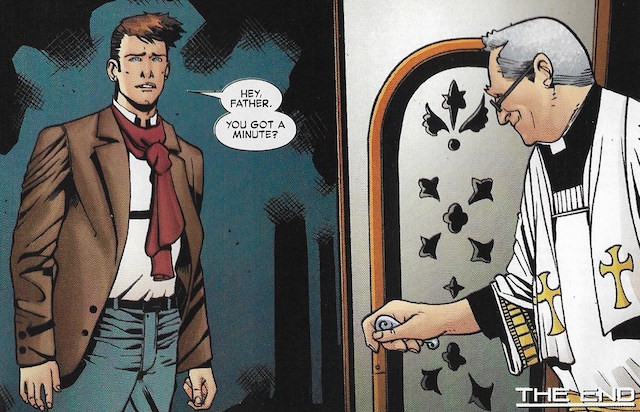
The story ends with Peter walking into a church and asking a priest to talk.

PeterParker Priest

The most disappointing thing about “Amazing Grace” is that it had a lot of potential and guys like me should have loved it.

  • Jose Molina is the first writer to seriously address spiritual issues in ASM in years.
  • “Spirit Uncle Ben,” or whatever you want to call him, actually makes some interesting points.
  • Peter Parker goes to a priest — for advice. (Marvel won’t even allow Matt Murdock into a church these days unless its on Netflix.)
  • The Santerians understand a grim reality that law enforcement personnel and soldiers all over the world are all too familiar with: Sometimes a life needs to be taken to save life.

The problem for Mr. Molina, however, is that Peter Parker should have never been portrayed as a militant atheist to begin with. He would have never blamed God for Uncle Ben’s death because he blames himself. Spider-Man was born out of the guilt that Peter felt over Ben’s murder.

I cannot cheer this particular scene, which respectfully broaches issues of faith, because the writer needed to warp Peter Parker’s origin to make it happen.

I hope Mr. Molina learns from this experience and goes on to write some solid comic books down the line, but someone needs a verbal beatdown for putting him on ASM before he was ready. The book was a disaster from start to finish.

Related:

Molina’s Amazing Spider-Man 1.5: Car crash scene a perfect metaphor for story

Molina’s Spider-Atheist: God ‘a lie’ because Uncle Ben died

Molina’s Amazing Spider-Atheist makes mockery of Peter Parker’s history

Molina’s Spider-Man: ‘Amazing Grace’ a sloppy mess

Daredevil #9: Charles Soule writes modern classic with Spidey-DD team-up

DD SpiderMan

Charles Soule’s Daredevil #9 should be assigned in every “Superhero Team-up 101” class for the next century. “Blind Man’s Bluff: Part II” brings the Man Without Fear and Spider-Man together in a pitch-perfect issue. It is flawless, and therefore should be mandatory reading for all Marvel employees.

Here is what you need to know for Daredevil #9:

  • Spider-Man meets Daredevil in Macau for a casino heist. Although DD offers scant details, the web-slinger agrees to help him snag a briefcase from heavily armed guards.
  • The heroes’ ambush does not go as planned and a man carrying the suitcase escapes onto a helicopter headed for Hong Kong.
  • Daredevil and Spider-Man hitch a hydrofoil ride to the city after Spider-Man reveals that he tagged the suitcase with a spider-tracer.
  • The two track down the suitcase to an apartment building, a massive fight ensues, and Spider-Man makes off with the prize. He agrees to meet up with DD later.
  • The two men convene at the top of a building looking over the entire city. Spider-Man refuses to give up the suitcase until DD explains why he needs it — in addition to why the memories of their friendship is hazy.
  • Matt Murdock debates lying to his friend, but then comes clean: He did something to wipe everyone’s memory of his secret identity. He also needs the suitcase because it has Black Cat’s files on the entire NYC criminal underworld. He wants to take down all the major players in one fell swoop.
  • Spider-Man hands over the suitcase and warns, “Watch out for those black-costume phases. They can really do a number on you.”

Mystery. Action. Humor. Intelligence. Wit. This issue had it all. There is hope for Marvel, and Daredevil #9 proves it.

How is this for a novel idea: Two characters with a rich history actually act in character while using the superpowers that helped make them famous to keep the other guy safe.

There were no “arachno-rockets” needed, and the moment of truth — when Matt takes a leap of faith on a good man and then his decision is reciprocated — was incredibly poignant. In short, Mr. Soule demonstrated that there is still a place in the world for good storytelling.

DD9 Spidey

Perhaps the best way to describe Blind Man’s Bluff: Part II is “timeless.” The story feels like something I could have read in the 1980s as a kid, but at the same time it feels relevant now. It is a tale that I might reopen ten or twenty years from now and still enjoy. That is the sign of a good writer. That is why I continue to buy comic books, and that is why I pray to God that Mr. Soule does not get weirdly political in the future like so many of his industry peers.

Buy this book. Reward good writing. This is a comic book gem and everything about it is even sweeter because it comes from a writer who does not tell people to “eat a bag of d***s” over partisan politics.

Thank you, Mr. Soule. It has been a long, long time since a book has made me this happy, and for that I am deeply grateful.

DD SpiderMan sunrise

‘Civil War II: Amazing Spider-Man #2’: Gage explores ‘self-fulfilling prophecy,’ recidivism, and redemption

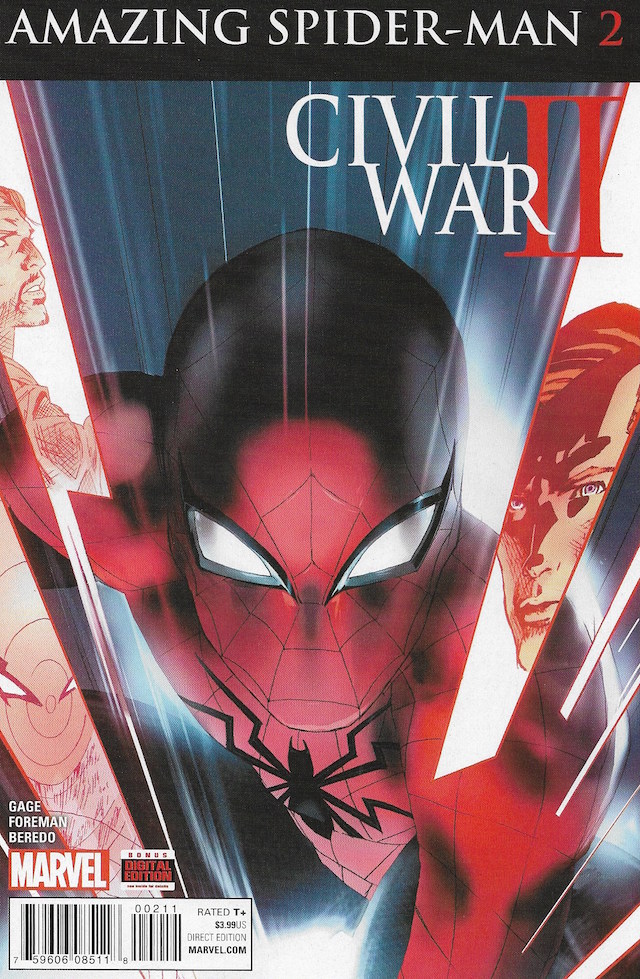
CWII ASMII cover

Marvel’s Civil War II has been a mixed bag of good ideas and poor execution, but writer Christos Gage’s work on the project has generally been a notch above his peers. Civil War II: Amazing Spider-Man #2, like the issue before it, highlights just how much potential he has as a writer, even if some elements of the book are rough around the edges.

Here is what you need to know for CWII: ASM 2:

  • Spider-Man, tipped off by Ulysses, defeats a “quintronic man.” (The aftermath features a nice nod to Amazing Fantasy #15.)
  • Clayton Cole (aka, Clash) runs into an old henchman he knows, but rebuffs an offer to talk about working with the Owl.
  • Clayton eats a meal with his parents, who are seemingly rotten people. They tell their son Peter Parker is exploiting his genius, liken Clayton’s beard to a something a homeless man would sport, and say his girlfriend Donna (a single mother who works at Parker Industries as an administrative assistant), is only interested in him for his future earnings.
  • Donna breaks up with Clayton just before he asks her to marry him. She is worried about what will happen when her son learns about his criminal past.
  • Clayton explodes on a coworker and later becomes paranoid (with good reason) when Ulysses and Spider-Man act like gossipy high-school kids around him.
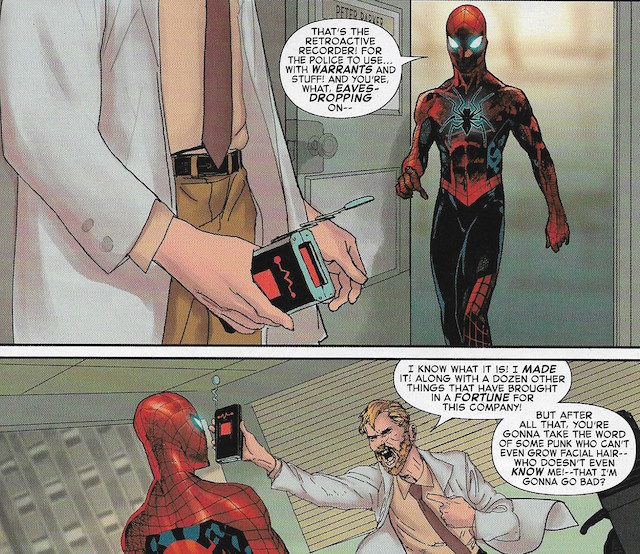
  • Spider-Man catches Clayton using an experimental device that can retroactively track and record sound waves. The two have an argument and Clayton storms off.
  • Mendel Stromm (aka, Robot Master), pitches a heist of Parker Industries to Clayton in a bar for henchmen. The plan is to frame Harry Osborn Lyman.
  • Peter tells Harry in a private meeting that he wants to make amends with Clayton, never realizing that the Tinkerer has been given a request to upgrade Mr. Cole’s “Clash” costume.

I mentioned in my first review that Mr. Gage added more intrigue to ASM in one issue than Dan Slott has in months. The good news is that Mr. Gage continues to creatively cross his ‘t’s’ and dot his ‘i’s’ in ways the head ASM scribe shows no interest in duplicating. The bad news is that as a reader it’s hard to witness Clayton’s behavior and not think, “Is Peter Parker the worst judge of character of all time?”

Consider this: Peter Parker’s ‘very close’ girlfriend tried to kill him, his inner circle lies to him and tries to work with corporate saboteurs, and his biggest investor (and secret santa) was the head of an international terrorist organization. He might want to have Doctor Strange check out that spider-sense one of these days, because it certainly doesn’t work during job interviews…

CWII ASMII

Overall, CWII: ASM #2 does a good job of getting readers to think about how hard it must be for an ex-convict to escape the long shadow of sins past. There is a nuance to Mr. Gage’s message about second chances and redemption that has always been absent from Mr. Slott’s work, and for that he should be commended.

At the end of the day, however, Mr. Cole largely comes across as an unsympathetic character due to his actions and the way artist Travel Foreman depicts his hair-trigger rage (an apology by the character afterwards does little to endear him to readers.)

Mendel Stromm

The best-case scenario for Mr. Cole is that he is using inside knowledge of Mendel Stromm’s attack to his advantage — as a hero. Perhaps he will set-up the villain to prove beyond a shadow of a doubt to Spider-Man and Ulysses that he is a good man. There will likely be confusion along the way  — a brief fight with Spider-Man, which technically will prove Ulysses was correct — but in the end Spider-Man and “Clash” will work together to take down Robot Master.

CWII ASMII SpiderMan

What did you think of CWII: ASM #2? Do you think “Clash” will be back to his villainous ways, or will he redeem himself by double-crossing Robot Master? Let me know in the comments section below.

Editor’s Note: Check out the YouTube page and subscribe if you’re into video reviews and podcasts. I plan on doing a lot more of that in the years ahead.

Amazing Spider-Man #15: Dan Slott’s Regent took down a god, then falls to … Mary Jane

Mary Jane Iron Spider

It is a good bet that when Marvel writer Dan Slott was a kid that he was the one who always changed the rules of whatever game he was playing with friends. The Amazing Spider-Man #15 is a perfect example of a story crumbling into a schizophrenic mess because the writer altered established realities to get to a desired end.

Readers last left their beloved web-slinger knowing that he and Iron Man were defeated at the hands of Regent. The same villain who defeated a god — She-Thor — Vision, Wolverine, Captain America, Daredevil, Deadpool, Human Torch and countless other superheroes (and villains), also took down Peter Parker and Tony Stark.

Regent has been established as a force to be reckoned with, right? Keep that in mind as we move forward with this review.

Here is what you need to know for ASM #15:

  • The Avengers are defeated. Heroes everywhere are missing. Regent is on the brink of victory.
  • Mary Jane decides to suit up in Peter’s old “Iron Spider” costume because … she once wore an old Iron Man suit and temporarily had spider-powers. Her plan is to take on Regent by herself.
  • Harry Osborn Lyman, captured and contained in one of Regent’s holding tanks, uses new Webware technology that he “just had Clayton [install]” (how convenient) to escape. Sound waves from Harry’s glorified iWatch shatter glass that can hold She-Thor.
  • Peter, encased in a bubble, distracts Regent so Iron Spider-MJ can sucker punch him. The distraction bursts his psychic bubbles and the previously defeated and fatigued Spider-Man springs into action. The three have a déjà vu moment.
  • Spider-Man leaves to save Harry while M.J. and Iron Man continue to fight.
  • Miles Morales is freed and his instant-win venom blast takes out Dr. Stillwell.

Miles Morales ASM 15

  • An army of superheroes are released and Regent acknowledges defeat. He is then confined within his own prison.
  • MJ, Tony, and Jarvis have a private party with champagne (Tony, understandably, does not drink).
  • Peter, the billionaire CEO of Parker Industries, throws a party for his friends … at a coffee shop. Bobbi Morse is introduced to Aunt May and Jay Jameson collapses after coughing up blood.

ASM #15 fails because Dan Slott sets precedents and then disregards them when it suits his needs. He pens stories for an older-skewing audience, but then expects the average reader to accept deviations from established rules like a child.

Regent SheThor

To add insult to injury, fans of the marriage between Peter and Mary Jane are punched in the gut at least twice.

  1. Spider-Man tells Tony: “[Peter] only realized he’d lost MJ after she moved on. You better not make the same mistake.”
  2. Peter essentially introduces Mockingbird to Aunt May as his new girlfriend (Whatever happened to the girlfriend who tried to murder him?)

The fact of the matter is not that Mary Jane “moved on” — it’s that Marvel’s editors and Dan Slott are telling readers to move on.

The message is clear: “Stop spitting up Tom Brevoort’s medicine. Take it. The beatings will continue until morale improves!”

If you want to see some stunning cover art by Alex Ross, then make sure to buy ASM #15.

If you don’t require a writer to stick to his own set of rules as long as characters are punching each other and “zany” hijinks ensue, then buy ASM #15.

If, however, you expect writers to offer creative cohesion and linear logic, which can easily be traced to acceptable premises, then you might want to read Charles Soule’s Daredevil instead.

Dan Slott, confronted on weird behavior, lies about Douglas Ernst Blog — again

DC Women tweet

Douglas Ernst Blog terrifies and irritates Marvel writer Dan Slott to no end. The man stalks this blog in the wee hours of the morning, keeps tabs on my professional life, and consistently tries to smear me every time someone cites my work.

Your friendly neighborhood blogger walked out of Steven Spielberg’s newest film, The BFG, this afternoon to see traffic spike for a post titled “Dan Slott trolls random woman on Twitter, then has the gall to bash GamerGate supporters.” I knew immediately that a really good Reddit conversation was going on somewhere or that Dan Slott was once again lying about me on Twitter. It turned out to be the latter.

Here is how Mr. Slott responded to the DC Women Kicking Ass blog when its creator called him out for his unprofessional Twitter antics.

Dan Slott dcwomenkicka tw1

Yes, Dan Slott is calling me a “Right Wing extremist” — because a Catholic guy who believes in free markets, a strong national defense and the rule of law somehow equates to extremism in his mind.

As usual, the writer attacks me from afar because the evidence is not in his favor.

Since Mr. Slott knows deep down that a quick internet search can easily prove him wrong, he then goes to his bag of logical fallacies — after “ad hominem” usually comes “poisoning the well.”

In today’s case we have Dan Slott referring to a previous employer I had (for eight months), that has dozens upon dozens of op-ed contributors from across the conservative spectrum — some I vehemently disagree with (e.g., Ann Coulter), and others (like economist Thomas Sowell) who are intellectual giants.

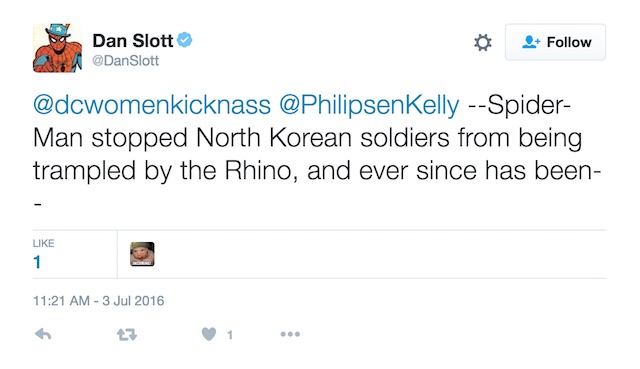
Dan Sott dcwomenkicka tw2

Regardless, I challenge anyone to go through my Twitter feed and find “extreme” work — it’s not there.

Like any writer who works for online magazines or newspapers, I am sometimes given assignments that I dislike, but I always try my best to stick to the principles espoused on this blog. Dan Slott’s insinuation that I’m a “birther” is pathetic, but at this point it is to be expected.

Finally, Dan’s tweet-screed shows that despite being exposed as Slottian misrepresentation at its finest (even CBR readers have called him out on his sad attempts to deflect criticism), he still insists on twisting my response to Peter Parker’s “No One Dies” mantra.

Dan Slott dcwomen3

Dan Slott dcwomenka tw response

Dan Slott says Douglas Ernst Blog “distorts” everything he does, which is weird because a.) I said he hit a “home run” with Renew Your Vows, and b.) his definition of distortion apparently is “quoting a man word for word and linking to the source material whenever available.”

A good example might be that time he said Peter Parker’s love for Mary Jane is “anti-Marvel.

I quoted the man at length, linked to an hour-long YouTube video, instructed readers to view the entire thing, and he still accused me of taking him “out of context.”

That, dear reader, is “distortion” to Mr. Slott.

Note to Dan Slott: You obviously have learned nothing from the time you stalked The Main Event and then exploited his charity run for Twitter sponge bathes. The guy tore you to shreds, but yet you continue to act like an online buffoon.

Keep talking, Mr. Slott. I will continue to expose your lies. I might even have to do my own YouTube takedown soon. If I can deliver half as well as The Main Event, then I will be happy.

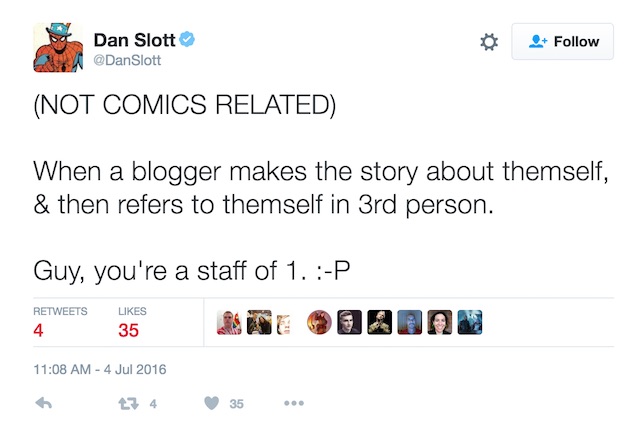
Update: Look who is stalking my blog again (despite blocking me on Twitter) — Dan Slott.

Dan Slott stalking tweet

The name of this website is Douglas Ernst Blog. There is nothing weird about referring to it by its proper name. Anyone who knows about branding understands that. How strange is it that Dan Slott mocks me for being a single person when it is glaringly obvious that my writing is constantly on his mind? What are you going to do, Dan Slott, when I continue to expand my social media presence in the years ahead?

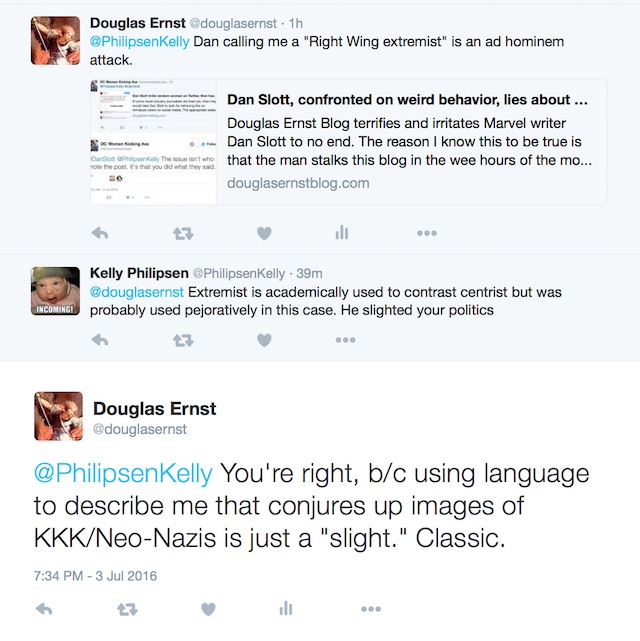
Side Note: Here is a brief glimpse into the mind of Dan Slott’s most ardent supporters. This individual tried to say that Mr. Slott does not resort to ad hominem attacks. When I said that calling me a “Right Wing extremist” is, in fact, an attack on my character his response was that it was “probably” used as a pejorative. Classic.

It was a mere “slight.” That’s all, old chap! Academics and all, you know. Hurrrm.

Dan Slott ad hominem attack