Tom Brevoort tries Hydra Captain America spin-job, Newsarama goes full toady

Captain America Jack Flag

One of the reasons this blog began reviewing the comics industry years ago was because the mainstream “news” outlets almost always serve as a mouthpiece for whatever bilge the creators dish out. If there is one good thing to come out of Nick Spencer’s “Captain America: Nazi-sympathizing Hydra Agent,” it is that more people realize that allegedly impartial reporters are usually glorified toadies for men like Tom Brevoort.

Take a recent piece by Newsarama’s piece by George Marston:

“Reaction to the news has been mixed, with some, familiar with the ebb and flow of comic book storytelling intrigued by the twist, or resigned to wait it out and see its explanation, while others less familiar with comic book tropes decried the reveal as an outright betrayal of Captain America or even his creators.

According to Tom Brevoort, Marvel Executive Editor, an editor of Captain America: Steve Rogers #1, where the reveal took place, Marvel was somewhat surprised by the reaction to the twist, not expecting the level of vitriol some fans have levied at the publisher, and at Nick Spencer, writer of the issue and architect of its twist.”

Did you get that first paragraph? If you view Marvel’s decision as a grotesque betrayal of the character, then you must be **hurrrrrrm** “less familiar with comic book tropes.”

Tut. Tut. Now excuse me while I wipe my monocle, you rubes.

The message by Newsarama is clear: Only ignorant fools who don’t know comics oppose the latest “bold” idea by Marvel’s editors and writers. Nick Spencer could turn Captain America into a serial killer and there would be guys like George Marston calling it “bold” at this point.

George Marston Newsarama Twitter

One would think that Mr. Brevoort’s “surprise” at the negative reaction to Mr. Spencer’s story would be challenged, considering it was the Marvel editor who told USA Today he knew it would be like slapping fans in the face.

“‘We knew it would be like slapping people in the face,’ says Brevoort. […] “The idea of Captain America means something very primal and very strong to the people of this nation, and they have a very visceral reaction when you get to something like that. You want people to feel and react to your story. So far, so good.”

Even though Mr. Marston covered the “slap” comment in his own column, there was no push-back against Tom Brevoort. The Marvel editor explicitly said a decision was made to “slap” readers in the face, and then he is “surprised” when people are angry. Newsarama’s decision is to then label critics as “less familiar with comic book tropes.” Classic.

Perhaps the most laughable moment in Newsarama’s interview with Mr. Brevoort comes when he tries (and fails) to say that equating Hydra-Cap to a Nazi is out of bounds.

“There’s a subset of people who are upset about this, who are exactly like that. The reporting on this, and the sort of game of telephone on the internet about this went from it being ‘Captain America is Hydra,’ to ‘Captain America is a Nazi’ – which is already a leap – to ‘This is anti-semitism,’ which is ridiculous, in that, if you look at the comic book that we put out, there is nothing in it that, in any way, shape, or form, is even slightly anti-semitic. But because people were able to go ‘Hydra = Nazi, and Nazi = anti-semitism,’ that’s what reactions became about.

By reporting that we revealed ‘Captain America is a Nazi and anti-semitic,’ people that haven’t even read the work react with outrage, because they understand who Captain America is, even if they’ve never read a comic book.”

Hyrda’s history is well established in the comics, the MCU, and television. The reason why Mr. Brevoort said the story would be a “slap” in the face to fans is because he knew people would put two and two together. Now that the story has amazingly unified readers across the political spectrum, he wants to feign ignorance.

Cap a Nazi sympathizer? Where would you get that idea? Who told you 2+2 = 4? It’s five.

If you want honest reporting on comic books, then websites Newsarama are typically not the place to go. The vast majority of the time their writers and editors are only interested in keeping the access-spigot flowing. They cannot bite the hand that feeds, but they will gladly give men like Tom Brevoort a thumb to suck every time he runs to them crying.

Withhold your cash when it comes to Captain America until Marvel learns its lesson. If you want to reward the company for good work, then purchase Charles Soule’s Daredevil. Just be aware that one day a writer will come up with the idea that Matt Murdock has never been blind and was working for Kingpin all along — and reporters like George Marston will be ready and waiting to insult you for showing displeasure.

Editor’s Note: Henchmen’s Lounge was kind enough to invite me onto a podcast to discuss Captain America. We begin talking about Hydra-Cap at the 18-minute mark.


Daredevil #7: Charles Soule running laps around Marvel peers

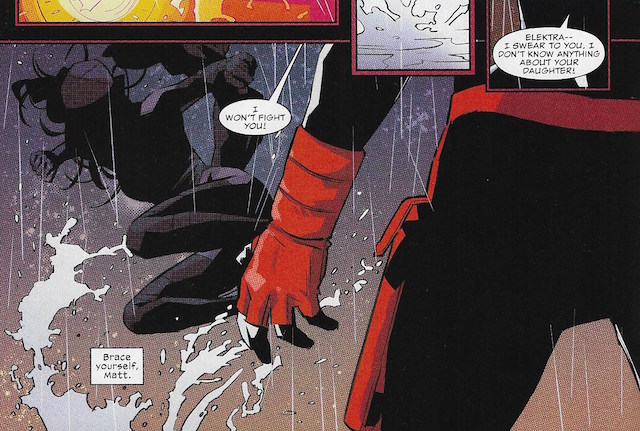
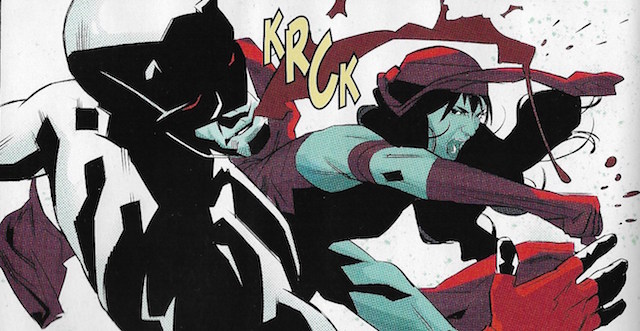
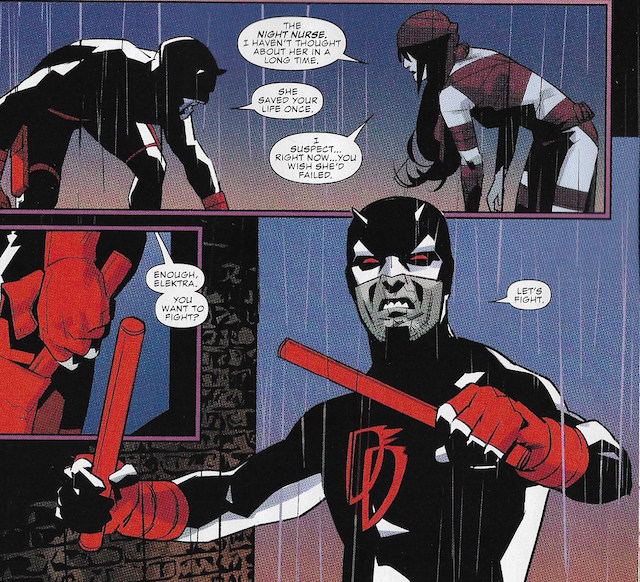
Daredevil Elektra 7

The seventh issue of Charles Soule’s Daredevil came out on May 25, and once again the man has churned out a solid piece of work. If writing comic books were a race, then it is safe to say that Mr. Soul would be lapping most of his Marvel peers at this point. His writing is crisp, he isn’t forcing weirdly partisan stories down readers’ throats, his pacing is consistently smooth, and he seems to inherently get what makes for a cool Daredevil story.

If there is one Marvel book worth getting each month, then it belongs to Team Soule.

Here is what you need to know for Daredevil #7:

  • The “man without fear”convinces Elektra to let him help unravel the mystery behind her daughter’s disappearance.
  • Elektra gives Daredevil a cell phone that purportedly shows him training her daughter.
  • Matt Murdoch takes the phone to Foggy Nelson despite the “rough patch” they’re going through, and Foggy says there is no video on the phone.
  • Matt, thinking the child might be his, inadvertently destroys the phone in a fit of rage when he can’t figure out what is going on.
  • Daredevil meets with Elektra and tells her there is nothing on the phone, but that he accidentally destroyed it. She is upset, but takes off to find answers on her own.
  • Elektra (with Daredevil tailing her) confronts the man who gave her the phone after killing his partner. The man says “The tangled web we weave!” and she realizes someone took control of her mind. Someone wanted her to feel the pain of losing a child.
  • Daredevil realizes that he knows the identify of the person who took control of Elektra’s mind, but does not disclose that information to her. She leaves with the intention of finding and killing the man who psychically abused her.

Daredevil 7

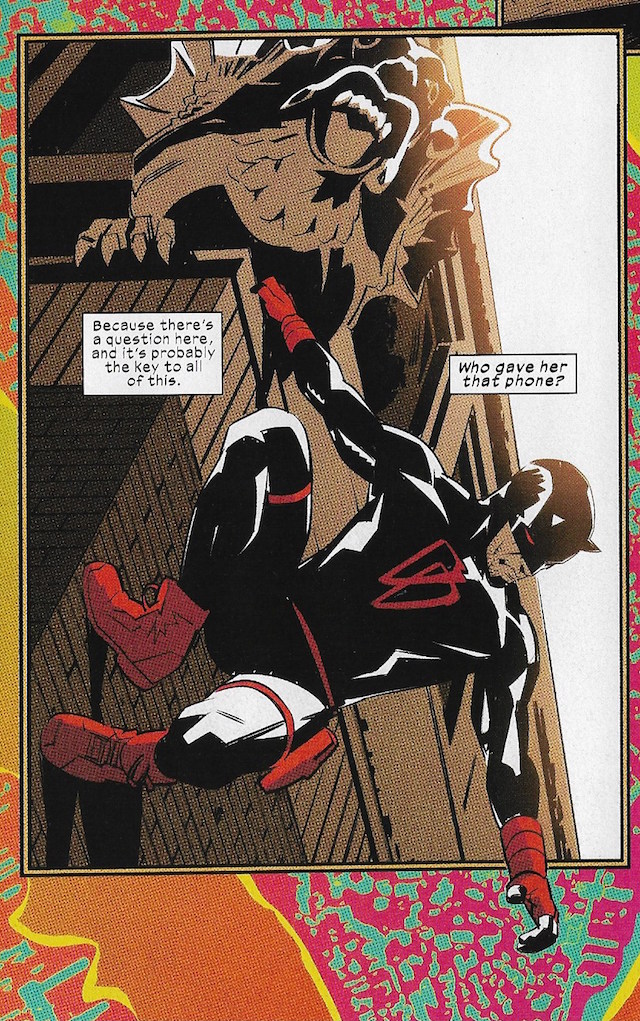
Complimenting Mr. Soule’s writing nicely is artist Matteo Buffagni, whose eye for awesome is incredibly keen. Besides the noir-perfect pitch, little details — like having Daredevil’s hand slightly hang out over the panel as he clings to a ledge in Hell’s Kitchen — indicate a creative team that is running on all cylinders. It is a shame that others within the company aren’t taking notes on what is clearly a winning formula.

In short, if you aren’t buying Daredevil then you should be. It’s only a matter of time before Mr. Soule steps aside and the next writer decides to come up with the “bold” **cough** twist that Matt Murdock has never been blind…

Molina’s Amazing Spider-Man 1.5: Car crash scene a perfect metaphor for story

ASM 1.5 wagon

Jose Molina’s latest installment of The Suddenly Atheist Spider-Man was released on May 25, and fans of the wall crawler will be glad to know the he apologized for being “less than respectful” to the Santerians over their religious beliefs. That is, unfortunately, the one bright spot in an issue that is best represented by a car crash scene later in the book.

Here is what you need to know for The Amazing Spider-Man 1.5:

  • Spider-Man is still on the hunt for Julio Manuel Rodriguez, the man who mysteriously came back from the dead and performs miracles.
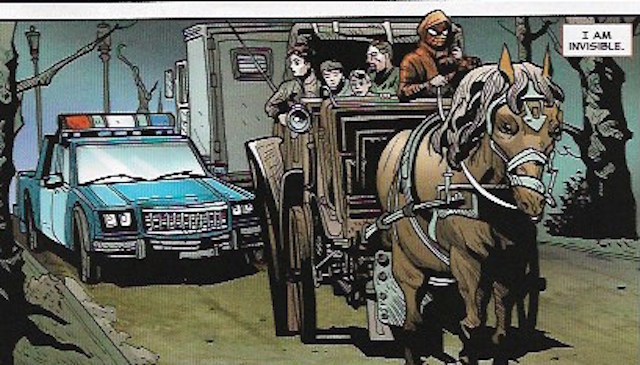
  • Writer Jose Molina actually thought it was a good idea to feature Spider-Man as a (female?) horse-drawn carriage driver.
  • Don Anselmo is “reborn” as a young man after a ceremony due to his faith. His god tells him Julio is controlled by a “false god.” (Question: Wouldn’t Don Anselmo’s god also be a false god since it isn’t God?)
  • Julio causes a car accident and then performs a miracle to resurrect a dead woman.
  • Spider-Man and the Santerians apologize to one another and then use Iron Man (shoe-horned into two pages) to locate where the spiritual conduit is that Julio’s host draws power from.
  • Iron Man gives the group an an address in Harlem and Spider-Man says “showdown time.”

ASM 1.5

It is very rare to see a Marvel comic that fails on pretty much every level imaginable. The entire creative team appears to given up all hope for salvaging the book.

  • Jose Molina continues to write a sloppy, poorly paced story that reads as if he has the attention span of a squirrel.
  • Artists Simone Bianchi and Andrea Broccardo have slapped together one of the ugliest issues of ASM of all time. Marvel would have gotten a better product if they asked a kid on Deviant Art to do them a favor for $100 bucks. Spider-Man wouldn’t look like a marshmallow, police cars wouldn’t look like they came off a Detroit assembly line in 1973, and Peter Parker wouldn’t look like Ace Ventura.
  • Editor Nick Lowe, who allowed a writer to have Peter Parker blame God for Uncle Ben’s death, is still M.I.A.
  • Question: Is it possible for a letterer to underperform? It seems like even the “AaaaaIIIEEEEEEE!” “KRIIIIII” and “CCRRNNNCHHH” in the crash panel are font failures, if that’s even possible.

In short, Marvel should be ashamed that there is essentially zero quality control for its “point” issues of ASM. There is one remaining issue of “Amazing Grace,” which is fitting because the few readers who are left will be singing the famous hymn after they finish.

Stay far, far away from ASM “point” issues for the foreseeable issue — at least until Mr. Lowe decides to do his job.

ASM 1.5 crash

‘Captain America #1’: Nick Spencer turns hero into Hydra agent with Tom Brevoort’s blessing

Hydra pamphlet

Your friendly neighborhood blogger wrote a piece of satire in January 2015 that involved Marvel Comics turning Red Skull into Captain America. Fast forward in time to May 25, 2016, and the company has, for all intents and purposes, done just that.

Captain America has seemingly been a Hydra agent since the very beginning — and Marvel executive editor Tom Brevoort claims it is not a gimmick.

TIME magazine reported:

Every single month whether it’s a run of the mill month for Captain America or an extraordinary month, our job is to put him in situations that place that character under some degree of pressure and see how he reacts to that. And hopefully our readers are surprised, shocked, elated, see something of themselves, learn something about themselves. To say it’s a gimmick implies that it’s done heedlessly just to shock. The proof is always going to be in the execution. So you’ll have to read the rest of the story to see.

But I certainly believe it’s not a gimmick. It’s a story that we spent a long time on, that’s compelling and captures the zeitgeist of the world. It will make readers wonder how the heck we’ll get out of this.

The truth, however, is slightly different: Readers want to know how Marvel got into this mess. Hiring Nick Spencer — a man who is so weirdly partisan that he says Republicans are “evil” — explains a lot, but the problem goes much deeper.

Before we move on, however, here is what you need to know about Steve Rogers: Captain America #1:

  • Steve Rogers had an abusive father.
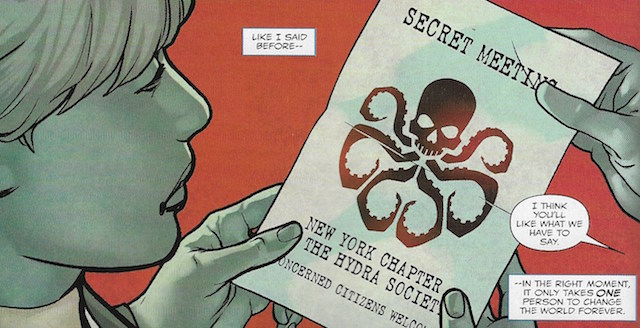
  • Steve’s mother, Sarah, is aided by a “Hydra Society” member one night after her husband beats her. She takes a pamphlet for Hydra’s New York chapter (because creepy skulls with tentacles would never set off warning bells).
  • Red Skull recruits the next generation of Hydra in 2016 by making fair points about Europe’s refugee crisis (i.e., Nick Spencer wants you to associate rather innocuous conservative observations with Nazi villains).
  • S.H.I.E.L.D. finds Baron Zemo, which prompts Captain America, Jack Flag, and Free Spirit to the lawless city of Bagalia.
  • Jack Flag ignores Cap’s orders and assists in confronting Zemo in the villain’s jet.
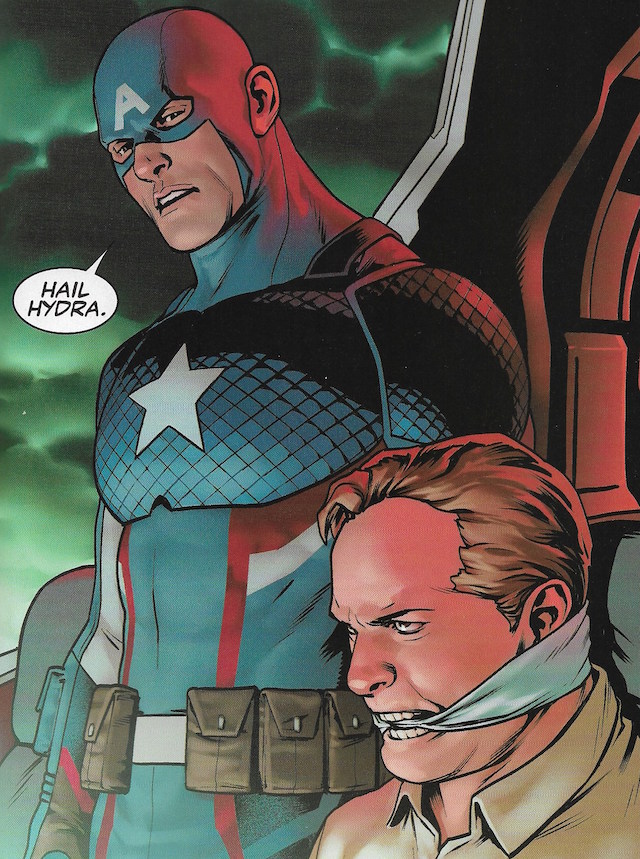
  • Captain America laments Jack Flag’s decision and then throws him out a cargo drop.
  • The issue ends with Captain America saying “Hail Hydra” to Doctor Erik Selvig, a scientist Zemo held hostage in an attempt to find the sentient Cosmic Cube known as Kobik.
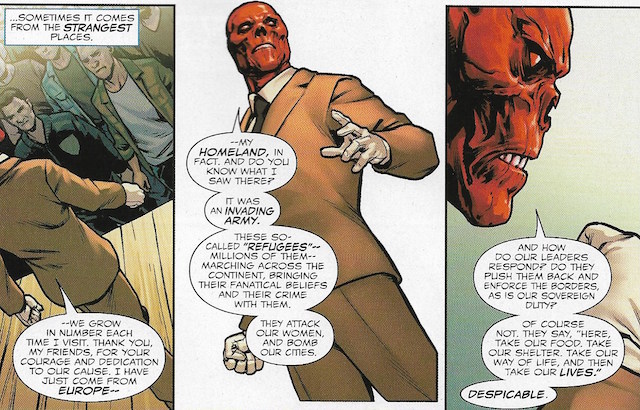
Red Skull

The question on everyone’s mind, judging from the #saynotohydracap hashtag that trended on Twitter all morning, is simple: Why?

The answer: A culture of moral relativism inside the halls of Marvel is so prevalent that Doctor Octopus had to become “Spider-man” for over a year and now Captain America must run around as a Nazi-sympathizing Hydra agent for an extended amount of time.

Iron Man was turned into a villain.

Spider-Man was turned into a villain.

Captain America is now a villain.

Heroes battled each other in Civil War and will do so again in Civil War II.

Notice a trend? These are the hallmarks of an organization that is so uncomfortable drawing a clear line between good and evil that instead it would rather go with a “one man’s Captain America is another man’s Red Skull” approach.

Nothing matters: Captain America is Hydra. Doctor Octopus is Spider-Man. Iron Man is a George W. Bush allegory and Red Skull agrees with Republicans (and moderate Democrats) on the issue of Syrian refugees. That is your modern Marvel comic book, and it wouldn’t be so embarrassing if men like Tom Breevort didn’t lie about writing for “the zeitgeist.”

Captain America Jack Flag

Take the following claim by Mr. Brevoort, for example:

TIME: In the comic the Red Skull of Hydra talks about “criminal trespassers” who “make a mockery” of America’s borders and calls the refugees in Germany an “invading army” bringing “fanatical beliefs and crime” to Europe. Obviously, this hate speech is nothing new for the organization, but it sounds like rhetoric we’ve been hearing this election. Is that purposeful?

Brevoort: We try to write comics in 2016 that are about the world and the zeitgeist of 2016, particularly in Captain America. Nick Spencer, the writer, is very politically active. He’s a Capitol Hill head and following this election very closely. So we can talk about political issues in a metaphoric way. That’s what gives our stories weight and meat to them. Any parallels you have seen to situations real or imagined, living or dead, is probably intentional but metaphorically not literally.

Mr. Brevoort liked the word “zeitgeist” so much that he used it twice in one interview, but it’s funny how the “zeitgeist” only relates to making Republican presidential candidates look like Nazis and then turning Captain America into a Hydra agent — all in the same issue where a guy with ties to white supremacists turned himself into a Hyrda suicide bomber.

Why is it that Marvel’s zeitgeist-quota is laughably focused on metaphors of white, Republican males as evil instead of, say, national security threats posed by Islamic terrorist organizations controlling large swathes of Syria, Iraq, Yemen, Libya, and Afghanistan?

How strange is it that Nick Spencer did not find it timely in a post-9/11 world to have Captain America team up with Ranger-run task forces in Pakistan, but he did to turn him into a Hydra agent?

If you increasingly find yourself feeling like Doctor Erik Selvig or any other characters who are held hostage in Marvel’s comics, then you should know that you are not alone. The characters you grew up with are now beholden to partisan writers and editors who enable immature and mean-spirited fantasies. Hashtag’s like #saynotohyracap are fine, but withholding hard-earned cash should always be the primary method of conveying displeasure.

Tune in here in for future updates into the sad decline of Marvel’s comics division and the activist-creators behind it all.

Update: John C. Wright was kind enough to link to this post. To all of his readers: Welcome!
Captain America Hydra

Civil War II: Did Marvel learn from previous debacle?

Captain Marvel

Marvel’s Civil War II doesn’t kick off until June, but readers have been given teasers with a release on Free Comic Book Day and Civil War II #0. The question many fans are asking now is: Did Marvel learn anything from the debacle that was Civil War I?

Anyone who has seen Captain America: Civil War knows that hero vs. hero tales can be entertaining — provided the writers don’t let political hackery get in the way. Marvel’s first attempt at a “civil war” between heroes was a pathetic Bush administration allegory gone wrong, but the “pre-crime” angle this time around may deny the writers the rope they would undoubtedly use to hang themselves.

She Hulk Civil War 0

Before we go on, here’s what you need to know about the Civil War II content released thus far:

  • Jennifer Walters (aka: She-Hulk) defends Jonathan Powers (aka: The Jester) in a New York City courtroom. She claims he was the victim of “entrapment” by the government while “talking shop,’ but he is convicted of a non-disclosed crime anyway.
  • The Jester is killed in prison before his sentence can be appealed.
  • Captain Marvel wishes she could stop disasters before they happen.
  • Ulysses, an Inhuman who “experiences” the future, teams up with Captain Marvel to try and learn more about his condition.
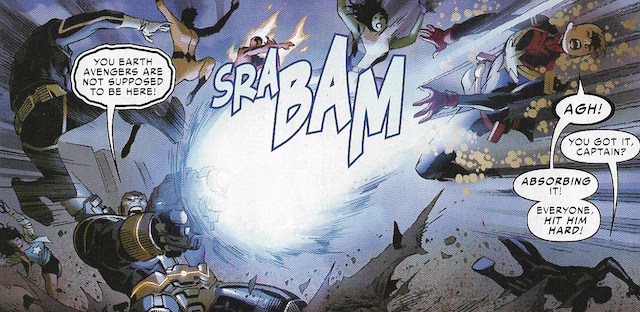
  • Captain Marvel, She-Hulk, War Machine, The Inhumans, and others use one of Ulysses’ visions to get the jump on Thanos before he can raid a facility housing the Cosmic Cube.
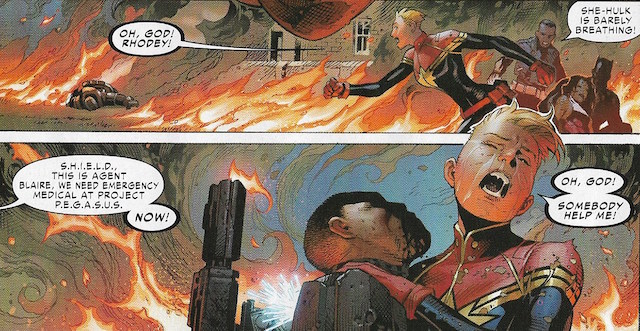
  • The group does stop Thanos but War Machine and She-Hulk are gravely injured in the process.

Ulysses Civil War

At a cursory glance, Civil War II looks like it has enormous potential.

  • When Bendis is on his game, he produces all-star work.
  • Oliver Coipel’s artwork is excellent (as was Jim Cheung’s in the Free Comic Book Day release.)
  • Exploring Minority Report-like themes with Marvel characters is a no-brainer.

Thanos FCBD

The problem Marvel’s comics division faces is that it’s often its own worst enemy. The company’s track record suggests that a ready-made winner will be turned into a loser by writers who use the event to take political potshots.

My guess is that Civil War II will be much better than the first incarnation, if for no other reason than because President Obama is still in office. Instead of feeling some bizarre social responsibility to convey to readers that all Republicans are evil, writers will focus on broader themes that transcend petty politics.

If you’re on the fence about whether to check out Civil War II or not, then stop in here over the next couple months to get an update. I plan on reviewing the event unless it goes completely off the rails.

Rhodey Captain Marvel

Spider-Man #4: Bendis reveals Morales’ secret identity — to ‘Goldballs’

Miles Ganke

Superheroes tend to place a high value on their secret identities, and Miles Morales is no exception to the rule. Unfortunately, the fourth issue of Brian Michael Bendis’ Spider-Man shows the hero losing it due to a decision by his best friend Ganke. He spills the beans to ex-X-Man “Goldballs” of all people. (Yes, Goldballs.)

Like the surface-to-air missiles that target Miles after Ganke’s betrayal, this issues misses the mark.

Before we move on, here is what you need to know:

  • Miles and Ganke argue in the school lunch room whether it’s harder to be a black teen in America or an overweight asian (groan).
  • Ganke wants Miles to talk to the new kid, Fabio Medina (aka: Goldballs), because they both have superpowers.
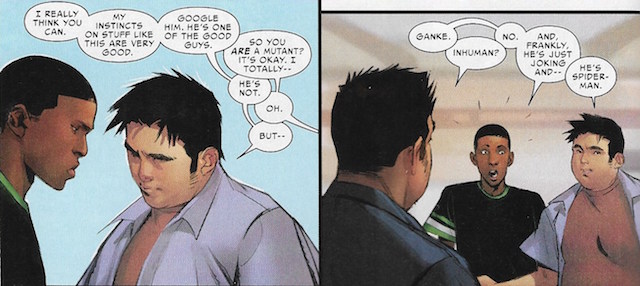
  • When Fabio accidentally launches one of his “goldballs” into Ganke’s food, the three young men start talking and Ganke inexplicably reveals his friend’s secret identity.
  • Miles storms off and while web-slinging through the city he is targeted by four heat-seeking missiles.
  • Spider-Man is knocked to the ground due to the concussive blast of one of the missiles. Hammerhead steps out of a vehicle and says it’s time to call Black Cat and collect his bounty.

Miles Morales 3

The decision to explore a best friend’s betrayal in a book involving high-school kids is appropriate, but it seems quite a stretch for someone like Ganke to suddenly reveal Miles’ secret identity. A writer should spend a lot of time setting the stage for game-changers, but readers sadly did not get it this time. As a result, half the issue didn’t ring true.

Making matters worse is the fact that Miles says, “I have actually never been this mad at anyone about anything,” but we never see his anger. He web-slings around the city for a few moments and then his spider-sense alerts him to incoming missiles.

Try this out: Think of the angriest you’ve ever been in your life. What did you do? How did you react? Did you just say, “I’ve never been this mad” and then walk around, or did you punch, kick, yell or scream?

A few years ago an old Army buddy of mine said, “Do you remember that time that you got so mad at [insert name of horrible squad leader here] that you burst into our room, slammed the door, screamed, flipped your entire bed, and then took off for the motor pool?” 

I do remember that — and that isn’t the most angry I have ever been.

People do not think clearly when they are livid. Given that, it seems like a no-brainer for Miles’ to have been so upset that he didn’t notice his own spider-sense going off until it was nearly too late. Maybe he could have even kicked a garbage can as he exited the school and sent it flying 100 yards down the road. Something — anything — would be better than just telling readers that Miles is angry.

After the heat-seeking missiles magically miss Miles while in “cammo mode,” he decides to lure them to parts of the city where detonations will pose the least amount of risk to the civilian population.

Miles Parker Industries

Miles chooses to destroy a Parker Industries sign, which is funny given that Arachno-Rockets” (See ASM #9) filled with liquid hydrogen are stored inside the building.

We’ll just say that it was by the grace of God that Miles didn’t kill scores of people…

Spider Rocket

Our hero’s luck runs out and he is seemingly incapacitated at Hammerhead’s feet. Besides wondering how a has-been underworld thug like Hammerhead got his hands on some SAMs and then deployed them in the middle of New York City, readers must now ask the following question: Is Spider-Man worth it? The jury is still out for this blogger.

  • If you like Marvel’s new take on Black Cat (I don’t), then Spider-Man #4 is for you.
  • If you like Hammerhead (I don’t), then Spider-Man #4 is for you.
  • If you like Goldballs (Huh?  Why, Marvel?), then I guess Spider-Man #4 is for you.
  • If you like best friends who act irrationally, then Spider-Man #4 is for you.

Spider-Man certainly has potential, but as of right now it still feels as though Bendis’ search for Miles identity within the 616 Universe is coming through in the title.

How big is his stable of characters to pick from? If Bendis is forced to use Goldballs and Hammerhead this early in his run, then it doesn’t bode well for the future. Perhaps he is limited one what villains he can use because Dan Slott needs them for The Amazing Spider-Man. Whatever the case, Bendis needs to settle into a groove soon our readers will move on.

Black Panther #2: Perhaps Ta-Nehisi Coates should have written a T’Challa novel instead

Black Panther 2

Black Panther #2 was released in comic shops across the nation on Wednesday, but it is beginning to feel as though Ta-Nehisi Coates would have been better off writing a novel called T’Challa instead. Marvel’s decision to experiment with a political commentator may be a noble one, but the company will need more than three variant covers to inflate sales in the future if Coates doesn’t make some editorial adjustments.

Black Panther 2 preview
Marvel is going to need more than three variant covers in the next year to sell copies of Black Panther if Mr. Coates doesn’t pick up the pace.

My review of BP #1 noted that there was a lot — perhaps too much — going on with “A Nation Under Our Feet.”  T’Challa returned to Wakanda to reclaim his kingdom; Shuri, his sister, died (or, rather, is trapped in a place “between” life and death); two members of an “elite female royal guard” stole “midnight angel” suits and vowed revenge against men who abuse their power; and T’Challa tried to revive his sister.

BP#2 is just as dense:

  • Readers learn more about the Nigandan plot to overthrow Wakanda.
  • The Midnight Angels save captured women in the Bandit Compound in Northern Wakanda.
  • Aneka and Ayo cuddle again and further plot their revenge.
  • Black Panther confronts the “witch” who has been poisoning the minds of Wakandans, but learns that she is really a “revealer” who forces repressed feelings to the surface.
  • A shaman and an academic, old friends (soon to be rivals?) discuss how “the weak” should “marshal justice against the powerful.”
  • Shuri finds herself conscious on the “plane of Wakandan memory.”

In many ways, BP is set up to be a book that is almost totally devoid of fun:  T’Challa — a man who must bear the weight of family history, his nation’s history, and the needs of those currently alive — even says, “heavy is the head… [that wears the crown].” Given that, it would be strange to criticize the author for being too mired in politics and philosophy when the book dictates a mastery of both fields of study. The problem, therefore, is likely something else.

The reason why BP continues to be an awkward title is not because readers are introduced to John Locke or allegories to real-world crises (e.g., Boko Haram kidnapping and raping women). The problem with BP is that Coates is juggling too many balls at one time.

Instead of spending time on Aneka and Ayo, perhaps Coates should have solely focused on the “mysterious woman.” That is six pages in BP #2 that could have been devoted to T’Challa, his new enemy (who does have a cool power), or his sister.

Instead of spending time in Hekima Shule (a school), why not plant the seeds for introducing a major Marvel villain? I want to see Black Panther face off against Sabertooth. I want to see Black Panther in hand-to-hand combat with Crossbones. I want to see Black Panther battle Blackheart.

What I do not want to do is read a BP comic book that focuses for 12 months on how much Aneka and Ayo love each other — even if the writing is technically sound.

Mr. Coates is an intelligent man, but at some point in time it will be a stupid decision not to use the rich Marvel rogues gallery at his disposal. If there is not a major Marvel villain in the book — or even the hint of one — by the sixth issue, then this reader will move on to another title.

‘Captain America: Civil War’: Russo brothers deliver mic-drop worthy Marvel movie

Captain America Civil War

Captain America: Civil War is downright amazing. It’s scary-good. It’s so good that it makes one wonder if Joe and Anthony Russo cut some sort of weird deal with Mephisto to make it happen. The script is so tight and the direction is so proficient that employers should ask questions about it during job interviews — any candidate who says Civil War is a rotten film should be told to have a nice day and shown the door due to their unfortunate lack of good judgment (I’m kidding … sort of).

For those who have been living in an underground bunker for the last year, Civil War involves the disintegration of the Avengers when the international community demands regulations governing the actions of super-humans. The United Nations has had enough with civilian casualties and diplomatic headaches linked to free-wheeling superheroes, and Tony Stark agrees. Steve Rogers decides the world is safest if he and his allies are only beholden to their own consciouses, and the disagreement puts everyone on a collision course.

Since this is a spoiler-free review, I will concentrate on what the Russo brothers professionally accomplished and only talk in broad brushstrokes about the of the film.

Imagine you’re the Russo brothers.

Now imagine Kevin Feige gives you $250 million and tells you to find a way to utilize Captain America, Iron Man, Winter Soldier, Black Widow, Falcon, War Machine, Hawkeye, Black Panther, Vision, Scarlet Witch, Ant Man, Spider-Man, Crossbones, and Zemo. You need to make sure the script is tight, juggle all the weirdness that actors bring with them to the set, navigate countless professional mine fields, and then somehow deliver a product that can impress a fanbase that has been spoiled with excellence since 2008’s Iron Man.

The verdict is in: Captain America: Winter Soldier was not a fluke. These guys not only met expectations given an almost impossible task — they exceeded expectations. Civil War is a modern superhero classic and should be used as the gold standard by which future installments are judged. One almost feels bad for the pressure their own greatness has created as production on Avengers: Infinity War – Parts I and II begins.

Regular readers of this blog know I am a stickler for superhero stories that work on multiple levels. If some child (or an adult) just wants to see Spider-Man swing across the screen and come to blows with other superheroes, then he or she will exit the theater with a smile. If intellectually curious individuals want their superhero flicks to be much more than “popcorn fare,” they too will be happy after the end credits roll.

Civil War has gravity, but it also has lighthearted humor. There is plenty of action, but the blows actually mean something because the script took the time to adequately address every character’s motivations. As an added bonus, the world will now get to see cinematic killjoys attempt to nitpick the film into oblivion (e.g., Well, the score wasn’t all that great and it was a bit too long.)

“Compromise where you can, but where you can’t — don’t. Even if everyone is telling you that something wrong is something right. Even if the whole world is telling you to move, it is your duty to plant yourself like a tree, look them in the eye, and say, ‘No. You move,'” S.H.I.E.L.D. agent Sharon Carton (Emily VanCamp) says at one point of advice her aunt once gave her.

After watching Civil War, it is obvious that the Russo brothers had a vision and refused to compromise on all the issues that mattered.

If you are a fan of superhero movies, then you owe it to the creative team that put Civil War together to see it before it leaves theaters.  When you are old and grey you will watch it again and say, “Those were the good old days.”

Bendis hopes Tony Stark fans take to Iron Riri … because Riri

RiRi Man

When Invincible Iron Man fans last left off, writer Brian Michael Bendis led them to believe Tony Stark, James Rhodes, and Spider-Man died in an explosion perpetrated by a mysterious enemy. IIM #9 picks up four weeks later and Tony Stark is still missing.

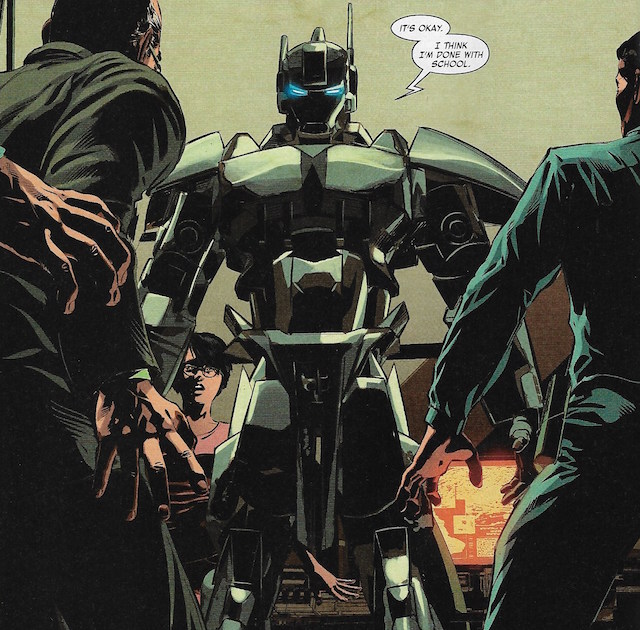
Investors want answers because a dead man cannot run a company. James Rhodes wants answers because he and Spider-Man apparently survived. MIT student RiRi, a teenage genius, is also looking for the billionaire in a suit she made from stolen parts because … why, exactly? The reasoning Bendis gives her is pretty flakey: Fate.

RiRi

Before returning to RiRi, here is what you need to know about IIM #9:

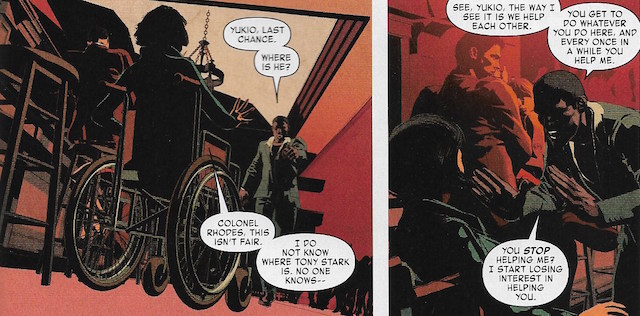
  • Rhodey returns to Osaka, Japan, to press Yukio for answers on Tony’s disappearance. He threatens to shut down her illegal gambling operation if she doesn’t talk.
  • S.W.A.T.-type agents raid Yukio’s establishment when she refuses to help. An anonymous man beats up Rhodey and takes her to safety during the chaos.
  • Doctor Doom convinces Stark’s girlfriend, biochemical engineer Amara Perera, to illegally test her experimental Alzheimer’s drugs on humans.
  • The man who helped Yukio escape, “Mr. Franco,” turns out to be Tony Stark in disguise. He somehow faked his own death to get closer to the organization that tried to kill him.

James Rhodes

IIM is now nine issues into its run and, quite honestly, not a whole lot has happened. While Bendis does a good job laying out breadcrumbs for readers to follow, there is only so long one can walk before fatigue sets in.

At this point it seems like a legitimate question for fans to ask, “When will we get the payoff?”

True, IIM has had moments of action, but they still have not really brought readers any closer to knowing what is going on with Madam Masque, Doctor Doom, or bio-hacking ninjas. The slog may be worth it, but at this point Bendis is testing readers’ patience. Spending time on a character who appears to be just the latest effort by Marvel to fill out a diversity checklist (i.e., We’ve got a new Iron Man — but’s it’s an Iron Woman and she’s a minority. How do you like us now?) exacerbates the problem.

Tony disguise

Will RiRi be a cool character? Perhaps. It just seems as though Marvel is on a weird quest to make female and minority versions of countless established characters.

Peter Parker, meet Miles Morales. Thor, meet She-Thor. Steve Rogers, go be an old man and make way for Sam Wilson. Logan, meet X-23. Bruce Banner, step aside for Amadeus Cho. Tony Stark, meet Iron Riri.

Sometimes it works, as with Sam Wilson and Amadeus Cho, but at the end of the day Marvel would be much better served by creating diverse heroes who are not derivatives of the classics.

If you have been reading IIM, then you should give Bendis a few more issues to deliver a decent payday before possibly jumping ship. If you have not been reading IIM, then you should probably wait until “The War Machines” wraps up before investing in the title.

Amazing Spider-Man #12: Slott’s Peter Parker impotent, Alpha Stark cradles MJ

SpiderMan IronMan

The introduction to the 12th issue of The Amazing Spider-Man informs readers that Peter Parker has returned to New York City to “breathe a sigh of relief” after his recent showdown with the Zodiac terrorist organization. Indeed, writer Dan Slott then goes on to provide a palate-cleanser in the form of an old-school team-up between Spider-Man and Iron Man. It’s generally a fun tale that includes the return of Mary Jane, plenty of action and humor, and set-ups for Marvel’s Civil War II and the return of Regent. Mr. Slott’s fundamental misunderstanding of who Peter Parker is, however, needlessly produces a character who is socially impotent and politically aligned with his adversary.

The story goes as follows:

  • Parker Industries is hosting a black tie event to raise money for the Uncle Ben Foundation.
  • Tony Stark and his personal assistant, Mary Jane, are in attendance.
  • Augustus Roman (aka, Regent) of Empire Unlimited shows up.
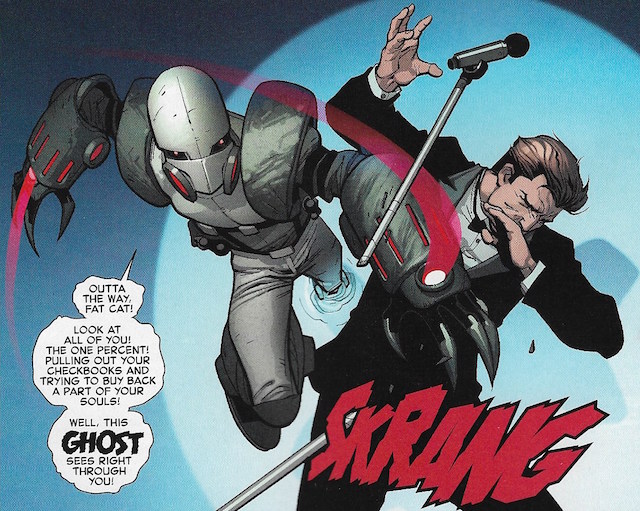
  • Corporate saboteur “Ghost” crashes the party.
  • Spider-Man and Iron Man team up to save the day.
  • Roman’s facility for super-powered criminals, The Cellar, is introduced.

If you are the type of reader who mindlessly consumes comic books like I devour chocolate-covered raisins before a big-budget movie, then stop reading now and buy ASM #12.

If you are the type of reader who wonders why Peter Parker so often does not seem right under Mr. Slott’s direction, then read on. You may want to save that $4.00 for another book — perhaps the next issue of Charles Soule’s Daredevil.

ASM #12 demonstrates from the very first panel that Dan Slott does not know how to strip his own politics from the book to provide a superior (no pun intended) product.

If you, dear reader, were to become the CEO of a major company, then you would have no problem buying a nice tuxedo for black tie events. If attending charity fundraisers was a recurring obligation you had as CEO of “Successful Business Dude Inc.,” then taking time out of your schedule to rent and return cheap suits would be bizarre.

Dan Slott’s Peter Parker, however, embraces the bizarre and as a result becomes, for all intents and purposes, politically aligned with corporate saboteur Ghost.

ASM12 Parker Harry

Only moments before Ghost attacks his fundraiser, Parker equates buying cheap suits with doing business “right.” Instead of being a CEO who finds a proper balance between thriving in a cutthroat industry and giving back to local communities, he possesses a mentality that is one step removed from the villain calling him a “fat cat” member of “the one percent.”

In short, Peter Parker can be a CEO without becoming self-loathing about it. I suggest Dan Slott read up on Tony Robbins if he wants a good blueprint for how to write about business and finance.

ASM12 Ghost

Finally, one cannot talk about ASM #12 without covering the return of MJ.

ASM12 Stark MJ

“I can face Doctor Doom or the Juggernaut. Easy,” says Peter Parker. “But knowing you’re right there, MJ … and with Tony Stark? Everything’s wrong. It shouldn’t be like this,” (emphasis added).

Indeed, long-time fans of ASM would concur that MJ locking arms with Tony Stark at a party is wrong. Likewise, seeing Stark cradle her head while asking if she is okay during an attack feels gross. Dan’s Slott’s decision is to have Peter react to the meeting by a.) first freezing up at the podium, and then b.) calling Pepper Potts and offering her a job at Parker Industries. She rejects the offer without hesitation.

Question: Is that really how Peter would react?

Answer: He would obviously be upset at seeing MJ with another man, but it seems sad and unacceptable to have him respond with a kind of impotence and immaturity that would signal she is better off with Stark.

One shudders to think of the indignities to come as Marvel writers explore the professional (as of now) relationship between MJ and Tony.