Dan Slott talks Silk follow-up — ‘Lady Liberty’ — the faster, stronger Captain America fans demanded

With Dan Slott’s creation Silk getting her own ongoing series in February, fans are wondering what he’ll do next to shake up with Marvel universe. It turns out that he hasn’t been resting on his laurels. “Lady Liberty” — a faster, stronger version of Captain America — is coming down the pike.

The creator of “The Superior Spider-Man” sat down with Comic Book Resources on Jan. 26:

CBR: First off, congratulations on your female version of Peter Parker who is better than him in every way. Fans have been clamoring for that for quite some time, so I’m glad you made it happen with “Silk.” We barely had time to catch our breath over her amazing ability to spin different colored costumes that can double as radiation suits before you announced Lady Liberty. Give us the scoop.

Dan Slott: Thanks! Well, I probably shouldn’t say it, but I know you guys will shill for anything I do — so what the heck?! Long story short, I want to make Red Skull into Captain America for a year. Then, when the real Cap comes back, we’ll have him discover the truth about Aiko Tinaka, a Japanese American who was the first truly successful applicant of the Super Soldier program (thanks to experiments conducted on Isaiah Bradley).

CBR: What?! That’s crazy town banana pants!

Dan Slott: Aiko is ironically inside an underground bunker in Hiroshima when the U.S. drops “Little Boy” on Aug. 6, 1945. The blast buries her and a secret unit of the Japanese military in a gigantic complex one mile beneath the earth. It is only after Steve Rogers puts all the pieces together and realizes that she may be alive that our story begins.

CBR: You had me at “female version of Captain America who is better than the original,” but now we’re really sold!

Dan Slott: Not only is she not white (score another one for ‘diversity for the sake of diversity!’), but Aiko will eventually discover that while she was serving her country, her family became prisoners of Japanese internment camps created by liberal icon Franklin Delano Roosevelt.

CBR: But…FDR was a liberal — and disabled. I’m a little uncomfortable with that.

Dan Slott: (laughing) Oh ye of little faith! That’s nothing a Republican Skrull couldn’t fix. Listen, I can’t tell you how many anonymous fans have been telling me at comic conventions that what the world needs is a female Captain America who is better in every way than Steve. I’m going to give it to them, but I’m going to do it the only way I know how — in Slottian style.

CBR: Dan, we can’t thank you enough. This was a real treat. I’m so overwhelmed with joy right now that I feel like I’m living in a piece of satire. I’m sure all of our fellow comic book “journalists” will be on board with this because it’s an insanely awesome idea. I’m sure that if you introduce Lady Liberty during a Captain America relaunch that a bulk of the sales will be because people want to know who she is and where she came from. Don’t be a stranger. Stop in again soon.

Dan Slott: I will. Thanks, buddy.

So there you have it! “Lady Liberty” — the faster, stronger version of the true Captain America, Steve Rogers. Dan Slott does it again. Genius. Until that comes out, make sure to buy Silk #1 this February — the title at the top of the pull list for every Peter Parker fan — written by Robbie Thompson with art by Stacey Lee.

Nicholas Irving’s ‘The Reaper’: Sniper’s book gives readers a raw look at the realities of war

Nicholas Irving FacebookMichael Moore’s now-infamous tweet, in which he called snipers “cowards” while moviegoers raved about Clint Eastwood’s “American Sniper,” showed that he never read Chris Kyle’s book. Likewise, Mr. Moore’s ignorant tweet also demonstrated that he was unfamiliar with Nicholas Irving, 3rd Ranger Battalion’s deadliest sniper, with 33 confirmed kills. Mr. Irving’s autobiography, “The Reaper,” is available now, and it is certainly worth checking out for anyone who wants to have a better understanding of the profession.

What separates Mr. Irving’s autobiography from others of a similar vein is that he details quite graphically just how close he came to death on multiple occasions. Many of the other first-person accounts of America’s elite war fighters never really recreate the sense of fear that can sweep over them when death closes in. The man known as “The Reaper” doesn’t shy away from acknowledging that real deal was hovering just over his head in many battles. Contrary to what Michael Moore thinks, snipers often put themselves in great danger — and when they’re spotted there is often nowhere to hide.

It takes brains, guts, and grace under pressure to survive on the battlefield when the best laid plans fall to pieces, and Mr. Irving does an impressive job articulating that reality for readers who are unlikely to ever take one step on foreign soil.

One of the other charges of men like Bill Maher is that American war fighters tell their stories in ways that make them come across as “psychopath patriots.” This once again proves that modern American liberals either do not read books like “The Reaper” or they only read them to the extent that they can find quotes to take completely out of context for their own political gain.

Nicholas Irving is certainly not glorifying war when he says of his experience shortly after a brutal firefight:

“Finally, though, when we were waiting for transport via Chinooks, I drifted off, though I heard a loud crack go past my ear. I immediately jumped up, put on my rucksack and stood there looking around, surveying the scene. All I saw was the rest of the guys just sitting there as calm as could be. In my head, bullets were still flying; in reality they weren’t.” (Nicholas Irving, The Reaper. Saint Martin’s Press, 2015. Page 182)

There are certainly passages in “The Reaper” that, taken out of context by partisan hacks, could be used to frame the Mr. Irving as a “psychopath patriot.” The reality is something else entirely: American snipers train for years to perform at the highest level of excellence. They take pride in their work (i.e., saving the lives of their fellow brothers-in-arms and killing enemies when necessary), just as cops or FBI agents take pride in what they do for a living.

If there are disagreements about foreign policy, then late-night talk show hosts and partisan filmmakers should criticize elected officials — not the men on the front lines who are literally diving into streams of raw sewage to avoid being torn to shreds by Toyota Hilux-mounted DShK machine guns.

The charge that books like “American Sniper” or “The Reaper” serve as “propaganda” (as Hollywood actor Seth Rogen might say) is laughable. Mr. Irving highlights this quite nicely when he describes a brief meeting with a young soldier who just recently completed Ranger School:

Just before we got to the car, our CQ, our company quartermaster, a really good guy named Lyons, came up to me.

“Just wanted to make sure you have everything squared away,” he said, shaking my hand.

“Yeah. Thanks for your help with all the gear and stuff.”

“No problem, Irv.”

Behind him, I could see another Ranger standing there. He was an E4 and I could see that he was a cherry guy, freshly shaved, quiet, standing there at parade rest.

Lyons introduced us. “Sergeant,” he said, “I wanted to meet you. All due respect but I heard you killed a bunch of guys. You set some record. I want to break it. I want my deployment to be just like yours was.”

I couldn’t believe what he was saying. Nobody says that. Nobody says that in front of a man’s wife.

Jessica stood there starting at me, looking like she was trying to figure something out, remember a phone number or something that someone had asked her for, something from her past she wanted to bring back up.

I looked at the cherry new guy, held his gaze until he backed his eyes off me, and said, very quietly but very firmly, “No. You don’t.” (Nicholas Irving, The Reaper. Saint Martin’s Press, 2015. Page 306)

If you’re looking for a compelling autobiography to read, pick up “The Reaper,” by Nicholas Irving. It may not be turned into a blockbuster movie anytime soon, but it’s still worth your time.

Related: American Sniper: Chris Kyle, Guardian Angel who doesn’t know it
Related: ‘American Sniper’ success prompts Michael Moore to take pot shots at deceased hero Chris Kyle

Dan Slott’s feckless Peter Parker needs Doctor Octopus to inspire Uncle Ben: Spider-Verse Part 5

SpiderVerse 5 Uncle BenPart 5 of Spider-Verse is out, and Dan Slott has reminded Peter Parker fans once again just how much he must truly despise the character.

Only in a Spider-Man comic written by Dan Slott will you see Peter Parker intellectually flail about as he attempts to inspire an alternate universe Uncle Ben into battle. Only in a Spider-Man comic written by Dan Slott will Uncle Ben receive the shot in the arm he needs to realize greatness — from Doctor Octopus. And only in a Spider-Man comic written by Dan Slott will his feckless Peter Parker then have the temerity to say “I’m running the show.”

Long story short, thanks to Dan Slott’s deus ex machina from Spider-Verse Part 4 (i.e., Master Weaver’s scrolls) and the sheer coincidence that a member of the team can read spider-totem hieroglyphics (Anya Corazon says it’s a “long story” — probably the kind that you can find out if you shell out another $4.00 for one of the ancillary books), the stage is set for everyone to head to Loomworld for a final showdown with The Inheritors. The entire cast is ready to go except Uncle Spider-Ben, who gave up the webs when “The Emerald Elf” killed his wife and nephew.

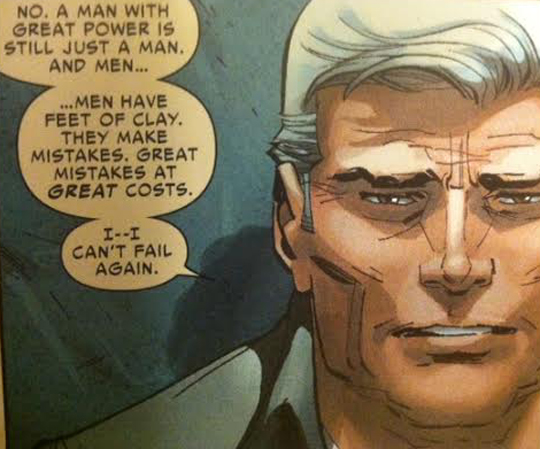
Peter’s response is to plead with Ben to put the suit on “one more time” — and he is rejected. Uncle Ben says, “No. A man with great power is still just a man. And men…men have feet of clay. They make mistakes. Great mistakes at great costs. I…I can’t fail again.”

SpiderVerse Uncle Ben1SpiderVerse UncleBen2

Otto then steps up to the plate, and his response is to call Ben out for acting, ironically, like a mealy-mouthed Peter Parker written by Dan Slott.

“You’re pathetic, old man! … You’re afraid to fail again? Tough! I’ve lost more times than I’ve ever won, and every damn time I got back up. That’s all that matters! When victory is easy, it’s cheap. Every fight that’s ever been worth fighting has been against adversity! Against a so-called ‘unbeatable foe!’ But there is no such thing! Every enemy has a weakness! You just have to find it! Once! You just have to win one time! Say it!”

Ben is moved, agrees to say “One time,” and before long he is ready and willing to fight. Inexplicably, he thanks both Otto and Peter for the help, even though it was clearly Otto who roused him from his cowardly stupor.

Peter’s response to Doctor Octopus’ speech: “I don’t believe it.” 

Fans of Peter Parker don’t believe it, either. That’s because any other writer of The Amazing Spider-Man would not have allowed Doctor Octopus to steal Peter Parker’s one chance to inspire Uncle Ben — even an alternate universe version of the man — to greatness.

Even worse, the whole ordeal only reminds fans that Doctor Octopus is performing an inverse-Winston Churchill; Doc Ock’s many failures weren’t rooted in a desire to save humanity, but to commit world-wide genocide on levels that surpassed “Pol Pot, Hitler, and Genghis Khan combined.”

Yes, Doctor Octopus failed many times — at killing Peter Parker for good. Unfortunately, writers like Dan Slott are doing more damage to Peter Parker than any super villain ever could.

At this point, if you’re a Peter Parker fan, you can only sit back and wonder what Dan Slott’s coup de grace will be in terms of castrating your friendly neighborhood Spider-Man in his own book.

Related: Spider-Verse Part 4: Side effects of Dan Slott’s Spider-Gluttony may include Spider-Diabetes
Related: Dan Slott’s Spider-Gump: Peter Parker is like a box of chocolates — you never know what you’re going to get
Related: Dan Slott’s Spider-Verse: Peter Parker sadly gives off ‘Where’s Waldo?’ vibe in his own book

‘American Sniper’: Clint Eastwood does Chris Kyle’s memory proud

American Sniper Bradley Cooper“American Sniper” Director Clint Eastwood was given a difficult task: he had to somehow squeeze Chris Kyle’s incredible life story into 132 minutes. What could have turned into an incredibly bloated mess had he tried to do too much was successfully streamlined in a way that stayed true to the autobiography while also teasing out the most important themes. Bradley Cooper and Sienna Miller both give strong performances, and audiences across the U.S. have rewarded them for all the hard work: “American Sniper” made $105 million in its first four days of wide-release.

Clint Eastwood seemed to have two goals with “American Sniper”:

  1. Show the audience what makes guys like Chris Kyle tick.
  2. Demonstrate the destructive power of combat on the war fighter’s psyche, as well as the family unit.

A glimpse of what Mr. Eastwood was able to transfer from the page to the screen comes towards the end of Chris Kyle’s autobiography, where he writes:

“My regrets are about the people I couldn’t save — Marines, soldiers, my buddies. I still feel their loss. I still ache for my failure to protect them.

I’m not naive and I’m beyond romanticizing war and what I had to do there. The worst moments of my life have come as a SEAL. Losing my buddies. Having a kid die on me.

I’m sure some of the things I went through pale in comparison to what some of the guys went through in World War II and other conflicts. On top of all the shit they went through in Vietnam, they had to come home to a country that spat on them.

When people ask me how the war changed me, I tell them that the biggest thing has to do with my perspective.

You know all those everyday things that stress you here? I don’t give a shit about them. There are bigger and worse things that could happen than to have this timely little problem wreck your life, or even your day. I’ve seen them. More: I’ve lived them,” (Chris Kyle, American Sniper. Harper Collins, 2012. Page 379.)

As I mentioned in my review of the book when it came out in 2012, Chris Kyle said that a guardian angel must have been looking over him on the battlefield on multiple occasions, yet he never really stopped to dwell on just how much of a guardian angel he was to his brothers-in-arms. The pressure he put upon himself to save everyone under his watch — an impossible task —would break any man. Yes, even Navy SEALs have a breaking point.

Families have breaking points, too. Again, Eastwood brings it home in a scene that takes place just before Chris Kyle’s fourth tour in Iraq:

Taya: Do you want to die? Is that what it is?

Chris: No.

Taya: Then just tell me. Tell me why you do it. I want to understand.

Chris: Baby, I do it for you. You know that I do it to protect you.

Taya: No you don’t.

Chris: Yes, I do.

Taya: I’m here. Your family is here. Your children have no father. […] You don’t know when to quit. You did your part. You sacrificed enough. You let somebody else go!

Chris: Let somebody else go?

Taya: Yeah.

Chris: Well, I couldn’t live with myself.

Taya: Well, you find a way. You have to. Okay? I need you — to be human again. I need you here. I need … you here. If you leave again, I don’t think we’ll be here when you get back.

Even to those who are closest to these very special men, it often seems like they have a death wish. But that is not the case. Even those who are supposed to understand what motivates a war fighter, can not. The question becomes: How do you dedicate your life to a man who has dedicated his own to ideas that are bigger than all of us?

At one point during “American Sniper,” Chris laments how obsessed civilians are with their cell phones, trips to the mall, and a variety of other seemingly-trivial things when he should be “over there.” But that’s the conundrum: Just as the principles a SEAL is willing to fight and die for make life worth living, it is also those little moments — a conversation on a lazy Sunday afternoon with your wife, or a quiet night alone with that very same woman — that make it special.

“American Sniper” is about one man’s attempt to successfully balance the desire to selflessly serve one’s country while also living up to the commitment to love and cherish his spouse with all his might.

Clint Eastwood may be an old man, but his latest movie shows that he can still direct better than most people who are half his age. If you get a chance, then you should check out “American Sniper” while it’s in theaters. It is one of the rare war movies within the past decade that is actually worth the price of admission.

Related: ‘American Sniper’ success prompts Michael Moore to take pot shots at deceased hero Chris Kyle

‘American Sniper’ success prompts Michael Moore to take pot shots at deceased hero Chris Kyle

“American Sniper” is a box office hit. In four days of wide-release, it has pulled in $105 million. Audiences across the country have been moved by the Bradley Cooper’s portrayal of Navy SEAL Chris Kyle. Director Clint Eastwood did a marvelous job showing the kind of selfless service displayed by American war fighters while also not shying away from the psychological toll that combat takes on them and their loved ones. It’s a stellar film about an American hero, which is why Michael Moore and Seth Rogen responded just as the world expects Hollywood liberals to act: like pathetic men who deep down resent the fact that for all their fame and fortune they are still glorified clowns.

Chris Kyle was a real hero, and instead of just dealing with their envy and jealousy in the privacy of their own home, Michael Moore and Seth Rogen lashed out on Twitter so the world could see how truly petty they are.

Michael Moore American SniperUsing Michael Moore’s logic, anyone who uses cover and concealment during the course of battle is a “coward.” Perhaps we should do away with camouflage and just wear bright red jackets with white pants in the middle of open fields, but I digress.
Michael Moore Twitter American SniperOnce negative feedback came rolling in, Michael Moore decided to just make it abundantly clear that whenever he talks about cowards, he is really just projecting his own inner demons.

Michael Moore Chris Kyle

Translation: “What are you so upset about? I wasn’t disparaging Chris Kyle with my sniper comments, even though I made them on the very day millions of Americans were talking about him. Where would you get that idea?”

And then there is Seth Rogen, whose main achievement in life is that he made a dumb movie about North Korea (we all know why he didn’t target Iranian mullahs), which forced millions of Americans to confirm: yes, we will defend Hollywood actors’ right to the freedom of expression, even if they are classless imbeciles.

Seth Rogen American SniperSeth Rogen’s tweet proves that he did not see “American Sniper,” or that he is a hate-filled buffoon (perhaps both?). The movie wasn’t a celebration of war or a piece of propaganda similar to faux-Nazi films created by Quentin Tarantino; if anything it was a clarion call to policy makers to think long and hard before sending men like Chris Kyle into war zones. Only a miserable person as defined by John Stuart Mill could watch Clint Eastwood’s “American Sniper” and think “coward.”

“The person who has nothing for which he is willing to fight, nothing which is more important than his own personal safety, is a miserable creature and has no chance of being free unless made and kept so by the exertions of better men than himself.” — John Stuart Mill.

C.S. Lewis, who fought and almost died during World War I, puts it another way in his famous essay, “Why I am not a pacifist”:

“For let us make no mistake. All that we fear from all the kinds of adversity, severally, is collected together in the life of a soldier on active service. Like sickness, it threatens pain and death. Like poverty, it threatens ill lodging, cold, heat, thirst, and hunger. Like slavery, it threatens toil, humiliation, injustice, and arbitrary rule. Like exile, it separates you from all you love. Like the gallies, it imprisons you at close quarters with uncongenial companions. It threatens every temporal evil — every evil except dishonor and final perdition, and those who bear it like it no better than you would like it. On the other side, though it may not be your fault, it is certainly a fact that Pacifism threatens you with almost nothing. Some public opprobrium, yes, from people whose opinion you discount and whose society you do not frequent, soon recompensed by the warm mutual approval which exists, inevitably, in any minority group. For the rest it offers you a continuance of the life you know and love, among the people and in the surroundings you know and love.” — C.S. Lewis

Michael Moore and Seth Rogen are very much like the “miserable creatures” referenced in Mill’s “On Liberty.” On many levels they are not worth writing about; they run in social circles with like-minded fools who would never point out that maybe — just maybe — the dough-like man-boys disparaging Navy SEALs might have a few insecurities hiding in those rolls of skin. However, because of their Hollywood connections, men like Michael Moore and Seth Rogen do affect American culture. The bully pulpit they have access to almost demands that those who can push back against their attempts at character assassination, should.

Congratulations, Michael Moore and Seth Rogen: you’re the type of guys who take shots at deceased Navy SEALs and the creative works that respectfully honor their sacrifice. Try doing that outside Hollywood circles and see how much it endears you to the crowd.

Update: Seth Rogen is now backtracking with the incredibly lame “Apples remind me of oranges,” excuse. Next he’ll say that every once-in-awhile he sits down, bites into a banana, and thinks, “Zucchini.”

Seth Rogen American Sniper Twitter
Related: ‘American Sniper’: Clint Eastwood does Chris Kyle’s memory proud

Related: At long last, Michael Moore openly admits he hates the troops

Related: American Sniper: Chris Kyle, Guardian Angel who doesn’t know it

Related: In remembrance: Navy SEAL Chris Kyle

Related: Eastwood’s ‘American Sniper’ trailer is out, and it looks like a movie Chris Kyle fans will appreciate

Spider-Verse Part 4: Side effects of Dan Slott’s Spider-Gluttony may include Spider-Diabetes

After months of lead-up to Spider-Verse, the actual series, and its tie-in material, fans of Peter Parker may find themselves suffering from a form of Spider-Diabetes due to Dan Slott’s Spider-Gluttony. Part 4 of Spider-Verse hit stores on Wednesday, but on some level it seems like Part 14. Even staunch supporters of the tale may be asking themselves: Are 20 issues really necessary to do this justice?

Spider-totems being destroyed. Again. Where have I seen that before?

Those who have followed Spider-Verse from the beginning can expect more of the same; throngs of spider-totems die; The Inheritors chase spider-totems around different dimensions; a few “whacky” panels are thrown in; Peter Parker needs help, and the issue ends with a big tease to generate buzz for future installments. On the cliff hanger, however, Mr. Slott does not disappoint. More on that later.

The ongoing problem with Spider-Verse is that any story that involves an army of spider-heroes (many who are just different versions of Peter Parker) will obscure those leadership skills that prove he is a cut above all the rest.

Dan Slott's Spider-Man is confused. He needs help! Good thing Dan Slott's creation, Silk, is there to get him where he needs to be. Whew. That was a close one.
Dan Slott’s Spider-Man is confused. He needs help! Good thing Dan Slott’s creation, Silk, is there to get him where he needs to be. Whew. That was a close one.

“I asked for this. The others are counting on me, and I don’t know what to do! I need help! I need…” Dan Slott’s Spider-Man says just before he is saved by Dan Slott’s creation, Silk. What a coincidence.

“Peter, it’s Cindy. … Earth-3145! Trust me…” says Silk, which then prompts Peter to bring his team to her location. Moments earlier, Peter was sent scrolls from Spider-Woman — provided by Master Weaver — spelling out “everything” he would need to know about The Other, The Bride, The Scion, and more.

It is hard to conclude that Peter Parker is the one essential hero in his own book when he depends on so many others to secure victory, let alone the assistance that comes from some Deus ex Machina action (i.e., Master Weaver).

Hmmm. How do we move this along? I suppose there isn't any problem that is too big for the Master Weaver to handle... Thanks for the scrolls, buddy!
Hmmm. How do we move this along? I suppose there isn’t any problem that is too big for Master Weaver to handle… Thanks for the scrolls, buddy!

The best part about Spider-Verse Part 4 is the last panel.

** Warning: Spoiler Alert. **

There is a special spider-totem who has been waiting inside a fall-out shelter on Earth-3145. Alone amongst the rubble of a post-apocalyptic New York City teeming with deadly radiation is … Uncle Spider-Ben. What role he will play as the story unfolds is still unclear, but it’s a sure-fire way to generate sales for Part 5.

The problem with the Uncle Spider-Ben reveal is that it reminds Peter Parker fans that it wasn’t too long ago that Peter died … or became Ghost Peter … or Memory Fragment Peter or some other kind of Phantasm Peter that hasn’t been clarified by Dan Slott or Marvel.

Given that The Amazing Spider-Man #700 indicated that Peter would die and reunite with Uncle Ben — the real Uncle Ben — in heaven, the appearance of an Uncle Spider-Ben isn’t particularly earth shattering. Peter and his real uncle would have had time to talk at length and untangle any unresolved issues associated with his untimely death. Besides, if there are spider-monkeys, spider-lizards, Spider-Hams and a whole host of other weird incarnations, it’s actually more bizarre that there hasn’t been Spider-Jonah or Aunt Spider-May. In fact, why has there not been a Spider-Mary Jane?

In the end, Spider-Verse is a little like one of those Brazilian steakhouses where they endlessly bring out meat, but instead of massive amounts of protein Dan Slott serves up Spider-totems. Even those who love meat and Spider-Man can reach a saturation point. For readers who can digest another eight issues and take a $32 hit to their wallets, kudos. For those hard-core fans who started out strong but are beginning to feel nauseous, at least you can get by with only purchasing ASM issues 13 and 14.

And finally, if you’re screaming “No mas! No mas!,” then save yourself the cash, read my next reviews, and share your opinions in the comments section below.

Exit Question: Is it possible for beings that can consume the life force of Captain Universe to be adversely affected by the fallout from a nuclear blast?

Bonus: Here is an excerpt from the feedback that makes it into the Letters to the Editor section of The Amazing Spider-Man:

“Dear Spidey editors, artists, and everyone else related to making The Amazing Spider-Man comic book… You all are gods! Only someone with such power could have the responsibility (see what I did there?) to make something with so much beautiful artistry.”

Now you can see why modern creators swear off message boards — they’re so used to cherry picking the kind of feedback they receive that they can’t professionally handle unfiltered criticism.

Related: Dan Slott’s Spider-Gump: Peter Parker is like a box of chocolates — you never know what you’re going to get

Related: Dan Slott’s Spider-Verse: Peter Parker sadly gives off ‘Where’s Waldo?’ vibe in his own book

Lucid dreaming: Connect with the conduit to your soul and unlock stores of wisdom

Charlie Morley Lucid Dreaming

In 2013 I wrote a piece titled, “The effects of meditation: What if you could ask your nightmares why they haunt you?”. The post was inspired by lucid dreams that I began having as a result of meditation.

I asked:

Imagine the personal growth men and women could attain if they could ask the symbolic representations in their dreams what, exactly, they mean. What if a individual spends his days trying to improve his body, mind and spirit — and his nights doing the same thing? What would happen if we could stop the elements of our nightmares in their tracks to ask them why they haunt us? How would the physical world transform if individuals made the conscious decision during sleeping hours to take the darkest corners of their minds and fill them with light?

It turns out that Charlie Morley said very much the same thing during a 2012 TedX talk in San Diego. He put this way while recounting the time he finally stood up to his inner demons:

“So there I am, face-to-face with this demon, fully lucid so I know I’m in my own head and I know there’s no real threat, but it’s still pretty scary.  So instinctively I get ready to fight. And then it hits me. Hang on. This must be an aspect of my shadow.  … I gotta integrate this thing. I gotta embrace this thing. How do I do that, exactly? I will give it a hug! So I run up to this thing in the lucid dream, and I bear hug it. This dream was so realistic I could feel it struggling against my embrace. I could feel it […] breathing down my neck.

You know, the shadow is the sum total of all your repressed capacity for violence and aggression, so as you can imagine it’s not much of a hugger. But there I am, and I’m hugging this thing that doesn’t want to be hugged, and it’s struggling to get away and I’m clinging on for deal life and then it does something really unexpected. It starts to shrink. Within my embrace, this three-headed shadow monster starts to shrink. And I keep holding on and it keeps shrinking and then it stops. And there’s a moment of stillness. I release my embrace and I realize I’m hugging myself.

This three-headed headed demon has transformed into me — a direct carbon copy of me. And there I am, face-to-face with myself — maybe for the first time in my life. We shared a smile, and I woke up in floods of tears. Not only am I in tears, but I’ve got this weird feeling in my belly like as if a knot had been untied. Some deep emotional knot that had been there for so long I had forgotten it was there at all.

I don’t know what part of my psyche that shadow-aspect represented. Maybe some denied childhood trauma. Maybe some disowned childhood complex. Who knows? But what I do know is that when I was embracing that demon I was embracing some deeper part of myself. And I was engaging the innate healing potential, which resides within us all. In a lucid dream you have the opportunity to engage psychological concepts immediately in a seemingly [physical] form. This is a unique opportunity to directly apply healing intent to mental embodiment and personifications of your own own psychology. This is deep healing territory. This is what thousands of people are paying thousands of therapists thousands of dollars to do. Now, I’m not saying you should all go and sack your therapists. But what I am saying is: if you can learn to lucid dream — not all of the time, but some of the time — you can make their job a heck of a lot easier. If you can learn to dream lucidly — and it is a [teachable] skill — you can begin to integrate your shadow and finally reclaim, as Jung said, ‘the seat of all human creativity.'”

Bravo, Mr. Morley. I could not agree more. We dream for a reason, and it isn’t just to have funny tales to tell our friends and coworkers once-in-awhile. It isn’t touchy-feeling mumbo-jumbo when someone says that dreams are powerful tools one can use for realizing his or her full potential — it’s a fact.

To show that I practice what I peach, I will now recount a lucid dream that I had early Tuesday morning around 6:00 a.m.

I’m in a large convention center for individuals whose employment concerns national security matters. I’m wearing a flak jacket while surrounded by military personnel, FBI agents, other members of Homeland Security, etc. The entire convention starts buzzing as if something is wrong, and people get out of their seats. I don’t know what is happening, so I get up and follow a stream of people heading out the door.

As I go through a doorway I think, “Did I bring an M16 and forget it in my chair? I can’t remember. How could I be so stupid!?” I double back to go into the convention hall and find myself in an airport hanger. Individuals are running around as if an air raid of some sort is about to take place and I think, “Now I know I must be dreaming,” and immediately ask my subconscious, “What is my biggest fault?” Immediately one of the men running around the hanger gets in my face and sticks out his tongue — so I punch him square in the nose, he recoils, and stumbles off. I then ask, “What is my best attribute?” and a man immediately trips in front of me — so I bend down on one knee, hold out my hand, and help him up. Shortly thereafter, I wake up.

Think about how amazing it is that you can ask your own subconscious deeply personal questions and, without missing a beat, it will supply honest answers. In my case, I am quick to anger. I can lash out mentally, spiritually, and physically at those who I perceive to be adversaries — and this is often the wrong thing to do. There is no denying it. Likewise, I am also quick to help those before me who stumble and fall mentally, spiritually, and physically.

It is easy for a man to ignore the advice of friends and family. It is easy for a man to lie to himself in his waking state. It is not so easy for a man to lie to himself when he consults the conduit to his own soul and receives an instant reply.

There is a wellspring of wisdom inside each and every one of us, and I firmly believe that lucid dreaming is one way of unlocking those stores of potential. If you have questions about lucid dreaming, then feel free to ask in the comments section. Otherwise, check out Mr. Morley’s TedX talk and see if it speaks to you.

Related: The effects of meditation: What if you could ask your nightmares why they haunt you?

Related: Lucid dreaming, the meaning of life, and flying through space like a ballistic missile

Related: Thoughts on lucid dreaming and the floating purple orb

Atheists mock science-loving Catholics from afar because ego massages feel better than ego checks

HubbleThe “Atheists 10 Commandments” recently made news with the release of “Atheist Heart, Humanist Mind,” by John Figdor and Lex Bayer. Yours truly pointed out how ridiculous it is to have nine “commandments” that are all superseded by “There is no one right way to live.” As a result, a slew of atheists deemed me a “fundie.” Two of my quotes generated rounds of ego-massaging among the congregants of “Fundies say the Darndest Things.”

Sadly, the majority of people over FSTDT seem to mistake sarcasm and personal attacks for intellect:

“While there is no one right way to live, there are certainly many wrong ways, such as being an adult with imaginary friends.”

“The self-loathing of the religious zealot is the same self-loathing that drives the heroin addict to the needle and the alcoholic to the bottle. It blunts the pain, but does nothing to resolve the underlying issues that cause that pain, the feelngs [sic] of worthlessness and despair, as revealed here.”

“Yet another person who’s good only because he’s scared of God. People like that scare me.”

It’s easier to laugh and joke about “being an adult with imaginary friends” than it is to have a mature conversation on the body, mind and spirit. It is also easier to mock science-loving Catholics from afar than it is to venture from the safe confines of the digital hive.  The modern atheist seems to think that science strengthens the case against God, and avoiding discussions with guys like me allows them to continue such a delusion.

Author Eric Metaxas wrote for The Wall Street Journal Dec. 25:

Today there are more than 200 known parameters necessary for a planet to support life—every single one of which must be perfectly met, or the whole thing falls apart. Without a massive planet like Jupiter nearby, whose gravity will draw away asteroids, a thousand times as many would hit Earth’s surface. The odds against life in the universe are simply astonishing. …

There’s more. The fine-tuning necessary for life to exist on a planet is nothing compared with the fine-tuning required for the universe to exist at all. For example, astrophysicists now know that the values of the four fundamental forces—gravity, the electromagnetic force, and the “strong” and “weak” nuclear forces—were determined less than one millionth of a second after the big bang. Alter any one value and the universe could not exist. For instance, if the ratio between the nuclear strong force and the electromagnetic force had been off by the tiniest fraction of the tiniest fraction—by even one part in 100,000,000,000,000,000—then no stars could have ever formed at all. Feel free to gulp.

Multiply that single parameter by all the other necessary conditions, and the odds against the universe existing are so heart-stoppingly astronomical that the notion that it all “just happened” defies common sense. It would be like tossing a coin and having it come up heads 10 quintillion times in a row. Really?

Fred Hoyle, the astronomer who coined the term “big bang,” said that his atheism was “greatly shaken” at these developments. He later wrote that “a common-sense interpretation of the facts suggests that a super-intellect has monkeyed with the physics, as well as with chemistry and biology . . . . The numbers one calculates from the facts seem to me so overwhelming as to put this conclusion almost beyond question.”

Men of faith look at the mind-bending odds against the possibility of life — any kind of life — in the universe, we conclude that our existence is a miracle attributable to God, and the response by online atheists is to liken us to a “self-loathing … heroin addict.” Which group is acting like an adult and which group is acting like a petulant child who is lashing out at his father?

Men of faith readily admit they fear eternal separation from God, and online atheists make the strange leap in logic that we view Him as some sort of cosmic Communist police state overseer. Which group is acting like an adult and which group is acting like a recalcitrant child who is upset that he will one day be held accountable for his actions?

The online atheists’ inclination to view anyone who believes in God as a backwoods hick with a sixth-grade home-school education is bizarre — but I welcome it. Their decision to cloister themselves in little online echo chambers is to the man of faith’s advantage. Keep likening law-abiding, well-adjusted, and productive members of society to heroin addicts, my atheist friends — each outlandish caricature you create only makes open-minded individuals more likely to ignore your future overtures.

The Atheist 10 Commandments are here — even though ‘There is no one right way to live’

A humanist chaplain at Stanford University and his co-writer on “Atheist Heart, Humanist Mind” have crowd-sourced the 10 Commandments — for atheists. The result is a philosophically-convoluted mess.

CNN reported Dec. 20 that John Figdor and Lex Bayer gleaned the Atheist 10 Commandments from 2,800 submissions from 18 countries and 27 U.S. states.

The “commandments” are:

1. Be open-minded and be willing to alter your beliefs with new evidence.
2. Strive to understand what is most likely to be true, not to believe what you wish to be true.
3. The scientific method is the most reliable way of understanding the natural world.
4. Every person has the right to control of their body.
5. God is not necessary to be a good person or to live a full and meaningful life.
6. Be mindful of the consequences of all your actions and recognize that you must take responsibility for them.
7. Treat others as you would want them to treat you, and can reasonably expect them to want to be treated. Think about their perspective.
8. We have the responsibility to consider others, including future generations.
9. There is no one right way to live.
10. Leave the world a better place than you found it.

If “there is no one right way to live,” then why should anyone “be willing to alter” their beliefs? If there is “no one right way to live,” then why do we have “a responsibility to consider others”? If there is “no right way to live,” then why should a man consider the perspective of others? If there is “no right way to live,” then it can not be wrong if one man decides that his “right way to live” includes controlling the bodies of those around him.

This is the conundrum atheists face: if we are all just cosmic accidents and God does not exist, then no man has the moral authority to tell another man how to live. If we are all just sentient space dust with no soul, then there really are no objective truths — right and wrong are relative — and there is no valid argument against those whose sole existence is based on taking advantage of their fellow man.

Even the authors seem to realize this. They told CNN about the inspiration for writing their book:

“A lot of atheists’ books are about whether to believe in God or not,” he said. “We wanted to consider: OK, so you don’t believe in God, what’s next? And that’s actually a much harder question.”

“What’s next?” is a very hard question, indeed. Perhaps the reason why so many atheist books concentrate on “whether to believe in God or not” instead of “What’s next?” is because it leads to “There is no one right way to live.”

On another level, it is incredibly telling that with limited real estate, atheists would use one of their “ten commandments” to emphasize the importance of not believing in a non-existent god. Try as he might, the atheist can not escape God. Perhaps for their next book, Messrs. Figdor and Bayer could write “Atheist Heart, Humanist Mind: We Can’t Escape God No Matter How Hard We Try.”

Related: Atheists mock science-loving Catholics from afar because ego massages feel better than ego checks

Dan Slott’s Spider-Gump: Peter Parker is like a box of chocolates — you never know what you’re going to get

Amazing SpiderMan 11Spider-Verse Part 3 has arrived, and the showdown everyone has been waiting for has finally happened: Peter Parker vs. Doctor Octopus (aka: The Superior Spider-Man). With Olivier Copiel vivifying Dan Slott’s words, Amazing Spider-Man #11 is injected with energy and vibrancy it otherwise doesn’t quite deserve. The reason being is because its writer seems to have drawn inspiration for his version of Peter Parker by watching Forrest Gump on repeat in his bedroom. Dan Slott’s Peter Parker is like a box of chocolates — you never know what you’re going to get.

After 10 issues of Peter fumbling and bumbling around as a sideshow character in his own book, a switch has seemingly been flipped and he suddenly takes charge. It’s jarring, and the result is a sort of cognitive dissonance for readers who haven’t been happy with the status quo for some time. If you’re like me, then you’re left scratching your head at the inconsistency. If you’re like Andrew Roebuck from Spider-Man Crawlspace, then you have a more curious take.

Mr. Roebuck says of Spider-Verse Part 3:

“It seems to me that we finally have a reason for Slott writing our Peter Parker so incompetently these last few months. He needed it to feel important for him to step into his big boy pants and take charge of the situation. We needed to see Peter at his worst to appreciate him when he is finally back doing the things that we all knew the character capable of.”

If one were to hold tight to this premise, then he or she would have to believe Dan Slott wanted Peter Parker fans to drop roughly $50 over the past year on a lackluster to embarrassing version of their favorite character for the so-called payoff of issue #11. That is certainly one way to deal with the cognitive dissonance the book has generated, but one I don’t think will be of much comfort to the vast majority of Peter Parker fans.

What is more likely: that Dan Slott views Peter Parker as a kind of Andy Dufresne from The Shawshank Redemption, who he had to drag through a mile of human waste to attain glory, or that he’s writing a character that he doesn’t quite know how to handle?

Perhaps the most bizarre moment of Peter’s momentary return to form is his assertion: “Ock can’t imagine a world where he loses. One where I come back, reclaim that body, and win!”

Given that there are plenty of instances in Spider-Man history where Peter Parker handily defeats Otto, it seems a bit odd to say that the villain can’t imagine a world where he loses. He’s lost. Multiple times. Regardless, any one who read The Superior Spider-Man knows that Peter didn’t come back and “win” per se — Otto basically stepped aside.

All of this again raises the question: What happened to Peter? Was he dead? If so, then where was his soul? Did Otto just take control of Peter’s mind for a year, which would mean that Peter was the one doing all sorts of dastardly deeds while brainwashed? Is there a “downloaded” Otto somewhere in the recesses of Peter’s brain just waiting to get out? There never was any clear answer, which may be why Peter hasn’t really grappled with the enormity of the situation. The personalities of individuals who survive near-death experiences often undergo profound changes. The Superficial Spider-Man just swings around and occasionally mentions that he maybe-sorta-kinda-died.

SSM Otto Anna Peter ParkerThe one diamond in the rough from The Amazing Spider-Man #11 comes when Peter and “Spider-Gwen” share a moment that could lead to some interesting stories down the road. As much as it pains me to say it, the smart move by Marvel would be to use each character’s shared experience as a spring board for a more serious relationship between the two of them. This particular Gwen knows exactly what Peter went through when he lost his first true love. Instead of having Peter Parker engage in stupid make-out sessions with Dan Slott’s creation Silk, it would be worth Marvel’s time to kick start something more serious between Peter and Gwen. Doing so would also open the possibility of a love triangle between Peter, the new Gwen, and Mary Jane. The Superficial Spider-Man could become The Substantive Spider-Man once again.

Amazing SpiderMan 11 SpiderGwenIn short, Spider-Verse Part 3 was one of the few issues of The Amazing Spider-Man since its relaunch that was actually worth the $4.00 cover price. Unfortunately, Dan Slott’s Spider-Gump is still like a box of chocolates — you never know what you’re going to get.

Update:

Shortly after this blog post went live, Dan Slott blocked me on Twitter. This is my second time with such an honor. I'm assuming the first time he unblocked me so he could once again see my Twitter feed. I promise I'll continue blogging on The Amazing Spider-Man, Dan Slott. I know you'll keep reading.
Shortly after this blog post went live, Dan Slott blocked me on Twitter (even though I never followed him to begin with). This is my second time with such an honor. I’m assuming the first time he unblocked me so he could once again see my Twitter feed. I promise I’ll continue blogging on The Amazing Spider-Man, Dan Slott. I know you’ll keep reading.

Update II:

I have also been blocked by Tom Brevoort. Marvel's reaction to intelligent criticism it can't shoot down with petty name-calling is to do the equivalent of sticking their fingers in their ears while screaming, "I can't hear you!"
I have also been blocked by Tom Brevoort. Marvel’s reaction to intelligent criticism it can’t shoot down with petty name-calling is to do the equivalent of sticking their fingers in their ears while screaming, “I can’t hear you!”