Dan Slott is an interesting guy — when he’s not trolling random women on Twitter or casting countless Peter Parker fans as racist rubes, he’s making the epilogue to his big Spider-Verse tale more exciting than the main story. In some weird way, the constraints imposed upon the writer by his epilogue — he had to wrap up countless loose ends and couldn’t engage in superfluous Spider-Ham jokes — forced him to put forth a tighter product. The result is, oddly enough, the most satisfying issue of The Amazing Spider-Man in months.
The good thing for Dan Slott with an epilogue like this is a.) there is no real need for characterization — readers are essentially told, “Hey, this is where are heroes ended up,” and b.) it provides the author with an easy opportunity in terms of providing fans with some “feel good” closure. With no defenders in his way, Dan Slott managed to sink a layup at the buzzer. He still lost the game…but at least he made his last shot.
With that said, Spider-Man fans might be disappointed when the thrill of seeing Peter Parker crack Doc Ock with a left hook wears off. As Peter Parker stands above Otto, the villain unmistakably telegraphs the vehicle that will carry him to revenge. Otto tells his hologram girlfriend “Now, Anna, as we discussed.” Was Peter Parker deaf, or did he just shrug his shoulders and say “What was that was all about? Eh, probably nothing.”
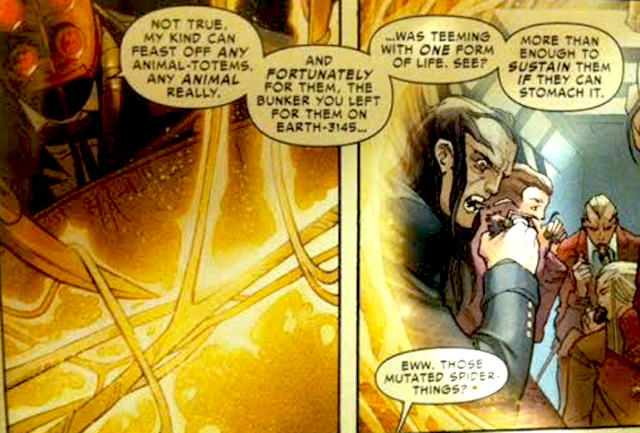
Another bizarre instance occurs when Karn reveals that the nuclear wasteland the Inheritors have been imprisoned on “fortunately” has a bunker “teeming” with spiders. What are the chances? It’s almost like Master Weaver giving the heroes a scroll with “everything” they need to succeed, or Silk conveniently teleporting to the planet and finding the bunker to begin with. Dan Slott’s Peter Parker is big on the “no one dies” mantra, but he’s apparently okay with the “shut you in a bunker and force you to live on spiders for all eternity,” verdict as well. Under normal circumstances such a panel could be laughed off, but since the writer has invested so much in “no one dies” during his tenure, it should not be ignored.
If you’ve purchased the rest of Spider-Verse and were thinking about skipping the epilogue, then you may want to reconsider. Dan Slott may have oversold the book when he promised “Big Things” (shocker, I know), but it’s still one of his better efforts in quite some time. If nothing else, Spider-Verse: Epilogue shows that Marvel might get tighter stories out of its scribe if it puts more constraints on him.
Spider-Man scribe Dan Slott took a break from bullying random women on Twitter this week to demonstrate a new an improved way of showing how clownish and immature he could be — he painted anyone who thinks “Peter Parker is a white character who believes ‘With great power comes great responsibility,'” as racist.
Yes, that’s right, in Dan Slott’s world, if you describe the white character you’ve read for decades as “white” when someone asks you, then you “don’t get” him.
This is the man who is Marvel’s ambassador to Spider-Man fans. This is the man who, ideally, would unite Peter Parker fans of all ages. This is the man whose argument (by his own admission) boils down to: “Would you go up to a [non-white child] and say ‘You can’t be Spider-Man’?”
Notice what Dan Slott has done — he conflates the idea of a “Spider-Man” with the character millions of people around the world recognize as Peter Parker.
When Dan Slott started this weird conversation Feb. 12, I put it this way:
I understand that it is the essence of a man that is important (e.g., “The Phantom” lives forever as different men who embody his noble spirit), but once you essentially start going down the, “Let’s just arbitrarily make Peter Parker black tomorrow and if you get annoyed, then you’re a racist” road, then that’s where you’ve lost me.
Marvel successfully pulled that off with Nick Fury. That makes sense because he was never a figure with national/world-wide recognition. It’s a different thing when basically the entire world has a vision of what “Peter Parker” looks like and guys like Dan Slott start screwing with it.
It would be like if Nintendo suddenly made Mario and Luigi black and said, “What? What? There are black Italians. What are you, racist?” to people who started rolling their eyes.
Well, no. I’m not racist, Nintendo executives, but I think you’re just taking the racial sensitivity thing to an absurd level.
If someone asked me to describe Blade, one of my “thousand” adjectives used to describe him would be “black.” The same goes for James Rhodes. Or “Robbie” Robertson. Or any number of black characters. But perhaps in Dan Slott’s world, Marvel fans are allowed to describe long-established black characters as black and that doesn’t have an effect of their understanding of the character.
As I said Feb. 14 in the comments section of a previous post (I was hoping Mr Slott wouldn’t continue to belabor this conversation and prompt me to expand it into a full-blown blog post):
I’m not sure if Dan Slott is just a giant troll, or a complete doofus. He starts a conversation that he knows is going to annoy people by insinuating that maybe it might be a good decision to arbitrarily make Peter Parker black or Hispanic or Asian — when generations of people associate Peter Parker with a very specific look — and then he acts incredulous when people start talking about doing the exact same thing to other characters.
If Charles M. Schulz were still alive and he randomly changed Snoopy from a beagle to a golden retriever, would it matter? A dog is a dog, right? Yes, it would matter for many Peanuts fans because the world fell in love with a very specific Snoopy.
I wouldn’t want Marvel randomly making Blade a white guy, and I wouldn’t want Marvel randomly making Peter Parker a black guy. In both instances, it would be a weird editorial move.
Sounds reasonable, right? Not to Dan Slott. Here is how he responds to other reasonable Spider-Man fans (great customer relations, Marvel): “My grandma knew Jim Crow laws. Didn’t make ’em right.”
Some random Peter Parker fan essentially says, “Even my grandma would be able to describe Peter Parker to forensic sketch artist, and he’d be white. That’s pretty iconic. I think it would probably be odd to randomly make Peter Parker black.”
Dan Slott’s reaction is to start talking about Jim Crow laws. Seriously. You, dear reader, are apparently the type of person who would tell a little black child he couldn’t be Spider-Man and you would probably admit to supporting Jim Crow laws if it was just you and Dan Slott drinking alone at the bar one night.
In his never-ending quest to fish for compliments in his Twitter feed while also putting himself up on a gigantic moral pedestal, Dan Slott is now resorting to needless race-baiting conversations with Peter Parker fans. Does it get any worse than this? Why does Marvel let him get away with acting like a petulant man-boy with a penchant for burning bridges? Since when did Marvel decide that its business model for attracting attention to Spider-Man comic books was to hire a writer who invents ways to slime customers?
The ironic thing about all of this is that if Dan Slott were to magically make Peter Parker black tomorrow, then he could very well be fending off racial conspiracy theory charges soon afterward — Peter Parker is a shell of the character he once was thanks to Dan Slott, so making him black at this stage in the game would actually be an insult to race-goggle wearing comic book readers everywhere.
One day a writer will take on Spider-Man who will bring together fans from a variety different backgrounds, ages, and political persuasions. He or she will do it without all the unnecessary antics, and when that happens Dan Slott’s legacy will sink even lower than it already has up to now.
Update: No amount of race-baiting would be complete without Dan Slott referring to “white history months.” This is the man who writes The Amazing Spider-Man, ladies and gentlemen. Pathetic.
It is hard to describe the joy of reading a book so well-crafted that words like “masterpiece” and “genius” come to mind. Reading Niall Ferguson’s “Civilization: The West and the Rest” feels like getting bowled over by an intellectual wrecking ball again and against and again — but you keep coming back for more. If you can take the punishment, then you too are handed a wrecking ball of your very own upon completion of the final page. With your newly acquired weapon you can knock down cultural relativists and anti-Western internet trolls who are too lazy to go through Mr. Ferguson’s gauntlet.
The task before Mr. Ferguson was great: he had to break down the entire history of Western Civilization and explain the key traits — the “killer apps” — its members downloaded to make them rise above the rest. He then had to explain how nations like the U.S. and the U.K. are at risk of letting it all slip away.
Ferguson’s six “apps” are:
Competition
The Scientific Revolution
The rule of law and representative government
Modern medicine
The consumer society
Work ethic
A sentient drop of water in Lake Ontario would have no clue that it was going to shoot over Niagara Falls in a few days without a broader sense of perspective. Likewise, it can be difficult to see just how close Western civilization is to going over a cliff without trying to obtain a bird’s eye view.
Mr. Ferguson writes:
What is most striking about this more modern reading of history is the speed of the Roman Empire’s collapse. In just five decades, the population of Rome itself fell by three quarters. Archaeological evidence from the late fifth century —inferior housing, more primitive pottery, fewer coins, smaller cattle — shows that the benign influence of Rome diminished rapidly in the rest of Western Europe. What one historian called ‘the end of civilization’ came within the span of a single generation.
Could our own version of Western civilization collapse with equal suddenness? It is, admittedly an old fear that began haunting British intellectuals from Chesterton to Shaw more than a century ago. Today, however, the fear may be more grounded. — Niall Ferguson, Civilization: The West and the Rest (New York: Penguin, 2011), 292.
To make matters worse, those charged with providing that elevated view have done a horrible job — for decades. The author accurately observes in the preface:
For roughly thirty years, young people at Western schools and universities have been given the idea of a liberal education, without the substance of historical knowledge. They have been taught isolated ‘modules’, not narratives, much less chronologies. They have been trained in the formulaic analysis of document excerpts, not in the key skill of reading widely and fast. They have been encouraged to feel empathy with imagined Roman centurions or Holocaust victims, not to write essays about why and how their predicaments arose. …
The current world population makes up approximately 7 percent of all the human beings who have ever lived. The dead outnumber the living, in other words, fourteen to one, and we ignore the accumulated experience of such a huge majority of mankind at our peril. … [T]he past is really our only reliable source of knowledge about the fleeting present and to the multiple futures that lies before us, only one of which will actually happen. History is not just how we study the past; it is how we study time itself. (Preface, xx)
‘Civilization: The West and the Rest’ is an extremely important book. If you find yourself looking around and asking, “Where did it all go wrong? What’s happening to us?” then you should buy it today. Mr. Ferguson and the researchers who helped put together his book should be proud. It’s a masterpiece that will be studied for years to come, whether Western civilization retains its global seat of prominence or not.
There are only so many national security threats a blogger can cover before he needs to create something a bit more uplifting. Valentine’s Day is over, but it’s never too late to go over tips to a successful relationship.
Douglasernstblog.com has never given out such a list, but there’s a first time for everything. Since I’ve been with the same woman for roughly 13 years (with only a few hiccups along the way), I will now give you one recipe for a healthy relationship.
Never swear at your significant other. I have often seen couples who will turn towards “asshole” and “bitch” when they’re angry. They say it doesn’t mean anything, but quite frankly it does. It means a lot. No matter how angry you may get at your significant other, it sends a powerful message if you never go down the rout of expletive-laced tirades.
Communication. Communication. Communication. This may sound like common sense, but it’s one that everyone — everyone — falls short of on occasion. Think about how many problems could be squashed if we would just be direct and honest with our significant other instead of letting poisonous thoughts swirl around inside our head until they manifest into arguments. A little communication with a lot of tact goes a long way.
Your job is not to fundamentally change your significant other. Political junkies will remember the time President Obama said he planned to fundamentally change America. Note: You do not try to fundamentally change something or someone you love. If you see your significant other as a “project” that needs to be fundamentally changed, then you probably should not be in a relationship with that person. People change, but their “core” self (i.e., spirit) is incredibly stable. If you find yourself trying to change your partner’s core traits, then something is probably wrong — with you.
Consciously work on growing together so you do not grow apart. If you’ve ever watched ivy growing up a wall (e.g., Chicago’s Wrigley Field), you’ll notice how it can twist and turn and overlap. You and your significant other will change over time, but in many ways you should grow like ivy: you should be separate, but one. Sometimes people fall in love with a very specific person at a very specific moment in time, and then seem to want to keep that person physically, mentally, and spiritually frozen in that moment forever. It doesn’t work. That is why it is important that you fall in love with the “core” or “root” of a person instead of the outer branches of their personality. If you don’t realize that the person you fell in love with at 20 may have many different interests at 30, then you will be in for some painful days down the road.
Don’t hold grudges. This is easier said than done for a lot of people, but it’s extremely important. If you can’t “wipe the slate clean” relatively quickly, then it will cause a lot of unnecessary suffering. People do stupid things. Sometimes they almost wreck your car. Sometimes they forget to pay bills. Sometimes they make insensitive comments. If you live in the past, then your present and your future will pay the price.
It’s not always about you. If you have always identified with the Peanuts character Lucy van Pelt, there’s a good chance that you will have some rocky romances before finally realizing that a pinch of “Linus” makes relationships run much more smoothly. There is a difference between having a “take charge” attitude and being a bossy jerk. Most people get bossed around at work. The last thing they want is to be ordered around when they come home at night.
Stick to your principles. No one likes a push-over. If someone knows your principles, then they may get irritated from time-to-time when a situation demands that you stand firm, but deep down they’ll respect you. You don’t have to have bulging biceps to have a spine of steel — women respect men with backbone.
Demand excellence at all times — from yourself. If you are your own toughest critic, then there is a good chance your significant other will never “nag” you. If you exude excellence, then it makes no sense for those around you to harp on the little things — you’ll have already taken care of them.
Employ random acts of kindness. Besides the fact that random acts of kindness make you less predictable (in a good way), this sort of behavior has a way of “infecting” the person targeted so that they return the favor. Random acts of kindness create a positive feedback loop that is hard to reverse.
Say “I love you” regularly. This may sound strange at first. In fact, your significant other may even sigh with exasperation — but do not relent! If you truly mean it, then they will never get tired of hearing you say those three words. You can never truly love someone too much, but you can definitely love a soul too little. If you exclaim your love every day, then it will yield enormous benefits for years to come.
This is by no means a comprehensive list. These ten tips are simply a few of the things that have helped me sustain a relationship with my girlfriend (now wife) for over a decade. If I’ve left anything out, then feel free to add to it in the comments section below. If you have any questions, then feel free to ask and I’ll do my best to answer.
Years ago this blog covered the U.S. government’s decision to change the food pyramid. When it turned out that the guidelines federal bureaucrats were putting out for years on what constituted a “healthy” diet were indeed a recipe for obesity, they quietly made the change and whispered in our ears, “Shhhhh. This old food pyramid never happened.” Now they’re doing the same thing as it pertains to cholesterol.
The nation’s top nutrition advisory panel has decided to drop its caution about eating cholesterol-laden food, a move that could undo almost 40 years of government warnings about its consumption. …
The finding follows an evolution of thinking among many nutritionists who now believe that, for healthy adults, eating foods high in cholesterol may not significantly affect the level of cholesterol in the blood or increase the risk of heart disease.
The greater danger in this regard, these experts believe, lies not in products such as eggs, shrimp or lobster, which are high in cholesterol, but in too many servings of foods heavy with saturated fats, such as fatty meats, whole milk, and butter. …
Adding to the complexity, the way people process cholesterol differs. Scientists say some people — about 25 percent — appear to be more vulnerable to cholesterol-rich diets.
“It’s turned out to be more complicated than anyone could have known,” said Lawrence Rudel, a professor at the Wake Forest University School of Medicine.
People turn to personal trainers because each person is different. How your body responds to an exercise program may be very different than mine. For similar reasons, we should question the masterminds crafting laws on how much sugar, salt, fat, etc. we should eat. I’m sensitive to spicy foods, but my wife could probably down a bucket of hot peppers and not worry about it. The point is that too many people have blind faith in what nameless, faceless bureaucrats tell them instead of doing their own research and then trusting common sense to guide their decision-making.
Remember the Sugar-Sweetened Beverages Tax (SWEET Act) submitted to Congress by Rosa DeLauro (D-Conn.)? For those who don’t remember, she literally wants to tax every teaspoon of sugar you consume. Why? Because she thinks she knows what’s best for you. The same goes for former New York City mayor Michael Bloomberg and a whole host of others.
Growing up in the 80s, I remember teachers telling me that eggs were “bad,” and that if I ate them I should try and just eat the whites. When I told my grandmother (who lived to be 98-years-old), she just laughed and told me to eat my eggs and not worry about it. My grandmother did not know more about food science than the nutritionists working for the federal government, but I’m inclined to believe that she did have more common sense.
Today, there are a whole host of issues where questioning “settled science” is met with the reply, “Are you anti-science?” Well, no. I’m anti-stupidity, and it is stupid to laugh at the men and women who acknowledge years before their so-called intellectual masters that some issues are “more complicated than anyone could have known.”
There are millions of Americans who have made science their religion, even as they mock the spiritual faith of their friends and neighbors.
Do your research. Be diligent. Take responsibility for your own life, and don’t apologize when what you determine is best suited for your health and wellness conflicts with conventional wisdom. You’ll be glad you did.
It may have taken 20 issues and $80, but Dan Slott’s Spider-Verse is finally over. Unfortunately for Peter Parker fans, the writer was able to get in one last parting shot by making his sex-crazed concubine Cindy Moon (Can anyone deny that’s how she comes across?) try yet again to get into the pants of Peter Parker. Our hero then takes their relationship to another level by calling her “honey.” Shouldn’t feminist comic book fans be raging over this bizarre and puerile treatment of Silk? The muted criticism is rather strange, but I digress.
When reviewing Spider-Verse Part 6 there is much to cover because it became a giant discombobulated mess. Perhaps one of the main takeaways is that the final battle ends — fast. In fact, the whole final battle is wrapped up so quickly that one of the main villains understands that something does not add up. It’s almost like Dan Slott subconsciously knew what readers would be thinking. He seemed to think that by having Morlun draw attention to the villains’ rapid downfall that readers would believe Spider-Man’s answer: “Everything is going according to my plan.”
What plan? There never really was a plan. For a good portion of Spider-Verse, Otto was in charge. When Peter was nominally the leader, he couldn’t even control his own team members.
Kaine took off to do his own thing, which prompted a “son of a…” response. Cindy took off as well (twice), which prompted a “@#$%! She took off again, didn’t she?!” response, and Dan Slott literally inserted a deus ex machina into the tale, which gave Peter’s team “everything” they needed to prevail. When it all spun out of control, his response was “Whatever you’re doing — drop it! We’re going to Loomworld.”
That doesn’t sound like a plan. That sounds like, “Charge!” (and hope for the best).
Perhaps one of the biggest problems with Spider-Verse is that there is no intellectual consistency. The Inheritors are built up to be almost unstoppable enemies, who then essentially collapse like a house of cards.
In one instance, Solus defeats a version Cosmic Spider-Man in the blink of an eye, but in the next he is effortlessly impaled to death by Kaine. The Inheritors have survived for time eternal, have the ability to clone themselves and insert their life force into crystals, but yet they can’t figure out how to clone a body that is resistant to radiation. The Inheritors feed off the life force of men and women powered by the bite of radioactive spiders, but a landscape with nuclear fallout in the air sucks the life out of them.
Spider-Verse seems as though it was born out of a stream-of-consciousness writing exercise that never had an editor take the time to go over it with a fine-toothed comb.
And what of Superior Spider-Man, you ask? Answer: Dan Slott has him kill Master Weaver — the character who controls “the nature of reality itself,” and the “god in the machine” who gave the spider-team “everything” they needed to be victorious. Yes, in that situation Dan Slott wants readers to believe that Otto would have applied Occam’s Razor to the idea of killing Master Weaver and followed through. I’m inclined to think Otto would be smart enough to know that killing a being that is literally tasked with weaving together space and time would not be wise; he would have found a different (evil) path to victory, but we can always debate that in the comments section. (Luckily for him, Master Weaver’s death seems to have no immediate consequences. How convenient.)
Whether you’re a fan of Spider-Verse or not, let me know what you think in the comments section below. As long as you keep it respectful and don’t start soliciting people for sex like Dan Slott’s Silk, we should get along just fine.
Spider-Man fans are rejoicing today because Sony finally admitted that it has no idea what it’s doing with the world’s most famous wall-crawler. A deal was struck between Sony Pictures and Marvel Studios that will allow Spider-Man to appear in Marvel’s cinematic universe, but it also forces Kevin Feige to produce Sony’s next installment with Amy Pascal.
Question: Will Amy Pascal become Kevin Feige’s Mephisto?
Under the deal, the new Spider-Man will first appear in a Marvel film from Marvel’s Cinematic Universe (MCU). Sony Pictures will thereafter release the next installment of its $4 billion Spider-Man franchise, on July 28, 2017, in a film that will be co-produced by Kevin Feige and his expert team at Marvel and Amy Pascal, who oversaw the franchise launch for the studio 13 years ago. Together, they will collaborate on a new creative direction for the web slinger. Sony Pictures will continue to finance, distribute, own and have final creative control of the Spider-Man films.
Marvel and Sony Pictures are also exploring opportunities to integrate characters from the MCU into future Spider-Man films.
In the short run, this is great for Marvel. Kevin Feige has done a wonderful job bringing the Marvel universe to the big screen, and there is no reason to believe that he will screw it up with Spider-Man. However, in the long run Sony still has creative control over the character and now the company must deal with Amy Pascal. Sony’s S.S. Spider-Man was foundering and in many ways Marvel may have just come to the rescue of drunk captains who deserved to lose it all.
It will be a sad day if Kevin Feige’s name is attached to future Spider-Man failures because of Amy Pascal’s intransigence. While Spider-Man fans should be thrilled that the character will show up in future Marvel Studios movies, they should seriously ask themselves if Marvel made a deal with the devil when total victory was within reach.
Marvel Comics is excited to announce the new group of Earth’s Mightiest Heroes taking over an all-new era with Marvel Comics’ A-FORCE co-written by G. Willow Wilson and Marguerite K. Bennett with artwork by Jorge Molina .
This May, beginning in Marvel’s Secret Wars, the Avengers are no more! …
“She-Hulk, Dazzler, Medusa, Nico Minoru and other fan favorites, will take charge,” says series co-writer G. Willow Wilson. “We’ve purposefully assembled a team composed of different characters from disparate parts of the Marvel U, with very different power sets, identities and ideologies.”
Given that the current crop of Marvel editors and writers tend to prioritize political correctness over sound storytelling, one has to wonder if A-Force will actually be a creative juggernaut or a forgettable mess loved only by feminists for what it aimed to do instead of what it actually accomplished. Series editor Daniel Ketch hints at the answer, and it is not good.
“Marvel has always celebrated the diversity of its family of characters and creators,” series editor Daniel Ketch said. “This new series will unite Marvel’s mightiest heroines with the exceptionally creative minds of writers G. Willow Wilson and Marguerite Bennett to craft a story full of epic battles, personal triumphs, and heart-stopping peril … and an all-new character who will push the boundaries of diversity in comic books even further.”
If a character just so happens to break new ground, then that’s great. It is a completely different situation when the creative origin of a character is “How do I push the boundaries of diversity?” The probability that the project will turn into politically correct psychobabble increases exponentially with the latter scenario because a writer will usually compromise his or her character’s integrity at the alter of “diversity” before allowing said hero to enter uncomfortable places.
Regardless, Ms. Wilson assured fans on Friday that she wasn’t going to “create yet another amazon.”
Marvel fans who rolled their eyes at She-Thor hope Ms. Wilson and Mr. Ketch are telling the truth. If they are, then perhaps A-Force will be a comic worth reading. If they are not, then it will be another embarrassing stain on a company that employs men like Tom take-your-devil-dealing-OMD-“medicine”-and-shut-up Brevoort.
Exit question: Marvel’s Daniel Ketch says the company celebrates the “diversity … of its creators.” Really? How many openly conservative writers are employed at Marvel? Can he name one? Where is the Captain America book penned by a writer who shares Nicholas Irving’s worldview? Has there been one since September 11, 2001? I don’t believe so.
Marvel’s ideological diversity seems to include a very small spectrum of political thought, which begins and ends with people like Dan go to “Christ-Land” Slott.
Update: If you’re one of the people bashing me over at Bell of Lost Souls, then … thanks for reading! I find it strange that you have such animated opinions of me that you’re willing to share with your friends, but not in the comments section here…but to each his own. It is telling, however.
And for the record, my avatar isn’t Tyler Durden from “Fight Club”; it’s Mickey O’Neil from “Snatch.” It fits with my “bareknuckled commentary” tagline. Your insults aren’t as funny when you can’t even get those straight.
Peter Parker fans often wonder where it all went wrong. Marvel’s flagship character has, more or less, been an inconsistent performer in his own book for years. With each passing season there are glimpses of what makes the hero so enduring, but in general it seems like he is creatively adrift in a sea of editors who don’t know what to do with him. Enter Tom Brevoort, who went a long way in terms of clearing up why the character regularly disappoints in his own title.
In response to a question about the almost universally-panned “One More Day,” where Peter Parker made a deal with the devil (for all intents and purposes) and his marriage was magically dissolved deus ex machina-style, Mr. Brevoort replied:
“The medicine may not taste good, but if it makes you better, then you need to take it.” – Tom Brevoort on why Marvel refuses to undo “One More Day.” Jan. 30, 2015.
According to Tom Brevoort, deals with the devil are fan-medicine, and if they don’t like it, then they’re just being recalcitrant fools.
The hubris of modern Marvel editors like Mr. Brevoort knows no bounds. The reason why so many horrible stories go forward is because they think they’re beyond reproach. Marvel’s Orwellian message boards long ago cleared out evidence of just how much Peter Parker fans detested the story, but at least one can still go on sites like Amazon and read some classic one-star reviews.
Yes, boys and girls… You are now told to believe that your hero makes deals with Satan, sacrifices his wife to keep his 80-yr-old Aunt alive (who would pinch his head off if she knew what he did) and that now, in this “new” reality, Peter Parker, a.k.a. Spider-Man, Mr. Responsibility, just “shacked-up” with a live-in lover, even tried to make a baby with her, but never got around to marrying her. Yeah… it didn’t work out, they split up and they are moving on… Whatever.
Cindy, Cindy, Cindy… Don’t you get it? Making a deal with Mephisto had to happen because apparently that’s a better option than divorce.
Here’s what Joe Quesada said to CBR on Jan. 28, 2008:
“First and foremost, I think Peter getting divorced to me says that they gave up on their love, that their life in love together was so awful, so stressful, so unfulfilling that they had to raise a red flag and walk away from it. They quit on their marriage and even more tragic, they quit on each other. In other words, Peter would rather be alone and single than to spend another moment with MJ.” — Joe Quesada
This, according to Tom Brevoort, is “medicine.” Even though there are countless examples of people who divorced and then eventually got back together, it was for your own good that Peter Parker made a deal with a devil to save his … ancient aunt who should already be dead and reunited with Uncle Ben.
Here is the bottom line: Tom Brevoort and his team of geniuses killed Peter Parker’s marriage and the stories still stunk. Then they literally killed Peter Parker off for over a year and made Doctor Octopus the book’s “hero.” Nothing says “good reads” like making a deal with the devil and then making the villain the hero… Then, Marvel brought back Peter Parker and made him a supporting character in his own book with Spider-Verse. Was Mary Jane the problem all along, or is it narcissistic know-it-alls like Tom Brevoort?
Years ago doctors gave women Thalidomide to alleviate nausea during their first trimester. Their babies were then born with arms and legs that were too short and incredibly deformed. If Tom Brevoort were a doctor, he probably would have been the guy who gave out large doses of Thalidomide to pregnant women. Luckily he decided to work at Marvel, where his “medicine” only damages fictional characters and his employer’s reputation.
Related: Dan Slott’s Spider-Verse: Peter Parker sadly gives off ‘Where’s Waldo?’ vibe in his own book
If comic book industry journalists did their job, then they would take Dan Slott to task for behaving like an immature clown on social media. The appropriate websites have abdicated their responsibility to discuss what it means to be a professional, so douglasernstblog.com will fill the void.
Those who follow The Amazing Spider-Man scribe probably remember the time he stalked The Main Event and got smacked down via YouTube. Readers of this blog will remember the time he tried to sic his Twitter followers on yours truly. Fans of Spider-Man Crawlspace and a host of other message boards undoubtedly have their own tales to tell. Now comes the time when Dan Slott tracked down and trolled a random woman on Twitter who said that The Superior Spider-Man sounded lame, and then afterwards he had the gall to bash GamerGate supporters.
I’m not sure when a man’s behavior qualifies him to be labeled a “douche canoe,” but it seems as though Dan Slott’s online impulse control problems can serve as a sound litmus test.
Ami Angelwings took the high road and simply pointed out how ridiculous and weird it is for the Marvel comic books writer of The Amazing Spider-Man to be manically searching through Twitter streams for criticism that he can use as an excuse to lash out at young women in front of his 65,000 + Twitter followers.
Slott, rightfully feeling shame, apologized. Then, without even picking up on the irony, he soon was bashing GamerGate supporters.
Despite the fact that GamerGate supporters are both men and women from a variety of different backgrounds, and despite the fact that many of them — including the Main Event — have very legitimate gripes about the gaming industry and the journalists who cover it, Dan Slott then goes on to slime all of them. Dan Slott — the man who just moments before found a random woman online and made jokes about the value of her life — said he will block people who merely defend guys like The Main Event. Telling.
Luckily, guys like Raúl get it: “She didn’t even tag you. You actually searched for people to bully. How is that okay?”
It’s not okay, Raúl. You are 100 percent correct. The problem is that Dan Slott — the guy who complains about deadlines — is busy finding random women on the internet to spout off to because they didn’t like the premise of The Superior Spider-Man.
The next time you read The Amazing Spider-Man and ask, “Isn’t that sort of lazy for a writer to literally insert a deus ex machina into his big Spider-Man project,” you can now say “Yes” without skipping a beat.
The reason is simple: Thin-skinned writers who feel the need to sift through Twitter streams looking for women to troll are not very efficient with their time.
In the future, Dan Slott can go back to stalking random Twitter users and then mocking them in his own Twitter feed without identifying them by name. The thing is, he doesn’t even realize that such a bizarre way of fishing for compliments is just as sad.
Exit question: What are the chances that “Mister Mets” over at Comic Book Resources will ever take Dan Slott to task over his online behavior? And if you talk with Mister Mets, ask him what I’ve done on Twitter that comes remotely close to Dan Slott’s behavior. I’d really like to know. Please, go through my feed. All of it. Or not, because I don’t act like Dan Slott.
Notice that Cameron Samuri was banned? Why do I think it has more to do with him not adhering to Orwellian message boards rules than actually speaking out of line?
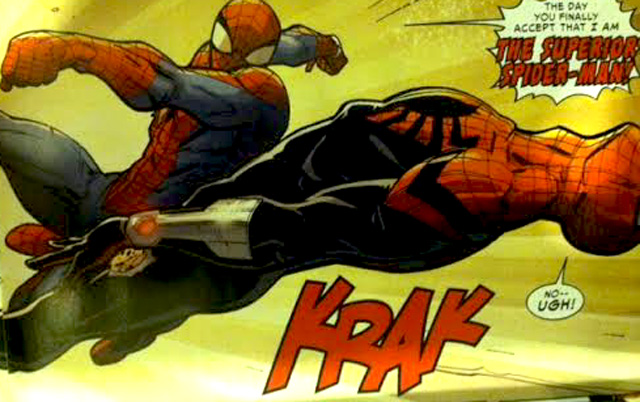 Dan Slott is an interesting guy — when he’s not trolling random women on Twitter or casting countless Peter Parker fans as racist rubes, he’s making the epilogue to his big Spider-Verse tale more exciting than the main story. In some weird way, the constraints imposed upon the writer by his epilogue — he had to wrap up countless loose ends and couldn’t engage in superfluous Spider-Ham jokes — forced him to put forth a tighter product. The result is, oddly enough, the most satisfying issue of The Amazing Spider-Man in months.
 Another bizarre instance occurs when Karn reveals that the nuclear wasteland the Inheritors have been imprisoned on “fortunately” has a bunker “teeming” with spiders. What are the chances? It’s almost like Master Weaver giving the heroes a scroll with “everything” they need to succeed, or Silk conveniently teleporting to the planet and finding the bunker to begin with. Dan Slott’s Peter Parker is big on the “no one dies” mantra, but he’s apparently okay with the “shut you in a bunker and force you to live on spiders for all eternity,” verdict as well. Under normal circumstances such a panel could be laughed off, but since the writer has invested so much in “no one dies” during his tenure, it should not be ignored.
 If you’ve purchased the rest of Spider-Verse and were thinking about skipping the epilogue, then you may want to reconsider. Dan Slott may have oversold the book when he promised “Big Things” (shocker, I know), but it’s still one of his better efforts in quite some time. If nothing else, Spider-Verse: Epilogue shows that Marvel might get tighter stories out of its scribe if it puts more constraints on him.








 Douglas Ernst Blog