Nick Lowe tries out Marvel’s ‘permission to leave’ business model

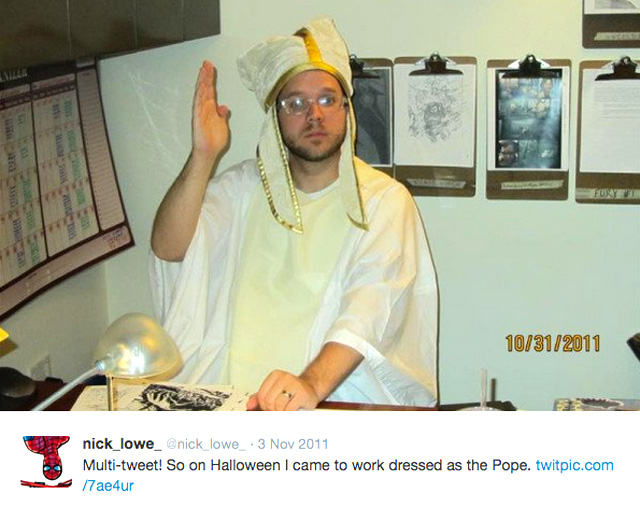
Nick Lowe Marvel EditorMarvel Senior Editor Nick Lowe is the type of guy who dresses up as the pope on Halloween because he’s scared to death of what would happen if he pranced around the office as an imam or Mohammed. Marvel Senior Editor Nick Lowe is the type of guy who dresses as the pope for Halloween because Dan Slott would probably not find it funny to see his editor mock Orthodox Jew rabbis on Halloween. Marvel Senior Editor Nick Lowe is also the kind of guy who needlessly burns bridges with loyal Marvel customers in the Letters to the Editor section of The Amazing Spider-Man.

It’s no secret that Marvel has run its Letters to the Editor section like something out of the Kim Jong-un School of Journalism for quite some time. Issue #17 of The Amazing Spider-Man continues that trend, although 1 out of 9 letters actually provides a critique of Dan Slott’s work.

Here is an excerpt from a letter sent in by Ryan Knight of New Port Richey, Florida:

Can you please offer your readers some kind of idea when Dan will be off the book? He’s written more Spider-Man than anyone with the exception of Stan Lee … and Brian Michael Bendis. I understand that his work is accessible for many casual readers with little to no frame of reference, but even many of his strongest supporters believed he should have left when Superior ended. …

I am sick of Marvel “Events” and so-called story arcs (look up the word story arc in the dictionary. You Marvel folks will see it’s different froma multi-part look at the Tablet Arc in Stan Lee’s run or the Jackal Arc in Conway’s if you want a clue.) screaming for attention, it just betrays how corrupt and lame some corners of the universe are. …

How often do we get one-issue stories? Two-parters? Character studies? Slice of life? Of yeah, Slott is a self-confessed plotter by nature. Howard Mackie’s run is downright readable in comparison to most of Slott’s work. History won’t remember the BND/Big Time/Superior/Relaunch era fondly at all.

Mr. Knight is not too happy with the current direction of the book. However, it’s obvious that he’s been reading Spider-Man for years. He’s a loyal Marvel customer. He has stuck through the book through thick and thin. Say what you want about the tone of his email, but he’s clearly sunk loads of cash into Marvel, and by extension Nick Lowe’s and Dan Slott’s bank accounts.

One would think that Mr. Lowe would be grateful for such customer loyalty and, even in the face of hard-nosed criticism, respond in a professional manner. Mr. I-dress-up-as-the-pope-because-I’m-scared-to-dress-up-as-Mohammed Lowe chose the “We don’t need you” route instead.

Nick Lowe responded:

Hi, Ryan. Sorry you don’t like Dan’s run, but you certainly seem to know it very well. If you’re a Gerry Conway fan, definitely pick up Amazing Spider-Man #16.1, on sale now. It’s the first part of a five-parter (sorry). Pains me that you’re so unhappy, so take this as permission to leave the book behind. I’m a big fan of Dan’s work and won’t be replacing him any time soon, providing we’re still publishing Spider-Man after Secret Wars.

In the mind of Nick Lowe, Marvel’s faux pope, it is a mortal sin to question the direction of The Amazing Spider-Man, even if you’re someone who has been religiously buying the book for decades. Question Dan “deus ex machina” Slott’s work, and you must be excommunicated from the Church of Marvel.

If you’re like me, then you long ago realized that Marvel decided on a business model that involves needlessly lashing out at paying customers. If you’re like me, then perhaps you’ve become much more discerning in which books you buy each month — if any — from the company.

The next time you see Nick Lowe at a Comic Con, ask him when he’s going to be Mohammed for Halloween, and then let him know what you think about Marvel’s “permission to leave” business model.

Hi, My name is Nick Lowe. I think it's a good idea to tell loyal Marvel customers to take a hike when they disagree with the direction of a book. I also dress up as the pope as a joke on Halloween because I know Catholics turn the other cheek. Dressing up as an imam or Mohammed as a joke would actually require me to display courage, so I won't do that.
Hi, My name is Nick Lowe. I think it’s a good idea to tell loyal Marvel customers to take a hike when they disagree with the direction of a book. I also dress up as the pope on Halloween because I know Catholics turn the other cheek. Dressing up as an imam or Mohammed as a joke would actually require me to display courage, so I won’t do that.

Bono channels G.K. Chesterton and C.S. Lewis to affirm his faith in Christ

Bono on JesusIt’s not often that a giant rock star gives an interview where he unflinchingly affirms his belief in Christ. That is exactly what U2’s Bono did during a March 2014 interview that is making the rounds again just in time for Easter. However, what is perhaps most interesting is how Bono appears to be well-versed in the writings of G.K. Chesterton and C.S. Lewis.

Here is what Bono said in his interview with RTE One’s Gay Byrne, which comes across at times like an FBI interrogation or a courtroom cross examination:

Bono: I think it’s a defining question for Christian. Who was Christ? I don’t think you’re let off easily by saying a great thinker or great philosopher because, actually, he went around saying he was the Messiah. That’s why he was crucified. He was crucified because he said he was the Son of God. So, he either, in my view, was the Son of God — or he was nuts. Forget rock-and-roll messianic complexes. This is, like, I mean Charlie Manson-type delirium. And I find it hard to accept that all the millions and millions of lives, half the Earth, for 2,000 years have been touched, have felt their lives touched and inspired by some nutter. I don’t believe it.

Byrne: So therefore it follows that you believe he was divine?

Bono: Yes.

Byrne: And therefore it follows that you believe that he rose physically from the dead?

Bono: Yes. I have no problem with miracles. I’m living around them. I am one.

Byrne: So when you pray, then you pray to Jesus?

Bono: Yes.

Byrne: The risen Jesus?

Bono: Yes.

Byrne: And you believe he made promises that will come true.

Bono: Yes. I do.

Friendly note to Bono: Your observation is actually more awe-inspiring than you originally thought because billions — not just millions — have been touched by the words of Christ. Regardless, here is what G.K. Chesterton said when “The Everlasting Man” was published in 1925:

“If Christ was simply a human character, he really was a highly complex and contradictory human character. For he combined exactly the two things that lie at the two extremes of human variation. He was exactly what the man with a delusion never is; he was wise; he was a good judge. What he said was always unexpected; but it was always unexpectedly magnanimous and often unexpectedly moderate.

Take a thing like the point of the parable of the tares and the wheat. It has the quality that united sanity and subtlety. It has not the simplicity of a madman. It has not even the simplicity of a fanatic. It might be uttered by a philosopher a hundred years old, at the end of a century of Utopias. Nothing could be less like this quality of seeing beyond and all round obvious things, than the condition of an egomaniac with the one sensitive spot in his brain. I really do not see how these two characters could be convincingly combined, except in the astonishing way in which the creed combines them.” — G.K. Chesterton.

Here is what C.S. Lewis said when “Mere Christianity” was published in 1952:

“Yet (and this is the strange, significant thing) even His enemies, when they read the Gospels, do not usually get the impression of silliness and conceit. Still less do unprejudiced readers. Christ says that He is “humble and meek” and we believe Him; not noticing that, if He were merely a man, humility and meekness are the very last characteristics we could attribute to some of His sayings.

I am trying here to prevent anyone saying the really foolish thing that people often say about Him: ‘I’m ready to accept Jesus as a great moral teacher, but I don’t accept His claim to be God.’ That is the one thing we must not say. A man who was merely a man and said the sort of things Jesus said would not be a great moral teacher. He would either be a lunatic — on the level of a man who says he is a poached egg — or else he would be the Devil of Hell. You must make your choice. Either this man was, and is the Son of God: or else a madman or something worse. You can shut Him up for a fool, you can spit at Him and kill Him as a demon; or you can fall at His feet and call Him Lord and God. But let us not come with any patronizing nonsense about His being a great human teacher. He has not left that open to us. He did not intend to.” — C.S. Lewis.

Chesterton and Lewis beautifully articulate the case before us: either Christ was who he said he was, or he was insane. But, as they both keenly observe, even his biggest detractors generally regard him as a profound thinker and a beacon of light whose example we should all follow.

Think of how many great men and women there were throughout all history, whose names are forgotten within weeks, months, or at most a few decades after they’ve passed away. Then consider Jesus, who for over 2,000 years has captivated the world and changed billions of lives — even those who don’t believe his claims. Like G.K. Chesterton, C.S. Lewis, a modern Irish rock star named Bono, and billions of other individuals throughout the course of history, I firmly believe he was exactly who he claimed to be.

Francis De Sales’ ‘Introduction to the Devout Life’: 1609’s must-read still amazing in 2015

Francis De Sales Intro Devout LifeIt is a rare occurrence to read a book and come to the conclusion that the writer’s initial inspiration was perfectly realized upon its completion. Saint Francis De Sales’ “Introduction to the Devout Life” may have been published in 1609, but its stunning insight into the human condition makes it a must-read in 2015. In another 400 years, it will still be leaving readers in awe.

While De Sales wrote for a Christian audience, the blueprint for a healthy civil society he presents is one that men and women of all faiths (or no faith) would be hard-pressed to criticize. The virtues he seeks to cultivate in his readers may be motivated by a desire to instill a love of God in  as many hearts as possible, but at the end of the day he is still talking about honesty, humility, patience, charity, fortitude, prudence, etc.

Even more impressive is how De Sales addresses the reader (“Philothea”) directly, yet with a delivery that feels like a kind and gentle father imparting time-tested wisdom to a child. De Sales (who must have consulted countless men and women from all walks of life) has such an exquisite grasp of humanity’s trials and tribulations that it is hard not to feel as though he already knows everything about you — yet still offers unconditional love.

De Sale somehow manages to write for the YouTube-Instagram-Facebook culture of 2015 while living in 1609:

“We apply the term vainglory to whatever we assign to ourselves, whether something that is not actually in us or something in us but not of us, or something in us and of us but not such that we can glory in it. Noble ancestry, patronage of great men, and popular honor are things that are not in us but either in our ancestors or in the esteem of other men. Some men become proud and overbearing because they ride a fine horse, wear a feather in their hat, or are dressed in a splendid suit of clothes. Is anyone blind to the folly of all this? If there is any glory in such things it belongs to the horse, the bird, and the tailor. It is a mean heart that borrows honor from a horse, a bird, a feather, or some passing fashion.

Others value and pride themselves because of a fine mustache, well-trimmed beard, carefully curled hair, soft hands, ability to dance, play cards well, or sing. Such light-minded men seek to increase their reputation by frivolous things. Others would like to be honored and respected by men because of a little learning, as if everyone should go to school to them and take them as their teachers. They are called pedants for this reason.

Other men have handsome bodies and therefore strut about and think that everybody dotes on them. All this is extremely vain, objectionable, and foolish and the glory based on such weak foundations is called vain, foolish, and frivolous.

We recognize genuine goodness as we do genuine balm. If balm sinks down and stays at the bottom when dropped into water, it is rated the best and most valuable. So also in order to know whether a man is truly wise, learned, generous, and noble, we must observe whether his abilities tend to humility, modesty, and obedience for in that case they will be truly good. If they float on the surface and seek to show themselves, they are so much less genuine in so far as they are more showy. Pearls conceived and nourished by wind or thunder claps are mere crusts, devoid of substance. So also men’s virtues and fine qualities conceived and nurtured by pride, show, and vanity have the mere appearance of good, without juice, marrow, solidity.” Francis De Sales, Introduction to the Devout Life (New York: Image, 2014), 121–122

The depth and breadth of De Sales’ understanding of humanity is a marvel to behold. If for no other reason, “Introduction to the Devout Life” shines a giant spotlight on just how far we’ve fallen as a culture. The book was written for the likes of carpenters, soldiers, sailors, and tailors — not academics — and yet the man on the street in 2015 would likely have a hard time digesting much of De Sales’ intellectual discourse.

If you have ever sat alone in your bed at night and tried to plumb the depths of your soul to root out what is rotten and realize what is wholly good, then I cannot recommend Francis De Sales’ “Introduction to the Devout Life” enough. If it is read with an open mind and seriously meditated upon, then I have no doubt that it will truly change your life for the better.

Joe Quesada, giant hypocrite, plays dumb when confronted on other comic industry hypocrites

Joe Quesada, Chief Creative Officer of Marvel Entertainment, took to Tumblr on Friday night to bemoan the way comic industry “professionals” are treated by fans. He played the world’s smallest violin for people like Steve Wacker, Dan Slott, Mark Waid, Erik Larsen, Gail Simone and countless others who say incredibly nasty things via their social media accounts. When confronted about his silence on the despicable behavior of his buddies, he chose to play dumb.

Here is what Mr. Quesada said Friday:

“It has never ceased to amaze me how some people, in defense of their favorite fictional characters or stories, treat creators and each other, flesh and blood people living actual lives with actual feelings and families, with such disrespect and cruelty as though they were two-dimensional, fictional villains who merely exist on a page or the imagination.”

A fan then called him out on the laughable attempt to play the victim.

Joe Quesada Tumblr

Joe Quesada’s response: What you talkin’ about Willis?

I don’t know what inexcusable behavior you’re referring to, but I know that they all love this medium and the fans as well. I see them at conventions and online, they’re giving of their time, funny, even cheeky at times, even when provoked in horrible ways. But, I’ve never known them to behave inexcusably.

Let’s take a trip down memory lane just for Joe, shall we?

There was that time Dan Slott stalked and upset a random woman on Twitter.

Dan Slott stalks girl Twitter

And then there was that time when Dan Slott told Hobby Lobby supporters to go to “Christ-Land.”

Dan Slott Christians

Note: I’m pretty sure that if a group of mostly Jewish individuals won a court case and I told them to go to “Jew-Land,” Dan Slott would find that rather repugnant. The same goes for a request to go to “Muslim-Land” to a group of Muslims. But hey, Mr. Quesada has “never known” Dan Slott to behave inexcusably.

Moving on, we have Erik Larsen last year letting all his Christian fans know just what he thinks of their faith by posting an Easter bunny ejecting bloody eggs out of its butt, which then hatched different versions of Jesus. But again, Mr. Quesada has “never” known comic book industry “professionals” to behave inexcusably.

Erik Larson retweet

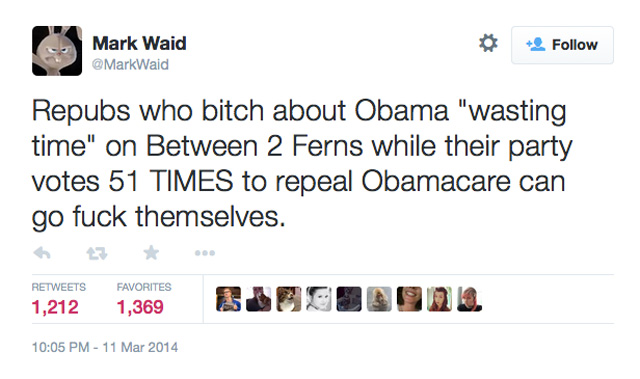
What about if you’re a conservative comic book fan? How do writers and artists comport themselves online, then? Since Mr. Quesada has “never” known creators to behave inexcusably, let’s see a snapshot of Mark Waid’s online behavior. Ah yes, he wants Republicans to go “f**k themselves.” How quaint.

Mark Waid

Speaking of conservatives, how many conservatives work with Joe Quesada? I know he likes to talk about diversity, but I seem to have trouble finding one comic book writer employed at Marvel who is openly conservative. I guess ideological diversity doesn’t count.

I can go on and on, but since Mr. Quesada struggled to find comic book industry “professionals” acting inexcusably I’ll even add in an example from Gail Simone. Apparently it’s okay to start resorting to personal attacks against combat veterans if they disagree with Ms.Simone’s politics.

Gail Simone

If I called Ms. Simone a “walnut-brained woolly mammoth” over a disagreement on politics or comics, I suppose Mr. Quesada would lecture me on how I need to treat her like “flesh and blood” with “actual feelings.” We all know that he won’t give that lecture to Ms. Simone, though — he agrees with her politics.

Here’s the bottom line: At Marvel, tolerance, tact and understanding are all part of a one-way street.

If you agree with them on politics or the creative direction of their books, then they’ll laugh and giggle and chortle along with you all day long. If you happen to think that young women who work the late shift at a hospital should be able to carry a handgun, then things start to change. If you think having Peter Parker make a deal with the devil goes against everything the character stands for, then it’s a different story. Steve Wacker and Dan Slott and Tom Brevoort and the whole Marvel crew can make smarmy, condescending cracks in your direction all day long, but if you’re a smart guy who has a few intellectual nuclear warheads in your back pocket, then suddenly you need to be concerned about “feelings” and “families.”

Joe Quesada is the guy who burns bridges and then berates fans for not making those bridges out of stronger material in the first place. Joe Quesada is the guy who eggs on his buddies to act like bullies, and then when fans give them a verbal beat-down he gives lectures on inflammatory rhetoric. The brown-nosing comic book and entertainment “journalists” who will do anything to cozy up to a few Marvel writers and artists may not call out inappropriate behavior, but bloggers will.

Keep playing dumb, Mr. Quesada. Keep going with the Arnold Jackson “What you talkin’ about Willis?” strategy. This isn’t 1990. The digital trail doesn’t go cold very quickly, and bloggers are always ready to chronicle your hypocrisy. If you want to know why you’re not treated with respect by countless fans — or why the comic book industry is a shadow of its former self — all you have to do is look in the mirror.

Related: Check out Colossus of Rhodey’s take on Joe Quesada’s hypocrisy.

Dan Slott: I write Peter Parker like a blockhead because Charlie Brown never kicked the football

Dan Slott LucyMarvel’s “Renew Your Vows” is just around the corner, which means Dan Slott has been making the rounds to preemptively defend the weird editorial mandates Marvel will soon shove down readers’ throats. Think of it like the “medicine” Tom Brevoort is fond of telling fans they need.

Flashback: “The medicine may not taste good, but if it makes you feel better, then you need to take it.”

Tom Brevoort Twitter OMDIn its lead-up to questions with The Amazing Spider-Man writer Dan Slott, here’s what Entertainment Weekly said March 16 about Marvel’s past attempts to administer fans their “medicine.”

While there isn’t much of a way to objectively measure these things, the dissolution of the Spider-marriage in 2007’s One More Day is easily one of the most widely disparaged story decisions for the character in recent memory. (The “death” of Peter Parker leading up to Superior Spider-Man may have come close, but a lot of people have come around on that front. Not nearly as many have said, “Hey, the Parkers selling their marriage to the devil to save Aunt May was actually great.”)

Entertainment Weekly writer Joshua Rivera (perhaps best known for not understanding why self-censorship is a bad thing for the industry), gently alluded to the possibility that Marvel would once again screw things up with “Renew Your Vows.” Dan Slott’s reaction: talk about Charles M. Schulz denying Charlie Brown the opportunity to kick the football out of Lucy’s hands.

Mr. Slott said:

“With any story where you give people what they want—there’s a difference, as a storyteller, between what your readers want and what your readers need. In a good Peanuts story, you want Charlie Brown to kick that football. But if Charlie Brown kicks the football, it’s over!” says Slott. “All the best stories in serialized fiction–it’s always about teasing the greatest wishes and wants, but monkey-pawing it. Always giving you what you want, but not the way you want it.”

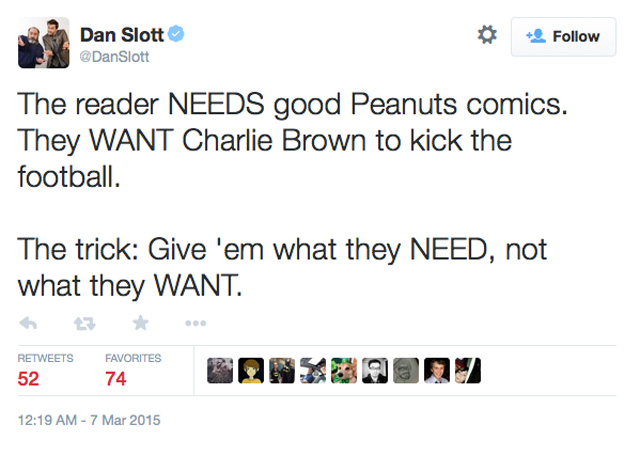
The Marvel writer was so proud of his false analogy that he even started using it on Twitter:

Dan Slott Charlie BrownHow bizarre is it that Dan Slott willingly casts himself as the comic industry’s Lucy Van Pelt and then wonders why fans often want to verbally kick him around like a football? Regardless, like Mr. Brevoort’s “medicine” comment, the hubris of the modern comic book creator is on full display. Tom Brevoort knows what medicine you “need” to take. Dan Slott knows what you “need” — and it’s not what you want.

Dan Slott Charlie Brown footballDan Slott seems to really believe he is comparing apples to apples when he compares a static character who never ages with one who is much more dynamic. In one instance there is Charlie Brown — the sole property of Charles M. Schulz — who is inspired by the artist’s childhood. In the other instance there is Peter Parker, a character who was created by Stan Lee and Steve Ditko, but in no way meant to be trapped in his own hell-ish editorial version of Groundhog Day.

Why is it “over” if Charlie Brown kicks the ball? It’s not. It’s only over if your point all along was to convey some strange message about how women are duplicitous jerks who send good men reeling when they are trusted.

Is Dan Slott saying that Peter Parker’s “Lucy and the football” situation is marriage to a strong woman like MJ? What does Dan Slott have against writing a married version of Peter Parker? Just as it’s totally legitimate to ask what the heck Charles M. Shulz was thinking by never allowing Charlie Brown to kick the football, it is also quite valid to wonder why so many writers and editors at Marvel are uncomfortable with a marriage between Peter and MJ.

If Dan Slott really believes that his job as a writer is to be the best “monkey-pawer” in the business — and I have no reason to doubt that he is sincere when he makes that case — then it should be abundantly clear why the relaunch of The Amazing Spider-Man has been an embarrassment in terms of Peter Parker’s characterization.

Dan Slott is great at telling naked Spider-Ham jokes and he is great at treating Peter Parker like Charlie Brown trying to kick at the old pigskin, but he is not great at characterization. If you plan on buying “Renew Your Vows,” then you should take the writer at his word when he says that his job is not to give the fans what they want.

‘The Great Degeneration’: Niall Ferguson explains how America is engineering its own demise

The Great DegenerationWith ‘Civilization: The West and the Rest,’ Niall Ferguson described the “killer apps” that Western civilization used to propel itself past its rivals. With ‘The Great Degeneration: How Institutions Decay and Economies Die,’ he shows readers how quickly the wheels can come off the bus and send all of civil society’s passengers over a cliff.

While Mr. Ferguson’s analysis does not exclusively focus on the U.S., by the time he’s done unsealing the “boxes” of democracy, capitalism, the rule of law, and civil society, it is obvious that America is very, very sick — perhaps terminally ill — and that short of a miracle our experiment in self governance will not end well.

As Mr. Ferguson states:

“Where bad institutions pertain, people get stuck in vicious circles of ignorance, ill health, poverty, and, often, violence. Unfortunately, history suggests that there are more of these suboptimal frameworks than there are optimal frameworks. A really good set of institutions is hard to achieve. Bad institutions, by contrast, are easy to get stuck in. And this is why most countries have been poor for most of history, as well as illiterate, unhealthy and bloody.” Niall Ferguson, The Great Degeneration: How Institutions Decay and Economies Die (New York: Penguin, 2012), 18.

When the author speaks of the rule of law turning into the rule of lawyers, it’s hard not to think of what America has become. When the author talks about a “corrupt and monopolistic elite” exploiting the system of law and administration to their own advantage, it’s hard not to think of what America has become. When the author talks about public debt being managed to allow the current generation of voters to “live at the expense of those as yet too young to vote or as yet unborn,” it’s hard not to think of what America has become.

Over and over again, ‘The Great Degeneration’ shows that we as a society are creating complex systems that are destined to fail. What makes the story all the more tragic is that it’s all quite predictable.

As Tocqueville said in 1835 with the publication of ‘Democracy in America’:

I see an innumerable crowd of like and equal men who revolve on themselves without repose, procuring the small and vulgar pleasures with which they fill their souls. Each of them, withdrawn and apart, is like a stranger to the destiny of all the other: his children and his particular friends form the whole human species for him; as for dwelling with his fellow citizens, he is beside them, but he does not see them; he touches them and does not feel them; he exists only in himself and for himself alone. …

Above these an immense tutelary power is elevated, which alone takes charge of assuring their enjoyments and watching over their fate. It is absolute, detailed, regular, far-seeing, and mild. It would resemble paternal power if, like that, it had for its object to prepare men for manhood; but on the contrary, it seeks only to keep them fixed irrevocably in childhood. …

Regular readers of this blog know that a shift in tone began to occur roughly three years ago. That is because I share many of the author’s conclusions about modern-day America and western civilization. Our culture is sick, but it is only willing to talk about its symptoms instead of the disease. The institutions have been compromised, and until they are fixed our slide into irrelevance will continue.

‘The Great Degeneration’ is a rather quick read at 153 pages. If you get a chance, pick it up at your local book store. If for no other reason, it is fascinating to think about some of the events that have occurred since its publication; Mr. Ferguson’s knowledge of the past helps him to accurately predict the future. You’ll give him a round of applause for the effort — after you wipe a few tears from your eyes.

‘Angels in My Hair’: Lorna Byrne’s gentle touch creates solid stepping stone to spirituality

Angels in My HairLorna Byrne’s 2008 book ‘Angels in My Hair’ is a bestseller. Her memoir covers the trials and tribulations she experienced while growing up with the ability to see angels — but not talk about it with anyone. Her own family thought she had mental problems. She was warned that there was a possibility they would send her to a mental institution. She was given foreknowledge of painful events that would happen later in life (e.g., the early death of her husband), but was sworn to secrecy. Finally, at a much later stage in her life, she was told to write her book so that people would know one simple message: We are never alone.

Ms. Byrne’s book has plenty of detractors — atheists, agnostics, Christians of various denominations, and individuals from other religious faiths. That is understandable, given the nature of her claims. As a Catholic, I certainly have qualms with topics that were left out of the book, but many of her editorial decisions make sense when one considers Ireland’s violent history between Protestants and Catholics.

‘Angels in My Hair’ is a great book for anyone who has ever wondered if angels exists. It’s also a worthwhile read for those who identify as a devout [insert religious denomination here], provided he or she accepts from the beginning that Ms. Byrne is writing exclusively on angels — not the Bible.

Before I go on, perhaps the best way to sum up how I feel about Ms. Byrne’s book is to first share a quick story from my own life.

When I was a young child I had a snowball fight with a bunch of kids. Half of us were on one side of the street, and half of us were on the other. We were running around having a good time, and at a certain point I picked up a snowball and charged towards the road with tunnel vision on my target. Suddenly I felt a force, as if someone had grabbed me by the shoulders and planted my feet into the ground. I was brought to an abrupt stop. A car slammed on its breaks and skidded to a halt right where I had been running. Even as a young child — with no formal religious education — I knew that I should have been hit by that car. I knew that I should have been injured or possibly dead. I knew that something intervened on my behalf. I had no knowledge of guardian angels at that time, but I remember being completely in awe of whatever force made itself known to me in that moment.

I tell this story because I have no reason to lie to my readers. I am not insane. I am not schizophrenic. I am not on some secret Vatican payroll to deceive people. I do not do drugs. I rarely drink. I am a law-abiding citizen who tries to do what is morally right. I also acknowledge that I am an incredibly flawed individual. Likewise, countless others like me — perhaps including individuals in your life who have never given you a reason to trust their integrity or mental health — have experienced something supernatural. Why should those individuals be treated as hostile witnesses? Answer: They shouldn’t.

Ms. Byrne says:

“We have become a very materialistic society, and so frequently we look at death and ask, ‘Is this it? I rot away and there is nothing more?’ I assure you there is more — much more. I hope that through the books I write I can communicate this and help people to understand. Believe what I say. Believe that, yes, there is more, much more, even though I may not be able to prove it or show it to you now; it is proven to everyone when they die. Some people feel that then it’s too late — if they have to wait to die to see the proof. People are given proofs while they are alive, but sometimes they have to look or listen very hard to recognize them.” Lorna Byrne, Angels in My Hair (New York: Random House, 2008), 174.

It is healthy to be skeptical. We should always read with a discerning eye. However, it is also healthy to have an open heart. The search for truth requires ample doses of each, even if it seems paradoxical. I believe that if you read ‘Angels in My Hair’ with that balancing act in mind, then you will see that there is much truth to what Ms. Byrne says.

You do not have to be a superman or superwoman. You do not have to bear all of life’s burdens as if you were Atlas holding up the globe. You do not have to create a tough-talk exterior shell to protect you from the opinions of others and you do not need to have all the answers. That is because you are not alone. In your darkest hours there is always someone by your side. Ask your angels to give you strength, and you will be surprised at what they bring you from the depths of your soul.

‘A nice place to visit’: Will technology make classic Twilight Zone episode a reality?

The Twilight Zone A Nice Place to VisitWhat if you could live for hundreds of years? What if you could have anything your heart desired? Would it be like experiencing a taste of heaven — or hell? Google Ventures’ efforts to find the fountain of youth and emerging technology like self-driving cars makes one wonder: Is it possible that future advances in technology will create our own little version of The Twilight Zone’s “A Nice Place to Visit”?

I recently finished Tony Robbins’ “Money: Master the Game.” In it, he briefly mentions a classic 1960 episode of The Twilight Zone where small-time crook “Rocky” Valentine dies and finds himself in a place where all his wishes are granted. If he wanted his favorite entertainment, it was there. If he wanted to go home with three girls, then they were willing. Anything he wanted was given to him. It wasn’t long before the situation began to drive him mad, and when he confronted his “guardian” about how he wasn’t a good fit with heaven, “Pip” informed him that he was actually in hell.

“A scared, angry little man who never got a break. Now he has everything he’s ever wanted and he’s going to have to live with it for eternity — in the Twilight Zone,” the narrator says as the episode ends.

Mr. Robbins’ point was that money is just a means to an end — it isn’t an end in itself. Material things do not bring true happiness, and until we learn that we are setting ourselves up for failure. Likewise, future technology will continue to raise the standard of living for billions of people — but what good will physical comforts be if it fosters a mental and spiritual wasteland?

A Nice Place to Visit Twilight ZoneSt. John Bosco once said:

“The principal trap that the Devil sets for young people is idleness. This is a fatal source of all evil. Do not let there be any doubt in your mind that we are born to work, and when we don’t, we’re out of our element and in great danger of offending God. … First tell the Devil to rest, and then I’ll rest, too.”

New technology can be a great force for good, but it’s not hard to see how a society focused on receiving rather than giving could easily churn out generation after generation of depressed and misanthropic drones.

A Nice Place To VisitEnjoy your future self-driving car. Take advantage of replacement kidneys and hearts and lungs that allow you to live until 115. Have fun playing video games in 2030 that will be unlike anything we’re capable of imagining today. Do all of that, but keep in mind that the man who only lives for the next gizmo or gadget will never have enough. He will never be filled and as a result he can never be truly happy. In some sense, he will be living in a Twilight Zone episode of his own making.

‘Money: Master the Game’: Tony Robbins gives readers a sound blueprint for financial freedom

Money Master The Game Tony RobbinsWhenever I tell people that I’m a big fan of Tony Robbins, I get one of two reactions: Either the person I’m talking to agrees and a big smile comes to his face, or he squints his eyes and then says something about how Mr. Robbins must be a fake. Usually the people who find him suspect have never really listened to his presentations — perhaps they saw short clips of him firing up a crowd with his perpetual energetic delivery, or a brief appearance on the “Today” show — but little else. After reading “Money: Master the Game,” a monster at 616 pages, I will once again reiterate to anyone who will listen: Tony Robbins is the real deal.

There is really no way to break down the blueprint for financial freedom in a single blog post, and to try and do so would only do the book an injustice. However, my feelings on whether you should plunk down $28 for the book (probably $15 or less online) can be summed up from the following passage:

I was working as a janitor, and I needed extra money. A man my parents knew, and whom my father had called a “loser,” had become quite successful in a short period of time, at least in financial terms. He was buying, fixing, and flipping real estate in Southern California and needed a kid on the weekend to help him move furniture. That chance encounter, that fateful weekend of working my tail off, led to an opening that would change my life forever. His name was Jim Hannah. He took notice of my hustle and drive. When I had a moment, I asked, him, How did you turn your life around? How did you become successful?”

“I did it,” he said, “by going to a seminar by a man named Jim Rohn.”

“What’s a seminar?” I asked. “It a place where a man takes ten or twenty years of his life and all he’s learned and he condenses it  into a few hours so that you can compress years of learning into days,” he answered.Wow, that sounded pretty awesome. “How much does it cost?” “Thirty five dollars,” he told me. What!? I was making $40 a week as a part-time janitor while going to high school. “Can you get me in?” I asked. “Sure!” he said. “But I won’t — because you wouldn’t value it if you didn’t pay for it.” I stood there, disheartened.  “How could I ever afford $35 for three hours with this expert? “Well, if you don’t think you’re worth the investment, don’t make it,” he finally shrugged. I struggled and struggled with that one — but ultimately decided to go for it. It turned out to be one of the most important investments of my life. I took a week’s pay and went to a seminar where I met Jim Rohn — the man who became my life’s first mentor. — Tony Robbins, Money: Master The Plan (New York: Simon & Schuster, 2014), 260–261

Is your financial freedom worth at least $30? If so, and if you are generally in the dark about how to properly save and invest for your retirement, then you should read “Money: Master the Game.” The information inside it can literally translate into hundreds of thousands of dollars (perhaps millions?) during the course of your life. It can be the difference between having to take a job as the Walmart greeter when you’re 70 years old, and sipping drinks on a beach in Florida.

I do not say this lightly: I am extremely grateful to Mr. Robbins for writing this book. It came around at a time in my life when I had to finally start getting serious about planning my family’s retirement, and before I was even half-way through with the book I was taking advantage of the knowledge imparted within. After finally getting my financial affairs in order I circled back with two close friends who are excellent with money, and they said I made the right moves.

If you’ve ever felt like money controls you — and you’d like to be the one controlling money — then I can’t suggest Mr. Robbins’ book enough. He (and some of the most brilliant financial minds alive) give advice that is essential to securing financial freedom. I do have a few issues with the book (which I’m happy to expand upon in the comments section), but in general it’s a fabulous tool to have at your disposal.

Buy “Money: Master the Game” today and we’ll talk about it on a beach in Florida in 25 years.

Michelle Rodriguez calls out Hollywood on lazy diversity shortcuts, apologizes to online babies

Michelle Rodriguez Machete Kills

You can get yourself in trouble by telling the truth in Hollywood. Just ask Michelle Rodriguez of “Fast and Furious” and “Machete” fame. Early Saturday morning she was asked by TMZ if she was going to play the Green Lantern, and her response prompted enough backlash by oversensitive online babies that she apologized on Facebook hours later.

TMZ: Michelle, are you going to be the Green Lantern?

Michelle Rodriguez: **Laughing ** That’s the dumbest thing I’ve ever heard.

TMZ: Really?

Michelle Rodriguez: Yeah. I think it’s so stupid for like everybody because of this whole  minorities in Hollywood thing…

TMZ: Well, it’s been all over the internet.

Michelle Rodriguez: But it’s so stupid, it’s like, ‘Stop stealing all the white people’s superheroes. Make up your own. You know what I’m saying? What’s up with that?”

Comic book fans are still laughing at how Marvel writer Dan Slott slimed them as racist for having a similar opinion over arbitrarily changing Peter Parker’s race. How long will it be before Mr. Slott starts lecturing Ms. Rodriguez on the importance of turning Guy Gardner into “Lady Gardner,” or John Stewart into “Jane Stewart,” or Kyle Rayner into “Kylie Rayner”?

M Rodriguez
Can you read Michelle Rodriguez’s mind? It says: “I can’t believe I have to apologize to these oversensitive babies for telling the truth.” Since the ‘Fast and Furious’ star is wearing a Nirvana shirt, perhaps it will inspire a screenwriter to pen a tale where Kurt Cobain was born Katy Cobain.

The kind of people who couldn’t sleep at night until a Ghostbusters reboot with an all-female cast was announced obviously started hounding Ms. Rodriguez’s social media accounts because hours later she was posting a sleepy-eyed apology to her Facebook page:

Hey guys, I want to clarify about my comment yesterday. I stuck my foot in my mouth once again. I said that people should stop trying to steal white people’s superheroes. I guess it got taken out of context because a lot of people got offended or whatever. I have a tendency to, you know, speak without a filter — sorry about that. What I really meant was that ultimately at the end of the day there’s a language and the language that you speak in Hollywood is ‘successful franchise.’

I think that there are many cultures in Hollywood that are not white that can come up with their own mythologies. We all get it from the same reservoir of life, the fountain of life. It doesn’t matter what culture you come from. I’m just saying that instead of trying to turn a girl character into a guy — or instead of trying to turn a white character into a black character or latin character I think that people should stop being lazy. People should actually make an effort in Hollywood to develop their own mythology. It’s time to stop. Stop trying to take what’s already there and try to fit a culture into it. I think that it’s time for us to write our own mythology and our own story. Every culture. That’s what I really meant, and I’m sorry if it came off rude or stupid. That’s not what I meant. So, cheers.

When Ms. Rodriguez apologizes for speaking without a filter, what she really means is “I’m sorry for telling the truth.” She laughs at the thought of playing Green Lantern because she knows that she has the creative and intellectual chops to play a new hero — one who will etch out her own special place in American culture — instead of some Green Lantern derivative that is created to appease online diversity activists.

What is more respectable: Michelle Rodriguez playing “Letty Ortiz” in the “Fast and Furious” franchise, or Michelle Rodriguez playing a female Green Lantern knockoff because Warner Bros. dropped the ball with its 2011 attempt? While it is sad that someone like Michelle Rodriguez must apologize to online babies for speaking the truth, it is refreshing to see an artist in Hollywood whose unfiltered self values originality over uninspired diversity.

Michelle Rodriguez FF6