Invincible Iron Man #8: ‘Ninjas and robots and Rhodey…oh my!’

IronMan8

Say what you want about Brian Michael Bendis, but the man’s self-awareness is better than 95 percent of the rest of the writers employed by Marvel. When he knows a particular story is open to criticism, he tends to find ways to subtly acknowledge the problem within the issue as a way of disarming bloggers like yours truly.

Take, for example, Invincible Iron Man #8, which is bursting at the seams with all it’s trying to accomplish. It is busy, busy, busy — but at one point Spider-Man says of the situation, “Ninjas and robots and Rhodey in his embarrassing boxers, oh my!”

Touché, Mr. Bendis. Touché.

For those who have not been reading the story, it goes as follows: Tony Stark offered a job to Mary Jane, Rhodey disappeared in Japan trying to find bio-hacking ninjas, and Spider-Man was called to help find him.

IIM #8, again, is a very busy issue. Mary Jane appears to walk away from Stark’s job offer (we know that won’t last), Iron Man and Spider-Man look for Rhodey, and it all culminates in a battle involving a horde of ninjas and a gigantic Iron-Man-inspired suit that utilizes mysterious technology.

Question: Is it a good issue?

Answer: Yes — with one minor caveat.

The problem with writers who take on Tony Stark and Peter Parker is that sometimes they use the sarcasm button too many times in a single issue. Yes, both men are masters at the one-liner. Yes, both men use sarcasm to mask all sorts of fears and insecurities, but it is possible to overdo it. Using such a trait when it’s uncalled for makes a character come across as a jerk. Luckily for Bendis, he realizes that one way to add extra gravity to the book is to find a situation so dangerous that it finally shuts Tony up.

IronMan8 Tony

Whoever this new villain is, he or she found a way to leave Tony speechless by the last page. It was a welcome surprise after countless panels of Iron Man, Spider-Man, and Rhodey all basically blowing off what appeared to be a serious opponent.

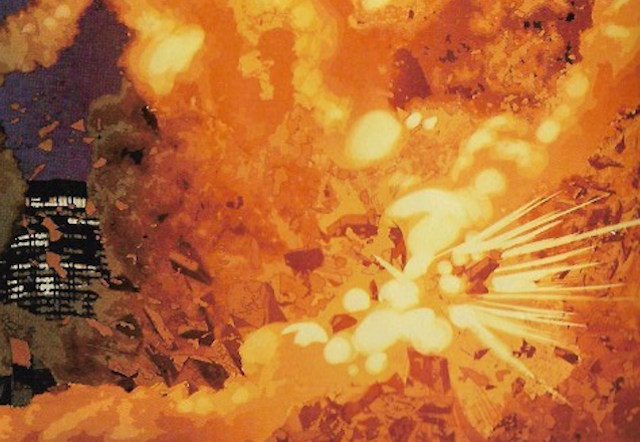
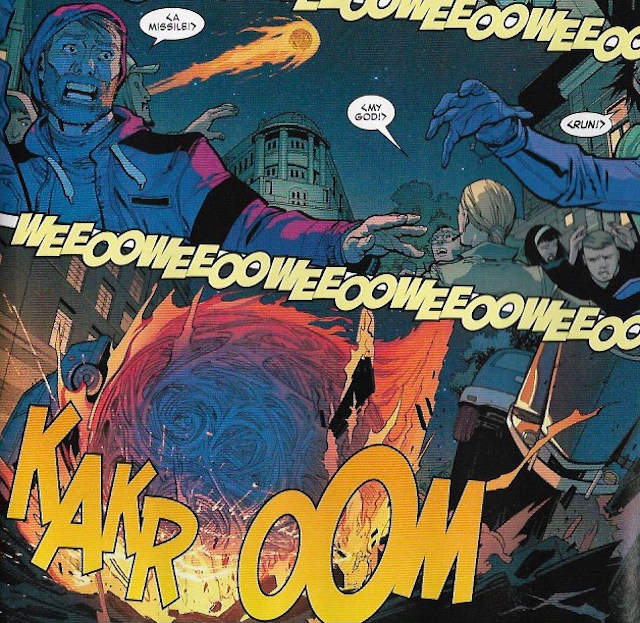
In many ways IIM #8 was going to succeed or fail based upon what happened on the final page, and it is safe to say that Bendis … detonated it.

IM8 explosion

Invincible Iron Man continues to be one of Marvel’s most carefully crafted books. If you want stories by a “writer’s writer,” then you should check out Bendis. If you want “nuke the fridge” moments reminiscent of Indiana Jones and the Kingdom of the Crystal Skull, then I suggest checking out Dan Slott’s run on The Amazing Spider-Man.

Bendis Bonus:

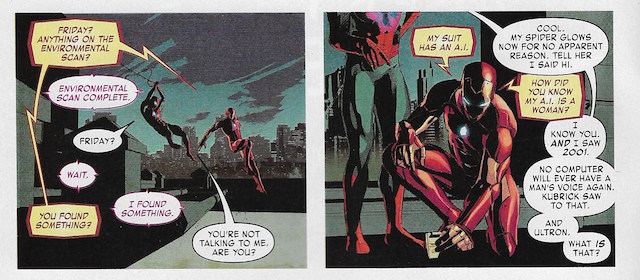
If you’re like me, then you were glad to see that Bendis seems to feel the same way about Spider-Man’s stupid glowing spider on the new suit. In response to finding out that Iron Man’s suit has A.I., Spider-Man says, “Cool. My spider glows now for no apparent reason.”

Zing!

IronMan SpiderMan


Charles Soule’s Daredevil: ‘The man without fear’ done right

Daredevil 5

Marvel is a strange company. On any given week readers might find themselves subjected to something as cringeworthy as The Amazing Spider-Man 1.4, or as spectacular as writer Charles Soule’s Daredevil. Your friendly neighborhood blogger is late to Soule’s ballgame, but it appears as though he and artist Ron Garney are in the middle of something truly special.

Blindspot

For those who haven’t purchased issues 1-4 of Daredevil, the story goes something like this:

  • Matt Murdock is now a New York City prosecutor (it’s about time!).
  • A Chinese illegal immigrant named Samuel Chung has become Daredevil’s protege.
  • A criminal named Tenfingers split from The Hand, stole some mystical power on his way out the door, and started his own cult.
  • The Hand sent a zombie-like being known as The Fist to exact revenge.
  • Tenfingers orders the assassination of everyone inside his church because they are witnesses to his failure. He cannot be seen as a savior if there is evidence of a setback.
  • Chung’s mom works for Tenfingers.

DD Blindspot

I haven’t followed Daredevil in years, but it appears as though the last time the book looked this cool — coupled with solid writing — was the 1980s. I tried to get into Daredevil on and off over the years, but this is the first time the title appears to have that “pop” that the defender of Hell’s Kitchen deserves.

If Mr. Soule doesn’t get too weirdly political with Chung’s immigration status, then I can certainly envision myself investing in this title for the long haul. Well done, Messrs. Soule and Garney.

Molina’s Spider-Atheist: God ‘a lie’ because Uncle Ben died

ASM Peter

Peter Parker’s origin has been told numerous times over the course of decades, but one thing that has remained consistent is that he primarily blames himself for Uncle Ben’s death. Writer Jose Molina, however, used the publication of The Amazing Spider-Man 1.4 to give Peter an easy way to avoid responsibility for his behavior on that day. Who does Peter blame for his uncle’s death? Answer: Jesus.

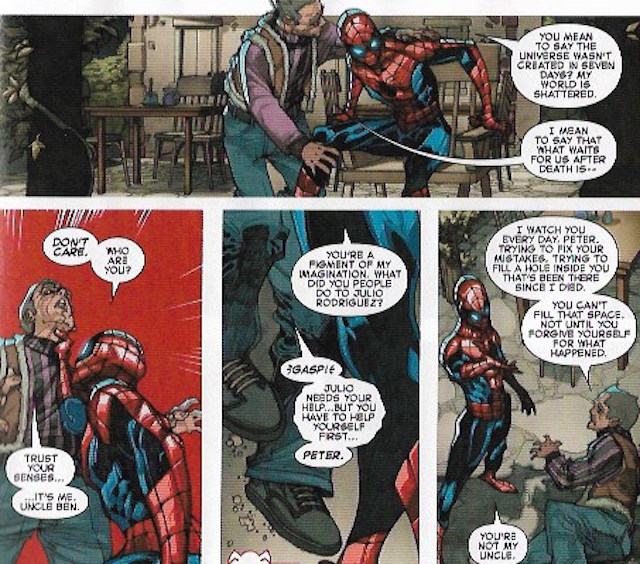
Yes, that’s right, Molina’s Amazing Spider-Atheist had his beliefs solidified on the day he infamously told a cop that looking after “number one” was all that mattered — right before the fugitive he let escape killed his uncle. It was all God’s fault, which is why years later the character is obsessed with proving that Julio Rodriguez did not return from the dead and miracles are all lies. (Note: At no point in this story does Peter bother to think about that time he died and came back to life…or the times he interacted with dead loved ones.)

SpiderMan fugitive

Sadly, this tale requires Anna Maria Marconi to be the voice of reason by mentioning that man’s purpose in time is, as Whittaker Chambers put it, not God’s purpose in eternity.

It seems safe to say that God would not be God if his totality were transparent to self-centered teenagers and cocksure adults, but that never dawns on Molina’s Peter Parker; acting out of character can do that to a superhero.

ASM AnnaPete

Perhaps the only bright spot in this story is that it will soon be over. Spider-Man goes full-Batman, dangles Julio’s murderer over a balcony, and finds out that dying was always Rodriguez’s intention. He apparently needed to sacrifice himself — just as he had to sacrifice his father in the previous issue.

Spider-Man finally tracks Julio down and he admits that his resurrection was all part of a plan to restore faith in mankind. The two are separated when a police helicopter unleashes a hail of bullets, and the next time readers see Julio he is in church allegedly talking with Jesus. This “Jesus” (we’ll just assume Julio has been possessed by a demon and give Molina the benefit of the doubt) promises that superheroes will come to Rodriguez like “lambs to the slaughter.”

ASM Julio

The final page of ASM 1.4 asks, “You want to know what happens next? Don’t miss The Amazing Spider-Man 1.5.”

Well, yes, I do want to know what happens next, but for all the wrong reasons.

  • Will Suddenly Spider-Atheist be vindicated?
  • Will Jesus be a new Marvel villain? (I wouldn’t put it past Marvel these days.)
  • Will Julio actually be possessed by a demon, or will he be a cyborg that will allow Spider-Atheist to rest easy at night?

Julio Rodriguez may have returned from the grave in this story, but copies of this book certainly deserve to be buried six-feet under.

RELATED: Dan Slott uses terror attack to mock Christians, play partisan politics

G.K. Chesterton’s ‘Everlasting Man’ — perfect Easter reading

Easter is here — that wonderful day when Christians rejoice and atheists shake their head and ask, “Why the heck are we still talking about that guy Jesus after 2,000 years?!” That is a fair question, which is why today seems like an ideal opportunity to revisit G.K. Chesterton’s “The Everlasting Man.”

“If Christ was simply a human character, he really was a highly complex and contradictory human character. For he combined exactly the two things that lie at the two extremes of human variation. He was exactly what the man with a delusion never is; he was wise; he was a good judge. What he said was always unexpected; but it was always unexpectedly magnanimous and often unexpectedly moderate.

Take a thing like the point of the parable of the tares and the wheat. It has the quality that united sanity and subtlety. It has not the simplicity of a madman. It has not even the simplicity of a fanatic. It might be uttered by a philosopher a hundred years old, at the end of a century of Utopias. Nothing could be less like this quality of seeing beyond and all round obvious things, than the condition of an egomaniac with the one sensitive spot in his brain. I really do not see how these two characters could be convincingly combined, except in the astonishing way in which the creed combines them.” — G.K. Chesterton.

Every year countless YouTube videos pop up by wannabe Joe Rogans, who blast the so-called “fairy tale” known as Christianity. They go apoplectic over said “fairy tale” and its longevity. Generation after generation after generation picks up the Bible, studies it, and then billions of people conclude that Christ was exactly who he claimed to be.

The reason for this, as Chesterton points out, is that Christ spoke with authority while simultaneously being “exactly what the man with a delusion never is; he was wise; he was a good judge.”

The Jesus of the New Testament seems to me to have in great many ways the note of something superhuman; that is of something human and more than human. But there is another quality running through all his teachings which seems to me neglected in most modern talk about them as teachings; and that is the persistent suggestion that he has not really come to teach.

If there is one incident in the record which affects me personally as grandly and gloriously human, it is the incident of giving wine for the wedding-feast. That is really human in the sense in which a whole crowd of prigs, having the appearance of human beings, can hardly be described as human.

It rises superior to all superior persons. It is as human as Herrick and as democratic as Dickens. But even in that story there is something else that has the note of things not fully explained; and in a way there very relevant. I mean the first hesitation, not on any ground touching the nature of the miracle, but on that of the propriety of working any miracles at all, at least at that stage; ‘my time is not yet come.’

What did that mean? At least it certainly meant a general plan or purpose in the mind, with which certain things did or did not fit in. And if we leave out that solitary strategic plan, we not only leave out the point of the story, but the story.

The imitation Joe Rogans often preface their derision of Christianity with lines like, “I went to Catholic school” — as if they weren’t like every other high-school kid who slept through classes, wrote notes to girlfriends, and generally just goofed around with buddies for four years. The same people who cannot understand basic economics in their 40s would have us believe they fully understood Christianity by age 16, but I digress.

The more one studies the Bible, the more obvious it becomes that Christ was unlike any man who walked the earth up until that time — and that He maintains that distinction to this very day. All the “flying spaghetti monster” jokes in the world cannot diminish the genius and goodness dispensed by Christ in ways, as Chesterton says, “more than human.”

Christ was born. His primary purpose in life was to die a horrible death — and then rise again. He did.

Chesterton states:

“I willingly and warmly agree that it is, in itself, a suggestion at which we might expect even the brain of the believer to reel, when he realized his own belief. But the brain of the believer does not reel; it is the brains of the unbelievers that reel. …

I care not if the skeptic says it is a tall story; I cannot see how so toppling a tower could stand so long without foundation. Still less can I see how it could become, as it has become, the home of man. 

Had it merely appeared and disappeared, it might possibly have been remembered or explained as the last leap of the rage of illusion, the ultimate myth of the ultimate mood, in which the mind struck the sky and broke. But the mind did not break. It is the one mind that remains unbroken in the break-up of the world.

If it were an error, it seems as if the error could hardly have lasted a day. If it were a mere ecstasy, it would seem that such an ecstasy could not endure for an hour. It has endured for nearly two thousand years; and the world within it has been more lucid, more level-headed, more reasonable in its hopes, more healthy in its instincts, more humorous and cheerful in the face of fate and death, than all the world outside.

Happy Easter, everyone. I am grateful for all of you who regularly give me precious time out of your day and I pray for your regularly.

Best,

Doug
Daredevil Season 2: Hold onto your principles — at any price

Daredevil

The second season of Marvel’s Daredevil is finally on Netflix — and it is good. Correction: It is great. The writing is so strong, in fact, that it is hard to fathom how the creative team will be able to live up to expectations going forward. It is rare to find a show that is about friendship, family, honesty and the importance of holding fast to core principles, but Daredevil delivers on all counts.

Frank Castle

This is a spoiler-free review, so I will try to only address the overall themes going forward.

In short, Matt Murdock (Charlie Cox), Frank Castle (Jon Bernthal), Elektra Natchios (Elodie Yung), Karen Page (Deborah Ann Woll), Foggy Nelson (Elden Henson), Claire Temple (Rosario Dawson) and pretty much every actor with decent screen time fires on all cylinders. What makes the series so good is that each character has a clear idea of his or her ideal self, but the fierce pursuit of those ideals put them at odds with friends, family, co-workers, fellow citizens, and even the rule of law.

Matt Murdock

What would you do for your core principles?

  • Would you be willing to quit a job?
  • Would you walk away from someone you love?
  • Would you be willing to shed blood and die?
  • Would you kill?
  • Would you be willing to be hated by society?

Over and over again the writers of Daredevil look at the cast and say, “Okay, what defines these characters and how do we put them in situations where their fidelity to core principles is tested?” 

The series explores big questions about life, death, truth, justice, loyalty, honesty, integrity, redemption and friendship in every episode — but it does so with intelligence and grace.

Finally, without a doubt, Jon Bernthal nails his performance as Frank Castle (aka: The Punisher). He was given a tough role, and he crushed it. There are not really enough good things to say about his take on the character other than to tell the man to take a bow. One can only hope he makes an appearance in Luke Cage.

If you do not have a Netflix account, then you may want to consider getting one to watch Daredevil. At this point the only question is: When will Charlie Cox’s version of Matt Murdoch make an appearance on the big screen? He certainly deserves it.


‘Captain America: Civil War’ trailer: Spidey, and more proof Russo bros. on point

Tony Stark Civil War

The second trailer for Captain America: Civil War was released Thursday, and it is good. Correction: It is excellent. It looks as if directors Joe and Anthony Russuo, along with writers Christopher Markus Stephen McFeely, will handle “Civil War” like is should have been years ago in the comics. Who is right? Who is wrong? The comic books — predictably — went with stupid political potshots instead of exploring complex issues in ways everyone could enjoy.

How do political leaders maximize security and individual liberty when man is fallible and capable of horrendous deeds? It’s a good question. Markus and McFeely appear to understand that’s it’s not as simplistic as “Conservatives, bad! Liberals, good!” as the writers in Marvel’s comics division would have you believe.

The exchange between Tony Stark and Steve Rogers in the trailer portends good things to come on May 6:

Tony Stark: That’s why I’m here. We need to be put in check. Whatever form that takes, I’m game.

Stever Rogers: I’m sorry, Tony. If I see a situation pointed south, I can’t ignore it. Sometimes I wish I could.

Tony Stark: Sometimes I want to punch you in your perfect teeth.

Steve Rogers: I know we’re not perfect, but the safest hands are still our own.

It is telling that Captain America’s rebuttal to Tony’s call for a “check” on people with superpowers is to acknowledge that he has no self-control.

Steve Rogers is obviously a good man, but a.) Not all men are good, and b.) The individual with an all-consuming desire to right wrongs in a fallen world is, in fact, dangerous.

Captain America Civil War

Captain America: Winter Soldier showed that there are legitimate reasons to fear and distrust the federal government, but Rogers appears to have decided that because man-made institutions are subject to the shortcomings of men, then he should be given a license to act outside the rule of law. When Stark talks about punching Rogers in his “perfect teeth” it resonates with viewers because Captain America smugly but unwittingly stands upon a moral pedestal.

How strange is it that Tony Stark understands The Federalist Papers better than Captain America?

“If men were angels, no government would be necessary. If angels were to govern men, neither external nor internal controls on government would be necessary.” — Federalist 51, James Madison.

These are the questions the Russo brothers seem ready to explore with maturity and professionalism, and for that fans should be grateful. Sadly, the comic book writers tend to dish out partisan slop and then feign indignation when they’re taken to task.

Tony Stark Cap

Finally, it is good to know that Spider-Man will make an appearance in a great movie for the first time in years. While it is frustrating that Marvel Studios was not able to wrestle full control of the character from Sony Pictures, at least fans know there will be a “check” on Sony’s habitual stupidity.

Check back in at this blog opening weekend for a full review of Captain America: Civil War. I’m looking forward to your feedback.

SpiderMan Civil War

Dan Slott’s Spider-Meteor: Peter Parker ‘Nukes the Fridge’

ArachnoRocket ASM

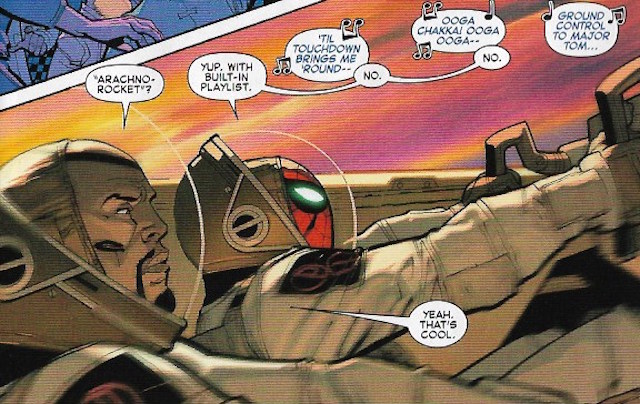
Your friendly neighborhood blogger correctly predicted months ago that Dan Slott was on a stupid-trajectory to write”Spider-Rockets” into The Amazing Spider-Man. “Arachno-Rockets” are officially part of Spider-Man history with the ninth issue of ASM. Sadly, it also includes Peter Parker’s “Nuke the Fridge” moment, which anyone remotely familiar with Indiana Jones and The Kingdom of the Crystal Skull will understand.

Here is the set-up: Peter Parker and S.H.I.E.L.D. are desperately looking for an international terrorist organization known as Zodiac, more specifically its leader Scorpio. The group hijacked all of S.H.I.E.L.D.S. satellites to locate an artifact known as The Orrery. Peter thinks he can manually take back control of the satellites and use them to pick up the energy signature of the artifact, a plan that coincidentally eluded Zodiac’s soothsayers because he came up with the idea exactly “one second after midnight.” (Seriously.)

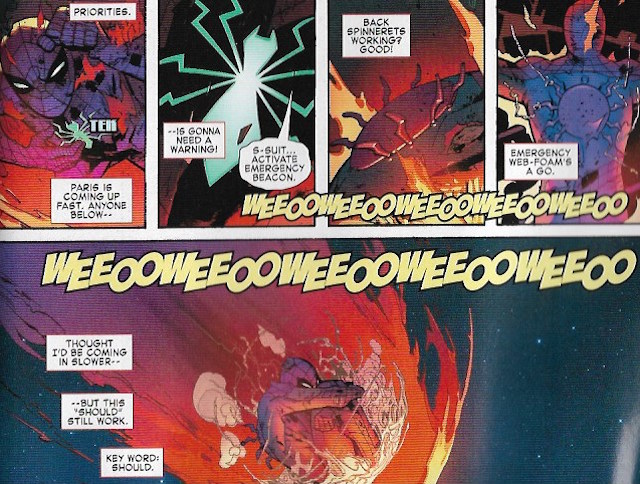
The issue begins with Spider-Man giving Nick Fury a spacesuit he happened to have on hand (it also makes digital logos “on the fly”), and the two literally take off from a launching dock connected to Parker Industries. After successfully locating The Orrey and fending off satellites doubling as battering rams (the “Arachno-Rocket” was destroyed in the process) Spider-Man tells Fury to “space walk” to the international space station while he turns himself into a human meteor and heads for Paris, France.

ASM web foam

It is hard not to read ASM #9 and wonder if Marvel has instructed Dan Slott to destroy all of Peter Parker’s credibility at any cost. Besides the jaw-dropping recklessness of turning himself into a meteor over Paris — without knowing if his plan would even work, where he would land, or how populated the area might be — one then needs to deal with the absurdity of “Spider-Suit Emergency Beacons, Spider-Back Spinnerets, and Emergency Web-Foam.

ASM Spider-Meteor

One must assume that it is only by the grace of God that Spider-Man only destroyed multiple vehicles (hopefully no-one was inside), instead of the nearby crowd of stunned citizens.

Spider-Man eventually pulls himself out of the wreckage like Indiana Jones from a refrigerator after a nuclear test, and the terrorist Scorpio appears. The villain says there is no way the Spider-Man will “make it to tomorrow,” but readers know that in many ways their hero is already dead.

Indiana Jones refrigerator

It is an absolute shame that the quality of Brian Michael Bendis’ “Spider-Man” towers over The Amazing Spider-Man. There is certainly room in the Marvel universe for fans of both Miles Morales and Peter Parker, but there is no excuse for allowing Dan Slott to “Nuke the Fridge” in the pages of ASM. At this point Nick Lowe is only nominally ASM’s editor because it appears there is little, if any, push-back against Dan Slott’s worst ideas.

The ninth issue of The Amazing Spider-Man should have been renamed The Atrocious Spider-Man. Do not buy it unless you plan on using it for toilet paper.

Iron Man #7: MJ hired by Stark, but is mystery girl Tony’s future replacement?

Iron Man 7

The issue of Invincible Iron Man that Mary Jane fans have been waiting for has arrived. The seventh issue on Bendis’ run features MJ’s first day at work for Tony Stark, and before it’s over she needs to reach Peter Parker at his emergency number. It may be the character who is introduced on the final page of the book, however, who Stark fans should be talking about.

One of the things Bendis understands, which certain other high-profile writers at Marvel do not, is that sometimes it is absolutely necessary to slow things down and just focus on character development, character development, character development. (Should I say it a fourth time?)

IIM #7 dedicates almost the entire issue to Tony’s first professional interactions with his new hire. They talk…and talk…and talk, but in this case it’s okay because standards are set, boundaries are established, and chemistry needs to form.

Readers simply need to imagine what a similar introduction between Peter Parker and Pepper Potts would look like in The Amazing Spider-Man. Instead of devoting 95 percent of the issue to authentic human interactions, Pepper would get a cursory introduction and then a calamity would strike. The audience would weirdly be expected to care for the new relationship simply because it’s Pepper and Peter working together — and then Comic Book Resources would give it the obligatory glowing review.

Iron Man

Perhaps one of the few awkward things about Stark’s decision to hire MJ is his cluelessness about her past. He invites a woman into his inner circle but does not really vet her. Only issues before he was telling his girlfriend about telepathic espionage, etc., and now he impulsively hires a former club owner. Regardless, Bendis’ scenario as it is written passes the smell test (barely).

Iron Man MJ

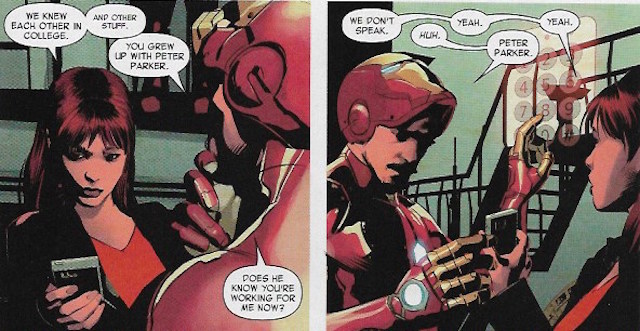
Aside from MJ’s meeting with her new boss, the rest of the issue is dedicated to Rhodey, who was sent to Japan to investigate a group of bio-hacker ninjas until Stark can get around to it. Rhodey goes missing, and through a strange twist of fate it turns out that technology titan Peter Parker is in country.

“You know your bodyguard, Spider-Man? Is he doing anything right now? Listen, I need a favor. It’s kind of a big one,” Stark says after getting Parker on the phone, which nicely sets up IIM #8.

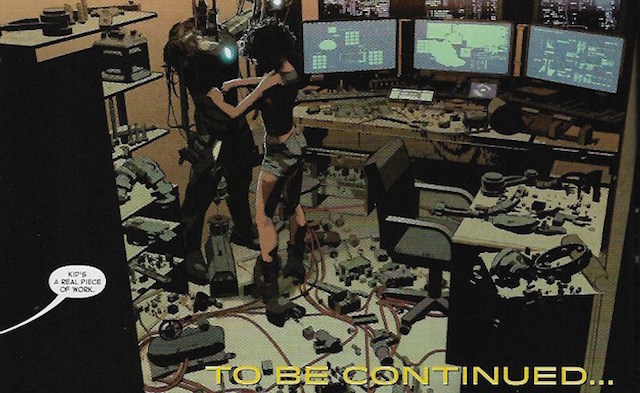
One would think the issue would end with Iron Man racing to save his friend, right? Wrong. Bendis cuts to Massachusetts Institute of Technology, where a young woman appears to be making her own “Iron Man” suit in one of its labs. She is scolded by some older staffers who call her a “kid” in the final panel.

Who is this kid genius? Why is she making “Iron Man”-type armor? (And yes, I realize I am asking these questions when “to be continued…” obviously means that we will get answers in due time.)

The previous questions need to be asked because Marvel has made no secret of its desire to social justice the heck out of its own universe. It seems entirely plausible that Bendis could be setting the stage for Tony to be “killed” or temporarily replaced, just like Captain America, Thor or even Spider-Man (e.g., Bendis’ Miles Morales wants to be seen as “the” Spider-Man”).

If you have thoughts on IIM #7, feel free to share them below. I’d love to hear what you thought of MJ’s first day on the job, Bendis’ mystery character, or predictions for the next issue.

Iron Man issue 7


Bendis weakens established heroes to elevate Miles, readers notice cheap shortcut

Miles Blackheart

Writer Brian Michael Bendis has a tricky job ahead of him. He is trying to establish Miles Morales as the Spider-Man, but he wants to do it in a short amount of time. While the first issue of Spider-Man was admittedly a fun read, the second issue shows some of the challenges Bendis’ social-justice project presents.

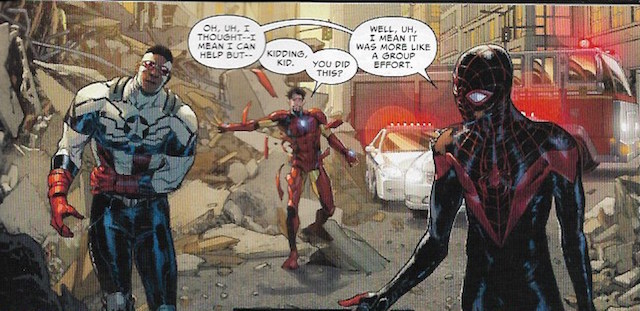
SM #2 begins with Spider-Man — the original — asking Miles who or what took out all the Avengers, yet retreated when he entered the fray. As the two are discussing the matter, along with whether or not Miles should continue to go by just “Spider-Man,” the demon Blackheart returns from the spirit world and essentially takes Peter Parker out of the fight with a single blow. Miles uses multiple venom blasts and Captain America’s shield to quickly dispose of the villain.

“You did this?” Tony Stark asks as he regains consciousness and stumbles forward. Even Bendis knows this is absurd, so he has Miles reply, “Well, uh, I mean it was more like a group effort.”

Miles IronMan Falcon

There is only one problem with that line: It wasn’t a group effort. Everything about the first two issues — including the cover, with Miles triumphantly standing with Cap’s shield over helpless Avengers — screams, “Respect this Spider-Man! Respect him! Seriously! Please?”

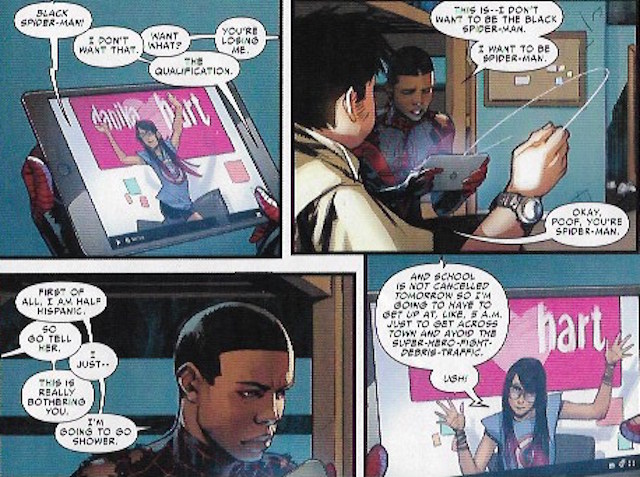
The reason for the cheap shortcut comes soon afterward, when word spreads of the new Spider-Man. A girl calls Miles “black Spider-Man” and this annoys him.

“I don’t want to be the black Spider-Man. I want to be Spider-Man,” Miles tells his friend Ganke.

“Okay, poof, you’re Spider-Man,” his friend replies.

If only it were that easy — but it’s not.

Readers can simultaneously appreciate Bendis’ mastery of the craft of writing while acknowledging that Miles is getting an embarrassing assist in the credibility department.

Miles SM2

Fact: In a world where Peter Parker exists, he will always be seen as the Spider-Man. Any derivative of him can never be the Spider-Man because Peter Parker was and always will be the original. Readers can either call Miles “black Spider-Man” because he is black, or because he chose to wear a black costume.

At the end of the day, it is bizarre to arbitrarily make Captain America black, Thor a woman, and Spider-Man a black guy when the original characters — who are still popular — are something else. Many Marvel readers get this, despite the creators’ best efforts to brainwash them otherwise.

Is Spider-Man a good book? Sure. So far. Is it worth spending $4.00 on? Yes. Will I ever consider Miles Morales the Spider-Man? No — because he’s not. He’s a Spider-Man (a good one), who came after Peter Parker.

I look forward to reading the third issue of Spider-Man. I just hope Bendis doesn’t have Miles taking down Ultron to prove the character’s worth.


Molina’s Amazing Spider-Atheist makes mockery of Peter Parker’s history

ASM Uncle Ben

Writer Jose Molina’s take on The Amazing Spider-Man is like beef stew, if all the carrots, potatoes, and onions were fresh and well-prepared, while the star of the show — the beef — were rotten. Issue 1.3 of Amazing Grace features The Amazing Spider-Atheist, which makes zero sense given the character’s history. Worse, he is not a tactful skeptic, but a condescending jerk.

For those who are not up to speed, Peter Parker: the Spectacular Atheist is investigating the death and resurrection of a man named Jose Rodriguez. While a mystical group of heroes called the Santerians attempt to get DNA samples from Rodriguez, Peter goes down to Cuba to find out what happened when the terminally ill man was there.

What makes Amazing Grace doubly disappointing is that scenes deserving of kudos for their ambition are spoiled by Molina’s betrayal of the character. Conversations happen with the spirit of Uncle Ben and Beast that intellectually tower over anything Dan Slott has dished out in years, but yet the scenes fall flat because a worldview that Peter Parker has never held has been shoved into his word balloons.

ASM Beast SpiderMan

Mike McNulty over at Whatever a Spider Can described the situation perfectly in his review of the issue:

Spider-Man lives a universe (albeit a comic book one) where real magic, gods, ghosts and demons do exist. He’s talked with Uncle Ben’s ghost before, courtesy of Doctor Strange, in Amazing Spider-Man #500. He’s knows people who have come back from the dead, himself included. He’s teamed-up with the likes of Ghost Rider and Thor, the later whom Beast even mentions in his theological debate with Spider-Man. He even had a lengthy conversation with God Himself in Sensational Spider-Man #40. And don’t even get me started again on his run-ins with Mephisto, who is the Marvel Universe’s version of the devil. Spider-Man has always been a scientific rationalist and his own religious upbringing is rather generic if not ambiguous; but the notion he would reject any supernatural explanation, or that he’d be so dismissive of those who subscribe to religion, faith or mysticism, is outright laughable and disingenuous given the character’s own history.

Boom. McNulty rightly drops a Truth Bomb on Molina’s head, and potential customers are better off for it.

Marvel has an enormous problem when it comes to Spider-Man. In the ongoing ASM series, Dan Slott has turned the character into Peter Parker-Wayne-Stark-Zuckerberg-Jobs-Musk. Now, with the “point” issues, readers are also subjected to a writer who dismisses core components of the character to suit his storytelling desires. There is almost zero fidelity to the “soul” of the character (no pun intended). The writers seem to treat ASM like the family van, with themselves in the role of the angry parents shuttling everyone on a vacation.

Slott or Molina: “I’m in charge, kids! We go where I want to go. Don’t make me turn this van around!”

Meanwhile, the passengers are wondering why their driver wants to take the van off a cliff.

If Peter Parker had always been a hard-charging skeptic, then none of this would be an issue. He has never been weirdly preachy or begged his friends to read the Bible, but it is abundantly clear that he has a quiet spirituality to him. To blatantly dismiss that fact and have him sneer at men of faith is an insult to anyone who cares about continuity.

Do not buy this book unless you want to watch a car crash play out for the next couple of months.