Daredevil #8: ‘Blind Man’s Bluff’ starts strong, teases Spider-Man team-up

Matt Murdock

It is fitting that Daredevil #8 takes place inside a Macau casino because readers must be wondering how long Charles Soule’s creative hot streak is going to last. “Blind Man’s Bluff” kicks off a new tale for Matt Murdock, and as far as stage-setters go the writer churns out another solid performance.

Is Mr. Soule just a lucky guy, or is his good fortune on the book positively correlated with his preparation and work ethic? This reviewer is inclined to go with the latter option.

Here is what you need to know about Daredevil #8 before we move on:

  • Matt Murdock has traveled to Macau for a winner-take-all poker tournament. He plays Texas Hold ‘Em because its rules are best suited for … a blind man with enhanced senses.
  • Daredevil is looking for an item that Black Cat sent to China.
  • A mysterious woman named Adhira latches onto Matt after he dominates his competitors.
  • The final round of the tournament features a telepath named Apex who is employed by the casino to make sure it never loses money. Matt’s telepathic defenses are pushed to the limits, but he ultimately holds out and wins a check for $10 million — made out to the alias Laurent Levasseur. (Note: He can’t cash the check.)
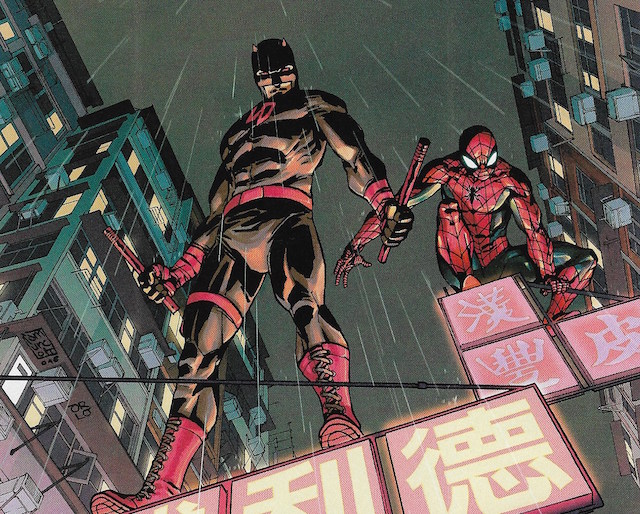
  • The casino gives Matt a complimentary stay in its best suite to keep him in town. Adhira also appears and asks to talk about his poker skills. He reminds her that he has a “friend” to meet, and the last page ends with Spider-Man telling Daredevil, “Took you long enough.”

One of the best things about Mr. Soule’s work on The Man Without Fear is that everything he does feels natural. Whether Matt Murdock is in a courtroom, battling ninjas, on a date with a beautiful woman, or in a high-stakes gambling tournament … everything feels right.

Ask yourself the following questions:

The answer (for many readers) is “No.”

With Daredevil, however, fans get stories that respect the character’s past while clearly charting a path forward. It says something about the quality of the title that Daredevil #8’s worst element is Goran Sudžuka’s artwork, which even isn’t bad; he just didn’t perform at Matteo Buffagni’s level with this particular issue.

“Why do I do this? Why do I always have to roll the dice?” Matt Murdock says at one point. “I’m always chasing. Trying to make up my losses. Betting everything I have to get back in the game. My identity, Kirsten, Foggy, my happiness…my life. On some level, I now it’s foolish. A compulsion. But if I don’t play…”

Readers take note: Charles Soule put more introspection into a single page of Daredevil than The Amazing Spider-Man writer Dan Slott has done in years with Peter Parker — a hero who was resurrected from the dead after a megalomaniac took over his body.

The point is this: If you have been unhappy with ASM for years but are still buying it out of sheer love for the character, then you owe it to yourself to purchase a book that consistently performs. There is no reason to give Marvel Comics money for dreck like Hydra-Cap (and an author who says all Republicans are “evil”), when someone like Mr. Soule is firing on all cylinders with Daredevil.

With that said, I will end this review with two points:

  1. I am not in Mr. Soule’s payroll, even if it seems like it at the moment.
  2. I look forward to seeing what the writer does with Spider-Man. That will be a true test of his creative prowess. If he hits a home run with the wall crawler, then I may have to announce a Charles Soule prize for one of the many Douglas Ernst C.R.O.N.I.E.S. (Comics Reconnaissance Operator, Negotiator, Intelligence Expert, and Soldier) around the globe.
Daredevil Spider-Man

‘Civil War II: Amazing Spider-Man #1’: Gage offers reprieve from Slott fare

Civil War II ASM 1

Civil War II: Amazing Spider-Man #1 came out on Wednesday, which gave Marvel fans an opportunity to see how everyone’s favorite wall crawler reacted to the Inhuman prognosticator at its core.  It is safe to say that writer Christos Gage offered more intrigue in a single issue than ASM writer Dan Slott in months.

Here is what you need to know for Civil War II: Amazing Spider-Man #1:

  • Peter Parker lands in New York City after a long flight from Shanghai. He crawls into bed at Parker Industries headquarters to take a quick nap and is shocked to find Johnny Storm — naked. He tells Johnny to put some clothes on or “flame on” so he can turn around. The Human Torch reminds Peter that he is scheduled to spend time with Ulysses, the Inhuman who can see and “experience” possible futures.
  • Spider-Man takes down the Vulture and the “Vulturions” over New York City. Ulysses is with the hero.
  • The two men make their way to Chinatown and stop a rage-filled man who was going to murder his ex-girlfriend.
  • Spider-Man tells Ulysses that if he hones his power, then he can help Parker Industries narrow down projects that will make it through the research and development phase — and therefore help a greater number of people.
  • Ulysses takes a tour of Parker Industries and meets Harry Osborn  **cough**Lyman**cough** and Clayton Cole.
  • Ulysses tells Spider-Man that Clayton Cole, aka Clash, will likely revert to his old ways. The Inhuman tells Spider-Man to prepare for an attack.

As I mentioned in the comments section of my review for Civil War II #1, there is incredible danger in fully embracing a man who only sees possible futures. Ulysses actually admits in the issue that his predictions “almost” always come true, but not 100 percent of the time.

What if, simply by allowing doubt to creep into his mind over his employee’s integrity, Peter Parker inadvertently plants the seeds for Mr. Cole’s recidivism?

What if Ulysses is unknowingly a harbinger of doom that can only transpire if heroes alter the “future-dominos” for him?

These are all very interesting questions, the kind of which are sorely lacking in The Amazingly Immature Spider-Man these days.

Clayton Cole Cvil War II ASM 1

Perhaps the only odd note the issue hits is the opportunistic way that Peter latches onto Ulysses and his ability. He rightly tells the young man that he can probably use his powers to affect more lives than he realizes, but the moment is ruined with a hasty job offer at Parker Industries. Readers want to believe Peter is not exploiting the situation, but it’s hard not to wonder given how petty and immature the character is under Slott’s direction.

Overall, if you’re looking for a book that gets the Civil War II ball rolling, then check out Christos Gage’s work. His effort also serves as a good audition for the role of lead ASM scribe. For the first time in many months I have not felt embarrassed for the title, and that is a good thing. I look forward to buying Civil War II: Amazing Spider-Man 2.

Civil War II ASM 1 Spider-Man

Exit Question: Is it me, or did this issue highlight how Peter Parker filled his entire inner circle at the company — courtesy of Dan Slott — with back-stabbers, criminals, and super villains?

  • Anna Maria Marconi: Doc Ock’s girlfriend. She went behind Peter’s back with Sanjani on Doc Ock’s nano-technology project.
  • Sanjani: She tried to strike a deal with The Ghost — a corporate saboteur — to destroy Parker Industries.
  • Lien Tang: Peter’s girlfriend tried to murder Spider-Man and traded company secrets to a terrorist organization.
  • Jacob Fury, aka Vernon Jacobs: Parker Industries’ biggest shareholder — and Peter’s “secret Santa” at the company Christmas party — ended up being the terrorist mastermind Scorpio.
  • Clayton Cole: Mr. Cole was formerly the villain known as Clash.
  • Harry Osborn: It’s really only a matter of time before Harry falls off the Green Goblin wagon. We might as well get it over with.
  • Living Brain: The robot is Doctor Octopus.

Civil War II #1: Rhodey’s death a missed opportunity

Rhodey Thanos Civil War II

Marvel Comics’ Civil War II officially kicked off on June 1 with James Rhodes … kicking the bucket. Fans were given a hint of his fate in late may with Civil War II #0, but writer Brian Michael Bendis and artist David Marquez made sure by the end of the first issue that everyone knew War Machine just saw his last* battle. It is hard not to believe, however, that killing Rhodey instead of pitting him against his best friend over a complex issue was an error on Marvel’s part.

Here is what you need to know for Civil War II #1:

  • A huge cast of superheroes square off against a Celestial Destroyer. A tip by The Inhumans allowed Iron Man, Dr. Strange, Captain Marvel and the others to devise a plan that would send the entity to its home dimension.
  • Tony Stark throws a party for the “unqualified, top-to-bottom home run of a win.” The mood is spoiled when it is revealed that Ulysses, an Inhuman who “experiences” the future, was the one who provided intelligence on the Celestial Destroyer’s arrival.
  • Captain Marvel asks Ulysses if he wants a job with The Ultimates after Jean Grey fails to read his mind. Tony Stark wants nothing to do with the young man. He warns everyone that using Ulysses’ power to confront people over a possible future is dangerous and wrong.
  • Ulysses has a vision of Thanos coming to earth and tells The Inhumans to contact Captain Marvel.
  • The events of Civil War II #0 unfold. She Hulk is greatly injured and Rhodey dies.
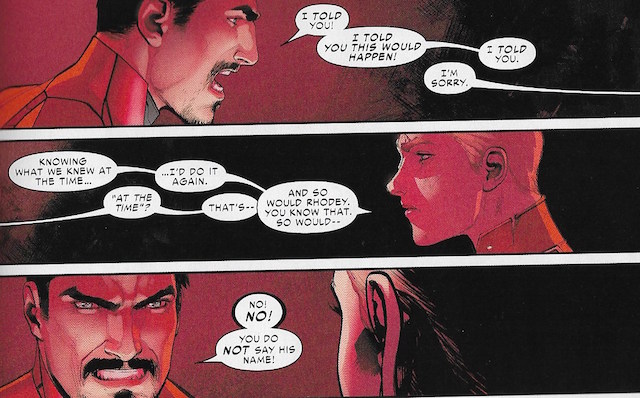
  • Tony confronts Carol Danvers, aka Captain Marvel. She tells Tony what happened and his is livid. “I told you! I told you this would happen!” he screams. Carol says she did the right thing and that Rhodey would act no differently if he had it all to do over again.
  • Tony storms off to “make sure none of [the superheroes] play God again.” She Hulk wakes from a coma and tells Captain Marvel to fight for the future (“It’s our future, Carol. Not his.”) before her heart stops.  Doctors try to revive her and the issue ends.

The good thing about Marvel’s decision is that there are plenty of legitimate arguments to be made for killing Rhodey. Unlike turning Steve Rogers into a Nazi-sympathizing Hydra Agent, James Rhodes’ integrity was not violated in the decision-making process. Soldiers die. Every time a warrior steps onto the battlefield, he knows that he might not live to see another day. That’s just how it works.

The bad thing about Marvel’s decision is that it robs readers of a chance to see two friends battle over fierce ideological differences while ultimately finding peace in the end. Both Tony and James would respect the other’s willingness to die for core principles, and in the long run their friendship would probably be stronger for having gone through the ordeal.

A standoff between Tony and Carol has the potential to be powerful, but the better choice would have been Tony vs. James.

Civil War II 1 Iron Man Rhodey

In short, Civil War II appears as though it will be a good read if Marvel finds a way to avoid the mistakes of Civil War I (e.g., inserting partisan politics in the story to make on side look evil). It’s just unfortunate that Bendis missed an opportunity to dial up the dramatic tension by keeping Rhodey alive.

*“Last battle” until a Cosmic Cube, a magical gem, or a spell brings him back to life.

Iron Man Captain Marvel

Bendis debuts ‘Iron Maiden’ in Iron Man #10 while Tony goes deep undercover

Iron Man Franco

Brian Michael Bendis’ Invincible Iron Man has employed a cloak and dagger sensibility for ten issues now. Readers have more or less been treated to a solid tale of corporate espionage, but at some point in time even the most patient readers will move on. There needs to be a payoff to months of running around in the shadows, and luckily it seems as though IIM #11 will be the issue to deliver.

Perhaps the best way to describe IIM #10 is to liken it to a man at a talent show spinning plates. Bendis jumps around to multiple locations to keep his “Tony,” “Rhodey,” “Riri,” and “Mary Jane” plates moving long enough to get to his grand finale. What would be a total disaster in lesser hands (e.g., Jose Molina’s “point” issues in The Amazing Spider-Man) is handled well, and as a result it appears as though IIM #11 will be a must-read.

Before we move on, here is what you need to know about IIM #10:

  • Tony has gone under cover as the former Navy SEAL and S.H.I.E.L.D. agent “Franco.” Biohack ninjas in Japan take him hostage in the middle of the night because their leader wants to know more about him (he saved Yukio when her illegal gambling operation was raided).
  • Tony meets face-to-face with  Tomoe, aka “Techno Golem,” an Inhuman who can control technology. After proving his hand-to-hand combat skills with her biohack ninjas, she tells “Franco” (i.e., Tony Stark using advanced bio-technology to look like an aging Luke Perry) that he may be potentially valuable to her. She wants to take down S.H.I.E.L.D., Hydra, Wakanda, Atlantis, and Attilan. She also wants to kill … James Rhodes.
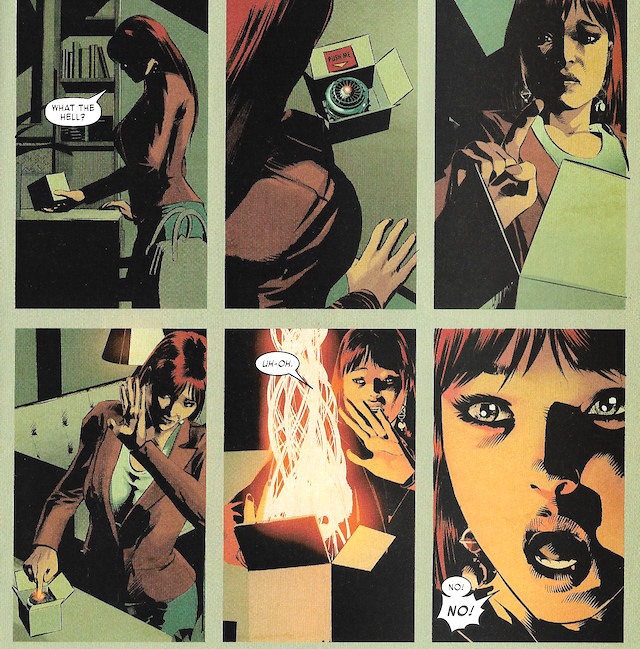
  • Mary Jane goes to her apartment after receiving a mysterious package. A device with a button says “push me” and she inexplicably obliges. Tony’s AI assistant, Friday, emerges and pleads with her to take the job at Stark Industries. The board of directors is meeting to seize control of the company because they believe Tony is dead.
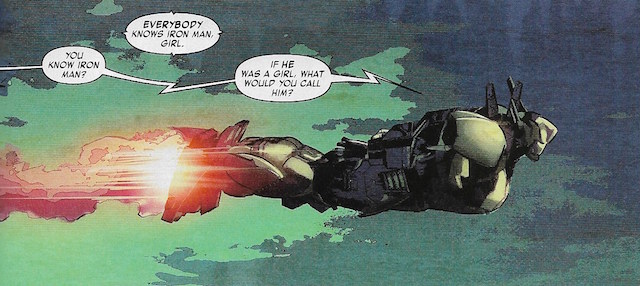
  • Riri Williams, the 15-year-old whiz kid from MIT, conducts a test flight in her Iron Man-like armor. She deems herself “Iron Maiden” and tells a friend, “You can tell no one what I am about to do.”
  • James Rhodes meets with the Avengers and says they need to figure out how to confront a tech-based terrorist group using only their “natural abilities.” He says all contact has been lost with Tony, which means things may “get very bad very quickly.”

Given what readers know, it is imperative for Bendis to bring serious action to IIM #11. Mary Jane will undoubtedly spend time attempting to defuse the situation with Stark Industries’ board of directors, but it can be stressed enough how much this title needs some high-octane butt-kicking, bullets, and giant explosions. It’s time. Make it happen, Mr. Bendis. Seriously.

Finally, one cannot talk about IIM #10 without wondering about Riri “Iron Maidan” Williams.

Riri Willaims Iron Maiden.jpeg

Who is she? Where did she come from? Is Bendis blatantly signaling this is just checking off a gender score card when she specifically asks her friend, “If Iron Man was a woman what would you call him?”

Fact: I want to like a superhero in Stark-like armor named Iron Maiden. It’s cool. I cannot deny that. What is not cool is blatantly beating readers with the message “I am doing this because every iconic male superhero needs a female counterpart — and if you roll your eyes then you’re kind of a bad person.”

Many readers, myself included, will give Riri Williams a shot — but if Bendis starts trying to guilt Iron Man fans into an instant love fest, then it is likely his efforts will spectacularly backfire.

Exit Questions:

  1. Mary Jane is supposed to be winking at readers in this cover photo, but why does it just look like Tony Stark gave her a black eye?
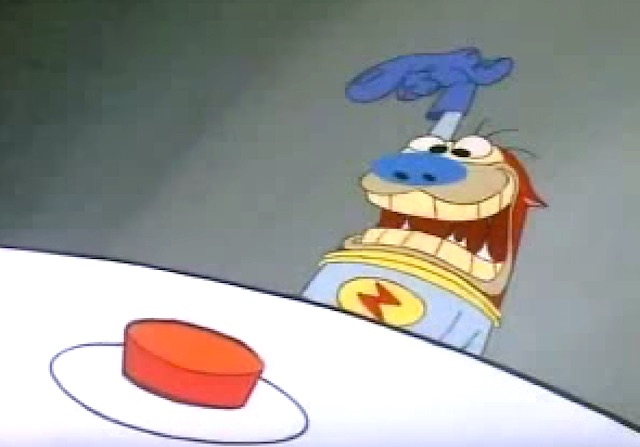
  2. Why would Mary Jane push a button from an anonymous stranger that looks incredibly bomb-like? She even covers her face with her left hand — as if that would somehow shield her from a giant blast. Did she not watch the old Ren and Stimpy episode with the “History Eraser Button”? Tsk, tsk, MJ.

MJ IIM 10
Mary Jane Iron Man button

Stimpy Red Button

Dan Slott’s Amazingly Immature Spider-Man makes protégé Miles Morales ‘ashamed’ of the costume

ASM13 SpiderMan IronMan fight

It would be incredibly hard for any comic book to steal headlines from Marvel’s Hydra-loving Captain America these days, but the latest issue of The Amazing Spider-Man gives it the old college try in terms of defiling a great character. It’s true that Marvel’s editors have not made Peter Parker admit to killing Uncle Ben — yet — but Dan Slott does turn a grown man into an immature loser who puts civilians’ lives at risk. Worse, Peter’s own protégé looks at his behavior and can barely keep his lunch down.

Before we continue on, here is what you need to know for ASM #13:

  • Harry Osborn and Betty Brant get ready to go to lunch with “the old gang.” Harry weirdly tells Peter that he isn’t invited because he’s “the big boss man” and Peter sheepishly replies, “Um…okay.”
  • Harry tells Betty he didn’t want to “risk” an awkward encounter with Mary Jane attending the lunch.
  • The three of them look at one of Betty’s Daily Bugle articles and realize that Augustus Roman is Regent.
  • Peter takes off as Spider-Man for a “Big Brother batting cage playdate” with Miles Morales, aka young Spider-Man.
  • Tony Stark arrived before Peter and soon ribs him about the quality of Parker Industries’ technology. Iron Man has also provided Miles with new web-shooters.
  • Spider-Man goes nuts and begins a street fight with Iron Man in front of parents and their children.
  • Miles Morales throws his hands in the air and says he’s “ashamed to be wearing this costume right now.” He leaves unnoticed and is immediately captured by Regent.
  • The giant explosion that takes down Miles stuns Spider-Man and Iron Man. The charge towards the blast area.

Ask yourself this question: If a writer claims to love Peter Parker, then why would he have the character behave in a way that causes a derivative version of himself to be “ashamed”?

The job of a writer is to make the protagonist shine in his own unique way as much as possible, yet Dan Slott’s Spider-Man has New Yorkers running for the hills as he acts like a clown.

“With great power comes great responsibility” — unless Tony Stark acts like Tony Stark, in which case it’s time to destroy public property and scare everyone within a half-mile radius. Perhaps J. Jonah Jameson was right all along…

ASM 13 SpiderMan IronMan

Regular readers will note that Peter Parker had a bizarre fight with Human Torch in ASM #3 and with Iron Man in ASM #12. He is actually regressing in terms of tact, professionalism, and maturity as the series goes on, so much so that his teenage protégé storms off in disgust. 

ASM 13 Miles explosion

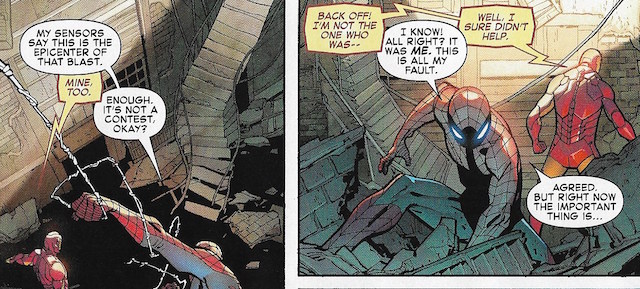
“It was me. This is my fault,” Spider-Man says as he searches through wreckage for Miles. That may be true within the context of the story, but fans are left thinking, “No, this was Dan Slott. This is his fault.”

Long-time Spider-Man fans need to be told the following since they will never get it from websites like Newsarama: Dan Slott uses ASM #13 to elevate Miles Morales by making a mockery out of Peter Parker.

Writer Brian Michael Bendis did the very same thing in SM #2, which is why readers must pay close attention. There is a concerted effort to chip away at Peter Parker’s credibility until Miles usurps him in popularity, and it will certainly happen unless readers push back — hard.

If you want to see the slow-motion destruction of Peter Parker, then run out and buy ASM today.

If you want to see writers knee-cap the original Spider-Man so that Miles Morales wins the long-distance sales race, then check out ASM.

If you want to show Marvel your displeasure at what it’s doing to both Captain America and Spider-Man, then keep your hard-earned cash for better products. Charles Soule, for instance, is running creative laps around his peers as the moment. I highly suggest checking out his version of Daredevil.

ASM 13 IM SM

Tom Brevoort tries Hydra Captain America spin-job, Newsarama goes full toady

Captain America Jack Flag

One of the reasons this blog began reviewing the comics industry years ago was because the mainstream “news” outlets almost always serve as a mouthpiece for whatever bilge the creators dish out. If there is one good thing to come out of Nick Spencer’s “Captain America: Nazi-sympathizing Hydra Agent,” it is that more people realize that allegedly impartial reporters are usually glorified toadies for men like Tom Brevoort.

Take a recent piece by Newsarama’s piece by George Marston:

“Reaction to the news has been mixed, with some, familiar with the ebb and flow of comic book storytelling intrigued by the twist, or resigned to wait it out and see its explanation, while others less familiar with comic book tropes decried the reveal as an outright betrayal of Captain America or even his creators.

According to Tom Brevoort, Marvel Executive Editor, an editor of Captain America: Steve Rogers #1, where the reveal took place, Marvel was somewhat surprised by the reaction to the twist, not expecting the level of vitriol some fans have levied at the publisher, and at Nick Spencer, writer of the issue and architect of its twist.”

Did you get that first paragraph? If you view Marvel’s decision as a grotesque betrayal of the character, then you must be **hurrrrrrm** “less familiar with comic book tropes.”

Tut. Tut. Now excuse me while I wipe my monocle, you rubes.

The message by Newsarama is clear: Only ignorant fools who don’t know comics oppose the latest “bold” idea by Marvel’s editors and writers. Nick Spencer could turn Captain America into a serial killer and there would be guys like George Marston calling it “bold” at this point.

George Marston Newsarama Twitter

One would think that Mr. Brevoort’s “surprise” at the negative reaction to Mr. Spencer’s story would be challenged, considering it was the Marvel editor who told USA Today he knew it would be like slapping fans in the face.

“‘We knew it would be like slapping people in the face,’ says Brevoort. […] “The idea of Captain America means something very primal and very strong to the people of this nation, and they have a very visceral reaction when you get to something like that. You want people to feel and react to your story. So far, so good.”

Even though Mr. Marston covered the “slap” comment in his own column, there was no push-back against Tom Brevoort. The Marvel editor explicitly said a decision was made to “slap” readers in the face, and then he is “surprised” when people are angry. Newsarama’s decision is to then label critics as “less familiar with comic book tropes.” Classic.

Perhaps the most laughable moment in Newsarama’s interview with Mr. Brevoort comes when he tries (and fails) to say that equating Hydra-Cap to a Nazi is out of bounds.

“There’s a subset of people who are upset about this, who are exactly like that. The reporting on this, and the sort of game of telephone on the internet about this went from it being ‘Captain America is Hydra,’ to ‘Captain America is a Nazi’ – which is already a leap – to ‘This is anti-semitism,’ which is ridiculous, in that, if you look at the comic book that we put out, there is nothing in it that, in any way, shape, or form, is even slightly anti-semitic. But because people were able to go ‘Hydra = Nazi, and Nazi = anti-semitism,’ that’s what reactions became about.

By reporting that we revealed ‘Captain America is a Nazi and anti-semitic,’ people that haven’t even read the work react with outrage, because they understand who Captain America is, even if they’ve never read a comic book.”

Hyrda’s history is well established in the comics, the MCU, and television. The reason why Mr. Brevoort said the story would be a “slap” in the face to fans is because he knew people would put two and two together. Now that the story has amazingly unified readers across the political spectrum, he wants to feign ignorance.

Cap a Nazi sympathizer? Where would you get that idea? Who told you 2+2 = 4? It’s five.

If you want honest reporting on comic books, then websites Newsarama are typically not the place to go. The vast majority of the time their writers and editors are only interested in keeping the access-spigot flowing. They cannot bite the hand that feeds, but they will gladly give men like Tom Brevoort a thumb to suck every time he runs to them crying.

Withhold your cash when it comes to Captain America until Marvel learns its lesson. If you want to reward the company for good work, then purchase Charles Soule’s Daredevil. Just be aware that one day a writer will come up with the idea that Matt Murdock has never been blind and was working for Kingpin all along — and reporters like George Marston will be ready and waiting to insult you for showing displeasure.

Editor’s Note: Henchmen’s Lounge was kind enough to invite me onto a podcast to discuss Captain America. We begin talking about Hydra-Cap at the 18-minute mark.


Daredevil #7: Charles Soule running laps around Marvel peers

Daredevil Elektra 7

The seventh issue of Charles Soule’s Daredevil came out on May 25, and once again the man has churned out a solid piece of work. If writing comic books were a race, then it is safe to say that Mr. Soul would be lapping most of his Marvel peers at this point. His writing is crisp, he isn’t forcing weirdly partisan stories down readers’ throats, his pacing is consistently smooth, and he seems to inherently get what makes for a cool Daredevil story.

If there is one Marvel book worth getting each month, then it belongs to Team Soule.

Here is what you need to know for Daredevil #7:

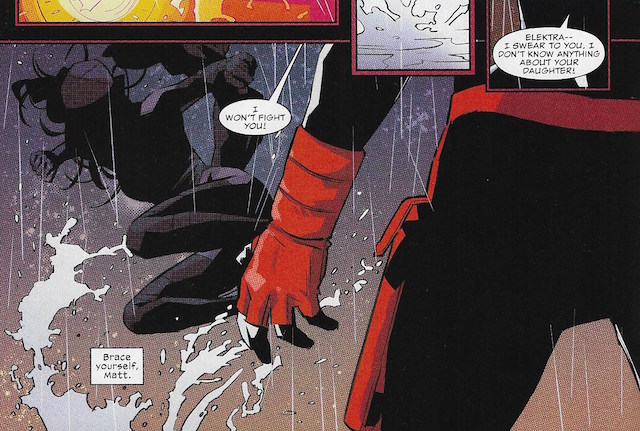
  • The “man without fear”convinces Elektra to let him help unravel the mystery behind her daughter’s disappearance.
  • Elektra gives Daredevil a cell phone that purportedly shows him training her daughter.
  • Matt Murdoch takes the phone to Foggy Nelson despite the “rough patch” they’re going through, and Foggy says there is no video on the phone.
  • Matt, thinking the child might be his, inadvertently destroys the phone in a fit of rage when he can’t figure out what is going on.
  • Daredevil meets with Elektra and tells her there is nothing on the phone, but that he accidentally destroyed it. She is upset, but takes off to find answers on her own.
  • Elektra (with Daredevil tailing her) confronts the man who gave her the phone after killing his partner. The man says “The tangled web we weave!” and she realizes someone took control of her mind. Someone wanted her to feel the pain of losing a child.
  • Daredevil realizes that he knows the identify of the person who took control of Elektra’s mind, but does not disclose that information to her. She leaves with the intention of finding and killing the man who psychically abused her.

Daredevil 7

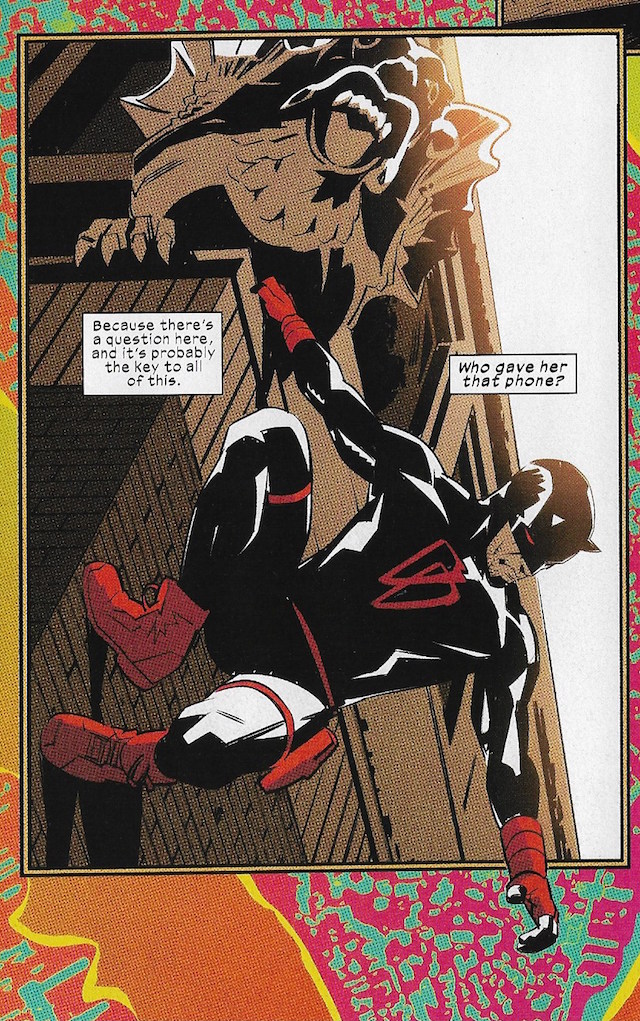
Complimenting Mr. Soule’s writing nicely is artist Matteo Buffagni, whose eye for awesome is incredibly keen. Besides the noir-perfect pitch, little details — like having Daredevil’s hand slightly hang out over the panel as he clings to a ledge in Hell’s Kitchen — indicate a creative team that is running on all cylinders. It is a shame that others within the company aren’t taking notes on what is clearly a winning formula.

In short, if you aren’t buying Daredevil then you should be. It’s only a matter of time before Mr. Soule steps aside and the next writer decides to come up with the “bold” **cough** twist that Matt Murdock has never been blind…

‘X-Men: Apocalypse’: Michael Fassbender saves mutants from mediocrity

Michael Fassbender Magneto

X-Men: Apocalypse was finally released in U.S. theaters for Memorial Day weekend after having premiered in places like the United Kingdom on May 9. The wait, overall, is worth it, but that is in large part due to Michael Fassbender’s performance as Magneto. The movie drags a bit at 144 minutes, but luckily Charles Xavier’s mutants are saved by the emotional weight Fassbender brings to the character Erik Lehnsherr.

Bryan Singer’s latest installment in the X-Men franchise (a tough act to follow after X-Men: Days of Future Past) breaks down as follows:

  • En Sabah Nur (played by Oscar Isaac) is allegedly the first mutant. Although he has god-like powers, a series of events leaves him in a state of suspended animation in a buried Egyptian temple.
  • En Sabah Nur is revived in the 1980s and becomes the “Apocalypse” X-Men fans are all familiar with. He begins his quest to gather “Four Horsemen,” wipe the earth clean, and begin anew with himself at the center of the universe.
  • Professor-X (played by James McAvoy) is captured by Apocalypse and his crew. The young X-Men must now save him — and the world.

X-Men: Apocalypse, in many ways like its predecessor, explores the idea of painful pasts and whether or not individuals choose to be defined by those experiences or rise above them. Mr. Singer wants everyone to know that they have greatness within them — a commendable message — but the script does not allow the supporting cast to truly shine.

Evan Peters as Quicksilver should probably be the linchpin of the next X-Men movie (i.e., it’s time for him to confront his father), and Sophie Turner shows real promise as Jean Grey, but the movie lacked a spark from the one person it was heavily invested in: Jennifer Lawrence.

XMen Jean Scott Nightcrawler

Ms. Lawrence’s role as Mystique felt flat for three reasons:

  • She simply looked bored. Her performance screamed, “at least I’m getting a paycheck.”
  •  The script shoved a slew of Katniss Everdeen-like platitudes into her mouth while shorting her on scenes that would have formed an instant connection with the audience. (Note: All husbands/fathers can related to Magneto after what happens to him in Poland.)
  • Can it be any more obvious that Ms. Lawrence didn’t want to sit in a makeup chair unless absolutely necessary, and that she was given her way because her name is Jennifer Lawrence? Anyone who plays Mystique should be blue for more than 5 percent of their screen time.

All things considered, however, X-Men: Apocalypse is still worth seeing for anyone enjoys the superhero genre. It is not as strong as X-Men: First Class or X-Men: Days of Future Past, but it is still does its job when all is said and done.

Finally, make sure to stay through the ending credits for a clue to the next film’s villain.


Molina’s Amazing Spider-Man 1.5: Car crash scene a perfect metaphor for story

ASM 1.5 wagon

Jose Molina’s latest installment of The Suddenly Atheist Spider-Man was released on May 25, and fans of the wall crawler will be glad to know the he apologized for being “less than respectful” to the Santerians over their religious beliefs. That is, unfortunately, the one bright spot in an issue that is best represented by a car crash scene later in the book.

Here is what you need to know for The Amazing Spider-Man 1.5:

  • Spider-Man is still on the hunt for Julio Manuel Rodriguez, the man who mysteriously came back from the dead and performs miracles.
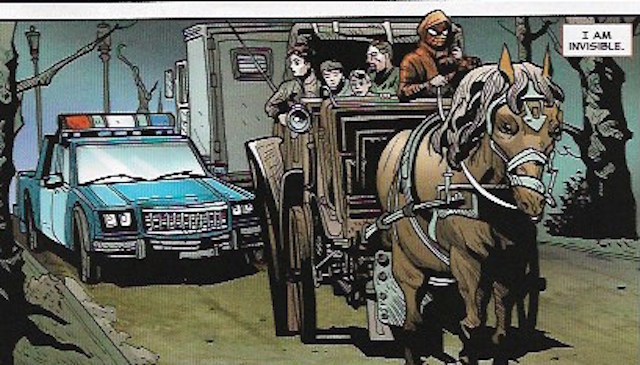
  • Writer Jose Molina actually thought it was a good idea to feature Spider-Man as a (female?) horse-drawn carriage driver.
  • Don Anselmo is “reborn” as a young man after a ceremony due to his faith. His god tells him Julio is controlled by a “false god.” (Question: Wouldn’t Don Anselmo’s god also be a false god since it isn’t God?)
  • Julio causes a car accident and then performs a miracle to resurrect a dead woman.
  • Spider-Man and the Santerians apologize to one another and then use Iron Man (shoe-horned into two pages) to locate where the spiritual conduit is that Julio’s host draws power from.
  • Iron Man gives the group an an address in Harlem and Spider-Man says “showdown time.”

ASM 1.5

It is very rare to see a Marvel comic that fails on pretty much every level imaginable. The entire creative team appears to given up all hope for salvaging the book.

  • Jose Molina continues to write a sloppy, poorly paced story that reads as if he has the attention span of a squirrel.
  • Artists Simone Bianchi and Andrea Broccardo have slapped together one of the ugliest issues of ASM of all time. Marvel would have gotten a better product if they asked a kid on Deviant Art to do them a favor for $100 bucks. Spider-Man wouldn’t look like a marshmallow, police cars wouldn’t look like they came off a Detroit assembly line in 1973, and Peter Parker wouldn’t look like Ace Ventura.
  • Editor Nick Lowe, who allowed a writer to have Peter Parker blame God for Uncle Ben’s death, is still M.I.A.
  • Question: Is it possible for a letterer to underperform? It seems like even the “AaaaaIIIEEEEEEE!” “KRIIIIII” and “CCRRNNNCHHH” in the crash panel are font failures, if that’s even possible.

In short, Marvel should be ashamed that there is essentially zero quality control for its “point” issues of ASM. There is one remaining issue of “Amazing Grace,” which is fitting because the few readers who are left will be singing the famous hymn after they finish.

Stay far, far away from ASM “point” issues for the foreseeable issue — at least until Mr. Lowe decides to do his job.

ASM 1.5 crash

‘Captain America #1’: Nick Spencer turns hero into Hydra agent with Tom Brevoort’s blessing

Hydra pamphlet

Your friendly neighborhood blogger wrote a piece of satire in January 2015 that involved Marvel Comics turning Red Skull into Captain America. Fast forward in time to May 25, 2016, and the company has, for all intents and purposes, done just that.

Captain America has seemingly been a Hydra agent since the very beginning — and Marvel executive editor Tom Brevoort claims it is not a gimmick.

TIME magazine reported:

Every single month whether it’s a run of the mill month for Captain America or an extraordinary month, our job is to put him in situations that place that character under some degree of pressure and see how he reacts to that. And hopefully our readers are surprised, shocked, elated, see something of themselves, learn something about themselves. To say it’s a gimmick implies that it’s done heedlessly just to shock. The proof is always going to be in the execution. So you’ll have to read the rest of the story to see.

But I certainly believe it’s not a gimmick. It’s a story that we spent a long time on, that’s compelling and captures the zeitgeist of the world. It will make readers wonder how the heck we’ll get out of this.

The truth, however, is slightly different: Readers want to know how Marvel got into this mess. Hiring Nick Spencer — a man who is so weirdly partisan that he says Republicans are “evil” — explains a lot, but the problem goes much deeper.

Before we move on, however, here is what you need to know about Steve Rogers: Captain America #1:

  • Steve Rogers had an abusive father.
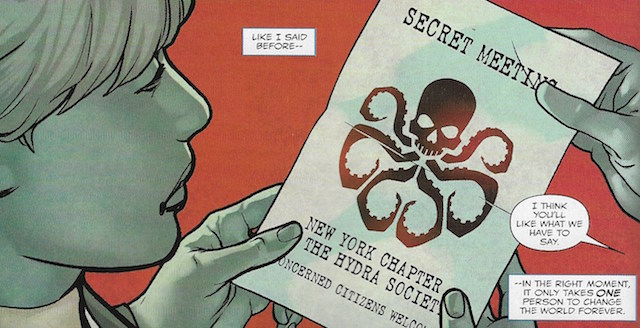
  • Steve’s mother, Sarah, is aided by a “Hydra Society” member one night after her husband beats her. She takes a pamphlet for Hydra’s New York chapter (because creepy skulls with tentacles would never set off warning bells).
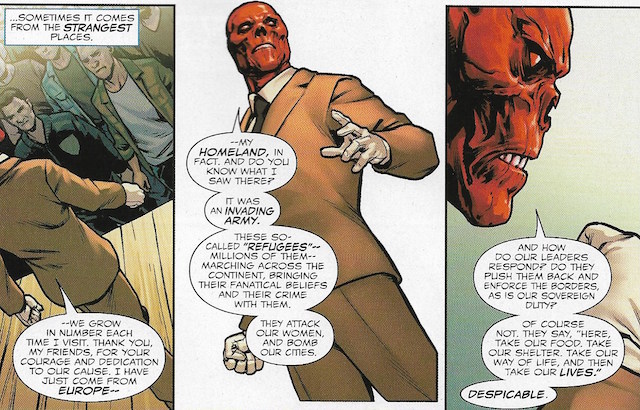
  • Red Skull recruits the next generation of Hydra in 2016 by making fair points about Europe’s refugee crisis (i.e., Nick Spencer wants you to associate rather innocuous conservative observations with Nazi villains).
  • S.H.I.E.L.D. finds Baron Zemo, which prompts Captain America, Jack Flag, and Free Spirit to the lawless city of Bagalia.
  • Jack Flag ignores Cap’s orders and assists in confronting Zemo in the villain’s jet.
  • Captain America laments Jack Flag’s decision and then throws him out a cargo drop.
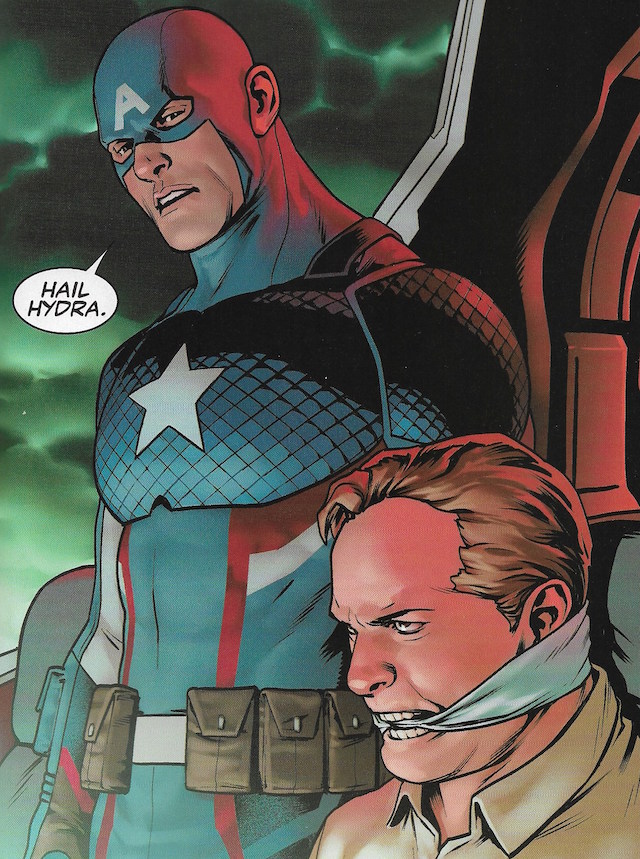
  • The issue ends with Captain America saying “Hail Hydra” to Doctor Erik Selvig, a scientist Zemo held hostage in an attempt to find the sentient Cosmic Cube known as Kobik.

Red Skull

The question on everyone’s mind, judging from the #saynotohydracap hashtag that trended on Twitter all morning, is simple: Why?

The answer: A culture of moral relativism inside the halls of Marvel is so prevalent that Doctor Octopus had to become “Spider-man” for over a year and now Captain America must run around as a Nazi-sympathizing Hydra agent for an extended amount of time.

Iron Man was turned into a villain.

Spider-Man was turned into a villain.

Captain America is now a villain.

Heroes battled each other in Civil War and will do so again in Civil War II.

Notice a trend? These are the hallmarks of an organization that is so uncomfortable drawing a clear line between good and evil that instead it would rather go with a “one man’s Captain America is another man’s Red Skull” approach.

Nothing matters: Captain America is Hydra. Doctor Octopus is Spider-Man. Iron Man is a George W. Bush allegory and Red Skull agrees with Republicans (and moderate Democrats) on the issue of Syrian refugees. That is your modern Marvel comic book, and it wouldn’t be so embarrassing if men like Tom Breevort didn’t lie about writing for “the zeitgeist.”

Captain America Jack Flag

Take the following claim by Mr. Brevoort, for example:

TIME: In the comic the Red Skull of Hydra talks about “criminal trespassers” who “make a mockery” of America’s borders and calls the refugees in Germany an “invading army” bringing “fanatical beliefs and crime” to Europe. Obviously, this hate speech is nothing new for the organization, but it sounds like rhetoric we’ve been hearing this election. Is that purposeful?

Brevoort: We try to write comics in 2016 that are about the world and the zeitgeist of 2016, particularly in Captain America. Nick Spencer, the writer, is very politically active. He’s a Capitol Hill head and following this election very closely. So we can talk about political issues in a metaphoric way. That’s what gives our stories weight and meat to them. Any parallels you have seen to situations real or imagined, living or dead, is probably intentional but metaphorically not literally.

Mr. Brevoort liked the word “zeitgeist” so much that he used it twice in one interview, but it’s funny how the “zeitgeist” only relates to making Republican presidential candidates look like Nazis and then turning Captain America into a Hydra agent — all in the same issue where a guy with ties to white supremacists turned himself into a Hyrda suicide bomber.

Why is it that Marvel’s zeitgeist-quota is laughably focused on metaphors of white, Republican males as evil instead of, say, national security threats posed by Islamic terrorist organizations controlling large swathes of Syria, Iraq, Yemen, Libya, and Afghanistan?

How strange is it that Nick Spencer did not find it timely in a post-9/11 world to have Captain America team up with Ranger-run task forces in Pakistan, but he did to turn him into a Hydra agent?

If you increasingly find yourself feeling like Doctor Erik Selvig or any other characters who are held hostage in Marvel’s comics, then you should know that you are not alone. The characters you grew up with are now beholden to partisan writers and editors who enable immature and mean-spirited fantasies. Hashtag’s like #saynotohyracap are fine, but withholding hard-earned cash should always be the primary method of conveying displeasure.

Tune in here in for future updates into the sad decline of Marvel’s comics division and the activist-creators behind it all.

Update: John C. Wright was kind enough to link to this post. To all of his readers: Welcome!

Captain America Hydra