Marvel turns Trump into villain ‘M.O.D.A.A.K,’ hopes hackery buoys sales

MODAAK Trump Marvel

It was only one month ago that activist-writer Nick Spencer turned Red Skull into a Donald Trump stand-in. Objective readers wondered just how deep Marvel’s well of partisan hackery might go. Spider-Gwen Annual #1 by writer Jason Latour offers the clearest evidence yet that it is deeper than anyone can imagine.

Comic Book Resources reported Saturday:

In this week’s “Spider-Gwen Annual” #1, writer Jason Latour and “an awesome assemblage of artists” offer a tour of Earth-65 with a collection of short stories that includes She-Hulk as a pro wrestler, the origin of Koala Kommander, and an all-too brief showdown between Captain America and M.O.D.O.K. — wait, make that M.O.D.A.A.K. (Mental Organism Designed As America’s King).

Illustrated by Chris Visions and colored by Jim Campbell, the two-page sequence depicts M.O.D.A.A.K. as an orange-skinned, tiny-handed villain sitting in his floating chair, leading the forces of A.I.M. near the United States/Mexico border. There he declares, “If American will not act — M.O.D.A.A.K must!”

However, just as he begins to utter a familiar slogan (“Must make America–“), he’s cut off by a well-placed shield throw from Captain America. Crashing to the ground, M.O.D.A.A.K. leaves us with a parting threat (and a jab at Trump): “Crush you … in … my … powerful handsss …”

Regular readers of this blog know that I have no love for the billionaire’s campaign, which is why it pains me to have to defend the man. Although, truthfully, it’s not really about Mr. Trump. What this is about is Marvel Comics filling its ranks with pathetic partisan trolls whose bright idea for keeping the company afloat is to cultivate loyalty with the lowest common denominator.

Note to Jason Latour, Nick Spencer, Dan Slott, Tom Brevoort, and everyone else within Marvel who thinks dividing people is a great business model for long-term growth: The internet exists. When you create stuff like Trump-M.O.D.A.A.K., those stories end up in news feeds next to ‘White House reveals number of civilian deaths from drone strikes.’

CNN reported Friday:

President Barack Obama’s administration estimated Friday that between 64 and 116 civilians have died during the years 2009-2015 from U.S. drone strikes outside of Iraq and Afghanistan.

In the same time span, the administration said between 2,372 and 2,581 militants had been taken out by drones. …

Human rights groups, however, were unsatisfied by the government’s disclosed figures, which came in far lower than independent estimates of civilian causalities.

Selective moral outrage and Marvel-approved hypocrisy are easy to expose thanks to the internet. Whether one loves him or hates him, Donald Trump has never dropped bombs on 116 civilian heads.

President Obama decided long ago that he would rather splatter suspected terrorists into a blood-red mist than capture and interrogate them like George W. Bush, but yet it is Mr. Trump who gets the M.O.D.A.A.K treatment. Telling.

Readers get what is going on, which is in part why Spider-Gwen had estimated sales of a whopping (drumroll please) … 33,797 copies last month.

The moral of the story is this: There are many, many, many readers who are fed up with immature antics of writers like Nick Spencer and Jason Latour. We do not have an affinity for Donald Trump, but we also don’t want to see him turned into a de facto Red Skull or alternate-universe M.O.D.O.K. (Mental/Mobile/Mechanized Organism Designed Only for Killing).

Superhero comic books were once used to unite readers of all ages and from all walks of life, but these days Marvel employees work to divide — and that is one reason why so many life-long customers no longer care and are walking away in droves.

Related:

Red Skull

Spider-Man #5: Bendis gives Miles new power … because god-like Miles

Miles SM3

Brian Michael Bendis wants “Spider-Man” readers to know that Miles Morales, one day, will be the most powerful superhero in the Marvel universe. How do I know this? Because the kid can take down anyone with a single touch, turn himself invisible, regenerate limbs, he’s (allegedly) immortal, and now he can randomly project giant bursts of energy.

It’s dumb, lazy, and just screams, “My Spider-Man will be the best Spider-Man ever and you will respect him!”

Spider-Man #5 exemplifies everything that is wrong and everything that is right with the title. On one hand Mr. Bendis excels at planting seeds for future conflict, but on the other his efforts are negated because there is no conflict with an immortal being with an endless string of powers.

The situation is so embarrassing that Marvel Wikia lists Miles’ one weakness as … inexperience.

Translation: Miles Morales is Marvel’s Big Dog — and and you, dear reader, just don’t know it yet.

Miles Morales powers

Here is what Bendis said in a recent interview with CBR about criticism about Miles’ powers:

I already got an e-mail tonight from somebody in England who gets their comics a day early b****ing to me, and I was given this a little bit in the last volume too, that some people don’t like when Miles wins a fight with his venom blast. They think it’s bulls**t.

That’s like saying you’re mad because Thor won a fight with his hammer. I don’t understand that criticism. He has a tool and he used it. It’s not like the readers didn’t know he could do it. We’ve known since the character’s first appearance. So I’m calling bullshit on people calling bulls**t on this particular thing. It’s a very weird criticism.

Note to Brian Michael Bendis: The validity of your argument is not positively correlated with the number of times you say “bulls**t” and “b***h.”

If Miles Morales only needs to touch an opponent to beat him (e.g., the demon Blackheart, Hammerhead), then he becomes boring.

If there are no chains that can hold Miles Morales because he might decide to become a levitating burst of god-like energy, then it is kind of lame.

When the message is: “You cannot defeat Miles Morales — you can only hope to contain him!” then the book becomes a snooze-fest. That is not “bulls**t.” That is the truth.

Here is what you need to know about Spider-Man #5:

  • Miles Morales is held in a warehouse by Black Cat, Hammerhead and his crew. He uses a Venom Blast on one of the goons and Hammerhead before projecting an “energy burst” to escape.
  • Miles’ annoying grandma decides to hire a private investigator, Jessica Jones, to figure out what the teenager does when he is not in school.
  • “Goldballs” takes Ganke up on the offer to live with he and Miles.
  • Black Cat tells Miles not to interfere with her “business.” She threatens to “ruin” his life if he crosses her.
  • Maria Hill meets with Miles’ father. There is an agreement made to look after the boy and she says, “Welcome back to S.H.I.E.L.D.”

Am I interested in seeing what happens when Jessica Jones tails Miles? Sure.

Does it pique my interest to know that Miles’ father is a S.H.I.E.L.D. agent? Sure. I think it’s weird for a husband to have giant secrets from his wife and son, but for entertainment purposes I suppose it works.
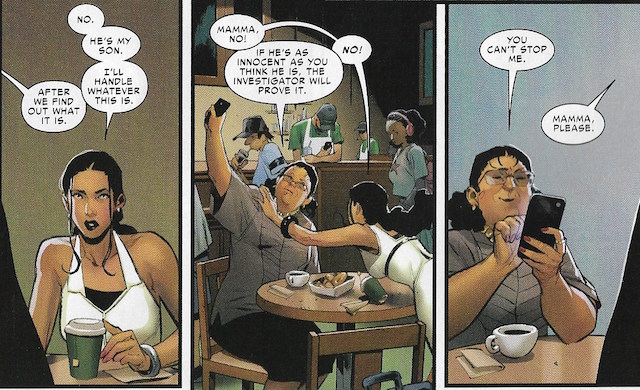
Miles Morales Grandma SM

The problem Spider-Man has, however, is that it appears to be trying too hard to establish Miles Morales as “the” Spider-Man. Unfortunately, just adding power after power after power to the kid actually ends up doing him a disservice.

When it becomes apparent that a writer is desperate to have his pet creation immediately enter the upper echelons of Marvel greatness, it becomes a turnoff for readers. This reviewer may be jumping off the book soon if the trend continues for much longer.

Black Panther #3: Plodding, pretentious book thrills … author’s aunt, bores non-family

Black Panther 3

Marvel took a leap of faith by giving a man with zero experience writing comic books the reins to Black Panther. Writer Ta-Nehisi Coates is primarily known for his academic work and political commentary, but the brass behind the scenes thought he could quickly make the transition. That has not happened.

The third issue of Black Panther is a meandering mess. It is pretentious and plodding to such an extent that it is hard to imagine sustained sales for twelve issues without incredible hype and a hefty amount of variant covers.

Here is what you need to know about this issue:

  • T’Challa continues to doubt his ability to lead Wakanda. His mother corrects him: “You say you are clouded. No. The problem is not your blindness. It is your clarity.”
  • The Midnight Angels, lovers Aneka and Ayo, subdue the White Gorilla Army.
  • T’Challa “stalks the soul” of Zenzi, the women who is helping to fuel a Wakandan insurgency in the Nigandan Borderlands.
  • A spiritual ally of Zenzi takes down Black Panther and his “war dogs. He says, “You dare accuse us of treachery…you, who plotted with those who drowned our people? You, who schemed while men murdered your uncle and ransomed your mother? Who fled while Wakanda burned? Who left our queen, your own sister, to die alone? Some of us remember the old ways, Haramu-Fal. … The worms of the earth shall devour all wolves, lions and leopards.”
  • T’Challa’s sister tries to find her soul on another plane of existence. She talks to a being who encompasses “all” of her “mothers” throughout time and is then armed with “the drum, for it carries the greatest power of all…the power of memory.”

If you had a hard time grinding out that summary, then imagine what it would be like to read three issues. As I said in my reviews for Black Panther #1 and Black Panther #2, Mr. Coates is clearly an intelligent man — but that doesn’t necessarily translate into an ability to write exciting comic books.

Complicating matters further is the fact that readers do not sympathize with the hero-king because the “villains” in many ways are portrayed as misguided or semi-righteous victims.

Instead of writing a story that would resonate with the majority of Black Panther fans, Mr. Coates appears to have used the character to work out his own personal hangups. It was a mistake, and someone at Marvel might want to talk to him about it as soon as possible.

Perhaps the easiest way to sum up Black Panther’s core audience is to give potential customers a look at the letters to the editor section.

  • “I just wanted to write in to congratulate you on writing something that I think the 9-year-old you would, and the 25-year-old me does, find amazing.” — Katie.

Katie’s analysis is delusional. Unless Mr. Coates was a weird kid, he would not eagerly await the story his adult self is telling. This is a book that excites people who watch the PBS News Hour — not kids — which brings us to our second reader.

  • “I haven’t read any new comics (except for some ‘event-related collections’) in nearly 20 years but I really enjoyed Mr. Coates’ appearances on the PBS News Hour and like most Marvel fans, I have long been a fan of Black Panther.” — Tom.

Tom is such a big fan of Black Panther that he hasn’t regularly purchased comics in 20 years. He will continue to buy the book due to a sense of ideological loyalty — a fellow PBS man is writing comics. Tut-tut! (What wine pairs best with Black Panther consumption? I need to find out and then pick it up on my next artisan cheese run.)

  • “Ta-Nehisi Coates…I played with doll babies, read Archie and Peanut comics, but never had an interest in super heroes. I am 67 years old and read Black Panther #1 cover to cover. … In some way, it reminds me of what we as a people have done or are doing to our brothers and sisters now.” — Aunt Jo Ann (Yes, Mr. Coates’ aunt).

Mr. Coates’ aunt is now telling readers what a great book he writes. ‘Nuff said.

I wanted to give this title at least six issues, but I cannot. I’m tapping out. Perhaps one day Mr. Coates’ will figure out how to write an intelligent, exciting and focused comic book, but as of now he has a long way to go. One out of three does not cut it. I wish him the best.

Nick Spencer’s Hydra-Cap #2: Brevoort’s ‘not a gimmick’ line a lie for quick sales

Red Skull Kobik

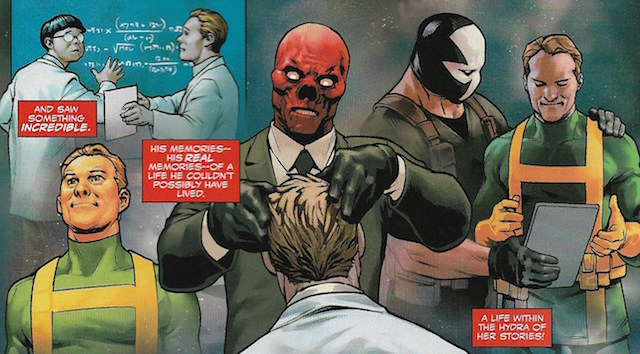
It was one month ago that Marvel executive editor Tom Brevoort and writer Nick Spencer asserted to the world that Captain America’s “Hail Hydra” moment was “not a gimmick.”  Sure, they responded to outrage by trying to Jedi mind-trick readers into forgetting the whole Nazi aspect of Hydra, Red Skull, and his crew, but the message was clear: Hydra-Cap wasn’t a shameless cash grab. Captain America: Steve Rogers #2, however, makes it clear that Mr. Brevoort has no qualms about lying if it will line Marvel’s pockets with short-term cash.

Here is what you need to know about the issue:

  • Kobik, the sentient Cosmic Cube, sought out Red Skull the moment she manifested in S.H.I.E.L.D. headquarters years ago.
  • Dr. Selvig and S.H.I.E.L.D. never knew that Kobik was being raised by Red Skull, who led her to believe the most ideal world would be one run by Hydra. The doctor’s mind was altered before his initial suspicions were confirmed.
  • Red Skull used Pleasant Hill, an super villain prison created by Kobik, as bait for Captain America.
  • Everything that transpired at the reality-altering facility was orchestrated so that Kobik would implant a false past — a Hydra-inspired past — into Steve Roger’s mind.

Most readers, your friendly neighborhood blogger included, assumed things would eventually be put right after “Cosmic-Cube weirdness” was revealed. We knew what Marvel was doing, but a.) objected to story as a matter of principle — writers should not desecrate a hero for mere shock value, and b.) deemed the length of time it was implied that Hydra-Cap would be working for the terrorist organization as a betrayal of the character.

Blind supporters of Messrs. Brevoort and Spencer made it seem like critics were hyper-impatient, when it was Marvel that created the perception that bread crumbs would be dropped over the course of months.

“I thought we wouldn’t know this much for at least five or six months,” the manager at my local comic shop said when I asked him what he thought about the issue. We both wondered if the timeline was accelerated due to fan backlash, but the owner said he was confident that was not the case.

All of this begs the question: Why?

Why would Marvel expend so much time and effort lying to its fans for a short-term sales boost?

Red Skull Selvig

That answer appears to be two-fold:

  1. The people running the show have no shame. Ironically, the writer who rails against Donald Trump now subscribes to the same “all publicity is good publicity” philosophy that has been perfected by the billionaire.
  2. Marvel Comics, which is currently populated by a slew of petulant man-boys, wanted to steal headlines from DC Comics’ Rebirth.

A rising tide lifts all boats, but guys like Tom Brevoort are working overtime to needlessly torpedo ships that sail the same ocean.

If that is the kind of behavior you want to reward, then head on over to your local comic shop as soon as possible. Otherwise, save the $4.00 for a day when the “House of Ideas” once again has significant floor space dedicated to respecting long-time readers.

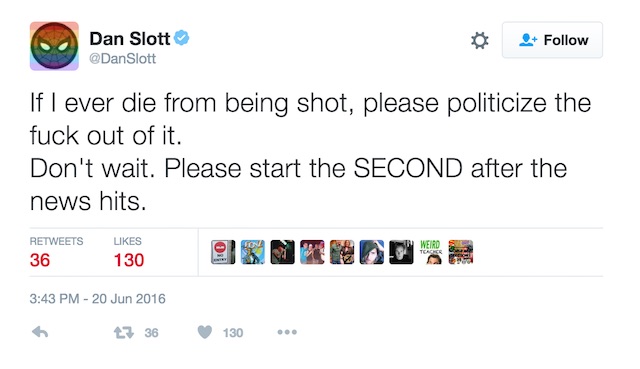
Dan Slott: ‘Politicize the f–k’ out of tragedy, ignore 5th Amendment to strip innocents of rights

Dan Slott

Marvel writer Dan Slott recently let it be known that he really doesn’t like it when Christians pray after Islamic terror attacks, but this week he made it clear that exploiting raw emotions after a tragedy is good and virtuous — “politicize the f–k” out of such moments were his exact words. He also wants innocent Muslims, Jews, Christians, atheists — all Americans, in fact — to know that it is “crazy” to uphold the 5th Amendment to the U.S. Constitution.

Due process? Who needs that? Police states are so much more efficient.

Dan Slott no fly list tweet

Men like Dan Slott are political vultures. They swarm around in circles and wait for people to die before tearing at the carcasses. There are millions of Americans who will look at the gruesome spectacle and agree to anything to get it to stop, but luckily there are others who use logic and reason to ensure the blessings of liberty for future generations.

South Carolina Rep. Try Gowdy, for instance, demonstrated after the San Bernardino, California, terrorist attack just how dangerous it would be to deny an innocents their constitutionally protected rights because the government suspects them of a committing a crime.

Mr. Gowdy had the following exchange in December with Kelli Burriesci, Deputy Assistant Secretary for Screening Coordination, Office of Policy of the United States Department of Homeland Security:

Trey Gowdy: Let me ask you a question about the terrorism list. What process is afforded a U.S. citizen — not someone who overstayed a visa, not someone who crossed a border without permission — but an American citizen?  What process is currently afforded an American citizen before they go on that list?

DHS: I’m sorry, there is not a process afforded the citizen prior to getting on the list. There is a process should someone feel they are and unduly placed on the list.

Gowdy: Yes there is. And when I say ‘process,’ I’m actually using half of the term due process, which is a phrase we find in the Constitution — that you cannot deprive people of certain things without due process.

So I understand Mister Goode’s idea, which is wait until you’re right has been taken from you and then you can petition the government to get it back. I understand that that’s his idea. My question is can you name another constitutional right that we have that is chilled until you find out it’s chilled, and then you have to petition the government to get it back? Is that true of the First Amendment?

DHS: Sir, there are strict criteria before anyone gets put on the list.

Trey Gowdy: That’s not my question ma’am. That is not my question. My question is what process is afforded a United States citizen before that person’s constitutional right is infringed? He’s fine when we do it with the Second Amendment. My question is, ‘How about the First?’ How about we not let them set up a website or Google account? How about we not let him join a church until until they can petition the government to get off the list. How about not get a lawyer? How about the Sixth Amendment?

How about you can’t get a lawyer until you petition the government to get off the list? Or my favorite — how about the Eighth amendment? We’re going to subject you to cruel and unusual punishment until you petitioned the government to get off the list.Is there another constitutional right that we treat the same way for American citizens that we do the Second Amendment? Can you think of one? **pause** Can you think of one?

DHS: I don’t have an answer for you, sir.

Ms. Burriesci didn’t have an answer because deep down she knows that Mr. Gowdy is correct.

Do you know who else agrees with Mr. Gowdy and not with comic book writer Dan Slott?

Answer: The American Civil Liberties Union.

“The standards for inclusion on the No Fly List are unconstitutionally vague, and innocent people are blacklisted without a fair process to correct government error,” the ACLU wrote on Dec. 7, 2015. “The government has emphasized that it is making predictive judgments that people like our clients — who have never been charged let alone convicted of a crime — might nevertheless pose a threat. That’s a perilous thing for it to do.”

How would Dan Slott feel if, 50 years from now, Jews in the United States were routinely put on terrorist watch lists because they were merely suspected of crimes? They could not fly, they could not own weapons, and perhaps their 8th Amendment rights were frozen until they could prove they weren’t terrorists.

That sounds pretty scary, right? Not to Dan Slott.

If you think due process is an essential component to living in a free society, then Dan Slott insults you on Twitter. That is because, like I said, he is a political vulture. It may be fitting for a guy who regularly writes about Spider-Man’s villains, but it is not funny.

With that said, I highly suggest listening to Reason’s Remy sing “How to React to a Tragedy,” with Dan Slott in mind. It perfectly lampoons activist-writers like those employed by Marvel.

Editor’s Note: Hat tip to Colossus of Rhodey for bringing attention to Mr. Slott’s tweets.

Civil War II #2: ‘Torture’ Stark duplicates dumb mistakes from 2006

CV2 No2 IM Md

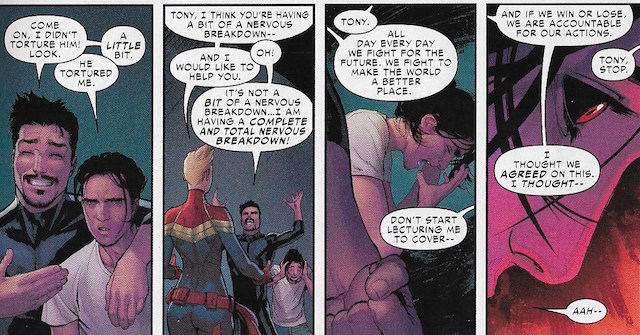
It was one month ago that this blog asked if Marvel’s Civil War II would avoid the kind of mistakes made during 2006’s first Civil War event. Mark Millar and others turned Tony Stark into a Dick Cheney-esque villain to forward an embarrassing Bush administration allegory, and as a result the story tanked. Brian Michael Bendis has seemingly learned nothing in ten years. His Tony Stark jokes about torturing others “a little bit” in scenes that are unnecessary in terms of moving the plot forward.

Here is what you need to know for Civil War II #2:

  • Tony Stark goes to New Attilan and kidnaps Ulysses. An Iron Man decoy defeats Medussa and Karnak while the real Tony escapes to a secret location.
  • The Inhumans head to Stark Tower. Karnak vows to tear it down when S.H.I.E.L.D., Captain Marvel and the rest of The Ultimates appear.
  • Captain Marvel wants “one chance” to get Tony under control.
  • Tony hooks Ulysses up to a brain scanner and threatens to beat him to see how the young man’s brain waves affect his precognition.
  • Friday downloads a “copy” of Ulysses’ brain just before the other heroes locate Tony Stark and confront him.
  • Ulysses says Tony tortured him, and the billionaire’s response with a smile is, “a little bit,” (because torture is supposed to be funny?).
  • Ulysses has a vision that the Hulk kills all the heroes, but this time the episode is seen by everyone in the room.
  • Captain Marvel arrives at Bruce Banner’s lab in Alpine, Utah.

While one can debate the definition of torture all day, it is much harder to deny that the scene in question was unnecessary. It only serves to make Mr. Stark look unhinged.

Ulysses even says, “You could have asked me to do these tests,” to which Tony says nothing. There is no response because Tony Stark, even while grieving for his friend, would have demanded an opportunity to study the kid’s brain.

Given that Ulysses has said he is (or was) a huge fan of Tony Stark, and given that the Inhumans let him web-sling around New York City with Spider-Man, it’s a safe bet that they would have allowed him to wear a few brain scanners. There is no reason to engage in character assassination in order to tell a good story, but for some strange reason Marvel likes turning Tony Stark into something from CIA leaker Edward Snowden’s worst nightmares.

CV2 No2 Im Uly

Stark’s CIA black site tactics are then juxtaposed with the measured diplomacy of female heroes. Bendis writes a scene that screams, “Imagine if the world were run by women — there would be no more wars! They would look into each other’s eyes, connect with universal sisterhood of things, and come to an agreement. Darn those…those…men!”

CV2 No2 Md Cm

The problem with hero versus hero events is that it is obvious that Marvel’s current staff does not know how to write a legitimately balanced story. The Russo brothers proved that it can be done with Captain America: Civil War, but for some unknown reason the comic book scribes are incapable of such a feat.

The result, sadly, is that readers think, “These guys are dysfunctional losers. The world would be better off without them. Why should I buy this?”

CV2 No2 Im Uly2

Civil War II could have been an intriguing tale, but turning Tony Stark into “Torture” Stark does not bode well for future issues. Perhaps Bendis will right the ship, but as of now it looks like it’s the captain who is trying to sink his own vessel.

CV2 No2 Hulk Uly vision

Amazing Spider-Man #14: Dan Slott puts ‘lipstick on a Regent-pig’

Regent SheThor

Marvel scribe Dan Slott hit a home run with 2015’s Renew Your Vows, but the feat happened despite the creation of a lame villain — Regent. ASM #14 attempts to once again elevate the character into upper echelons of evil, but one cannot help but think of the old line about putting “lipstick on a pig” while reading. Giuseppe Camuncoli puts forth a worthy effort to make the character look cool in costume (don’t ask about supporting cast), but readers care more about the side-stories than the main event.

Here is what you need to know about ASM #14.

  • Ms. Marvel, Nova, Captain America, Vision, and She-Thor are all captured by Regent.
  • Peter Parker, Tony Stark, and MJ tell Miles Morales’ parents that their son (also taken hostage) won a science contest, but is safe … somewhere … with no internet access … on purpose. (Note: This kind of idea only worked in Captain America: Civil War because Peter Parker wasn’t missing.)
  •  MJ tells Peter, “You have no idea how glad I am to have all of this ‘secret identity’ nonsense out of my life. Tony’s not perfect, but with him everything is out in the open.” (Don’t tell Dan Slott, but that is 180 degrees from the truth — Bendis’ Tony Stark disappears for weeks at a time for undercover missions, and no-one knows if he’s dead or alive.)
  • Aunt May coughs up blood and keeps it from her husband.
  • Harry Osborn Lyman calls for a meeting with Augustus Roman and reveals that he knows the businessman is Regent. Harry says he knows Betty Brant was kidnapped, and then uses webware to warn Spider-Man that he is in danger.
  • Spider-Man and Iron Man are crushed by Regent, whose suit was pushed to its limit.

Even if one were to take the position that Regent is an exciting new character, it doesn’t change the fact that readers are getting a rehashed version of Renew Your Vows less than one year after its publication. At least when Marvel does something as tired and worn out as Aunt May dying…the company waits a few years before hitting the “recycle” button. This is like a rerun of your favorite television show after the first three episodes of its new season.

Aunt May

As is often the case with Mr. Slott’s work, there are a lot of pieces shuffled around the chessboard while ultimately not a whole lot goes on. The story bounces from setup to setup (You’re going to love how this comes together in Dead No More, kids!) while ignoring the attention to detail that makes single issues soar.

For instance, Regent dispatches with heavy-hitting heroes like Vision and Captain America in a single panel. He battles She-Thor in what is teased as an epic clash, only to show her captured in an energy bubble two pages later. It’s jarring. It’s strange, and it just isn’t enough for a relatively new character who is met with indifference by most fans.

Regent

If you are the kind of Marvel fan who has collected ASM since 1975 and don’t want to break up your complete set, then make sure to head on out to your local comic book shop this week. For everyone else, I suggest waiting until the reviews for Dead No More are published before you consider opening up your wallets.

Daredevil #8: ‘Blind Man’s Bluff’ starts strong, teases Spider-Man team-up

Matt Murdock

It is fitting that Daredevil #8 takes place inside a Macau casino because readers must be wondering how long Charles Soule’s creative hot streak is going to last. “Blind Man’s Bluff” kicks off a new tale for Matt Murdock, and as far as stage-setters go the writer churns out another solid performance.

Is Mr. Soule just a lucky guy, or is his good fortune on the book positively correlated with his preparation and work ethic? This reviewer is inclined to go with the latter option.

Here is what you need to know about Daredevil #8 before we move on:

  • Matt Murdock has traveled to Macau for a winner-take-all poker tournament. He plays Texas Hold ‘Em because its rules are best suited for … a blind man with enhanced senses.
  • Daredevil is looking for an item that Black Cat sent to China.
  • A mysterious woman named Adhira latches onto Matt after he dominates his competitors.
  • The final round of the tournament features a telepath named Apex who is employed by the casino to make sure it never loses money. Matt’s telepathic defenses are pushed to the limits, but he ultimately holds out and wins a check for $10 million — made out to the alias Laurent Levasseur. (Note: He can’t cash the check.)
  • The casino gives Matt a complimentary stay in its best suite to keep him in town. Adhira also appears and asks to talk about his poker skills. He reminds her that he has a “friend” to meet, and the last page ends with Spider-Man telling Daredevil, “Took you long enough.”

One of the best things about Mr. Soule’s work on The Man Without Fear is that everything he does feels natural. Whether Matt Murdock is in a courtroom, battling ninjas, on a date with a beautiful woman, or in a high-stakes gambling tournament … everything feels right.

Ask yourself the following questions:

The answer (for many readers) is “No.”

With Daredevil, however, fans get stories that respect the character’s past while clearly charting a path forward. It says something about the quality of the title that Daredevil #8’s worst element is Goran Sudžuka’s artwork, which even isn’t bad; he just didn’t perform at Matteo Buffagni’s level with this particular issue.

“Why do I do this? Why do I always have to roll the dice?” Matt Murdock says at one point. “I’m always chasing. Trying to make up my losses. Betting everything I have to get back in the game. My identity, Kirsten, Foggy, my happiness…my life. On some level, I now it’s foolish. A compulsion. But if I don’t play…”

Readers take note: Charles Soule put more introspection into a single page of Daredevil than The Amazing Spider-Man writer Dan Slott has done in years with Peter Parker — a hero who was resurrected from the dead after a megalomaniac took over his body.

The point is this: If you have been unhappy with ASM for years but are still buying it out of sheer love for the character, then you owe it to yourself to purchase a book that consistently performs. There is no reason to give Marvel Comics money for dreck like Hydra-Cap (and an author who says all Republicans are “evil”), when someone like Mr. Soule is firing on all cylinders with Daredevil.

With that said, I will end this review with two points:

  1. I am not in Mr. Soule’s payroll, even if it seems like it at the moment.
  2. I look forward to seeing what the writer does with Spider-Man. That will be a true test of his creative prowess. If he hits a home run with the wall crawler, then I may have to announce a Charles Soule prize for one of the many Douglas Ernst C.R.O.N.I.E.S. (Comics Reconnaissance Operator, Negotiator, Intelligence Expert, and Soldier) around the globe.

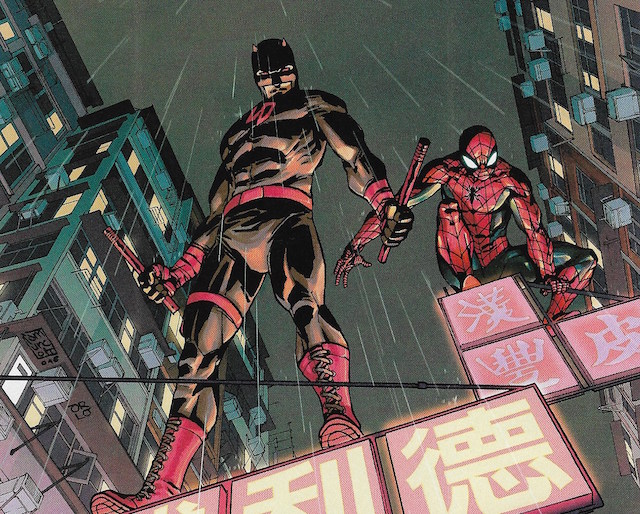
Daredevil Spider-Man

‘Civil War II: Amazing Spider-Man #1’: Gage offers reprieve from Slott fare

Civil War II ASM 1

Civil War II: Amazing Spider-Man #1 came out on Wednesday, which gave Marvel fans an opportunity to see how everyone’s favorite wall crawler reacted to the Inhuman prognosticator at its core.  It is safe to say that writer Christos Gage offered more intrigue in a single issue than ASM writer Dan Slott in months.

Here is what you need to know for Civil War II: Amazing Spider-Man #1:

  • Peter Parker lands in New York City after a long flight from Shanghai. He crawls into bed at Parker Industries headquarters to take a quick nap and is shocked to find Johnny Storm — naked. He tells Johnny to put some clothes on or “flame on” so he can turn around. The Human Torch reminds Peter that he is scheduled to spend time with Ulysses, the Inhuman who can see and “experience” possible futures.
  • Spider-Man takes down the Vulture and the “Vulturions” over New York City. Ulysses is with the hero.
  • The two men make their way to Chinatown and stop a rage-filled man who was going to murder his ex-girlfriend.
  • Spider-Man tells Ulysses that if he hones his power, then he can help Parker Industries narrow down projects that will make it through the research and development phase — and therefore help a greater number of people.
  • Ulysses takes a tour of Parker Industries and meets Harry Osborn  **cough**Lyman**cough** and Clayton Cole.
  • Ulysses tells Spider-Man that Clayton Cole, aka Clash, will likely revert to his old ways. The Inhuman tells Spider-Man to prepare for an attack.

As I mentioned in the comments section of my review for Civil War II #1, there is incredible danger in fully embracing a man who only sees possible futures. Ulysses actually admits in the issue that his predictions “almost” always come true, but not 100 percent of the time.

What if, simply by allowing doubt to creep into his mind over his employee’s integrity, Peter Parker inadvertently plants the seeds for Mr. Cole’s recidivism?

What if Ulysses is unknowingly a harbinger of doom that can only transpire if heroes alter the “future-dominos” for him?

These are all very interesting questions, the kind of which are sorely lacking in The Amazingly Immature Spider-Man these days.

Clayton Cole Cvil War II ASM 1

Perhaps the only odd note the issue hits is the opportunistic way that Peter latches onto Ulysses and his ability. He rightly tells the young man that he can probably use his powers to affect more lives than he realizes, but the moment is ruined with a hasty job offer at Parker Industries. Readers want to believe Peter is not exploiting the situation, but it’s hard not to wonder given how petty and immature the character is under Slott’s direction.

Overall, if you’re looking for a book that gets the Civil War II ball rolling, then check out Christos Gage’s work. His effort also serves as a good audition for the role of lead ASM scribe. For the first time in many months I have not felt embarrassed for the title, and that is a good thing. I look forward to buying Civil War II: Amazing Spider-Man 2.

Civil War II ASM 1 Spider-Man

Exit Question: Is it me, or did this issue highlight how Peter Parker filled his entire inner circle at the company — courtesy of Dan Slott — with back-stabbers, criminals, and super villains?

  • Anna Maria Marconi: Doc Ock’s girlfriend. She went behind Peter’s back with Sanjani on Doc Ock’s nano-technology project.
  • Sanjani: She tried to strike a deal with The Ghost — a corporate saboteur — to destroy Parker Industries.
  • Lien Tang: Peter’s girlfriend tried to murder Spider-Man and traded company secrets to a terrorist organization.
  • Jacob Fury, aka Vernon Jacobs: Parker Industries’ biggest shareholder — and Peter’s “secret Santa” at the company Christmas party — ended up being the terrorist mastermind Scorpio.
  • Clayton Cole: Mr. Cole was formerly the villain known as Clash.
  • Harry Osborn: It’s really only a matter of time before Harry falls off the Green Goblin wagon. We might as well get it over with.
  • Living Brain: The robot is Doctor Octopus.

Civil War II #1: Rhodey’s death a missed opportunity

Rhodey Thanos Civil War II

Marvel Comics’ Civil War II officially kicked off on June 1 with James Rhodes … kicking the bucket. Fans were given a hint of his fate in late may with Civil War II #0, but writer Brian Michael Bendis and artist David Marquez made sure by the end of the first issue that everyone knew War Machine just saw his last* battle. It is hard not to believe, however, that killing Rhodey instead of pitting him against his best friend over a complex issue was an error on Marvel’s part.

Here is what you need to know for Civil War II #1:

  • A huge cast of superheroes square off against a Celestial Destroyer. A tip by The Inhumans allowed Iron Man, Dr. Strange, Captain Marvel and the others to devise a plan that would send the entity to its home dimension.
  • Tony Stark throws a party for the “unqualified, top-to-bottom home run of a win.” The mood is spoiled when it is revealed that Ulysses, an Inhuman who “experiences” the future, was the one who provided intelligence on the Celestial Destroyer’s arrival.
  • Captain Marvel asks Ulysses if he wants a job with The Ultimates after Jean Grey fails to read his mind. Tony Stark wants nothing to do with the young man. He warns everyone that using Ulysses’ power to confront people over a possible future is dangerous and wrong.
  • Ulysses has a vision of Thanos coming to earth and tells The Inhumans to contact Captain Marvel.
  • The events of Civil War II #0 unfold. She Hulk is greatly injured and Rhodey dies.
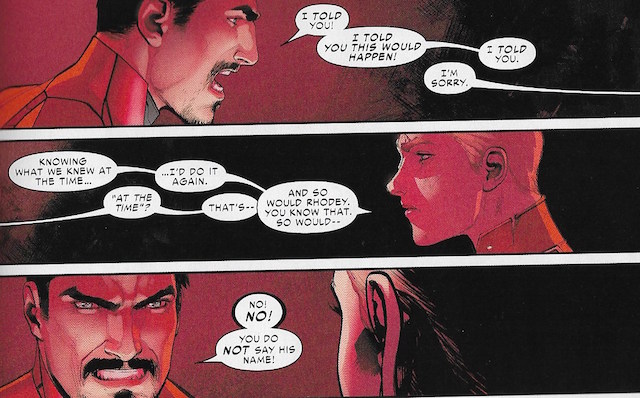
  • Tony confronts Carol Danvers, aka Captain Marvel. She tells Tony what happened and his is livid. “I told you! I told you this would happen!” he screams. Carol says she did the right thing and that Rhodey would act no differently if he had it all to do over again.
  • Tony storms off to “make sure none of [the superheroes] play God again.” She Hulk wakes from a coma and tells Captain Marvel to fight for the future (“It’s our future, Carol. Not his.”) before her heart stops.  Doctors try to revive her and the issue ends.

The good thing about Marvel’s decision is that there are plenty of legitimate arguments to be made for killing Rhodey. Unlike turning Steve Rogers into a Nazi-sympathizing Hydra Agent, James Rhodes’ integrity was not violated in the decision-making process. Soldiers die. Every time a warrior steps onto the battlefield, he knows that he might not live to see another day. That’s just how it works.

The bad thing about Marvel’s decision is that it robs readers of a chance to see two friends battle over fierce ideological differences while ultimately finding peace in the end. Both Tony and James would respect the other’s willingness to die for core principles, and in the long run their friendship would probably be stronger for having gone through the ordeal.

A standoff between Tony and Carol has the potential to be powerful, but the better choice would have been Tony vs. James.

Civil War II 1 Iron Man Rhodey

In short, Civil War II appears as though it will be a good read if Marvel finds a way to avoid the mistakes of Civil War I (e.g., inserting partisan politics in the story to make on side look evil). It’s just unfortunate that Bendis missed an opportunity to dial up the dramatic tension by keeping Rhodey alive.

*“Last battle” until a Cosmic Cube, a magical gem, or a spell brings him back to life.

Iron Man Captain Marvel