Dan Slott’s Peter Parker: Spineless whipping boy for supporting female cast

Parker Industries ASM 18

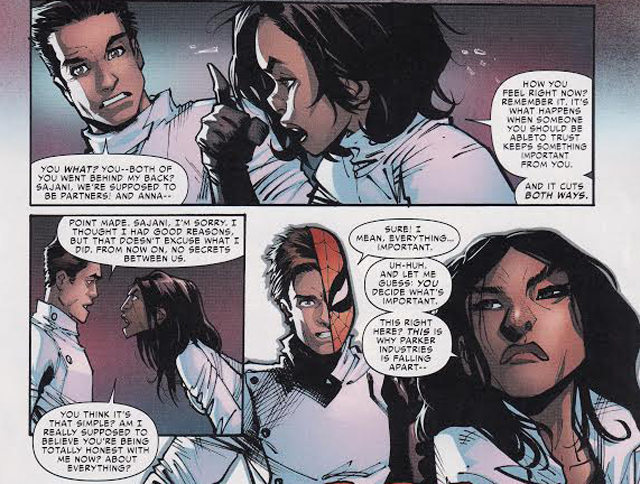
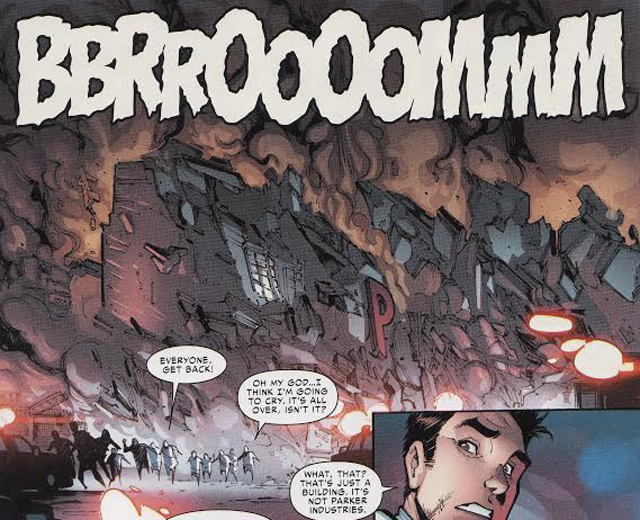
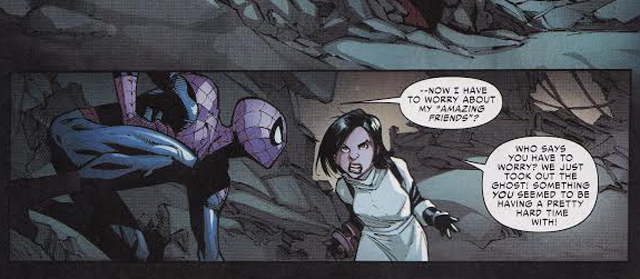
The 18th issue of The Amazing Spider-Man features Parker Industries collapsing into a smouldering pile of rubble. This is fitting because the character’s credibility now exists as sad and twisted wreckage under Dan Slott’s direction. Leading into Spider-Verse, the most memorable moment was the time Peter had to be saved by Silk and nursed back to health by Anna Maria. During Spider-Verse he became a Where’s Waldo-ish character in his own book. Now, as Renew Your Vows closes in, he becomes a spineless whipping boy for Anna and Sajani.

SpiderMan Anna ASM 18

Perhaps other Spider-Man fans can chime in, but when did Anna Maria become Peter Parker’s mom, who is often written as if she should have a halo around her head? “Anna’s covering my butt…literally. She thought of everything. Again,” Peter says to himself after the supporting cast member saves him from Ghost. Not only is Ms. Marconi saintly and wise, but she has the inner strength to save the suddenly-hapless Spider-Man from his own incompetence — during battle.

Amazing SpiderMan 18Perhaps worst of all is the way the book’s hero — and company CEO — just sits there and takes the bizarre rantings of the horribly-written Sajani. At what point do fans corner Dan Slott and force him to admit that he’s turned Peter Parker into an impotent clown in order to highlight Anna Maria’s awesomeness? When do they ask him why he feels the need to shoehorn “girl power” messages into The Amazing Spider-Man instead of just telling solid stories?

  • Silk, although locked away for most of her life, is Peter’s equal or a better when it comes to the superhero business.
  • Anna Maria Marconi is the voice of reason, a source of strength, and an anchor that keeps Peter grounded.
  • Sajani pushes CEO-Parker around like he’s some low-level employee who is on thin ice for constantly screwing up.
  • Black Cat is a megalomaniac super-villain who can orchestrate a Spider-Man beat-down and near-unmasking for a national television audience.

Over and over and over again throughout Dan Slott’s run, Peter Parker is marginalized in his own title — and yet Marvel wants fans to believe that he loves the character. The reboot should have been called The Sensational Silk, Spider-Verse gave fans the inspirational Uncle Ben speech delivered by Doctor Octopus, and now ASM #18 presents the hero more like an immature kid who could barely tie his own shoes, let alone stop a super-villain or run a business.

If you are short on cash this month, then do not buy this book. It is so bad that you may find yourself wishing Marvel uses Secret Wars to erase most of Peter Parker’s history.

The power of prayer: A blueprint for realizing faith’s potential

It is incredibly tough to get those who do not believe in prayer to understand how it works. Even those who do believe in God often pray in strange ways and then get frustrated by the results. Since prayer recently helped me regain my work-related Twitter account after it was unjustly suspended, I will try to use that story to explain how it works.

First, a recap:

  • After I wrote a story on Iran for work, an apologist for the regime Tweeted “I will find you and kill you … death to America.”
  • Twitter said it “could not determine” if that violated its terms of service. When I publicly questioned that decision, my account was suspended. Countless appeals were ignored over the course of one month.
  • The company’s press account ignored my emails and the emails of my co-workers.
  • A Washington, D.C. spokesman for Twitter ignored an inquiry by my employer.
  • Public pressure from countless Twitter followers and a story by WND did nothing to forward the process along.
  • My attempts to get certain conservative media outlets and personalities to take up my cause fell on deaf ears.
  • Well-connected people said they were at a loss as to how to help me. They essentially said my cause was hopeless.

During this whole ordeal I had a conversation with a friend about well-known personalities who did nothing to help me. I told my friend that it didn’t bother me because if God ultimately wanted to use them to help me, then He would. I prayed for an entire month, and last night I prayed throughout most of the night when an idea came to me: I would email Twitter’s CEO. I would make the case that he needed to intervene on my behalf. Then the words came to mind. When work started I didn’t know his email, but I took a chance on what I thought it might be — and I was right. Within 30 minutes of emailing him, my suspension was lifted and I received an apology from Twitter. A friend of mine said that what I did was something straight out of Ferris Bueller’s Day Off. I must admit, I did feel like the “The Sausage King of Chicago: Abe Froman.”

I nearly broke down into tears, knowing that my prayers had been answered. For someone who writes news for a living, Twitter is indispensable. Six-years worth of contacts and personalized news lists were restored.

Twitter apologyThis is just one story of many that I can tell where prayer has worked miracles in my life. If you’re interested in understanding how I pray and prepare for prayer, then here is the general blueprint:

  • A man’s heart must first be open to the possibility that God exists and that He and His angels hear our prayers.
  • We all have a lot to be grateful for, no matter what situation we find ourselves in. Prayer should take place after acknowledging those blessings. I often try to think about all the things that I am grateful for — to the point where I almost become overwhelmed with emotion.
  • Pray for the ability to discern God’s will and strength carry it out. If you are doing God’s will, then success is guaranteed.
  • Realize that what you may perceive as setbacks or failures on God’s part are never such things. If a man with night-vision was guiding you through a dark path and you occasionally slipped, would it make sense to get angry at him? How foolish would you feel if the path was suddenly illuminated and you realized that without the man’s help you would have fallen into a giant crevasse? In my story with Twitter, what would have happened if I shook my fist in anger and gave up when at least 10 different so-called media allies turned down my requests for help? Answer: I would not have come to a point where I would successfully email an insanely-busy CEO with a net worth of roughly $450 million.
  • Believe that the crosses that you carry are the burdens you must bear. There are very good reasons why hardship exists. With each obstacle we overcome, there are lessons to be learned. You should find a way to be grateful — even for those things in your life that cause pain or, at a cursory level, seem unwanted. Pray for the ability to understand the lessons God is trying to teach you.
  • Work hard. Prepare. Know your God-given talents and then hone them to perfection. Take my situation with Twitter. Imagine that I prayed, “God, if it is your will, please assist me in regaining my Twitter account,” and then sat on my butt waiting for a miracle that seemed to be denied. Now imagine me asking God why he denied my prayer and His response: “I made you a talented writer, but instead of writing to Twitter’s CEO and trusting in me, you took that talent for granted and expected some sort of dazzling light show. That was kind of a weird move on your part, don’t you think?”

I can probably add to this list, but that is a good start. I’m confident that someone who takes this advice will see amazing results over time. It is a humbling experience to see just how prayers can be perfectly answered. Often I reflect on how seamlessly some of them have been answered and cannot help but well up. A passing glimpse at perfection — true perfection — is a thing of beauty, but at the same time it can be emotionally crippling. Perhaps others have had a different experience, but my own brief tastes of infinite knowledge and infinite love can only be dwelt in for mere moments. It is a paralyzing epiphany to realize that on many levels we are comically insignificant beings, yet infinitely loved by our Creator.

If you believe in God, then I hope my prayer blueprint can be of use to you. If you do not believe in God, then hopefully I have given you some worthwhile insight into a Catholic mind that’s been around since 1979. In either case, thanks for reading and know that there’s a good chance that on random nights I am praying for you, too.

Daredevil: Charlie Cox and crew give fans a winning Marvel crime drama

Daredevil Cast

At some point in time an executive at ABC Studios said, “I think Daredevil would be perfect for Netflix.” That man or woman should be given a raise, because all 13 episodes of the show’s first season come together to form an incredibly entertaining product. Charlie Cox in the starring role does a commendable job as Matt Murdock, and most of his supporting cast delivers solid performances (particularly Vondie Curtis-Hall as Ben Urich).

One of the best scenes that sums up what Daredevil is all about involves courtroom closing arguments in the third episode. Matt and his law partner, Foggy Nelson (Elden Henson), must give an honest defense for a dubious client.

Mr. Murdock says:

“Ladies and gentlemen of the jury, forgive me if I seem distracted. I’ve been preoccupied as of late with questions of morality. Of right and wrong, good and evil. Sometimes the delineation between the two is a sharp line. Sometimes it’s a blur. And often it’s like pornography — you just know it when you see it.

A man is dead. I don’t mean to make light of that. But these questions — these questions — are vital because they tether us to each other, to humanity. Not everyone feels this way. Not everyone sees the sharp line, only the blur. A man is dead. A man is dead, and my client, John Healy, took his life. This is not in dispute. It is a matter of record. Of fact. And facts have no moral judgment. They merely state what is. Not what we think of them. Not what we feel. They just are. What was in my client’s heart when he took Mr. Prohaszka’s life — whether he is a good man or something else entirely — is irrelevant. These questions of good and evil, as important as they are, have no place in a court of law. Only the facts matter.

My client claimed he acted in self defense. Mr. Prohaszka’s associates have refused to make a statement regarding the incident. The only other witness, a frightened young woman, has stated that my client was pleasant and friendly, and that she only saw the struggle with Mr. Prohaszka after it had started. Those are the facts. Based on these — and these alone — the prosecution has failed to prove beyond a reasonable doubt that my client wasn’t acting solely in self-defense.  And those, ladies and gentlemen of the jury, are the facts. My client, based purely on the sanctity of the law, which we’ve all sworn to uphold, must be acquitted of these charges. Now, beyond that, beyond these walls, he may well face a  judgment of his own making. But here, in this courtroom, the judgment is yours and yours alone.” — Daredevil: Episode 3: Rabbit in a Snowstorm.

The fascinating thing about Daredevil is that each character has their own cross to bear, and over the course of the first season viewers get to see how they stumble, fall, get back up again, and continue moving forward while trying to find the righteous path. For Matt that means figuring out how to bring criminals to justice when the system designed to do just that has been corrupted.

Matt Murdock court

Matt Murdock is aided in that task by his Catholicism and a priest he speaks to for guidance. He even jokes with Claire during an exchange in “Cut Man” from Episode 2:

Claire: I find a guy in a dumpster who turns out to be some kind of blind vigilante who can do all sorts of weird shit — like smell cologne through walls and sense whether someone is unconscious or faking it. Slap on top of that he can take an unbelievable amount of punishment without one damn complaint.

Matt Murdock: That last part is the Catholicism.

Daredevil’s writers strike a fine balance throughout the season in terms of addressing Murdock’s faith. It is very much a part of who he is, but it never becomes preachy, nor is it denigrated. This is a welcome surprise; covering themes found in Hubert Van Zeller’s “Suffering, The Cross of Christ and Its Meaning For You,” will only make Daredevil a better show.

While Mr. Murdock draws strength from his spirituality, it is also stressed that all of us need friends and family to lean on in tough times. The crosses we carry can be heavy, and the body is often weak. Without trusted allies, many of us would not be long in this world.

Matt delivers this message during Episode 11’s “The Ones We Leave Behind.”:

Matt Murdock: I had a really shitty night. The kind where you think you’ve seen the bottom of humanity, but the pit keeps on getting deeper. You know? I can’t do this alone. I can’t. I can’t take another step.

Karen: You’re not alone. You never were.

In short, Daredevil is a great fusion of crime drama and superhero fare. If you have Netflix, then it’s worth checking out. If you don’t have Netflix, then you may want to consider getting it when Daredevil’s second season arrives.

Robert Downey Jr. ambushed over politics: Reporters want Iron Man to be a liberal activist

Robert Downey Jr Channel 4 InterviewI said in 2013 that one of the reasons conservatives defended Robert Downey Jr. was because liberals attacked the man. Perhaps the best example was the 2011 hit piece from Jeffrey Wells’ Hollywood Elsewhere (now flushed down the Memory Hole), in which an anonymous source said the actor’s values “are pure Republican values.” That came after an interview in The New York Times that drove liberals batty, but before the actor attended a fundraiser for President Obama. Apparently Robert Downey Jr’s ideological blasphemy is still stuck in the media’s craw because he was just ambushed during an interview with British reporter Krishnan Guru-Murthy.

The Huffington Post reported Wednesday on the interview, which ended with Marvel Studio’s Iron Man walking out:

Krishnan Guru-Murthy: I’d really like to ask you about a quote you gave to The New York Times. I don’t want to pry so if you don’t want to talk about it that’s fine, but what you said to The New York Times was — it was about, it was after your incarceration and you said that you can’t go from a $2,000 a night hotel suite to a penitentiary and understand it and come out a liberal. I just wondered what you meant by that.”

Robert Downey Jr.: The funny thing is — and I appreciate your point of view — things you said 5-7 years ago or things you said in an interview that made sense to you at the time — I could pick that apart for two hours and I’d be no closer to the truth than I’d be giving you some half-assed answer right now. I couldn’t even really tell you what a liberal is, so therein lies the answer to your question.

Krishnan Guru-Murthy: The statement sort of stands by itself, doesn’t it? Does that mean that you’re not a liberal? Or that you came out of a prison not being liberal?

Robert Downey Jr.: Are we promoting a movie? To me the thing is that it’s — I’m certainly not going to backpedal on anything I’ve said, but I wouldn’t say I’m a Republican or a liberal or a Democrat. I think when I was talking to the person who was doing the interview that day and that just happened to be my opinion. That’s the nice thing, you can have opinions and they change and flow.”

Robert Downey Jr. is in a horrible position. A guy who has been to prison probably realizes that hard-core criminals will never adopt the peace-love-dope worldview of liberal beat poetry readings and bongo-circles. Perhaps he’s a fiscal conservative who is socially liberal. Maybe he was against the war in Iraq but he understands that leaving radical Islamic head choppers the their own devices is a bad idea.

How does the man define himself politically, especially when he has to work with hard-core liberal activists like Joss Whedon and Mark Ruffalo? The best thing to do to keep the peace on set is probably to just stay silent and stick to playing Tony Stark really well — but that is not good enough for the media.

Robert Downey Jr. will always have to be on guard against a media ambush because he refuses to use his Twitter feed to lecture people on climate change. He doesn’t get into abortion politics. He doesn’t harangue people about minimum wage laws or demonize Republican politicians. This is unacceptable to pundits who want celebrities to push liberal politics on as many people as possible while they’re in the limelight.

Krishnan Guru-Murthy RDJ interviewThe vast majority of Americans do not want Hollywood stars to lecture them on public policy. They appreciate that Robert Downey Jr. keeps his politics close to the vest. They are glad that he walked out on Krishnan Guru-Murthy and wish more actors would follow his example.

The moral of the story is this: The creative team behind “Avengers: Age of Ultron” could learn a thing or two from Robert Downey Jr. If Marvel’s talent wants independent, libertarian, and conservative fans to continue flocking to Marvel Studio movies, then they should knock it off with the political activism.

Iceman is now gay because … diversity! Marvel hopes Brian Michael Bendis critics stay in the closet

Ice Man Bobby Drake gayOne of my older brothers used to read X-Men and X-Factor when I was growing up in the 80s. Regular readers know that I’ve always been a Spider-Man fan, but I think it’s safe to say that I read plenty of stories with Bobby Drake. Now, after all these years, Brian Michael Bendis has decided that the character is gay. Why? Answer: Diversity!

The Verge reported Tuesday:

Bobby Drake, otherwise known as classic X-Men member Iceman, will come out of the closet this week. In a collection of leaked panels from All-New X-Men #40, due out tomorrow, Drake finds himself outed by fellow teammate Jean Grey. The revelation makes Iceman one of the most prominent (and powerful) LGBT superheroes in Marvel comics, and is in keeping with the company’s push for more diversity among its characters.

The circumstances surrounding the character’s coming out are unique, to say the least. Readers discover that the past, teenaged Bobby Drake, who has been transported to the future along with the original X-Men to help solve a crisis, is gay. Meanwhile, the present-day Iceman — who is still very much around — has had relationships with multiple women in the past. Apparently, that was an act.

A writer who thinks that a character with a long history of dating women can convincingly be turned gay over night is almost as embarrassing as the writer who tells a long and involved tale that ends “…and then I woke up!” Only a company with zero respect for its audience would allow such lazy and transparent pandering to happen. Marvel expects its fans to clap like trained diversity seals who care more about politically correct editorial mandates than sound storytelling. Given that comic industry journalists are little more than Marvel and DC propaganda arms, it’s a good bet you will soon hear the sound of happy seals.

Perhaps just as bizarre was Brain Michael Bendis lamenting the fact that the issue couldn’t come out and “just be. no press. no sensational headlines.”

Brian Michael Bendis Ice Man gayIf Marvel created a brand new hero who just so happened to be gay — or perhaps a gay, disabled, black and Muslim super-powered diversity-mutant — then that could have happened. No one really cares about introducing new characters, but they do care about arbitrarily making drastic changes to a character they’ve known for decades. They also care when legitimate criticism runs up against men like Dan you-support-Jim-Crow-laws-if-you-think-Peter-Parker-should-stay-white Slott.

Read through the comments section on the websites reporting on the suddenly-gay Bobby Drake, and you’ll see plenty of the “you just have a thing against gay people” mentality on display. It’s sad and pathetic, but it’s the kind of stupid partisanship Marvel needs in spades if it plans to continue these stunts.

After years and years of evidence to the contrary, readers are now supposed to believe that the way to melt Iceman’s heart is to have a Y chromosome. If you’re not a fan of Marvel’s diversity for the sake of diversity business model, then I suggest walking away from the brand and letting them know on your regular circuit of comic-related news sites. Only when it bleeds enough in sales will the company possibly get the message.

Hat Tip: douglasernstblog.com reader Eidolon.

Ben Affleck went full-Lex Luthor instead of Batman, pushed PBS to censor slave-owning ancestry

Ben Affleck Bill MaherI said in August of 2013 that Ben Affleck’s political activism would derail the ability of many people to see Batman v Superman with an open mind. The actor would go on to insult Republican moviegoers by December. He then disappeared to make Gone Girl, only to almost break down into tears while discussing radical Islam with Bill Maher in October, 2014. Mr. Affleck is now in the news with another embarrassing story: he pressured PBS to censor his slave-owning ancestry while filming PBS’s Finding Your Roots series.

USA Today reported April 19 on the newest Wikileaks revelation:

The emails between Finding Your Roots host Henry Louis Gates and Sony chief executive Michael Lynton show Gates’ dealing with the issue of featuring the slave-owning portion of Affleck’s past on the popular PBS program.

“Here’s my dilemma: confidentially, for the first time, one of our guests has asked us to edit out something about one of his ancestors — the fact that he owned slaves,” Gates’ leaked email states. ” Now, four or five of our guests this season descend from slave owners, including Ken Burns. We’ve never had anyone ever try to censor or edit what we found. He’s a megastar. What do we do?” …

“Once we open the door to censorship, we lose control of the brand,” Gates writes in the emails, adding that he wouldn’t “demonize” the slave-owning ancestor.

“Now Anderson Cooper’s ancestor was a real s.o.b.; one of his slaves actually murdered him. Of course, the slave was promptly hanged. And Anderson didn’t miss a beat about that,” Gates writes.

The series ultimately did leave out Ben Affleck’s slave-owning ancestry, laughably saying “We decided to go with the story we used about his fascinating ancestor who became an occultist following the Civil War.” Sorry PBS, but now everyone knows that you have “lost control of the brand.”

A friend of mine asked why Ben Affleck would run from his history instead of embracing it. The answer once again ties back to the actor’s political activism.

Ben Affleck not only runs from history — he tries to revise it. He is the type of person who literally stops himself mid-sentence while saying Americans are endowed by their Creator with certain inalienable rights to say that Americans are “endowed by our forefathers with certain inalienable rights.” Rights don’t come from God, according to Batman — they come from a small group of liberal guys like Ben Affleck in the nation’s capital.

Given that the Hollywood actor is a committed liberal, it’s a safe bet to say that on the right episode of “Real Time” with Bill Maher, he would be happy to lecture Americans on “white privilege.” It’s also likely that when cornered on constitutional debates, he would resort to the tried-and-true red herring that “the founding fathers had slaves” (as if a man’s flaws invalidate the timeless principles he espouses).

Ben Affleck knows that the knowledge of his slave-owning ancestry makes it near-impossible for him to spew spurious racial arguments with impunity. Bloggers like yours truly will always be able to joke, “You know what, Ben? You’re right! We need to do something about white privilege. Why don’t you lead the way by paying reparations to Americans whose ancestors were chained and whipped by Old Man Affleck.”

It is now apparent that Ben Affleck will act manipulatively behind the scenes like a wannabe Lex Luthor when his political activism is threatened. There is no reason for a man to hide from his family’s past unless it threatens to topple the moral pedestal he stands upon while lecturing the rest of us.

If PBS executives are smart, then they will release a version of Finding Your Roots where Ben Affleck is confronted about his slave-owning ancestry. Why would anyone want to watch a show titled “Finding Your Roots” when in reality it should be called “Finding the Roots that Hollywood Wants You To See”? They wouldn’t.

Word of advice for Zack Synder: Tell Ben Affleck to go into his own personal Batcave and not come out until it’s time to promote Batman v Superman. It’s hard to believe Ben Affleck is Bruce Wayne when every few months he strengthens the impression that he’s really just a pampered Hollywood activist.

Batman v Superman teaser trailer: ‘We as a population on this planet have been looking for a savior’

Superman v Batman angelThe Batman v Superman teaser trailer is out, and it looks amazing. I may be biased given that it looks like many of the ideas director Zack Synder is going to explore were covered on this blog when the Man of Steel trailer was revealed.

Here is what I wrote December 11, 2012:

“The truth is, the world would reject Superman. And in his love for humanity he would offer himself up to them. No matter how strong and powerful he was and no matter how much he tried to convince humanity that he loved it they would fear and, ultimately, seek to destroy him. A world in which Superman exists would thrust a moral weight upon the shoulders of its citizens that would be too uncomfortable to bear for millions (possibly billions) of people, and they would seek to find ways to cast off such a burden by banishing him from earth, discrediting or destroying him all together.”

Now, here is what an assortment of pundits said during the Batman v Superman trailer released April 17:

“Is it really surprising that the most powerful man in the world should be a figure of controversy … We as a population on this planet have been looking for a savior. … Human beings have a horrible track record of following people of great power … Power corrupts and absolute power corrupts absolutely. … Now we know better now, don’t we? Devils don’t come from hell beneath us. No, they come from the sky.”

The world wants to believe that the perfect human could exist, but if he were to ever really walk amongst us then they would destroy him. They would call him a false prophet. They would fear him. They would seek to make him bleed because a perfect man would change everything. (Hmmm. This story sounds familiar…almost like it really happened.)

Superman v Batman False GodIn a world where Superman existed, there would be those who rightly conclude that if he was not a god, then a check on his power must be put in place. A man with the power of a god — a fallible man — could not be trusted with absolute power. There would always be the chance that he could turn evil, which would beg the question: Then what?

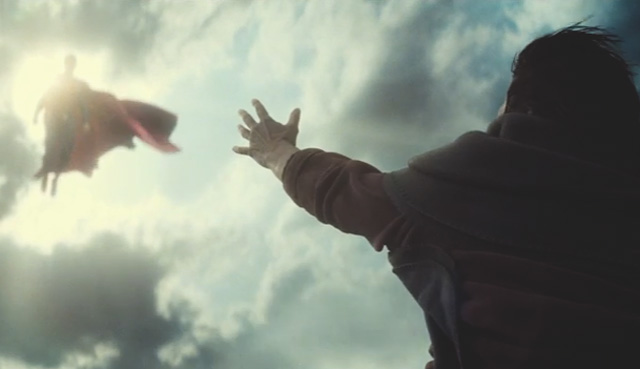
Superman v Batman bowThe answer: Batman.

Superman v Batman cowlThe one man who could create a plausible contingency plan for dealing with a rogue Superman would be Bruce Wayne. He may be a mere mortal, but he has the necessary combination of attributes necessary to pull off such a mission.

Zack Synder has a lot to juggle with Batman v Superman. Audiences won’t know how strong the script is until they step into the theater, but as of Friday, April 17, 2015, they at least know that thematically and visually things appear to be right where they need to be.

‘The Inner Ring,’ by C.S. Lewis explains Washington, D.C. perfectly

Twitter recently suspended my account for daring to question its decision not to penalize the man who sent me a death threat. I was then contacted privately by a friend who asked why certain conservatives weren’t coming to my defense. This person knows that I once worked for a large think tank in Washington, D.C., and that I currently work for a newspaper.

The answer is simple: I willingly left a specific “Ring” years ago, and those who leave the Ring are not afforded its support.

C.S. Lewis explains this phenomenon well in his classic speech to young university students:

“I believe that in all men’s lives at certain periods, and in many men’s lives at all periods between infancy and extreme old age, one of the most dominant elements is the desire to be inside the local Ring and the terror of being left outside. This desire, in one of its forms, has indeed had ample justice done to it in literature. I mean, in the form of snobbery. Victorian fiction is full of characters who are hagridden by the desire to get inside that particular Ring which is, or was, called Society. But it must be clearly understood that “Society,” in that sense of the word, is merely one of a hundred Rings and snobbery, therefore, only one form of the longing to be inside.

People who believe themselves to be free, and indeed are free, from snobbery, and who read satires on snobbery with tranquil superiority, may be devoured by the desire in another form. It may be the very intensity of their desire to enter some quite different Ring which renders them immune from the allurements of high life. An invitation from a duchess would be very cold comfort to a man smarting under the sense of exclusion from some artistic or communist côterie. Poor man — it is not large, lighted rooms, or champagne, or even scandals about peers and Cabinet Ministers that he wants; it is the sacred little attic or studio, the heads bent together, the fog of tobacco smoke, and the delicious knowledge that we — we four or five all huddled beside this stove — are the people who know. …

The lust for the esoteric, the longing to be inside, take many forms which are not easily recognizable as Ambition. We hope, no doubt, for tangible profits from every Inner Ring we penetrate: power, money, liberty to break rules, avoidance of routine duties, evasion of discipline. But all these would not satisfy us if we did not get in addition the delicious sense of secret intimacy. …

Of all passions the passion for the Inner Ring is most skillful in making a man who is not yet a very bad man do very bad things. …

The quest of the Inner Ring will break your hearts unless you break it. But if you break it, a surprising result will follow. If in your working hours you make the work your end, you will presently find yourself all unawares inside the only circle in your profession that really matters. You will be one of the sound craftsmen, and other sound craftsmen will know it.”  — C.S. Lewis, The Inner Ring.

Regular readers know that I do not name drop. I think it’s tawdry and weird and something people use as a crutch when they’re incapable of formulating sound arguments. However, I will say this: Once I left the employment of a well-known think tank, there were individuals who treated me like a ghost overnight.

The kind of people who populate Washington, D.C. are very much like a well-connected man I once got into an argument with while working near the Capitol. He said to me: “Do you know who I am? I’m the maître d’ of the conservative movement.” My skin crawled. I didn’t care who he was — he was wrong — and I’d rather choose the hard right than the easy wrong.

The kind of man who calls himself the “maître d’ of the conservative movement” is very much the kind of man who cares about the Inner Ring that C.S. Lewis covers in great detail. He may be conservative, but he cares much more about himself and his career than he does about the principles he espouses in front of large crowds or on cable news shows.

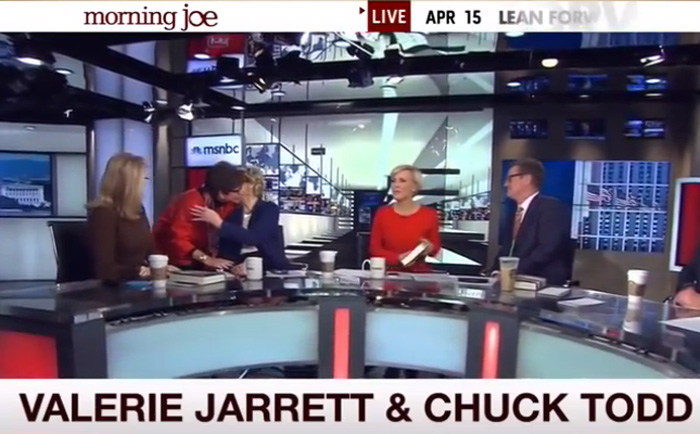
Perhaps the most recent example of a larger Ring that actually gained traction on social media was Valerie Jarrett’s appearance on MSNBC’s “Morning Joe.” President Obama’s top adviser went around the table giving pundits hugs and kisses, with Joe Scarborough saying “Valerie, come give me a hug!” before cutting to a commercial break.

Morning Joe Valerie JarrettWashington D.C. is an incestuous place, where reporters, pundits, politicians, academics and bureaucrats all go to the same parties over … and over … and over … and over. It’s the kind of place where you can go to dinner with someone and the person sitting across the table can say with a straight face that they’re “kind of a big deal.” I know because it happened to me.

As C.S. Lewis notes, no one is immune from the desire to be a part of some Inner Ring. The difference between Washington, D.C. and other places, however, is that the capital’s rings lure people who seek power and influence. Very smart, very shrewd individuals are attracted to Washington, which means that they are capable of advanced levels of evil.

Who is more evil: the dumb fool who punches you in the face and steals your wallet because he knows of no other way to vent frustration over his shortcomings, or the intelligent man who methodically finds ways to trample your soul and deny your god-given rights — all while convincing you that he’s really your best friend?

All men are capable of great good or great evil, but my point is that the concentration of highly-educated individuals in the nation’s capital, who are obsessed with power, also means that the city possesses a unique kind of evil.

If you get a chance, then I highly suggest reading “The Inner Ring,” by C.S. Lewis. If I had read it years ago, then I would have hopped on a happier path ahead of schedule. No matter what city or town you live in, it’s worth your time.
MoMA: New York City’s zoo that masquerades as an art musuem

Museum of Modern Art is a strange place. It has everything one would expect from a first class art museum, but in many respects it is more like a zoo. Your friendly neighborhood blogger went to MoMA on his day off from work to check out art like Gustav Klimt’s Adele Bloch-Bauer II, but instead struggled not get to swept away in a rip tide of tourists taking selfies.

Perhaps the best way to describe what it feels like to walk through MoMa is to use a painting analogy: I felt like Georges Braque’s “Man with Guitar” (1911). It’s easy to feel like you’re coming apart at the seams as a cacophony of laughs, giggles, squeals, shuffling feet, and jumbled conversations make it incredibly difficult to properly take in each artist’s work.

Man with Guitar BraqueWhile it is impressive that any museum in the world can convince the average tourist to pay $25 to view Marcel Duchamp’s “In Advance of the Broken Arm” (1915) — yes, that’s right, Mr. Duchamp literally hung a shovel from a ceiling and deemed it art — packing in as many people into a museum as humanly possible isn’t necessarily a good thing.

Marcel DuchampMoMA is certainly a place every art lover should go to — once. I suppose Mr. Duchamp would call me a “bourgeois” snob for saying it, but I don’t care: It’s hard to appreciate art in a museum when families are invited to run around like a bunch of chickens with their heads cut off.

There is plenty to do in New York City if you love the arts. Unless you have a burning desire to check it out, I would suggest looking at the snow shovel in your garage, pretending you’ve just seen “art” by Duchamp, and calling it a day.

Twitter: Death threats get a pass, but users who question that decision will be suspended

Twitter blocks Douglas Ernst

FINAL UPDATE: Twitter lifted my suspension after one month. To learn more about how it all unfolded, you can read more about it here.

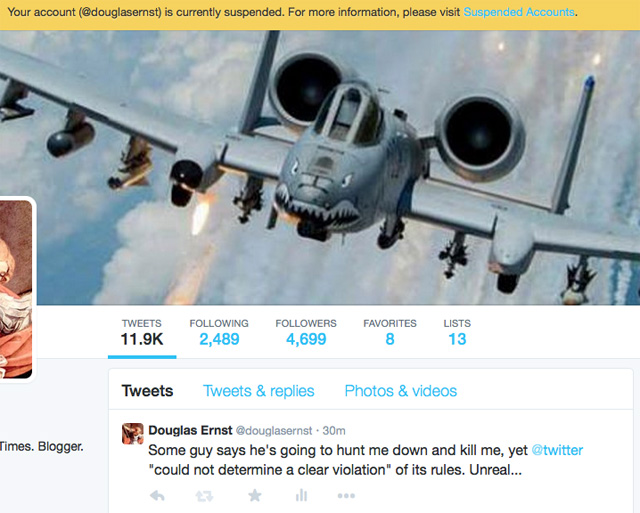
Twitter CEO Dick Costolo said earlier this year he was “ashamed” and “embarrassed” at how the company deals with bullying. Apparently they haven’t made much progress, because these days Twitter allows death threats to slide. Worse, if you’ve been the target of a death threat and you question how on earth the user responsible can get away with it, then Twitter Support will ban you. I know from first-hand experience.

Twitter unrealI wrote a story for work on March 31st on Iranian aircraft that buzzed a U.S. Navy helicopter in the Persian Gulf. I often have incredibly shady people follow me or tweet strange things in response to anything I write on the Middle East, but that story actually generated a death threat.

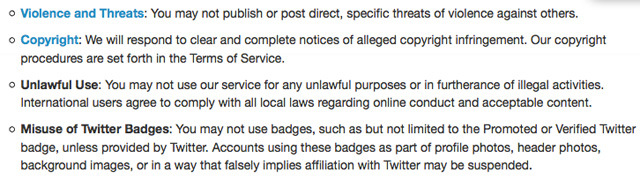
Twitter threatTwitter’s policy on threats of violence seem pretty straight forward to me: “You may not publish or post direct, specific threats of violence.”

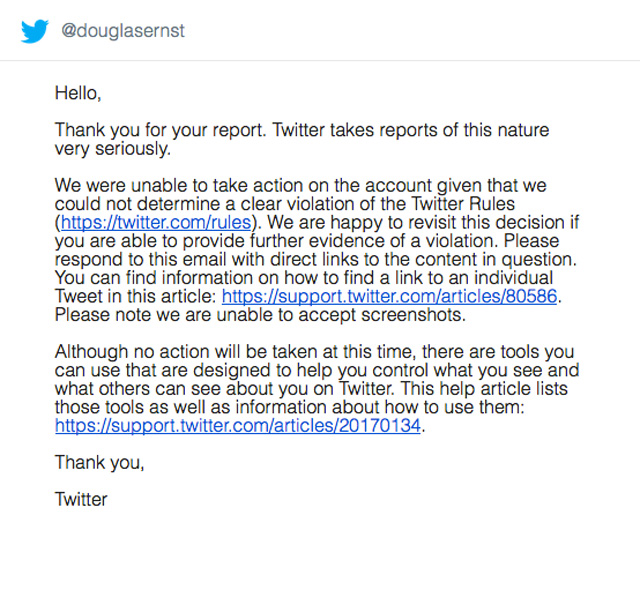
Perhaps my logic is lacking on this one, but I’ve always been under the impression that something like “We will find you and kill you — death to America,” is a direct threat of violence. If you agree with me, then you too are wrong! Twitter Support “could not determine” if such tweets constitute a violation of its terms of service.

Twitter RulesHere is the email that Twitter Support sent me on Monday, April 6, 2015:

Twitter noticeKind of frustrating, isn’t it? To Twitter Support, my account must be suspended for publicly bringing attention to the fact that a guy making death threats is currently allowed to do so with impunity.

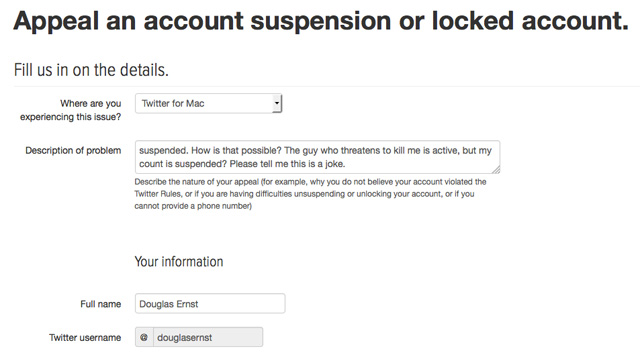
Twitter suspend appealQuestion for Twitter CEO Dick Costolo: If you’re “ashamed” at how Twitter deals with online bullying, then what emotions do you feel now that your support staff are suspending the accounts of people who are the target of death threats?

If Twitter is going to be suspending accounts, then maybe it should start internally with employees who are unsure if threatening to kill someone is a violation of the company’s terms of service.

Update: It is now May 4 and my suspension began on April 6. I have put in four appeals — all ignored by Twitter. The social media manager at my place of employment sent three emails to Twitter’s press account, and all of those were ignored. A coworker of mine had a contact at Twitter who helped her with a story — Nu Wexler — but when my employer’s social media manager reached out to him the silent treatment continued. This is the weirdest situation on social media I have ever encountered. Thank you to everyone who has been sharing this story on my behalf.

Press Inquiry

Twitter AppealRelated: WND has reported on my story. Give it a read if you get a chance.