Red Platoon: Clinton Romesha’s combat memoir will floor you. Buy it — now

red-platoon-cover

One of the rarest things on earth is the perfect blending between a warrior and a scholar. To meet such a man or to read his wisdom on the written page is truly a blessing, which is why I search … and search … and search for those moments. It is safe to say that Clinton Romesha, Medal of Honor recipient and author of Red Platoon, unequivocally belongs in that elite group. His memoir is exquisitely written, which feels somewhat odd to say given the subject matter.

For those who are unfamiliar with Mr. Romesha’s story — or, rather, the story of the men deployed to Combat Outpost (COP) Keating in Afghanistan on Oct. 3, 2009 — it is the stuff of legend. The former Staff Sergeant and his comrades were told to man an outpost that was in every way imaginable a death trap, and then when all their worst fears came true the majority of them found a way to survive.

Here is an excerpt that in many ways sums up what the book is about:

In 1958, a soldier named J. Glenn Gray wrote a book about soldiers in combat called The Warriors: Reflections on Men in Battle. Gray, who was drafted into the army as a private in May 1941, was discharged as a second lieutenant in October 1945 after having seen fighting in North Africa, Italy, France, and Germany. His book, which is both obscure and revered, touches on something that would later strike me as relevant to what was now unfolding at Keating as our counterassault came in danger of unraveling.

Gray wrote with elegance and precision about how the essence of combat basically boils down to an exchange of trust between two men — or two groups of men — each of whom are providing support by fire for the other. This simple agreement — you move while I shoot at the guys who are trying to kill you, then I will move while you shoot at the guys who are trying to kill me — depends on a willingness to place one’s life into the hands of someone else while in turn taking responsibility for that person’s life in your own hands. When this pact is executed well, it is not only extraordinarily effective but also tends to create a bond between men who enter into it that may stand as the most powerful connection they will ever experience to another human being.

There is, however, one thing that Gray doesn’t explore in his book, which is what can happen when one of the two parties who are supposed to be working in tandem fails — for whatever reason, legitimate or not — to keep his end of the deal. That was what appeared to be taking place right then with Hill’s machine-gun team.” — Clinton Romesha, Red Platoon (New York, Penguin Random House LLC, 2016), 243-244.

I cannot say enough good things about this book. It seems awkward to call a wartime memoir “flawless” (How does one give glowing reviews to true story where men died gruesome deaths without seeming inconsiderate or detached?), but that seems to be the best adjective to use.

Red Platoon is powerful, organized, thrilling, poignant, inspirational and educational all at the same time. It is intelligent, but relatable to a wide audience. It is honest, but respectful to all Americans involved — regardless of how they handled themselves on the battlefield.

In short, buy the book. It is awesome, and probably something I will come back to for many years to come.

RELATED: ‘Black Hawk Down’: Read the book because the movie can never do the men who died justice

Dan Slott ‘kills’ Peter Parker (again) in Amazing Spider-Man #20, repeats key mistake from infamous Clone Saga

peter-parker-doctor-octopus

The Amazing Spider-Man #20 has arrived, which means readers get the return of Doctor Octopus in his original body and the “death” of Peter Parker — again. Yes, you read that right, Dan Slott has essentially “killed” Peter Parker for a third time.

Here is what you need to know for ASM#20:

  • Otto (inside his Octobot form the future) and AI Anna Maria Marconi visit his grave and find it empty.
  • An investigation reveals that someone has stolen Otto’s corpse from a cemetery that serves as a resting place for many super villains. There is a black market for dead super villains.
  • Otto and AI Anna go into the internet and use their digital “minds” to deceive New U into placing a bid for Otto’s corpse.
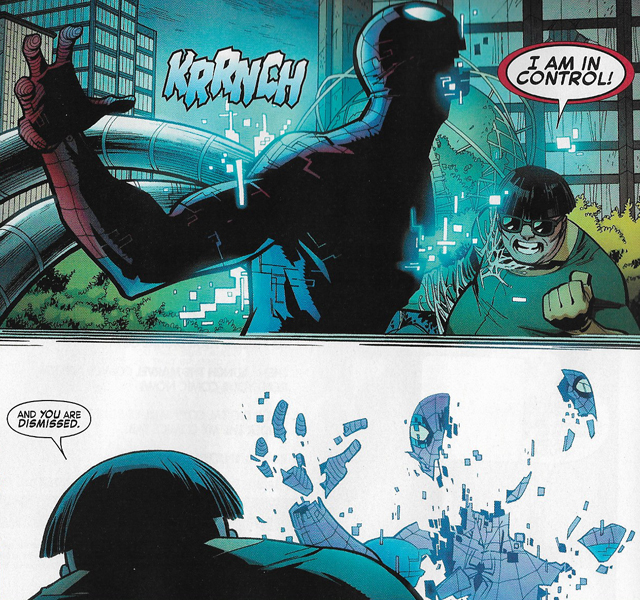
  • Otto heads to New U and realizes that his corpse contains the brain waves of none other than…Peter Parker!
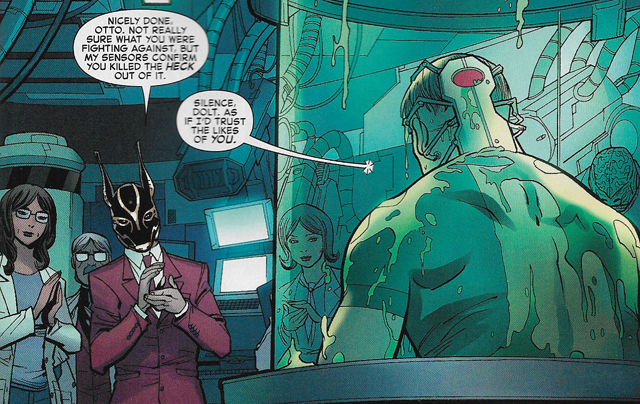
  • A fight ensues (again), and Otto makes short work of everyone’s favorite hero. It turns out (and readers should assume this will change at least one more time) that the original Peter Parker died while only a memory “fragment” made it into the ASM #700 Peter Parker body. Jackal even applauds Otto while saying, You killed the heck out of it.”
  • A spy for Kingpin monitors everything that happens in New U.
  • Otto and the Jackal team up to try and figure out a way to keep “reanimated” bodies from decomposing without a pill.
  • The issue ends right where Dead No More: Clone Conspiracy #1 finished.

Just to make sure that everyone understands what is going on, Peter Parker “died” in ASM #700, he was “killed” again for all intents and purposes during Superior Spider-Man #9, and now “executed” in ASM #20. But — and this is a big but — it could very well turn out that this “real” Peter Parker was in fact a “memory fragment” left behind by the “real” Peter Parker as he returned to his body in ASM #700.

Confused? Don’t feel bad about it.

asm20-spiderman

The problem with the original Clone Saga was that it broke one of the most common sense rules for storytellers — don’t break your readers’ trust. That doesn’t mean that authors can’t have twists and turns; it means that readers should never feel duped or misled.

No one wants to believe that the Peter Parker (i.e., hero) they’ve been reading about for days, weeks, months, or years is just a “memory fragment” or a “clone” or a “reanimation.” People sink a lot of money and time into a character, so it becomes bothersome if a writer does the equivalent of, “And then I woke up” on his audience. That is something that high school creative writing classes teach, so it is bizarre that Marvel writer Dan Slott would mine that “reanimation” well throughout Clone Conspiracy.

doc-ock-fight-spiderman

So who is the “real” Peter Parker? Who is the fake? Are any of them real? Readers are supposed to be thrilled with the prospect that the last couple of years have really just been one big fake-out, but human nature does not work that way.

People do not like to be lied to. It’s one thing to play games with supporting characters, but it is a whole different “can of clones” when the protagonist is disrespectfully jerked around.

jackal-otto

There is much more to say, but in this instance I think I’ll cut it short and ask you to share your thoughts in the comments section below. And please make sure to watch my latest YouTube video on ASM #20 and subscribe for regular comic book reviews.

‘Black Hawk Down’: Read the book because the movie can never do the men who died justice
blackhawk-down

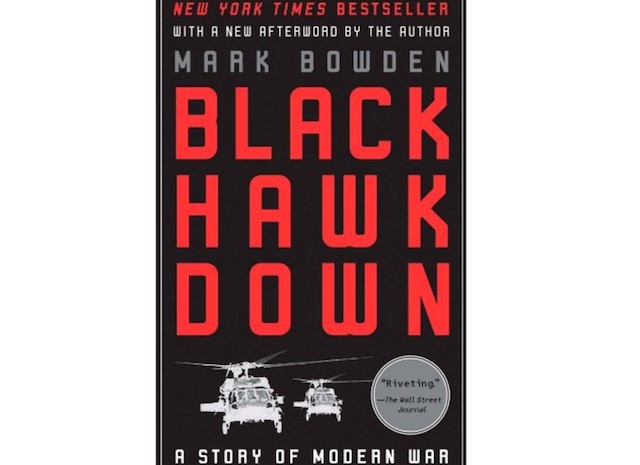
If you ask most people what they think of Black Hawk Down, then the vast majority of the time the response you’ll get will probably be something along the lines of, “Good movie.” That is understandable, given that it was a blockbuster film in 2001 produced by Jerry Bruckheimer and directed by Ridley Scott.

If you are like me, then perhaps you’ve always had an itch regarding the movie and, more importantly, the event — the downing of two MH-60 Black Hawk helicopters and the subsequent deaths of 18 American soldiers Oct. 3-4, 1993, in Mogadishu, Somalia.

Sure, it made for a night out at the theater, but perhaps you’ve felt that it was somehow insulting to only know the tale through its Bruckheimerization.

As regular readers of this blog know, I have been working on a book in my spare time that will eventually see the light of day (we’re at the artwork stage now, so hang tight!). There are parts of the novel that required knowledge of Task Force Ranger, and at some point I admitted to myself that it would be literary heresy to not read Mark Bowden’s masterpiece to assist with authenticity. It is safe to say that there probably is not a more comprehensive retelling of the ill-fated attempt to capture two top lieutenants of a Somali warlord Mohamed Farrah Aidid.

And if you do not think any of this is still relevant, then I suggest you start reading The New York Times. The paper reported Sunday in a piece titled In Somalia, U.S. Escalates a Shadow War:

The Obama administration has intensified a clandestine war in Somalia over the past year, using Special Operations troops, airstrikes, private contractors and African allies in an escalating campaign against Islamist militants in the anarchic Horn of Africa nation.

Hundreds of American troops now rotate through makeshift bases in Somalia, the largest military presence since the United States pulled out of the country after the “Black Hawk Down” battle in 1993. …

In March, an American airstrike killed more than 150 Shabab fighters at what military officials called a “graduation ceremony,” one of the single deadliest American airstrikes in any country in recent years. But an airstrike last month killed more than a dozen Somali government soldiers, who were American allies against the Shabab.

Outraged Somali officials said the Americans had been duped by clan rivals and fed bad intelligence, laying bare the complexities of waging a shadow war in Somalia. Defense Secretary Ashton B. Carter said the Pentagon was investigating the strike.

Who, exactly, are we fighting? Why are we there? Should we be there?

Mr. Bowden’s book provides many of the answers, which unfortunately raise more questions:

“In books and movies when a soldier shot a man for the first time he went through a moment of soul searching. Waddell didn’t give it a second thought. He just reacted. he thought the man was dead. He had just folded. Startled by Waddell’s shot, Nelson hadn’t seen the man drop. Waddell pointed to where he had fallen and the machine gunner stood up, lifted his big gun, and pumped a few more rounds into the man’s body to make sure. Then they both ran for better cover.

They found it behind a burned out-car. Peering out from underneath toward the north now, Nelson saw a Somali with a gun lying prone on the street between two kneeling women. The shooter had the barrel of this weapon between the women’s legs, and there were four children actually sitting on him. He was completely shielded in noncombatants, taking full cynical advantage of the Americans’ decency.

“Check it out, John,” he told Waddell, who scooted over for a look.

“What do you want to do?” Waddell asked.

“I can’t get that guy through those people.”

So Nelson threw a flashbang, and the group fled so fast the man left his gun in the dirt.” — Mark Bowden, Black Hawk Down (New York: Grove Press, 1999), 46.

If you want to know what it’s like to have an entire city honed in on killing you and those you hold dear, then I suggest reading Black Hawk Down. The book can be a bit arduous at times — it’s like trying to eat a steak the size of your head — but there is no escaping it because a.) Mr. Bowden leaves no stone unturned, and b.) the experience for the men on the ground was grueling.

Perhaps the best endorsement of the book that I can give is this: I did not know much about the author before picking up the book, and was surprised to find out he is not a veteran. He’s just a reporter who did a damn good job telling a story.

Black Hawk Down is a book about courage and fear, the nature of war, success and failure on the battlefield, and most importantly the experiences of the men who fought valiantly to save one another in situation that was so surreal that it seem like “a movie.”

 It was not a movie — it happened — which is why those who care about national defense issues should read it sooner rather than later.

Kudos to Mr. Bowden for writing a book that will be read by military men and women for generations to come.

Dan Slott says ‘favorite Spider-Man villain’ is ‘Peter Parker,’ yearns for deal with ‘ultimate devil’

Dan Slott Renew Your Vows

Marvel’s release of Dead No More: The Clone Conspiracy this week brought with it an obligatory round of promotional interviews. Therefore, it was reasonable to conclude that writer Dan Slott of The Amazing Spider-Man would say something to prove how he fundamentally misunderstands Peter Parker. A recent interview with The Hollywood Reporter was all it took, as he said his favorite Spider-Man “villain” is, in fact, Peter Parker.

Regular readers of this blog remember how an October 2015 entry — Dan Slott: Peter Parker’s love for Mary Jane is ‘anti-Marvel’ — was accused of being taken “out of context,” despite the fact that full context (and an hour-long embedded YouTube video) was provided.  Therefore, your friendly neighborhood blogger will preemptively draw attention to the fact that I am linking to the full Hollywood Reporter interview, asking you to read it in its entirety, and going out of my way to provide full context.

THR’s Graeme McMillan and Mr. Slott had the following exchange:

Graeme McMillan: You have fans complaining that you don’t “know” Spider-Man.

Dan Slott: Despite the fact that I’ve written one out of every five issues of Amazing Spider-Man, which is kind of scary. But, to me, the fun of it is, at his basic core, even if you strip away ‘with great power must come great responsibility,’ what makes Peter Parker this character that resonates with all of us is that he’s really the first character who’s you. He’s the guy you know. He’s not a wealthy billionaire playboy, he’s not an alien from another planet, he’s not a god from a pantheon. He’s the guy down the block who trips and falls, who screws up in every way that you screw up. All the self-destructive traits that you have, and your friends have, he has. People say to me, ‘Who’s your favorite Spider-Man villain?’ and my answer is Peter Parker, because no-one can mess up Spider-Man’s life like Peter Parker can.

One of those fans who “complains” that Dan Peter’s-love-for-MJ-is-anti-Marvel Slott does not “know” Spider-Man (or, rather, Peter Parker) is right here, so let us begin.

Words mean something. The words we use have consequences. There is great power in words, and with that comes great responsibility. Therefore, it stands to reason that being imprecise or flippant with a word like ‘villain’ can lead to terrible results — even if we have good intentions.

Mr. Slott says “no-one can mess up Spider-Man’s life like Peter can,” but we know that his rogue’s gallery is filled with homicidal monsters, megalomaniacs with a desire for genocide, at at least one literal demon who successfully severed the bond between he and his soulmate, Mary Jane.

Question: Why on earth would a writer pretend that “villain” is synonymous with “fallible human being”?

Answer: Because a writer like Dan Slott is the kind of person who publicly admits he wants a hero like Peter Parker making deals with a devil.  Heroes do not consciously make deals with devils — villains do. If Peter Parker is described as a guy who tries his best but isn’t perfect, then Mr. Slott’s vision cannot be realized. The language needs to change. Readers need to be convinced that their hero is simultaneously a villain, and that it’s acceptable.

That is perverse. That is sick. That is naked moral relativism, and it is propagated by a man who mistakes writing a character for a long time with doing it well (i.e., Saying, “I’ve written one of every five issues of Amazing Spider-Man,” in response to charges of not knowing Peter Parker).

Let us return to his THR interview:

Dan Slott: The Jackal has expanded his science. He’s not getting it from a blood sample, he’s getting it from a corpse. It’s all the memories, all the way up to your death —

Graeme McMillan: So they’re complete copies.

Dan Slott: Yes! They remember everything, all the way up to that last moment. It’s less a clone — I wanted to brand them, and the Jackal brands them, ‘re-animates.’ It’s different than a clone, it’s better than a clone. And in that moment, the Jackal becomes the ultimate devil you can make a deal with. He becomes the person who says, ‘If you’ve lost anyone, I can give them back to you. Whatever person you’ve loved or lost, or maybe someone who tormented you and lost, I can bring them back to you.’

Ignore the fact that clones would know that they are clones and immediately branch off into a completely different life-path than his or her progenitor. What matters here is that Mr. Slott a.) attaches a very specific word — ‘villain’ — to the hero, and b.) admits that he wants said hero/villain making deals with an “ultimate devil.”

If you are a long-time reader of The Amazing Spider-Man, look at Mr. Slott’s track record and ask yourself if he was being glib or if he says what he means and means what he says. It is this blogger’s contention that when he says Peter Parker is a villain, he means it. And he gets away with it because many people who are repulsed by such a premise buy ASM out of their life-long love for the character.

Things will only change when enough readers vote with their wallet. (Exacerbating the problem are access-addicted comic book websites that are terrified of offering legitimate criticism, but I digress.)

Anyway, I’d love to hear your thoughts on the “villainous” Peter Parker and the writer behind his reign of terror. Let me know what you think in the comments section below.

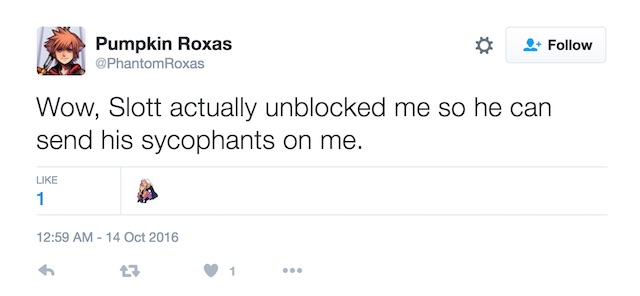
Update: Dan Slott is now unblocking people on Twitter who discuss this blog post, and then trying to hide behind some weird excuse that Stan Lee would have called Peter Parker a “villain.” You can’t make this up. Classic! (Hat tip to reader JB for the catch.)

pumpkin-roxas

dan-slott-twitter-peter-villain

Dan Slott’s ‘Dead No More #1’ can’t shake stale smell of clone stories better left buried in Spider-Man history

asm-dead-no-more

Marvel’s big Spider-Man event of the year has finally arrived with Dead No More: The Clone Conspiracy #1. Readers who lived through the 90s wondered why writer Dan Slott would dig up the still-rotting corpse of The Clone Saga, and DNM #1 seems to confirm their worst fears. Recycled plastic usually has a weird quality to it that fails to match the original, and recycled stories are the same way.

Here is what you need to know for DNM #1:

  • Peter attends the funeral of Jay Jameson and Jonah explodes on him, which is odd because he knows New U has the power to bring people back from the dead. Jonah’s first wife Marla, after all, has returned.
  • Peter says “this is all my fault” to himself after everyone leaves, even though it clearly was not.
  • Anna Maria Marconi finds out that Peter’s spider-sense went off when he used Jerry Salteres as a guinea pig for New U’s experimental treatment. The two decide to visit the employee’s house to investigate.
  • Jerry’s wife reveals that her husband failed to take his medicine and had something “terrifying” happen to him. New U told her not to talk about it and scrubbed her webware, which contained video of the incident.
  • Peter inexplicably vows to bring Jerry home after retrieving lost data from the webware. Anna privately scolds him for the promise and he heads off to New U as Spider-Man.
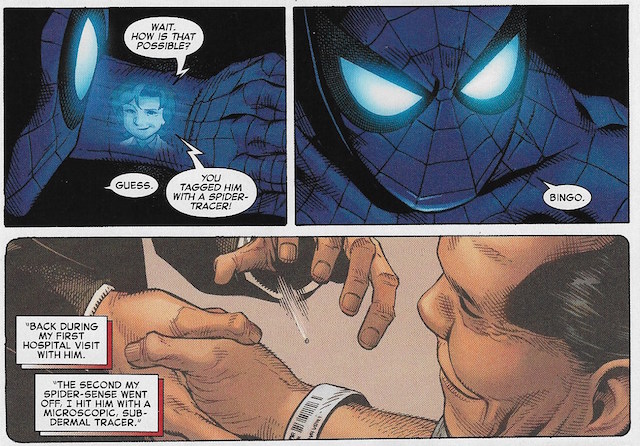
  • It turns out Peter used a “microscopic, sub-dermal tracer” on Jerry when they saw each other in the hospital, so he tracks down the man’s “reanimating” body inside a lab.
  • Miles Warren walks in on Peter and within moments Rhino and female Electro are headed for battle.
  • Spider-Man goes into a room marked “Do Not Enter” and finds Gwen Stacy. He is surprised when she doesn’t set off his spider-sense.
  • A reanimated Doctor Octopus punches Peter in the face with a tentacle and the issue ends.

DNM #1 also features a story by Dan Slott titled The Night I Died, which tweaks elements of 1973’s The Amazing Spider-Man #122 to include a semi-conscious Gwen finding out that Peter Parker was Spider-Man just before her death. She cries while thinking of Peter as “the man who helped kill dad.”

Gwen is then “reanimated” by Miles Warren, aka The Jackal, and introduced to her father as a means of convincing her to become a “business partner.”
j-jonah-jamesom-dead-no-more

The problem with mixing clone stories and The Amazing Spider-Man, besides the fact that they have been done to death (no pun intended) — and badly done — is that a writer is tasked with covering the very nature of existence, consciousness, and the soul. Even unintelligent readers seem to inherently understand that the writer is entering into serious territory, so if the tale isn’t handled right it crumbles under its own weight.

peter-parker-dead-no-more

Let’s put it another way: Even clones in real life would know that they are clones (i.e., see the panel of Gwen Stacy realizing what has happened before grabbing a knife to slit her own throat). Readers are the same way. Why should they care about Gwen Clone?

They shouldn’t — unless it is done well.

gwen-stacy-dead-no-more

And there’s the rub. On Dan Slott’s watch, Peter Parker “died” and came back to life. The character has not had a single moment of honest reflection on his own death (or whatever it was, since it was never clear) since the series relaunched. Human beings — flesh and blood with thoughts and emotions and hopes and dreams — would be shaken to their core if they died and were brought back to life. Not Dan Slott’s Peter Parker.

Therefore, it stands to reason that if Mr. Slott does not even apply basic human reactions to the protagonist of the series then he will not do so in a meaningful way with clones.

DNM #1 appears to set up all sorts of twists and turns for Peter Parker in the next couple of months. That is the good news.

The bad news is this: Like most conspiracies, the people who weave them usually lose their audience in an incoherent mess that unravels with the least bit of scrutiny. Before you plunk down $4.99 for this book, consider Mr. Slott’s track record and then ask yourself if he seems up to the task.

Editor’s Note:

Regular readers of this blog remember the time when I accurately predicted Dan Slott’s “Arachno-Rockets.” It appears as though your friendly neighborhood blogger has another notch on the belt after having asked in February when “single-cell Spider-tracers” would arrive. DNM #1 does not quite give us a single-celled tracer, but it is “microscopic, sub-dermal.” Given that the function is essentially the same, we’ll consider that a win.

spider-tracer-dnm

Dan Slott’s Spider-Man: ‘Web-cement’ ready in China, not when Peter’s family needs him in ASM #19

spiderman-asm19

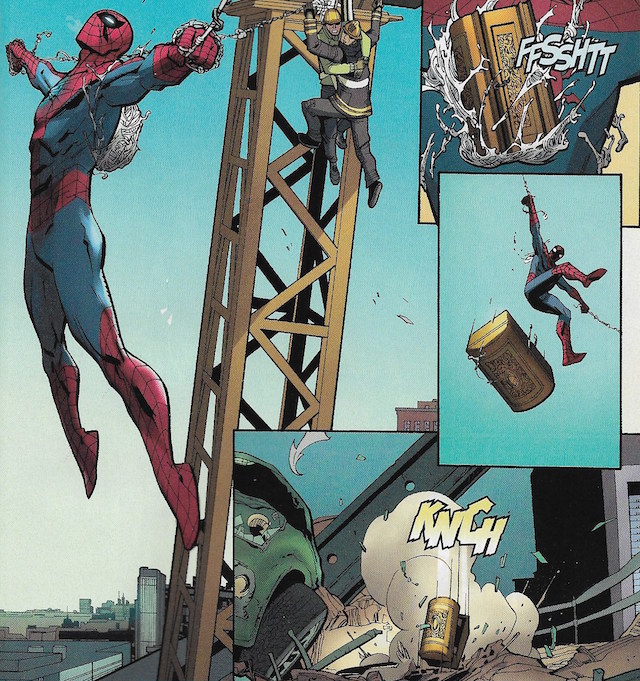
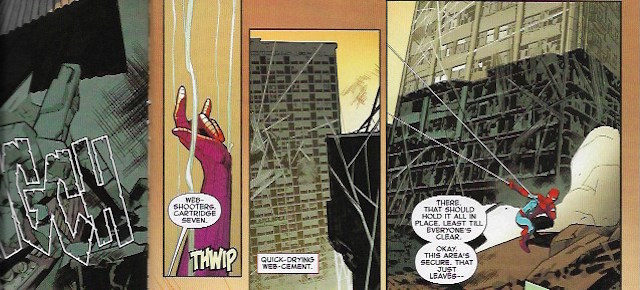
The last two issues of The Amazing Spider-Man have seen the strongest writing on the book in months, which is odd given that its main character — Peter Parker — was relegated to the sidelines. He is back in ASM #19 and, seemingly like clockwork, the book has taken an embarrassing turn. Ham-fisted attempts to prove that he’s a snake-bitten loser abound, and tears flow because the guy with 10,000 specialized web cartridges couldn’t remember that Cartridge Seven contained “quick-drying web-cement” (as seen in ASM #6).

ASM6 web cement
When Peter Parker is in China, “quick-drying web-cement” is on hand for a nearly abandoned construction site. When he’s in New York and his family needs him, he doesn’t think to use it. What does editor Nick Lowe actually do in the office, anyway?

Here is what you need to know for ASM #19:

  • Aunt May tells Peter to hurry to the hospital because her husband, Jay Jameson Sr., is getting worse with some disease that Marvel has not elaborated on. It’s just bad…and deadly…because illness.
  • Peter is on his way when he hears someone scream, “Stop! Thief! That’s all my money!” Our hero turns the corner and sees two men running down the street. He webs both of them up and a shop owner yells at Spider-Man for webbing up his son (even though it was perfectly understandable to make such a mistake and the hero literally secured the guy’s entire life savings).
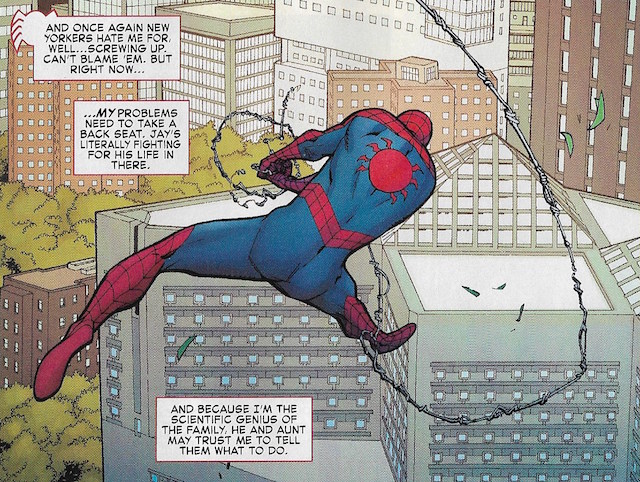
  • Peter then inexplicably says he doesn’t blame New Yorkers for hating him.
  • Everyone wants to know why Peter used New U’s technology on an employee, but he doesn’t want it applied to Jay Jameson Sr. They don’t believe him when he says that further Parker Industries research has shown that conventional methods are probably safer as long as time permits. (Again, what is the disease? Can’t Dan Slott call a doctor and do a little research for something plausible?)
  • Jay privately asks Peter to go to his apartment and get a clock that was brought to America from Ireland. Jay wants to give it to his son before he dies. Peter agrees to get the heirloom.
  • Peter webs the clock to his back and heads for the hospital, but a greedy industrialist’s decision to ignore safety regulations (but of course!) causes an accident. A crane comes unmoored from a building and Peter, in a Christ-like pose, must hold it in place from falling while rescue workers arrive. Aunt May calls him and berates him for taking his time. She wants to see him face-to-face on his phone, but he tells her it’s impossible at the moment.
  • J. Jonah Jameson talks to the “reanimated” Marla and asks her what to do.  She tells him to convince Peter to use New U’s technology on his father.
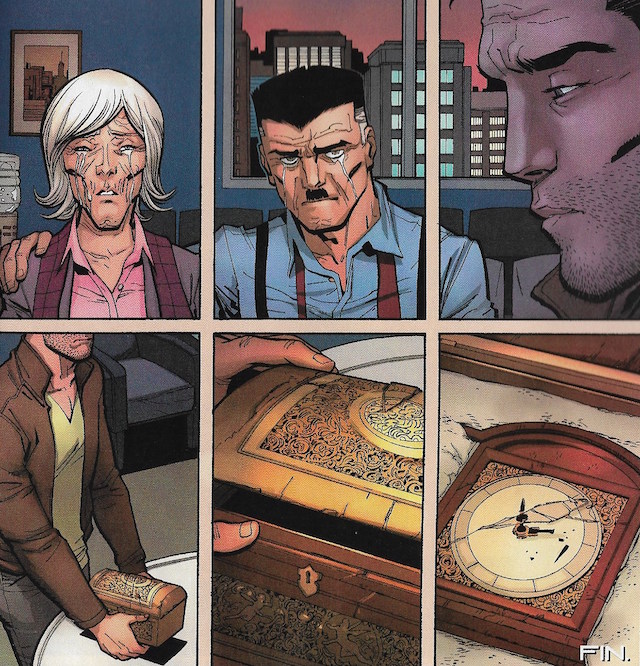
  • Peter’s webbing dissolves after an hour and the clock falls from his back. He finds it later and it’s broken.
  • Aunt May and J. Jonah Jameson cry as perpetually tardy Peter arrives to the hospital with the shattered clock.

Perhaps the two best ways to describe ASM #19 is “forced” and “convoluted.” Characters behave in ways that are downright weird to advance the plot, and Peter is shoe-horned into situations show the tension that his secret identity imposes upon his personal life.

asm19-spiderman

What makes this issues climax fall flat is the fact that for well over a year Dan Slott has pulled out numerous inventions out of Peter Parker’s butt, but for no apparent his reason his technological butt-magic disappears in ASM #19. He literally held up an entire building with web fluid in ASM #6, but now — when he really needs it — the proven technology is not even mentioned.

Heck, Spider-Man even had “web-foam” literally spin off his back on voice command in ASM #9, which protected him as he entered earth’s atmosphere. Are readers supposed to believe he wouldn’t wrap a precious family heirloom in it? Thanks for making Peter look like a total doofus, Dan Slott.

j-jonah-jameson-asm19
Marvel’s message to readers translated: “Did you think J. Jonah Jameson was praying to God in the first panel? Gotcha! Who would do such a crazy thing? Haha. He was talking to Marla the whole time.”

In short, you may enjoy ASM #19 if you watch bad soap operas. Readers have hospital death scenes, people coming back from the dead, a lot of tears and hackneyed writing. Tune in next month for more Mighty Marvel Mayhem, true believers, when Peter Parker needs his “acid-webbing” to save the day, but then decides not to use it!

peterparker

‘Letters to a Young Catholic’: George Weigel hits a literary home run

letters-to-a-young-catholic-weigel

George Weigel’s Letters to a Young Catholic is a wonderful book, but oddly enough I must begin this review by griping about the title — it’s something that Catholics of any age should read. In fact, the publisher does not lie by billing the book as “a modern spiritual classic,” which is why I recommend it to anyone who is interested in such issues.

Like many Catholic kids, my parents took me to Mass every Sunday growing up. And, like many Catholic kids, I was not exposed to the writings of G.K. Chesterton, George Weigel or other intellectual heavyweights. What I did have access to were kind adults who lacked the ability to articulate the faith in a way that “clicked” for me. I drifted from the Church as a young man and did not come back until I learned many painful lessons. If I were exposed to a book like this as a teenager then it probably would have saved me a lot of lost time, although I admit to having a largely impenetrable chip on my shoulder in those days. (And yes, I know that some of you would argue that it’s still there!)

Perhaps the most fascinating aspect of Letters to a Young Catholic is that in many ways it doubles as a must-read for those who are wondering why America’s political institutions are crumbling before our eyes. The way in which the author travels the globe, goes back in time, covers essential questions about the Catholic faith that all young people ask, and then ties it into our contemporary political landscape is like watching a gymnast who puts everything out on the floor before the judges — and nails it.

Mr. Weigel writes:

If American popular and high culture could ever agree on a theme song that captured the idea of freedom driving much of contemporary life, it would almost certainly be Frank Sinatra’s “My Way.” I did it my way seems to sum up the widespread notion that freedom is a matter of asserting myself and my will — that freedom is really about choice, not about what we choose and why. Suggest that certain choices are just incompatible with human dignity and with growth in goodness, and you’ll get some very strange looks these days, whether on campus or in the workplace.

Catholicism has a different idea of freedom. In the Catholic idea of freedom, freedom and goodness go together. A great contemporary moral theologian, Father Servais Pinckaers, OP, explained all this. […] Learning to play the piano, he reminded us, is a tedious, even dreary business at first: well do I remember my own distaste for a book of technique-strengthening tortures entitled Scales, Chords, and Arpeggios. But after doing one’s exercises for a while, what originally seemed like a burden comes into clearer focus — learning to do the right thing in the right way is actually liberating. You can play anything you like, even the most difficult pieces. You can make new music on your own. Sure, Father Pinckaers writes, anybody can pound away on a piano. But that’s a rudimentary, savage sort of freedom,” not a truly human freedom. …

I did it my way teaches us an idea of freedom that Father Pinckaers calls “the freedom of indifference.” Doing things “my way,” just because it’s my way, is like banging idiotically on the piano or talking gibberish. The richer, nobler idea of freedom the Catholic Church proposes is what Father Pinckaers calls freedom for excellence — the freedom to do the right thing, in the right way, for the right reasons, as a matter of habit. That’s the truly human way. Because that’s the kind of freedom that satisfies our natural desire for happiness, which itself reflects our desire for God, who is all Good, all the way.  […] What’s all this got to do with democracy? Everything. Freedom untethered from moral truth will eventually become freedom’s worst enemy. — Weigel, George. Letters to a Young Catholic. Basic Books, 2015. 305-306.

A friend of mine texted me on Monday and said she hoped that I would cover the first U.S. presidential debate on the blog. In many ways, the text from Mr. Weigel’s book shown here tells us everything we need to know.

Why is America forced to choose between a woman who should be wearing an orange jumpsuit in a federal prison, and an egomaniac with occasionally orange skin?

Answer: Because America long ago decided it wanted to untether freedom from moral truth.

There really is no way to read Letters to a Young Catholic and not have a crystal clear understanding as to why civil society in the U.S. is unraveling. Our cultural influencers embrace a kind of nihilism “that enjoys itself on the way to oblivion, convinced that all of this — the world, us, relationships, sex, beauty, history — is really just a cosmic joke,” and we are now paying the price.

Mr. Weigel counters that “against the nihilist claim that nothing is really of consequence, Catholicism insists that everything is of consequence, because everything has been redeemed by Christ. And if you believe that, it changes the way you see things. It changes the way everything looks.”

If for no other reason, wayward Catholics should read this book to realize that what they thought was Catholicism growing up was in all likelihood a grossly watered down version of the Faith that denied them knowledge of its true richness and beauty. There are numerous reasons for this, and the author does a masterful job spelling it all out. I found myself thinking, “Finally! Someone who gets it,” and I am sure you will too.

Magnificent Seven: Fuqua brings in Washington, Pratt and crew for awesome Western

magnificent-seven-trailer

Westerns have been box office poison for quite some time, but for whatever reason the powers that be allowed director Antoine Fuqua to have a go at a “Magnificent Seven” remake. The film, which stars Denzel Washington and Chris Pratt, came in first place its opening weekend for good reason — it’s awesome.

denzel-magnificent-seven-trailer

Anyone who is familiar with the Western genre doesn’t need to work too hard to guess how the story goes:

  • Bad dude controls a town and kills good people.
  • Stranger is enlisted to take out bad dude.
  • Showdown eventually happens and bad dude is removed from the equation.

Where is the fun in the movie if we already know how it goes, you ask? In this case, everywhere.

Denzel Washington plays post-Cvil War bounty hunter Chisolm, Chris Pratt plays a troubled gambler with a heart of gold, and the two of them eventually put together a motley crew that will oust the evil Bartholomew Bogue (Peter Sarsgaard) from a mining town. Their success will also avenge the death of a frontierswoman Emma Cullen’s (Haley Bennett) husband.

chris-pratt-magnificent-seven-trailer

There are elements of the movie that could be spoiled in an extensive review, so in this case I’ll stick to saying that everyone in this movie looks like they’re having a great time. The scenery is beautiful. Every single actor has his or her moment to shine. The gunfights are top-notch, and there are even a few surprises towards the end that had the audience gasping during my showing.

In short, this is the movie that Sony’s team on Ghostbusters should have seen before making this summer’s box office bomb. Mr. Fuqua pays homage to Akira Kurosawa’s Seven Samurai (1954), John Sturges Magnificent Seven (1960), and other Westerns while also creating something distinctly his own.

This is not a Western for Baby Boomers, nor it does it try to be. It tips its hat to the past, but it cinematically moves forward. In a year of lackluster movies, this is a fun film that is worth seeing before it leaves theaters. See it in IMAX if you get a chance. This blogger did not, and I’ve been kicking myself for the decision for the past week.

Civil War II #5: Team Stark v. Team Danvers throw down

cwii-5

Brian Michael Bendis’ Civil War II #5 hit stores this week, and someone must have slipped something in his drink because he dedicated the entire issue to a massive brawl between Team Stark and Team Danvers. Is that a good thing? A bad thing? You’ll have to check out my latest YouTube video to find out.

After you’re done watching, let me know what you think in the comments section below — particularly you’re thoughts on the Inhuman Ulysses’ latest vision.

Dan Slott’s excitement, focus return in Amazing Spider-Man #18 with Doctor Octopus in limelight

living-brain-peter-parker

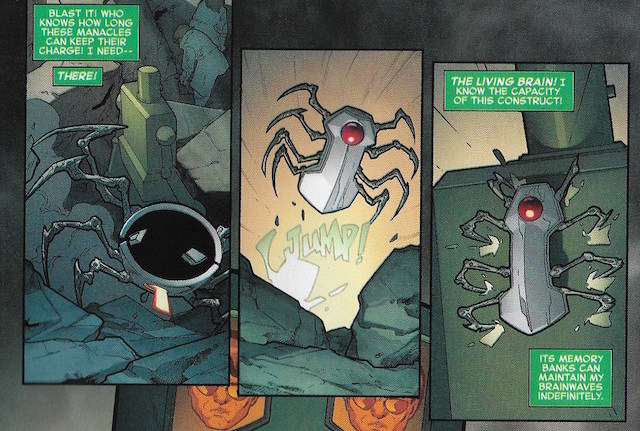
The Amazing Spider-Man #18 is an issue that has been building since the end of Spider-Verse in February 2015, so it stands to reason that writer Dan Slott would put extra care into the product. Still, it seems undeniable that this Doctor Octopus-centric tale possesses the most energy the creator has brought to the title in months. Fans of The Superior Spider-Man will be thrilled with the flashbacks and the loose ends that are tied up, while others will be left wondering, “Why can’t the book have this much life on a regular basis?”

Here is what you need to know about ASM #18:

  • Doctor Octopus explains how he was able to transfer his consciousness into the gauntlet of his Superior Spider-Man costume during Spider-Verse. The technology became a “fully functional octobot” and then downloaded his consciousness into Living Brain.
  • Readers are informed how Otto dispatched with Ann Maria Marconi’s new boyfriend, Blain, after he was unable to download his consciousness into the man’s brain. In short, Otto was able to get headhunters in Australia to offer him a job “too good to pass up.” (Blain decided to not even talk to Peter Parker about the situation, apparently…)
  • Doc Ock, still secretly inside Living Brain, demands Anna “explain” when she says she would not date Otto if he were standing before her. She mentions the fact that he tried to kill six billion people. “I could never love someone like that. Ever,” she says while kissing the robot on its cheek.
  • Peter contacts Anna on his way to New York and tells her to “double” her efforts on figuring out the cloning process used by New U Technologies.
  • Otto devises a plan to have Anna fly back to New York because he believes Anna wants Ott’s mind in Peter’s body. When they land in New York she tells Peter that Living Brain has “been acting up a lot lately.”
  • Peter decides to work on Living Brain, aka Doc Ock, who demands Peter “explain” how Otto’s mind was erased from the real Spider-Man’s brain. Peter explains how Otto killed himself so that Peter could save Anna from the Green Goblin, at which point the downloaded consciousness of Otto from Spider-Verse goes ballistic. “Lies! Lies! Lies!” he says while smashing equipment.
  • Living Brain destroys himself as Spider-Man tries to shut him down, but not before Otto’s consciousness again returns to gauntlet from Spider-Verse. Peter and Anna both act as if they only faced a “Doc Ock revenge program from beyond the grave,” as opposed to the real deal (for some inexplicable reason).

Does that sound like a mouthful? If so, that’s because it is — there was a lot going on in ASM #18. To Mr. Slott’s credit, he organized his thoughts about as well as could be expected with the plot threads at hand.

living-brain-doc-ock


As was said earlier, fans of SSM will enjoy this issue. There really isn’t too much to ding it on aside from the fact that once again people must act like morons to move the plot forward.

“Please, he won’t hurt me. He never would. Don’t ask me how I know. I just do. Trust me!” Anna says while trying to convince Peter to get closer to a rampaging Living Brain — but it might as well have been Dan Slott speaking to the readers.

Translation: “Don’t ask too many questions. I don’t. Trust me!”

And Dan is right: If you just want a “wacky” adventure and don’t have a desire to think too hard, then this issue is a fun read. Don’t ask why Anna and Peter give the equivalent of, “Huh. That was weird,” after Living Brain’s meltdown. Don’t ask questions about the nature of life and if humans have a soul, and don’t ask how Otto literally had Peter’s entire life beamed into his mind and didn’t change one bit.

“But Doug!” you say, “Didn’t Otto die to save Anna in Superior Spider-Man #30? Doesn’t that count?”

Answer: No, because readers were given no reason to believe Otto had changed in the previous 29 issues. It just happened.

anna-living-brain

Regardless, as already mentioned, ASM #18 is worth buying for anyone who has been eager to see the series once again focus on Doctor Octopus. It is rather intriguing to think about a man who cannot have the woman he loves because he is trapped inside an “inferior” body, and the villain’s plans to resurrect himself are a good tie-in to Dead No More.

asm18-anna-peter

If you plan on buying Dead No More, then ASM #18 is worth picking up this weekend. If not, then you still might want to give it a read. The author seldom is capable of packing pathos, organized thought, enthusiasm, and action into a single issue of ASM, and it might be months before such a feat is witnessed again.

Related:

Dan Slott’s Spider-Verse Epilogue: Wrap-up oddly more exciting than main story