Banksy doesn’t get it: The world owes you nothing

Let me first start off this post by saying that I think Banksy is a creative genius. There is something special in his work that is worth tipping our hats to. It makes us think and question and turn over ideas in our head that we long ago cast aside like a child bored with the new toy mom bought the previous week.

With that said, I think it is ironic that in many ways he contributes to strengthening the system he rails against.

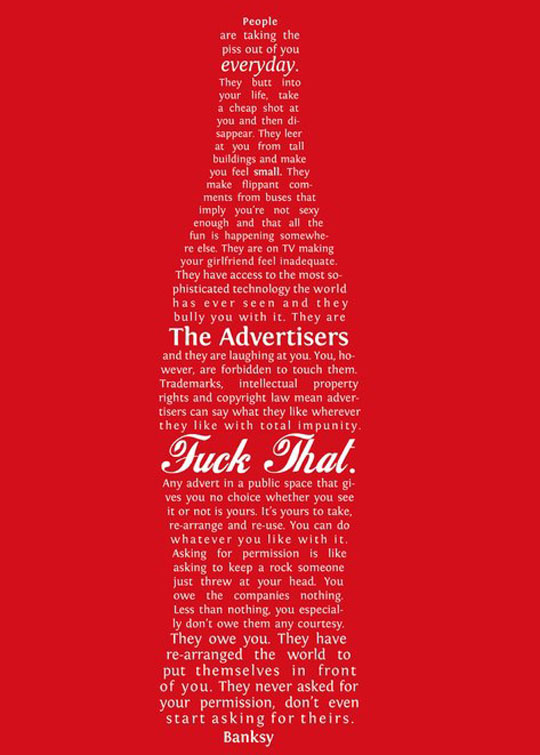
Take the following piece:
BY

“Asking for permission is like asking to keep a rock that someone just threw at your head. … They owe you.”

Translation: “Do what you want because the world owes you.

No. The world doesn’t owe us anything. Advertisers don’t owe you anything. The government doesn’t owe you anything. Rich people don’t owe you anything. Poor people don’t owe you anything, and neither does your neighbor.

In the middle of the vast cold void of space we were granted life, health and intelligence, and we often spend it sitting on a couch shoving potato chips in our face while complaining we don’t live like a Hollywood celebrity. Life alone should motivate someone to look inside themselves, be eternally grateful and then go out into the world to be the best person he could be. But instead, we’re told that someone or some thing “owes” us. It’s a poisonous seed of thought that generally just sprouts fear and envy and jealousy.

One of my best friends sent me the following email that sums it up quite well. (I’ve altered the text slightly, but he’ll understand why):

I think it’s the whole mindset that only govt can solve things … Since there is no personal responsibility, there are no personal human failings in their world because they believe only the system corrupts. Where they confuse me is that they want to add on to the system they hate.

I’d point out that when govt dominates every facet of life, you inevitably get the mess that you have in Detroit, and the people suffering are the poor, tax-paying (if there was a job available) people that they want to protect. The officials in Detroit artificially inflated wages (unions/politicians in city), they taxed heavy to “look out for the poor,” they filtered every city contract through a goverment committee that led to worse corruption — they threw money at everything — and look at Detroit now.

Talking biblically to them is difficult because belief in God forces you to acknowledge you are a sinner, which forces you to look at yourself. It’s much easier to blame the system. The reward is heaven. Jesus dies a horrible death, St. Paul dies a horrible death, 11 of the 12 apostles meet an end at human hands, and yet they didn’t “blame the system” — they kept trying to do what’s right (Jesus didn’t have to “try,” but you get my point). Even Judas took some sort of personal responsibility and threw the silver away and killed himself in shame realizing what he did. You will never get that mindset in their world.

I’ve thought long and hard about guys like them. I think it’s a fear to fail. Doing something about your situation is riskier than blaming God for your problems. The television will always be there, but stepping out on your own is much more difficult. I may fall flat on my face for leaving a comfortable job, learning a new skill set, and establishing a new career, but I hated what the company I worked for morphed into, so instead of blaming the system I decided to do something about it. I’d have it no other way, but I have faith in God and because of that, faith in myself. I actually feel sorry for individuals who won’t see past a system and tap into their own abilities.

Again, Banksy is a creative genius, but for whatever reason he looks around him, doesn’t like what he sees, and instead of looking inward he keeps his eyes focused on the material world. He seems to assume that people do not have free will, and instead of coming up with art that unleashes what is already inside all of us, he expresses himself in ways that, in all likelihood, calcifies the human spirit.

Coupling the idea that we should be able to do whatever we want with the belief that others owe us something is an extremely dangerous thing. While Banksy’s creative talent is worth acknowledging, the effect it has on society is something that deserves much more scrutiny.

Clueless sociologists writing on marriage should read the Bible — or watch Pacific Rim

Since sociologists who write on marriage are too lazy (or afraid) to address the religious aspect to the institution, perhaps they would learn something from watching 'Pacific Rim' this summer. Just think of the 'mind meld' as something you'd find close Mark 10:8.
Since sociologists who write on marriage for the New York Times are too lazy (or afraid) to address the religious and spiritual aspects of the institution, perhaps they could learn something from watching ‘Pacific Rim’ this summer. They could just think of the ‘mind meld’ as something they’d find around Mark 10:8.

Andrew J. Cherlin is a sociologist and the author of ‘The Marriage-Go Round: The State of Marriage and the Family in America Today.’ He’s apparently studied marriage for three decades, which is sad because he doesn’t seem to have learned very much over the years.

Amazon.com’s plug for the new book reads:

Andrew J. Cherlin’s three decades of study have shown him that marriage in America is a social and political battlefield in a way that it isn’t in other developed countries. Americans marry and divorce more often and have more live-in partners than Europeans, and gay Americans have more interest in legalizing same-sex marriage. The difference comes from Americans’ embrace of two contradictory cultural ideals: marriage, a formal commitment to share one’s life with another; and individualism, which emphasizes personal choice and self-development. Religion and law in America reinforce both of these behavioral poles, fueling turmoil in our family life and heated debate in our public life.

Wrong. Marriage and individualism are only “contradictory cultural ideals” in the world of clueless sociologist clowns writing pseudo-intellectual psycho-babble in the Opinion section of the New York Times.

Here’s an excerpt from Cherlin’s NYT’s piece, which oddly enough never mentions the words ‘God’ or ‘love’ once:

IT’S surprising how many people still marry. As everyone knows, it’s a risky proposition; the divorce rate, though down from its peak of one in two marriages in the early 1980s, remains substantial. Besides, you can have a perfectly respectable life these days without marrying. …

Marriage has become a status symbol — a highly regarded marker of a successful personal life. This transformed meaning is evident in the Obama administration’s briefs in the two same-sex marriage cases now in front of the Supreme Court. Those documents reflect, in part, the assumption that marriage represents not only a bundle of rights but also a privileged position. …

In the case of Hollingsworth v. Perry, the Justice Department wrote that marriage “confers a special validation of the relationship between two individuals and conveys a message to society that domestic partnerships or civil unions cannot match.” …

Today, marriage is more discretionary than ever, and also more distinctive. It is something young adults do after they and their live-in partners have good jobs and a nice apartment. It has become the capstone experience of personal life — the last brick put in place after everything else is set. People marry to show their family and friends how well their lives are going, even if deep down they are unsure whether their partnership will last a lifetime.

How is it possible to write an entire op-ed on marriage and not mention the words ‘love’ or ‘God’ once? As of 2010, roughly 75 million Catholics live in the United States, and yet no mention of God, Mr. Cherlin? Gallup found that as of 2012, 77% of Americans identify with a Christian religion, and yet no mention of God, Mr. Cherlin? I suppose it’s much easier to redefine marriage when one takes any mention of God out of the equation and replaces religious elements with words like “status symbol” and “capstone,” but one would think that academics with an agenda would hide their tracks a little easier. The smart kid who cheats on his spelling test always gets a few wrong on purpose because a 100% by a kid who has never shown he was capable of delivering such a score is mighty fishy. In short, Mr. Cherlin is probably not nearly as smart as he thinks he is.

But I digress. Back to the issue at hand, which is that marriage and individualism are not contradictory in the least. The astute reader will realize that there is another word missing from Cherlin’s opinion piece: ‘compromise.’

It is entirely possible for two people to embrace individualism while also being 100% dedicated to another person. The two are not mutually exclusive, and anyone who understands the nature of compromise knows the two can coexist.

Since Mr. Cherlin is afraid to touch the Bible, I will. Mark 10:6 – 10:9 reads:

“But from the beginning of creation, God made them male and female. For this reason a man shall leave his father and mother and be joined to his wife. And the two shall become one flesh; so they are no longer two, but one flesh. Therefore, what God has joined together let no man separate.”

Again, perhaps I’m just a rube, but if tens of millions of Americans draw some sort of basic understanding about the nature of marriage from the Bible, it might be worth maybe-sorta-kinda looking into it. Just a thought.

Regardless, my point stands: On the most important level, I do not view myself as a separate entity from my wife because we are spiritually tied together. We are spiritually one. And so, it would make no sense for me to not try and aid her in reaching her full potential, just as I’m sure she feels the same way about me and my long-term goals.

If I were to lash out and hurt my wife, I would be hurting myself. If I was to cause her unnecessary emotional distress, it would ultimately be my own spirit that was damaged. There is no reason for me to work at odds with my wife because it would be similar to me picking up something with my left hand and then slapping it out with my right. It would make no sense.

Mr. Cherlin’s refusal to try and understand what individualism is to a man and a woman who see themselves as spiritually one unit hurts him. It’s a very complex subject, which is another reason why I suspect he avoided it all together.

With that said, I might still buy ‘The Marriage-Go Round: The State of Marriage and the Family in America Today,’ if for no other reason than to make me laugh.

And since this blog is supposed to mix politics with pop culture, here’s another analogy for marriage: the “mind meld” from Guillermo Del Toro’s ‘Pacific Rim’. If you haven’t seen it, check it out. For sociologists who are too scared to study the Bible, it’s a dumbed-down version of two essentially becoming one.

Miracles happen every day: Girls pull 3,000-pound tractor off trapped father

Jeff Smith Tractor

How do you prove miracles happen to a person who doesn’t believe in them? Short answer: You can’t. You would think that the millions of chemical reactions that have to perfectly take place every second of every day for our bodies to function properly would be “evidence” enough for the skeptics, but that’s an issue for another time. Today, I’m talking about miracles in the classical sense.

For example: Say two teenage girls who might weigh 160 lbs. between the two of them lifted a 3,000-pound tractor off a man’s chest. Would that count? I think so.

LEBANON, Ore. — A Linn County man pinned by his overturned tractor said his teenage daughters saved his life by lifting the 3,000-pound machine off of him.

Jeff Smith was able to wriggle free and get breathing room after his daughters, 14-year-old Haylee and 16-year-old Hannah, lifted the huge machine up, as first reported by the Albany Democrat-Herald.

“I was saying, ‘God help me’ over and over because I obviously could not lift it myself. It was heavy,” [daughter Haylee said].

Recently I broke 300 lbs. on my dead lift. As my buddy told me, I’ve gone from a range that isn’t worth talking about to “sh*t” status. My next range is “suck.” I’m shooting for 340 lbs. by my 34th birthday. Regardless, I’m ecstatic. I consider myself a pretty strong guy, pound-for-pound. I weigh 154 lbs. And yet, my rational brain tells me that finding a way to leverage a tractor off a guy’s chest would be a Herculean feat. I have to believe that only with the help of God would I be able to move a small mountain like that.

Apparently, Jeff Smith agrees and his daughters are still in disbelief:

“They’re great girls, but I mean that’s a lot of weight. I’m a big guy and I don’t know if I could do that,” Mr. Smith said. …

“It’s crazy. I can’t believe we did it,” said Hannah.

It kind of like a dream when you think back. It feels like a dream. It feels like it never happened,” said Haylee.

But you did do it, Hannah. And it wasn’t a dream, Haylee. You did it. There was a hidden reserve of strength inside two teenage girls that was on display that years from now people will dismiss as if it never happened. Or they’ll call it a lie. Or they’ll come up with all sorts of reasons why it’s “really not that hard when you think about it.”

Sure. You go with that, guys.

Regardless, I think the takeaway here is that all people have a reservoir of strength inside them that is beyond human comprehension. This spring can be channeled into the body or the mind. Harnessed properly, it can take people to great heights. And, obviously, it can be used for good or evil.

Jim over at Vermont Verse adds to the story:

Being a farmer’s son, I know a thing or three about tractors and their dangers. The tractor in question appears to be a l940′s or /50′s International low-bow general purpose rig – made for plowing, discing, cultivating, planting, hauling. Not for heavy stump pulling. There are no front end weights to hold the machine down, and there is no roll cage to protect the operator. Dumb.

Dad’s a lucky dude, and Mom should make him sell that tractor immediately. God’s sending you a message, bro.

I couldn’t agree more. God sends us messages all the time, but you have to be willing to look and listen for the calls. My atheist friends think I’m crazy for saying that, but I don’t really care. They do not find God because they are not looking for Him. Imagine yourself turning your back on your father and then berating him because he isn’t visible. Imagine screaming “Why don’t you exist?!” when he’s standing right in back of you smiling, patiently waiting for you to turn around.

Tractor

Let’s put this another way using string theory, shall we? Correction: M-theory and F-theory.

Can you see what the implications are of the scientific geniuses working out these theories? It means that there could me entire planes of existence all around us that we can not see because we are not operating on their frequency. (What’s the frequency, Doug? What’s the frequency?) I don’t know, but I know that the more I learn about science, the more my faith in God is strengthened. Faith is that bridge between what we know and what we can never know, and contrary to popular opinion science keeps making that bridge smaller and smaller.

Keep believing in miracles. They’re real.

Now if you’ll excuse me, I have to go assault Dan Rather.

Pyrros Dimas was able to chuck almost 400 lbs. over his head in his prime. But could he lift 3,000 lbs. of the chest of a dying man? Two high school girls did when their father's life depended on it. Amazing.
Pyrros Dimas was able to snach almost 400 lbs. over his head in his prime. But could he lift 3,000 lbs. off the chest of a dying man? Two high school girls did when their father’s life depended on it. Amazing.

Attack of the Lizz Winstead Drones

Apis abortis mellifera, also known as the Planned Parenthood Honeybee, can exist as an attack drone. When their queen is threatened they will swarm. But remember: drones are still drones, and the honey badger doesn't care.

Note to self: If you want to stir up a bees nest of angry feminists, postulating on the psychological profile of a Planned Parenthood advocate (using public statements readily available to anyone with Internet access), is the way to go. Like the life of the honey badger, future conflict is inevitable.

The drones of any good insect colony dutifully attack when the queen is threatened; Lizz’s did just that. It reminded me of a night years ago in Fort Benning, GA, when I spent an entire sleepless night getting chomped on by fire ants—simultaneously amusing and annoying, but ultimately something that would not prevent the overall mission from being completed. I didn’t hate those little guys, just like I don’t hate Lizz’s drones, but I have no problem properly disposing of either nuisance.

In the span of 24 hours I’ve had roughly 2000 liberal feminists and their friends read my piece on the co-creator of the Jon Stewart show. I’ve also been called a “turd” by a juggalo on Twitter, although I didn’t have the heart to directly remind him that as much as I wish he’d be the face of Planned Parenthood, he’s not…he’s just a juggalo.

The comments I’ve received have been indicative of what conservatives can expect when they strike a nerve: blind rage, distortions and pseudo-intellectual gibberish. I will address them one-by-one.

Blind Rage: “I want to boil his nuts in Aunt Trudy’s cast-iron chicken pot and set a match to his wiener until it explodes like a cigar.”

This one is somewhat understandable, given the sisterly bond the writer shares with Winstead. What is most interesting, however, is the liberal feminist’s instinctual reaction to conjure up visions of penis-mutilation. The inner rage and hate that bubbles up from them at a moment’s notice is reminiscent of characters brought to life by “Emperor George Lucas.” Remember: anger leads to hate, and hate leads to the Dark Side. But that’s okay ladies, because I can take your hate. Give me your hate. It dissipates into an invisible mist as it nears me; the love of the things I “bitterly cling” to (God, family and country) burns white hot, like the barrel of a S.A.W.

Distortions: You don’t believe abortions should be legal. Or available to women at all. … [Your] opinion doesn’t matter. She doesn’t need your permission, or your approval. I’m certain she doesn’t give a s**t.

Not once in my piece did I mention my preferences for U.S. public policy on abortion. Faced with someone who doesn’t fit into the wacky-religious stereotype, the drones are incapable of adapting to their new adversary and continue to act as if the conditions on the ground match what they were told in the deployment briefing. In regards to Lizz not giving a “s**t”, again we have a case of cognitive dissonance producing pure entertainment. The internal monologue goes: “Lizz doesn’t give a s**t, yet she tweeted out the story to all her followers. Does. Not. Compute. Error code. Resort to default: Doesn’t give a sh**t.”

Pseudo-intellectual gibberish: “It just reeks of unexamined male privilege. You can’t even conceive how a woman might see being a parent as a chore, even while suggesting that she’ll be the primary childraiser. It’s your blindness which marked you as a male, not your opinion on abortion.”

When I was at USC years ago I was tasked with reading a piece by Peggy McIntosh called White Privilege: Unpacking the Invisible Knapsack. The message for guys like me: You’re white. You’re racist. You don’t even know it. They system is rigged in your favor and will always be that way.

I then went to a presentation during Black History Month and asked one of the speakers what I could do to combat racism, since he referenced “White Privilege.” Answer: Nothing. I was told I would always be “subconsciously racist.” How convenient. The guy who had plenty of black and Hispanic “battle buddies” he’d gladly die for in the military was subconsciously racist, which would also allow said Black History Month speaker to collect checks for the rest of his life.

Fast forward to yesterday, where it turns out Planned Parenthood’s drones are capable of passing Gender Studies 101. Like “white privilege,” “male privilege” is a great way to end the debate. If you agree with the premise, you’ve already lost.

My advice for conservatives who come into contact with the drones is to kill them with kindness. Smile. Get that glint in the eye that Mark Steyn has when he drops intellectual atom bombs on his opponents. Show them that you love life, and they will usually let you know what they think about death:

“There is a direct correlation between the Roe v Wade judgment and crime percentages. Approximately 18 years post Roe v Wade the national crime average started going down. There seems to be no other major influencer besides that to attribute this to. A lot of people disagree with that. Although this is not conclusive – one cannot argue that this is inconsequential to the equation, in my opinion.”

Great point there. Nothing like promoting abortion based on the selling point that it results in lower crime rates. I don’t think I need to explain why that’s not a winner at the ballot box. Here’s a clue: Margaret Sanger.

Now, for you honey badgers, go find yourself a bees nest to upset. I have a favorite clip of Mark Steyn I’d like to watch for the 100th time.

Lizz Winstead: Planned Parenthood’s personal narcissist

Lizz Winstead has called motherhood “indentured servitude.” She recalls that even as a child she never wanted to be a mom. Perhaps. She can tell herself that. Although,  it’s also likely that the abortion she had as a teenager might have something to do with it.

Liberal feminists have a long history of denigrating stay-at-home moms. One could argue that raising children (and raising them right), is quite possibly the most important job there is. And yet, time and time again they act as if all the wonderful technology we have today always existed and that those evil men banished them indoors anyway. For that, Lizz only needs to travel to the Middle East…

Liberal feminists act as if being a mother is a “chore,” when in fact the ability to give life and then nurture it into someone who will be a good, honest contributing member of society is a blessing. Comedienne and co-creator of the Daily Show, Lizz Winstead, is Exhibit-A for the case against the liberal-feminist worldview. Or perhaps I should say Exhibit-Z4, since no one really knows who she is. She states:

One time my mom gave me a stove, a toy stove, for Christmas and I was like, are you kidding?! Even at 8, I was like, cooking is not a game. You know, this is not a game. I want to be outside. I want to do anything but cook and have a baby that pees and that you call that a game. That is not a game, that is a baby that pees. That is not fun for me. That’s indentured servitude.

Indentured servitude. It takes a special kind of narcissist to refer to motherhood as “indentured servitude.” Of course, when you think the world should revolve around you that’s the logical progression of thoughts, I guess. With that said, I can’t help but think that perhaps there’s more to the story than an 8 year old little girl who never wanted to be a mommy. Perhaps Winstead’s antipathy toward motherhood doesn’t trace back to her Barbie days, but her…abortion.

Please, watch the entire video. It’s a fascinating case study of denial and projection. Lizz, a staunch supporter of Planned Parenthood, talks about her experience as a 16 year old—she became pregnant the first time she had sex. In her desperation she went to a religious organization to get tested anonymously. After tests came back, besides being told that she could have the child or give it up for adoption, a woman deadpanned: “It’s either mommy or murder.”

Harsh words for a 16 year old? Sure. But what does one expect when they go to an organization that believes life begins at conception? That’s like being surprised you got pregnant after having sex without a condom. At eight Lizz was smart enough to be thinking about ‘indentured servitude,’ but at 16 she wasn’t smart enough to go to the drug store for a pack of condoms. Teenage Liz wasn’t too bright, but then again, we’re all lucky that being a good person isn’t dependent on IQ.

The most telling takeaway from her pro-choice tale seem to be:

In response to being told she had the baby’s life to think about: “What about my life? What are my choices? … I have pom-poms in my room! I can’t be a mom! … I felt so alone … How could she be pro-life when she wasn’t pro-my-life? That wasn’t pro-life, that was profane.”

Lizz never wanted choices—she wanted an abortion. And she didn’t want just an abortion, she wanted to be told that it was okay. A clinic worker who didn’t tell Lizz she could live a life without consequences was somehow “profane”? Nice try. The fact of the matter is that Winstead wanted her pregnancy to be over and done with—forgettable, like the high school sporting events she used to cheer for. Then, instead taking out her anger on the boyfriend who left her and acknowledging her own culpability for the way things unfolded, she lashes out at religious organizations and pro-life members of society.

Like Bill Maher and so many other comedians, Lizz is carrying around some serious pain. She’s angry, and she masks that anger by telling jokes. She aborted her baby and will carry that memory with her to the grave, and to downplay the seriousness of her actions she must downplay the importance of motherhood. According to Liz, she didn’t have an abortion—she freed herself from at least 18 years of “indentured servitude.” And through her advocacy of Planned Parenthood, perhaps she even sees herself as the pro-choice movement’s Harriet Tubman. Although perhaps that’s not the best analogy, since Harriet Tubman was a Christian, those crazy believers who are laughed at and ridiculed on the show Winstead co-created.

Related: Attack of the Lizz Winstead Drones

Good Friday and the wisdom of self-denial

Americans can learn a thing or two from the Knights of Malta, particularly when it comes to self-denial and its ability to lead to personal growth.

It’s Good Friday, and if you’re a Catholic you’re probably sick of people asking why you can’t eat meat. You’re forced to either listen to a bunch of dumb jokes, or take time out of your day to explain it. If you’ve had a tough time articulating why fasting is so important—not just for religious reasons but for for personal growth—then you’ve come to the right place.

Perhaps the most eloquent passage I’ve found to date comes from The Spiritual Heritage of the Sovereign Military Order of Malta, by Francois Ducaud-Bourget. (I’d link to it, but it doesn’t exist online. If you want more you’ll probably have to go to a rare books library like I did, at least for the time being.) If you’re not familiar with the history of The Knights of Malta I highly suggest researching them, the numerous works of charity they’ve done, and the work they continue to perform for the world’s sick and needy.

Regardless, Ducaud-Bourget writes:

The first means for attaining perfection offered by the Rule of the Blessed Raymond is chastity, which is the domination of the flesh and its appetites by the spirit.

For good reasons it was formerly called “continence”, a restraint which contains, which masters what is opposed to duty.

Of the three lusts of which St. John speaks the flesh is the most brutal, the most seductive, but the easiest to overcome. To dominate it, the will to do so, with the help of the grace of God, suffices. But since it is not only outside of us but also in us, because we are its unconscious accomplices, it can all the more easily charm, flatter, madden, and reduce us to slavery. Energy yields, truth fades away, before lying pretexts and more or less subtle excuses; courage is broken, and we fall. We no longer have enough strength to flee from danger, and, giving it the false name of love, we accept weakening pleasure, the always degrading sensuality. All the “muscles of the soul” are relaxed, loosened, by this acceptance; then they are atrophied by the inaction in which this disorder immobilizes the high powers of the spirit and heart. Reaction against evil becomes difficult, then almost impossible, without a kind of divine miracle. The sensual person finally finds himself completely a slave of his appetites: laziness, gluttony, or voluptuousness, a trilogy often fusing in the same individual to annihilate his real personality and suppress his spiritual, fecund, and creative virility.

Against all the forms of egotism summarized in those three capital sins, against that unrestrained love of self (or rather, against that blind hatred of self) which makes of the individual the center of the universe and sacrifices the whole world to his appetites and desires, against that monstrous caricature of real love which forgets itself in order to procure happiness for others, against the blasphemy of the self-centered flesh which sets itself up as the god and universal rule of creation, the Order of St. John of Jerusalem supposes the virtue of chastity which, strangling the interest which each person has in himself and the appeals of a nature which promises pleasure, but brings only disillusionment, affords us the real and noble joy of being our own masters and of making our own that Law we have received and heartily accepted, and finally, of accomplishing the noble and exalting sacrifices required to fulfill the Christian ideal.

Amazing stuff. To see how such teachings are applicable to everyday life all you need to do is look at Sylvester Stallone’s chiseled abs at 65, or you can look at the walking heart attacks you see at work, in retail stores, a Kevin Smith interview or…possibly in the mirror. When we improve our self-control and discipline we become a completely different person. In fact, we move closer to the person we were meant to be, because we can never reach our full potential if we don’t have control over the desires of the flesh. Don’t believe me? Ask any number of politicians caught with their pants down. Think back to your favorite musician or movie star who died too soon because of substance abuse. Ask your next door neighbor who is sure he lost the love of his life because he was unfaithful.

It says a lot about our society that abstaining from meat a few times a year for six weeks is considered an onerous task. It says even more that so many people are unfamiliar with self-denial as a means with which personal growth can be attained.

Every day I am thankful for the few short years I spent as an infantryman. Having to live and work in the field for long periods or time, deprived of life’s amenities—it was the best thing that could have ever happened to me. I became focused. I became serious. It was there that I learned the wisdom of self-denial, and by extension the wisdom embedded in many of the teachings of the Catholic Church. In the Army there were constant references to conditioning the body and the mind; the Catholic Church does the same thing, except it stresses that a sound mind and body will in turn feed the spirit. The Knights of Malta fused the best of both worlds, and came up with The Spiritual Heritage of the Sovereign Military Order of Malta. When it comes out in print I’ll be sure to review it here.

Happy Easter,

Douglas

PS: for my non-religious readers, I’ve included a little philosophy from Tyler Durden, who it’s probably safe to say is not a Catholic character. He does seem  to know a thing or two about self-denial and humility, though.

The Case for Santa Claus: Saint Nicholas and Advanced Quantum Mechanics!

Should parents “lie” to their kids about Santa Claus? If they teach their children about the very real Saint Nicholas and the lessons they can learn from his example (e.g., secret acts of kindness), sure! If they can work in a lesson on advanced quantum mechanics, even better!

Every time Christmas rolls around stories pop up as to whether it’s healthy or appropriate to teach kids to believe in Santa Claus. Inevitably the question of lying comes up, and what it teaches children to start them off at a young age in what is, arguably a cruel hoax. When I have kids, I’m actually inclined to be pro-Santa with a scientific twist. I’ve talked about Barack Obama Wormholes, so it’s only natural that Santa use them as well!

Santa clearly uses wormholes, the tunnels through space and time that allow travelers to jump from one side of the cosmos to the other or—in this case, from one neighborhood to the next. But trying to give your kid a primer on relativity, gravity and negative energy would be pointless. Instead, take a piece of paper, draw a picture of your house on one half, then a friend’s home on the oppposite one. Trace a line from one side of the sheet to the other to represent the standard path—the route Santa would take in an airborne sleigh. Now fold the paper down the middle so the two houses are back-to-back, one on either side.

You don’t have to get into the curvature of space-time, but you can tell your kids that Santa uses deep scientific knowledge to see a different map of the universe, one that contains roads most people don’t know about.

When I was a kid, my belief in Santa came to a halt when I noticed that many of the gifts from him had Toys-R-Us stickers attached. It didn’t scar me in any way to realize he wasn’t real. Sure, it was a let down, but I’ll always have the memories of going to bed excited, wondering what Santa would leave under the tree.

The question at the heart of the Santa dilemma seems to be: Is it ever okay to lie? As with anything, it depends on what the underlying motive is. If you act in a way where the root motivation is to deceive another to benefit yourself, then it is wrong. A person who “lies” to their friend in order to buy time to set up a surprise party has done no wrong. A person who lies to their “friend” to buy time for a surprise party—knowing their friend has hormephobia (the fear of shock)—might be a really big jerk.

Kids today seem to have almost no window of time where they get to be a kid. They’re bombarded from the very beginning by a culture that seeks to strip them of their innocence, and to me the “lie” of Santa allows them to suspend disbelief, if only for a few moments each year. Thomas Hobbes said that life is “nasty, brutish, and short,” and he was right. I’d like to think that as long as the real meaning of Christmas is conveyed to a child, there is nothing wrong with a Santa charade.

Does the anti-Santa truth brigade stop the child who pretends to be a superhero or a princess and say, “Stop lying to yourself. That’s not real. That’s make-believe. It’s weird. Live in the real world,”? Of course not. It might be funny on some level…but no one says that. A child that dreams and pretends is healthy. They can have a sense of wonder about tall tales of fiction, and can glean very real, very practical lessons from them. Likewise, the child who realizes that Santa Claus isn’t real can be encouraged to figure out who Saint Nicholas really was, why he did matter (e.g., secret acts of kindness), and how the way he ran his life is important to their own.

I would even argue that when the Communist Chinese—openly unfriendly to religion—start to embrace the commercialized depiction of Santa they’re really just opening the door for millions of citizens to look into his origins. And when they look into who Saint Nicholas was, many of them will be led to that which China is notorious for stamping out—faith.

When I have kids, Santa’s tale will be told, but he’s generally going to avoid chimneys and opt for wormholes and advanced quantum mechanics. Hopefully yours will too!

Next: Left to Use Gay Rights Logic On Fiscal Crisis.

Jason Alexander believes New York’s gay marriage law was a great step for “humanity.” Next up for liberals: applying gay rights logic to the laws of supply and demand.

Hollywood was certainly happy with New York State’s passing of a gay marriage bill. In fact, liberals everywhere were so psyched by the development that some have already surmised that the same logic can be carried over into the budgetary realm, where the law of supply and demand and its conservative disciples have thwarted “progress” for centuries! Faced with skyrocketing national debt and no way to pay for it, New York’s gay marriage victory has instilled hope that the world will finally “advance mankind” when it comes to knuckle-dragging creditors (as Seinfeld’s Jason Alexander might put it).

Wiping tears from her eyes in Greenwich Village, a young Bongo Studies Major at New York University puts it best:

I’ve never been attracted to men. I’ve never had a desire to be with one. Now society has progressed to the point where a majority of New Yorkers understand. The conventional wisdom and the Laws of Nature strongly suggest that a union between men and women should have a special institution set aside for them—but that’s not true. Likewise, certain mathematical properties suggest that algebraic equations only work if strict adherence to the rules of dead white men are followed. Well, I’ve never had a desire to live within my means. I’ve never had a desire to balance my budget. And millions of others around the globe haven’t either! Perhaps those old dead men…were wrong. Did you ever think of that?

Paul Ryan may have a budget plan, but it appears as though his hard data may be up against a new foe: “progress.” For years conservatives have based public policy on the idea that prices mean something, that they’re not just arbitrarily decided upon by “greedy” businessmen (playing poker with liberals like Matt Damon and Ben Affleck in a smoke-and-cocaine-filled hooker closet). Now, if the left gains traction, the right will have to convince millions of Americans that unprecedented debt isn’t something to be embraced. What’s an easier sell: fiscal conservatism or Repudiation Pride parades? Long story short: free market conservatives have their work cut out for them.

Editor’s Note: This post was written in a Safe House for Satire.

Red State’s Kevin Smith Plays Silent Bob on Radical Islam.

Silent Bob goes silent on jihad because it's easier to make fun of Christians (they tend not to murder you in broad daylight when they're offended).

Imagine if you will, a scenario where director Kevin Smith releases his indie horror film, Red State, in March of 2011.  Inspired by the infamous Westboro Baptist Church and the cultish followers of Fred Phelps, it causes quite a stir. One day as Smith walks the streets of Santa Monica, California after one of his popular podcasts an enraged Christian slits his throat and leaves a note behind, warning Lady Gaga that her advocacy of gay rights has endangered her life.

On the other side of the globe, a director by the name of Theodore Van Gogh releases a documentary titled Submission. Written by Ayaan Hirsi Ali, it pulls no punches in its criticism of Islam.  Although irate, the Muslim community in the Netherlands essentially shrugs its shoulders, issuing a few press statements and holding a few sparsely-attended boycotts.  A Dutch-Moroccan Muslim by the name of Mohammed Bouyeri appears on The Hofstad Network, a Fox News of sorts, where he has a spirited debate with a Dutch version of Bill O’Reilly.  No one dies.

If you experienced such a reality it would be time to worry, as it would be apparent that you crossed over into The Twilight Zone.

The reality is this:  Theo Van Gogh was murdered by Mohammed Bouyer.  An ominous note was left on the stabbed, bullet riddled, and bloody body for Ayaan Hirsi Ali. The Hofstad Network is composed of a group of individuals who would like to behead Hollywood’s inspiration for Social Network, and Ayaan Hirsi Ali requires security guards close at hand.  In the United States, however, Christians respond to “art” like Andres Serrano’s Piss Christ with, essentially, a collective grumble.

And that is why Kevin Smith made Red State instead of, say, Islamic State.

Hollywood artists were great at patting themselves on the back for speaking “truth to power” when BushHitler (one word) was in the White House, but the dirty little secret is that their courage generally only rears its head when the power they’re confronting shows absolutely no interest in sending them off to gulags (i.e., North Korea), stoning them (e.g., Iran), or assassinating them in the vein of Theo Van Gogh.  The reason why Kevin Smith is able—by his own admission—to make a movie that is “so fucking vicious and nasty and mean and stark…” is because he lives in the United States of America.  The country’s Christian heritage paved the way for the kind of rights Kevin takes for granted.  Those same rights he thinks are at risk because of inconsequential nincompoops like Fred Phelps and his followers—so much so that he used his own limited time and resources to make a horror movie about them.

The most puzzling aspect of Kevin Smith’s War on Ostracized Christian Outliers is that he comes from New Jersey.  He was a hop, skip, and a jump on 9/11 (a Silent Bob jump, nonetheless) from Ground Zero to see the smoldering rubble, twisted metal, and shattered lives because of the machinations of Islamic terrorists.  After comparing that national tragedy with the battle scars left behind by the Catholic outrage over his 1999 movie Dogma (note: there weren’t any), one wonders why he’d return to the Christian-bashing well.  Fear and cowardice have already been mentioned.  The other — desperation.

Kevin Smith needs a hit.  Badly.  Even his stronger offerings in recent years (Zack and Miri Make a Porno, Clerks II), while ultimately making the studio money, haven’t been breakout successes.  Consider this:  Zach and Miri was beaten out its first week by High School Musical 3: Senior Year.

The easiest way for a Hollywood liberal to immediately get fawning coverage is to douse their work in condescension towards the conservative worldview; it’s an accelerant for positive reviews by liberal leaning critics.  However, what Hollywood types don’t get is that accelerants are often used to commit arson, and a movie like Red State will most likely leave a big black hole in Kevin’s career—what’s left of it—where conservative fans once stood.

While the knee jerk reaction might be to boycott the kind of tired, predictable, cliched Christian-bashing Kevin Smith offers with Red State, that kind of attention is exactly what he wants.  Instead, I wish conservatives would familiarize themselves with the movie and flock to blogs in droves to ask why Kevin Smith keeps playing Silent Bob when it comes to radical Islam.

The Hitchens Atheist Denigrates Faith, Even as He Uses It.

Hi, I use faith every day to help me navigate through the world. However, when it comes to God's existence I suddenly balk.

I’m always surprised at which of my blog entries get the most traffic.  For some reason when I review Leonardo DiCaprio movies my wordpress stats are solid for days.  Marvel Comics posts are hit or miss, which is sad because I wish everyone understood how rare it is to have a conservative who can liken Neal Gabler to the Fantastic Four’s nemesis The Mole Man…

Regardless, I found it fascinating to see interest spike over a religious post on Christopher Hitchens, since it’s not an arena I’m comfortable fighting in.  It’s incredibly easy to look like a doofus when discussing God, and it’s not hard to get tied in intellectual knots if the thread you’re weaving for readers isn’t well thought out and painstakingly on point.

So, because I’m a glutton for punishment, I’ll give it another go.  Since I’m on a train leaving DC, I can’t help but think that my mind will be clearer.

In this post I’d like to talk about faith, because non-believers often seem to portray believers as knuckle-dragging boobs for utilizing it.  I find this offensive not so much because of my religious convictions, but because I find the image of a boob with knuckles disturbing…

In all seriousness, though, all of us use faith.  It’s a perfectly legitimate tool that should help shape our views of the world, as well as our navigation through it.  Atheists use faith every day as well, and yet, when it comes time to apply it to the existence of God, they balk.

Anyone who has ever gone with their “gut instinct” has used faith.  Anyone who has been in love has used faith.  Anyone who has opened their own business has used faith.  In so many aspects of our lives, there are decisions that have to be made because the gap between what we know and what we don’t (or can’t) know is too large to bridge with empirical studies.  As much as I’d love to run regression analysis for years on end in order to tell me whether or not I should get married, it isn’t possible.   That last bit of gumption everyone needs to ultimately ask the Big Question is in some part made with the sticky, gooey usually-goodness…of faith.

Bill Maher uses faith to see his way through many aspects of his own life, even if he doesn’t realize it.  Given that, when he mocks men and women of any religious affiliation by comparing God to The Easter Bunny, he really only makes himself look silly.

Here’s a question for Christopher Hitchens:  Why is it, that over the course of my life, whenever I consulted with God and lived it in accordance with what I thought He had planned for me, things came together?  Why is it, when I strayed from God it all seemed to fall apart and, ultimately, I felt lost and confused?  As an Irish Catholic with an independent streak and time in an infantry unit as a young man, I haven’t always been an angel. I’ve never knocked on doors or proselytized (although I once put a boot through a window).  So my relationship with God didn’t come at the behest of a priest or family member or a member of the clergy, but as a result of a lifetime of learning from boneheaded mistakes.

Are God’s fingerprints plastered all over my life, particularly the successes I’ve had and the failures I’ve overcome?  I believe so.  But just because a real-life member of CSI couldn’t find them, does that mean that they’re not there?  I don’t think so.  Joy Behar and her liberal friends can call me crazy all they want, but the fact is, I feel God in my life.  I know He’s there.  Just as you, dear reader, feel and know the affection of your wife or husband or son or daughter without ever being able to test their blood for love-levels hidden in plasma.

Just because Grissom can't find God's fingerprints all over the successes and failures of my life, does that mean they're not there? I don't think so.

When things were bleakest and blackest in my own life, and I felt as though I had nowhere left to turn, I turned to God.  And each time I was lifted up and seemingly saved from a hopeless situation.   For me to ever embrace the atheist notion that nothing special was at play, but perhaps some neurons and synapses in my head, would be to deny what I know to be true.

I can’t convince the atheist to believe in God, but perhaps I can get them to acknowledge and explore the unseen avenues of faith they walk down every day in their own life.  And once they’re aware of those streets, perhaps one will take them down a path—one with a gap in it that will give them a feeling that someone or something that cares about them more than they can ever realize is waiting on the other side.  And then, perhaps, they’ll take that leap.