Dan Slott says ‘favorite Spider-Man villain’ is ‘Peter Parker,’ yearns for deal with ‘ultimate devil’

Dan Slott Renew Your Vows

Marvel’s release of Dead No More: The Clone Conspiracy this week brought with it an obligatory round of promotional interviews. Therefore, it was reasonable to conclude that writer Dan Slott of The Amazing Spider-Man would say something to prove how he fundamentally misunderstands Peter Parker. A recent interview with The Hollywood Reporter was all it took, as he said his favorite Spider-Man “villain” is, in fact, Peter Parker.

Regular readers of this blog remember how an October 2015 entry — Dan Slott: Peter Parker’s love for Mary Jane is ‘anti-Marvel’ — was accused of being taken “out of context,” despite the fact that full context (and an hour-long embedded YouTube video) was provided.  Therefore, your friendly neighborhood blogger will preemptively draw attention to the fact that I am linking to the full Hollywood Reporter interview, asking you to read it in its entirety, and going out of my way to provide full context.

THR’s Graeme McMillan and Mr. Slott had the following exchange:

Graeme McMillan: You have fans complaining that you don’t “know” Spider-Man.

Dan Slott: Despite the fact that I’ve written one out of every five issues of Amazing Spider-Man, which is kind of scary. But, to me, the fun of it is, at his basic core, even if you strip away ‘with great power must come great responsibility,’ what makes Peter Parker this character that resonates with all of us is that he’s really the first character who’s you. He’s the guy you know. He’s not a wealthy billionaire playboy, he’s not an alien from another planet, he’s not a god from a pantheon. He’s the guy down the block who trips and falls, who screws up in every way that you screw up. All the self-destructive traits that you have, and your friends have, he has. People say to me, ‘Who’s your favorite Spider-Man villain?’ and my answer is Peter Parker, because no-one can mess up Spider-Man’s life like Peter Parker can.

One of those fans who “complains” that Dan Peter’s-love-for-MJ-is-anti-Marvel Slott does not “know” Spider-Man (or, rather, Peter Parker) is right here, so let us begin.

Words mean something. The words we use have consequences. There is great power in words, and with that comes great responsibility. Therefore, it stands to reason that being imprecise or flippant with a word like ‘villain’ can lead to terrible results — even if we have good intentions.

Mr. Slott says “no-one can mess up Spider-Man’s life like Peter can,” but we know that his rogue’s gallery is filled with homicidal monsters, megalomaniacs with a desire for genocide, at at least one literal demon who successfully severed the bond between he and his soulmate, Mary Jane.

Question: Why on earth would a writer pretend that “villain” is synonymous with “fallible human being”?

Answer: Because a writer like Dan Slott is the kind of person who publicly admits he wants a hero like Peter Parker making deals with a devil.  Heroes do not consciously make deals with devils — villains do. If Peter Parker is described as a guy who tries his best but isn’t perfect, then Mr. Slott’s vision cannot be realized. The language needs to change. Readers need to be convinced that their hero is simultaneously a villain, and that it’s acceptable.

That is perverse. That is sick. That is naked moral relativism, and it is propagated by a man who mistakes writing a character for a long time with doing it well (i.e., Saying, “I’ve written one of every five issues of Amazing Spider-Man,” in response to charges of not knowing Peter Parker).

Let us return to his THR interview:

Dan Slott: The Jackal has expanded his science. He’s not getting it from a blood sample, he’s getting it from a corpse. It’s all the memories, all the way up to your death —

Graeme McMillan: So they’re complete copies.

Dan Slott: Yes! They remember everything, all the way up to that last moment. It’s less a clone — I wanted to brand them, and the Jackal brands them, ‘re-animates.’ It’s different than a clone, it’s better than a clone. And in that moment, the Jackal becomes the ultimate devil you can make a deal with. He becomes the person who says, ‘If you’ve lost anyone, I can give them back to you. Whatever person you’ve loved or lost, or maybe someone who tormented you and lost, I can bring them back to you.’

Ignore the fact that clones would know that they are clones and immediately branch off into a completely different life-path than his or her progenitor. What matters here is that Mr. Slott a.) attaches a very specific word — ‘villain’ — to the hero, and b.) admits that he wants said hero/villain making deals with an “ultimate devil.”

If you are a long-time reader of The Amazing Spider-Man, look at Mr. Slott’s track record and ask yourself if he was being glib or if he says what he means and means what he says. It is this blogger’s contention that when he says Peter Parker is a villain, he means it. And he gets away with it because many people who are repulsed by such a premise buy ASM out of their life-long love for the character.

Things will only change when enough readers vote with their wallet. (Exacerbating the problem are access-addicted comic book websites that are terrified of offering legitimate criticism, but I digress.)

Anyway, I’d love to hear your thoughts on the “villainous” Peter Parker and the writer behind his reign of terror. Let me know what you think in the comments section below.

Update: Dan Slott is now unblocking people on Twitter who discuss this blog post, and then trying to hide behind some weird excuse that Stan Lee would have called Peter Parker a “villain.” You can’t make this up. Classic! (Hat tip to reader JB for the catch.)

pumpkin-roxas

dan-slott-twitter-peter-villain

Dan Slott’s ‘Dead No More #1’ can’t shake stale smell of clone stories better left buried in Spider-Man history

asm-dead-no-more

Marvel’s big Spider-Man event of the year has finally arrived with Dead No More: The Clone Conspiracy #1. Readers who lived through the 90s wondered why writer Dan Slott would dig up the still-rotting corpse of The Clone Saga, and DNM #1 seems to confirm their worst fears. Recycled plastic usually has a weird quality to it that fails to match the original, and recycled stories are the same way.

Here is what you need to know for DNM #1:

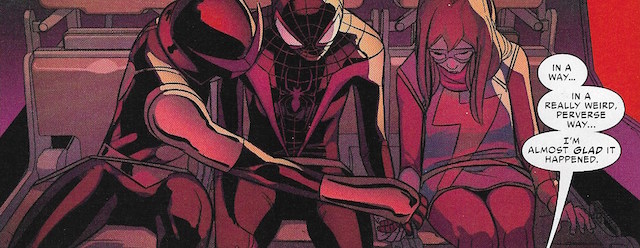
  • Peter attends the funeral of Jay Jameson and Jonah explodes on him, which is odd because he knows New U has the power to bring people back from the dead. Jonah’s first wife Marla, after all, has returned.
  • Peter says “this is all my fault” to himself after everyone leaves, even though it clearly was not.
  • Anna Maria Marconi finds out that Peter’s spider-sense went off when he used Jerry Salteres as a guinea pig for New U’s experimental treatment. The two decide to visit the employee’s house to investigate.
  • Jerry’s wife reveals that her husband failed to take his medicine and had something “terrifying” happen to him. New U told her not to talk about it and scrubbed her webware, which contained video of the incident.
  • Peter inexplicably vows to bring Jerry home after retrieving lost data from the webware. Anna privately scolds him for the promise and he heads off to New U as Spider-Man.
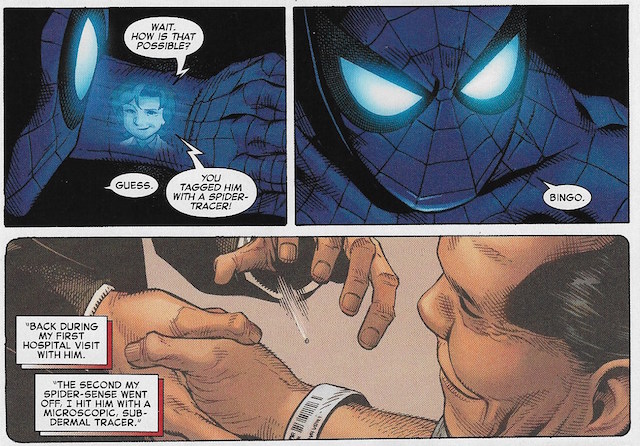
  • It turns out Peter used a “microscopic, sub-dermal tracer” on Jerry when they saw each other in the hospital, so he tracks down the man’s “reanimating” body inside a lab.
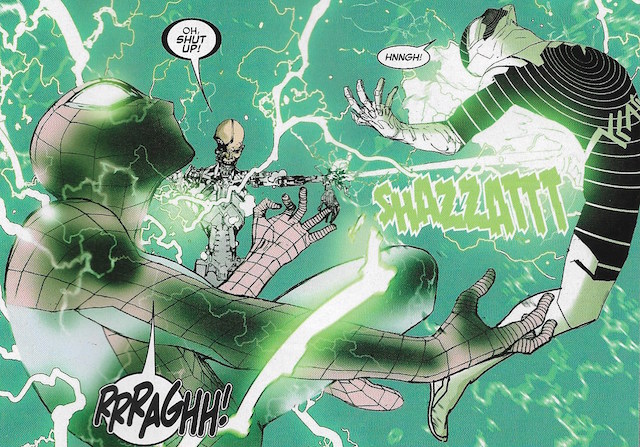
  • Miles Warren walks in on Peter and within moments Rhino and female Electro are headed for battle.
  • Spider-Man goes into a room marked “Do Not Enter” and finds Gwen Stacy. He is surprised when she doesn’t set off his spider-sense.
  • A reanimated Doctor Octopus punches Peter in the face with a tentacle and the issue ends.

DNM #1 also features a story by Dan Slott titled The Night I Died, which tweaks elements of 1973’s The Amazing Spider-Man #122 to include a semi-conscious Gwen finding out that Peter Parker was Spider-Man just before her death. She cries while thinking of Peter as “the man who helped kill dad.”

Gwen is then “reanimated” by Miles Warren, aka The Jackal, and introduced to her father as a means of convincing her to become a “business partner.”
j-jonah-jamesom-dead-no-more

The problem with mixing clone stories and The Amazing Spider-Man, besides the fact that they have been done to death (no pun intended) — and badly done — is that a writer is tasked with covering the very nature of existence, consciousness, and the soul. Even unintelligent readers seem to inherently understand that the writer is entering into serious territory, so if the tale isn’t handled right it crumbles under its own weight.

peter-parker-dead-no-more

Let’s put it another way: Even clones in real life would know that they are clones (i.e., see the panel of Gwen Stacy realizing what has happened before grabbing a knife to slit her own throat). Readers are the same way. Why should they care about Gwen Clone?

They shouldn’t — unless it is done well.

gwen-stacy-dead-no-more

And there’s the rub. On Dan Slott’s watch, Peter Parker “died” and came back to life. The character has not had a single moment of honest reflection on his own death (or whatever it was, since it was never clear) since the series relaunched. Human beings — flesh and blood with thoughts and emotions and hopes and dreams — would be shaken to their core if they died and were brought back to life. Not Dan Slott’s Peter Parker.

Therefore, it stands to reason that if Mr. Slott does not even apply basic human reactions to the protagonist of the series then he will not do so in a meaningful way with clones.

DNM #1 appears to set up all sorts of twists and turns for Peter Parker in the next couple of months. That is the good news.

The bad news is this: Like most conspiracies, the people who weave them usually lose their audience in an incoherent mess that unravels with the least bit of scrutiny. Before you plunk down $4.99 for this book, consider Mr. Slott’s track record and then ask yourself if he seems up to the task.

Editor’s Note:

Regular readers of this blog remember the time when I accurately predicted Dan Slott’s “Arachno-Rockets.” It appears as though your friendly neighborhood blogger has another notch on the belt after having asked in February when “single-cell Spider-tracers” would arrive. DNM #1 does not quite give us a single-celled tracer, but it is “microscopic, sub-dermal.” Given that the function is essentially the same, we’ll consider that a win.
spider-tracer-dnm

Dan Slott’s Spider-Man: ‘Web-cement’ ready in China, not when Peter’s family needs him in ASM #19

spiderman-asm19

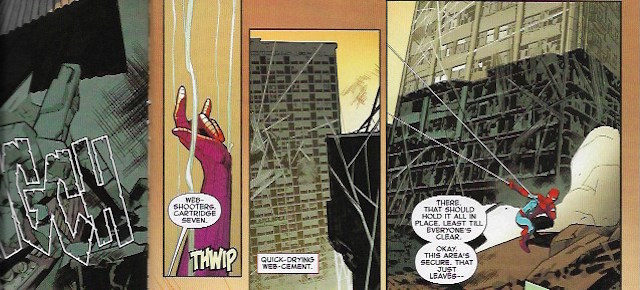
The last two issues of The Amazing Spider-Man have seen the strongest writing on the book in months, which is odd given that its main character — Peter Parker — was relegated to the sidelines. He is back in ASM #19 and, seemingly like clockwork, the book has taken an embarrassing turn. Ham-fisted attempts to prove that he’s a snake-bitten loser abound, and tears flow because the guy with 10,000 specialized web cartridges couldn’t remember that Cartridge Seven contained “quick-drying web-cement” (as seen in ASM #6).

ASM6 web cement
When Peter Parker is in China, “quick-drying web-cement” is on hand for a nearly abandoned construction site. When he’s in New York and his family needs him, he doesn’t think to use it. What does editor Nick Lowe actually do in the office, anyway?

Here is what you need to know for ASM #19:

  • Aunt May tells Peter to hurry to the hospital because her husband, Jay Jameson Sr., is getting worse with some disease that Marvel has not elaborated on. It’s just bad…and deadly…because illness.
  • Peter is on his way when he hears someone scream, “Stop! Thief! That’s all my money!” Our hero turns the corner and sees two men running down the street. He webs both of them up and a shop owner yells at Spider-Man for webbing up his son (even though it was perfectly understandable to make such a mistake and the hero literally secured the guy’s entire life savings).
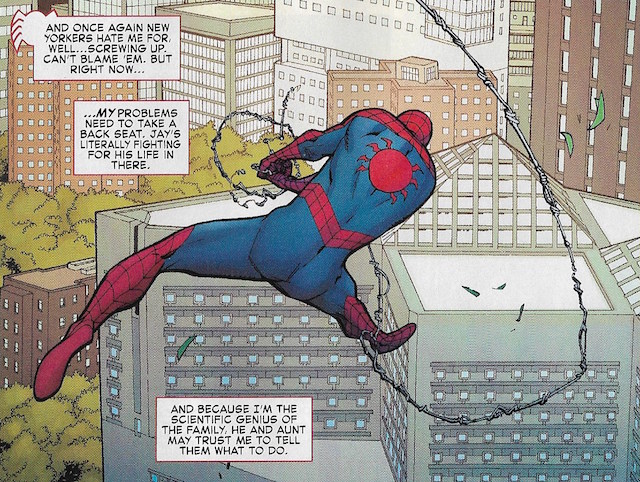
  • Peter then inexplicably says he doesn’t blame New Yorkers for hating him.
  • Everyone wants to know why Peter used New U’s technology on an employee, but he doesn’t want it applied to Jay Jameson Sr. They don’t believe him when he says that further Parker Industries research has shown that conventional methods are probably safer as long as time permits. (Again, what is the disease? Can’t Dan Slott call a doctor and do a little research for something plausible?)
  • Jay privately asks Peter to go to his apartment and get a clock that was brought to America from Ireland. Jay wants to give it to his son before he dies. Peter agrees to get the heirloom.
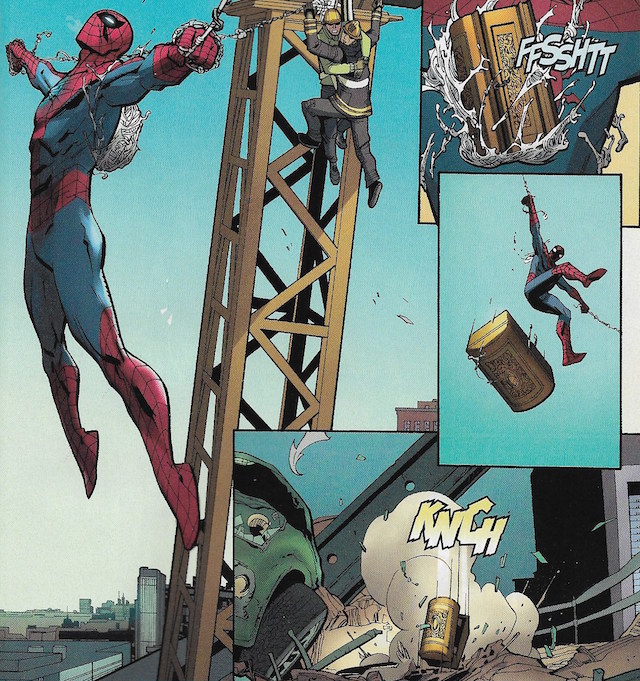
  • Peter webs the clock to his back and heads for the hospital, but a greedy industrialist’s decision to ignore safety regulations (but of course!) causes an accident. A crane comes unmoored from a building and Peter, in a Christ-like pose, must hold it in place from falling while rescue workers arrive. Aunt May calls him and berates him for taking his time. She wants to see him face-to-face on his phone, but he tells her it’s impossible at the moment.
  • J. Jonah Jameson talks to the “reanimated” Marla and asks her what to do.  She tells him to convince Peter to use New U’s technology on his father.
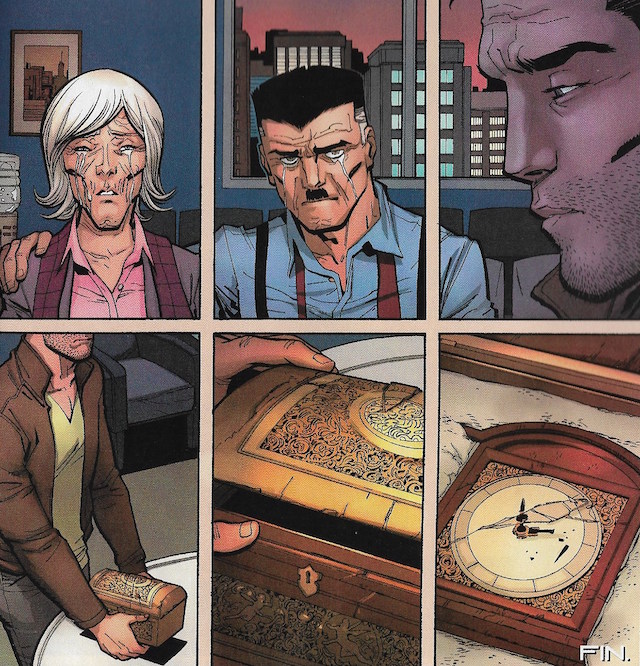
  • Peter’s webbing dissolves after an hour and the clock falls from his back. He finds it later and it’s broken.
  • Aunt May and J. Jonah Jameson cry as perpetually tardy Peter arrives to the hospital with the shattered clock.

Perhaps the two best ways to describe ASM #19 is “forced” and “convoluted.” Characters behave in ways that are downright weird to advance the plot, and Peter is shoe-horned into situations show the tension that his secret identity imposes upon his personal life.

asm19-spiderman

What makes this issues climax fall flat is the fact that for well over a year Dan Slott has pulled out numerous inventions out of Peter Parker’s butt, but for no apparent his reason his technological butt-magic disappears in ASM #19. He literally held up an entire building with web fluid in ASM #6, but now — when he really needs it — the proven technology is not even mentioned.

Heck, Spider-Man even had “web-foam” literally spin off his back on voice command in ASM #9, which protected him as he entered earth’s atmosphere. Are readers supposed to believe he wouldn’t wrap a precious family heirloom in it? Thanks for making Peter look like a total doofus, Dan Slott.

j-jonah-jameson-asm19
Marvel’s message to readers translated: “Did you think J. Jonah Jameson was praying to God in the first panel? Gotcha! Who would do such a crazy thing? Haha. He was talking to Marla the whole time.”

In short, you may enjoy ASM #19 if you watch bad soap operas. Readers have hospital death scenes, people coming back from the dead, a lot of tears and hackneyed writing. Tune in next month for more Mighty Marvel Mayhem, true believers, when Peter Parker needs his “acid-webbing” to save the day, but then decides not to use it!

peterparker

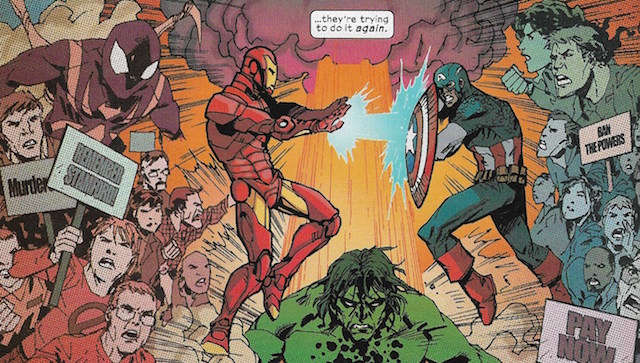
Civil War II #5: Team Stark v. Team Danvers throw down

cwii-5

Brian Michael Bendis’ Civil War II #5 hit stores this week, and someone must have slipped something in his drink because he dedicated the entire issue to a massive brawl between Team Stark and Team Danvers. Is that a good thing? A bad thing? You’ll have to check out my latest YouTube video to find out.

After you’re done watching, let me know what you think in the comments section below — particularly you’re thoughts on the Inhuman Ulysses’ latest vision.

Dan Slott’s excitement, focus return in Amazing Spider-Man #18 with Doctor Octopus in limelight

living-brain-peter-parker

The Amazing Spider-Man #18 is an issue that has been building since the end of Spider-Verse in February 2015, so it stands to reason that writer Dan Slott would put extra care into the product. Still, it seems undeniable that this Doctor Octopus-centric tale possesses the most energy the creator has brought to the title in months. Fans of The Superior Spider-Man will be thrilled with the flashbacks and the loose ends that are tied up, while others will be left wondering, “Why can’t the book have this much life on a regular basis?”

Here is what you need to know about ASM #18:

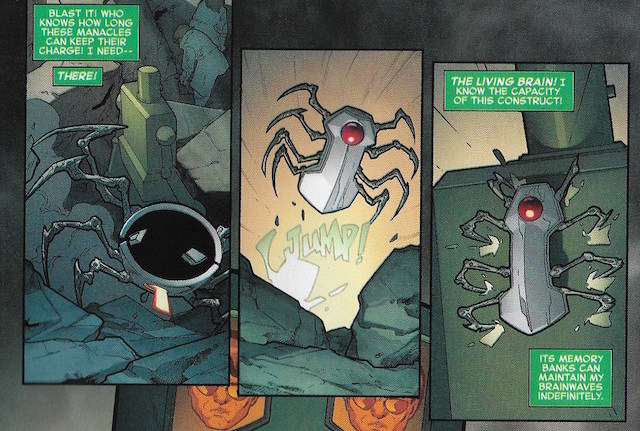
  • Doctor Octopus explains how he was able to transfer his consciousness into the gauntlet of his Superior Spider-Man costume during Spider-Verse. The technology became a “fully functional octobot” and then downloaded his consciousness into Living Brain.
  • Readers are informed how Otto dispatched with Ann Maria Marconi’s new boyfriend, Blain, after he was unable to download his consciousness into the man’s brain. In short, Otto was able to get headhunters in Australia to offer him a job “too good to pass up.” (Blain decided to not even talk to Peter Parker about the situation, apparently…)
  • Doc Ock, still secretly inside Living Brain, demands Anna “explain” when she says she would not date Otto if he were standing before her. She mentions the fact that he tried to kill six billion people. “I could never love someone like that. Ever,” she says while kissing the robot on its cheek.
  • Peter contacts Anna on his way to New York and tells her to “double” her efforts on figuring out the cloning process used by New U Technologies.
  • Otto devises a plan to have Anna fly back to New York because he believes Anna wants Ott’s mind in Peter’s body. When they land in New York she tells Peter that Living Brain has “been acting up a lot lately.”
  • Peter decides to work on Living Brain, aka Doc Ock, who demands Peter “explain” how Otto’s mind was erased from the real Spider-Man’s brain. Peter explains how Otto killed himself so that Peter could save Anna from the Green Goblin, at which point the downloaded consciousness of Otto from Spider-Verse goes ballistic. “Lies! Lies! Lies!” he says while smashing equipment.
  • Living Brain destroys himself as Spider-Man tries to shut him down, but not before Otto’s consciousness again returns to gauntlet from Spider-Verse. Peter and Anna both act as if they only faced a “Doc Ock revenge program from beyond the grave,” as opposed to the real deal (for some inexplicable reason).

Does that sound like a mouthful? If so, that’s because it is — there was a lot going on in ASM #18. To Mr. Slott’s credit, he organized his thoughts about as well as could be expected with the plot threads at hand.

living-brain-doc-ock


As was said earlier, fans of SSM will enjoy this issue. There really isn’t too much to ding it on aside from the fact that once again people must act like morons to move the plot forward.

“Please, he won’t hurt me. He never would. Don’t ask me how I know. I just do. Trust me!” Anna says while trying to convince Peter to get closer to a rampaging Living Brain — but it might as well have been Dan Slott speaking to the readers.

Translation: “Don’t ask too many questions. I don’t. Trust me!”

And Dan is right: If you just want a “wacky” adventure and don’t have a desire to think too hard, then this issue is a fun read. Don’t ask why Anna and Peter give the equivalent of, “Huh. That was weird,” after Living Brain’s meltdown. Don’t ask questions about the nature of life and if humans have a soul, and don’t ask how Otto literally had Peter’s entire life beamed into his mind and didn’t change one bit.

“But Doug!” you say, “Didn’t Otto die to save Anna in Superior Spider-Man #30? Doesn’t that count?”

Answer: No, because readers were given no reason to believe Otto had changed in the previous 29 issues. It just happened.

anna-living-brain

Regardless, as already mentioned, ASM #18 is worth buying for anyone who has been eager to see the series once again focus on Doctor Octopus. It is rather intriguing to think about a man who cannot have the woman he loves because he is trapped inside an “inferior” body, and the villain’s plans to resurrect himself are a good tie-in to Dead No More.

asm18-anna-peter

If you plan on buying Dead No More, then ASM #18 is worth picking up this weekend. If not, then you still might want to give it a read. The author seldom is capable of packing pathos, organized thought, enthusiasm, and action into a single issue of ASM, and it might be months before such a feat is witnessed again.

Related:

Dan Slott’s Spider-Verse Epilogue: Wrap-up oddly more exciting than main story

Civil War II: The Accused #1: Guggenheim does Daredevil well despite flimsy ‘SRA II’ set-up

daredevil-accused-1

This blog asked the following question roughly four months ago: Did Marvel learn from the mistakes of Civil War I? The answer to that question is a resounding “no,” and Civil War II: The Accused #1 further highlights that unfortunate point. As was the case with Christos Gage’s work on The Amazing Spider-Man and even Brian Michael Bendis’ on Spider-Man, fairly impressive writing is undermined by the story’s weak foundation.

Marc Guggenheim does an admirable job showing Matt Murdock’s role in the project, but editorial mandates will give many readers heartburn. In short, Marvel has planted the seeds for Civil War III. Sigh.

dd-cwii-accused-1

Here is what you need to know for CWII: The Accused #1:

  • The Department of Justice has asked Matt Murdock to join its case against Hawkeye, aka Clint Barton, who killed Bruce Banner. The ace lawyer accepts the challenge.
  • Barton asserts that Bruce Banner gave him the means to the Hulk if he returned. He says he does not know if he did the right thing, but that he had “a reason and it was a good one.”
  • The trial starts and the judge seems to have her thumb (actually, her entire fist) on the scale in favor of Murdock and his team of federal prosecutors. Hawkeye’s legal team meets with Murdock and tells him there is a conspiracy to make sure the superhero winds up in prison. Matt is told that if he looks for the truth then he will find out that he is being manipulated like a puppet.
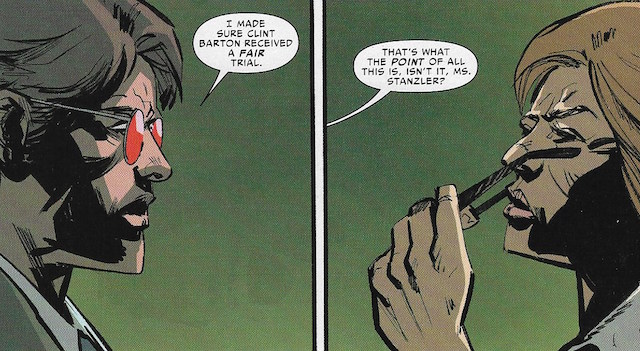
  • Daredevil breaks into the Department of Justice and comes across a meeting between a military general and federal prosecutor Evelyn Stanzler. The government wants Hawkeye in prison to give officials “political cover” to introduce Superhuman Registration Act II. A murder conviction will give them what they need.
  • Murdock shows up in court and withdraws the government’s motion to exclude Bruce Banner’s video diary from the case. He knows the move damages his case, but does so because he believes it will give Barton a fair trial.
  • Barton is ultimately acquitted. Most people believe Hawkeye did the world a favor.

The key bullet point here is the last one because people in the Marvel Universe would believe that a living and highly unpredictable nuclear weapon should be dead — especially after years of witnessing his destructive capabilities firsthand.

The government does not need to execute a successful conspiracy to launch Superhuman Registration Act II because the sound rationale for it never disappeared after it failed the first time.

matt-murdock-cwii-accused-1

CWII: The Accused #1 makes the case (no pun intended), that nefarious forces need a conviction to persuade the public that it is time for SRA II, which is laughable. The only reason why some readers do not get the absurdity is because Marvel turned Tony Stark into a psychotic warmonger in Civil War I.

If you want to see Mr. Guggenheim do the best he can with the shoddy hand he has been dealt, then check out CWII: The Accused. If you are tired of seeing heroes fighting heroes — and one side always being portrayed as cartoonish goons — then hold onto your cash. Amazing Spider-Man: Renew Your Vows is looking like a must-read.

Dan Slott, Mr. ‘politicize the f**k’ out of gun death ‘the second after news hits,’ bashes Trump for calling NYC bomb … a bomb

dan-slott-cbr

One of the most fascinating things about Marvel writer Dan Slott’s decision to turn his Twitter feed into a giant political soapbox is that readers get to see his never-ending stream of hypocrisy. When shootings or terror-related issues capture national headlines, he is always there to show fans of The Amazing Spider-Man that crafting strong stories comes secondary to political hackery.

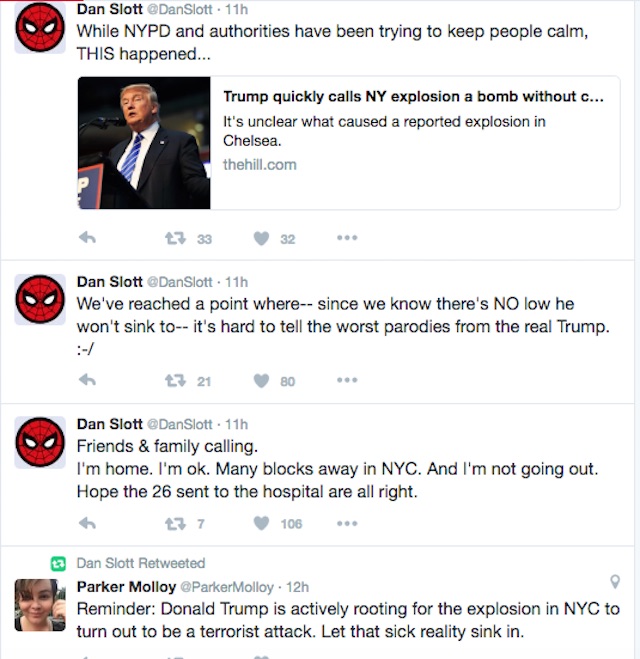
An improvised explosive device — a pressure cooker bomb — went off Thursday night in New York City and injured 29 people. A secondary device that failed to detonate was found blocks away. Republican presidential candidate Donald Trump told an audience of the explosion as news broke, and for that Mr. Slott called it a “new low.”

Anyone who is familiar with Mr. Slott’s online behavior over the years knows that the two men have more in common than he would like to admit. What makes this moment even richer is that his “new low” remark came moments after retweeting the following by another user: “Reminder: Donald Trump is actively rooting for the explosion in NYC to turn out to be a terrorist attack. Let that sick reality sink in.”

Dan Slott’s self awareness knows no bounds. It is indeed a “new low” to accuse a New Yorker of “actively rooting” for terrorism in New York.

Here is a”reminder” for everyone: Dan Slott is the same person who once said he wanted people to “politicize the f**k” out of his death if he were ever shot…“the second after news hits.”

dan-slott-nyc-explosion-tweets

Here is what Mr. Trump said:

“Just before I got off the plane, a bomb went off in New York and nobody knows exactly what’s going on, but, boy we are really in a time. We better get very tough, folks. It’s a terrible thing that’s going on in our world and in our country and we are going to get tough and smart and vigilant. We’ll see what it is.”

Question: Is it more deplorable for a presidential candidate to factually state that a bomb has gone off and that an investigation is underway, or for a writer to say that political opponents “actively root” for terrorism in their home town?

The answer is self-evident.

dan-slott-politicize-the-f

Even if Mr. Slott were correct and Mr. Trump was politicizing the bombing, what would give the writer the moral authority to lecture anyone on such behavior?

When a man tells tens-of-thousands of supporters to “please politicize” his own murder “the second after news hits,” he cannot harangue others for picking up the partisan baton and running with it.

Dan Slott’s Twitter feed is a free resource for anyone who ever wanted to learn about projection. His habitual need to blast “new lows” comes from the knowledge deep within his soul that it is he who engages in loathsome behavior.

Some of Mr. Slott’s many “new lows” have been chronicled here, since mainstream comic book websites fail to demand a modicum of professional behavior from the industry’s artists and writers:

The next time Mr. Slott starts bashing Donald Trump, I suggest reminding him that his online antics have mirrored the New York billionaire for many years. My guess is that the writer with impulse-control problems will block you, but that is to be expected as long as he continues to live in denial.

Update: 

Dan Slott, who blocked me on Twitter, once again shows the world that he still can’t help but read this blog. As usual, his tweets are filled with red herrings and utter falsities, which is why he won’t send people to check out with their own eyes what I have said.

dan-slott-stalking-douglasernstblog

I watched Trump’s speech as it was happening, and my Twitter feed had plenty of stories saying an explosion occurred inside a dumpster and that many people were hurt. I’m assuming that the New Yorker with Secret Service protection and national security briefings was also up-to-date well before the rest of us.

Readers who go to Dan Slott’s Twitter feed will note that he surreptitiously erased a re-tweet that said Donald Trump was “actively rooting for the explosion in NYC to turn out to be a terrorist attack.” Telling. Very telling.

Note to Dan Slott: I do not work for a “birther” conspiracy website. Nice try. That is your new go-to distraction because you don’t know how to respond to my blog posts and you are terrified to come here (there are no slavish moderators to shield you from intelligent scrutiny).

I have worked for years for the same newspaper, with only a brief leave of absence that I won’t get into for personal reasons. I wrote stories for another website for eight months, which has contracts with literally dozens of op-ed writers. Go online and try and find one birther story by me. You can’t find them because they do not exist.

In Dan Slott’s world, I am apparently responsible for what random op-ed writers say and do. Perhaps Dan should check with President Obama’s original literary agent, who boasted that he was “born in Kenya and raised in Indonesia and Hawaii.” Hmmm. Where would anyone get the idea that Obama was born in Kenya? Weird. I suppose the Daily Caller and every other media outlet that reported on this issue are also “birthers.”

Update II: You can’t make this up. Dan Slott deleted the tweets shown above. Classic! This is why he will not come to this blog and debate me. He knows that he cannot throw his stupid and impulsive comments down an Orwellian Memory Hole.

dan-slott-kobayashi-maru

What situation could possibly be Dan Slott’s “Kobayashi Maru”? Heh. Why don’t you join the comments section and tell us about it, Dan? Or not, because you can’t delete posts when you say foolish things.

Charles Soule’s ‘Dark Art’ continues slow burn in Daredevil #11

daredevil-11

New York City is home to the Museum of Modern Art and scores of creators who would do just about anything to get into its exhibits. Therefore, it makes sense that on a long enough timeline Marvel would have a Banksy-esque villain running around the city who would literally kill to get name recognition. The question on this blogger’s mind however, is this: Can a villain ever truly be cool if he wears suspenders?

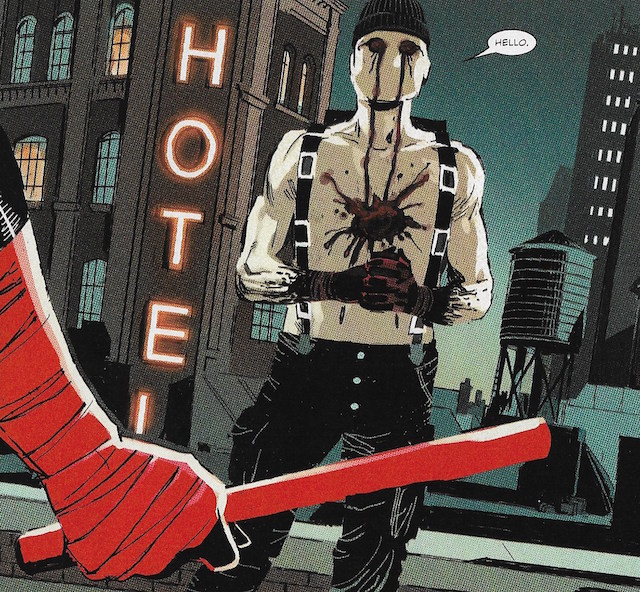
All joking aside, Charles Soule’s “Dark Art” continues its slow burn in Daredevil #11. When readers last left off, Blindspot had been lured to a Bronx building that contained a mural painted in blood. Daredevil concluded that over 100 people likely died during the project’s creation. DD #11 furthers the plot along and reveals the individual deemed “Vincent Van Gore” by the city’s tabloids.

Here is what you need to know about DD #11:

  • The owner of the building where the blood mural was found decides to charge people to see it. A powerful city councilwoman threatens to shut him down because her niece’s blood is on the evidence.
  • Owner Freedy Durnin tells the city official to take a hike because he knows his First Amendment rights and the painting is on private property. (Question: Wouldn’t the cops immediately take the mural as evidence for an ongoing missing persons case? It makes no sense that Mr. Durnin is allowed to keep it just because it was found inside his building.)
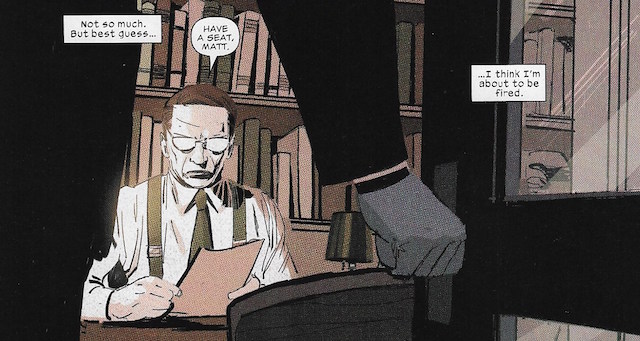
  • Matt Murdock’s boss calls him into his office and says the “wheels of justice have been greased” for him to shut down Mr. Durnin’s grotesque “exhibit.”
  • Matt meets with Foggy for coffee (the two have a chilled relationship), and they talk about what the D.A.’s office wants Matt to do. Matt says it isn’t right that government stooge’s are looking for ways to take a man down for political reasons instead focusing on their job — ensuring justice for all. Foggy says, “You wanted to be a D.A., Matt. All your wishes came true. So now…you do what they tell you to do.”
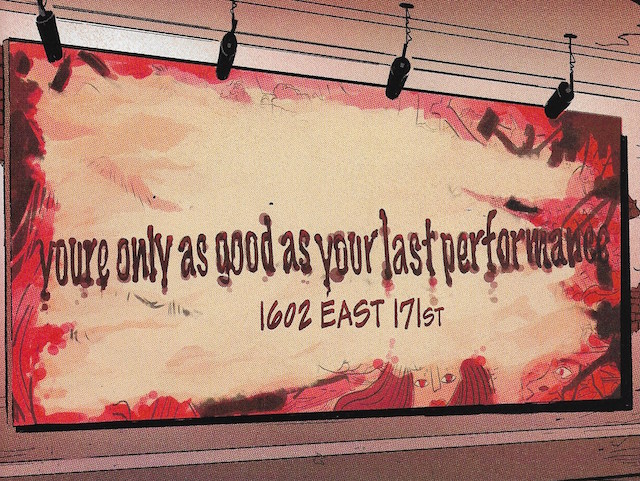
  • Opening night at Durnin’s exhibit is thrown into chaos when the mural is defaced with a new message: “You’re only as good as your last performance. 1602 East 171st.” Investigators find a murderous “tableau” with dead Inhumans inside an apartment. Matt Murdock interprets the “artist’s” work as, “Inhumans are humans, too.”
  • Matt picks up a racing heartbeat on a nearby roof. He finds and excuse to leave Samuel Cheung (aka, Blindspot), and their police escort, and soon confronts the individual as Daredevil.
  • “Did you like my work?” the killer asks.

Mr. Soule packs a lot of material into DD #11, but the slower pacing never hampers the book. If this were a story by Brian Michael Bendis, for example, it would be reasonable to believe that the payoff would come about 12 months from now — or never. But it’s Charles Soule, and up until this point his writing has been solid.

matt-dd11murdock

Perhaps one of the most impressive things about DD #11 isn’t the David Fincher-like murder mystery (think Se7en), but the fact that he is working a politically motivated D.A.’s office into the tale. The last thing I expected to see in a Marvel book in 2016 was an author who makes the case that city officials use a never-ending maze of laws and regulations to attack everyday citizens. In this instance the target of their rage happens to be a shameless jerk, but the underlying point is incredibly important. It is nice to see that Mr. Soule, unlike many of his peers, is capable of thinking outside petty partisan boxes.

dd-11-gallery

While it is a bit silly to think a man would not be forced to turn over a blood mural to the police, there really is not too much to complain about at this point. My wife says it sounds like Mr. Soule was inspired by an old episode of Criminal Minds, but until he reaches Slottian levels of “homage” (i.e., Dr. Who), I will forgive him.

Conclusion: Daredevil continues to roll as it nears one dozen issues. It’s just a huge shame that Mr. Soule continues to go with Bendis’ stupid decision to turn Matt Murdock into a “lapsed Catholic.”  That move fundamentally changes the character — in a negative way — for reasons I will cover in an upcoming blog post.

Editor’s note: A primer on my upcoming Daredevil post can be found here: ‘Daredevil Season 2 trailer: Good men grapple with rotten culture.’

inhumans-crime-scene-dd11

Related:

Daredevil #10: ‘Dark Art’ starts strong, but Soule drops ball on basic Catholicism

Bendis nicely sets up ‘Champions’ in Spider-Man #8, but classic heroes turned into giant goofs

miles-morales-spiderman-8

Brian Michael Bendis is one of Marvel’s key writers, but in a previous life he may have been a circus juggler. Spider-Man #8 somehow manages to move the title’s plot forward, set the stage for Champions, and seamlessly tie into Civil War II. Technically, Mr. Bendis hits all of his marks. Creatively, however, SM #8 once again shows why many older Marvel fans are fed up with the company.

Here is what you need to know for SM #8:

  • Jessica Jones and Luke Cage confront Miles Morales on a rooftop and say they know his secret identity.
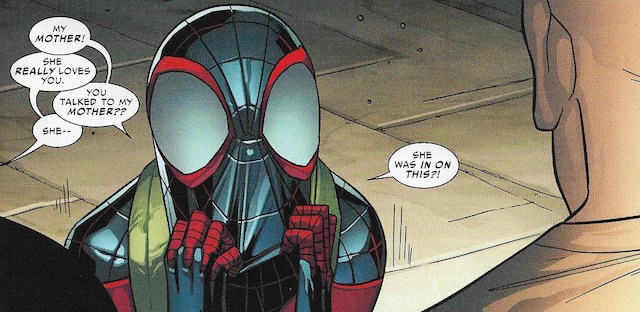
  • Miles is upset to find out that his grandmother hired Jessica Jones to spy on him, but he is glad to hear that his mother tried to pay the investigator to cancel the contract. He agrees not to say anything to his family after the older heroes tell him to get his act together.
  • Miles is summoned to the Triskelion, S.H.I.E.L.D. headquarters, by Tony Stark. A large group of superheroes are informed by Stark and Captain Marvel that everyone will confront the Hulk about Ulysses’ vision of him killing everyone.
  • Bruce Banner is killed by Hawkeye, as previously shown in Civil War II #3.
  • Nova, Spider-Man, and Ms. Marvel are stunned by what happens and the two young men publicly state their allegiance to Tony Stark. Ms. Marvel breaks down into tears because her role model set the stage for Banners’s death.

This sounds like a great issue, right? Well, sort of. One’s enjoyment or hatred of SM #8 really hinges on his or her opinions on Civil War II. Bendis — and artist Nico Leon — do an admirable job showing young heroes who struggle to find their place in an “adult” world, but at the same time it all comes at the expense of classic characters.

nova-morales-spiderman-msmarvel

There is a scene after Banner’s death where the three kids come together to comfort one another that is incredibly poignant, but the feeling disappears the moment one realizes that Captain Marvel and every superhero who sides with her has taken on a goofy position to make Civil War II work.

sm-nova-msm-team

In short, Mr. Bendis has nicely set up an “us against the world” dynamic for the future “Champions” that will also serve Spider-Man well, but in many ways he is doing so at the expense of icons like the original Spider-Man, Peter Parker.

If you are an older reader, the best way to show your displeasure is to withhold your wallet for any title that engages in character assassination of the heroes that made Marvel what it is today.

spiderman-carol-danvers-cwii-asm4

‘Civil War II: Amazing Spider-Man #4’: Dan Slott’s ASM #17 haunts Christos Gage’s latest effort

cwii-asm4-spiderman-clash

It’s hard not to feel sorry for Christos Gage. The guy was asked to write a Spider-Man story that stood on its own while also supporting Brian Michael Bendis’ Civil War II and Dan Slott’s run on The Amazing Spider-Man.

Question: How does the hero who a.) asked The Prowler to resort to corporate espionage on behalf of Parker Industries, and b.) teams up with Carol “Minority Report” Danvers have the moral authority to lecture a confused man like Clayton Cole?

Answer: He doesn’t.

Civil War II: Amazing Spider-Man #4 is a book that actually reads better the less one knows about the current Marvel universe. For people who just want to roll around a few philosophical questions about redemption and free will like marbles, Mr. Gage’s work satisfies. For people who love the character Peter Parker, however, the issue is just one more reminder of just how intellectually discombobulated he has become thanks (in large part) to writer Dan Slott.

stromm

Here is what you need to know for CWII: ASM #4:

  • Spider-Man tries to talk Clayton Cole off a psychological ledge during the one-on-one battle predicted by Ulysses. Peter wants the scientist to give up his “Clash” technology and start a new life.
  • Robot Master reconstitutes himself and attacks the two men just as Peter seems as though he might have a breakthrough.
  • Clayton leaves Spider-Man to deal with the villain on his own, saying that he needs to go his own way.
  • Spider-Man defeats Robot Master, who vows to take Parker Industries to court for Cole’s attack.
  • Peter Parker and Ulysses discuss the Inhuman’s powers, whether they are appropriate to use, and how to channel them to save lives. Peter now says it would be wrong for Ulysses to work for Parker Industries because the company will be stronger by learning from its own from failures.
  • Spider-Man agrees to work with Carol Danvers to profile potential future criminals. He will fight for the cause if necessary, but says he will act like her personal Jiminy Cricket (It worked out so well with Doctor Octopus, right Pete?)
  • Clash steals a massive amount of off-the-books cash from Roxxon and announces that he will no longer work for other men. The villain begins to recruit for a criminal empire.

Fact: Clayton Cole wanted to “redefine” himself as a hero using Clash technology.

  • What then, we must ask, gave Spider-Man the moral authority to say that Clayton Cole should not do that, but Hobie Brown as the Prowler can?
  • Why is Dan Slott’s Peter Parker a stand-up guy for asking Mr. Brown to break into a business and steal technology for his own selfish reasons, but Mr. Cole is “ruining” his life for trying to turn over a new leaf as Clash — the superhero?
  • How can Peter Parker, a man who has been falsely convicted in the court of public opinion multiple times, endorse Captain “secret detention” Marvel?

In short, CWII: ASM #4 is filled with creative contradictions, which are not treated as such. As was stated in previous reviews, it is tough to discern how culpable Mr. Gage is for the story’s flaws when a strong argument can be made that he is doing the best he can with messes made by other men.

spiderman-carol-danvers-cwii-asm4

If you have read the previous three issues of Civil War II: The Amazing Spider-Man, then you may as well buy the conclusion. If you have held off this long, then skip it and take note: The modern Spider-Man is like a boat without an anchor in a storm that shows no sign of breaking.

Again, I feel bad for Mr. Gage — but even more so for the writer who eventually replaces Mr. Slott. Where does a man begin with so much rubble to clear? I guess we’ll find out.

clayton-cole-clash-cwii-asm4

Related:

‘Civil War II: Amazing Spider-Man #1’: Gage offers reprieve from Slott fare

‘Civil War II: Amazing Spider-Man #2’: Gage explores ‘self-fulfilling prophecy,’ recidivism, and redemption

‘Civil War II: Amazing Spider-Man #3’: Peter Parker turned into hypocritical jerk to keep story going