‘The Imitation of Christ’: Antidote for Media-addicted America

Politicians and pundits use every election cycle to talk about the need for “new” ideas. Increasingly secular yet tech-savvy societies are always looking for the next “new” idea, and yet they wonder why the same old problems persist. The more I read, the more I think that many “old” ideas should be dusted off and embraced.

Take Thomas à Kempis’ “The Imitation of Christ,” written in 1418, for example. Just like our good friend Saint Augustine, it’s been a while since he walked the earth. Regardless, Kempis’ devotional book is one that would be beneficial to Christians and non-Christians alike. Even if one were to weirdly strip out all references to Christ, much of the wisdom regarding the right way to live would still remain.

Atheists say that Christ was not the Son of God, but if you asked them if the man — from a purely historical point of view — lived a life worth imitating, then the vast majority of them would probably say yes.

Facebook, Twitter, Tumblr, Snapchap. CBS, NBC, ABC, CNN, MSNBC and FOX. Xbox, Playstation, Nintendo. Warner Bros, Sony, Disney, Universal and Netflix. NFL, MLB, NBA, NHL and UFC. Amazon, Ebay, Microsoft, Apple and more, more, more always vie for our attention — and we give it to them.

Addiction to the temporal is a horrible thing, but it is hard to recognize because it sneaks up on a man. It slowly slithers around the psyche. Its initially brings warmth and joy, but in the end it’s all a ruse. When it has completely enveloped the whole of a man’s being it constricts like a python and suffocates his soul while he sleeps.

In the addicted man’s waking state he is, on many levels, unaware that the most important part of him is in peril.

He is sad. He is lost. He does not know why he is never complete, and so he turns to the very thing that fills him with venom while he dreams.

Enter Thomas à Kempis, who breaks down the blueprint for a happy life into four parts: 1. Useful Admonitions for a Spiritual Life. 2. Admonitions Concerning Interior Things. 3. Internal Consolation. 4. The Blessed Sacrament.

Ask yourself if there is a reason why politicians never mention “The Imitation of Christ” as one of their favorite books.

“Who is so wise as to be able fully to know all things? Therefore, trust not too much to thine own thoughts, but be willing also to hear the sentiments of others. Although thine opinion be good, yet if for God’s sake thou leave it to follow that of another, it will be more profitable to thee.

For I have often heard, that it is more safe to hear and to take counsel than to give it.

It may also happen that each one’s thought may be good, but to refuse to yield to others when reason or a just cause requires it is a sign of pride and willfulness,” (Book 1, Chapter 9).

Interesting, isn’t it?

“Don’t listen to those ‘old’ ideas, kind voter. Listen to me, [Insert Politician’s Name Here], because I’m never wrong and my ‘new’ ideas will fix all your problems.”

Kempis continues:

“How happy and prudent is he who strives to be such now in this life as he desires to be found at his death.

For it will give a man a great confidence of dying happily if he has a perfect contempt of the world, a fervent desire of advancing in virtue, a love for discipline, the spirit of penance, a ready obedience, self-denial, and patience in bearing all adversities for the love of Christ,” (Book 1, Chapter 23).

It takes just two sentences for the author to give readers seeds that will bear a harvest of joy for all the years of their lives. As a Catholic, I would implore readers not to take Christ out of the sentence, but I will concede that doing so does not negate the rest of the advice embedded in the text.

America faces many challenges in the years ahead. If you are interested in giving yourself mental and spiritual tools for the task, then I highly suggest reading “The Imitation of Christ.”

Editor’s Note: I will send a copy of the book to the first regular reader who asks.

Bono channels G.K. Chesterton and C.S. Lewis to affirm his faith in Christ

Bono on JesusIt’s not often that a giant rock star gives an interview where he unflinchingly affirms his belief in Christ. That is exactly what U2’s Bono did during a March 2014 interview that is making the rounds again just in time for Easter. However, what is perhaps most interesting is how Bono appears to be well-versed in the writings of G.K. Chesterton and C.S. Lewis.

Here is what Bono said in his interview with RTE One’s Gay Byrne, which comes across at times like an FBI interrogation or a courtroom cross examination:

Bono: I think it’s a defining question for Christian. Who was Christ? I don’t think you’re let off easily by saying a great thinker or great philosopher because, actually, he went around saying he was the Messiah. That’s why he was crucified. He was crucified because he said he was the Son of God. So, he either, in my view, was the Son of God — or he was nuts. Forget rock-and-roll messianic complexes. This is, like, I mean Charlie Manson-type delirium. And I find it hard to accept that all the millions and millions of lives, half the Earth, for 2,000 years have been touched, have felt their lives touched and inspired by some nutter. I don’t believe it.

Byrne: So therefore it follows that you believe he was divine?

Bono: Yes.

Byrne: And therefore it follows that you believe that he rose physically from the dead?

Bono: Yes. I have no problem with miracles. I’m living around them. I am one.

Byrne: So when you pray, then you pray to Jesus?

Bono: Yes.

Byrne: The risen Jesus?

Bono: Yes.

Byrne: And you believe he made promises that will come true.

Bono: Yes. I do.

Friendly note to Bono: Your observation is actually more awe-inspiring than you originally thought because billions — not just millions — have been touched by the words of Christ. Regardless, here is what G.K. Chesterton said when “The Everlasting Man” was published in 1925:

“If Christ was simply a human character, he really was a highly complex and contradictory human character. For he combined exactly the two things that lie at the two extremes of human variation. He was exactly what the man with a delusion never is; he was wise; he was a good judge. What he said was always unexpected; but it was always unexpectedly magnanimous and often unexpectedly moderate.

Take a thing like the point of the parable of the tares and the wheat. It has the quality that united sanity and subtlety. It has not the simplicity of a madman. It has not even the simplicity of a fanatic. It might be uttered by a philosopher a hundred years old, at the end of a century of Utopias. Nothing could be less like this quality of seeing beyond and all round obvious things, than the condition of an egomaniac with the one sensitive spot in his brain. I really do not see how these two characters could be convincingly combined, except in the astonishing way in which the creed combines them.” — G.K. Chesterton.

Here is what C.S. Lewis said when “Mere Christianity” was published in 1952:

“Yet (and this is the strange, significant thing) even His enemies, when they read the Gospels, do not usually get the impression of silliness and conceit. Still less do unprejudiced readers. Christ says that He is “humble and meek” and we believe Him; not noticing that, if He were merely a man, humility and meekness are the very last characteristics we could attribute to some of His sayings.

I am trying here to prevent anyone saying the really foolish thing that people often say about Him: ‘I’m ready to accept Jesus as a great moral teacher, but I don’t accept His claim to be God.’ That is the one thing we must not say. A man who was merely a man and said the sort of things Jesus said would not be a great moral teacher. He would either be a lunatic — on the level of a man who says he is a poached egg — or else he would be the Devil of Hell. You must make your choice. Either this man was, and is the Son of God: or else a madman or something worse. You can shut Him up for a fool, you can spit at Him and kill Him as a demon; or you can fall at His feet and call Him Lord and God. But let us not come with any patronizing nonsense about His being a great human teacher. He has not left that open to us. He did not intend to.” — C.S. Lewis.

Chesterton and Lewis beautifully articulate the case before us: either Christ was who he said he was, or he was insane. But, as they both keenly observe, even his biggest detractors generally regard him as a profound thinker and a beacon of light whose example we should all follow.

Think of how many great men and women there were throughout all history, whose names are forgotten within weeks, months, or at most a few decades after they’ve passed away. Then consider Jesus, who for over 2,000 years has captivated the world and changed billions of lives — even those who don’t believe his claims. Like G.K. Chesterton, C.S. Lewis, a modern Irish rock star named Bono, and billions of other individuals throughout the course of history, I firmly believe he was exactly who he claimed to be.

Francis De Sales’ ‘Introduction to the Devout Life’: 1609’s must-read still amazing in 2015

Francis De Sales Intro Devout LifeIt is a rare occurrence to read a book and come to the conclusion that the writer’s initial inspiration was perfectly realized upon its completion. Saint Francis De Sales’ “Introduction to the Devout Life” may have been published in 1609, but its stunning insight into the human condition makes it a must-read in 2015. In another 400 years, it will still be leaving readers in awe.

While De Sales wrote for a Christian audience, the blueprint for a healthy civil society he presents is one that men and women of all faiths (or no faith) would be hard-pressed to criticize. The virtues he seeks to cultivate in his readers may be motivated by a desire to instill a love of God in  as many hearts as possible, but at the end of the day he is still talking about honesty, humility, patience, charity, fortitude, prudence, etc.

Even more impressive is how De Sales addresses the reader (“Philothea”) directly, yet with a delivery that feels like a kind and gentle father imparting time-tested wisdom to a child. De Sales (who must have consulted countless men and women from all walks of life) has such an exquisite grasp of humanity’s trials and tribulations that it is hard not to feel as though he already knows everything about you — yet still offers unconditional love.

De Sale somehow manages to write for the YouTube-Instagram-Facebook culture of 2015 while living in 1609:

“We apply the term vainglory to whatever we assign to ourselves, whether something that is not actually in us or something in us but not of us, or something in us and of us but not such that we can glory in it. Noble ancestry, patronage of great men, and popular honor are things that are not in us but either in our ancestors or in the esteem of other men. Some men become proud and overbearing because they ride a fine horse, wear a feather in their hat, or are dressed in a splendid suit of clothes. Is anyone blind to the folly of all this? If there is any glory in such things it belongs to the horse, the bird, and the tailor. It is a mean heart that borrows honor from a horse, a bird, a feather, or some passing fashion.

Others value and pride themselves because of a fine mustache, well-trimmed beard, carefully curled hair, soft hands, ability to dance, play cards well, or sing. Such light-minded men seek to increase their reputation by frivolous things. Others would like to be honored and respected by men because of a little learning, as if everyone should go to school to them and take them as their teachers. They are called pedants for this reason.

Other men have handsome bodies and therefore strut about and think that everybody dotes on them. All this is extremely vain, objectionable, and foolish and the glory based on such weak foundations is called vain, foolish, and frivolous.

We recognize genuine goodness as we do genuine balm. If balm sinks down and stays at the bottom when dropped into water, it is rated the best and most valuable. So also in order to know whether a man is truly wise, learned, generous, and noble, we must observe whether his abilities tend to humility, modesty, and obedience for in that case they will be truly good. If they float on the surface and seek to show themselves, they are so much less genuine in so far as they are more showy. Pearls conceived and nourished by wind or thunder claps are mere crusts, devoid of substance. So also men’s virtues and fine qualities conceived and nurtured by pride, show, and vanity have the mere appearance of good, without juice, marrow, solidity.” Francis De Sales, Introduction to the Devout Life (New York: Image, 2014), 121–122

The depth and breadth of De Sales’ understanding of humanity is a marvel to behold. If for no other reason, “Introduction to the Devout Life” shines a giant spotlight on just how far we’ve fallen as a culture. The book was written for the likes of carpenters, soldiers, sailors, and tailors — not academics — and yet the man on the street in 2015 would likely have a hard time digesting much of De Sales’ intellectual discourse.

If you have ever sat alone in your bed at night and tried to plumb the depths of your soul to root out what is rotten and realize what is wholly good, then I cannot recommend Francis De Sales’ “Introduction to the Devout Life” enough. If it is read with an open mind and seriously meditated upon, then I have no doubt that it will truly change your life for the better.

Atheists attack easy targets to distract you from men like Hubert Van Zeller

A recent YouTube video that went viral shows a woman who claims Monster Energy Drinks are the work of the devil. Atheists and their allies in the media ran with it. An atheist friend of mine even passed it along with the message, “One of your people.”

I love my friend on many levels, but like most atheists these days he tends to reflexively go after the low-hanging fruit while ignoring the works of serious Christians.

The reason why many websites are keen to find the Christian equivalent of 9/11 Truthers or the next Westboro Baptist Church is because the mind that can be convinced early on that men and women of faith are all intellectually bankrupt kooks is the mind that is much more likely to avoid picking up books by C.S. Lewis, G.K. Chesterton, and Hubert Van Zeller.

To an atheist, men like Mr. Zeller are terrifying. Picking almost any random page out of Mr. Zeller’s “Suffering: The Cross of Christ and Its Meaning For You,” gives insight as to why Christians — particularly intelligent Christians — come across as frightening to unbelievers:

“A man is discouraged either because he looks back at the past and sees a sequence of misfortunes that has shaped for him a mold of failure, or because he looks into the the future and can see no security, happiness, or prospects of success. His experience of life has given him these findings, so he feels, understandably, that life is insupportable.

But if he knew more of Christ, he would know that he had misinterpreted his experience, and that life is not at all insupportable. He would neither shy away from the thought of the past, nor stand dismayed by the thought of the future. The immediate present would not daunt him either: he would know that it could be related, together with the failures that have been and the horrors that are in store, to the Passion.

That is not to say that deliverance from disillusion, discouragement, and despair can be effected by a mere trick of the mind — the knack of referring our desolations  automatically to God — but that, in the gradual and painful conversion of the soul from self-centeredness to God-centeredness, there will be a growing tendency toward confidence. No longer brought low by the sight of so much evil in ourselves, in others, and in the world, we rise by the slow deepening of detachment to the sight of a possible good in ourselves, in others, and in the world. The vision extends to a probable good, and then to a certain good. Together with this widening horizon, which reveals the positive where before only the negative was expected, goes the knowledge that the only good is God’s good, and that it exists on earth — as those who receive the Word made flesh exist on earth — not of the will of man, but of God,” (57-58).

A man who believes in God is confident. He sees pain and suffering as a path to overcoming pain and suffering. There is nothing that the world can throw at him — nothing — that will deter him from steadily marching towards his objective. He finds strength in weakness. He is calm. He sees God everywhere and in everything — grace can come from even the most unexpected of places.

Put another way:

“The man of faith has reserves; he surrenders to nothing but the will of God. His desire is united to the desire that was in the mind of Christ when He fell on the road to Calvary. His failure is Christ’s failure; the waste of his talents is the waste of Christ’s. There is no question here of desperation, panic, self-pity, rebellion; no talk of accident or bad luck,” (25).

Put yourself in the shoes of an atheist Huffington Post editor, whose deepest desire is to have 400 million Americans dependent on an ever-expansive federal government. If you wanted the civilian population to dutifully bow to 535 bureaucratic overlords in Washington, D.C., would you want them watching Christian conspiracy theorists who see the devil in caffeinated beverages, or reading the works of men who believe “When I am weak, then I am strong”?

If you want to see just how powerful you really are, then I highly suggest reading “Suffering, The Cross of Christ and Its Meaning For You.” If you want to put yourself on a moral pedestal while denying the existence of God, then stick to The Huffington Post.

Hollywood on ‘Son of God’ and ‘The Passion of the Christ’: If it has Jesus, we’ll find an excuse to hate it

Son of God among people

‘Son of God’ came out in theaters this past weekend, and you’ll be shocked (not really) to find out that critics hated it while most audiences walked away happy. The movie raked in well over $26 million dollars, coming in second to Liam Neeson’s ‘Non-stop,’ where the bad guy is a veteran who loves the Constitution. I saw ‘Son of God’ this weekend and am baffled (not really) how it could have possibly scored a “26% rotten” on Rotten Tomatoes. While it’s obvious that the movie was made by believers for believers (and those who may want to dip their toes into the pool of Christianity), it’s certainly not a “bad” film.

Perhaps critics were simply harsh because they feel it belongs on television instead of the big screen. That seems plausible. Given that, I decided to revisit another movie about Jesus, Mel Gibson’s ‘The Passion of the Christ.’ It turns out the critics didn’t like that one too much either.

Son of God critics versus viewersHere is what I found: Rotten Tomatoes doled out a 49% “rotten” score for ‘The Passion of the Christ,’ while audiences overwhelmingly liked what they saw. Maybe if it made an extra $100 million over its already-impressive global haul it would have matched Rotten Tomatoes’ score for Neeson’s evil constitution-loving veterans flick…

Passion of the Christ rotten tomatoes‘The Passion of the Christ’ was a “film” by a “filmmaker.” Whether you like Mel Gibson as a person or not, the guy has talent. Audiences recognized it as well, and rewarded ‘The Passion of the Christ’ to the tune of $370 million at the box office in 2004. If I take my “Catholic hat” off and look at both movies from the point of view of someone who doesn’t particularly care for Christians, ‘Son of God’ would get the 49% “rotten” score and ‘Passion of the Christ’ would get a 65% “fresh” rating — but I’d shake my fist at Mel as I did it. There is really no way to read some of the critic’s reviews without coming to the conclusion that they simply don’t want Jesus on the big screen.

Son of God with child

Probably one of the best reviews I’ve seen on the movie comes from YouTube critic Jeremy Jahns:

I was really skeptical about this movie. Going into it I was like: “All right, it’s part of a mini-series. It’s going to feel like it’s made for TV.” And it does for the most part, but there there were a couple of things about this movie that I did like what they did with it. Going into this movie first and foremost I was hoping they would touch on the fact as to why people felt this Jesus had to die. Seriously, a lot of these Jesus movies gloss over that. They’re like “Hey it was Jesus and he died because he had to, it’s salvation and stuff. It’s magic.”

But I’m always left with that feeling, “No, like politically speaking why did they feel they had to kill this guy and why was it just such a big deal and what went into it? And this movie — actually to my surprise — touched on that very thing. …

This movie is one of two things: it’s either a really impressive made-for-TV movie or it’s a not-as-impressive theatrically released movie. … ‘Son of God’ engaged me where I wanted to be engaged. And it played the angle I was actually hoping it would play that I didn’t think it would play. It still feels like a made-for-TV movie for sure, especially in some scenes. However, I’ll still say ‘Son of God’ is a good time…”

There’s more to it, but you get the point. It’s a fair review. Head on over to Rotten Tomatoes if you want to see a slew of people who seemed to be looking for things to criticize from the first moment Diogo Morgado — who did a commendable job as Jesus — appeared on screen.

Son of God 1

The other thing that ‘Son of God’ did a good job with was showing the relationship Jesus had with his disciples. Think about it: Peter, the “rock” of the Church, denied Christ three times. Matthew was a tax collector. Judas betrayed him for 30 pieces of silver. Jesus called imperfect people to Him. He took in misfits. He loved the unloved and forgave those who society said were unforgivable. While ‘Son of God’ does skip a lot of important parts of the Bible, those it did show were handled with care. It’s a solid movie to watch if there is someone in your life who has ever essentially asked, “What’s the big deal with this guy? Tell me about Him.”

With that said, for those who already believe in Christ I’d have to go with Gibson’s ‘The Passion of the Christ’ as a must-see Jesus film. If you watched ten movies with Jesus in them and someone asked “Which one was directed by a Catholic?” there would be no question (which to this Irish-Catholic is a good thing).

Passion of the Christ

While ‘Son of God’ says, “Hey, there’s this guy and his name was Jesus and you should look into him,” Gibson’s ‘The Passion of the Christ’ says: “Listen buddy, this guy went through some serious s**t — grueling gut-wrenching pain that you can not even fathom as you curl into bed at night with your XBox in 2014 — so check it out and appreciate what this man did for you.”

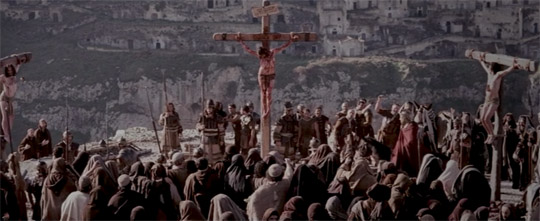
Jesus cross

When I read reviews by critics who obviously have a thing against religious people I can’t help but think of the Romans laughing, kicking, spitting and punching Christ as he carried his own cross to the place of his execution. Whether one believes Jesus was the Son of God or not, no serious person argues that He wasn’t a real man who was put to a gruesome death for what He preached. That is why guys like Jeremy Jahns ask: “Why was it just such a big deal [to kill Him] and what went into it?” Most people do not know the story aside from the watered-down version they might get as a kid, or (sadly) the jokes that are told about Christ on television sitcoms.

Jesus on cross

In short, if you’re curious about Christianity, then check out ‘Son of God.’ If you want to get a taste of the very real pain Jesus went through before his death, check out Mel Gibson’s ‘Passion of the Christ.’ In both cases, if you go into each movie with an open mind, then you’ll walk away and realize that the critics at Rotten Tomatoes hold openly Christian films to an unfair standard.

Kevin Smith: I’ll make ‘Christzilla’ — but my courage ends at Muhammad vs. Mothra

Kevin Smith Mothra

Remember when Kevin Smith’s Westboro Baptist Church-inspired horror flick ‘Red State’ barely cracked $1 million dollars? Since portraying roughly half the nation as potential religious whack jobs worked out so well for him, he’s decided to up the ante by pitting humanity and Satan against a giant raging “Christzilla” figure. As usual, the “daring” filmmaker failed to disclose any plans to ridicule Islam.

From The Hollywood Reporter:

Smith shared details about that project and updates on other movies in the works, and also revealed how he’s going to approach his film career going forward, in an extensive Facebook post on Monday.

The filmmaker wrote that he’ll soon start writing a movie about mankind teaming up with Hell to fight a rapturing giant Jesus.

Here’s what Smith said on his Facebook page:

“[R]ight now, the aim is to shoot CLERKS III this May — so this HELENA HANDBAG picture would still be a ways off anyway. But why sit around commenting on other people’s lives and art on the internet when I can try to make some NEW art instead? As for the title: If you heard the podcast, you know Scott suggested CHRISTZILLA in place of HOLY CHRIST! – the title of the fake movie in the original podcast. I asked the audience to offer up their suggestions at #BeatChristzilla and they were all really fun! But I’m going with the title HELENA HANDBAG – which comes directly from the plot of the flick (it’s kind of a nod to David Lynch’s unproduced ONE SALIVA BUBBLE screenplay, too — which was also about the end of the world and also carried a title that didn’t really prepare you for what the movie was about). So I’m off to write HELENA HANDBAG.

“Clerks III” followed by another attempt to get under the skin of religious folks? Perhaps in a few years “Clerks IV: Dante’s Inferno” can fuse Kevin Smith’s two primary go-to career options. Jay and Silent Bob can travel to the depths of Hell to save Brian O’Halloran.

For younger moviegoers, it is hard to explain how time has exposed Smith’s incredibly limited range as a writer and director. 1994’s “Clerks” was a truly inspired effort, and “Chasing Amy” solidified his reputation at the time as a witty guy with his finger firmly planted on the pulse of American pop-culture. People started copying his style, and instead of searching out new intellectual landscapes to explore he stayed in the same arena of thought with the usual creative teams. With each iteration, the “Kevin Smith” brand became more stale. Smith, however, doesn’t quite see it that way:

JERSEY GIRL, ZACK & MIRI, COP OUT – while I love them all, these are movies anybody could make. Like ’em or hate ’em, nobody else but me could’ve (or would’ve) ever made CLERKS. Or CHASING AMY. Or DOGMA. Or RED STATE. Or CLERKS II. Or MALLRATS. Or JAY & SILENT BOB STRIKE BACK.

  • Mall Rats — a funny movie about slackers. No one but Smith would have done that? The 90s would disagree.
  • Chasing Amy — a sharply written romantic comedy involving Lesbians? No one but Smith would make that? The growing Netflix section on gay and lesbian movies says otherwise.
  • Dogma — a critique on the Catholic Church. No one but Smith would make that? Okay.
  • Red State — a horror flick that blasts fundamentalist Christians. No one but Smith would make that? Gotcha.

Does Kevin Smith use the caps lock button to convince himself that his assertions are true, or does he think that talking loudly convinces the rest of us of the veracity of his claims? Will the sequel to “Helena Handbag” be called “Islamabad Burka”? Don’t count on it.

If Kevin Smith wants a movie that no one else would make, perhaps he could write a film that pits Giant Muhammed against Mothra. Giant Muhammed could also have a harem of topless women the size of The Sacred Mosque Al-Masjid Al-Haram. But Smith won’t go there because it’s easier to needle Christians with “Christzilla” than it is to make a film that lands on the radar of the world’s nuttiest Islamic clerics. Just ask Mark Basseley Youssef (formerly Nakoula Basseley Nakoula), the director of “Innocence of Muslims.” He’s the guy the Obama administration couldn’t act fast enough to pull out of his home for a perp walk. Crime? Daring to criticize Islam.

Kevin Smith is an intelligent guy with some good instincts. He was way ahead of the game when it came to podcasting and the format plays to his strengths. However, his role as screenwriter and filmmaker has suffered from years of staying inside his comfort zone. Worse, he still thinks that making jokes at the expense of devout followers of Jesus is edgy. It’s not. It’s just sad and, on some level, cowardly considering many of the real threats to the creative freedoms he enjoys as a citizen of the United States.

Kevin Smith doesn't want to end up like Mark Basseley Youssef (Nakoula Basseley Nakoula), the director of "Innocence of Muslims," so he sticks to mocking Christians.
Kevin Smith doesn’t want to end up like Mark Basseley Youssef (Nakoula Basseley Nakoula), the director of “Innocence of Muslims,” so he sticks to mocking Christians.

Related: Red State’s Kevin Smith Plays Silent Bob on Radical Islam

Related: Red State Teaser Trailer Hits Christians because Teasing Muslims Terrifies Kevin Smith