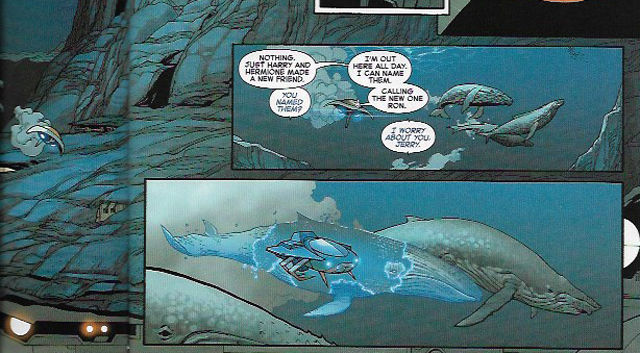
Older readers will remember the episode of “Happy Days” where Fonzi “jumped the shark” in his famous leather jacket while waterskiing. Years from now, perhaps some fans of The Amazing Spider-Man will trace back Peter Parker’s character derailment to the time he started using “holographic whales” on missions to take on global terrorist organizations.
The current relaunch of ASM will likely be as divisive for Spider-Man fans as other aspects of writer Dan Slott’s extended run because, as mentioned before, the character is being used as some sort of James Bond/Bruce Wayne/Tony Stark/Steve Jobs/Peter Parker chimera.
Is it fun to see Spider-Man and The Prowler sneaking around one of The Zodiac’s underwater bases? Yes. Of course. The inner child of any man loves the thought of taking a submarine into the depths of the ocean, finding an evil terrorist organization’s base, and then infiltrating it to save the free world.
The problem in this instance, however, isn’t the dilemma Parker must overcome but changes made to the character to propel him there. Last issue it was revealed that Peter Parker became fluent in Mandarin and mastered secret-agent driving skills within months — as CEO of a rapidly-expanding tech company. Now he is employing holographic whales while selling spider-tracer technology in the global marketplace.
At what point in time do fans of The Amazing Spider-Man say the integrity of the character has been compromised?
At what point has the character been taken so far from his roots that he ceases to be the same man?
At what point does the treatment of Peter Parker, like his holographic whales, become an illusion that hides what is right and what is true?
With that said, the issue did have its strengths — most notably Parker’s reflection upon the time he was forced to leave Silver Sable to (seemingly) die at the hands of Rhino in order to save the world. I have always said that placing heroes in such difficult situations provides opportunities for character development. The “No one dies!” era of ASM was an embarrassment for the book, but it appears as though Mr. Slott was able to turn a few lemons into lemonade. Kudos.
As is the case with the last issue, the decision to buy or pass on this book all depends on your fidelity to the character of Peter Parker.
At this point it doesn’t seem far-fetched to predict Dan Slott turning him into Marvel’s Elon Musk. Instead of Space-X, perhaps Peter Parker will launch “Spider-X.” If readers criticize the “Spider-Rockets” that are introduced in ASM #25, then they will be mocked and ridiculed by those who “know better” (i.e., Marvel’s writers and editors).
One of the common complaints about Marvel writer Dan Slott is that he fundamentally misunderstands the character Peter Parker. While there is plenty of evidence from his run on The Amazing Spider-Man to make such a case, I have found the best way to illustrate this is to simply quote the man.
An incredibly telling moment from Florida Supercon went under the radar roughly eight months ago. Mr. Slott said Dr. Octopus is actually better at appreciating real beauty than Peter Parker — and that Parker’s love for Mary Jane is “anti-Marvel.”
“Ann is beautiful. When you think of Peter Parker, I wanted to have this big change in the life of what makes Otto different from Peter. And when you read all the Otto Octavius stories of his background, of his growing up, of who he was — and even as Dock Ock — all the women he falls in love with, he sees them for who they are inside.
Look at Stunner. Look at all these, like, nerdy girls he was dating as Otto. I think that’s something Otto does something better than Peter. He sees people who are truly beautiful and loves them for that.
And you look at everyone Peter has fallen in love with, and every single one of them is superficially beautiful on the outside. And the reason for that is they’re all created by John Romita Sr., who drew everyone woman beautiful.
What guy wouldn’t fall for Gwen Stacy or Mary Jane? Or even if he falls in love with like a Deb Whitman, yeah, she’s the girl with glasses, but she’s the girl with glasses who can suddenly take off her glasses and whip out the hair.
Everyone Peter falls in love with is so classically beautiful, and to me that is anti-Marvel.
To me, the Marvel Universe is not about perfect people. To me the Marvel Universe — the thing that makes it so much better than any other superhero universe — is the Marvel Universe is the book about people with feet of clay.
When I read DC Comics, my favorite DC characters that I love the most are the most f***ed-up ones.
In Dan Slott’s world, there is something unacceptable with Peter Parker falling in love with a beautiful woman — but it’s perfectly okay if he falls into lust with Silk (Cindy Moon), due to Slott-created spider-pheromones.
Why is Anna Maria Marconi considered “truly” beautiful by Dan Slott, but Mary Jane is not? It has been established that MJ’s beauty is not just skin-deep, so what is the problem?
Only if Peter Parker was a shallow man who married an equally-shallow party-girl would there be an issue — but that is not the case.
Here is Mr. Slott’s problem with Peter Parker:
When I read DC Comics, my favorite DC characters that I love the most are the most f***ed-up ones.
Peter Parker is a well-adjusted character, despite all of his trials and tribulations. He has guilt issues due to Uncle Ben’s and Gwen Stacy’s death, but in general he has always handled the challenges life throws at him with grace and dignity. He is not “f***ed-up,” which Mr. Slott indicates is a prerequisite for becoming one of his favorites. As a result, he must make up weird personality deficits for Peter Parker like Doctor Octopus being better at appreciating “true” beauty.
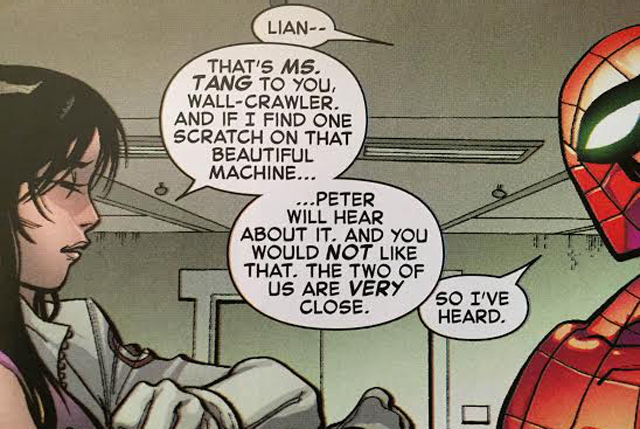
Dan Slott’s Peter Parker is now “very close” to Lian Tang. Is she not beautiful? Or is Peter just falling in lust again with a new Asian flavor-of-the-month?
Is it “anti-Marvel” for the character to fall in love with Gwen Stacy and MJ, but Marvel-certified to fall in lust with women of Japanese and Chinese heritage? We thought we were getting diversity, but perhaps we’re just getting the objectification of Asian women… Sad.
If you feel like Mr. Slott does not understand Peter Parker, then I suggest watching the Dan Slott Q&A Spotlight from Florida Supercon. The whole thing runs for an hour, but it will take less than five minutes to understand why The Amazing Spider-Man has been creatively spotty for years.
Update:
Dan Slott is playing the old “I was taken out of context” card. Classic. Ask yourself how he is taken out of context. He isn’t. Should I have transcribed the entire hour’s worth of dialogue — in addition to posting and linking to the YouTube video?
Mr. Slott’s definition of “out of context” is, “Someone accurately highlighted my words and now I look bad.”
The frustration of being in the public eye (even in a small pond) is everything you do or say gets scrutinized, pulled out of context, and twisted by those with an agenda. Oy.
In a video from a convention in January I talked about two or three different characters from the Spider-Man supporting cast being designed/drawn as being “superficially beautiful on the outside”. That was talking about the characters’ external appearance ONLY — and NOT about them being superficial on the inside as well.
Thanks for reading, Dan. If by “agenda” you mean, “honoring Peter Parker’s integrity,” then guilty as charged. Even if you were only talking about external features, what proof is there that Peter Parker could not appreciate Anna’s beauty?
Regular readers of this blog know that I am a U.S. Army veteran. What they might not know is the last thing I did before walking into the recruiter’s office as an 18-year-old — I sat and stared at a Captain America comic book in my local comic shop. I thought about what it would mean to serve my country, where it would take me, and whether or not I should take that leap into the super-unknown. That is why it saddens me when a writer like Nick Spencer infuses characters with his own petty politics.
I went on record when it was first announced that Sam Wilson would be Captain America that I was on board with the decision. I wanted to support Marvel financially. Why would I do that, however, when the first issue of Sam Wilson: Captain America turns conservative Americans into the enemy over an issue like illegal immigration?
The action — and the political preaching — unfolds in the Marvel-produced “Captain America: Sam Wilson #1,” as noted in a video released by the MacIver Institute.
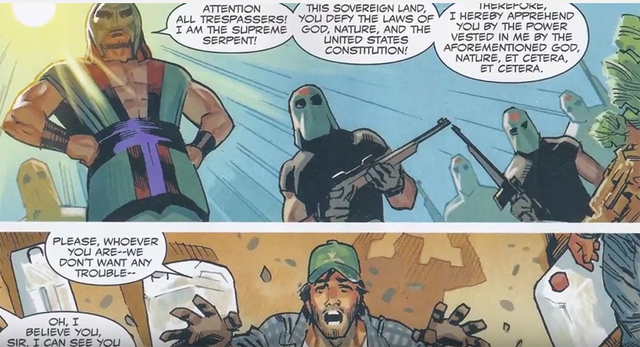
In the issue, Captain America beats up members of a white supremacist militia called the Sons of the Serpent as they attempt to apprehend a group of illegal aliens crossing the desert from Mexico into Arizona.
The leader of the group, the Serpent Commander, makes statements that are similar to what Republican presidential candidate Donald Trump has been criticized for saying during his White House run. The Commander longs for the construction of “the mighty wall” and laments the “trouble and disease and crime” that the border-crossers are bringing with them.
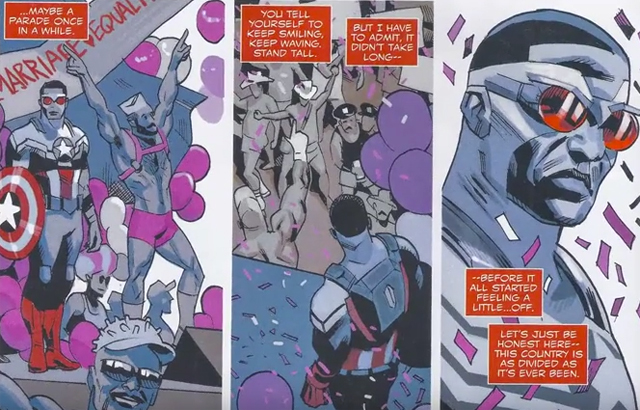
When Captain America isn’t on stage at a gay pride parade, he now fights silly depictions of conservative Americans. A similar thing happened in 2010 when Steve Rogers took on … the Tea Party.
Why isn’t he working with Ranger-run task forces to take down individuals in the Haqqani Network?
Why have we never seen Captain America in Kandahar province, Afghanistan?
Why have we never seen Cap on a mission in the Sulaiman Mountains?
Why have we never seen Steve Rogers perform a HAHO (high-altitude, high-opening) jump into Abbotttabad, Pakistan?
Shall I go on?
It is embarrassing that Marvel regularly wastes potential of a character like Captain America on the myopic tit-for-tat politics of men like Nick Spencer.
In the one book that should attempt to unite all Americans, we now have immature political pot-shots that a.) will not stand the test of time, and b.) turn off readers who would otherwise be interested in purchasing the product.
Perhaps Sam Wilson or Steve Rogers will eventually be written by someone whose mind operates outside the domestic public policy squabbles of short-lived news cycles. Until then, I won’t be picking up Sam Wilson: Captain America.
Three cheers to Marvel, and its highly unique business model of needlessly alienating potential customers.
Imagine an old man walked up to you on the street and said he had insights on life that could help infuse your own with meaning and purpose — if you gave him $10. Would you do it? Probably not.
Imagine that old man rolled up his sleeve and it was immediately evident by the tattoo roster on his skin that he was a Holocaust survivor. Then would you do it? Perhaps, but perhaps not.
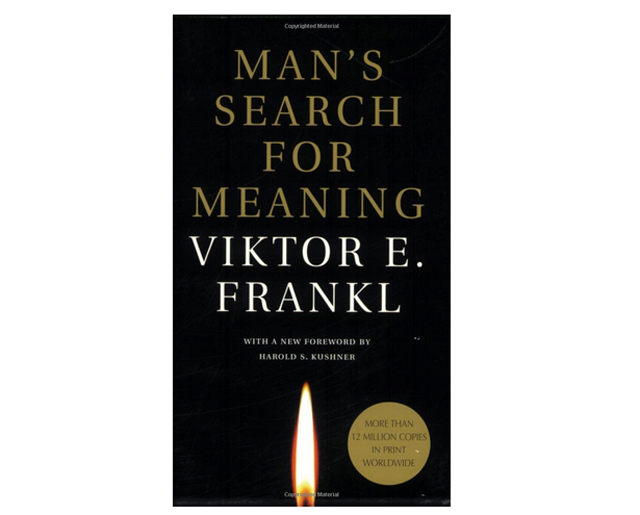
Luckily, Viktor E. Frankl’s memoir, “Man’s Search for Meaning,” is well-known. There are plenty of others who feel the same way I do: It is one of the most profound books ever written.
Mr. Frankl was a psychiatrist who had all sorts of theories about the will to survive, how man goes about giving life meaning, and the ways we respond to suffering. Those theories were then put to the test when he found himself a prisoner in Nazi concentration camps during World War II.
He writes:
“We who lived in concentration camps can remember the men who walked through the huts comforting others, giving away their last piece of bread. They may have been few in number, but they offer sufficient proof that everything can be taken from a man but one thing: the last of the human freedoms — to choose one’s attitude in any given set of circumstances.
And there were always choices to make. Every day, every hour, offered the opportunity to make a decision, a decision which determined whether you would or would not submit to those powers which threatened to rob you of your very self, your inner freedom; which determined whether or not you would become the plaything of circumstance, renouncing freedom and dignity to become molded into the form of the typical inmate.
Seen from this point of view, the mental reactions of the inmates of a concentration camp must seem more to us than a mere expression of certain physical and sociological conditions. Even though conditions such as lack of sleep, insufficient food and various mental stresses may suggest that the inmates were bound to react in certain ways, in the final analysis it becomes clear that the sort of person the prisoner became was the result of an inner decision, and not the result of camp influences alone. Fundamentally, therefore, any man can, even under such circumstances, decide what shall become of him — mentally and spiritually. (Victor Frankl. Man’s Search for Meaning. Beacon Press, 1959, 1962, 1984, 1992, 2006. 77)
A man who has given a specific meaning to his life can withstand almost any set of circumstances with dignity — even a Holocaust. A man who does not know why he must live can feel as though he is trapped inside a nightmarish prison — even as a free citizen.
Frankl writes:
“We had to learn ourselves and, furthermore, we had to teach the despairing men, that it did not really matter what we expected from life, but rather what life expected from us. We needed to stop asking about the meaning of life, and instead to think of ourselves as those who were being questioned by life — daily and hourly. Our answer must consist, not in talk and meditation, but in right action and in right conduct.” (77)
If the implications of Mr. Frankl’s insight are not clear, consider the effect of his wife on his mind’s eye as he trudged through snow during forced labor:
“For the first time in my life I saw the truth as it is set into song by so many poets, proclaimed as the final wisdom by so many thinkers. The truth — that love is the ultimate and highest goal to which man can aspire. Then I grasped the meaning of the greatest secret that human poetry and human thought and belief impart: The salvation of man is through love and in love.
I understood how a man who has nothing left in this world still may know bliss, be it only for a brief moment, in the contemplation of his beloved. In a position of utter desolation, when man cannot express himself in a positive action, when his only achievement may consist in enduring his sufferings in the right way — an honorable way — in such a position man can, through loving contemplation of the image he carries of his beloved, achieve fulfillment.
For the first time in my life I was able to understand the meaning of the words, ‘The angels are lost in a perpetual contemplation of an infinite glory.'” (38)
If I was thrown into a concentration camp tomorrow, then one of the things that would keep me alive would be the desire to write about my experience — perhaps on this very blog. My wife is my beloved, but so too is writing because I believe God made me a writer.
Everyone’s life has a meaning. Finding it is often painful and difficult. I firmly believe, however, that reading Mr. Frankl’s memoir can help make the task, as monumental as it is, much easier. I highly recommend “Man’s Search for Meaning.”
Editor’s Note: I will mail a copy of this book to the first regular reader who asks for a copy. I don’t mean to penalize readers who stay behind the scenes (I appreciate all of you), but for the purposes of this give-away I need to have seen you in the comments section on occasion. Just let me know if you’re interested and I will contact you at the email address you have provided WordPress.
The Amazing Spider-Man has relaunched yet again, and this time around Peter Parker is a CEO of his own worldwide company. He apparently took driving lessons to handle a car like a young Mario Andretti. He apparently took Mandarin and became fluent in a matter of months. He is “very” close to his Asian business partner, and he’s fortunate to have new technology on hand for almost any dilemma. At the end of the day, a review of this relaunch boils down to whether or not Peter Parker fans should embrace The Amazing “poor man’s Tony Stark.”
Like much of Dan Slott’s work, he offers a mixed bag of interesting ideas with the downright bizarre and embarrassing.
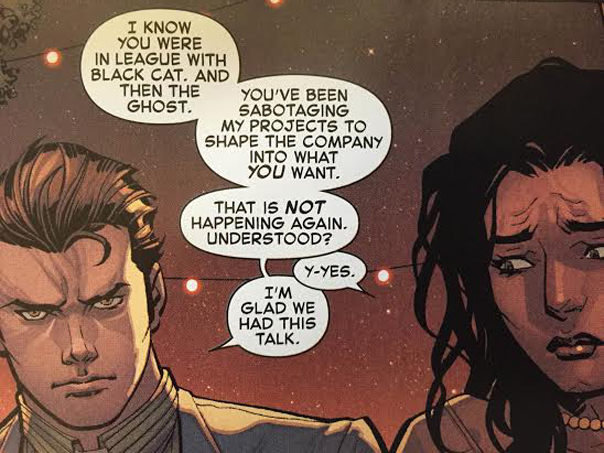
Take, for instance, Parker’s refusal to fire the woman he knows has a.) pro-actively worked to undermine his core vision, and b.) actually attempted to ally with a super-villain who destroyed his New York offices and almost killed everyone inside.
For those don’t remember, here is a flashback to The Amazing Spider-Man #17:
Sajani Jaffrey: I think we can be allies. I’ve heard of you. The Ghost – corporate saboteur, right? Which means someone hired you, probably to torpedo our super-prison. Well, guess what? Nothing would make me happier. It’s all my partner’s idea. I think it’s a stinker. I’ll make you a deal: Don’t hurt anyone, leave the rest of our projects alone…and I’ll show you the best, fastest way to wreck the prison stuff beyond repair. What do you say?
The Ghost: You’re a shrewd negotiator, young lady.
To CEO Peter Parker, working with corporate saboteurs to destroy his company is only worth a “talk.”
As was the case with The Superior Spider-Man, Mr. Slott must dumb down his characters in order to get from Point A to Point B. Characters during SSM needed to not realize Doctor Octopus was inside Peter’s mind to keep Slott’s story going, and so their intelligence dropped 20 points.
Mr. Slott now needs Sajani to move his plot along, so Peter Parker blithely overlooks a betrayal that any normal person would fire – and sue – her over.
One of the more interesting aspects of the book comes when it is revealed Peter has hired Hobie Brown (aka: The Prowler) to be his “decoy” Spider-Man. While the decision offers the potential for a very fun relationship to form, one cannot help but wonder if Brown is a “poor man’s James Rhodes.”
Is The Amazing Spider-Man #1 worth buying? That’s a good question. If you like Guiseppe Camuncoli’s work, then sure. If you want to read about Peter Parker-Stark, then sure. If you can put up with Dan Slott’s “sweet” ideas being drowned out by others that are seriously “sour,” then sure.
If, however, you read Renew Your Vows and felt as though Marvel finally captured the essence — no matter how fleeting — of the “real” Peter Parker, then you will probably want to withhold your cash.
Editor’s Note: Regular readers know that I am in the process of learning Mandarin. Let me just say that one does not simply begin taking Mandarin lessons and become fluent in a matter of months. This is the kind of writing that drives fans mad. Dan Slott could put Peter in Saudi Arabia tomorrow, have him speak fluent Arabic, and then make the character say, “Yeah, so…in addition to expanding this global tech-empire, fighting super-villains, inventing new technology, and learning Mandarin over the last couple of months, I just-so-happened to take a few Arabic classes as well.”
If you think that is jarring and lazy writing, then it is likely Dan Slott will call your criticism invalid.
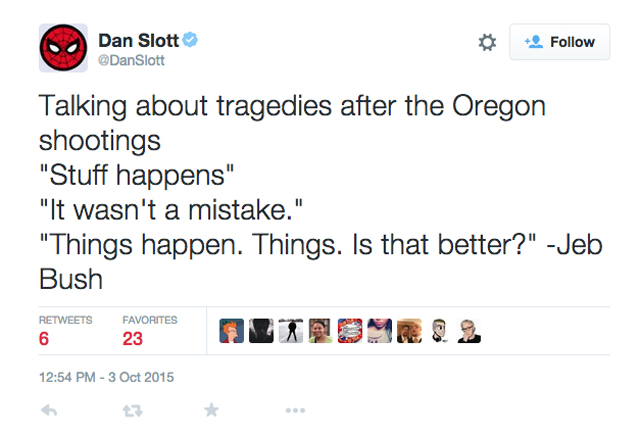
Dan Slott, the Marvel writer who regularly whines about people taking him out of context, has no qualms taking others out of context when his personal politics are at play. The same guy who had his “Superior” Spider-Man blow a guy’s face off with a handgun from point-blank range had no problem chopping up a lengthy conversation by Jeb Bush on the Umpqua Community College shootings into Tweets devoid of any context.
Before we move on, let us examine a Dan Slott quote from Aug. 1, 2015:
“Jesus. Could you at least link to the exchange instead of paraphrasing and misinterpreting?” – Dan Slott.
Dan Slott’s standard of fairness when it involves his reputation or things he cares about is at least a link to a full conversation. The rules he applies to others do not apply to himself. And then he wonders why it’s impossible for people to have mature, honest discussions on complex issues…
Jeb Bush: “The tendency when we have these tragedies that took place yesterday, it’s just heartbreaking to see these things, but this is the broader question of rule-making I think is an important point to make. That whenever you see a tragedy take place, the impulse in the political system, most, more often than at the federal level, but also at the state level, is to ‘do something,’ right? And what we end up doing lots of times is we create rules on the 99.999 percent of human activity that had nothing to do with the tragedy that forced the conversation about doing something. And we’re taking people’s rights away each time we do that, and we’re not necessarily focusing on the real challenge. …
We’re in a difficult time in our country and I don’t think more government is necessarily the answer to this. I think we need to reconnect ourselves with everybody else. It’s very sad to see. I had this challenge as governor. We have, look, stuff happens. There’s always a crisis. And the impulse is always to ‘do something,’ and that’s not necessarily the right thing to do.”
Unlike Dan Slott, Jeb Bush had to deal with the aftermath of hurricanes, budgets that affected millions of people, etc. Jeb Bush actually had to make gut-wrenching decisions as the governor of Florida. He understands that with a stroke of the pen, politicians can turn the lives of entire communities upside down.
When Dan Slott doesn’t go to a comic convention or misses a deadline, civil rights are not eroded.
Here is the full context for Bush’s “things” quote. Politico reported:
“‘Things’ happen all the time. ‘Things,’ is that better? … A child drowns in a pool and the impulse is to pass a law that puts fencing around pools. Well it may not change it or you have a car accident and the impulse is to pass a law that deals with that unique event and the cumulative effect of this is in some cases, you don’t solve the problem by passing the law, and you’re imposing on large numbers of people, burdens that make it harder for our economy to grow, make it harder for people to protect liberty, and that is, the whole conversation today was exactly about that.”
Mr. Bush was trying to have a serious public policy debate when he made those comments. He acknowledged that what happened in Roseburg, Oregon, was a “heartbreaking” tragedy, and then talked about the broader public policy question at hand.
Unfortunately, Mr. Slott couldn’t resist acting like a political vulture to exploit the situation.
For those who want a better idea of what Dan Slott does, I will now provide a clear example.
Last Thursday, 26-year-old Christopher Harper-Mercer specifically targeted Christians in a massacre that killed nine and injured seven. He took his own life during an exchange of gunfire with cops. Imagine if I shared that information and then juxtaposed it with Dan Slott’s infamous “Christ-Land” tweet – without any context. Do you think Mr. Slott would be upset? I do.
Ask yourself this question before reading it: If there was another Boston Marathon-type bombing and a politician Dan Slott didn’t like said, “Scared by the number of Muslims who are silent on domestic terrorism. This is America. Go to Muslim-Land,” do you think he would call that person a bigot? I do.
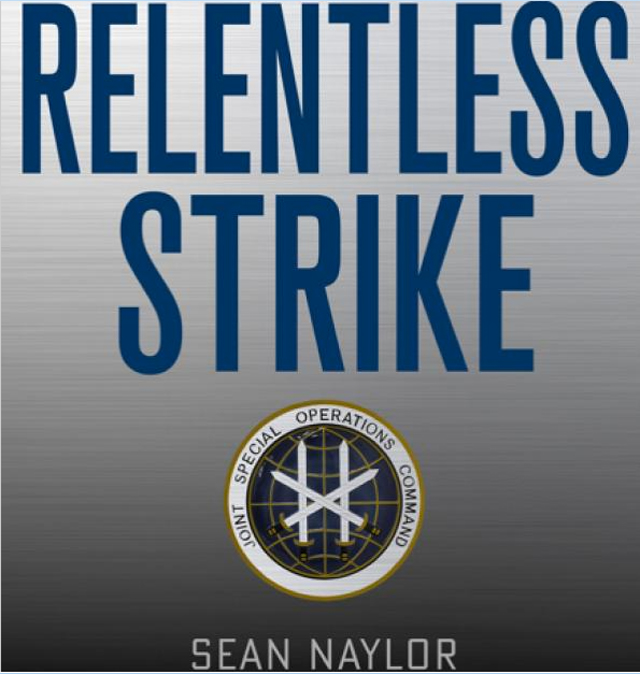
I heard about a book called “Relentless Strike: The Secret History of Joint Special Operations Command” in early September. Pentagon officials were not thrilled that author Sean Naylor wanted to shed light on the Herculean efforts required to keep Americans safe. Given that special operators tend to work in the shadows, the Pentagon’s position makes sense — but I bought the book anyway — and found myself relentlessly reading it until the finish.
It is incredibly hard to review a book that spans the entire history of JSOC. Perhaps the best way to approach the book is to say how painful it was to read of all the many successes these elite operators had since Sept. 11, 2001, only to see much of their work squandered since 2008.
Towards the end of the book, Naylor discusses the rise of the Islamic State group and what its gains in Iraq meant to JSOC.
The list of Iraqi cities the Islamic State had taken by the end of the summer was a roll call of places where the JSOC task force had engaged in hard, vicious fights to dislodge Saddam Hussein’s forces and then to eviscerate Al Qaeda in Iraq: Haditha, where the Rangers withstood a fearsome artillery barrage to take a vital dam during the 2003 invasion; Tikrit, where Task Force Wolverine and Team Tank fought it out with the Fedayeen; Fallujah, where Don Hollenbaugh had earned his Distinguished Service Cross by holding off an insurgent assault single-handedly in April 2004; Rawa, where Doug Taylor’s Delta troop had impersonated farmhands to snare Ghassan Amin in April 2005; Al Qaim, where Delta operators Steven Langmack, Bob Horrigan, and Michael McNulty had died in the bloody spring of 2005; and Mosul, where the Rangers killed Abu Khalaf in a perfectly executed assault in 2008. (Sean Naylor. Relentless Strike. New York: St. Martin’s Press, 2015, 437)
By the time this summery occurs, the reader has been familiarized with details of every one of the hard-fought battles mentioned. It is tough to read without wincing.
The vast majority of Americans will never comprehend the amount blood, sweat, and tears shed by special operators. Naylor’s work, as prolific as it is, scratches the surface in terms of heroic tales known only to a select few.
Regardless, if nothing else, “Relentless Strike” makes it obvious that while millions of Americans are watching cat videos on YouTube or mindlessly uploading selfies to their social media page, shadow wars are raging all around them.
There is a thin veil of peace and tranquility over most Americans’ eyes, and it is only kept in place by the rough hands of those who are willing to fight and die on the other side of the globe.
I highly suggest “Relentless Strike” for anyone who wants to know what, exactly, it takes to provide national security to 350 million Americans on a daily basis.
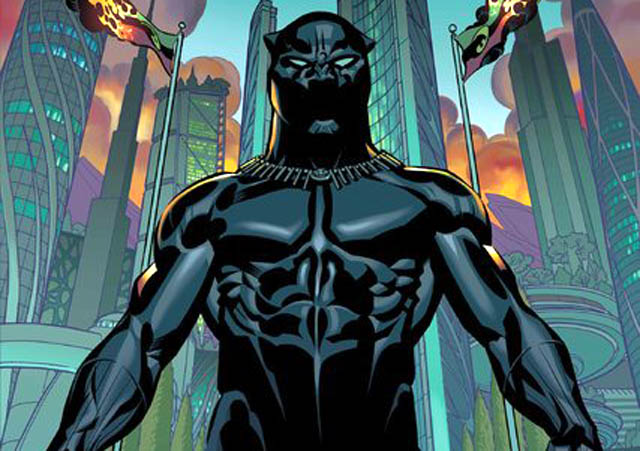
The New York Times reported Tuesday on Marvel’s decision to name Ta-Nehisi Coates its “Black Panther” scribe. What it didn’t mention is how Mr. Coates wants American taxpayers to cough up reparations cash to black Americans. (Congratulations: If you immigrated here in the last three decades, then you probably still qualify! Because colonialism … or something.)
Ta-Nehisi Coates can be identified in many ways: as a national correspondent for The Atlantic, as an author and, as of this month, as a nominee for the National Book Award’s nonfiction prize. But Mr. Coates also has a not-so-secret identity, as evidenced by some of his Atlantic blog posts and his Twitter feed: Marvel Comics superfan.
So it seems only natural that Marvel has asked Mr. Coates to take on a new Black Panther series set to begin next spring. Writing for that comics publisher is a childhood dream that, despite the seeming incongruity, came about thanks to his day job.
Do you know how else Mr. Coates can be identified, Marvel? Again, he’s a guy who wants American taxpayers to give black Americans reparations for slavery and other injustices.
Mr. Coates talked to Bill Moyers of PBS in May, 2014 about the need to taxpayers to make up for public policy “practical damage” perpetrated upon black Americans.
“The most obvious example of is the wealth gap. When you have a family that has 20 times the wealth — a white family has 20 times the wealth of black families. And then you can really trace this to actual policy. You see it. Again, you know, when we look at incarceration rates, we still see it. I mean, the gap is so, so huge. It’s not a mere minor discrepancy.”
Let us for a moment agree with Mr. Coates’ assertion that “policy” is to blame for the plight of urban black Americans. If that is the case, then why do these black Americans — who have lived in Democrat-controlled strongholds for decades — continue to vote for liberal politicians again…and again…and again?
Liberal public policy destroyed the black family unit over the course of decades (i.e., 75 percent of births occur out-of-wedlock).
Liberal public policy encourages black women to abort their children in numbers that can only be described as genocide.
Liberal public policy is what has driven cities like Detroit into an economic death spiral.
But yet, for some odd reason, men like Mr. Coates never really want to get into those discussions. How convenient.
I’ve said this before in the comments section, but I’ll say it again: My wife immigrated to the U.S. at a young age without knowing how to speak English. Her parents did not have “wealth” — but over time they created enough of it so their daughter could one day become a doctor.
How is it possible for a family from China — one that speaks no English and has no money — to produce a family doctor within a single generation, but yet the good citizens of Detroit are economically paralyzed in 2015?
If the government hands a man a check for $1 million dollars and that person does not possess the kind of virtues found in successful people, then that person will lose his fortune.
Money is not the same as wealth. As long as activists like Mr. Coates focus on giving people money instead of encouraging them adopt and hold tight to invaluable principles, then these sorts of debates will continue.
Call me when Marvel hires an openly conservative comic fan who worked at a major conservative organization. Until then, I doubt I will be checking out “Black Panther.”
Editor’s Note: I am currently learning how to speak Mandarin. That is one of the reasons why I have not been blogging as much. I can say with confidence that if someone transplanted me inside China tomorrow and gave me 20 years to become a doctor…it probably would not happen. Heh.
I grew up in a suburb just outside Chicago and O’Hare International Airport. There wasn’t a day that went by that I didn’t hear the roar of planes flying directly over my house or somewhere just off into the distance — until Sept. 11, 2001. Like most Americans, there was a tangled mess of thoughts swirling through my head after seeing American 11, United 175, and American 77 crash into the World Trade Center Towers and the Pentagon, respectively. As commercial flights were grounded in in the wake of the attacks, I remember noticing the silence and then feeling shame for thinking it contained an eerie beauty. To this day the shame still lingers, which is why I feel it is important to share the history of United 93 and the 33 passengers who stood up to their executioners.
The following is a brief excerpt from the 9/11 Commission Report:
At 9:57, a passenger assault began. Several passengers had terminated phone calls with loved ones in order to join the revolt. One of the callers ended her message as follows: “Everyone’s running up to first class. I’ve got to go. Bye.”
The cockpit voice recorder captured the sounds of the passenger assault muffled by the intervening cockpit door. Some family members who listened to the recording report that they can hear the voice of a loved one among the din. We cannot identify whose voices can be heard. But the assault was sustained.
In response, Jarrah immediately began to roll the airplane to the left and right, attempting to knock the passengers off balance. At 9:58:57, Jarrah told another hijacker in the cockpit to block the door. Jarrah continued to roll the airplane sharply left and right, but the assault continued. At 9:59:52, Jarrah changed tactics and pitched the nose of the airplane up and down to disrupt the assault. The recorder captured the sounds of loud thumps, crashes, shouts, and breaking glasses and plates. At 10:00:03, Jarrah stabilized the airplane.
Five seconds later, Jarrah asked, “Is that it? Shall we finish it off?” A hijacker responded, “No. Not yet. When they all come, we finish it off.” The sounds of fighting continued outside the cockpit. Again, Jarrah pitched the nose of the aircraft up and down. AT 10:00:26, a passenger in the background said, “In the cockpit. If we don’t we’ll die!” Sixteen seconds later, a passenger yelled, “Roll it!” Jarrah responded with violent maneuvers at about 10:01:00 and said, “Allah is the greatest! Allah is the greatest!” He then asked another hijacker in the cockpit, “Is that it? I mean, shall we put it down?” to which the other replied, “Yes, put it in it, and pull it down.”
The passengers continued their assault and on 10:02:23, a hijacker said, “Pull it down! Pull it down!” The hijackers remained at the controls but must have judged that the passengers were only seconds from overcoming them. The airplane headed down; the control wheel was turned hard to the right. The airplane rolled onto its back, and one of the hijackers began shouting, “Allah is the greatest. Allah is the greatest.” With the sounds of the passenger counterattack continuing, the aircraft plowed into an empty field in Shanksville, Pennsylvania, at 580 miles per hour, about 20 minutes flying time from Washington, D.C.
Jarrah’s objective was to crash his airliner into symbols of the American Republic, the Capitol or the White House. He was defeated by the alerted, unarmed passengers of United 93.” — (The 9/11 Commission Report. 7- 8.)
It is almost impossible to fathom what it must be like to fight for ones life on a hijacked plane — let alone an aircraft where the hijackers perform barrel rolls and roller coaster maneuvering to obtain their objective. How many lives were saved because of the actions of those 33 passengers on Flight 93? There is no way to calculate an exact number, but the final intended destination — Washington, D.C. — gives us a clue.
Americans said “Never forget” after the 9/11 terror attacks, but it sadly feels like many of them want to forget. While it is indeed dangerous to allow painful memories to (ironically) hijack our collective psyche, the same can be said for losing important lessons from history.
Beauty can be found in incredibly horrific experiences, and the bravery and heroism displayed by the passengers of Flight 93 is a sterling example. If you have a moment to yourself today, say a prayer for the lost souls of September 11, 2001, and the loved ones they left behind.
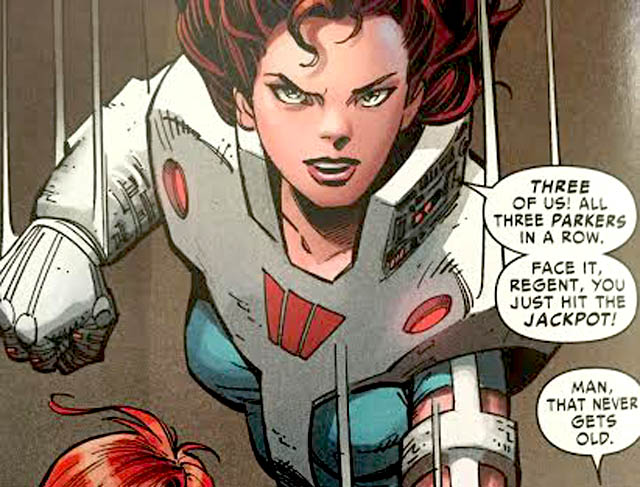
The final issue of The Amazing Spider-Man: Renew Your Vows has finally arrived, but borderline diabetics may need to withhold their cash. Dan Slott ends his defacto “What if … the Parker family lived in an Orwellian police state ruled by a super-powered despot?” with plenty of sugary sap — and cheese.
Renew Your Vows continues a trend for Mr. Slott, which is that he has a tough time at the finish. If he were a baseball player for the New York Yankees, then he would not be a closing pitcher. It’s almost as if he’s saying, “Let’s wrap it up. Wrap it up. Wrap it up-up-up-up-up! Love and happiness, strength and family, yadda, yadda, yadda — those plot holes never happened.”
It was only one issue ago that Regent was using telekinesis to immobilize Peter Parker and Sandman with a thought, perhaps the mere seed of a thought. He was, for all intents and purposes, a god. And yet, because the script calls for a “love conquers all”-type ending, readers are supposed to cheer its slap-dash construction.
Perhaps one of the weirdest moments comes when MJ turns to Peter at the end of the tale and says, “I have to know…if our daughter was in real danger, would you have killed him?”
Regent took out all of the Avengers. He took out almost every superhero in existence. And yet, a small child who just randomly decided to rush into battle against him was apparently never in any “real” danger. That begs the question:Then why should readers have bothered to care?
Renew Your Vows had some fine moments. Dan Slott hit a “home run” with the second issue and performed adequately in the third and fourth installments. Regardless, the story ended up as little more than a sweet treat for fans who wanted to see a few flashes of “Parker power.”
Buy the issue if you’ve already followed it this far, but make sure to have an insulin injection nearby.














 Douglas Ernst Blog