The good news about Iron Man 3 is that it’s a sharply written, well-directed movie. The bad news is that while some of the messages it conveys to the audience hold incredible truth (e.g., “we create our own demons”), it might just be the conspiracy-theorist must-see blockbuster of the summer.
Do you have any friends who think 9/11 was “an inside job”? Iron Man 3 is the movie for them. (You might want to consider getting new friends if that’s the case, but in the mean time you could still enjoy a solid movie.) Do you have any friends who refer to the “military industrial complex” at parties so they sound smarter than they really are? Iron Man 3 is the movie for them. Do you have friends who hate “Big Oil” and “fat cats”? Iron Man 3 is the movie for them. Director Shane Black ingeniously — or perhaps devilishly? — devised a film that is drenched in anti-Americanism in a way that will leave many Americans exiting the theater not even knowing they’re all wet. At the showing I went to in Tyson’s Corner, Va., many people even burst out clapping twice during the film. On many levels, Mr. Black deserves kudos. That’s not easy to do.
Because so much of the movie focuses on Robert Downey Jr. and the “demons” his actions have brought into his life (his enemies literally breathe fire), and because he owns the role, one could forgive friends and relatives if they don’t leave the theater angry. The “truth” about the Mandarin alone, which I will refrain from disclosing here, is one that will play very well in Muslim nations that actually allow Western movies to be screened — for reasons that have nothing to do with their religion and everything to do with conspiracy theories that run rampant in those parts of the world. Given the fact that the writers and producers created entirely new scenes for the Chinese release, it’s not hard to believe that the endeavor was specifically crafted to maximize both foreign and domestic sales. Again, it is rather awe-inspiring what Mr. Black has pulled off.
Strangely enough, perhaps the group of moviegoers who will be most disappointed in Iron Man 3 will be long time fans of the Iron Man comic book. As already mentioned, the “truth” about the Madarin is something that will drive fans of the character up a wall. They will be livid, and rightly so. However, the average person who knows nothing about the character’s history will not care because within the context of the film, the changes work and that’s all that really matters to people who count box office receipts. It’s sad, but that’s the truth.
Moving forward, it will be hard for figure out how an Iron Man 4 would take shape. Robert Downey Jr’s shtick is enjoyable, but even the great and powerful RDJ gets annoying. It was a wise move to knock the chip off his shoulder in the third installment by stripping everything away from him. He needed to be taken down a notch. He needed the smile wiped off his face. He needed to look lost and confused and panicked because sometimes the rich billionaire guy who mocks everyone and everything just comes across as a jerk. Downey had an incredible balancing act to play between being that witty sarcastic smartass with a smile, and being the vulnerable guy who just recently learned their are forces in the universe that are beyond human comprehension — and he did it almost perfectly.
Perhaps my feelings on Iron Man 3 can be best summed up in response to something the Madarin says midway through the movie. The character, played by Ben Kingsley, says that America is “like a fortune cookie — hollow, and it leaves a bad taste in your mouth.”
Iron Man 3 is definitely not hollow. There are many, many layers to it. The acting, writing, directing and special effects are all top-notch. Iron Man 3 does, however, leave a bitter aftertaste. Shane Black could have written a movie that did not blatantly appeal to large swathes of moviegoers who love nothing more than to blame America for the world’s ills, but he did not. Marvel signed off on it. Disney signed off on it, and so did Robert Downey Jr. And for that, while I thoroughly enjoyed the film, it is not one that I will ever purchase for myself.
Regardless, I’m looking forward to seeing Iron Man fly again when The Avengers 2 hits theaters. See you there.
April 15, 2013 will be remembered by millions of Americans as the day of the Boston Marathon terror attack. They will look back on it with sadness and anger and confusion. In an odd twist of fate, I will look back on it as one of the happiest days of my life. For an entire day I got to spend time with one of my best friends — an old Army buddy who I’ve only been able to see twice in the last 13 years.
Long story short, James was my roommate years ago in Charlie Co., 1/18th Infantry Battalion in Schweinfurt, Germany. I got out and he stayed in. But the thing about military friendships is that they are often times iron clad. While our lives took two very separate paths years ago, the experiences we shared bonded us in a way that no matter how much time goes by, we will always be able to pick up right where we left off. It’s as if nothing has changed — because it hasn’t. We are opposite sides of the same coin; I am the civilian, and he the full time soldier. Had things gone slightly different for either one of us, the roles would probably be reversed. What is most important is that at our core is a respect and admiration for the war fighter — and each other — that can only come from having spent time in the field.
James and I outside the White House. Although we were in the dark as to why we were pushed so far away from the gates, at this point we had not been informed of the Boston Marathon terrorist attack.
Before the Boston Marathon had even started James and I were at Arlington National Cemetery to pay our respects to the fallen. I got to hear stories about heroes like SSG Larry Rougle and SSG Troy Ezernack, both of whom selflessly sacrificed their lives during Operation Enduring Freedom. While they died honorably, it was how they lived that brought tears to my eyes. We talked about SSG Leija, who died in Iraq at the hands of a sniper. Before I exited the military, Leija helped me study up for the kind of material I’d receive years later at USC. He knew I was applying to college and wanted to help me get a leg up. That’s the sort of guy he was.
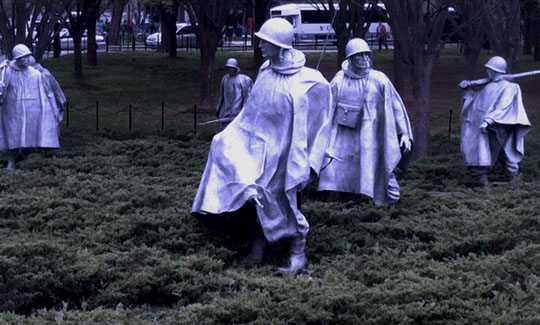
After Arlington National Cemetery we went to the White House, but because of barricades that had been set up (unbeknownst to us, as a response to the terror attack), we were forced to take pictures from a distance. From there it was on to the Korean War Memorial, the Lincoln Memorial, the Vietnam Memorial, the World War I and World War II Memorials, and the Washington Monument. And because we were on foot, there were conversations about American foreign policy, terrorism, U.S. history, the civilian population, the left, the right, the rules of engagement and the politicians who set them.
When we finally did get word about the Boston Marathon terror attack we didn’t dwell on it. Why? I’ll put it this way: After 9/11, many of those who said “Never forget!” did. James and I didn’t.
And so, we used the rest of the night to eat and drink, reminisce, enjoy the present and plan for a day when we’d meet again (all contingent upon the whims of Uncle Sam and world events, of course).
Yesterday, while the bombs went off we honored the fallen. As the commentators predicted the future we remembered the past. And in that brief moment in time I was happy in a way I haven’t been for years. My friend was alive and well and laughing right there next to me. It was just like it was all those years ago in Germany — and how I know it will be when we meet again.
Yesterday I spent time at the Korean War Memorial. It’s at its most beautiful and most haunting in the rain or in the fog. “The Forgotten War”? Not by all of us.
Today I ran across an old picture of me ascending a rock climbing wall while at the Cumberland County fair in Maine. For some odd reason it dawned on me that rock climbing is a great metaphor for life. Before this picture was taken I had been working a booth for The Heritage Foundation, talking to the good people of Maine about the organization and its principles. A National Guardsman dared me to take the climb and, not one to back down from a challenge, I accepted.
Given that, I will now explain rock climbing as a metaphor for life, as well as how one’s worldview changes how they approach the wall.
In life, we all have an end point we’re shooting for. We all want to get to the top of some mountain. Some people want to prosper monetarily; others seek spiritual wealth. Some people seek knowledge; others wish to experience their fill of earthly pleasures. We all value different things, and as such our lives will all take vastly different twists and turns before we call it a day.
In between our starting point and the final destination there is an infinite number of paths laid out before us. We have a general idea of how we want to go about attacking the mountain, but there’s a big difference between gauging obstacles from afar and then experiencing them up close and personal.
Just like with rock climbing, sometimes the path that you thought would get you to the top in theory doesn’t work out in practice. You have to recalibrate your route. You might have to backtrack or go far out of your way to traverse a difficult section. In a worst-case scenario you might even fall off the wall, but thanks to a harness you don’t kill yourself and, if you so choose, you can start all over again — armed with the knowledge only failure can teach.
The conservative knows that every person who attempts the rock-climbing wall of life will have different strengths and weaknesses. Some people want to shoot for the top, and some don’t. Some people have amazing upper body strength, and others have an iron grip. Some people are light and some people are heavy. Some people are tall and some people are short. Given all these variables, the conservative generally doesn’t worry too much about what the guy next to him is doing and begins climbing away. He focuses on his technique. He monitors his strength. He takes time to stop and pause and re-evaluate his strategy when necessary. He isn’t afraid of falling. The conservative does all this, and in the long run he is generally rewarded for it.
The liberal, by contrast, does not fare too well. He complains about the size of the footholds. He looks at their placement on the wall and wonders who put them there and if there was some sort of nefarious plot connected to the decision process. He complains that he doesn’t have chalk, but the guy next to him does. He wants better shoes. It’s unfair that he has to climb in rainy weather, when the guy before him had nice weather. The winds are shifting one way or the other. He wants a different belay man. The list is endless. And at the end of the day the liberal sits at the bottom of wall, having wasted valuable time that would have been better spent just climbing the damn wall.
Sometimes, the liberal will look up and see his conservative counterpart smiling at the top of the mountain and will yell nasty things in his direction. The conservative will be accused of being a heartless bastard for basking in the sun’s rays and enjoying the view while the liberal down below must sit in the shadows — again, even if it was the liberal who chose to spend the limited time and resources afforded to him unwisely.
If you have a rock climbing wall around your neck of the woods, I suggest giving it a try. You’ll learn a lot about yourself, both mentally and physically.
Imagine if you will, a scenario where a thin-skinned comic book writer goes off on a tirade laced with ad hominem attacks on blogger who was simply putting forth a straight-forward critique of his work. Imagine that online outburst setting off a chain of events in which another fan ends up introducing the blogger to a Newsarama interview he was unfamiliar with. The reader says he’d like to see a response to the interview. Does the blogger do it?
Well imagine no longer, because that blogger is me and I intend to do address the issue. The Newsarama interview, in short, perfectly embodies everything that is wrong with Dan Slott’s approach to Spider-Man. As I did in my last piece, I will break it up into smaller sections so readers can see the two different visions side by side.
Nrama: With Superior Spider-Man, you’re writing Doc Ock as a lead character for really the first time, and a more long-term Doc Ock story than has really been seen before. We’re seeing the character put in very different situations, interacting with totally different characters. What kind of task has that been — approaching his mindset and his attitude in the position of a lead character?
Slott: He’s trying his best to be a hero, but he’s doing it in a very Doc Ock way. And Doc Ock’s an egotistical, annoying sh*t. It makes him an interesting character. At his core, he’s someone we don’t really think of heroic. But is he any more annoying than [former villain] Hawkeye used to be?
Forgive me if I’m wrong, but did Hawkeye ever try and put in motion plans to bring about an extinction-level event? If I missed that one, can someone let me know the issue so I can read it tomorrow? I would say that trying to incinerate 6 billion people is slightly more “annoying” than anything Hawkeye could ever dish out.
Slott: Also, when you look at Doc Ock, he was so much like Peter Parker. Peter Parker, if he didn’t know the lessons of power and responsibility, that teenage nerd would have grown up to be an Otto Octavius nerd, with the same kind of, “I’m going to make them pay.” This is the flip of that. This is Doc Ock getting to go back in time and be as young as Peter Parker, and have force-fed into him this sense of power and responsibility. He has that lesson from Uncle Ben in his core. That was Peter Parker’s parting gift to the world — I’m not going to leave the world a villain, I’m going to leave them a hero.
Peter Parker’s “gift” (i.e., Dan Slott’s “gift”) to the world was that he has allowed a character who should be serving 5,000 life sentences for crimes against humanity off the hook. Before redemption can occur on earth a man must pay for his crimes and atone for his sins. Doc Ock has the blood of countless innocents on his hands, but because Peter beamed “with great power comes great responsibility” into the villain’s head moments before he died then it’s somehow all okay? Of course not. And that’s why this current run is so repulsive to anyone with a shred of respect for the character; they would never allow Doctor Octopus to take up the mantle of Spider-Man.
Slott: Doc never intended to be on this path, and in his own way he’s very good at it. He’s just doing it differently than Peter would.
Do you see Punisher as a hero? Do you see Wolverine as a hero? If these guys can be heroes, why can’t Doc Ock?
And this is where the moral relativist in Dan Slott exposes himself for all the world to see. It’s the “one man’s terrorist is another man’s freedom fighter” mentality. One man’s Spider-Man is another man’s Doc Ock. One man’s Captain America is another man’s Red Skull. It’s sick.
Since when has the core of Wolverine’s or the Punisher’s character ever been about wanton destruction, innocents be damned? When have they ever took it upon themselves to devise plots and plans that would see countless men, women and innocent children blown to bits?
Do Wolverine and Punisher push the definition of what it means to be a hero to its limits? Yes. But reasonable people know that if they were ever tried and convicted in a court of law for taking matters into their own hands (e.g., tracking down a drug lord and killing him in his sleep) that is the price one must pay for dishing out vigilante justice.
That aside, the philosophical gap between Wolverine and Doctor Octopus is so enormous that to even ask why one can be a hero and the other can’t is ludicrous. When anyone can be a hero — despite a lifetime of evilthey have not answered for— then we might as well all be villains.
Slott: Here’s someone as evil as Massacre — if Spider-Man had just captured him and webbed him up, he’d be out six months from now, doing this again. Yeah, sure he was helpless, and his wrist was snapped, and disarmed, but, “If I shoot him in the head, I’ve saved 30 people in the future.” Doc Ock can look at it almost as a math equation, and be very happy with himself, and sleep well at night knowing what he did. For him, that’s power and responsibility.
Again, unless the hero is on a battlefield or working on behalf of a sovereign nation to mitigate threats to national security, the discretion he has as it pertains to the use of deadly force is severely constrained. Cases like Massacre’s are what the criminal justice system is for. Maybe in the Marvel Universe citizens are so dumb that they have done away with the death penalty — I don’t know. But from what I gather, a justice system exists, and a real hero would attempt to work within the confines of the system as much as possible, given how difficult it would be in a world where Galactus could show up at a moment’s notice.
Given that Dan Slott’s Superior Spider-Man simply runs numbers in his head to determine whether or not he’s doing the right thing or not, what would stop him from wiping out an entire city of innocents to “save” lives? Perhaps one day the ‘Superior Spider-Man’ will go all evil Al Gore (is that redundant?) and determine that the only way to stave off global warming is to wipe out Los Angeles, New York and Chicago. If you torture numbers long enough they’ll tell you anything you want to hear, and Dan Slott’s own concept of what a “hero” is allows for megalomaniacs like Doctor Octopus to enter the tent.
Nrama: It might be too probably reading too much into it, but with the cutaway, and only Captain America out and out saying that Spidey killed Massacre, is he definitely dead, or is there some deliberate ambiguity there?
Remember a few years ago, during Marvel’s weird Bush-allegory, whereas the Civil War story line and the events surrounding the Superhero Registration Act gave readers their daily does of social commentary on the Patriot Act? I do. Captain America was fighting for the “rights” of the guy who could walk into his neighbor’s house on a daily basis, rape his wife and kids in front of them, and then mind-wipe the family so no one remembered the gruesome crimes took place.
What does that have to do with Superior Spider-Man? Quite a bit, actually. The liberalism that worked it’s way in to a Marvel event, in such a way that Captain America would be so insane as to oppose a federal registry of citizens in the U.S. with the power to alter space and time, is the same liberalism that allows allows Dan Slott to wonder why Doctor Octopus can’t be a hero — merely months after the character came within inches of triggering the apocalypse.
Slott: Massacre’s dead. I think what people are reading as ambiguous is what we can show you in a Spider-Man comic. We can’t show you brain matter shooting out of the back of a head. … With Massacre we can look at it, and go, “He just saved a lot of lives.”
And with Superior Spider-Man, Marvel is hemorrhaging tens-of-thousands of fans who would be happy to buy a Spider-Man book, if only the men in charge weren’t so morally confused that they would redefine the word ‘hero’ until it permitted Peter Parker to make a deal with the devil and for Doctor Octopus to ultimately don the true hero’s mask.
There’s only one word left to describe the state of Spider-Man today: Sad.
Dan Slott stalked ‘The Main Event’. Last night I posted this piece, but did not share it on Twitter, Tumblr or any other social media platforms. Slott obviously was keeping tabs on this site or weirdly looking for stories about himself, and then he has the nerve to call me crazy.
One of the best motivational videos on YouTube is titled ‘How bad do you want it (success)’. There are different versions of it and it’s been around for quite some time, but because things can disappear at any moment on YouTube I thought I would transcribe it for anyone who wanted the heart of the text.
‘How bad do you want it’ really reminds my of my own life. There were some pretty dark days, financially personally, and professionally when I first moved out to DC — not knowing anyone — but those long nights and early mornings eventually paid off. Sleep? There were at least three years where a good night’s sleep was a rarity, and while such a schedule can quickly lead to burn out, it was also necessary to get to where I am today.
No one needs to pay me to write. I’d do it whether I worked for a think tank or a newspaper or if something extremely weird happened and I ended up working for Target again. Today, I’m lucky enough to get paid to do things that I love. But the odd thing is, the old saying is true: the harder you work, the better your luck tends to get.
Who knew.
Anyway, I hope you enjoy the video as much as I did.
Edited Text, ‘How bad do you want it (Success)’:
There was a young man who wanted to make a lot of money, and so he went to a guru. He told the guru he wanted to reach his level of greatness. And so the guru said: “If you want to be on the same level I’m on, I’ll meet you tomorrow at the beach.”
So the young man arrived at 4:00 a.m. He had on a suit, but he should have worn shorts. The old man grabbed his hand and said: “How bad do you want to be successful?” The young responded: “Badly.”
So the old man told the young man to walk out into the water. It was waist deep. The young man thought: “This old man is crazy.”
The young man said to himself: “I want to make money and this guy has me out here swimming. I didn’t ask to be a lifeguard. I want to make money.
Then the old man said: “Come out a little farther,” and the young man did so.
As the young man was up to his shoulders in water he again thought: “This old man is crazy! He’s making money, but he’s crazy.”
The old man said, “Come out a little farther.”
The young man obeyed, but wavered as if he might turn back.
So the old man said: “I thought you said you wanted to be successful?”
“I do,” said the student.
So the old man ordered the young man to come out even farther, and when he did he pushed the young man’s head under water and held it down. Although the young man fought, the old man would not let him up. Just before the young man passed out the old man raised his head above the surface and said: “When you want to succeed as bad as you want to breathe, then you’ll be successful.”
I don’t know how many of you have asthma today, but if you ever had an asthma attack before and you’re S.O.B. — you’ve got shortness of breath — and you’re wheezing, the only thing you’re trying to do is get some air. You don’t care about no basketball game. You don’t care what’s on TV. You don’t care about anybody calling you. You don’t care about a party. The only thing you care about when you’re trying to breathe is to get some fresh air. That’s it. And when you get to the point where all you want to do is be successful as bad as you want to breathe, then you’ll be successful.
Most of you say you want to be successful, but you don’t want it bad. You just kind of want it. You don’t want it badder than you want to party. You don’t want it as much as you want to be cool. Most of you don’t want success as much as you want to sleep. Some of you want sleep more than you want success. And I’m here to tell you today that if you want to be successful you got to be willing to give up sleep.
You have to be willing to work off of three hours of sleep, two hours of sleep. If you really want to be successful, some day you’re going to have to stay up three days in a row because if you go to sleep you might miss the opportunity to be successful. That’s how bad you got to want it.
Listen to me. You’ve got to want to be successful so bad, you forget to eat.
Beyonce said one day she was on the set doing her thing and three days went by. She forgot that she didn’t eat because she was engaged.
I’ll never forget, when 50 Cent was doing his movie I did a little research on him and 50 said when he wasn’t doing the movie, he was doing the soundtrack. And they said: “When do you sleep, 50?”
He said: “Sleep? Sleep is for those people who are broke. I don’t sleep.” He said, “I have an opportunity to make a dream become a reality.”
Don’t quit. You’re already in pain. You’re already hurt. Get a reward from it! Don’t go to sleep until you succeed.
I’m here to tell you today that you can come here, you can jump up, you can do flips, you can be excited when we give out money but listen to me: You will never be successful until I don’t have to give you a dime to do what you do. You won’t be successful until you say: “I don’t need that money because I got it in here.”
Lt. Cmdr. Rorke Denver’s ‘Damn Few’ hits bookstores on Feburary 19, and it is damn awesome. Given that there are roughly 2,500 SEALs, any book that delves into the mindset of America’s elite warriors has a high probability of being deemed “awesome,” but this effort earns the distinction for its ability to zoom in on some of the more intimate aspects of SEAL life before seamlessly pulling back to 10,000 feet to give readers the bigger picture. Lt. Cmdr. Denver is direct, but tactful. And unlike Chris Kyle’s ‘American Sniper’ (another amazing read), in which Kyle brings his audience a completely uncensored account of his exploits, ‘Damn Few’ is diplomatic. It’s an instruction booklet that is more mindful of bridging the gap in understanding between civilian and special operations forces.
Lt. Cmdr. Denver may have led more than 200 combat missions overseas, and he may have been the officer in charge of every phase of training, basic and advance, for America’s ultimate assault teams, but like most SEAL books it really begins with BUD/S (Basic Underwater Demolition/SEAL). And while most Americans are familiar with the grueling nature of BUD/S, (70 to 80 percent of the class washes out), they tend to focus their admiration on the physical demands of the class. Lt. Cmdr. Denver doesn’t disappoint on that level, but he also makes a point to stress that it takes a team player with extraordinary mental toughness to earn the coveted SEAL Trident.
Winning pays. Losing has consequences. Nothing substitutes for preparation. Life isn’t fair and neither is the battlefield. Even the smallest detail matters. We are a brotherhood. Our success depends on our team performance. And we do not fail. These are precepts are driven home constantly as we make new SEALs. …
You have to want to win. You have to want to win so badly, losing is not even a possibility for you. If you feel that way, there is no obstacle the instructors can put in front of you that you won’t figure out how to get past. …
As a student at BUD/S, I never allowed myself to think, I have a choice here. I never let that concept anywhere into my consciousness, not even the faintest possibility I might not survive Hell Week and BUD/S. It wasn’t like I answered the should-I-leave question with “I’m staying.” It was that no such question was ever even asked.
Lt. Cmdr. Denver makes a very profound point here. An incredibly profound point. How our lives take shape are largely determined by the questions we ask ourselves. When you ask yourself a question, you get an answer. There is an extremely large divide between “How am I going to complete this task?” and “Is completing this task possible?” Your success and failure in life is, to an enormous extent, determined by the endless string of questions and answers — the perpetual conversation — you are having with yourself. But what most people don’t understand is that they have the power to control the questions! Once we realize this, we possess the keys to happiness and success. The SEALs inherently know this, which is why they are a cut above.
While “Damn Few” does discuss terrorism, the Middle East, tyrannical regimes and any number of hell holes around the world, passages like those mentioned above are what make the book a compelling read. Readers who cuddle themselves in the freedom and liberty SEALs secure, while simultaneously mocking the national security threats they’re sent to neutralize, will not be swayed by the first-hand accounts from a war zone. If they see America as an imperialist oppressor before opening the book, they will likely see America as an imperialist oppressor after the book. Lt. Cmdr. Denver’s anecdotes are worth the purchase price alone, but as mentioned, it is his insight into the mind of a warrior that solidifies the book as a must-read for military enthusiasts.
I had confirmed what I believe was the case, that I was capable of executing the most intense exchange between two human beings, the attempted taking of another life, a deadly force connection. And that I was the one who’d come out alive.
I was now in a new category of warrior. I was a “meat eater” now. That’s the expression SEALs use for someone who has killed on the battlefield. When I entered the category of those who had done that, it was a special distinction to me.
Because of our training and temperament, SEALs are attuned to a more primitive version of what men were once required to be — and still are — when our special skills are called for. …
Nevertheless, I am cognizant of the fact that people we took off the battlefield had families, too. I know that I have changed a family, that this is a son, a brother, a father, or a husband whose life is now over while mine continues. … I didn’t see anyone we shot at who wasn’t prepared to shoot at us — or who wasn’t already shooting. I’ve never shot at a target or an individual I didn’t believe was absolutely the enemy. …
The ability to perform the ultimate act of a warrior lives inside me. I know because I have let it out. And that’s given me a higher sense of responsibility and a stronger appreciation for all that life offers. Those who have fought in combat units in any way know what I am talking about. When you have fought for your life, that life means more to you.
There aren’t many true warriors out there, and there are even fewer who are willing to offer the rest of us a glimpse into their minds and souls. “Damn Few” is part of a rare collection of books, in which our most highly-trained special operations forces tell their side of the story. Give it a read if you want to expose yourself to the kind of mentality that produces winners, on the battlefield and off.
Yours truly along the Serbian/Macedonia border in the late 90’s (sadly working under a United Nations mandate). Guess who got to haul the SINCGAR on patrol?
In 1997 I enlisted in the U.S. Army straight out of high school and spent three years as a mechanized infantryman.
After Basic Training in Fort Benning, Ga., I was sent to Schweinfurt, Germany, to join my unit, Charlie Co., 1/18th Infantry Battalion. I was part of First Infantry Division, known by most civilians as “The Big Red One.”
My time in service does not include the kind of deployments faced by the men and women who serve in a post 9/11 world, but I am confident that I can speak knowledgeably on the culture of combat units.
And I am confident Army Gen. Martin E. Dempsey’s announcement that the front lines will now be an option for women is, for all intents and purposes, a policy shift that will get good soldiers killed.
While most commentary since the shift was revealed Wednesday has focused on the physical rigors demanded in combat roles, little has been mentioned about the sexual element that first sergeants and company commanders will now be forced to deal with.
Editor’s note: I’m trying to knock out “Damn Few” by the former Head of Basic and Advanced SEAL Training so I can give you guys a worthy review. In the mean time, hopefully this piece I did for TWT will serve as an adequate addendum to yesterday’s post on women in combat units.
My grandmother, Etta Mae Deghetto, was born March 4, 1914. Woodrow Wilson was president. Last night, on the 4th of July, she passed away. She was 98 years old. I have always had a lot to be thankful for on Independence Day, but from now on the date will take on added significance.
My grandmother lived with me since I was born, her husband having passed away from cancer shortly before my birth. With my mom and dad both working full time jobs, our family was blessed to have someone waiting at home at the end of the school day to help look after the kids, raise us, shape us and give us all the tools we would need to be honest, productive citizens. She was a living history book, having experienced the Great Depression, World War II, the moon landing, Vietnam and a host of other seminal moments in American history.
Some of my fondest memories growing up involved lying on her bed while she sat in her favorite chair. I’d ask her to tell me stories about what it was like growing up. She was one of 13 children and her family grew up poor — very poor — in ways it’s hard for modern Americans to really grasp. She never went to college, but in many ways I learned more from her than any of my professors.
“What was it like to live through The Great Depression?” I’d ask. “What did you think when you saw Albert Einstein walking through the streets of Princeton barefooted? What did you think when FDR rolled down his car window to speak with you?” I asked these questions repeatedly over the years, and each time I learned something new.
I consider myself blessed to have had someone close to me who could share such experiences and impart the kind of knowledge the internet can never provide. Facebook status updates, Twitter feeds and even streaming video can never fully capture a one-on-one conversation with our elders.
Sometimes, I see a World War II veteran in a restaurant or in a store and I have to force myself not to tear up, knowing that before too long they’ll be gone, along with the opportunity to glean knowledge and wisdom from them. I won’t be able to shake their hand and say “thank you.” There’s a sadness in those moments that stems from knowing I haven’t done my due diligence to pay respect and learn from them. My tears are tears of regret.
With my grandmother, it will be different. Next year on Independence Day I’m sure I’ll well up, but my tears will be of joy and happiness and thanks because God gave me more time with my grandmother than I probably deserved before He called her home. In this world she had to battle breast cancer and kidney failure and blood clots and finally the ravages of old age. And while life is a special gift, it is also a joyous occasion when someone is reunited with their Creator.
Hopefully, in the time that I have left on this earth, I will love those closest to me in ways that would make her proud. Eventually we will meet again, at which point my first words will be: “I love you.”
Run to see ‘The Avengers’ this weekend. Jump over a bus and dodge some explosions and laser beams if you have to. You’ll be glad you did.
If someone said to you years ago that Marvel Comics was going to methodically lay out a series of movies, building an audience of a core group of characters that would culminate in one big insane summer tent pole film called The Avengers, you would not have believed it. Yet, as of May 4th, 2012 they pulled it off. And not only did they pull it off, but they shattered the mold for what was possible for a superhero franchise.
My sources are giving very early estimates for Marvel’s The Avengers of between $65 million and $67 million for Friday (including $18.7M midnights) based on matinee trends. Not a record. That would bring the worldwide total to $371 million so far… and counting.
How many articles have we seen over the years with some sort of headline that asked, “Is the superhero genre dead?” It seems like a every time there’s a comic property that flops there’s an Entertainment Weekly or Entertainment Weekly knockoff that runs such a story. What the authors fail to understand is that there is plenty of strong source material — it’s up to the studios, screenwriters, actors and directors to pull their end of the bargain. With The Avengers, a seriously large cast and crew (again, across multiple movies) came together in a collaborative effort and created something magical. The movie isn’t flawless, but it’s certainly close. It could have very easily collapsed under its own weight, and the fact that it didn’t says a lot about the people working behind the scenes.
On person who deserves many pats on the back is writer and director Joss Whedon. After hearing about the bizarre health care rant he scripted for Captain America I was worried. Very worried. Whedon wisely cut the scene from the film, and for the most part stayed away from the political soapbox. Luckily, he didn’t shy away from going over each character with a fine-toothed comb early on to really figure out what their motivation was. With hundreds of millions of dollars on the line Joss Whedon came through in the clutch. I’m not sure if he got through the ordeal without an ulcer or two, but if he didn’t Marvel should be paying his medical bills.
So how does one write a movie review and not actually talk about the movie? I just did. There’s not much I need to say. Do you want to see a movie that says, “this product was made by professionals”? Do you want to see something that’s funny, filled with action, and family-friendly? Do you like good, tight writing? Do you want to see a team of actors who all appear to have been on board with the director’s vision and who have given it their best shot to make that vision a reality? If so, go see The Avengers.
The creator of ‘Go right’ makes us look back and smile with nostalgia while urging us to charge forward and battle through life’s obstacles. It’s an amazing little piece of work. If you grew up playing video games, you’ll love it.
Anyone who grew up playing video games as a kid needs to watch the video ‘Go Right.’ It’s amazing. Even a lot of people who don’t like video games, don’t care for them, and wish they didn’t exist will get it.
Long story short, in most side-scrolling video games you spend a lot of your time charging forward, blasting and beating your enemies, jumping over and through obstacles and hurling yourself into the great unknown. You must time your decisions just right, but often times the environment you find yourself in is tricky and unpredictable. The game is “unfair.” Your character is unevenly matched. There are inequalities between you and your competitor. The cards are stacked against you, and you must build up your arsenal of weapons and knowledge by making prudent and wise decisions over the course of the game.
Sometimes, you get knocked down. Sometimes, you fail. Miserably. Sometimes you feel like your world is caving in on you, you can’t do anything right, and that you might as well give up. And, just like in ‘Go right’ we often try to go backwards. We try and head in the opposite direction, away from the uncertainty and the battles we know are waiting for us. It usually takes awhile, but the true hero realizes what he must do. There’s a moment where it all sinks in, and we find our inner mettle and dive back into the fray.
The battles we fight are fierce, but in the end you will either be victorious or die trying. Both outcomes are honorable. What isn’t honorable is giving up and pulling the plug when the bombs are going off around us and failure becomes a viable option.
The creator of ‘Go right’ found a way to tap into a sense of nostalgia with a message about how important it is to always drive forward. For that, I tip my hat to him.






 Douglas Ernst Blog