My wife is reading Neil Gaiman’s “Smoke and Mirrors: Short Fictions and Illusions.” As she was doing so this past weekend she read the following out loud, knowing that it would make me smile:
“People talk about books that write themselves, and it’s a lie. Books don’t write themselves. It takes thought and research and backache and notes and more time and more work than you’d believe.”
In some sense, this is a good thing. Writing that is worth reading often seems effortless, but it can be a double-edged sword. When a consumer reads something that looks “easy” to create, they then expect the writer to churn out content as if it were rumbling down an automotive assembly line. It doesn’t work that way.
Readers of this blog know that I’ve been chipping away at my own book for perhaps eight months whenever time permits. If one were to liken writing a book to building a house, then I would say that I successfully laid the foundation and then realized that I wasn’t a very good plumber. Do I build a house with crappy plumbing and hope to sell it to people who aren’t too concerned about water pressure, or do I take the time to learn how to lay pipes?
For my own book, there is a character who is a former Army Special Forces team member. I found myself saying during the writing process, “Okay, I have infantry friends who have been deployed overseas, but wouldn’t it be better to actually talk to some guys who are Special Forces operators?” I’m now in the process of taking care of that task. That sort of thing takes time, which is something that friends and family and coworkers are usually in the dark about.
Likewise, all of my characters are men of faith (to different degrees). Months ago I found myself saying, “Wow, this is really hard because I’m not nearly as well-versed in my own faith as I thought I was!” What followed was three months of devouring the best and brightest work put forth by religious men that I could get my hands on. Again, that takes time (especially with a full-time job and a blog to keep fresh), but how do you explain that to friends who ask, “How is the book coming along?”
The answer: you don’t.
Unless you’re talking with fellow writers about the creative process, then I would suggest not discussing your book with friends and family and instead concentrating on writing in isolation. If you are a blogger, then I would also suggest refraining from talking about your book unless you plan to have open and honest discussions about the writing process.
Personally, I feel as though I would be done with my own project by now if I could tear myself away from this blog for more than a few days at a time, but my readers are like the mob — every time I think I’m out, you guys pull me back in!
If you’re a writing a book of any kind, then feel free to let me know what you do to stay focused. Or, if you have a question you think I might be able to help you with, then ask away. I’d be happy to give it my best shot in the comments section below.
Navy Veteran Joe Geoghagan needed help, and the Alabama VA failed him. For reasons I won’t detail here, I will now admit that I failed him as well — and I feel horrible. Hopefully, by telling his story it will slightly ease the pain of a man who has already suffered far too much, and perhaps shed some light on just how woefully deficient we as a nation are in taking care of the men and women who risk it all so that we might live in a safer world.
Joe enlisted in the Navy in 2003 and was honorably discharged almost five years later. During that time he deployed two times to Afghanistan and once to Iraq. When he returned home he started suffering symptoms of Post Traumatic Stress Disorder and Depression, which was followed years later by perpetual nausea.
The Alabama VA couldn’t figure out what was going on with Joe, so it came up with a solution: Cut hole in his stomach, stick a tube in him, give him some Boost shakes five times a day and hope for the best. Then, not long afterward, he got a letter in the mail saying his mysterious stomach illness was not the result of his military service and that he would be having a portion of his benefits cut.
Why does it not surprise me that the same U.S. Department of Veterans Affairs that denied 80 percent of disability claims filed by Gulf War veterans (citing “inadequate and insufficient evidence” to indicate that the cancers, chronic fatigue and migraines they suffer from are service-related) would pull that same sort of stunt with Mr. Geoghagan?
Luckily, local media outlets and Sen. Jeff Sessions put pressure on the Birmingham VA Medical Center and Joe was admitted back into the hospital for further testing on Monday, July 14. Joe had to endure seven long months of constant vomiting, a drop in weight from 267 pounds to 130 pounds, and unspeakable mental and physical distress — but at least he’s one step closer to finding out what’s wrong with him. The funny thing is, after Sen. Sessions’ office began looking into the matter, the VA temporarily granted Joe total disability. He will now receive $2,859 a month to cover his medical needs instead of $577. Amazing how that works, doesn’t it?
If you’re looking for the VA’s side of the story, here’s what Birmingham VA Chief of Staff Dr. Bill Harper told a local station: “We have a cadre of people that are very happy, and we have a cadre of people who aren’t so happy.” He added that because the Medicare website on hospital comparison put The Birmingham VA “equal to and/or above average in three areas — treatment of heart attacks, pneumonia and surgical care,” it’s a clear indicator that the quality of care veterans are receiving is sufficient. “I would put [Alabama’s VA care] up against anyone else in the country and the proof is in the pudding,” he added. Perhaps Dr. Harper should have said “the proof is in the Boost shake.” Or maybe not, since that would remind people of how Joe has been treated.
Question: Is the Alabama VA a model of for veterans health care everywhere, or are they just like the VA personnel operating out of Philadelphia — cooking the books, retaliating against whistleblowers and attempting to bug congressional investigators?
The committee investigators were directed to a workspace at the regional office which was outfitted with cameras and microphones. Upon discovering they were being monitored, the aides requested to be moved.
“Am I surprised? No, I’m shocked,” [House Veterans Affairs Chairman Jeff Miller (R-Fla.)] said. “The VA may ignore everybody, but I stress you will not ignore this committee anymore.”
The Under Secretary for Benefits apologized to the committee, clearly embarrassed.
Despicable. How many “Joes” in Pennsylvania are there that we never hear about?
Here is what Joe told the Daily Mountain Eagle July 4:
Feeling despondent and being heavily medicated for depression, he attempted suicide last year.
“Though I’m not suicidal now, I can safely tell you that the disparity and hopelessness I feel on the inside has not changed,” Geoghagan said.
Although he is still determined to fight, he has made peace with the fact that he may not win this battle.
“I feel like I’m in a pit, looking up at this little speck of light where I fell in,” Geoghagan explained. “It’s so defeating to look at because you know you cannot reach it, no matter what you do. That light is my health and future.”
No veteran should ever have to feel like he is hopelessly stranded in a a pit. No veteran should ever be placed in a situation where suicide seems like the only option capable of easing his pain. It is culturally criminal for the individuals who send men and women off to war to allow a system to exist that would foster this level of despair upon their return home.
Right now I feel as though I could have made that speck of light just a bit bigger for Joe, but like I said — I failed him. Hopefully this blog post will telegraph just how much complete strangers care for his physical and mental well being. Hopefully, it will lift his spirits to know that others will read this and possibly share it with their friends, family and loved ones.
If you’re able to help Joe out, there is a Go Fund Me account seeking to raise $10,000 for his medical expenses. And if you meet a veteran, make it a point to be a speck of light in their life because you may just be the only one they see.
Burger King recently started a limited-market promotion of the Proud Whopper, which included the underlying message “We’re all the same inside.” It was supposed to be a show of support for San Francisco’s gay community, but it could also serve as Burger King’s stealth pro-life campaign. Since Burger King employee Victoria Duran of Columbus, Ohio seems to think that the unborn are just a “clump of cells,” the Proud Burger message can teach her that we’re all just bigger “clumps of cells.”
Ms. Duran is composed of many more cells than an unborn child, but no one is advocating that we kill her. It seems odd that she would a.) discriminate against someone with less cells than she, and b.) resort to assault and battery on the streets of Columbus because other clumps of cells are exercising their First Amendment rights.
As Hotair’s Ed Morrisey observes, “It’s amusing in one respect to see someone so passionately engaged in exposing her ignorance of human biology while attempting to lecture someone else about it, as well as her ignorance on basic American civics.”
As humorous as it is, it’s also rather frightening. While Ms. Duran ultimately has little power to strip social conservatives of their rights, there are plenty of “Durans” out there who would love to see that happen. Sometimes they expose themselves (literally) in places like Argentina when they assault Catholic men, or sometimes such bigotry rears its head when guys like Marvel Comics writer Dan Slott tells Hobby Lobby and its Christian supporters they should go to “Christ-land.”
Let us revisit Ms. Duran’s actual speech. While it is hardly eloquent, the intellectual DNA is similar among “clumps of cells” who categorize themselves as liberal.
“This is absolute lying there, fucking dipship. That is not what a fetus looks like, okay? It’s a clump of cells at twelve weeks. It does not look like that. It’s a clump of mother fucking cells. No hands are shown at that time. You so white privilege racist fucking male that doesn’t stand for women’s rights. Get the fuck out of her, fucking dipshit. And get that camera out of my face, either. Fuckwit! … Fuck you. Fuckwit. You are fucking white male privilege assholes. What you are is a racist motherfucker as well. How dare you fucking do this kind of shit, asshole. … You fucking sexist misogynist motherfuckers. That is all you are! You don’t give a shit about women! You don’t give a shit about life! All you are is a bunch of assholes. All you are a bunch … No uterus, no right to talk about it! Understand me, motherfucker? … Your signs deserve to get fucked up!
The thought police are out in full force. Race? Class? Gender? It’s all there. “Privileged…white…males” only have free speech until that speech upsets women like Ms. Duran. Then it’s gone. Regardless, it seems odd that Ms. Duran would accuse a young man from Created Equal of being racist, when it is women like Ms. Duran that have arguably cheered on black genocide via abortion for decades.
What if science told us that certain DNA sequences are likely to result in a gay or lesbian child? Would Ms. Duran support abortion then? Does she support forced abortions in China? Burger King’s motto used to be “Your way, right away,” but in Ms. Duran’s world it’s “My way, right away. Understand me, punk?”
We used to live by the old saying: “I disapprove of what you say, but I will defend to the death your right to say it.” Today, a bunch of totalitarian thug wannabes don’t even give the phrase lip service — they just get in your face, destroy your property and threaten you with violence.
At the end of the day, it is not the Victoria Durans of the world who are the most dangerous to society as a whole. Instead, we must primarily concern ourselves with influential individuals sowing seeds of hate into the fertile minds of the young. Her consciousness is filled with weeds, but it is the farmer who planted them there that we should be concerned about.
And with that, I will leave you with this: Even The Burger King Kids Club was once just a “clump of cartoon cells.”
Update:
Just in case there are any Ms. Durans who want to take part in the comments section, I have some hard science for you.
“Five weeks after conception, the embryo first begins to assume features of human appearance. The face is recognizable, with the formation of discernible eyes, nose, and ears. Limbs emerge from protruding buds; digits, cartilage, and muscles develop. The cerebral hemispheres begin to fill the brain area, and the optic stalk becomes apparent. Nerve connections are established between the retina and the brain. The digestive tract rotates from its prior tubular structure, and the liver starts to produce blood cells and bile. Two tubes emerge from the pharynx to become bronchi, and the lungs have lobes and bronchioles. The heart is beating at 5 weeks and is almost completely developed by 8 weeks after conception. The diaphragm begins to divide the heart and lungs from the abdominal cavity. The kidneys approach their final form at this time. The urogenital and rectal passages separate, and germ cells migrate toward the genital ridges for future transformation into ovaries or testes. Differentiation of internal ducts begins, with persistence of either müllerian or wolffian ducts. Virilization of external genitalia occurs in male embryos. The embryo increases from about 6 to 33 mm in length and increases 50 times in weight.
Structurally, the fetus has become straighter, and the tubular neural canal along which the spinal cord develops becomes filled with nerve cells. Ears remain low on the sides of the head. Teeth are forming, and the two bony plates of the palate fuse in the midline. Disruptions during the latter part of the embryonic period lead to various forms of cleft lip and palate. By 10 weeks after the last menstrual period, all major organ systems have become established and integrated,” (Gabbe Obstetrics: Normal and Problem Pregnancies. 6th Ed. Copyright 2012 Saunders/Elsevier. Chapter 8: Drugs and Environmental Agents in Pregnancy and Lactation: Embryology, Tetratology, Epidemiology).
Update II:
It looks like I wasn’t too far off with my observation about the intellectual DNA of Ms. Durnan. From the Tumblr account “Pro-choice or No Voice” comes this gem: “I always look at these ‘pro-choicer assaults pro-lifer’ videos hoping to see some smug little shit get socked in the face…”
You have it first hand from the source, folks. That’s the “tolerance” of Ms. Duran’s worldview.
Months ago ‘I Look Down on Young Women with Kids and I’m Not Sorry’ was published. It was written by Chrissy Stockton under the pen name “Amy Glass.” My wife read some of it out loud to me last weekend and asked what I thought. I told her that it required a blog post, even if the original piece was released in January. Besides, sometimes feminist drones get really upset and say things about me like: “I want to boil his nuts in Aunt Trudy’s cast-iron chicken pot and set a match to his wiener until it explodes like a cigar,” which also provides a window into their soul.
Let’s start from the beginning:
Do people really think that a stay at home mom is really on equal footing with a woman who works and takes care of herself? There’s no way those two things are the same. It’s hard for me to believe it’s not just verbally placating these people so they don’t get in trouble with the mommy bloggers.
Having kids and getting married are considered life milestones. We have baby showers and wedding parties as if it’s a huge accomplishment and cause for celebration to be able to get knocked up or find someone to walk down the aisle with. These aren’t accomplishments, they are actually super easy tasks, literally anyone can do them. They are the most common thing, ever, in the history of the world. They are, by definition, average. And here’s the thing, why on earth are we settling for average? …
You will never have the time, energy, freedom or mobility to be exceptional if you have a husband and kids.
Indeed, any two fools can have kids. That is easy. But it is difficult to be a father and a mother. It is hard to shape and mold young hearts and minds and spirits so that little human beings grow up to become productive members of civil society. One could make the argument that being an “exceptional” mother and father is society’s most important task. Ms. Stockton confidently crosses “exceptional” off the list for young married women, even though she’s never even been in love. Sad.
Let’s say you want to have a husband and kids and a job that pays enough for you to be comfortable. That’s an achievable dream for most of my peers, the upkeep of a relationship with an easy to moderate job can work for a woman. You can balance. However, there’s people like me who don’t like middle ground, it’s not for everyone. I don’t want to be a latte, I want to be an espresso. I want all of something, or I don’t want it at all.
Ms. Stockton obviously considers herself a “successful” woman, or at least on her way to being a success, so we must deduce from her own statement that she has never fallen in love. How is it that a woman who has never been in a loving relationship — especially a loving marriage — is so sure about what is possible for those couples? If a mother is doing what truly makes her happy, why is her life any less “successful” or “exceptional” than Ms. Stockton’s? Answer: It isn’t. Ms. Stockton just fashions herself an intellectual espresso-in-progress when in reality she’s more like drip-brew coffee.
In the case of Amy Glass, a pen name is justifiable. Amy Glass did not (and cannot) destroy anyone’s life by publishing “I Look Down On Young Women With Husbands And Kids And I’m Not Sorry.” It can make people feel bad, yes. It can make people rage, yes. But it can also lead to a massive, weeks-long discussion about the merits of the argument, rather than the merits of the person who published it. This distinction—exactly how the pen name is used—is crucial.
Then she says of her core beliefs:
I think of all my opinions as in transit. None of them are destinations: stagnant, immobile things that don’t change. I’m human—I have all sorts of ideas, and not all fall in line with one grand, value-consistent philosophy. Like Whitman, I am large, I contain multitudes.
Ms. Stockton pats herself on the back for not destroying someone’s life, and then brushes off the fact that she says mean and hurtful things that she might not even believe a month, a week, a day or even a few hours after hitting the publish button. Why? Because she “contains multitudes.” I agree: her mind houses the belief that she’s smarter than the young married woman next to her while also possessing deep wells of vapid pseudo-intellectual psychobabble.
If the nonsensical ramblings of this self-absorbed single woman sounds like a philosophy major to you, then give yourself a hand.
Ms. Stockton, OMG-Philosopher extraordinaire, is the author of PhiLOLZophy:
A popular question in philosophy is “How do I know I exist?” That seems really boring though. How about, “How can I use logic to get over my ex?” If you really love wisdom, you love it in all situations—you don’t need to be spoonfed unsolved problems in philosophy, because you’re already analyzing the US Weekly you’re reading or your kinda significant other. Sarah Heuer and Chrissy Stockton are writers living in Minneapolis who are determined to do something more interesting with their philosophy degrees than talk about dead white guys.
The picture is becoming so much clearer now: A female philosophy major who has never been in love — who has convinced herself that she can’t be successful and in love — finds out after graduation that a.) being able to quote Plato’s The Republic is nice but it isn’t particularly a marketable skill, and b.) she may not have the chops to be a “philosopher king.” She soothes her inner frustrations by lashing out at women who are in truly loving relationships before moving on to denigrating “old white men” — intellectual giants — who would “L-O-L” at “PhiLOLZophy.”
I hope that one day Ms. Stockton does fall in love. I hope that she enters into a healthy marriage. When that happens she’ll see ‘I Look Down on Young Women with Kids and I’m Not Sorry’ for what it really is — shallow self-centered tripe. There’s something deliciously ironic about a philosopher who doesn’t see that she’s The Allegory of Cave vivified. I’m confident that one day an older and wiser version of Ms. Stockton will see the light.
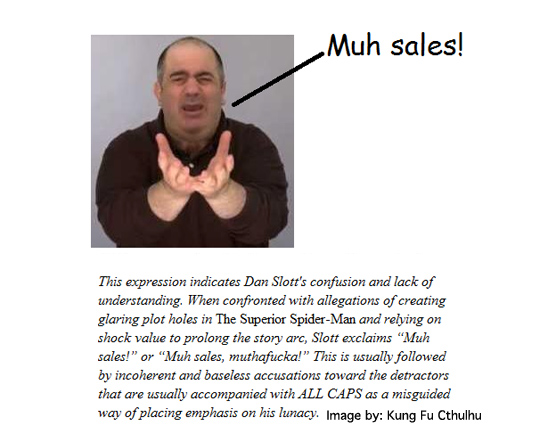
For roughly an entire year now Dan Slott has had regular meltdowns directed at yours truly. Last May, I wrote a piece titled: ‘Is Dan Slott’s ‘Superior Spider-Man’ really a Superior anti-Semite?’ The whole point of the article was to show that a villain who came within inches of exterminating 6 billion people was about to be placed in Peter Parker’s body. Marvel’s flagship character was going to be taken over by a genocidal maniac. At a pivotal point in Spider-Man history, one of his greatest villains declared that he would transcend Hitler, Pol Pot, and Genghis Khan in terms of infamy perpetrated upon the world.
Dan Slott has obsessed over me for almost a year — even going so far as to sic his Twitter groupies on me — because I had the gall to react to his insertion of a real-world monster into a fictional comic. In response to his attacks I asked: What is more offensive — Dan Slott’s indiscriminate use of incendiary names or my reminder of the implications of his indiscriminate use of incendiary names? He never answered. All he’s done is engage in online ranting and raving (e.g., I’m a “terrible human being”) that must make consummate professionals within the confines of Marvel’s offices cringe.
For the past year he’s taken to multiple platforms to engage in character assassination. I’m a “terrible” person. I’m a “bad” person. He’s holds that I simultaneously “implied” and “flat-out” said that he — a Jew — was anti-Semitic (as if I even knew or cared about his heritage in 2013).
My response was that it was quite clear in the piece — and in the comments section within an hour of writing the piece, that I did no such thing and that his accusations were false.
From the piece: Silly me. The guy who “just” came within inches of an extinction level event because he hated all of humanity is now housed in Peter Parker’s body. …
Slott [to Newsarama]: He’s trying his best to be a hero, but he’s doing it in a very Doc Ock way. And Doc Ock’s an egotistical, annoying sh*t. It makes him an interesting character. At his core, he’s someone we don’t really think of heroic. But is he any more annoying than [former villain] Hawkeye used to be?
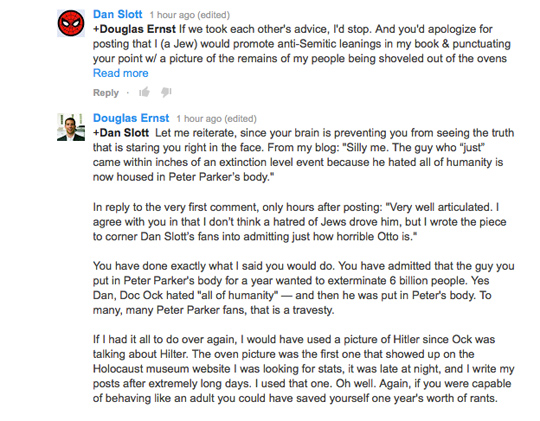
From the comments section the day it was published: Very well articulated. I agree with you in that I don’t think a hatred of Jews drove him, but I wrote the piece to corner Dan Slott’s fans into admitting just how horrible Otto is.
Rational adults can see that. I even used Dan Slott’s own words to show who and what he believes Otto represents (i.e., a wannabe hero is just kinda-sorta more annoying than Hawkeye before he was an Avenger — never mind that whole extinction-level event plot months earlier). Dan Slott refuses to acknowledge the truth when it’s right in front of his face, so I had to reiterate it for him:
Note that I say that if I had it all to over again I probably would have just used a picture of Hitler, but that it was “the first one that showed up on the Holocaust museum website [as] I was looking for stats, it was late at night, and I write my posts after extremely long days. I used that one. Oh well.” I needed a Nazi picture. There was one on the page I was reading at that moment. I grabbed it. Case closed.
How was I to know that a single blog post — by a random guy Dan Slott doesn’t know and will likely never meet — would cause the Marvel scribe to seethe with “crazy town banana pants” anger for an entire year? Of course I would have picked a different picture if I had it to do over again.
Afterward, Dan Slott started littering up the YouTube page with jokes about how I said I was unable to find a picture of Hitler online. Why would he do that? Because when faced with irrefutable evidence that he is wrong about the objective of my piece — or at a minimum should rethink his knee-jerk reaction to categorize me with real-world rapists, murderers, dictators and despots — he does what he does best: attack. And then, in order to feel even better about himself, he turns to Twitter, where The Dan Slott Ego Massage Squad can go to work. It’s always ready to rub down all those tender areas of his fragile mind.
Today a blogger explained to me why he used a picture of Jewish remains being shoveled out of ovens in his Spider-Man article. And why he left it up on his site for the better part of a year. It was because he couldn’t find a picture of Hitler. There are TWO takeaways here. 1) This guy is the world’s BIGGEST asshole. […] and 2) Apparently it’s REALLY hard to Google a picture of Hitler.
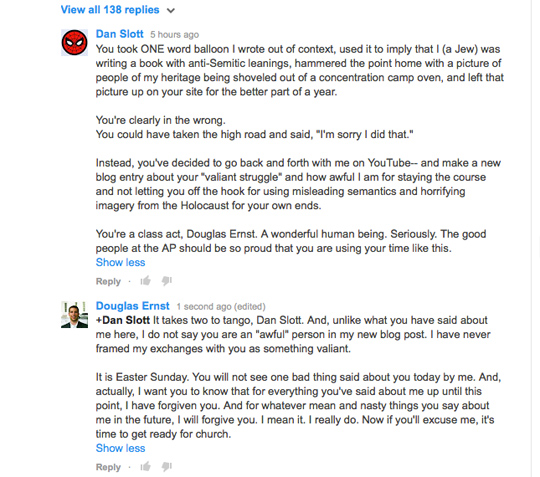
You see, it’s much more soothing for his sensitive psyche to soak in the slobbering Slott-worship of Superior Spider-Man diehards, who will lather him in in praise and confirm his conclusion that detractors are “assholes” and “douches,” than it is to deal with rational people on YouTube:
Dan Slott’s reply? I simultaneously “imply” and “flat-out” call him an anti-Semite. It’s a good thing that Dan Slott covers all his bases. Never mind the quotes above that demonstrate I did no such thing.
The truth of the matter is that Dan Slott didn’t like the way I went about making my point. He didn’t like the fact that I used very real historical pictures to point out that there are implications to what all of us write and say. When you put words in a character’s mouth, those words mean something.Or, as President Obama would say: “words matter.”
Dan Slott now says that Doc Ock citing a desire to surpass Hitler, Pol Pot and Khan’s collective infamy was merely the rhetorical flourish of a “James-Bond”-type villain. Fair enough, but if Dan Slott thinks that Hitler’s name is now merely fodder for James Bond-ish dialogue, some of us think that with that should come a dose of perspective.
And so, at this time, I will include the following image, which I show you with Dan Slott’s blessing.
Human remains found in the Dachau concentration camp crematorium after liberation. Germany, April 1945. — U.S. Holocaust Memorial Museum
That’s a wake-up call, isn’t it? Given Dan Slott’s reaction over the past year, it appears that he’s gotten the message — when you infuse real-world genocidal maniacs into the pages of Marvel comics, do not act surprised when history lovers take it seriously. Strangely enough, Dan Slott didn’t go into a TwitLonger rage when Bleeding Cool called out his character for “full-blown Nazi-like experimentation/ torture on his victims.” Ouch. How did that scene sneak by Dan Slott before going to print, given how important it is for him to protect the honor of his ancestors?
Being a veteran, whose friend was killed by a sniper in Iraq, I’ve had people say some pretty gruesome things to me, both online and in person. (Try dealing with it when it’s your college professors.) I’ve seen some horrible images that were personal affronts to the experience that probably shaped my life more than any other. However, I never obsessed over the individuals behind those hurtful or offensive acts and I didn’t call them “evil” people because, unlike Dan Slott, I know how to put things in proper perspective. But I digress. Back to the Holocaust image.
I received two reader comments that nicely summed up the debate about the picture after Dan Slott’s attacks began. They are excerpted here:
Reader #1. I think the pic was in poor taste. I see your point about taking a fictional character’s frame of reference as being wildly inappropriate. You are absolutely correct about that, it didn’t need that kind of punch. I believe Slott was only trying to maximize the horror and insanity of Ock’s mind. Regardless of his remarkably bad decision, it is still fiction, and the references should have stayed away from real-life mass murderers, unless it was far in the past. Hitler was too recent a reference, and as a Jew, Slott should have had the good taste to stay away from it. Enter Doug Ernst, who not only takes very real umbrage at this reference, but feels the need to one-up it with not only a blog post, but a photo of these poor, massacred souls to make a point. You also overstepped a boundary, Doug, and I still hope you decide to remove it on your own without further prompting. Slott is too full of bile to ask nicely, even if he is the one who instigated this. I then ask you, for the sake of those people who were in those ovens, the descendants of those unknown souls, and the millions who suffered this still-historically-relevant fate to please remove it from that entry. It serves no purpose other than sensationalism, and you don’t strike me as that kind of man who needs to stoop to that level.
Reader #2. I think Rogue is way off on the sensationalism and especially the testosterone rationale. It is important to show what Slott so casually put in his dialogue and inside Spider-Man’s head. I agree they are real people with no voice, I agree it was horrible, I agree it’s grisly — but it was Slott who betrayed their legacy — and that needs to be shown. Obviously his own grandfather’s story didn’t keep Slott from writing a tasteless story with an iconic hero, so maybe that image drove it home. I respect Rouge’s opinion, but I wouldn’t have changed it. It was Slott who inserted this awful chapter of history into the comic.
Two very different points of view, but which one is right? I ended up taking down the photo, even though I agreed with Reader #2.
My rationale:
I have removed the image and added an editor’s note. While I disagree about your conclusion that the only purpose it serves is to be sensationalistic, I think the more important point at this moment in time is that through respectful dialogue adults can work through their issues.
For that, Dan Slott called me a “coward,” proving my point that he is currently incapable of respectful dialogue.
Instead of responding to the coward claim, I will again cite Reader #1, who prompted me to take down the picture:
Slott never should have used Hitler as a reference, period. Can a fictional story use hot political or religious topics without the author being blamed as the source? No. Authors have been targeted over the course of history for their words, fictional or not. I won’t give history lessons here, but Slott decided to use a non-fictional, politically monstrous, recent, religiously sensitive reference to further a Spider-Man (HYPHEN!!!) story, and (I’m possibly reaching here), since he is a Jew, decided it was OK for him to use it. Only him. Because he’s a Jew. And he’s sensitive to the plight of the Jews. And his family has personally suffered from the Holocaust, so it was OK. Anyone else using Hitler as a reference is a BAD man, and has taken his “one thought bubble” out of context. What Slott fails to see is the hypocrisy inherent in what he did. You cannot use Hitler as a fictional hot button safely, simply because you are a Jew, then fall back on Jewish outrage to bury it once someone else picked up and expanded upon it. The truly laughable part was the threat to sue. Oy vey. I didn’t like Doug’s use of the pic for reasons stated above, none of which were in any way sympathetic to Slott or his reactions.
The point is, this whole debate is actually a lot more complex and nuanced than someone of Dan Slott’s maturity level can handle. It’s easier to call me “evil” and “terrible” and “bad” over and over again. And then, when a guy like me points out — after nearly a year of verbal diarrhea hurled in his direction — that one of the reasons why I enlisted in the armed services was so guys like him would never have to fear being shoved in an oven or shot and killed, he has the nerve to say I have unfairly used my military service as a shield.
A friend of mine put just laughed and mentioned that Dan Slott is pretty good at hiding behind his Jewish heritage (a point that Reader #1 also seems to have noticed).
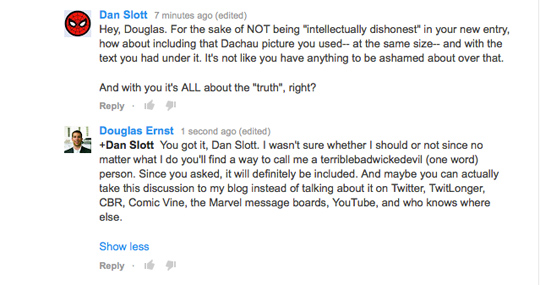
And with that, I give you one last piece of evidence to show you what an immature and confused man Dan Slott is at this point in his life:
The guy encourages me to use the Holocaust picture for “intellectual honesty,” and then when I tell him I will do just that he again loses it and lashes out at my character. Do you see how it works in Dan Slott’s world? If I use the picture at his request — essentially his dare to provide “intellectual honesty” — I’m a “terrible” person; if I don’t use the picture, I’m a “terrible and dishonest” person. Dan Slott wins every time.
If I put up a picture that offends Dan Slott, I’m a “terrible human” on par with (ironically) Hitler. If I take it down after a reader acts like an adult, I’m a “coward.” While East Ukrainian Jews are being told to register with pro-Russian forces, Dan Slott pats himself on the back at night because he’s identified and attacked the real threat to the Jewish community — me. For days. And weeks. And months.
What courage. What bravery. What sacrifice. Churchill would be proud.
The great thing about Dan Slott calling me a “coward” is that anyone who reads these blog posts will understand that he’s attacked me personally on YouTube, Comic Book Resources, Twitter, TwitLonger, Comic Vine, the Marvel Message Boards and probably a few other places that I don’t even know of for roughly one year — but he hasn’t come here. Maybe now he’ll show his face. Or not. He seems to like the sound his Twitter followers make when he blows the stroke-my-ego dog whistle.
If he does decide to show up, expect him to once again say that I implied that he was anti-Semitic, even though I quite clearly never did such a thing. (Or was that “flat-out” say he was an anti-Semite? I can’t remember because it changes hourly.) No Dan, you did not write a book with an anti-Semitic character — you just wrote one with a man who wanted to kill six billion people because he hated all of humanity. And then, you made him Spider-Man. For an entire year. Again, silly me.
As a practicing Catholic, I find this to be incredibly tasteless (understatement of the year award). Using the Dan Slott litmus test for “bad” and “terrible” people, Erik Larson fits the bill. It’s a good thing I don’t use Slottian methods for judging someone’s character. If I did, then I’d obsess over Mr. Larsen’s single tweet for the next year and abuse the caps-lock button as I proclaim: “I’m Catholic! I’m Catholic! I — a Catholic — am Catholic! I’m Cathooooooooolic! How dare you challenge the Universal Salvific Will of God! RAGE!”
If you enjoyed this post, just know that there will probably be more in the future, as Dan Slott’s obsession with me shows no signs of slowing down. The next time he complains about tight deadlines, take a moment to think about just how much time he wastes attacking his critics.
If you’ve made it this far I now invite you to enjoy Dan Slott’s favorite song: ‘You Spin Me Round’
Exit question: How long will it be before Dan Slott lies to his Twitter groupies and tells them that a.) I picked ‘You Spin Me Round (Like a Record Baby)’ for surreptitiously evil purposes, and b.) I seriously implied/said (pick one … or both) that he enjoys listening to Wagner, even though he’s not supposed to.
Bonus Number 2: Tomorrow Dan Slott tweets to his followers that Francis Ford Coppola may be an anti-Semite.
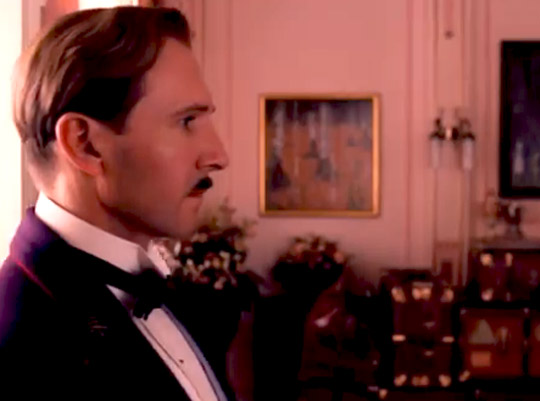
Wes Anderson films are like little cinematic snow globes. They’re intricate. They’re meticulously put together by someone who loves his craft. They’re truly unique little worlds that I wish I could jump inside and wander around in for hours at a time. With The Grand Budapest Hotel, Mr. Anderson adds yet another “snow globe” to a body of work that fans will treasure for years to come.
The story centers around Grand Budapest concierge Mr. Gustave (Ralph Fiennes), his friendship with lobby boy Zero (Tony Revolori), and the adventures that ensue when Gustave is framed for the murder of the incredibly wealthy Madame D. (Tilda Swinton). With a large inheritance at stake the “vipers” come out, as Gustave puts it, and it’s up to he and his friends (including Zero’s love interest Agatha, played by Saoirse Ronan) to set things right.
As with most Wes Anderson films, the thing I love about them is that so many of his characters are incredibly refined, yet they possess numerous idiosyncrasies that set them apart from one another. They’re all smart, but they don’t come across as clones because so much attention to detail has been paid to flesh out their histories, likes, dislikes and dispositions. If each character were compared to a color I would say that they are often similar shades, but that the pleasure comes from noting the subtle differences between them.
In between each shade of the same color are in fact infinite differences, and Wes Anderson’s appreciation for that is what resonates with this moviegoer.
Mr. Gustave is a man with whom, even if I were to disagree, I would not find him disagreeable. He harkens back to a day when strong differences in opinion were handled with class and dignity. It’s humorous for modern audiences — raised in the time and age in which the politics of personal destruction are the norm — to see on the big screen, but deep down we long for the world to breed more Gustaves:
M. Gustave: “Rudeness is merely the expression of fear. People fear they won’t get what they want. The most dreadful and unattractive person only needs to be loved, and they will open up like a flower. I’m reminded of a verse: ‘The painter’s brush touched the inchoate face with ends of nimble bristles.'”
Even when he’s vulgar, he has class:
Mr. Gustave: Oh, how the good die young. With any luck she’s left a few klubecks for your old friend, but one never knows until the ink is dry on the death certificate. She was fabulous in the sack, by the way.
Zero: She was 84, Mr. Gustave.
Mr. Gustave: I’ve had older. When you’re young it’s all fillet steak, but as the years go by you have to move on to the cheaper cuts, which is fine with me because I like those. More flavorful, or so they say.
He has standards. He lives by a set a principles and does his best to stick to them.
Mr. Gustave: “The beginning of the end of the end of the beginning has begun. The sad finale played off key on a broken down saloon piano in the outskirts of a forgotten ghost town. I’d rather not bear witness to such blasphemy. … The Grand Budapest has become a troops barracks. I shall never cross its threshold again in my lifetime.
And when facing Death’s door, he is stoic:
Mr. Gustave: If this to be the end, ‘Farewell!’ cried the wounded piper boy whist the muskets cracked and the yeoman cried “Hurrah!” and the ramparts fell. ‘Me thinks me breaths me last me fears,’ said he…”
We laugh at Gustave’s idealism, but we secretly wish we had 1/10 of his decency and decorum.
There are two scenes which, in my mind, best sum up Gustave’s friendship with Zero. Because I don’t want to include spoilers, I will only refer to the exchange where Gustave asks if he can officiate Zero’s future wedding with Agatha:
Mr. Gustave: May I officiate, by the way — the ceremony?
Zero: With pleasure.
Mr. Gustave: I must say, I find that girl utterly delightful. Flat as a board, enormous birthmark the shape of Mexico over half her face. Sweating for hours on end in that sweltering kitchen where Mendl — genius that he is — looms over her like a hulky guerrilla. Yet, without question, without fail, always and invariably she’s exceedingly lovely. Why? Because of her purity.
Zero: She admires you as well, Mr. Gustave.
Mr. Gustave: Does she?
Zero: Very much.
Mr. Gustave: That’s a good sign, you know. It means she gets it. That’s important.
Zero: Don’t flirt with her.
The audience knows that Gustave is at his core a good man, but like all of us he is deeply flawed. He wishes to officiate at his friend’s wedding, but both know that if given a chance he would sleep with Agatha. He admires her purity, but can not help himself for wanting to steal it. He strives to embody the best within him, yet regularly succumbs to his basest desires. He lives to serve others, yet often uses that service to fulfill his own selfish needs.
Like all of us, Mr. Gustave is a fusion of the decadent and the divine. With that said, he also aims to project that fusion in its most presentable package. Like the Mendl’s confectionery treats that play an important part of the film, The Grand Budapest Hotel shows us that beneath the pristine packaging and painstaking work we go to in order to appear a cut above the rest, our pomp and circumstance and cute little bow ties often belie our insides.
Some might say that such a message is a hopeless one — we’re all rotten inside. I disagree. Like I said: we are a fusion of the depraved and the sublime. That is the service rendered for human flesh. The Grand Budapest Hotel’s message, to me, is that while we may not be pure, by striving to become a better version of ourselves we can more often than not be “invariably and exceedingly” lovely.
Agatha says at one point in the movie: “Whence came these two radiant celestial brothers united for an instant as they crossed the stratosphere or our starry window — one from the East and one from the West?”
Answer:the mind of Wes Anderson. Hopefully, he’ll be turning out “radiant celestial brothers” on screen for years to come.
You’re
Torn
Tattered
Pages,
That book I read
Over and Over
And Over again
Always finding something new
Within the familiar
Before I slip
Up, an accident
Or two
Tiny rips
No one witnesses
But me as I lie
In bed
Because you’re closed
To Them.
You’re
Worn,
A weathered
Cover
With smiles
That say: “I hold sentimental value To someone. He holds me In high esteem.”
But such
Understatements
Need a copy editor:
You’re Beautiful and Loved
So never fear—You’ll never
Be neglected
By Me.
John Nese of Galcos Soda Pop in Los Angeles has an infectiously optimistic vibe to him. He started working there with his father when he was five years old and still has a childlike charm. The store he works for has been around since 1897, so it’s a good bet that he knows a thing or two about running a business.
First things first: he’s able to establish that there is indeed a difference between capitalism and crony capitalism:
About ten or eleven years ago the Pepsi Cola salesman came in. And he said, ‘I got the best buy you’re ever going on a pallet of Pepsi Cola cans. I’m only going to charge you 5.59 a case.’ I said, ‘Thank you, but no thank you. I’m going to send my customer’s down the street to Ralph’s because they’re going to be on sale down there for $1.99 a twelve-pack.’
And he says, ‘Well, you can’t do that. Pepsi Cola is a demand item and your customers are going to demand that you carry Pepsi Cola.’ And I said, ‘My customers are going to be happy I was honest with them and sent them down the street. They can buy them cheaper than I can buy them.’ And after two weeks of really being upset I said, ‘Thank you very much Pepsi Cola for reminding me that I own my shelf space and I can do anything I want.’ …
So I immediately went out and found 25 little brands of soda. Gee whiz, they’re still in glass bottles. I put them on the shelf and people would come in and look at them and say ‘What are you doing with all those old things that don’t sell?’ And when I got to 250 it was ‘Where are you finding them?” So now we have about 500 different kinds of sodas. …
When the American public has a choice, they’re going to try it. … Big Business loves Big Government. They just take the marketplace up, eliminate all the little guys — they run them out of business and then they jack the price ups and control the market. But you look at the candy section it’s Nestle’s, Hershey’s and Mars. Or you look at the soda pop market it’s Coke and Pepsi. My thought had always been that what I wanted to do was to do business with other businesses my size — to make them become unique businesses.
The more expansive the government, the more capitalism is replaced with crony capitalism. People always think that business don’t like government interference, but that’s not true because many times big companies love seeing new laws passed — as long as it benefits them.
That dovetails nicely with Mr. Nese’s experience with California’s “Refund Value” laws, which are billed as being necessary to help make a greener world. Is that true?
Perhaps, to some extent — but consider this:
Who do you think passed the RV laws? You’re going to get me on my soapbox again and then you’re going to have to point the camera up. It wasn’t written for the consumer and it certainly wasn’t written to keep this country green. It was written so Coke and Pepsi wouldn’t have to wash a bottle and they wouldn’t have to make recyclable bottles and they could transfer the cost to the consumer.
I called the recycling center when I got started and said, ‘Listen, I want to put a recycling center in. They bring them back to me and I’ll give them the money and I’ll sell them some more sodas.’
‘Oh, I’m sorry, you can’t do that because you have a recycling center two blocks away.’ I said, ‘Yeah, but they don’t give the full price. I want to give the full price to the customer to get them back to sell them some more!’ And he says, ‘Well, if you did anything like that you’d be in restraint of trade and you can probably get sued by the state.’ If we really cared about the state we would have reuse — not recycling.
So a business owner wants to install his own recycling center in his building, but he can’t because it will somehow be in violation of “restraint of trade” laws? Unbelievable.
How much more green could you get than a guy who sells soda in glass bottles to his local community, who then return those glass bottles to him — so that he could in turn wash them — and sell more? You can’t. And yet, the state of California would likely sue him if he went there.
Finally, John Nese makes perhaps the most important point of all, and it has nothing to do with politics. It’s about life.
People say, ‘Well, you’re here and you’re working all the time.’ And I’m saying, ‘I don’t work. I just play all day long.’ I come in and play.
Do what you love to do, and it won’t seem like work for you. When you do what you love — when you do what you believe you were born to do — getting up in the morning will be a joy. When you do what you love, it shows. It creates a positive feedback loops whereas you contribute more to your area of expertise, coworkers and customers are happy, they reward you, you’re happy and the process begins anew.
Years ago I left a job that I felt in my heart was not in line with where I wanted to be. I took a leap of faith (and a pay cut) to do what I thought would get me there and I couldn’t be happier. There were bumps and bruises along the way, but I know that even if it didn’t work out that I’d have one less regret on my death bed. (I hope to have none.)
If you’re not happy with where you’re at, try and figure out what job you could envision yourself performing that you wouldn’t take a dime to do. When you figure it out, start working toward that goal and years down the road you’ll be one of the few who could say that their job is to “play all day long.”
For years I always thought I was weird because when I explained my worldview to people I’d get strange looks. I’d tell them “x” was going to happen because I refused to accept any other outcome. When “x” happened, I was told I was “lucky.” When it happened again I was told that I always find a way to “worm” my way into advantageous situations. When it happened again I was told things “always have a way of working out” for me.
Recently I was talking to a friend a mine about some things that will happen a year or two from now and she said, “Doug, you’re talking about your book as if it’s already published. You’re still writing it!” and I replied, “It is done. It’s published. It’s already happened. We’re just not there yet.” You can guess what kind of look I got…
It is because of these experiences that I was overjoyed when I ran across an audio recording by Earl Nightingale. I had never heard of the man before, but as he was talking I felt as if I knew exactly what he was going to say before he said it. I started mouthing the words as he was talking and it felt as if he was speaking through me. I had never heard the recording in my life, but it was as if I heard it 1,000 times.
“Finally!” I thought. “Someone who gets it!” I still don’t know much about him, but a quick internet search reveals he was born in Los Angeles, a radio host, motivational speaker, and Marine. I’m a USC Trojan, I’ve been on the the radio, I love motivational speakers, and I’m former-Army. I’ll cut Earl some slack for throwing off that last one…
Long story short, when he talks about what it takes to achieve success he couldn’t be more correct. I have included an excerpt from the video below, although if you get a chance I suggest listening to the whole thing.
Why do we become what we think about? We’ll I’ll tell you how it works as far as we know. Now to do this I want to tell you about a situation that parallels the human mind.
Suppose a farmer has some land and it’s good fertile land. Now the land gives the farmer a choice: he may plant in that land whatever he chooses — the land doesn’t care. It’s up to the farmer to make the decision. Now remember, we’re comparing the human mind with the land because the mind, like the land, doesn’t care what you plant in it. It will return what you plant, but it doesn’t care what you plant.
Now let’s say he has two seeds in his hand. One is a seed of corn. The other is nightshade, a deadly poison. He digs two little holes in the earth and he plants both seeds — one corn, the other nightshade. He covers up the holes, waters and takes care of the land, and what will happen? Invariably, the land will return what’s planted. As it’s written in the Bible: “As you sow, so shall you reap.” Now remember, the land doesn’t care. It will return poison in just as wonderful abundance as it does corn. So up come the two plants — one corn, one poison.
Now, the human mind is far more fertile, far more incredible and mysterious than the land but it works the same way. It doesn’t care what we plant. Success. Failure. A concrete worthwhile goal, or confusion. Misunderstanding, fear, anxiety and so on. But what we plant it must return to us. You see, the human mind is the last great unexplored continent on earth. It contains riches beyond our wildest dreams. It will return anything we want to plant.
Now you might say, ‘Well, if that’s true, why don’t more people use their minds more?’ …
Our mind comes with standard equipment at birth. It’s free, and things that have been given to us for nothing we place little value on. Things that we pay money for, we value. The paradox is that exactly the reverse is true. Everything that is really worthwhile in life came to us free.
Our minds, our souls, our bodies, our hopes, our dreams, our ambitions, our intelligence, our love of family and children and friends and country — all these priceless possessions are free. But the things that cost us money are actually very cheap and can be replaced at any time. A good man can be completely wiped out and make another fortune. He can do that several times. Even if our home burns down, we can rebuild it. But the things we got for nothing we can never replace.
The human mind isn’t used because we take it for granted. Familiarity breeds contempt. It can do any kind of job we assign to it, but generally speaking we use it for little jobs instead of big important ones. …
So decide now: What is it you want? Plant your goal in your mind. It’s the most important decision you will ever make in your entire life.
Bravo. I can’t even begin to describe what it felt like for me to hear this for the first time. It was like all of the things I had privately thought for years and largely kept to myself were shared with this man.
I’m not a very touchy-feely sort of guy, but I think that if I ever met Mr. Nightingale during his lifetime I would have shaken his hand and given him a great big bear hug.
If you get a chance, I highly suggest listening to the whole thing.
In my last post I talked about Robert DeNiro’s apt description of the mind of a writer. One of the things I’ve always wondered is why there aren’t more openly conservative poets and writers. I have a few thoughts of my own, but I’d like to hear what you have to think.
I’ve shared a poem or two over the course of this blog, but I don’t think I’ve ever posted one that really makes a political statement. If you want a peak into my mind as a 21 year old kid, and the reaction I had after exiting the military and entering the college classroom, here it is. My writing has improved since then (I’m 34, so I would hope so!), but I don’t mind giving you a glimpse of my younger self.
In Defense of Dead Presidents and the American Way of Life.
Bees make beehives and we make buildings
Don’t lament the ingenuity within this sleek machine I’m driving;
It’s an extension of our being
Natural, like honeycomb or busy bees consumed by some activity
To better their day-by-day existence.
Let’s return to the lush green-wooded yesteryear
Where tribal chants and chieftain rants
Were aspects of everyday living.
Or better yet let’s not,
Intertribal rape and head lice were never that appealing.
American Empire, or so they say
Rapes third world resources from exploited labor—
Fire those lads lined up and ready to work long hours
Making meager earnings three times their peers!
Let’s pull out and prop up tin pot despots with aid that will never get there.
Curses! Western Civilization
With your claims of moral superiority
Ah yes, I’m aware of your duplicity—
Behind those technological wonder kids and wonder cures
Churned out from rule-of-law freedom spawn is something sinister I’m sure.
Back home things are horrid
The burger and fry flippers scream foul
Ten, Twenty, why not Thirty!
Let’s hike that minimum wage stand back and see what happens
Never mind the economics.
What’s wrong with the summertime soldier and sunshine patriot?
Let’s redefine patriotism to include
Malcontents and misfits and anti-war mentalities
Dead set on peace at any cost
Although rooms for rape, rooms for torture, rooms for worse are tricky.
I had been ill for quite some time—
Green tea tasted great but did little to quell my disease.
I asked my son to pray for me, but his principal said no.
Dejected, I turned to God and in a dream
He told me to see a doctor—who knew.
America, you make me sick
What with your so-called religious freedom, I’m persecuted at every turn.
I informed my priest I was heading to Saudi Arabia.
I would’ve went too! (if it were legal)
Christians can’t be citizens.
Mom and Dad say it’s not healthy
To be so wry, so angry, all the time.
The soul, like worn copper pennies.
It’s hard, I tell them, when notable poets and award winning scholars
Invent ways to trash Abe Lincoln.



















 Douglas Ernst Blog