These grains of sand
And tiny shells between my toes
Ground Me —
I’m sentient sand
With a pair of eyes
For a time
And today
Right Now
I’m fine
Dust
Before an infinite ocean
Listening to its breath break
Along the shoreline.
My wave meditation
Can’t be broken
By the call of seagulls
Squealing kids or random beach bodies
Entering and Exiting
The scene.
Like high and low tide
My moment to go will come
At the perfect time in the perfect place
And in that Now
As in all
I am thankful
Elderly couple die hours apart, remind us of the kind of love we all deserve
Just over a year ago, my grandmother died at the age of 98. Less than 24 hours later — without having heard the news — my grandmother’s best friend passed away. While it might seem bizarre to find joy in death, I did. It was comforting to know that as my grandmother moved on to the next life her good friend was experiencing it all with her. In a similar sense, I believe many family members of Harold and Ruth Knapke are feeling the same sense of peace:
DAYTON, Ohio — Relatives of an Ohio couple who died at a nursing home 11 hours apart on the same day said their love story’s ending reflects their devotion over 65 years of marriage.
Harold and Ruth Knapke died in their shared room on Aug. 11, days before their 66th anniversary, The Dayton Daily News reported.
Their daughters said they believe their father willed himself to stay by his wife’s side despite failing health until they could take the next step in their journey together. He went first — his children saw it as his “final act of love” — and she followed.
“We believe he wanted to accompany her out of this life and into the next one, and he did,” daughter Margaret Knapke said.
The couple had known each other as children and began their courtship as pen pals while Harold, known as “Doc,” served in the Army during World War II. Ruth would later joke: “I let him chase me until I caught him!” …
“It is really just a love story,” said Carol Romie, another daughter. “They were so committed and loyal and dedicated, they weren’t going to go anywhere without the other one.”
The body often fails us, but the mind and the spirit are extremely powerful. A person with a reason to live can will the body to hold on to a quality of life others would find unacceptable.
There are many lessons we can take away from the Knapke story, but I find two in particular to be of utmost importance:
- To make the most of life, finding your reason for being is paramount.
- You not only have the power to forge deeply spiritual relationships with friends and family — the kind that you would want to carry over into the next life — but you deserve them.
For many people, mastering these two elements of life can seem like a 7-10 split in bowling, but it can be done. I suggest starting with introspection and regular acts of kindness, but there are many ways to accomplish the task.
One of the reasons many relationships end is because people fail to grow in concert with their partner. If you married your “perfect” mate tomorrow, they would soon not be perfect to you because you will change over time. People are like plants, and they can be like two strands of Ivy wrapping and winding around each other as they thrive and expand, or they could allow their desires to take them in different directions. The key takeaway is that every step along the way we have complete control over how it all unfolds.
If you have someone in your life that you care for so much that you’d will your dying body into a kind of loving life support, say a prayer of thanks for them every day. If you do not have someone in your life like that at the moment and have been wondering why, ask yourself if at the core of your being you believe you deserve such a relationship. If the answer is “no,” then I implore you to find a way to realize that you are worthy of love, abundance, healthy and happiness. When you make that mental shift, your life will begin to change.
Mr. and Mrs. Knapke had a connection many consider rare, but the truth is much more nuanced: all of our relationships have the potential to produce deeply spiritual love. We stand on fertile ground with pockets filled with seeds, but it’s up to each individual to sow them.
WSJ Fall Fashion issue: Is androgynous the new black?
Is androgynous the new black? Take a look at the Wall Street Journal Fall Fashion issue and you’ll notice a trend — maybe sorta kinda women who are supposed to be models.
I’m assuming the photographer just didn’t apply eye makeup in order to de-emphasize her eyes? Or maybe the WSJ just hired women with more masculine features and accentuated them?
Am I wrong? Why does this woman have a cleft chin?
Am I supposed to attracted adolescent boys now?
Tilda Swinton is the key here; she played Archangel Gabriel in 2005’s Constantine. It’s hard not to think that the Wall Street Journal is trying to push fashion better suited for David Bowie’s gender-bending days with its fall fashion issue.
I love Bowie’s music, but I don’t enjoy looking at him. In short, the Wall Street Journal needs more women who look like … women. Kate Upton would be a good start.
Ben Affleck’s outspoken politics hurt his Batman more than his box office bombs
Warner Bros. needed someone who could take on Superman. Correction: Warner Bros. needed someone who could theoretically beat Superman. They decided that man was … Ben Affleck.
Ben Affleck has been cast as Bruce Wayne/Batman in Zack Snyder’s still untitled Superman/Batman sequel to this past summer’s Man of Steel. The announcement was made today by Greg Silverman, President, Creative Development and Worldwide Production, and Sue Kroll, President, Worldwide Marketing and International Distribution, Warner Bros. Pictures. The studio has slated the film to open worldwide on July 17, 2015. …
In the announcement, Silverman stated, “We knew we needed an extraordinary actor to take on one of DC Comics’ most enduringly popular Super Heroes, and Ben Affleck certainly fits that bill, and then some. His outstanding career is a testament to his talent and we know he and Zack will bring new dimension to the duality of this character.”
Snyder also expressed his excitement about the casting of Affleck, noting, “Ben provides an interesting counter-balance to Henry’s Superman. He has the acting chops to create a layered portrayal of a man who is older and wiser than Clark Kent and bears the scars of a seasoned crime fighter, but retain the charm that the world sees in billionaire Bruce Wayne. I can’t wait to work with him.”
There is no getting around how utterly weird this decision is. However, there is also no getting around how awesome ‘Man of Steel’ was.
Fact: Zack Snyder knows what he is doing. ‘300’ was awesome. ‘Watchmen’ is severely underrated. ‘Man of Steel’ reinvigorated Superman. If he thinks he can make it work with Ben Affleck as Batman, then he’s earned the benefit of the doubt. Fans owe it to him to try their best to withhold judgement and give Affleck a shot.
Here are a few things to help you view the glass as half full:
- Zack Synder gives his actors the Gym Jones treatment: Ben Affleck will be in shape when it’s time to film. Batman shape. “Holy-crap-is-that-Ben-Affleck?” shape.
- ‘Chasing Amy’: Ben Affleck showed us he could do a relatively decent job at “tortured soul” when he played Holden in 1997’s Chasing Amy. Sure, his range is limited, but if Snyder can tap into his strengths and minimize his weaknesses then we might just have a decent Batman on our hands.
- Fan backlash: In a weird way, Affleck will probably use all the anger directed his way as motivation to knock it out of the park.
People keep mentioning Daredevil as proof that Affleck can’t hack it as Batman, but a.) it’s not nearly as bad as people make it out to be and b.) Zack Synder is not Mark Steven Johnson.
In truth, I think the thing that hurts Ben Affleck the most is his political activism. How many people will look at him and think, “This Batman told me John Kerry should have been president in a post 9/11 world and that John Edwards was a trustworthy guy,” — or some other reaction based on his political talk show appearances?
How can moviegoers see Affleck as a blank slate going into the theater when they’ve had to put up with his activism for years?
In this past presidential election Mr. Affleck was more muted, saying his feelings for the president were “complicated.” (i.e., I got duped in 2008 and don’t want to admit it.) However, from now until July 17, 2015, how many times will he lecture the American people on climate change, taxes, immigration or a whole host of public policy issues? Even his wife believes he’ll be running for office in the not-too-distant future. If I were a betting man, I’d say that Mr. Affleck will continue saying and doing things in public that will make it harder for roughly half the nation to lose themselves in his version of “Batman” on opening night. In that sense, Warner Bros. made an unwise decision.
In short, if Ben Affleck can keep a low profile from now until July 17, 2015, it will actually work to his advantage. People want to see whether he sinks or swims and the right teasers will heighten that interest even more. If Ben Affleck can keep from alienating people with political rhetoric, there’s a good chance that Synder will come through in the clutch. The key is for fans to do the right thing and try to walk into the theater with an open mind.
At Georgia Tech, you can build the Iron Man suit: The making of an amazing speech
If you haven’t seen the video clip of the Georgia Tech Freshman convocation speaker that’s making the rounds, I highly suggest watching it. It’s priceless.
Here’s a taste:
“In the words of Sir Isaac Newton: “If I have seen further it is by standing on the shoulders of giants.” Georgia Tech is proud of its many traditions, but the one I find most exciting is our tradition of excellence. Our mission as students is not to follow in the footsteps of the astronauts, Nobel Prize laureates and president of graduated before us, but to exceed their footsteps. Crush the shoulders of the giants upon whom we stand. We here are all such innovative people.
So I am telling you: If you want to change the world, you’re at Georgia Tech — you can do that. If you want to build the Iron Man suit, you’re at Georgia Tech — you can do that! If you want to play theme music during convocation speech like a badass, we’re at Georgia Tech — we can do that. I AM DOING THAT!”
I’d love to meet this guy, buy him a drink and shake his hand. No matter what you think of the speech, it’s stuff like this that makes me get up every day and say to myself: “Life is awesome.”
The effects of meditation: What if you could ask your nightmares why they haunt you?

Since this blog’s inception much of its content has been dedicated to getting people to think about freedom and individual liberty, how precious it is, and the public policy decisions that either strengthen or erode America’s moral fabric. At the start of the new year, I came to the conclusion that my ability to change perceptions was extremely limited because I was focusing on the external world’s problems before my own flaws were adequately addressed. And so, I turned inward. One aspect of that introspection began with meditation. Besides stripping away anger and frustration, which has allowed me to think more clearly, it’s also had another profound impact — on my dreams.
Dreams are often discounted as nothing more than a mish-mashed thought-manifestation of whatever is going on in a person’s life at any given moment. I have always believed they possess a deeper meaning. Now, I have come to the conclusion that the subconscious mind will gladly reward the person who makes the conscious decision to want to learn from it.
The following is a dream I woke up from at 6:57 a.m. Was it just a run-of-the-mill dream, a lucid dream or an out-of-body experience? And if lucid dreams are real, what are the implications for a man who could ask his subconscious mind questions about life, the universe and … everything? (Cool points awarded if you got the Douglas Adams reference.)
I’m getting ready to leave a hotel that seems inspired by the Moulin Rogue set design. I’m sitting on some steps just collecting my thoughts and J.K. Simmons walks by. He has no hair and is dressed like a skinhead. He has a swastika tattoo on his shoulder. He stops as he nears me and I wonder if he thinks I’m really a skinhead because I’m muscular and have all my hair shaved off. He sees my favorite Army cap on a railing and says, “Hey…” and looks like he might take it. I grab it and calmly say, “Do you know where you can get these? Old Navy. $10 bucks.” He nods and walks away with his entourage.
The hotel clerk then says to me, “I think that guy was going to steal your hat!”
I reply “Maybe, but I don’t think so.” In my head (in the dream) I think, “because I wasn’t going to let him.” Then I think: “That clerk doesn’t know he was an actor. He thinks he was a real Nazi!” which makes me laugh.
I then stand up and jump from the staircase I was sitting on, but suddenly I’m falling down a shaft farther and farther and father. Then I slow down and start floating. Again, I’m in some sort of Moluin Rouge-ish theater house. I see all sorts of strange things on shelves and there are walls with words written all over them.
I feel like I’m going through a slow Disneyland ride and I’m trying to read all the lettering on the walls. Some sort of fairground music is playing. I then think: “I need to read all of this.” The only thing I can make out is the name of author ‘S.E. Cupp’ although there are many others. As I’m floating I see a game that reminds me of ‘Fireball Island.’ I think: “I used to love that as a kid!” and laugh.
As I continue on I see a sign that says ‘Which Way To The End?’ I then rotate like a clock. I think: “I must want to go home now,” and then do a full clockwise rotation in the air.
At this point I begin speeding up. I’m going faster and as I’m accelerating I see a sign that says ‘You End With a Jump!’ and in midair I do just that like a happy kid. I burst forward at an incredible speed — like a fighter jet with its afterburners on. I’ve never felt like I was going so fast in my life.
I’m suddenly back in the theater, speeding along what seems to be a never ending wind tunnel lined with red velvet movie curtains along the walls. I think: “This is awesome!”
I’m so close to the ceiling that I see a blue glow reflecting off the tile. I think “Is that coming from me? Am I having an out of body experience? Am I returning to my body? I think I am!” I tell myself not to get too excited but I can’t help it and I let out an exhilarating yell. Immediately I come to an abrupt stop, slowly reverse, hear a “woooshhhoop!” noise, and wake up with my wife shaking me; she was under the impression I was having a nightmare (which I used to have regularly). She tells me that in my sleep I was breathing incredibly fast. I tell her that’s because I was flying like Superman if he wanted to get somewhere in a hurry.
Imagine the personal growth men and women could attain if they could ask the symbolic representations in their dreams what, exactly, they mean. What if a individual spends his days trying to improve his body, mind and spirit — and his nights doing the same thing? What would happen if we could stop the elements of our nightmares in their tracks to ask them why they haunt us? How would the physical world transform if individuals made the conscious decision during sleeping hours to take the darkest corners of their minds and fill them with light?
If these are questions that interest you as much as they do me, I suggest giving meditation a try. Then, feel free to circle back with me here with your findings. I’d love to hear your stories.
Best,
Doug
Mysterious ‘angel’ priest at car crash reminds us of our true nature
Miracles happen every day. Angels exist. If you’re on the fence about either statement, look no further than New London, Missouri, where a mysterious priest has fire fighters and rescue workers scratching their heads:
Emergency workers and community members in eastern Missouri are not sure what to make of a mystery priest who showed up at a critical accident scene Sunday morning and whose prayer seemed to change life-threatening events for the positive.
Even odder, the black-garbed priest does not appear in any of the nearly 70 photos of the scene of the accident in which a 19-year-old girl almost died. No one knows the priest and he vanished without a word, said Raymond Reed, fire chief of New London, Mo. …
The scene unfolded Sunday morning. Katie Lentz, a sophomore at Tulane University, was driving from her parents’ home in Quincy, Ill., to Jefferson City, Mo., where she has a summer internship and planned to attend church with friends. The Mercedes she was driving collided with another vehicle on a highway near Center, Mo. The accident crushed Lentz’s vehicle into a ball of sheet metal that lay on the driver’s side, Reed said.
Reed’s team and emergency workers from several other jurisdictions tried for at least 45 minutes to remove the twisted metal from around Lentz. Various pieces of equipment broke and the team was running out of choices. A helicopter waited to carry Lentz to the nearest trauma center. Though Lentz appeared calm, talking about her church and her studies toward a dentistry degree, her vital signs were beginning to fail, Reed said.
“I was pulled off to the side by one of the members of the” helicopter evacuation team, Reed said. “He expressed to me that we were out of time. Her condition looked grim for her coming out of that vehicle alive. She was facing major problems.”
At that point, Reed’s team agreed to take the life-threatening chance of sitting the vehicle upright so that Lentz could be removed from it. This is dangerous because a sudden change in pressure to the body can be critical, he said.
That’s when Lentz asked if someone would pray with her and a voice said, “I will.”
The silver-haired priest in his 50s or 60s in black pants, black shirt and black collar with visible white insert stepped forward from nowhere. It struck Reed as odd because the street was blocked off 2 miles from the scene and no one from the nearby communities recognized him.
“We’re all local people from four different towns,” Reed said. “We’ve only got one Catholic church out of three towns and it wasn’t their priest.”
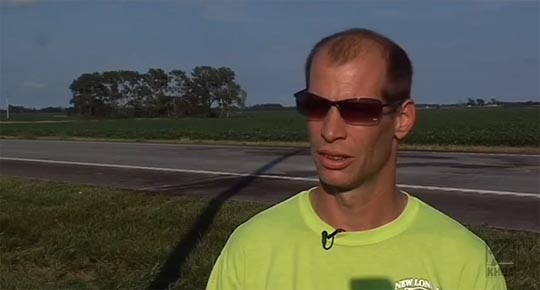
Mr. Reed continued in an on-air interview with the local news station:
“He came up an approached the patient and did offer a prayer. It was a Catholic priest. He had anointing oil with him. A sense of calmness came over her then, even more so than what she had been already — and it did us as well. I can’t be for certain who said or how it was said or where it came from but myself and one of the other firefighters who was beside me — we very plainly heard that we should remain calm, that our tools would now work, and that we would get her out of that vehicle. …
As a first responder, you don’t know what you’re going to run into. Everything is on a case by case basis. Everything that we come across. We have a lot of tools that allow us to do many things and we have extensive training. In this particular case it is my feeling that it was nothing more than sheer faith and nothing short of a miracle,” (Raymond Reed, fire chief, New London, Mo.).
Who was this mystery priest? Was he an angel in human form? Was it just a priest who happened to be wandering the corn fields of Missouri at the perfect time in the perfect place to come to the aid of a devote Catholic who asked for someone to pray out loud for her — just as her vital signs were failing? Did the fire chief of New London, Mo. and the local townspeople all decide in the moments after a gruesome car crash to put together an elaborate hoax? Interesting questions, indeed.
The fact of the matter is this: Whether Katie Lentz was saved by an angel or comforted by the wandering priest of the Missouri cornfields, a miracle happened. And in the end, this story reminds us that we are all spiritual beings. We all have a higher self. When we realize that, we too can act as earth’s angels. Are the emergency workers any less of an angel than the priest? In many ways, no. As humans, we are confined by our physical bodies but we are certainly not our physical bodies and we are not our thoughts. We are the animating force behind our thoughts. Once an individual realizes their true nature then nothing is impossible.
Matthew 21:21 Jesus answered and said unto them, Verily I say unto you, If ye have faith, and doubt not, ye shall not only do this which is done to the fig tree, but also if ye shall say unto this mountain, Be thou removed, and be thou cast into the sea; it shall be done.
The story of the mystery priest reminds me of the two Christian girls who pulled a 3,000 pound tractor of their father’s chest when they prayed for God to give them strength. When you believe in something with all your soul the physical world has no choice but to react. There are countless instances of this being the case, but to the non-believer such stories simply serve as more material for a round of jokes. And that is fine.
Teal Scott explains the predicament of the non-believer with stunning accuracy:
Even though every single person alive today has [the attention and devotion of angels], regardless of what you’re doing, you must ask for their active help in your life because of the law of free will. When you came into this physical dimension you chose to become two points of perspective. You are the perspective of your higher self; you are also the perspective of your individual physical existence. And as such, you have the free will of focus. You get to pay attention to whatever it is you want to pay attention to, and thus your subjective reality will become the exact match, the physical match, of that focus. And so, if you choose not to focus on the presence of angels they can not show up in your objective reality. And we can flip this and say: Unless you choose to consciously focus on and invite these angelic presences into your life they can’t be a part of your reality. If you choose to focus on angelic presences and invite them into your life, they must become a part of your subjective reality. They can not impose themselves on your reality.
We create our own reality. The difference between Katie Lentz and the person who makes jokes about the priest who appeared before her when she needed him is this: Katie invited God into her life with open arms. Ms. Lentz is smart enough to know that there’s a whole heck of a lot out there that is beyond human comprehension. Thankfully, she’ll be around for a lot longer to share her experience with others once her wounds heal.
I believe Ms. Lentz may very well have been visited by an angel. However, if I am wrong I hope the priest stays silent. I like it better that way.
Matthew 6:1-6
“Be careful not to practice your righteousness in front of others to be seen by them. If you do, you will have no reward from your Father in heaven.
So when you give to the needy, do not announce it with trumpets, as the hypocrites do in the synagogues and on the streets, to be honored by others. Truly I tell you, they have received their reward in full. But when you give to the needy, do not let your left hand know what your right hand is doing, so that your giving may be in secret. Then your Father, who sees what is done in secret, will reward you.
And when you pray, do not be like the hypocrites, for they love to pray standing in the synagogues and on the street corners to be seen by others. Truly I tell you, they have received their reward in full. But when you pray, go into your room, close the door and pray to your Father, who is unseen. Then your Father, who sees what is done in secret, will reward you.”
No matter how you slice it, a miracle was performed in Missouri. For that, we can all be thankful.
Update: The mysterious ‘angel’ has come forward. His name is Father Patrick Dowling of the Diocese of Jefferson City:
“I thank God and the amazingly competent rescue workers,” Mr. Dowling said Monday. “I thank them for making me welcome in such a highly charged situation and allowing me to minister as a priest.”
The Aug. 4 wreck near Center, Mo., involving Tulane University sophomore Katie Lentz made news nationwide after reports of a man dressed like a priest who supposedly cured her and disappeared without a trace.
Miss Lentz was trapped in a clump of twisted metal that used to be her Mercedes as her vital signs continued to fall. Rescuers spent almost an hour trying to remove her from the wreckage when she asked someone to pray for her.
“I will,” the priest said.
Some people have already used this revelation to mock the idea that an angel came to Katie’s aid. Indeed, a priest just so happened to be in the perfect location at the perfect time to come to the aid of a devout Catholic who asked for someone to pray out loud for her — just as her vital signs were failing. I still maintain a miracle was performed.
Also note this from Father Dowling:
“I was probably part of the answer to their prayers, I came by and Anointed and absolved, (but) I didn’t say another word … I did not say anything like the machinery would begin to work or they would succeed in getting her out of the car.”
Take it for what you will.

The power of ‘thank you’
We’ve all had good bosses and bad bosses. Over the years, I’ve found that the best ones are those who take time on occasion to say two simple words: ‘thank you.’
As I’ve said before, at the deepest of levels everyone wants to be loved and appreciated. When you say ‘thank you’ to someone you are letting them know that, indeed, they have self-worth. Employees will stick around a lot longer, they’ll work harder and they’ll be exponentially more loyal if the phrase ‘thank you’ is said regularly. This sounds like it should be common sense, but for many organizations (even some that are perceived as being extremely successful), it is not.
My worst bosses over the years have been individuals who have viewed their employees as cattle. They used people to squeeze as much productivity out of them as possible, and when they were done with them they shrugged their shoulders and looked for the next piece of meat. Yes, if you demand a lot from employees you will probably a lot out of them — until they quit — but the person who is treated with dignity and respect brings all sorts of intangibles to the table that ‘Worker No. 74562’ does not.
When I enjoyed working for someone, my hardest efforts seemed to flow naturally. I didn’t have to psyche myself up to do my job. I didn’t have to put my “work hat” on because it was essentially “on” all the time. I put in extra hours … simply because. I spent time trying to figure out ways to solve problems during my off hours … because I wanted to. I stuck around after the close of business to do little things that might not be noticed by my superiors, but that I knew would benefit the organization.
With that said, it should be noted that I do not expect people to be babied. Some employees expect to be praised simply for doing their job. That is the wrong answer and, truthfully, there are many people with such a warped perception of what their workplace environment should be.
On a deeper level, saying ‘thank you’ for all that you’ve been given is also very powerful. I suggest saying ‘thank you’ for something every day when you wake up and every day before you go to bed. Once you start — once you become conscious of just how much you have to be thankful for — the list will not stop. You’ll be amazed at just how much you’ve taken your life, your health, your family and friends for granted.
Just as you become a harder worker when you have a boss who says ‘thank you,’ you become a better person when you become thankful for the abundance in your life. Taking a quiet moment every day to acknowledge how thankful you are for a loving wife, a best friend or just a heart that beats will change you. As you become more thankful, you will be become more humble. When you become more humble, you treat those around you with more respect. When you respect yourself and others around you that respect will be returned in spades.
Think about how often you go through the day on autopilot. Eat, shower, shave, dress, drive to work with the radio on to avoid having to confront your own thoughts … work, work, work … and then head home for just long enough to eat and pass out. Turn the radio off on your drive to work and spend more time listening to the commentary in your own head. Evaluate it. Analyze it and, again, be thankful. You will be surprised at just how powerful those two words can be.
In keeping with the theme of this post I will lead by example: I am thankful every day for the friends I have met through this blog and other social media sites. There are individuals, young and old, who I have met online who have made me a better person. You have pushed and prodded me to think about many issues from new perspectives. You have creatively lifted me up when I was down. You have taught me that everyone — particularly those I disagree with the most — is worthy of respect.
Although I sometimes fall short of the lessons you have taught me over the years, I can confidently say that I am a better person for having been in contact with you. I am always striving to improve myself and for your part in helping to keep the ball rolling in the right direction I say it again: “thank you.”
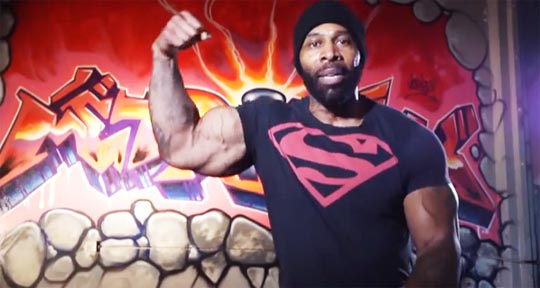
CT Fletcher is correct: Over-training is a myth
By now most people who watch exercise videos on YouTube have seen CT Fletcher. His no nonsense, take-no-prisoners, tell-it-as-it-is approach has garnered him a large viewing audience. Now it turns out that he’s a veteran, which I should have seen before because all the signs were there… Regardless, his recent installments have created some controversy as it pertains to “over-training,” so I’d like to add my two cents.
CT Fletcher is correct: Over-training is a myth.
Okay, I’m a throwback. In my era there were gentlemen like Tom Platz — known for having the greatest legs of all time in bodybuilding. Also known for squatting for three or for hours in a session. By many standards, back in the day even, they would say that Tom Platz was over-training. But this results — friends, mother fuckers and mother fuckees — are undeniable. Greatest pair of legs in bodybuilding history doing what many of you refer to as over-training.
Over-training is individualized. What may be over-training for one man is nothing but a regular workout for another. Over-training can not be generalized. Over-training is individualized to you. What you may call over-training might be my warmup. Understand?
I’m a veteran, United States Army. Proud veteran of the United States Army. I go to veterans hospitals on a monthly basis. I talk to many veterans from World War II, Korea, Vietnam, and almost down to the last man each one will tell me that the best shape they were in for their entire life was during basic training. In basic training you are forced to push your body past previously expected limitations. What you thought you could not do your drill instructor or drill sergeant made you do. He gave you no choice, and therefore, your body adapted to the regimen — the strenuous regimen dictated to you by that drill instructor — because he gave you no fucking choice. He dared you, he made you push, and some of you are scared to put that type of dictation upon yourself. You can’t do it. You’ll say that it’s over-training because you are afraid to push yourself that far. You will be amazed — amazed — at what the human body can do. …
I don’t advocate you do what I do. 100, 200, 300 rep sessions. … All I ask is that you give it a try before you say, “CT is full of shit and he doesn’t know what he’s talking about.” All I have is six world titles. All I can tell you what I’ve done, what I’ve put into action in real-life situations. Not what I think about. Not what I theorize about. Not what I talk shit about. It’s what I have done.
What have these so-called experts in these fields done? … What have you put into application? In most case, not a God-damn thing. Flapping gums don’t mean shit. What have you done, mother fucker, besides talk shit? …
Flex your biceps. What have you done? … Over-training my ass.
What is over-training? That’s the problem. If you ask 10 different people that question you’re probably going to get ten different answers. That’s because, like Mr. Fletcher said, the vast majority of people will never reach the point where they “over-train.” There are so many different factors that determine how a person’s body will respond to an exercise program that terms like “over-training” become relative.
How much sleep do you get a night? Are you eating enough calories to feed your muscles? Are you psychologically strong or weak? There’s a reason why people turn to personal trainers: each person is unique. To prove it, I’ll use CT’s “basic training” example.
CT says almost all the veterans he spoke to mentioned that Basic Training was the physical fitness pinnacle of their lives. As someone who went through Infantryman Basic Training in Fort Benning, Georgia, I can say that I don’t know if that’s the case for me.
Going into Basic Training, I was a cross country runner. I was running over 50 miles per week before I went into the Army, so my mileage actually dropped significantly when I enlisted. I went from running roughly a 10:05 two-mile to probably a 11:30 two-mile. However, with push-ups and sit-ups and three square meals I day, I put on about 25 lbs. and my upper body strength increased dramatically. Was I in “better” shape or “worse” shape? I don’t know. I was in better “Army” shape, but I was in worse “cross country” shape.
I was 18 years old then and I’m 34 years old now. I might be able to run a 12:00 two-mile before puking all over the place, but I can dead lift much more weight than I could as a kid. My upper body strength puts my younger self to shame. Am I in good shape? Again, it all depends on my individual goals. Right now my only real goal is to be able to max the Army Physical Fitness test if someone told me I had to take it on a moment’s notice. It’s not to look like CT Fletcher. Given that, I’d say I’m where I need to be.
Here’s perhaps the most important lesson from CT’s speech:
What you thought you could not do your drill instructor or drill sergeant made you do. He gave you no choice, and therefore, your body adapted to the regimen — the strenuous regimen dictated to you by that drill instructor — because he gave you no fucking choice.
The mind plays much more of a role in achieving your physical fitness goals than, in many ways, the genetics you were born with. When you can put yourself in the psychological space where failure is not an option, you’re exactly where you need to be. When you’re honest with yourself you can then gauge whether or not the pain you feel is because you’re pushing yourself beyond your comfort zone or you’re pushing yourself in ways that will result in bodily harm. When you listen to your body you’ll know when you’re not getting enough rest and need to ease off, and when you can go full throttle. As CT says: What might be “over-training” to you might be another man’s warm-up.
Embrace pain. Make it your friend. Laugh at it more than you cry at it and it will reward you. In the mean time, take a moment to watch CT’s latest video. There are many words of wisdom in his little clips, even if they’re littered with expletives.
Related: Schwarzenegger’s ‘Six Rules for Success’: Sage advice for all Americans
Related: Flip the switch: Tap into ‘fight or flight’ for gains in the weight room
Related: At 70, bodybuilder Sam ‘Sonny’ Bryant, Jr. stays young with the right mindset
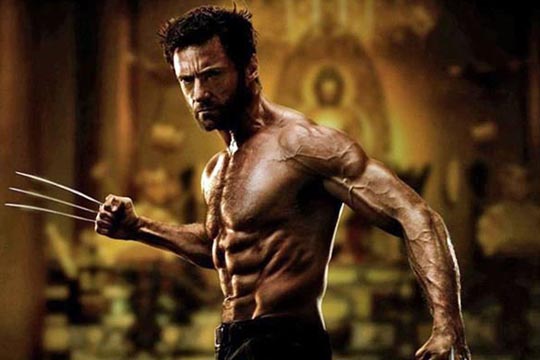
‘The Wolverine’ does Logan proud: Hugh Jackman atones for ‘X-Men Origins: Wolverine’
Logan may not rest easy at night, but Hugh Jackman can. It’s official: He has now atoned for 2009’s ‘X-Men Origins: Wolverine.’
In 2009, the brilliant minds at Fox decided to put Deadpool, “the merc with a mouth,” into a Wolverine movie … only they sewed his mouth shut and did away with one of the coolest uniforms in comics. The movie was a letdown, so one can’t blame an American audience for being coy on the opening weekend of ‘The Wolverine.’ Regardless, it still did pretty darn well; fans have been given a quality product.
Hollywood’s summer tentpole strategy continued to suffer in North America with the muted debut of The Wolverine, but the X-Men spin-off more than made up for it overseas.
The 20th Century Fox pic opened to $55 million domestically and roughly $86.1 million internationally for a worldwide total of $141.1 million — easily covering the film’s $120 million production budget. Internationally, it posted the strongest opening ever for an X-Men title.
Wolverine certainly isn’t a dud in North America and still claimed the No. 1 position, but came in at least $10 million behind expectations and well behind the $85.1 million opening of X-Men Origins: Wolverine in early May 2009. It opened on par with last summer’s X-Men: First Class, an origins pic versus a sequel.
Word of mouth will help ‘The Wolverine’ out, which is a good thing because it’s obvious that Mr. Jackman loves the character. He’s not getting any younger — a bitter pill to swallow when playing a guy who doesn’t age — but at least the success of this film will guarantee him a few more times running around on screen as the mutant.
Perhaps the smartest move director James Mangold did was to scale everything down into something that wasn’t a typical “superhero” movie. It’s a Samurai flick. It’s a Japanese mob story. It’s a character study. And yes, it just so happens to have super-powered mutants doing what you expect super-powered mutants to do. There’s a crisscrossing of genres that really works, which is impressive because it could have gone horribly wrong.
In short, Wolverine has retreated into the forest after the events depicted in ‘X-Men: The Last Stand.’ Having killed the woman he loved, Jean Grey, he attempts to deny who (and what) he is — a soldier. The result? He’s a man without a purpose. He wants to die — or so he thinks.
Logan is eventually tracked down by a mutant named Yukio (Rila Fukushima). She tells him that a man he saved during World War II, Yashida (Haruhiko Yamanouchi), is dying and would like to see him one last time. Logan relents, and the two are off to Japan. From there the plot unfolds with Wolverine having to play protector for Yashida’s granddaughter Mariko (Tao Okamoto), all while trying to keep himself alive; his healing powers have mysteriously been suppressed and the bullet holes and blood loss take a toll on his body in ways he’s never experienced.
With all of this going on,’The Wolverine’ is at its best when it’s getting inside Logan’s head. I always pictured a Wolverine film to be reminiscent of ‘Rambo: First Blood’ instead of fare meant for “pop-corn” sensibilities, (e.g., ‘Iron Man 3’). Wolverine is a tortured soul, and it was nice to see him in a film that slowed things down to explore the mind of a soldier who is struggling to find peace. In between satisfying action scenes (the bullet-train fight in particular), fans finally get to see Logan’s psychology explored in ways that do him justice.
‘The Wolverine’ is not without its flaws, but it’s hard to deny that Hugh Jackman worked overtime (physically and mentally) to make up for ‘X-Men Origins.’ Fans might not have a healing factor like Wolverine, but this latest effort will rebuild a lot of trust with skeptical moviegoers.