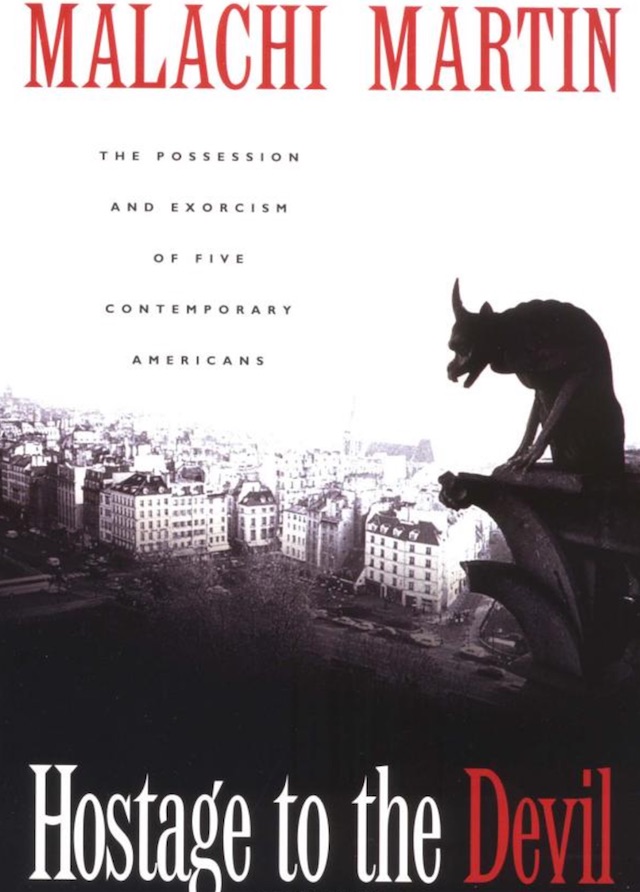
‘Hostage to the Devil’: Malachi Martin’s masterwork on possession, exorcism more than a must-read for Catholics

hostage

Former Jesuit priest Malachi Martin died in 1999, but he wrote one of the most comprehensive books on possession and exorcism in 1976 — Hostage To The Devil. Those who are unfamiliar with the man’s work may dismiss Hostage as fare for old school Catholics, but it is much more than that. Anyone who is interested in humanity’s struggle with morality, truth, free will, sex and gender, spirit and psyche would do themselves a favor by purchasing it soon.

Regular readers of this blog know that the intersection of politics and popular culture are covered on a regular basis. Movies, music and comic books are reviewed, but at the heart of it all is a fight against moral relativism.

The message is simple: Good and Evil exist. To deny that, or to pretend as though a man can go through life making morally neutral decisions, is to walk down a road of confusion. And, as Fr. Malachi notes, confusion seems to be a “prime weapon of evil.”

The author says:

“The surest effect of possession in an individual — the most obvious and striking effect common to all possessed persons, whether observed or apart from Exorcism — is the great loss in human quality, in humanness.

Curiously enough, the difficulty in talking nowadays about possession and describing its progress and effects in those attacked does not come from the weird, bizarre, or ‘unimaginable’ happens that may accompany possession.

The difficulty comes, instead, from the insistence of latter-day opinion makers that the religious view of good and evil is outdated; that the personality of each man, woman, and child exists only as a cross section of single traits and attributes best revealed in scores we achieve in psychological tests; that the truest and purest models for our behavior come from ‘lower animals’ and from ‘natural man,’ a mythical invention that has never existed and that we cannot imagine. …

Even though our coverage of these questions concerning Jesus and Lucifer must be brief due to limitations of space, we are not merely indulging in a comforting cliché when we make one observation: The best that latter-day prophets and modern doom sayers seem able to do with these matters is to ignore them and tell us to do the same. They cannot prove them false, but only increase their efforts to persuade us so. And for all their mighty efforts, they cannot repair the damage they do in this way to our humanness.,” Malachi Martin, Hostage to the Devil (San Francisco: Harper Collins, 1992), 409, 411-412.

In short, the bulk of Hostage deals with five cases:

  • Zio’s Friend and the Smiler — 29
  • Father Bones and Mister Natch — 83
  • The Virgin and the Girl-Fixer — 173
  • Uncle Ponto and the Mushroom-Souper — 249
  • The Rooster and the Tortoise — 321

As readers can see by the pagination, trying to respectfully break down any one of these cases in a book review would be difficult. Exhaustive interviews were conducted with all parties involved, written records were examined, and hours upon hours of audio recordings analyzed.

What is important to know before buying the book — particularly for skeptics — is that Fr. Martin is not an intellectual slouch. He is a very intelligent man. He is serious, and the content within Hostage is extremely disturbing.

The fact of the matter is that possession is nothing like Americans see in Hollywood movies. It is much more insidious than that because bodiless beings that can glean knowledge from eternity are not stupid. Possession is a process by which patient demons wait for an entry point, exploit confusion, and ultimately seize control when victims voluntarily present their souls on a silver platter.

Exacerbating this threat is a culture that grants Satan “the ultimate camouflage” — the belief that he does not exist.

“Raised more and more in an atmosphere where moral criticism is not merely out of fashion, but prohibited, [we] swim with little help in a veritable sea of pornography. Not merely sexual pornography, but the pornography of unmitigated self-interest. Whether spoken or acted out without explanation, the dominant question of the younger generations among us is, What can you do for me? What can my parents, my friends, my acquaintances, my enemies, my government, my country, do for me?

The difficulty is that as individuals and as a society, we are no longer willing — many of us are no longer able — to give an answer to that question that will satisfy anyone for long. …

Not to believe in evil is not be be armed against it. To disbelieve is to be disarmed. If your will does not accept the existence of evil, you are rendered incapable of resisting evil. Those with no capacity of resistance become prime targets for Possession,” (Preface, XIII, XIV, XV).

As Fr. Martin says, “no one wants to believe in evil, really, above all, not in an evil being, an evil spirit,” because acknowledging that places a perpetual responsibility on our shoulders.

“That [disbelief] is the opening through which [Satan] crawls, stilling all suspicions, making everything seem normal and natural. This is the ‘thought,’ the unwariness of the ordinary human being which amounts to a disinclination to believe in evil. And, if you do not believe in evil, how can you believe in or even know what good is?” (389)

Hostage is an amazing book. Anyone who is remotely spiritual should read it, but they must be forewarned that it will leave them shaken to the core.

If you have any questions about the cases covered by Fr. Martin, then feel free to ask in the comments section below.

‘Letters to a Young Catholic’: George Weigel hits a literary home run

letters-to-a-young-catholic-weigel

George Weigel’s Letters to a Young Catholic is a wonderful book, but oddly enough I must begin this review by griping about the title — it’s something that Catholics of any age should read. In fact, the publisher does not lie by billing the book as “a modern spiritual classic,” which is why I recommend it to anyone who is interested in such issues.

Like many Catholic kids, my parents took me to Mass every Sunday growing up. And, like many Catholic kids, I was not exposed to the writings of G.K. Chesterton, George Weigel or other intellectual heavyweights. What I did have access to were kind adults who lacked the ability to articulate the faith in a way that “clicked” for me. I drifted from the Church as a young man and did not come back until I learned many painful lessons. If I were exposed to a book like this as a teenager then it probably would have saved me a lot of lost time, although I admit to having a largely impenetrable chip on my shoulder in those days. (And yes, I know that some of you would argue that it’s still there!)

Perhaps the most fascinating aspect of Letters to a Young Catholic is that in many ways it doubles as a must-read for those who are wondering why America’s political institutions are crumbling before our eyes. The way in which the author travels the globe, goes back in time, covers essential questions about the Catholic faith that all young people ask, and then ties it into our contemporary political landscape is like watching a gymnast who puts everything out on the floor before the judges — and nails it.

Mr. Weigel writes:

If American popular and high culture could ever agree on a theme song that captured the idea of freedom driving much of contemporary life, it would almost certainly be Frank Sinatra’s “My Way.” I did it my way seems to sum up the widespread notion that freedom is a matter of asserting myself and my will — that freedom is really about choice, not about what we choose and why. Suggest that certain choices are just incompatible with human dignity and with growth in goodness, and you’ll get some very strange looks these days, whether on campus or in the workplace.

Catholicism has a different idea of freedom. In the Catholic idea of freedom, freedom and goodness go together. A great contemporary moral theologian, Father Servais Pinckaers, OP, explained all this. […] Learning to play the piano, he reminded us, is a tedious, even dreary business at first: well do I remember my own distaste for a book of technique-strengthening tortures entitled Scales, Chords, and Arpeggios. But after doing one’s exercises for a while, what originally seemed like a burden comes into clearer focus — learning to do the right thing in the right way is actually liberating. You can play anything you like, even the most difficult pieces. You can make new music on your own. Sure, Father Pinckaers writes, anybody can pound away on a piano. But that’s a rudimentary, savage sort of freedom,” not a truly human freedom. …

I did it my way teaches us an idea of freedom that Father Pinckaers calls “the freedom of indifference.” Doing things “my way,” just because it’s my way, is like banging idiotically on the piano or talking gibberish. The richer, nobler idea of freedom the Catholic Church proposes is what Father Pinckaers calls freedom for excellence — the freedom to do the right thing, in the right way, for the right reasons, as a matter of habit. That’s the truly human way. Because that’s the kind of freedom that satisfies our natural desire for happiness, which itself reflects our desire for God, who is all Good, all the way.  […] What’s all this got to do with democracy? Everything. Freedom untethered from moral truth will eventually become freedom’s worst enemy. — Weigel, George. Letters to a Young Catholic. Basic Books, 2015. 305-306.

A friend of mine texted me on Monday and said she hoped that I would cover the first U.S. presidential debate on the blog. In many ways, the text from Mr. Weigel’s book shown here tells us everything we need to know.

Why is America forced to choose between a woman who should be wearing an orange jumpsuit in a federal prison, and an egomaniac with occasionally orange skin?

Answer: Because America long ago decided it wanted to untether freedom from moral truth.

There really is no way to read Letters to a Young Catholic and not have a crystal clear understanding as to why civil society in the U.S. is unraveling. Our cultural influencers embrace a kind of nihilism “that enjoys itself on the way to oblivion, convinced that all of this — the world, us, relationships, sex, beauty, history — is really just a cosmic joke,” and we are now paying the price.

Mr. Weigel counters that “against the nihilist claim that nothing is really of consequence, Catholicism insists that everything is of consequence, because everything has been redeemed by Christ. And if you believe that, it changes the way you see things. It changes the way everything looks.”

If for no other reason, wayward Catholics should read this book to realize that what they thought was Catholicism growing up was in all likelihood a grossly watered down version of the Faith that denied them knowledge of its true richness and beauty. There are numerous reasons for this, and the author does a masterful job spelling it all out. I found myself thinking, “Finally! Someone who gets it,” and I am sure you will too.

‘Proof of Heaven’: Neurosurgeon turns NDE into fascinating read for skeptics, believers

Proof of Heaven

Skeptics have fascinated me for many years because they will often hear a supernatural story from a trusted source — a long-time friend who no history of mental illness or a reason to lie — and still find ways to dismiss it. Dr. Eben Alexander, a neurosurgeon who also worked at Harvard Medical School in Boston, was one of those skeptics until he contracted a case of E. coli meningitis, which attacked his brain and left him in a coma for seven days.

What makes Proof of Heaven: A Neurosurgeon’s Journey into the Afterlife such a compelling read is that its author a.) was a secular man, b.) is a doctor who specializes in the brain, and c.) knows that his illness attacked the very parts of the brain that give skeptics an “out” in terms of believing that neath death experiences (NDEs) offer proof of the spirit world.

Dr. Alexander’s NDE is important because he isn’t just some random guy who drowned and was resuscitated; it is important because he knows about “endogenous glutamate blockade with excitotoxicity,” the limbic system, the lateral amygdala, N,N-dimethyltryptamine (DMT) “dumps,” cortical function, etc.

In short, he is not a man who can be “out-scienced” because he has dedicated his life to medicine.

Random blog posts by a lucid dreamer who was visited by a floating purple orb can be easily dismissed — but a Near Death Experience by a neurosurgeon with over 25 years experience, who uses science to back his claims, is much more difficult to deny.

Dr. Alexander says at one point:

Depending on whom you talk to, consciousness is either the greatest mystery facing scientific enquiry, or a total non-problem. What’s surprising is just how many more scientists think it’s the latter. For many — maybe most — scientists, consciousness isn’t really worth worry about because it is just a by-product of physical processes. Many scientists go further, saying that not only is consciousness a secondary phenomenon, but that in addition, it’s not even real.

Many leaders in the neuroscience of consciousness and the philosophy of the mind, however, would beg to differ. Over the last few decades, they have come to recognize that ‘hard problem of consciousness.’

Like many other scientific skeptics, I refused to even review the data relevant to the questions concerning these [supernatural] phenomena. I prejudged the data, and those providing it, because my limited perspective failed to provide the foggiest notion of how such things might actually happen. Those who assert that there is no evidence for phenomena indicative of extended consciousness, in spite of overwhelming evidence to the contrary, are willfully ignorant. They believe they know the truth without needing to look at the facts.”

For those still stuck in the trap of scientific skepticism, I recommend the book Irreducible Mind: Toward a Psychology for the 21st Century, published in 2007. The evidence for out-of-body consciousness is well presented in this rigorous scientific analysis. Irreducible Mind is a landmark opus from a highly reputable group, the Division of Perceptual Studies, based at the University of Virginia.” — Eben Alexander, Proof of Heaven, (Simon and Schuster, 2012), 151-153.

I do not want to spoil any details of the doctor’s experience in the spirit realm, so I will refrain from mentioning them here. I will say, however, that Proof of Heaven is a quick and worthwhile read for anyone interested in the subject matter. The paperback edition is $16 for a new copy, but it is money well spent.

DeGrasse Tyson pushes Matrix-like theory of reality, still mocks Christians

Neil DeGrasse Tyson

Your friendly neighborhood blogger is always perusing the internet for science-related news. Given that fact, it did not go unnoticed that two stories pushing the idea that reality is all an illusion gained widespread media attention over the past month.

The first piece came when Neil DeGrasse Tyson said it was “very likely” humans are living in a simulation. The second story involved Princeton University scientists who think free will may just be a trick the brain plays to rewrite history. None of this would be very fascinating if it weren’t for the fact that Morepheus DeGrasse Tyson and his atheist followers take pot shots at Christians on a regular basis.

Extreme Tech reported April 22:

“At the most recent Isaac Asimov Memorial Debate, recently held at New York’s Hayden Planetarium, scientists gathered to address the question for the year: Is the universe a computer simulation? It’s an older question that you might imagine, and if we interpret it a bit more broadly then it’s really one of the oldest questions imaginable: How do we know that reality is reality? And, if our universe were a big, elaborate lie, could we ever devise some test to prove that fact? At the debate, host and celebrity astronomer Neil deGrasse Tyson argued that the probability is that we [‘very likely’] live in a computer simulation.”

The U.K. Independent reported Sunday:

Free will might be an illusion created by our brains, scientists might have proved.

Humans are convinced that they make conscious choices as they live their lives. But instead it may be that the brain just convinces itself that it made a free choice from the available options after the decision is made.

The idea was tested out by tricking subjects into believing that they had made a choice before the consequences of that choice could actually be seen. In the test, people were made to believe that they had taken a decision using free will – even though that was impossible. …

In one of the studies undertaken by Adam Bear and Paul Bloom, of Princeton University, the test subjects were shown five white circles on a computer monitor. They were told to choose one of the circles before one of them lit up red.

The participants were then asked to describe whether they’d picked the correct circle, another one, or if they hadn’t had time to actually pick one.

Statistically, people should have picked the right circle about one out of every five times. But they reported getting it right much more than 20 per cent of the time, going over 30 per cent if the circle turned red very quickly.

The scientists suggest that the findings show that the test subjects’ minds were swapping around the order of events, so that it appeared that they had chosen the right circle – even if they hadn’t actually had time to do so.

Is it more likely scientists “proved” free will is an illusion, or that they reestablished people are capable of lying?

Is it more likely scientists “proved” free will is an illusion, or that they reestablished the human brain is a beautiful box of paradoxes?

The human brain is incredibly sturdy, yet fragile. It is awe-inspiring in its complexity, yet ultimately a sponge-like mass of neurons, blood vessels, and tissue. It can turn science fiction into reality, yet it often falls for “tricks” played by researchers in white lab coats. The list goes on and on.

Matrix

Imagine what the world would look like if billions of people simultaneously listened to Morepheus DeGrasse Tyson and researchers at the University of Free Will Is Just an Illusion. Tyson likes to lump “crazy” Christianity in with Scientology, but my guess is that he would soon yearn for a world solely populated by “cracker”-eating Catholics if 7 billion people concluded a.) they were living in a glorified video game, and b.) they did not need to take responsibility for their actions.

Regardless, men of faith should smile. DeGrasse Tyson’s acknowledgment that humans “very likely” have a Creator will prompt some of his supporters down a spiritual path in the years ahead.

Why does God seem absent at times? ‘Dark Night of the Soul’ explains

Dark Night of the Soul

The questions “Why does God allow bad things to happen to good people?” and “Why does God sometimes seem absent in my life?”  have repeatedly come up in conversations with my friends over the years. Many times people beat around the bush, but the underlying point is always transparent. A stellar resource on this subject — and quite honestly one of the toughest books I have ever read — is St. John of the Cross’ Dark Night of the Soul.

First, it should be noted that if anyone had a right to question why bad things happen to good people, then it was St. John of the Cross. The Spanish mystic and Catholic saint, born in 1542, was once kidnapped (by monks), thrown in a dark jail cell, and beaten for months until he managed to escape.

A man who could have looked at his circumstances and concluded that God does not exist instead found God within the darkness.

Key points to consider when contemplating the dark night of the soul include:

  • Man’s nature is both sensual and spiritual.
  • Man is inclined to judge God by Man’s standards instead of Man by God’s standards.
  • Just as looking into the sun forces a man to close his eyes because it is too bright, individuals often cannot grasp that what they perceive as darkness is actually a reaction to incomprehensible light.
  • Just as a small child becomes anxious when its mother seems to have disappeared, humans are confused when God creates the illusion of distance so that they might spiritually grow.
  • Souls cannot approach God without being purged of imperfections. Trials and tribulations serve a greater purpose.

Given all this, St. John says:

“It follows from this that the greater is the darkness wherein the soul journeys and the more completely is it voided of its natural operations, the greater is its security. […] Hence, at the time of this darkness, if the soul considers the matter, it will see very clearly how little its desire and its faculties are being diverted to things that are useless and harmful; and how secure it is from vainglory and pride and presumption, vain and false rejoicing and many other things. It follows clear, then, that by walking in darkness, not only is the soul not lost, but it has even greatly gained since it is here gaining the virtues.” — St. John of the Cross, Dark Night of the Soul.

Astute readers will note that St. John was talking about a spiritual darkness that envelops the soul as it continues on its path towards God, as opposed to physical ailments or obstacles that plague us all. That is true, but the physical and the spiritual overlap. It is often very difficult for an individual to discern which is which, and more so in an age where individuals are conditioned to believe they must be happy at all times or consider themselves broken.

It is incredibly difficult to see the blessings bestowed upon us through mental, physical and spiritual pain, but they are there.

Paradoxically, we must often embrace the darkness to see the light.

Good health, popularity, and financial success may be nice, but much is expected of the individual who has them all. Life’s difficulties are fertile ground for virtue, which is why we must not lament adversity.

If you have questions on the dark night of the soul, feel free to ask below. I’ll do my best to articulate St. John’s message for interested readers.

G.K. Chesterton’s ‘Everlasting Man’ — perfect Easter reading

Easter is here — that wonderful day when Christians rejoice and atheists shake their head and ask, “Why the heck are we still talking about that guy Jesus after 2,000 years?!” That is a fair question, which is why today seems like an ideal opportunity to revisit G.K. Chesterton’s “The Everlasting Man.”

“If Christ was simply a human character, he really was a highly complex and contradictory human character. For he combined exactly the two things that lie at the two extremes of human variation. He was exactly what the man with a delusion never is; he was wise; he was a good judge. What he said was always unexpected; but it was always unexpectedly magnanimous and often unexpectedly moderate.

Take a thing like the point of the parable of the tares and the wheat. It has the quality that united sanity and subtlety. It has not the simplicity of a madman. It has not even the simplicity of a fanatic. It might be uttered by a philosopher a hundred years old, at the end of a century of Utopias. Nothing could be less like this quality of seeing beyond and all round obvious things, than the condition of an egomaniac with the one sensitive spot in his brain. I really do not see how these two characters could be convincingly combined, except in the astonishing way in which the creed combines them.” — G.K. Chesterton.

Every year countless YouTube videos pop up by wannabe Joe Rogans, who blast the so-called “fairy tale” known as Christianity. They go apoplectic over said “fairy tale” and its longevity. Generation after generation after generation picks up the Bible, studies it, and then billions of people conclude that Christ was exactly who he claimed to be.

The reason for this, as Chesterton points out, is that Christ spoke with authority while simultaneously being “exactly what the man with a delusion never is; he was wise; he was a good judge.”

The Jesus of the New Testament seems to me to have in great many ways the note of something superhuman; that is of something human and more than human. But there is another quality running through all his teachings which seems to me neglected in most modern talk about them as teachings; and that is the persistent suggestion that he has not really come to teach.

If there is one incident in the record which affects me personally as grandly and gloriously human, it is the incident of giving wine for the wedding-feast. That is really human in the sense in which a whole crowd of prigs, having the appearance of human beings, can hardly be described as human.

It rises superior to all superior persons. It is as human as Herrick and as democratic as Dickens. But even in that story there is something else that has the note of things not fully explained; and in a way there very relevant. I mean the first hesitation, not on any ground touching the nature of the miracle, but on that of the propriety of working any miracles at all, at least at that stage; ‘my time is not yet come.’

What did that mean? At least it certainly meant a general plan or purpose in the mind, with which certain things did or did not fit in. And if we leave out that solitary strategic plan, we not only leave out the point of the story, but the story.

The imitation Joe Rogans often preface their derision of Christianity with lines like, “I went to Catholic school” — as if they weren’t like every other high-school kid who slept through classes, wrote notes to girlfriends, and generally just goofed around with buddies for four years. The same people who cannot understand basic economics in their 40s would have us believe they fully understood Christianity by age 16, but I digress.

The more one studies the Bible, the more obvious it becomes that Christ was unlike any man who walked the earth up until that time — and that He maintains that distinction to this very day. All the “flying spaghetti monster” jokes in the world cannot diminish the genius and goodness dispensed by Christ in ways, as Chesterton says, “more than human.”

Christ was born. His primary purpose in life was to die a horrible death — and then rise again. He did.

Chesterton states:

“I willingly and warmly agree that it is, in itself, a suggestion at which we might expect even the brain of the believer to reel, when he realized his own belief. But the brain of the believer does not reel; it is the brains of the unbelievers that reel. …

I care not if the skeptic says it is a tall story; I cannot see how so toppling a tower could stand so long without foundation. Still less can I see how it could become, as it has become, the home of man. 

Had it merely appeared and disappeared, it might possibly have been remembered or explained as the last leap of the rage of illusion, the ultimate myth of the ultimate mood, in which the mind struck the sky and broke. But the mind did not break. It is the one mind that remains unbroken in the break-up of the world.

If it were an error, it seems as if the error could hardly have lasted a day. If it were a mere ecstasy, it would seem that such an ecstasy could not endure for an hour. It has endured for nearly two thousand years; and the world within it has been more lucid, more level-headed, more reasonable in its hopes, more healthy in its instincts, more humorous and cheerful in the face of fate and death, than all the world outside.

Happy Easter, everyone. I am grateful for all of you who regularly give me precious time out of your day and I pray for your regularly.

Best,

Doug

‘The Imitation of Christ’: Antidote for Media-addicted America

Politicians and pundits use every election cycle to talk about the need for “new” ideas. Increasingly secular yet tech-savvy societies are always looking for the next “new” idea, and yet they wonder why the same old problems persist. The more I read, the more I think that many “old” ideas should be dusted off and embraced.

Take Thomas à Kempis’ “The Imitation of Christ,” written in 1418, for example. Just like our good friend Saint Augustine, it’s been a while since he walked the earth. Regardless, Kempis’ devotional book is one that would be beneficial to Christians and non-Christians alike. Even if one were to weirdly strip out all references to Christ, much of the wisdom regarding the right way to live would still remain.

Atheists say that Christ was not the Son of God, but if you asked them if the man — from a purely historical point of view — lived a life worth imitating, then the vast majority of them would probably say yes.

Facebook, Twitter, Tumblr, Snapchap. CBS, NBC, ABC, CNN, MSNBC and FOX. Xbox, Playstation, Nintendo. Warner Bros, Sony, Disney, Universal and Netflix. NFL, MLB, NBA, NHL and UFC. Amazon, Ebay, Microsoft, Apple and more, more, more always vie for our attention — and we give it to them.

Addiction to the temporal is a horrible thing, but it is hard to recognize because it sneaks up on a man. It slowly slithers around the psyche. Its initially brings warmth and joy, but in the end it’s all a ruse. When it has completely enveloped the whole of a man’s being it constricts like a python and suffocates his soul while he sleeps.

In the addicted man’s waking state he is, on many levels, unaware that the most important part of him is in peril.

He is sad. He is lost. He does not know why he is never complete, and so he turns to the very thing that fills him with venom while he dreams.

Enter Thomas à Kempis, who breaks down the blueprint for a happy life into four parts: 1. Useful Admonitions for a Spiritual Life. 2. Admonitions Concerning Interior Things. 3. Internal Consolation. 4. The Blessed Sacrament.

Ask yourself if there is a reason why politicians never mention “The Imitation of Christ” as one of their favorite books.

“Who is so wise as to be able fully to know all things? Therefore, trust not too much to thine own thoughts, but be willing also to hear the sentiments of others. Although thine opinion be good, yet if for God’s sake thou leave it to follow that of another, it will be more profitable to thee.

For I have often heard, that it is more safe to hear and to take counsel than to give it.

It may also happen that each one’s thought may be good, but to refuse to yield to others when reason or a just cause requires it is a sign of pride and willfulness,” (Book 1, Chapter 9).

Interesting, isn’t it?

“Don’t listen to those ‘old’ ideas, kind voter. Listen to me, [Insert Politician’s Name Here], because I’m never wrong and my ‘new’ ideas will fix all your problems.”

Kempis continues:

“How happy and prudent is he who strives to be such now in this life as he desires to be found at his death.

For it will give a man a great confidence of dying happily if he has a perfect contempt of the world, a fervent desire of advancing in virtue, a love for discipline, the spirit of penance, a ready obedience, self-denial, and patience in bearing all adversities for the love of Christ,” (Book 1, Chapter 23).

It takes just two sentences for the author to give readers seeds that will bear a harvest of joy for all the years of their lives. As a Catholic, I would implore readers not to take Christ out of the sentence, but I will concede that doing so does not negate the rest of the advice embedded in the text.

America faces many challenges in the years ahead. If you are interested in giving yourself mental and spiritual tools for the task, then I highly suggest reading “The Imitation of Christ.”

Editor’s Note: I will send a copy of the book to the first regular reader who asks.

Yes, dead relatives can visit you in your dreams

My day job requires me to be a voracious reader. Over the past few months I’ve read a spate of articles on why increasingly technological and science-minded societies cannot shake off spirituality. There are many reasons for that, but one is visitation dreams.

If you don’t believe your friendly neighborhood Catholic blogger, then perhaps you’ll listen to Patrick McNamara Ph.D., of Psychology Today.

Dr. McNamara wrote in October 2011.

My father and mother died over a decade ago and about one year apart. Approximately 6 months after each death, I had at least one vivid dream with one or both of them in it. In both cases the dream did not feel like the typical run of the mill dream.

Instead the dream had a kind of hyper-real intensity to it. I felt that I had been touched or visited or communicated with. I could not easily shake the conviction that my father and my mother had communicated with me from beyond the grave. Now if I, an individual who studied dreams with a skeptical scientific cast of mind, could not shake the conviction that I had just communicated with my dead parents, how much stronger must be the conviction of someone with a less skeptical approach to dreams than me?

The general rule of thumb about a visitation dream is that if you have to ask yourself if your were visited by a deceased relative, then you probably were not. Regardless, here are a few signs that someone was trying to communicate with you:

  1. Visitation dreams are like dreams in high-definition.
  2. The deceased relative does not look sickly or old. If they are old, they will have a glow to them.
  3. The deceased relative will be direct and to the point. They have a message to get across and a short amount of time to communicate.
  4. You will wake up with a sense of relief.
  5. You will wake up and know in your gut that you were visited.

Since it would be rather rude to say “This is real” and then not share an example from my own life, I will do so now.

My grandmother died four years ago. We were extremely close. When she was in the hospital with a blood clot, I remember staying with her and brushing her teeth. When she was sick in her late 90s, I remember sleeping on the floor next to her bed so I could be there to help her get to the bathroom in the middle of the night. She moved in with our family when I was born and always said, “We came here together, Douglas!”

She was, for all intents and purposes, a second mother to me.

Prior to my grandmother’s death, my mom called and said I should buy a plane ticket as soon as possible. I secured a flight home that night, but sadly I did not make it from Washington, D.C. to Chicago in time. My grandmother visited me in a dream within a few days.

In my dream — my “high-definition dream” — I was standing over my grandmother’s bed. She was “dying” again in a way where I was allowed to be there, but she looked at peace. I told her I was sorry that I couldn’t be there in time. She told me not to worry and that she was okay. She said she had to leave and that she loved me. I told her I loved her and kissed her on the forehead and she disappeared. I woke up and my lips felt like electrical currents were running through them. I was crying tears of joy because I knew in my heart it wasn’t a dream — and my “official” grieving process ended. I knew she was at peace, and there is nothing anyone on earth can say to make me believe otherwise.

There are other ways the dead sometimes communicate with the living, which I am happy to talk about, but the five points above are tell-tale signs of a visitation dream.

If you’ve had a visitation dream, feel free to share it below. I’d love to hear about your experience. Or, if you just have questions about dreams in general, then I’m happy to talk about that. Regular readers know that I am a lucid dreamer.


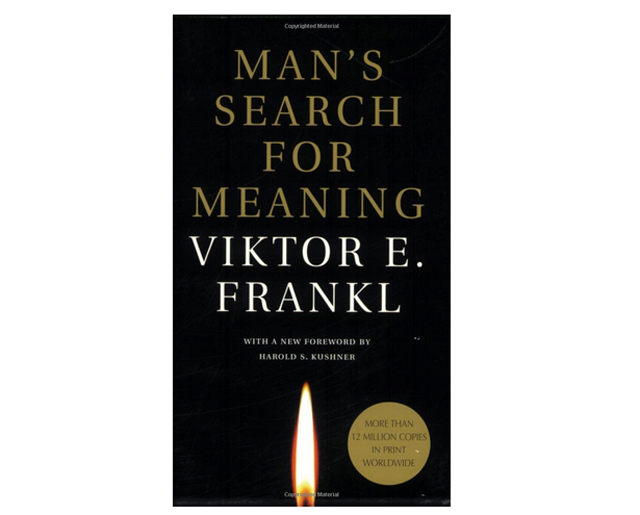
‘Man’s Search For Meaning’: Viktor E. Frankl’s incredibly profound, must-read memoir

Viktor E Frankl

Imagine an old man walked up to you on the street and said he had insights on life that could help infuse your own with meaning and purpose — if you gave him $10. Would you do it? Probably not.

Imagine that old man rolled up his sleeve and it was immediately evident by the tattoo roster on his skin that he was a Holocaust survivor. Then would you do it? Perhaps, but perhaps not.

Luckily, Viktor E. Frankl’s memoir, “Man’s Search for Meaning,” is well-known. There are plenty of others who feel the same way I do: It is one of the most profound books ever written.

Mr. Frankl was a psychiatrist who had all sorts of theories about the will to survive, how man goes about giving life meaning, and the ways we respond to suffering. Those theories were then put to the test when he found himself a prisoner in Nazi concentration camps during World War II.

He writes:

“We who lived in concentration camps can remember the men who walked through the huts comforting others, giving away their last piece of bread. They may have been few in number, but they offer sufficient proof that everything can be taken from a man but one thing: the last of the human freedoms — to choose one’s attitude in any given set of circumstances.

And there were always choices to make. Every day, every hour, offered the opportunity to make a decision, a decision which determined whether you would or would not submit to those powers which threatened to rob you of your very self, your inner freedom; which determined whether or not you would become the plaything of circumstance, renouncing freedom and dignity to become molded into the form of the typical inmate.

Seen from this point of view, the mental reactions of the inmates of a concentration camp must seem more to us than a mere expression of certain physical and sociological conditions. Even though conditions such as lack of sleep, insufficient food and various mental stresses may suggest that the inmates were bound to react in certain ways, in the final analysis it becomes clear that the sort of person the prisoner became was the result of an inner decision, and not the result of camp influences alone. Fundamentally, therefore, any man can, even under such circumstances, decide what shall become of him — mentally and spiritually. (Victor Frankl. Man’s Search for Meaning. Beacon Press, 1959, 1962, 1984, 1992, 2006. 77)

A man who has given a specific meaning to his life can withstand almost any set of circumstances with dignity — even a Holocaust. A man who does not know why he must live can feel as though he is trapped inside a nightmarish prison  — even as a free citizen.

Frankl writes:

“We had to learn ourselves and, furthermore, we had to teach the despairing men, that it did not really matter what we expected from life, but rather what life expected from us. We needed to stop asking about the meaning of life, and instead to think of ourselves as those who were being questioned by life — daily and hourly. Our answer must consist, not in talk and meditation, but in right action and in right conduct.” (77)

If the implications of Mr. Frankl’s insight are not clear, consider the effect of his wife on his mind’s eye as he trudged through snow during forced labor:

“For the first time in my life I saw the truth as it is set into song by so many poets, proclaimed as the final wisdom by so many thinkers. The truth — that love is the ultimate and highest goal to which man can aspire. Then I grasped the meaning of the greatest secret that human poetry and human thought and belief impart: The salvation of man is through love and in love.

I understood how a man who has nothing left in this world still may know bliss, be it only for a brief moment, in the contemplation of his beloved. In a position of utter desolation, when man cannot express himself in a positive action, when his only achievement may consist in enduring his sufferings in the right way — an honorable way — in such a position man can, through loving contemplation of the image he carries of his beloved, achieve fulfillment.

For the first time in my life I was able to understand the meaning of the words, ‘The angels are lost in a perpetual contemplation of an infinite glory.'” (38)

If I was thrown into a concentration camp tomorrow, then one of the things that would keep me alive would be the desire to write about my experience — perhaps on this very blog. My wife is my beloved, but so too is writing because I believe God made me a writer.

Everyone’s life has a meaning. Finding it is often painful and difficult. I firmly believe, however, that reading Mr. Frankl’s memoir can help make the task, as monumental as it is, much easier. I highly recommend “Man’s Search for Meaning.”

Editor’s Note: I will mail a copy of this book to the first regular reader who asks for a copy. I don’t mean to penalize readers who stay behind the scenes (I appreciate all of you), but for the purposes of this give-away I need to have seen you in the comments section on occasion. Just let me know if you’re interested and I will contact you at the email address you have provided WordPress.

The power of prayer: A blueprint for realizing faith’s potential

It is incredibly tough to get those who do not believe in prayer to understand how it works. Even those who do believe in God often pray in strange ways and then get frustrated by the results. Since prayer recently helped me regain my work-related Twitter account after it was unjustly suspended, I will try to use that story to explain how it works.

First, a recap:

  • After I wrote a story on Iran for work, an apologist for the regime Tweeted “I will find you and kill you … death to America.”
  • Twitter said it “could not determine” if that violated its terms of service. When I publicly questioned that decision, my account was suspended. Countless appeals were ignored over the course of one month.
  • The company’s press account ignored my emails and the emails of my co-workers.
  • A Washington, D.C. spokesman for Twitter ignored an inquiry by my employer.
  • Public pressure from countless Twitter followers and a story by WND did nothing to forward the process along.
  • My attempts to get certain conservative media outlets and personalities to take up my cause fell on deaf ears.
  • Well-connected people said they were at a loss as to how to help me. They essentially said my cause was hopeless.

During this whole ordeal I had a conversation with a friend about well-known personalities who did nothing to help me. I told my friend that it didn’t bother me because if God ultimately wanted to use them to help me, then He would. I prayed for an entire month, and last night I prayed throughout most of the night when an idea came to me: I would email Twitter’s CEO. I would make the case that he needed to intervene on my behalf. Then the words came to mind. When work started I didn’t know his email, but I took a chance on what I thought it might be — and I was right. Within 30 minutes of emailing him, my suspension was lifted and I received an apology from Twitter. A friend of mine said that what I did was something straight out of Ferris Bueller’s Day Off. I must admit, I did feel like the “The Sausage King of Chicago: Abe Froman.”

I nearly broke down into tears, knowing that my prayers had been answered. For someone who writes news for a living, Twitter is indispensable. Six-years worth of contacts and personalized news lists were restored.

Twitter apologyThis is just one story of many that I can tell where prayer has worked miracles in my life. If you’re interested in understanding how I pray and prepare for prayer, then here is the general blueprint:

  • A man’s heart must first be open to the possibility that God exists and that He and His angels hear our prayers.
  • We all have a lot to be grateful for, no matter what situation we find ourselves in. Prayer should take place after acknowledging those blessings. I often try to think about all the things that I am grateful for — to the point where I almost become overwhelmed with emotion.
  • Pray for the ability to discern God’s will and strength carry it out. If you are doing God’s will, then success is guaranteed.
  • Realize that what you may perceive as setbacks or failures on God’s part are never such things. If a man with night-vision was guiding you through a dark path and you occasionally slipped, would it make sense to get angry at him? How foolish would you feel if the path was suddenly illuminated and you realized that without the man’s help you would have fallen into a giant crevasse? In my story with Twitter, what would have happened if I shook my fist in anger and gave up when at least 10 different so-called media allies turned down my requests for help? Answer: I would not have come to a point where I would successfully email an insanely-busy CEO with a net worth of roughly $450 million.
  • Believe that the crosses that you carry are the burdens you must bear. There are very good reasons why hardship exists. With each obstacle we overcome, there are lessons to be learned. You should find a way to be grateful — even for those things in your life that cause pain or, at a cursory level, seem unwanted. Pray for the ability to understand the lessons God is trying to teach you.
  • Work hard. Prepare. Know your God-given talents and then hone them to perfection. Take my situation with Twitter. Imagine that I prayed, “God, if it is your will, please assist me in regaining my Twitter account,” and then sat on my butt waiting for a miracle that seemed to be denied. Now imagine me asking God why he denied my prayer and His response: “I made you a talented writer, but instead of writing to Twitter’s CEO and trusting in me, you took that talent for granted and expected some sort of dazzling light show. That was kind of a weird move on your part, don’t you think?”

I can probably add to this list, but that is a good start. I’m confident that someone who takes this advice will see amazing results over time. It is a humbling experience to see just how prayers can be perfectly answered. Often I reflect on how seamlessly some of them have been answered and cannot help but well up. A passing glimpse at perfection — true perfection — is a thing of beauty, but at the same time it can be emotionally crippling. Perhaps others have had a different experience, but my own brief tastes of infinite knowledge and infinite love can only be dwelt in for mere moments. It is a paralyzing epiphany to realize that on many levels we are comically insignificant beings, yet infinitely loved by our Creator.

If you believe in God, then I hope my prayer blueprint can be of use to you. If you do not believe in God, then hopefully I have given you some worthwhile insight into a Catholic mind that’s been around since 1979. In either case, thanks for reading and know that there’s a good chance that on random nights I am praying for you, too.