The Grand Budapest Hotel: Wes Anderson makes another ‘invariably’ and ‘exceedingly lovely’ film

The Grand Budapest Hotel Wes Anderson

Wes Anderson films are like little cinematic snow globes. They’re intricate. They’re meticulously put together by someone who loves his craft. They’re truly unique little worlds that I wish I could jump inside and wander around in for hours at a time. With The Grand Budapest Hotel, Mr. Anderson adds yet another “snow globe” to a body of work that fans will treasure for years to come.

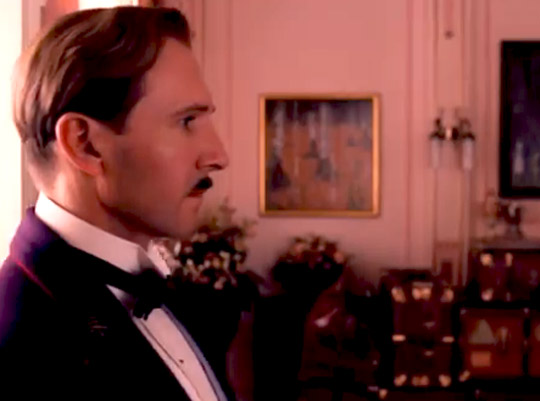
The story centers around Grand Budapest concierge Mr. Gustave (Ralph Fiennes), his friendship with lobby boy Zero (Tony Revolori), and the adventures that ensue when Gustave is framed for the murder of the incredibly wealthy Madame D. (Tilda Swinton). With a large inheritance at stake the “vipers” come out, as Gustave puts it, and it’s up to he and his friends (including Zero’s love interest Agatha, played by Saoirse Ronan) to set things right.
 

Grand Budapest

As with most Wes Anderson films, the thing I love about them is that so many of his characters are incredibly refined, yet they possess numerous idiosyncrasies that set them apart from one another. They’re all smart, but they don’t come across as clones because so much attention to detail has been paid to flesh out their histories, likes, dislikes and dispositions. If each character were compared to a color I would say that they are often similar shades, but that the pleasure comes from noting the subtle differences between them.

In between each shade of the same color are in fact infinite differences, and Wes Anderson’s appreciation for that is what resonates with this moviegoer.

Mr. Gustave is a man with whom, even if I were to disagree, I would not find him disagreeable. He harkens back to a day when strong differences in opinion were handled with class and dignity. It’s humorous for modern audiences — raised in the time and age in which the politics of personal destruction are the norm — to see on the big screen, but deep down we long for the world to breed more Gustaves:

M. Gustave: “Rudeness is merely the expression of fear. People fear they won’t get what they want. The most dreadful and unattractive person only needs to be loved, and they will open up like a flower. I’m reminded of a verse: ‘The painter’s brush touched the inchoate face with ends of nimble bristles.'”

Even when he’s vulgar, he has class:

Mr. Gustave: Oh, how the good die young. With any luck she’s left a few klubecks for your old friend, but one never knows until the ink is dry on the death certificate. She was fabulous in the sack, by the way.

Zero: She was 84, Mr. Gustave.

Mr. Gustave: I’ve had older. When you’re young it’s all fillet steak, but as the years go by you have to move on to the cheaper cuts, which is fine with me because I like those. More flavorful, or so they say.

He has standards. He lives by a set a principles and does his best to stick to them.

Mr. Gustave: “The beginning of the end of the end of the beginning has begun. The sad finale played off key on a broken down saloon piano in the outskirts of a forgotten ghost town. I’d rather not bear witness to such blasphemy. … The Grand Budapest has become a troops barracks. I shall never cross its threshold again in my lifetime.

And when facing Death’s door, he is stoic:

Mr. Gustave: If this to be the end, ‘Farewell!’ cried the wounded piper boy whist the muskets cracked and the yeoman cried “Hurrah!” and the ramparts fell. ‘Me thinks me breaths me last me fears,’ said he…”

We laugh at Gustave’s idealism, but we secretly wish we had 1/10 of his decency and decorum.


Grand Budapest Lobby Boy

There are two scenes which, in my mind, best sum up Gustave’s friendship with Zero. Because I don’t want to include spoilers, I will only refer to the exchange where Gustave asks if he can officiate Zero’s future wedding with Agatha:

Mr. Gustave: May I officiate, by the way — the ceremony?

Zero: With pleasure.

Mr. Gustave: I must say, I find that girl utterly delightful. Flat as a board, enormous birthmark the shape of Mexico over half her face. Sweating for hours on end in that sweltering kitchen  where Mendl — genius that he is — looms over her like a hulky guerrilla. Yet, without question, without fail, always and invariably she’s exceedingly lovely. Why? Because of her purity.

Zero: She admires you as well, Mr. Gustave.

Mr. Gustave: Does she?

Zero: Very much.

Mr. Gustave: That’s a good sign, you know. It means she gets it. That’s important.

Zero: Don’t flirt with her.

The audience knows that Gustave is at his core a good man, but like all of us he is deeply flawed. He wishes to officiate at his friend’s wedding, but both know that if given a chance he would sleep with Agatha. He admires her purity, but can not help himself for wanting to steal it. He strives to embody the best within him, yet regularly succumbs to his basest desires. He lives to serve others, yet often uses that service to fulfill his own selfish needs.

Like all of us, Mr. Gustave is a fusion of the decadent and the divine. With that said, he also aims to project that fusion in its most presentable package. Like the Mendl’s confectionery treats that play an important part of the film, The Grand Budapest Hotel shows us that beneath the pristine packaging and painstaking work we go to in order to appear a cut above the rest, our pomp and circumstance and cute little bow ties often belie our insides.

Mendls

Some might say that such a message is a hopeless one — we’re all rotten inside. I disagree. Like I said: we are a fusion of the depraved and the sublime. That is the service rendered for human flesh. The Grand Budapest Hotel’s message, to me, is that while we may not be pure, by striving to become a better version of ourselves we can more often than not be “invariably and exceedingly” lovely.

Agatha says at one point in the movie: “Whence came these two radiant celestial brothers united for an instant as they crossed the stratosphere or our starry window — one from the East and one from the West?”

Answer: the mind of Wes Anderson. Hopefully, he’ll be turning out “radiant celestial brothers” on screen for years to come.

Related: Moonrise Kingdom: The Young Person’s Guide to Great Movies

CBO: This American debt bomb is going really to hurt when it explodes — just so you know

CBO Director Douglas Elmendorf was speaking at The Atlantic’s 2014 Economy Summit in Washington and he had a message for the American people: Pain.

CNS News reported:

The United States faces “fundamental fiscal challenges” stemming from the growth in spending for Social Security and major health care programs,” CBO Director Douglas Elmendorf told a gathering in Washington on Tuesday.

The rising cost of those programs leaves Americans with “unpleasant” choices to make, but the sooner they’re made, the better, he said: “So we have a choice as a society to either scale back those programs relative to what is promised under current law; or to raise tax revenue above its historical average to pay for the expansion of those programs; or to cut back on all other spending even more sharply than we already are,” Elmendorf said.

“And we haven’t actually decided as a society…what we’re going to do. But some combination of those three choices will be needed.”

Elmendorf said there are various ways to proceed: “But they tend to be unpleasant in one way or another, and we have not, as a society, decided how much of that sort of unpleasantness to inflict on whom.”

I’ve been beating this drum for over four years now on this blog — I’ve called it the Jenga Economy — but Mr. Elmendorf is correct: “we have not, as a society, decided how much … unpleasantness to inflict on whom.”

The right answer is that you disperse the pain across as wide an area as possible because we are all Americans and we are all responsible for the debt tumor within. The problem is that we have “leaders” who lie to the American people about what is really happening under the surface, we have some that are just plain stupid, and we have others —like Sen. Claire McCaskill — who openly admit they have serious issues.

Hotair reported:

I do believe a $17 trillion debt is irresponsible. I do believe that. … It’s not like I am such a fiscal hawk that I don’t see that there are needs out there that we need to address. Supporting extending unemployment insurance, all of those things. … I don’t think we can keep our eye completely off that ball. So, some of the people who think, well, you know, deficits don’t matter, and debt doesn’t matter. We have cut our deficit by a lot, and that’s great, but I don’t think it’s responsible to go back to the old way, ’cause you know what the old way was? We said yes to everybody. You know, we want to be loved. That’s why we run for office.

She wants to be loved? That’s why she runs? Again — she’s said yes to everybody because she wants to be loved.

Unbelievable. You can not make this stuff up.

Leaders do not say yes to everyone. Leaders know that they must make tough decisions and that they will not be loved by everyone. Leaders take it on the chin because they know that what they’re doing is in the long-term interest of those under their command.

It is safe to say that Sen. Claire McCaskill is not a leader. The vast majority of her friends in the Senate are not leaders, and neither are the vast majority of her counterparts in the House. But, like I said, we’re all in some way culpable for what is to come.

The constituents who elected politicians to whisper sweet nothings into their ears are responsible. The American citizen who seemingly prides himself for being an uninformed boob is responsible. Independents who only opt to rhetorically throw stones at both parties are responsible. And yes, yours truly is responsible…in many, many ways that I’d be happy to expand on in the comments section.

Are you prepared for the “unpleasantness” coming down the pike? I am.

Related: The Jenga Economy: Brought to you by the federal government

Socialism’s failures on full display in Venezuela; NPR reports on misery, but won’t assign blame

Chavez

Last June the reports came of Venezuelan efforts to stop toilet paper and diaper shortages by raiding warehouses, and we knew at that time that it was the beginning of the end. The country had long ago swallowed the socialist poison pill, and when the predictable economic diarrhea arrived they were left with a nasty mess.

The protests, the murdered students, the jailed opposition leaders and intimidation — it was all very predictable, because socialism’s historical track record is one of pain and misery.

Today, NPR reported:

Alvaro Villarueda starts his morning the same way every day — putting in a call to his friend who has a friend who works at a Caracas, Venezuela, supermarket.

Today, he’s looking for sugar, and he’s asking his friend if he knows if any shipments have arrived. As he talks on the phone, his wife Lisbeth Nello, is in the kitchen.

There are 10 mouths to feed every day in this family — five of them children. The two youngest are still in diapers.

“The things that are the scarcest are actually what we need the most,” Nello says. “Flour, cooking oil, butter, milk, diapers. I spent last week hunting for diapers everywhere. The situation is really tough for basic goods.”

Again, completely predictable. Yes, over and over again individuals do not get the lesson. Perhaps part of the reason is because news outlets refuse to report the obvious:

As with everything in Venezuela, the reasons given for the food shortages depend on political affiliation. The government says it’s the result of unscrupulous businessmen waging an economic war and hoarding by regular people afraid of shortages.

Those in the opposition blame a system that imposes price controls, the lack of money to buy imports and problems in the supply chain after the expropriation of farms and factories by the socialist government.

Whatever the reasons, the shortages have meant that Nello spends a lot of time in long lines.

“Whatever the reasons”?! It is quite clear that socialism is to blame for Venezuela’s woes, but NPR can’t bring itself to do more than “report” on the symptoms of the disease. It doesn’t want you to know about the disease itself. All it can manage to “report” is a “whatever…” when it comes to the results of spitting in the face of basic economics.

Instead of looking at the very real history of price controls around the world — a dismal track record indeed — NPR would rather shrug its shoulders and essentially say, “Well, it could be those ‘unscrupulous’ businessmen. Who are we to say?”

The sad truth is that if you pick ten random people on the street in any country, then most of them will probably not have a firm grasp on basic economic principles. However, all of them understand hope and will gravitate to the person who instills it in them. When educational systems and news outlets fail to show people the dire consequences of socialism, the stage is set for generation after generation to fall victim to its smooth talking salesmen.

It is a very distinct possibility that Venezuela will lurch further to the left before the country collectively takes part in an ideological course correction. There are countless variables in the air at the moment, but the one constant is the cult-like addiction to the socialist vision by its advocates. As long as Western media outlets continue to engage in mealymouthed coverage of the truth that is staring them in the face — socialism doesn’t work — the cycle will continue to repeat itself.

Venezuela.food.shortage

Related: Venezuela: You can’t have a revolution without a few skidmarks; ignore the toilet paper shortage!

The Copy Editor

Books

The Copy Editor

You’re
Torn
Tattered
Pages,
That book I read
Over and Over
And Over again
Always finding something new
Within the familiar
Before I slip
Up, an accident
Or two
Tiny rips
No one witnesses
But me as I lie
In bed
Because you’re closed
To Them.

You’re
Worn,
A weathered
Cover
With smiles
That say: “I hold
sentimental value
To someone.
He holds me
In high esteem.”

But such
Understatements
Need a copy editor:
You’re Beautiful and Loved
So never fear—You’ll never
Be neglected
By Me.

Related: Wave meditation

Related: In Defense of Dead Presidents and the American Way of Life

Soda Pop guru John Nese makes the case for limited government

John.Nese

John Nese of Galcos Soda Pop in Los Angeles has an infectiously optimistic vibe to him. He started working there with his father when he was five years old and still has a childlike charm. The store he works for has been around since 1897, so it’s a good bet that he knows a thing or two about running a business.

First things first: he’s able to establish that there is indeed a difference between capitalism and crony capitalism:

About ten or eleven years ago the Pepsi Cola salesman came in. And he said, ‘I got the best buy you’re ever going on a pallet of Pepsi Cola cans. I’m only going to charge you 5.59 a case.’ I said, ‘Thank you, but no thank you. I’m going to send my customer’s down the street to Ralph’s because they’re going to be on sale down there for $1.99 a twelve-pack.’

And he says, ‘Well, you can’t do that. Pepsi Cola is a demand item and your customers are going to demand that you carry Pepsi Cola.’ And I said, ‘My customers are going to be happy I was honest with them and sent them down the street. They can buy them cheaper than I can buy them.’ And after two weeks of really being upset I said, ‘Thank you very much Pepsi Cola for reminding me that I own my shelf space and I can do anything I want.’ …

So I immediately went out and found 25 little brands of soda. Gee whiz, they’re still in glass bottles. I put them on the shelf and people would come in and look at them and say ‘What are you doing with all those old things that don’t sell?’ And when I got to 250 it was ‘Where are you finding them?” So now we have about 500 different kinds of sodas. …

When the American public has a choice, they’re going to try it. … Big Business loves Big Government. They just take the marketplace up, eliminate all the little guys — they run them out of business and then they jack the price ups and control the market. But you look at the candy section it’s Nestle’s, Hershey’s and Mars. Or you look at the soda pop market it’s Coke and Pepsi. My thought had always been that what I wanted to do was to do business with other businesses my size — to make them become unique businesses.

The more expansive the government, the more capitalism is replaced with crony capitalism. People always think that business don’t like government interference, but that’s not true because many times big companies love seeing new laws passed — as long as it benefits them.

Moxie.1884

That dovetails nicely with Mr. Nese’s experience with California’s “Refund Value” laws, which are billed as being necessary to help make a greener world. Is that true?

California.Refund.Value.CRV

Perhaps, to some extent — but consider this:

Who do you think passed the RV laws? You’re going to get me on my soapbox again and then you’re going to have to point the camera up. It wasn’t written for the consumer and it certainly wasn’t written to keep this country green. It was written so Coke and Pepsi wouldn’t have to wash a bottle and they wouldn’t have to make recyclable bottles and they could transfer the cost to the consumer.

I called the recycling center when I got started and said, ‘Listen, I want to put a recycling center in. They bring them back to me and I’ll give them the money and I’ll sell them some more sodas.’

‘Oh, I’m sorry, you can’t do that because you have a recycling center two blocks away.’ I said, ‘Yeah, but they don’t give the full price. I want to give the full price to the customer to get them back to sell them some more!’ And he says, ‘Well, if you did anything like that you’d be in restraint of trade and you can probably get sued by the state.’ If we really cared about the state we would have reuse — not recycling.

So a business owner wants to install his own recycling center in his building, but he can’t because it will somehow be in violation of “restraint of trade” laws? Unbelievable.

How much more green could you get than a guy who sells soda in glass bottles to his local community, who then return those glass bottles to him — so that he could in turn wash them — and sell more? You can’t. And yet, the state of California would likely sue him if he went there.

Finally, John Nese makes perhaps the most important point of all, and it has nothing to do with politics. It’s about life.

People say, ‘Well, you’re here and you’re working all the time.’ And I’m saying, ‘I don’t work. I just play all day long.’ I come in and play.

Do what you love to do, and it won’t seem like work for you. When you do what you love — when you do what you believe you were born to do — getting up in the morning will be a joy. When you do what you love, it shows. It creates a positive feedback loops whereas you contribute more to your area of expertise, coworkers and customers are happy, they reward you, you’re happy and the process begins anew.

Cucumber Soda

Years ago I left a job that I felt in my heart was not in line with where I wanted to be. I took a leap of faith (and a pay cut) to do what I thought would get me there and I couldn’t be happier. There were bumps and bruises along the way, but I know that even if it didn’t work out that I’d have one less regret on my death bed. (I hope to have none.)

If you’re not happy with where you’re at, try and figure out what job you could envision yourself performing that you wouldn’t take a dime to do. When you figure it out, start working toward that goal and years down the road you’ll be one of the few who could say that their job is to “play all day long.” 

Earl Nightingale had it right on success: ‘We become what we think about’

For years I always thought I was weird because when I explained my worldview to people I’d get strange looks. I’d tell them “x” was going to happen because I refused to accept any other outcome. When “x” happened, I was told I was “lucky.” When it happened again I was told that I always find a way to “worm” my way into advantageous situations. When it happened again I was told things “always have a way of working out” for me.

Recently I was talking to a friend a mine about some things that will happen a year or two from now and she said, “Doug, you’re talking about your book as if it’s already published. You’re still writing it!” and I replied, “It is done. It’s published. It’s already happened. We’re just not there yet.” You can guess what kind of look I got…

It is because of these experiences that I was overjoyed when I ran across an audio recording by Earl Nightingale. I had never heard of the man before, but as he was talking I felt as if I knew exactly what he was going to say before he said it. I started mouthing the words as he was talking and it felt as if he was speaking through me. I had never heard the recording in my life, but it was as if I heard it 1,000 times.

“Finally!” I thought. “Someone who gets it!” I still don’t know much about him, but a quick internet search reveals he was born in Los Angeles, a radio host, motivational speaker, and Marine. I’m a USC Trojan, I’ve been on the the radio, I love motivational speakers, and I’m former-Army. I’ll cut Earl some slack for throwing off that last one…

Long story short, when he talks about what it takes to achieve success he couldn’t be more correct. I have included an excerpt from the video below, although if you get a chance I suggest listening to the whole thing.

Why do we become what we think about? We’ll I’ll tell you how it works as far as we know. Now to do this I want to tell you about a situation that parallels the human mind.

Suppose a farmer has some land and it’s good fertile land. Now the land gives the farmer a choice: he may plant in that land whatever he chooses — the land doesn’t care. It’s up to the farmer to make the decision. Now remember, we’re comparing the human mind with the land because the mind, like the land, doesn’t care what you plant in it. It will return what you plant, but it doesn’t care what you plant.

Now let’s say he has two seeds in his hand. One is a seed of corn. The other is nightshade, a deadly poison. He digs two little holes in the earth and he plants both seeds — one corn, the other nightshade. He covers up the holes, waters and takes care of the land, and what will happen? Invariably, the land will return what’s planted. As it’s written in the Bible: “As you sow, so shall you reap.” Now remember, the land doesn’t care. It will return poison in just as wonderful abundance as it does corn. So up come the two plants — one corn, one poison.

Now, the human mind is far more fertile, far more incredible and mysterious than the land but it works the same way. It doesn’t care what we plant. Success. Failure. A concrete worthwhile goal, or confusion. Misunderstanding, fear, anxiety and so on. But what we plant it must return to us. You see, the human mind is the last great unexplored continent on earth. It contains riches beyond our wildest dreams. It will return anything we want to plant.

Now you might say, ‘Well, if that’s true, why don’t more people use their minds more?’ …

Our mind comes with standard equipment at birth. It’s free, and things that have been given to us for nothing we place little value on. Things that we pay money for, we value. The paradox is that exactly the reverse is true. Everything that is really worthwhile in life came to us free.

Our minds, our souls, our bodies, our hopes, our dreams, our ambitions, our intelligence, our love of family and children and friends and country — all these priceless possessions are free. But the things that cost us money are actually very cheap and can be replaced at any time. A good man can be completely wiped out and make another fortune. He can do that several times. Even if our home burns down, we can rebuild it. But the things we got for nothing we can never replace.

The human mind isn’t used because we take it for granted. Familiarity breeds contempt. It can do any kind of job we assign to it, but generally speaking we use it for little jobs instead of big important ones. …

So decide now: What is it you want? Plant your goal in your mind. It’s the most important decision you will ever make in your entire life.

Bravo. I can’t even begin to describe what it felt like for me to hear this for the first time. It was like all of the things I had privately thought for years and largely kept to myself were shared with this man.

I’m not a very touchy-feely sort of guy, but I think that if I ever met Mr. Nightingale during his lifetime I would have shaken his hand and given him a great big bear hug.

If you get a chance, I highly suggest listening to the whole thing.

‘300: Rise of an Empire’ delivers: Themistokles isn’t Leonidas, but he’s a hero worth watching

300 Rise of an Empire

It’s hard to believe that Zack Snyder’s ‘300’ came out seven years ago. It was 2007 when King Leonidas and his Spartans met their “beautiful deaths” on the big screen, although for this moviegoer it felt like yesterday. Love or hate ‘300,’ it’s a movie that was unlike anything else around at the time, and it inspired a slew of imitators.

Due to the some of the lackluster derivatives of ‘300’ that have come out over the years, audiences could be forgiven for walking into ‘Rise of an Empire’ with a healthy dose of skepticism. Regardless, after having seen the film I must say that I was pleasantly surprised. A friend of mine put it nicely: bring on ‘300: End of an Empire’ with the Battle of Plataea.

Sullivan Stapleton plays Themistokles, the kind of politician-warrior the world has long forgotten. (Can you imagine Harry Reid at the Battle of Salamis? Western Civilization would be doomed!) Themistokles has seen battle — watched men die because of the decisions he has made — and so does not take the decision to go to war lightly. Like King Leonidas, however, he understands the danger of attempting to negotiate with the world’s “wolves.”

“Negotiate with tyranny? Give me one example of when that has ever profited a nation? My fellow countrymen, we can only judge the future from what we’ve suffered in the past. Now many of you here stood with me at Marathon. And for those of you who served with me and suffered the cut and thrust of battle, you know how true peace is forged. Xerxes, the son of Darius, is a wolf at our door. Right here, right now we must choose — do we stand and fight for Greece or not? … We must persevere as one nation or we will perish clinging on to our own self interests.” — Themistokles

Stapleton’s Themistokles could never live up to Leonidas, but director Noam Murro wisely doesn’t ask him to try. He’s very comfortable in his own skin. No one can match the awesomeness of the Spartans, but they could be the best Athenians they could be. It was actually satisfying to see men who weren’t born and bred to be soldiers charge into battle in defense of higher ideals.

The flip side of the coin is Eva Green’s Artemisia who, quite frankly, might be one of the best movie villains of all time. She’s got strength and intelligence mixed with pure evil and sexuality. Green delivered a hell of a performance; when she was on screen you couldn’t take your eyes off her — even when she was kissing a man she just decapitated.

Eva Green Artemisia

To understand how evil Artemisia was the audience just needs to have a sense of history. During ‘Rise of an Empire’ she meets with Themistokles and tells him that if he does not join her, then he will die simply because she has the numbers to overwhelm him. As it is with all dictators and despots, people are merely their pawns; the person with enough pieces to send to the slaughter “wins.”

Remember Ho Chi Min’s warning to the French? I do: “You can kill ten of my men for every one I kill of yours, but even at those odds, you will lose and I will win.” Human life means little to Communists in real life, and it meant little to Ms. Green’s Artemisia.

During the same scene she also promises Themistokles freedom “without consequences or responsibilities.” The Spartans and the Athenians knew that it is the fusion of freedom and liberty that is worth dying for, and not some definition of freedom that would require no concern for the man next to you. Strangely enough, when people talk about “freedom” today in America they are most often (sadly) using the term as Artemisia defines it.

Those who think “freedom” from consequences and responsibilities are what our founding fathers envisioned for the country have been mislead by individuals who are just as manipulative as Artemisia.

Finally, it would be a case of gross negligence to discuss ‘Rise of an Empire’ without talking about the blood spilled and the battles fought. Long story short, if you enjoyed the original ‘300’ then you will enjoy ‘Rise of an Empire.’ The movie is beautiful to watch, and director Noam Murro did a worthy job of displaying Themistokles’ strategic and tactical prowess. The movie messes with historical accuracy a bit, but then again it’s not vying for a prime time slot on History.

In short, if you miss Leonidas and the gang, then checkout Themistokles and his men. They’re not Spartans, but they’re pretty darn entertaining.

Editor’s note for regular readers: The book I’m working on references the Battle of Salamis, which was depicted in ‘Rise of an Empire.’ My characters need to get out of some dicey situations, and one in particular uses the strategies and tactics employed during some of the world’s most famous battles to do so. I’ll continue to keep you posted regarding the book’s progress.

In Defense of Dead Presidents and the American Way of Life

Penny

In my last post I talked about Robert DeNiro’s apt description of the mind of a writer. One of the things I’ve always wondered is why there aren’t more openly conservative poets and writers. I have a few thoughts of my own, but I’d like to hear what you have to think.

I’ve shared a poem or two over the course of this blog, but I don’t think I’ve ever posted one that really makes a political statement. If you want a peak into my mind as a 21 year old kid, and the reaction I had after exiting the military and entering the college classroom, here it is. My writing has improved since then (I’m 34, so I would hope so!), but I don’t mind giving you a glimpse of my younger self.

In Defense of Dead Presidents and the American Way of Life.

Bees make beehives and we make buildings
Don’t lament the ingenuity within this sleek machine I’m driving;
It’s an extension of our being
Natural, like honeycomb or busy bees consumed by some activity
To better their day-by-day existence.

Let’s return to the lush green-wooded yesteryear
Where tribal chants and chieftain rants
Were aspects of everyday living.
Or better yet let’s not,
Intertribal rape and head lice were never that appealing.

American Empire, or so they say
Rapes third world resources from exploited labor—
Fire those lads lined up and ready to work long hours
Making meager earnings three times their peers!
Let’s pull out and prop up tin pot despots with aid that will never get there.

Curses! Western Civilization
With your claims of moral superiority
Ah yes, I’m aware of your duplicity—
Behind those technological wonder kids and wonder cures
Churned out from rule-of-law freedom spawn is something sinister I’m sure.

Back home things are horrid
The burger and fry flippers scream foul
Ten, Twenty, why not Thirty!
Let’s hike that minimum wage stand back and see what happens
Never mind the economics.

What’s wrong with the summertime soldier and sunshine patriot?
Let’s redefine patriotism to include
Malcontents and misfits and anti-war mentalities
Dead set on peace at any cost
Although rooms for rape, rooms for torture, rooms for worse are tricky.

I had been ill for quite some time—
Green tea tasted great but did little to quell my disease.
I asked my son to pray for me, but his principal said no.
Dejected, I turned to God and in a dream
He told me to see a doctor—who knew.

America, you make me sick
What with your so-called religious freedom, I’m persecuted at every turn.
I informed my priest I was heading to Saudi Arabia.
I would’ve went too! (if it were legal)
Christians can’t be citizens.

Mom and Dad say it’s not healthy
To be so wry, so angry, all the time.
The soul, like worn copper pennies.
It’s hard, I tell them, when notable poets and award winning scholars
Invent ways to trash Abe Lincoln.

Robert DeNiro gets it right on writers: We have ‘terrifying’ minds — and wouldn’t have it any other way

Robert De Niro Oscars

While presenting at the 86th annual Academy Awards, actor Robert DeNiro had a spot-on observation about writers. He was joking — but not — when he said:

“The mind of a writer can be a truly terrifying thing—isolated, neurotic, caffeine-addled, crippled by procrastination, consumed by feelings of panic, self-loathing, and soul-crushing inadequacy.”

While I suppose this analysis could be applied to almost anyone, it has a ring of truth to it that, as a writer, I can not deny. While I’m not “caffeine-addled,” I admit to having struggled with many of the traits on his list.

I believe that one of the reasons good writers struggle with feelings of self-loathing and inadequacy is because most of the time you must be your toughest critic in order to achieve excellence.

A good writer is constantly asking “How can this be better? How can I bring this character to life? How can I make this scene touch someone at the deepest of levels? Am I doing my characters justice?”

What exacerbates the problem for many good writers is that they often use financial success as a barometer of their self-worth. Some of them toil away on blogs or on books that might never see the light of day or make much money. It also takes hours — in isolation — to finish, which means the writer often finds himself alone when his mind wanders to unhelpful places.

If you’re a writer, I’d love to hear your thoughts on DeNiro’s awards presentation. Personally, I’m okay with having a “terrifying” mind. I wouldn’t have it any other way.

Captain America exists — and his real name is William Kyle Carpenter

Marine.Medal.of.Honor

Remember the scene in the first Captain America — the one where Cap throws himself on what he thinks is a real grenade to protect his fellow soldiers?

It's incredibly honorable to sacrifce oneself for the protection of others. There are few better ways to die. The fact that Marvel's Captain America depicts such a scene is a good sign for American moviegoers.

Yeah. Well, that guy really exists.

Cpl. William Kyle Carpenter, who was severely wounded during a 2010 grenade attack, is set to become the third Medal of Honor recipient from the Afghanistan and Iraq wars.

The medically retired Marine Corps veteran will be commended for shielding Lance Cpl. Nicholas Eufrazio from a live grenade in Afghanistan on Nov. 21, 2010, the Army Times reported.

“We knew the area we were moving into was one of the rougher areas. … The grenade hit … and our Marines do what they do best — they took care of us and they kept us alive,” he told the Army Times.

Cpl. Carpenter, 24, suffered the loss of his right eye, a blown-out eardrum, a “pretty much blown off” lower jaw and various other broken bones. Damage to the soldier’s frontal lobe also left him unable to speak until just recently. …

“I’m still here and kicking and I have all my limbs, so you’ll never hear me complain,” he said.

If you get a chance, read up on his full story. It’s amazing.

“I just wanted to give a little shout out to all the people that not necessarily doubted, but who didn’t think 15 months ago that I’d be running 10K marathons and doing more pull-ups than I at one point thought I could do. I guess this is a message and a constant reminder for me and everybody out there that thinks they have obstacles to accomplish and overcome.”

The guy was in many respects blown to bits, he couldn’t talk for an extended amount of time because of injuries sustained to his brain, and yet he finds the drive and determination to get back into the kind of shape it takes to run marathons and knock out pull-ups.

Imagine what the world would look like if everyone had William Kyle Carpenter’s attitude. I feel confident saying that it would be a much better place.