In 1992 there was a kid with a chip on his shoulder from Illinois who listened to “Core” by the Stone Temple Pilots for the first time. The attitude and the energy and the raw power exuded from singer Scott Weiland blew the teenager away. There was something truly special about Mr. Weiland, a gift from God wielded with grace and authority that began a life-long love of his work. That kid was me, which is why the news of his death on Friday cast an heavy pall over my mind; it could only be removed by sharing the sincere sorrow.
Scott Weiland, the charismatic rock vocalist who first gained fame with 1990s rock band Stone Temple Pilots, has died, according to his wife.
The Grammy-winning singer, 48, who struggled with addiction, earned post-Pilots success with the platinum-selling supergroup Velvet Revolver. His cause of death was not immediately available.
His wife, Jamie Weiland, a photographer, confirmed his death to The Times in a brief conversation.
“I can’t deal with this right now,” she said, sobbing. “It’s true.”
Scott Weiland rose to stardom in the 90s, but he wasn’t “of” the 90s. At his best he rivaled David Bowie in terms of his ability to seamlessly experiment with musical styles. He was in a rock band, but he fit in right along Sinatra during the holidays with “Have Yourself a Merry Little Christmas.” He could do punk, but he often soared with ballads — and no matter what genre he was swimming in from song to song, you always felt as though he was trying to give you a glimpse into the depths of his soul.
Life is a lot of things, but part of it involves the slow realization (put beautifully by The Flaming Lips) that everyone you know will one day die. That actually isn’t as pessimistic as it seems — especially if you believe in God — but it can be painful when someone who has touched your life in profound ways passes over to the other side.
I never met Scott Weiland. I never broke bread with him or had a chance to help him wrestle his demons into submission — but he still affected my life in ways most people cannot fathom.
If nothing else, this post is a thank you that perhaps Scott can read from the “Great Beyond.”
Thank you for blessing me with your music. Thank you for the memories you helped me create with my sister in our youth and my friends as an adult. And thank you for helping everyone else out there whose problems were temporarily kept at bay by your talent.
We achieve greatness when we grab hold of the potential God has granted within us and manifest it in the physical world. We see the beauty of all souls when we witness those rare individuals who can give us a high-definition musical photograph of their own.
Scott Weiland exited this earth way too soon, but his life’s work left indelible marks in the minds of millions.
Instead of being selfish and cursing God for allowing Scott to leave us early, we should take comfort — the singer’s questions, “What does God look like? And angels’ wings?” have been answered.
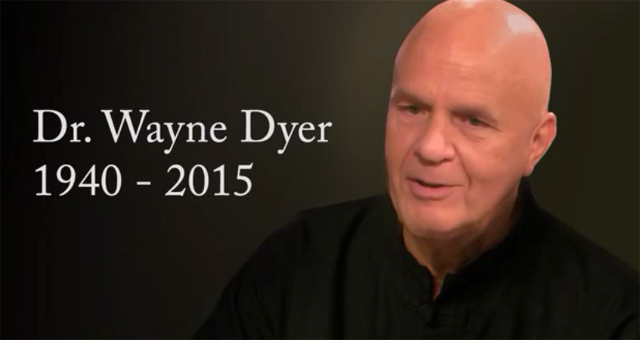
Dr. Wayne W. Dyer passed away over the weekend. He was 75 years old. The speaker and author was often referred to as a “self-help guru,” but in some sense that distinction does not do him justice. The term “self-help guru” can conjure up images of men who find ways of helping themselves — to other people’s money. Dr. Dyer was no con man. He was a student of the spiritual world who became a master. One does not need to agree with everything a man like Dr. Dyer says in order to admit that he was an excellent teacher.
In memory of Dr. Dyer, here now are a few excerpts from his book ‘Change Your Thoughts — Change Your Life: Living the Wisdom of the Tao’:
Living from the Void:
Consider the paradoxical term nonbeing as you ponder your own beingness. You’re comprised of bones, organs, and rivers of fluids that are encapsulated by a huge sheet of skin molded to hold you together. There’s definitely a distinctive quality of beingness that is “you” in this arrangement of bodily parts — yet if it were possible to disassemble you and lay all of your still-functioning physical components on a blanket, there would be no you. Although all of the parts would be there, their usefulness depends on nonbeingness, or in Lao-tzu’s words, ‘what is not.’
Imagine lining up the walls of the room you’re presently in, with all of the elements present: Without the space of the center, it’s no longer a room, even though everything else is the same. A clay pot is not a pot without the emptiness that the clay encapsulates. A house is not a house if there is no inner space for the exterior to enclose.
A composer once told me that the silence from which each note emerges is more important than the note itself. He said that it’s the empty space between the notes that literally allows the music to be music — if there is no void, there’s only continuous sound. …
Ask yourself what makes a tree, a tree. The bark? The branches? The roots? The leaves? All of these things are what is. And all of them do not constitute a tree. What’s needed to have a tree is what is not—an imperceptible, invisible life force that eludes your five senses. You can cut and carve and search the cells of a tree endlessly and never capture it. — (Dr. Wayne W. Dyer, Change Your Thoughts — Change Your Life. Hay House, Inc., 2007. 53-54)
Living by Emulating the Sea:
“Be humble. Never put yourself above others or see yourself as superior to anyone. The highest power is a yielding valley. Become a servant, not a dominator. When even the tiniest waterways are left alone, they uniquely carve out a path that leads them to the sea. And the great ocean never lords its greatness and power over the rivers and streams: It doesn’t rise above them and demand devotion, nor does it threaten them with punishment or extinction if they refuse to cooperate. The sea knows instinctively that the streams and rivers will naturally gravitate toward that which stays low.” — (Dr. Wayne W. Dyer, Change Your Thoughts — Change Your Life. Hay House, Inc., 2007. 313)
Although the loss of Dr. Dyer will be felt by many, it is comforting to know that those closest to him realize the end is also the beginning:
“Wayne has left his body, passing away through the night. He always said he couldn’t wait for this next adventure to begin and had no fear of dying. Our hearts are broken, but we smile to think of how much our scurvy elephant will enjoy the other side.”
Only days after Donald Trump essentially painted the vast majority of Mexican illegal immigrants as rapists and murderers, Kate Steinle, 32, was gunned down by one in broad daylight. The federal government had deported the man five times. San Francisco is a sanctuary city and refused to hand over the suspect when it had the chance.
Reporter Cornell Barnard was able to interview apprehended suspect Francisco Sanchez on Sunday.
[Francisco Sanchez] says he was wandering on Pier 14 after taking sleeping pills he found in a dumpster.
He claims he kicked the gun into the San Francisco Bay, lit up a cigarette, and walked off, not knowing he shot someone until he was arrested by police hours later. Sanchez reportedly first told police he was shooting at sea lions.
He appeared frail and nervous when he talked about returning to the U.S. after being deported back to his native Mexico five times.
Barnard: “Why did you keep coming back to the U.S., why did you come back to San Francisco?”
Sanchez: “Because I was looking for jobs in the restaurant or roofing, landscaping, or construction.”
Sanchez said he knew San Francisco was a sanctuary city where he would not be pursued by immigration officials.
Mr. Trump was one of only a few high-profile individuals to bring attention to this story when he tweeted it Friday night. Sadly, it doesn’t matter how much truth there is to a man’s message if his delivery convinces others that he is a bad person.
Consider what Francis de Sales said in “Treatise on the Love of God”:
“We dislike imitating those we hate even in their good qualities. The Lacedaemonians would not follow the good counsel of an evil man unless some good man stated it after him.
On the contrary, we cannot help conforming ourselves to those we love. It is in this sense, I think, that the great apostle says that ‘the law is not made for the just.’ In fact, the just man is not just unless he has holy love. If he has love, there is no need to urge him on with the rigor of the law, since love is a more cogent teacher and solicitor to persuade a heart possessing it to obey the will and intentions of its beloved. Love is a magistrate who exercises his authority without noise, without bailiffs or sergeants-at-arms, but merely by that mutual complacence whereby, just as we find pleasure in God, so also we reciprocally desire to please Him.” — Francis de Sales.
Yes, it is possible to learn a thing or two from men who lived in the late 1500s and early 1600s.
If you have an important message to deliver to a skeptical audience, then it is crucial that the vehicle for that message not come across as a bully, a jerk, a racist or an evil man.
I am not saying that Mr. Trump is any of those things, but the way he carries himself in front of a microphone makes it incredibly easy for his detractors to make such a case.
Large scale illegal immigration brings with it a whole host of (often deadly) problems. When you have “sanctuary cities,” criminals will gladly take politicians up on the offer. Innocent people pay the price for officials who do not take the rule of law seriously. That is why we need serious and articulate men and women to explain what is going on to the American people.
It is not good enough to simply be correct when speaking on public policy issues like illegal immigration; one must also be able to show empathy. Sadly, too many people who are right on the issue seem to have little to zero empathy for the millions who are trying to flee dysfunctional and oppressive hell holes.
People will often vote for a man with horrendous public policy ideas if he seems like he cares about his constituents. People will often not vote for the man with great public policy ideas if he seems cold, detached or weird. Wouldn’t it be nice if the Republican Party could run a candidate who actually had good ideas and he or she exuded the kind of empathy skills that could win over Independents and Democrats?
Perhaps if Donald Trump read the works of Saint Francis de Sales years ago, then he could have been that man.
It is incredibly tough to get those who do not believe in prayer to understand how it works. Even those who do believe in God often pray in strange ways and then get frustrated by the results. Since prayer recently helped me regain my work-related Twitter account after it was unjustly suspended, I will try to use that story to explain how it works.
First, a recap:
After I wrote a story on Iran for work, an apologist for the regime Tweeted “I will find you and kill you … death to America.”
Twitter said it “could not determine” if that violated its terms of service. When I publicly questioned that decision, my account was suspended. Countless appeals were ignored over the course of one month.
The company’s press account ignored my emails and the emails of my co-workers.
A Washington, D.C. spokesman for Twitter ignored an inquiry by my employer.
Public pressure from countless Twitter followers and a story by WND did nothing to forward the process along.
My attempts to get certain conservative media outlets and personalities to take up my cause fell on deaf ears.
Well-connected people said they were at a loss as to how to help me. They essentially said my cause was hopeless.
During this whole ordeal I had a conversation with a friend about well-known personalities who did nothing to help me. I told my friend that it didn’t bother me because if God ultimately wanted to use them to help me, then He would. I prayed for an entire month, and last night I prayed throughout most of the night when an idea came to me: I would email Twitter’s CEO. I would make the case that he needed to intervene on my behalf. Then the words came to mind. When work started I didn’t know his email, but I took a chance on what I thought it might be — and I was right. Within 30 minutes of emailing him, my suspension was lifted and I received an apology from Twitter. A friend of mine said that what I did was something straight out of Ferris Bueller’s Day Off. I must admit, I did feel like the “The Sausage King of Chicago: Abe Froman.”
I nearly broke down into tears, knowing that my prayers had been answered. For someone who writes news for a living, Twitter is indispensable. Six-years worth of contacts and personalized news lists were restored.
This is just one story of many that I can tell where prayer has worked miracles in my life. If you’re interested in understanding how I pray and prepare for prayer, then here is the general blueprint:
A man’s heart must first be open to the possibility that God exists and that He and His angels hear our prayers.
We all have a lot to be grateful for, no matter what situation we find ourselves in. Prayer should take place after acknowledging those blessings. I often try to think about all the things that I am grateful for — to the point where I almost become overwhelmed with emotion.
Pray for the ability to discern God’s willand strength carry it out. If you are doing God’s will, then success is guaranteed.
Realize that what you may perceive as setbacks or failures on God’s part are never such things. If a man with night-vision was guiding you through a dark path and you occasionally slipped, would it make sense to get angry at him? How foolish would you feel if the path was suddenly illuminated and you realized that without the man’s help you would have fallen into a giant crevasse? In my story with Twitter, what would have happened if I shook my fist in anger and gave up when at least 10 different so-called media allies turned down my requests for help? Answer: I would not have come to a point where I would successfully email an insanely-busy CEO with a net worth of roughly $450 million.
Believe that the crosses that you carry are the burdens you must bear. There are very good reasons why hardship exists. With each obstacle we overcome, there are lessons to be learned. You should find a way to be grateful — even for those things in your life that cause pain or, at a cursory level, seem unwanted. Pray for the ability to understand the lessons God is trying to teach you.
Work hard. Prepare. Know your God-given talents and then hone them to perfection. Take my situation with Twitter. Imagine that I prayed, “God, if it is your will, please assist me in regaining my Twitter account,” and then sat on my butt waiting for a miracle that seemed to be denied. Now imagine me asking God why he denied my prayer and His response: “I made you a talented writer, but instead of writing to Twitter’s CEO and trusting in me, you took that talent for granted and expected some sort of dazzling light show. That was kind of a weird move on your part, don’t you think?”
I can probably add to this list, but that is a good start. I’m confident that someone who takes this advice will see amazing results over time. It is a humbling experience to see just how prayers can be perfectly answered. Often I reflect on how seamlessly some of them have been answered and cannot help but well up. A passing glimpse at perfection — true perfection — is a thing of beauty, but at the same time it can be emotionally crippling. Perhaps others have had a different experience, but my own brief tastes of infinite knowledge and infinite love can only be dwelt in for mere moments. It is a paralyzing epiphany to realize that on many levels we are comically insignificant beings, yet infinitely loved by our Creator.
If you believe in God, then I hope my prayer blueprint can be of use to you. If you do not believe in God, then hopefully I have given you some worthwhile insight into a Catholic mind that’s been around since 1979. In either case, thanks for reading and know that there’s a good chance that on random nights I am praying for you, too.
It’s not often that a giant rock star gives an interview where he unflinchingly affirms his belief in Christ. That is exactly what U2’s Bono did during a March 2014 interview that is making the rounds again just in time for Easter. However, what is perhaps most interesting is how Bono appears to be well-versed in the writings of G.K. Chesterton and C.S. Lewis.
Here is what Bono said in his interview with RTE One’s Gay Byrne, which comes across at times like an FBI interrogation or a courtroom cross examination:
Bono: I think it’s a defining question for Christian. Who was Christ? I don’t think you’re let off easily by saying a great thinker or great philosopher because, actually, he went around saying he was the Messiah. That’s why he was crucified. He was crucified because he said he was the Son of God. So, he either, in my view, was the Son of God — or he was nuts. Forget rock-and-roll messianic complexes. This is, like, I mean Charlie Manson-type delirium. And I find it hard to accept that all the millions and millions of lives, half the Earth, for 2,000 years have been touched, have felt their lives touched and inspired by some nutter. I don’t believe it.
Byrne: So therefore it follows that you believe he was divine?
Bono: Yes.
Byrne: And therefore it follows that you believe that he rose physically from the dead?
Bono: Yes. I have no problem with miracles. I’m living around them. I am one.
Byrne: So when you pray, then you pray to Jesus?
Bono: Yes.
Byrne: The risen Jesus?
Bono: Yes.
Byrne: And you believe he made promises that will come true.
Bono: Yes. I do.
Friendly note to Bono: Your observation is actually more awe-inspiring than you originally thought because billions — not just millions — have been touched by the words of Christ. Regardless, here is what G.K. Chesterton said when “The Everlasting Man” was published in 1925:
“If Christ was simply a human character, he really was a highly complex and contradictory human character. For he combined exactly the two things that lie at the two extremes of human variation. He was exactly what the man with a delusion never is; he was wise; he was a good judge. What he said was always unexpected; but it was always unexpectedly magnanimous and often unexpectedly moderate.
Take a thing like the point of the parable of the tares and the wheat. It has the quality that united sanity and subtlety. It has not the simplicity of a madman. It has not even the simplicity of a fanatic. It might be uttered by a philosopher a hundred years old, at the end of a century of Utopias. Nothing could be less like this quality of seeing beyond and all round obvious things, than the condition of an egomaniac with the one sensitive spot in his brain. I really do not see how these two characters could be convincingly combined, except in the astonishing way in which the creed combines them.” — G.K. Chesterton.
Here is what C.S. Lewis said when “Mere Christianity” was published in 1952:
“Yet (and this is the strange, significant thing) even His enemies, when they read the Gospels, do not usually get the impression of silliness and conceit. Still less do unprejudiced readers. Christ says that He is “humble and meek” and we believe Him; not noticing that, if He were merely a man, humility and meekness are the very last characteristics we could attribute to some of His sayings.
I am trying here to prevent anyone saying the really foolish thing that people often say about Him: ‘I’m ready to accept Jesus as a great moral teacher, but I don’t accept His claim to be God.’ That is the one thing we must not say. A man who was merely a man and said the sort of things Jesus said would not be a great moral teacher. He would either be a lunatic — on the level of a man who says he is a poached egg — or else he would be the Devil of Hell. You must make your choice. Either this man was, and is the Son of God: or else a madman or something worse. You can shut Him up for a fool, you can spit at Him and kill Him as a demon; or you can fall at His feet and call Him Lord and God. But let us not come with any patronizing nonsense about His being a great human teacher. He has not left that open to us. He did not intend to.” — C.S. Lewis.
Chesterton and Lewis beautifully articulate the case before us: either Christ was who he said he was, or he was insane. But, as they both keenly observe, even his biggest detractors generally regard him as a profound thinker and a beacon of light whose example we should all follow.
Think of how many great men and women there were throughout all history, whose names are forgotten within weeks, months, or at most a few decades after they’ve passed away. Then consider Jesus, who for over 2,000 years has captivated the world and changed billions of lives — even those who don’t believe his claims. Like G.K. Chesterton, C.S. Lewis, a modern Irish rock star named Bono, and billions of other individuals throughout the course of history, I firmly believe he was exactly who he claimed to be.
It is a rare occurrence to read a book and come to the conclusion that the writer’s initial inspiration was perfectly realized upon its completion. Saint Francis De Sales’ “Introduction to the Devout Life” may have been published in 1609, but its stunning insight into the human condition makes it a must-read in 2015. In another 400 years, it will still be leaving readers in awe.
While De Sales wrote for a Christian audience, the blueprint for a healthy civil society he presents is one that men and women of all faiths (or no faith) would be hard-pressed to criticize. The virtues he seeks to cultivate in his readers may be motivated by a desire to instill a love of God in as many hearts as possible, but at the end of the day he is still talking about honesty, humility, patience, charity, fortitude, prudence, etc.
Even more impressive is how De Sales addresses the reader (“Philothea”) directly, yet with a delivery that feels like a kind and gentle father imparting time-tested wisdom to a child. De Sales (who must have consulted countless men and women from all walks of life) has such an exquisite grasp of humanity’s trials and tribulations that it is hard not to feel as though he already knows everything about you — yet still offers unconditional love.
De Sale somehow manages to write for the YouTube-Instagram-Facebook culture of 2015 while living in 1609:
“We apply the term vainglory to whatever we assign to ourselves, whether something that is not actually in us or something in us but not of us, or something in us and of us but not such that we can glory in it. Noble ancestry, patronage of great men, and popular honor are things that are not in us but either in our ancestors or in the esteem of other men. Some men become proud and overbearing because they ride a fine horse, wear a feather in their hat, or are dressed in a splendid suit of clothes. Is anyone blind to the folly of all this? If there is any glory in such things it belongs to the horse, the bird, and the tailor. It is a mean heart that borrows honor from a horse, a bird, a feather, or some passing fashion.
Others value and pride themselves because of a fine mustache, well-trimmed beard, carefully curled hair, soft hands, ability to dance, play cards well, or sing. Such light-minded men seek to increase their reputation by frivolous things. Others would like to be honored and respected by men because of a little learning, as if everyone should go to school to them and take them as their teachers. They are called pedants for this reason.
Other men have handsome bodies and therefore strut about and think that everybody dotes on them. All this is extremely vain, objectionable, and foolish and the glory based on such weak foundations is called vain, foolish, and frivolous.
We recognize genuine goodness as we do genuine balm. If balm sinks down and stays at the bottom when dropped into water, it is rated the best and most valuable. So also in order to know whether a man is truly wise, learned, generous, and noble, we must observe whether his abilities tend to humility, modesty, and obedience for in that case they will be truly good. If they float on the surface and seek to show themselves, they are so much less genuine in so far as they are more showy. Pearls conceived and nourished by wind or thunder claps are mere crusts, devoid of substance. So also men’s virtues and fine qualities conceived and nurtured by pride, show, and vanity have the mere appearance of good, without juice, marrow, solidity.” Francis De Sales, Introduction to the Devout Life (New York: Image, 2014), 121–122
The depth and breadth of De Sales’ understanding of humanity is a marvel to behold. If for no other reason, “Introduction to the Devout Life” shines a giant spotlight on just how far we’ve fallen as a culture. The book was written for the likes of carpenters, soldiers, sailors, and tailors — not academics — and yet the man on the street in 2015 would likely have a hard time digesting much of De Sales’ intellectual discourse.
If you have ever sat alone in your bed at night and tried to plumb the depths of your soul to root out what is rotten and realize what is wholly good, then I cannot recommend Francis De Sales’ “Introduction to the Devout Life” enough. If it is read with an open mind and seriously meditated upon, then I have no doubt that it will truly change your life for the better.
Lorna Byrne’s 2008 book ‘Angels in My Hair’ is a bestseller. Her memoir covers the trials and tribulations she experienced while growing up with the ability to see angels — but not talk about it with anyone. Her own family thought she had mental problems. She was warned that there was a possibility they would send her to a mental institution. She was given foreknowledge of painful events that would happen later in life (e.g., the early death of her husband), but was sworn to secrecy. Finally, at a much later stage in her life, she was told to write her book so that people would know one simple message: We are never alone.
Ms. Byrne’s book has plenty of detractors — atheists, agnostics, Christians of various denominations, and individuals from other religious faiths. That is understandable, given the nature of her claims. As a Catholic, I certainly have qualms with topics that were left out of the book, but many of her editorial decisions make sense when one considers Ireland’s violent history between Protestants and Catholics.
‘Angels in My Hair’ is a great book for anyone who has ever wondered if angels exists. It’s also a worthwhile read for those who identify as a devout [insert religious denomination here], provided he or she accepts from the beginning that Ms. Byrne is writing exclusively on angels — not the Bible.
Before I go on, perhaps the best way to sum up how I feel about Ms. Byrne’s book is to first share a quick story from my own life.
When I was a young child I had a snowball fight with a bunch of kids. Half of us were on one side of the street, and half of us were on the other. We were running around having a good time, and at a certain point I picked up a snowball and charged towards the road with tunnel vision on my target. Suddenly I felt a force, as if someone had grabbed me by the shoulders and planted my feet into the ground. I was brought to an abrupt stop. A car slammed on its breaks and skidded to a halt right where I had been running. Even as a young child — with no formal religious education — I knew that I should have been hit by that car. I knew that I should have been injured or possibly dead. I knew that something intervened on my behalf. I had no knowledge of guardian angels at that time, but I remember being completely in awe of whatever force made itself known to me in that moment.
I tell this story because I have no reason to lie to my readers. I am not insane. I am not schizophrenic. I am not on some secret Vatican payroll to deceive people. I do not do drugs. I rarely drink. I am a law-abiding citizen who tries to do what is morally right. I also acknowledge that I am an incredibly flawed individual. Likewise, countless others like me — perhaps including individuals in your life who have never given you a reason to trust their integrity or mental health — have experienced something supernatural. Why should those individuals be treated as hostile witnesses? Answer: They shouldn’t.
Ms. Byrne says:
“We have become a very materialistic society, and so frequently we look at death and ask, ‘Is this it? I rot away and there is nothing more?’ I assure you there is more — much more. I hope that through the books I write I can communicate this and help people to understand. Believe what I say. Believe that, yes, there is more, much more, even though I may not be able to prove it or show it to you now; it is proven to everyone when they die. Some people feel that then it’s too late — if they have to wait to die to see the proof. People are given proofs while they are alive, but sometimes they have to look or listen very hard to recognize them.” Lorna Byrne, Angels in My Hair (New York: Random House, 2008), 174.
It is healthy to be skeptical. We should always read with a discerning eye. However, it is also healthy to have an open heart. The search for truth requires ample doses of each, even if it seems paradoxical. I believe that if you read ‘Angels in My Hair’ with that balancing act in mind, then you will see that there is much truth to what Ms. Byrne says.
You do not have to be a superman or superwoman. You do not have to bear all of life’s burdens as if you were Atlas holding up the globe. You do not have to create a tough-talk exterior shell to protect you from the opinions of others and you do not need to have all the answers. That is because you are not alone. In your darkest hours there is always someone by your side. Ask your angels to give you strength, and you will be surprised at what they bring you from the depths of your soul.
What if you could live for hundreds of years? What if you could have anything your heart desired? Would it be like experiencing a taste of heaven — or hell? Google Ventures’ efforts to find the fountain of youth and emerging technology like self-driving cars makes one wonder: Is it possible that future advances in technology will create our own little version of The Twilight Zone’s “A Nice Place to Visit”?
I recently finished Tony Robbins’ “Money: Master the Game.” In it, he briefly mentions a classic 1960 episode of The Twilight Zone where small-time crook “Rocky” Valentine dies and finds himself in a place where all his wishes are granted. If he wanted his favorite entertainment, it was there. If he wanted to go home with three girls, then they were willing. Anything he wanted was given to him. It wasn’t long before the situation began to drive him mad, and when he confronted his “guardian” about how he wasn’t a good fit with heaven, “Pip” informed him that he was actually in hell.
“A scared, angry little man who never got a break. Now he has everything he’s ever wanted and he’s going to have to live with it for eternity — in the Twilight Zone,” the narrator says as the episode ends.
Mr. Robbins’ point was that money is just a means to an end — it isn’t an end in itself. Material things do not bring true happiness, and until we learn that we are setting ourselves up for failure. Likewise, future technology will continue to raise the standard of living for billions of people — but what good will physical comforts be if it fosters a mental and spiritual wasteland?
St. John Bosco once said:
“The principal trap that the Devil sets for young people is idleness. This is a fatal source of all evil. Do not let there be any doubt in your mind that we are born to work, and when we don’t, we’re out of our element and in great danger of offending God. … First tell the Devil to rest, and then I’ll rest, too.”
New technology can be a great force for good, but it’s not hard to see how a society focused on receiving rather than giving could easily churn out generation after generation of depressed and misanthropic drones.
Enjoy your future self-driving car. Take advantage of replacement kidneys and hearts and lungs that allow you to live until 115. Have fun playing video games in 2030 that will be unlike anything we’re capable of imagining today. Do all of that, but keep in mind that the man who only lives for the next gizmo or gadget will never have enough. He will never be filled and as a result he can never be truly happy. In some sense, he will be living in a Twilight Zone episode of his own making.
In 2013 I wrote a piece titled, “The effects of meditation: What if you could ask your nightmares why they haunt you?”. The post was inspired by lucid dreams that I began having as a result of meditation.
I asked:
Imagine the personal growth men and women could attain if they could ask the symbolic representations in their dreams what, exactly, they mean. What if a individual spends his days trying to improve his body, mind and spirit — and his nights doing the same thing? What would happen if we could stop the elements of our nightmares in their tracks to ask them why they haunt us? How would the physical world transform if individuals made the conscious decision during sleeping hours to take the darkest corners of their minds and fill them with light?
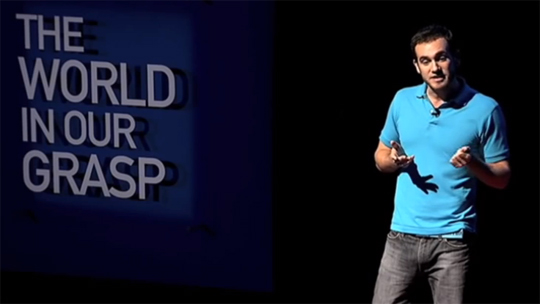
It turns out that Charlie Morley said very much the same thing during a 2012 TedX talk in San Diego. He put this way while recounting the time he finally stood up to his inner demons:
“So there I am, face-to-face with this demon, fully lucid so I know I’m in my own head and I know there’s no real threat, but it’s still pretty scary. So instinctively I get ready to fight. And then it hits me. Hang on. This must be an aspect of my shadow. … I gotta integrate this thing. I gotta embrace this thing. How do I do that, exactly? I will give it a hug! So I run up to this thing in the lucid dream, and I bear hug it. This dream was so realistic I could feel it struggling against my embrace. I could feel it […] breathing down my neck.
You know, the shadow is the sum total of all your repressed capacity for violence and aggression, so as you can imagine it’s not much of a hugger. But there I am, and I’m hugging this thing that doesn’t want to be hugged, and it’s struggling to get away and I’m clinging on for deal life and then it does something really unexpected. It starts to shrink. Within my embrace, this three-headed shadow monster starts to shrink. And I keep holding on and it keeps shrinking and then it stops. And there’s a moment of stillness. I release my embrace and I realize I’m hugging myself.
This three-headed headed demon has transformed into me — a direct carbon copy of me. And there I am, face-to-face with myself — maybe for the first time in my life. We shared a smile, and I woke up in floods of tears. Not only am I in tears, but I’ve got this weird feeling in my belly like as if a knot had been untied. Some deep emotional knot that had been there for so long I had forgotten it was there at all.
I don’t know what part of my psyche that shadow-aspect represented. Maybe some denied childhood trauma. Maybe some disowned childhood complex. Who knows? But what I do know is that when I was embracing that demon I was embracing some deeper part of myself. And I was engaging the innate healing potential, which resides within us all. In a lucid dream you have the opportunity to engage psychological concepts immediately in a seemingly [physical] form. This is a unique opportunity to directly apply healing intent to mental embodiment and personifications of your own own psychology. This is deep healing territory. This is what thousands of people are paying thousands of therapists thousands of dollars to do. Now, I’m not saying you should all go and sack your therapists. But what I am saying is: if you can learn to lucid dream — not all of the time, but some of the time — you can make their job a heck of a lot easier. If you can learn to dream lucidly — and it is a [teachable] skill — you can begin to integrate your shadow and finally reclaim, as Jung said, ‘the seat of all human creativity.'”
Bravo, Mr. Morley. I could not agree more. We dream for a reason, and it isn’t just to have funny tales to tell our friends and coworkers once-in-awhile. It isn’t touchy-feeling mumbo-jumbo when someone says that dreams are powerful tools one can use for realizing his or her full potential — it’s a fact.
To show that I practice what I peach, I will now recount a lucid dream that I had early Tuesday morning around 6:00 a.m.
I’m in a large convention center for individuals whose employment concerns national security matters. I’m wearing a flak jacket while surrounded by military personnel, FBI agents, other members of Homeland Security, etc. The entire convention starts buzzing as if something is wrong, and people get out of their seats. I don’t know what is happening, so I get up and follow a stream of people heading out the door.
As I go through a doorway I think, “Did I bring an M16 and forget it in my chair? I can’t remember. How could I be so stupid!?” I double back to go into the convention hall and find myself in an airport hanger. Individuals are running around as if an air raid of some sort is about to take place and I think, “Now I know I must be dreaming,” and immediately ask my subconscious, “What is my biggest fault?” Immediately one of the men running around the hanger gets in my face and sticks out his tongue — so I punch him square in the nose, he recoils, and stumbles off. I then ask, “What is my best attribute?” and a man immediately trips in front of me — so I bend down on one knee, hold out my hand, and help him up. Shortly thereafter, I wake up.
Think about how amazing it is that you can ask your own subconscious deeply personal questions and, without missing a beat, it will supply honest answers. In my case, I am quick to anger. I can lash out mentally, spiritually, and physically at those who I perceive to be adversaries — and this is often the wrong thing to do. There is no denying it. Likewise, I am also quick to help those before me who stumble and fall mentally, spiritually, and physically.
It is easy for a man to ignore the advice of friends and family. It is easy for a man to lie to himself in his waking state. It is not so easy for a man to lie to himself when he consults the conduit to his own soul and receives an instant reply.
There is a wellspring of wisdom inside each and every one of us, and I firmly believe that lucid dreaming is one way of unlocking those stores of potential. If you have questions about lucid dreaming, then feel free to ask in the comments section. Otherwise, check out Mr. Morley’s TedX talk and see if it speaks to you.
The “Atheists 10 Commandments” recently made news with the release of “Atheist Heart, Humanist Mind,” by John Figdor and Lex Bayer. Yours truly pointed out how ridiculous it is to have nine “commandments” that are all superseded by “There is no one right way to live.” As a result, a slew of atheists deemed me a “fundie.” Two of my quotes generated rounds of ego-massaging among the congregants of “Fundies say the Darndest Things.”
“While there is no one right way to live, there are certainly many wrong ways, such as being an adult with imaginary friends.”
“The self-loathing of the religious zealot is the same self-loathing that drives the heroin addict to the needle and the alcoholic to the bottle. It blunts the pain, but does nothing to resolve the underlying issues that cause that pain, the feelngs [sic] of worthlessness and despair, as revealed here.”
“Yet another person who’s good only because he’s scared of God. People like that scare me.”
It’s easier to laugh and joke about “being an adult with imaginary friends” than it is to have a mature conversation on the body, mind and spirit. It is also easier to mock science-loving Catholics from afar than it is to venture from the safe confines of the digital hive. The modern atheist seems to think that science strengthens the case against God, and avoiding discussions with guys like me allows them to continue such a delusion.
Author Eric Metaxas wrote for The Wall Street Journal Dec. 25:
Today there are more than 200 known parameters necessary for a planet to support life—every single one of which must be perfectly met, or the whole thing falls apart. Without a massive planet like Jupiter nearby, whose gravity will draw away asteroids, a thousand times as many would hit Earth’s surface. The odds against life in the universe are simply astonishing. …
There’s more. The fine-tuning necessary for life to exist on a planet is nothing compared with the fine-tuning required for the universe to exist at all. For example, astrophysicists now know that the values of the four fundamental forces—gravity, the electromagnetic force, and the “strong” and “weak” nuclear forces—were determined less than one millionth of a second after the big bang. Alter any one value and the universe could not exist. For instance, if the ratio between the nuclear strong force and the electromagnetic force had been off by the tiniest fraction of the tiniest fraction—by even one part in 100,000,000,000,000,000—then no stars could have ever formed at all. Feel free to gulp.
Multiply that single parameter by all the other necessary conditions, and the odds against the universe existing are so heart-stoppingly astronomical that the notion that it all “just happened” defies common sense. It would be like tossing a coin and having it come up heads 10 quintillion times in a row. Really?
Fred Hoyle, the astronomer who coined the term “big bang,” said that his atheism was “greatly shaken” at these developments. He later wrote that “a common-sense interpretation of the facts suggests that a super-intellect has monkeyed with the physics, as well as with chemistry and biology . . . . The numbers one calculates from the facts seem to me so overwhelming as to put this conclusion almost beyond question.”
Men of faith look at the mind-bending odds against the possibility of life — any kind of life — in the universe, we conclude that our existence is a miracle attributable to God, and the response by online atheists is to liken us to a “self-loathing … heroin addict.” Which group is acting like an adult and which group is acting like a petulant child who is lashing out at his father?
Men of faith readily admit they fear eternal separation from God, and online atheists make the strange leap in logic that we view Him as some sort of cosmic Communist police state overseer. Which group is acting like an adult and which group is acting like a recalcitrant child who is upset that he will one day be held accountable for his actions?
The online atheists’ inclination to view anyone who believes in God as a backwoods hick with a sixth-grade home-school education is bizarre — but I welcome it. Their decision to cloister themselves in little online echo chambers is to the man of faith’s advantage. Keep likening law-abiding, well-adjusted, and productive members of society to heroin addicts, my atheist friends — each outlandish caricature you create only makes open-minded individuals more likely to ignore your future overtures.









 Douglas Ernst Blog