Zero Dark Thirty is a first class movie

Zero Dark Thirty Maya
Jessica Chastain does a magnificent job as Maya in ‘Zero Dark Thirty’. She manages to embody the hopes, fears, determination and frustration of not just the CIA, but of the entire country. (Image: YouTube)

Not since Paul Greengrass’ United 93 has there been a movie related to 9/11 that has impressed me as much as Kathryn Bigelow’s Zero Dark Thirty. Fittingly, the film begins with 911 calls on September 11th from a helpless victim inside the World Trade Center. A woman says to the dispatcher: “I’m going to die, aren’t I? I’m going to die,” before the line cuts out. It was a wise move on Bigelow’s part. Sitting in the theater I was transported to that day and from there on out I was emotionally invested. By the final credits it was her directorial chops that kept me glued to my seat, despite the predictable ending.

The problem with reviewing a movie like Zero Dark Thirty is that everyone wants to talk about the torture scenes. And how could they not? Anyone who has seen Django Unchained will recall the “hot boxes” Broomhilda is thrown in when “the box” Zero’s recalcitrant detainees must face makes its debut, before thinking: “The more things change, the more they stay the same.” And the dog collar used in Zero alludes to Lynndie England’s Abu Ghraib leash photo, Bigelow’s way of saying the problem was much more systemic than previously thought. Perhaps in a parallel universe Quentin Tarintino will direct a jihad revenge fantasy titled Mohammed Unchained? Who knows.

The point is, there is much more to this movie than water boarding and sleep deprivation. And that is: there are very smart, very evil people out there who are plotting and planning — every moment of every day — ways to attack Western Civilization and kill its people. They are hardened. They are crafty. They are true believers in their cause, and “solving” the problem is no easy task. Perhaps that’s one of the reasons why former Navy SEAL Mark Owen (his real name withheld here) titled his book on the capture and killing of Osama bin Laden No Easy Day.

During an explosive scene, one of the CIA big shots slams his hand on a desk in front of his team and says: “Do your fucking jobs! Bring me people to kill!” Well, that isn’t his job. His job is not to simply kill people — but when your own countrymen are dying, when your team members are dying (i.e., the Khost terror attack, in which a double-agent took out seven CIA members in a suicide bombing), and you can’t find the world’s most wanted terrorist after having spent billions of dollars and countless man hours — it becomes easy to unravel. The urge to substitute drone-bombing for a cohesive counter-terrorism strategy is tempting, but it only masks more difficult tasks; left unattended, they still fester and grow.

The star of Zero Dark Thirty is Maya, a CIA analyst played fabulously by Jessica Chastain. Maya is apparently a composite character, but she seems mostly based on an analyst mentioned in Owen’s No Easy Day. The trials and tribulations she displays during her quest to capture and kill Osama bin Laden are shared by the audience. Her frustrations are our frustrations. Her dilemmas are our dilemmas. And her triumph is the nation’s triumph.

I teared up during Zero Dark Thirty because this was the kind of movie the subject matter deserved years ago. I found myself thinking about my friends who were deployed overseas in a post 9/11 world, and one in particular who didn’t come back alive. I found myself thinking about my friends in the intelligence community or my sister, who lived in downtown Manhattan on 9/11 and watched the second plane fly by her window. It was gratifying to see onscreen just how messy and complex and difficult the subject of Islamic terrorism is. Knowing that millions of self-righteous know-it-alls will walk into the theater and leave enraged or confused means that Bigelow did the right thing.

Zero Dark Thirty ends with a pilot asking Maya where she wants to go. With Osama bin Laden dead, there is a cathartic release on her face — but she has no answer. I would argue that her expression is almost as classic as Dustin Hoffman’s and Katharine Ross’ in The Graduate. Regardless, the nation has its own soul-searching to do, and we should all thank Kathryn Bigelow for prompting an adult conversation on the subject when she could have created a polemic. Now somebody just needs to ask Hollywood: What took you so long?

Tekkonkinkreet: Anime that transcends anime

Tekkonkinkreet White

This review of Tekkonkinkreet comes far too long after the movie came out — 2006 — so all I have to say for myself is: better late than never.

Most of my friends are either really into anime, or not at all. And that’s a shame, because Michael Arias directed something special when he took Taiyo Matsumoto’s manga to the big screen. Tekkonkinkreet is anime that transcends anime. It’s a complex movie that is sad and touching and one of those rare pieces of art that I appreciate more with each viewing.

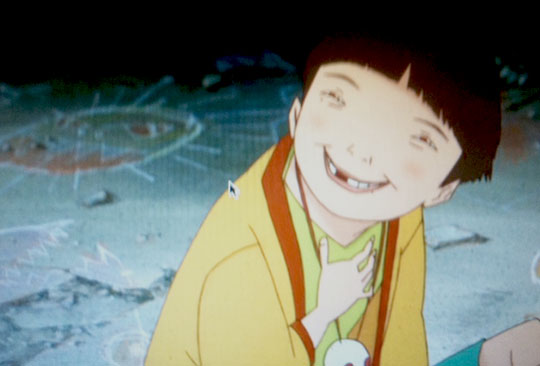
The movie begins with “Gramps” asking his grandchildren, “Black” and “White,” the following question as White strikes a match:

What is it about the fire, so calm and peaceful, but inside all power and destruction? It’s hiding something, just like people do.
Sometimes, you have to get close to find out what’s inside. Sometimes, you need to get burned to see the truth.

From there, Tekkonkinkreet is out the gates and never lets up (the two young boys, orphans, seemingly fly over city during the title sequence).

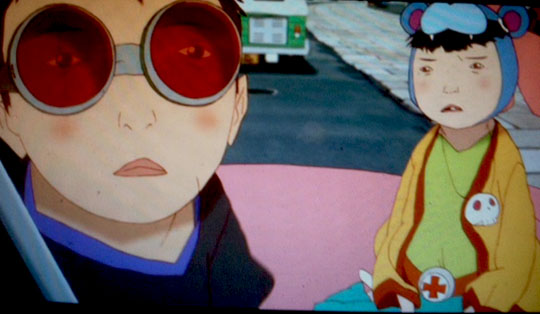
The central premise of the film as that these two brothers (“stray cats”), must survive and adapt in a changing city. They’re tough kids — the rulers of Treasure Town — and they’re willing to fight anyone who seeks to impose a new vision on their home. Black and White’s story is about the importance of familial bonds, good vs. evil, free will vs. destiny, the loss of innocence and the search for inner peace. It’s a fantasy film that in many ways feels real. Some of that is due to camera techniques and art direction, but primarily it’s because of the care that went into crafting the characters. Like the first five minutes of Pixar’s Up, Arias’ Tekkonkinkreet is an animated film that just might bring a tear or two to your eyes.

One of my favorite moments comes when White describes his relationship with Black to a cop, Sawada:

White is missing lots of screws. I need screws for my heart. God made me broken.
Black, too. He’s broken. He’s missing screws too — for his heart. But I got all the screws Black needs. I got every one. I got every one.

We’re all broken. We’re imperfect. We’re fallible. If we’re being honest, we all know that we’re missing some screws. But there is someone out there — a husband, wife, boyfriend, girlfriend, brother, sister, or another loved one — who has the missing parts we need to keep us from falling apart. Some of us need that other half to keep us from visiting the darker parts of our nature. We think we’re in charge, but in reality it is that other person who has all the power because they bring out the best in us and temper our less desirable traits.

If you’ve never seen Tekkonkinkreet before, I highly suggest checking it out. Try and figure out who the “Black” or “White” is in your life, and then share it with them. Hopefully, you’ll both enjoy it as much as I did.
Tekkonkinkreet Black White
Black and White have one of the best brotherly bonds ever portrayed on the big screen. Period.


Man of Steel Trailer: Harbinger of an epic film

Man of Steel

The new Man of Steel trailer is amazing. It is flat out awesome. Every aspect of what has been teased over the last few months indicates that Zack Snyder has directed something that aims for epic and in all likelihood will succeed. Snyder proved that he could handle a cynical take on Superman (i.e., Dr. Manhattan in the underrated Watchman), and all the early indicators are that he will deliver with the real deal.

First, let’s look at Jonathan Kent:

Pa Kent: You just have to decide what kind of man you want to grow up to be, Clark. Whoever that man is, he’s going to change the world.

Pa Kent (Teaser Trailer 2): You’re not just anyone. One day you’re going to have to make a choice. You have to decide what kind of man you want to grow up to be. Whoever that man is — good character or bad — he’s going to change the world.

Bravo. Good and Evil exist — and not only do we have the power to choose the person we become, but we must choose. Moral clarity out of the gates is reassuring. The world is clearly a messy place (e.g., Should Clark have let children die to protect his secret?), but deep down we know what is right and just and what must be done.

Growing up, I was never a huge fan of Superman and I never could quite pinpoint why. He was just “boring.” I didn’t realize it for quite some time, but Jor El explains the situation clearly:

Jor El (Teaser Trailer 1): You will give the people an ideal to strive towards. They will race behind you. They will stumble. They will fall. But in time, they will join you in the sun. In time, you will help them accomplish wonders.

Superman is the ideal we all strive for, but will never attain. He sets the bar for all other superheroes. He has nearly-unlimited power, but he chooses to serve others. He is so much more than the humans he walks among, and yet he loves and protects and cares for them. And perhaps the truth is I didn’t dislike Superman because he is actually boring; I disliked him because he reminded me of just how flawed I was. And am. And always will be. Superman is that moment in time when after months of denying something you know to be true you look in the mirror and it’s there — there’s no escaping it — and the truth just stares you in the eye and forces you to confront the issue or fight that much harder to live in denial. Zack Snyder gets it, and he wisely made sure to include it in the script:

Clark Kent: My father believed that if the world found out who I realize was, they’d reject me. He was convinced that the world wasn’t ready. What do you think?

When I first saw an image of Superman in cuffs and flanked by U.S. servicemen my instinct was to become skeptical. Would Snyder go the route of so many other Hollywood directors and portray the U.S. government as the “bad” guy for a good portion of the flick? I thought about it, and decided not to write on the issue because everything I’ve seen from him suggests he’s smarter than that. There had to be a better angle. After having viewed the trailer, I’m glad I held off.

The truth is, the world would reject Superman. And in his love for humanity he would offer himself up to them. No matter how strong and powerful he was and no matter how much he tried to convince humanity that he loved it they would fear and, ultimately, seek to destroy him. A world in which Superman exists would thrust a moral weight upon the shoulders of its citizens that would be too uncomfortable to bear for millions (possibly billions) of people, and they would seek to find ways to cast off such a burden by banishing him from earth, discrediting or destroying him all together.

Man of Steel 1

If Zack Synder plays his cards right he will have a hit movie on his hands that millions of its critics will hate for reasons they won’t be able to comprehend until years after the fact, if at all.